# Best Review Management Software - Page 12

  *By [Subhransu Sahu](https://research.g2.com/insights/author/subhransu-sahu)*

   Review management software allows businesses to collect, host, track, monitor, and respond to product and service reviews on their websites, helping e-commerce businesses engage with consumers, understand customer behavior, and improve offerings based on authentic feedback.

### Core Capabilities of Review Management Software

To qualify for inclusion in the [Review Management software](https://learn.g2.com/best-review-management-software) category, a product must:

- Collect and capture feedback on e-commerce websites through reviews
- Be applicable for both product and service reviews
- Moderate, manage, and analyze reviews
- Deploy as a widget, pop-up, email follow-up, or short-answer Q&amp;amp;A on the website
- Optimize for desktop, mobile, or tablet use

### Common Use Cases for Review Management Software

E-commerce teams and marketers use review management software to build social proof and drive purchase confidence. Common use cases include:

- Collecting post-purchase reviews via automated email follow-ups or on-site prompts
- Moderating and responding to customer reviews to demonstrate responsiveness and build trust
- Analyzing review data to identify product or service improvement opportunities

### How Review Management Software Differs from Other Tools

Unlike online reputation management software, which provides broader capabilities for monitoring brand mentions and managing reputation across the web, review management software focuses specifically on collecting and managing reviews on e-commerce websites. It integrates with e-commerce platforms and works alongside [email marketing software](https://www.g2.com/categories/email-marketing) and social networks to drive review volume and engagement.

### Insights from G2 on Review Management Software

Based on category trends on G2, ease of review collection and flexible display options stand out as standout capabilities. Increases in review volume and improved conversion rates stand out as primary outcomes of adoption.


## Category Overview

**Total Products under this Category:** 243


## Trust & Credibility Stats

**Why You Can Trust G2's Software Rankings:**

- 30 Analysts and Data Experts
- 11,000+ Authentic Reviews
- 243+ Products
- Unbiased Rankings

G2's software rankings are built on verified user reviews, rigorous moderation, and a consistent research methodology maintained by a team of analysts and data experts. Each product is measured using the same transparent criteria, with no paid placement or vendor influence. While reviews reflect real user experiences, which can be subjective, they offer valuable insight into how software performs in the hands of professionals. Together, these inputs power the G2 Score, a standardized way to compare tools within every category.


## Best Review Management Software At A Glance

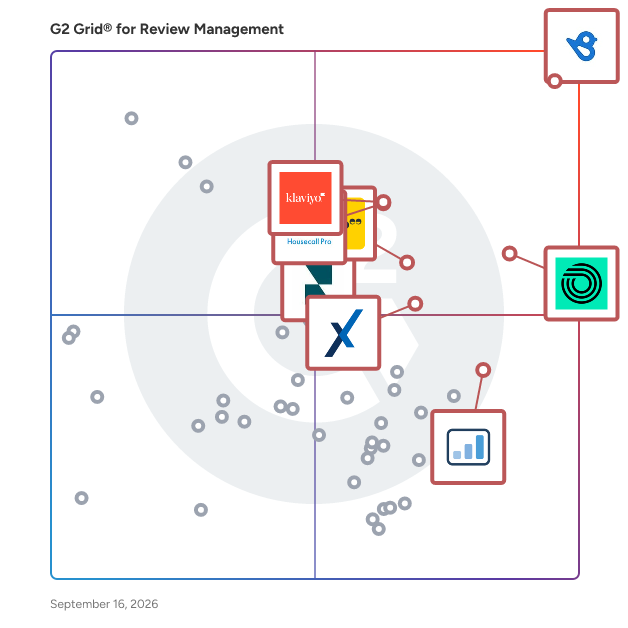
- **Leader:** [Okendo](https://www.g2.com/products/okendo/reviews)
- **Highest Performer:** [Reviews.io](https://www.g2.com/products/reviews-io/reviews)
- **Easiest to Use:** [ReputationStacker](https://www.g2.com/products/reputationstacker/reviews)
- **Top Trending:** [Klaviyo](https://www.g2.com/products/klaviyo/reviews)
- **Best Free Software:** [Reviews.io](https://www.g2.com/products/reviews-io/reviews)


---

**Sponsored**

### GMBapi.com

GMBapi.com is the last all-in-one local SEO software solution you will use. Stop Overpaying for Local SEO. Get 90% of Enterprise Power at 15% of the Cost. GMBapi.com is the high-performance, cost-effective alternative to &quot;black box&quot; enterprise tools you are currently using. Built specifically for multi-location brands, retail chains, and agencies, we provide the automation you need to dominate local search without the &quot;per-credit&quot; fees or restrictive long-term contracts. Why 50+ Location Brands are Switching to GMBapi: Unlimited Geo Grids (Local Rank Tracking): We are the only platform offering free, unlimited local rank tracking heatmaps. See exactly how you rank block-by-block against 20+ competitors—no credits or top-up fees required. The &quot;Operational&quot; Advantage: Unlike competitors who &quot;take over&quot; your listings, GMBapi acts as a powerful layer on top of your Google Business Profile. Your local managers can still use the native Google app, while your central team uses our dashboard for bulk automation. AI-Powered Reputation Guard: Go beyond simple templates. Our AI generates on-brand, localized review responses and includes a unique Deleted Review Tracker so you never lose valuable customer sentiment data. Bulk Management at Scale: Sync business hours, services, photos, and localized posts across 10 or 10,000 locations instantly. We sync your data to Google, Apple Business Connect, Bing, Foursquare, and more. Built for the Future of AI Search (LLM Visibility) Traditional SEO isn&#39;t enough in 2026. GMBapi includes specialized Local LLM Tracking to monitor how your brand appears in AI-driven results like ChatGPT, Perplexity, and Gemini. The Agency-First Engine For agencies, GMBapi provides a complete solution with automated, location-specific reporting that proves ROI to your clients along with integration into your reporting structure. That comes with stellar support from ex Google experts and the operational efficiency that comes with using GBP as your source of truth. Transparency as a Feature With a near-perfect score for &quot;Ease of Setup&quot; and four consecutive G2 awards for &quot;Best Estimated ROI,&quot; we deliver a comprehensive solution that fits your budget. Dominate your local markets at scale. Experience the platform free for 14 days—no commitment required. Single or only a few locations? Still worth a try. Single location business owners love to use our citation module, our free geo grids, monitor their competitor, and get recommendations to optimize their local visibility, content and reputation.


[Visit website](https://www.g2.com/external_clickthroughs/record?secure%5Bad_program%5D=ppc&amp;secure%5Bad_slot%5D=category_product_list&amp;secure%5Bcategory_id%5D=96&amp;secure%5Bdisplayable_resource_id%5D=96&amp;secure%5Bdisplayable_resource_type%5D=Category&amp;secure%5Bmedium%5D=sponsored&amp;secure%5Bplacement_reason%5D=page_category&amp;secure%5Bplacement_resource_ids%5D%5B%5D=96&amp;secure%5Bprioritized%5D=false&amp;secure%5Bproduct_id%5D=1211717&amp;secure%5Bresource_id%5D=96&amp;secure%5Bresource_type%5D=Category&amp;secure%5Bsource_type%5D=category_page&amp;secure%5Bsource_url%5D=https%3A%2F%2Fwww.g2.com%2Fcategories%2Freview-management-software&amp;secure%5Btoken%5D=ab34d8c63e3823fcb6c016733b9a051cd7bebabaecbdd49cd33a2ae9b9e34c15&amp;secure%5Burl%5D=https%3A%2F%2Fgmbapi.com%2Frequest-demo%2F%3Futm_source%3DB2B_Platform%26utm_medium%3DG2%26utm_content%3DAds_CTA_Button&amp;secure%5Burl_type%5D=free_trial&amp;secure%5Bvisitor_segment%5D=180)

---


## Parent Category

[E-Commerce Software](https://www.g2.com/categories/e-commerce)


## Related Categories

- [Online Reputation Management Software](https://www.g2.com/categories/online-reputation-management)
- [User-Generated Content Platforms](https://www.g2.com/categories/user-generated-content-platforms)
- [Social Commerce Platforms](https://www.g2.com/categories/social-commerce-platforms)


---

## Buyer Guide

### What You Should Know About Product Reviews Software

### What is review management software?

Review management software is a powerful tool that enables businesses to effectively oversee and engage with customer reviews and feedback across multiple platforms. By consolidating reviews from various sources into a single, centralized dashboard, this software simplifies the process of monitoring and responding to customer interactions. This streamlined approach saves time and enhances businesses&#39; ability to improve their service and reputation based on customer insights.

This type of software should not be confused with review platforms, even though they serve similar purposes. Review platforms allow any product or service provider to collect reviews, while a company usually uses review management software to create its own reviews portal.

### Key benefits of review management software

- Generate brand awareness to help ensure consumers are aware of the distinctive qualities of a brand.
- Encourage authenticity by allowing prospects and customers to learn about brand weaknesses.
- Allow consumers to provide feedback since a positive customer experience is essential to attract and retain customers.
- Increase sales by understanding the overall brand image

### Why use review management software?

Review management software helps companies gather, manage, and analyze reviews from customers and consumers. What matters most, though, is using reviews to better engage with prospects and customers and adapt to market changes and consumer needs.

**Engagement—** Companies use review management tools to engage reviewers, address their concerns, and provide assistance when necessary. Engagement makes reviewers feel their opinions matter and can create relationships between consumers and brands.

**Improve products and services—** Analyzing large numbers of reviews can generate valuable insights into a product or service&#39;s strengths and weaknesses. Companies can use this information to improve their offering, which can improve the customer experience and boost customer loyalty.

### Who uses review management software?

Reviewer feedback can benefit multiple company departments, from sales and marketing to product development.

**Marketing —** Marketers use review management software to capture and use reviews for promotional purposes. Review data helps marketers identify buyer personas and more accurately target prospects based on their preferences.

**Sales—** Salespeople use reviews to help prospects make buying decisions. While case studies and other types of content can still be useful in sales, genuine feedback from many customers is the most beneficial.

**Product management —** Product managers analyze customer feedback to define or improve go-to-market strategies to increase sales and customer satisfaction.

### Kinds of review management software

Review management software can be categorized in various ways depending on how vendors deliver standard and advanced functionality for review management.

**Best-of-breed—** Most review management software focuses exclusively on collecting and managing reviews. Some products provide additional features, such as brand management and technologies like artificial intelligence. Best-of-breed software has the benefit of providing all features as a single solution at a reasonable price.

**Suites—** Some vendors provide functionality to manage multiple types of consumer-generated content, such as questions and answers or curated social media content. Other features that may be included are e-commerce personalization, content management, product sampling, or brand protection. Suites are usually delivered as a mix of multiple software products that can be bought and used in multiple configurations.

**Point solutions —** A multitude of integrations and tools focus on a subset of the capabilities included in review management tools. These tools complement but cannot replace review management software.

### Review management software features

**Collection—** Reviews are usually collected through an online portal embedded in the company&#39;s website or online store. Reviewers can provide feedback when looking for or buying a product, but companies also use other methods to collect reviews. Some of the most important include email campaigns, social media, or pop-up ads. To streamline the collection process, most review management software solutions allow users to post multiple reviews simultaneously.

**Moderation—** Each review should be verified and validated to ensure it is genuine and applies to the right product. Moderation can be done automatically using algorithms to detect potential issues such as duplicate text. The identity of the reviewers and their eligibility for rewards can also be verified. Also, any changes to existing reviews should go through a validation process.

**Management—** Once reviews are validated and publicly available, they cannot be modified by reviewers or the company. However, administrators may need to manage reviews in certain situations. For instance, when a product is discontinued and removed from the website, the associated reviews will also be removed. If some of those reviews are also related to another product that is still active, they should not be deleted.

Visual display elements such as photos, ratings, or badges can make reviews more attractive.

[**Syndication**](https://www.g2.com/categories/product-reviews/f/syndication) **—** Syndication refers to using reviews to provide consumers with an overview of what others think about a product. Through syndication, companies can consolidate reviews about a product and display the results on their website or online store. Therefore, it is critical to match reviews with the right products and analyze all reviews for each product to generate stats.

Other features of review management software: [Community Q&amp;A Capabilities](https://www.g2.com/categories/product-reviews/f/community-q-a), [Customer Service Capabilities](https://www.g2.com/categories/product-reviews/f/customer-service), [Engagement Capabilities](https://www.g2.com/categories/product-reviews/f/engagement), [Integration &amp; APIs Capabilities](https://www.g2.com/categories/product-reviews/f/integration-apis), [Marketing Capabilities](https://www.g2.com/categories/product-reviews/f/marketing), [Response Types Capabilities](https://www.g2.com/categories/product-reviews/f/response-types), [Sampling Capabilities](https://www.g2.com/categories/product-reviews/f/sampling)

#### Additional review management software features

**Brand management—** Review data provides valuable details about how a brand is perceived. Companies can monitor reviews and respond when their brand is at risk due to negative feedback. Since companies cannot remove or alter reviews because they don’t like them, brand managers need to engage and address issues as soon as possible.

**Omnichannel communications—** Advanced review management platforms include multiple options for communicating with reviewers, such as email, social media, or SMS. Anyone can share reviews on multiple channels and comment on and rate them.

### Trends related to review management software

**Retail use—** While reviews are mostly used online, retailers are starting to gather consumer feedback in physical locations such as stores or public spaces. Retailers also test technologies like virtual and augmented reality to capture reviews and customer feedback.

**Artificial intelligence (AI) —** As reviews become more popular, their number can increase exponentially, which makes them challenging to manage and analyze. AI can help companies process large amounts of data and identify fraud attempts or duplicate content. AI makes it easy for companies to moderate tens of thousands of reviews. Furthermore, AI can help provide valuable insights into customer behavior, sentiment analysis, and industry trends.

### Potential issues with review management software

**Moderation—** Review moderation requires necessary human and technical resources, which many companies cannot afford. While review management software usually provides functionality for moderation, this type of feature can vary significantly from one product to another. Also, moderation features rarely replace human intervention completely, meaning companies still require some moderators.

**Integration—** Review management systems integrate with other types of software, such as [CRM](https://www.g2.com/categories/crm), sales, and [marketing automation](https://www.g2.com/categories/marketing-automation). Since review data is essential to improving sales and marketing strategies, seamlessly transferring data between multiple systems is also important. Vendors usually provide standard integration and connectors or APIs, but these aren’t always enough for complex integrations. Companies may need to invest in additional software, such as [data integration software](https://www.g2.com/categories/data-integration).

**Review relevance—** Due to the fast pace of change in most markets, especially consumer products, reviews may become irrelevant very quickly. Companies need to constantly receive new reviews and ensure that irrelevant reviews don’t influence buyer behavior.

**Privacy —** While review management platform vendors provide secure features, companies in highly regulated industries often require additional privacy functionality. Examples include financial institutions, healthcare organizations, government agencies, and public sector agencies.

**Increased competition —** As reviews become more popular, finding new reviewers or convincing existing users to share new reviews will become difficult. More brands will try to source reviews from the same people, and they will need to provide better incentives.

### Software and services related to review management software

[**E-commerce personalization software**](https://www.g2.com/categories/e-commerce-personalization) **—** Companies can use reviews to learn about their customers and use this information to personalize their shopping experience. E-commerce personalization uses primarily data gathered through website tracking technology, but product reviews can provide valuable additional information.

[**Brand protection software**](https://www.g2.com/categories/brand-protection) **—** Review data can help companies identify threats that may negatively impact their branding. Brand protection software analyzes public data about a company’s products and services. Product data such as names, descriptions, or prices can be mentioned in reviews, and brands need to ensure that it’s accurate information.

[**Gamification software**](https://www.g2.com/categories/gamification) **—** Since monetary incentives aren’t always efficient for motivating reviewers, gamification software provides digital awards and achievements to improve engagement. It uses gaming principles to create competition between users, incentivizing them to write reviews or share and comment on reviews posted by others.