Learn More About Product Analytics Software
What is Product Analytics Software?
For today’s tech companies, product development is a continuous process. This entails a perpetual cycle of testing and improving, based on not only technical performance, but on user behaviors and insights. In addition to soliciting feedback from your business audience, you can gain a deeper understanding of the user experience by monitoring product usage from all angles. If you offer a digital application of any type, the solutions in this category can help you uncover key metrics surrounding how your customers interact and respond to it.
User engagement speaks volumes about your app, from its capabilities to its layout and beyond, and modern product analytics software, no code user behavior tracking included, has made this kind of visibility possible without needing an engineer to instrument every click. The biggest mistake a developer can make is thinking they can steer the customer experience to its intended results without carefully measuring user response, and admitting mistakes or oversights, along the way. Each user is different, and it is impossible to create a platform that is advantageous to everyone. But the more user experience data you collect, the better you can identify and prioritize your improvements for the maximum response. With the right analytics solution, you will know how to optimize your platform for the current portfolio of customers as well as your future customers.
Key Benefits of Product Analytics Software
- Monitor product sessions for each user, from login to completion
- Track the user’s experience with different features, events, and other performance aspects
- Gather data about your most valuable users, from their demographics to key moments in their journey
- Determine the most logical areas of improvement in relation to customer success and overall efficacy of your platform
Why Use Product Analytics Software?
If your business has a unique, customer-facing digital platform, the products in this category could greatly benefit your organization. Routine analysis of user sessions can pave the way for critical updates and keep you abreast of overall customer behaviors and the response to different aspects of the product. Depending on the complexity and popularity of your product (or products) there may be a great deal of data worth collecting. Working to track and improve your products in this way is not only beneficial to you and the customer but is part of being a responsible business owner.
Product analytics vendors are continually improving these offerings, including leveraging emerging technology such as machine learning. A modern platform with embedded analytics can help maximize your customer retention and revenue through generated high-level insights that were previously unobtainable. The solutions in this category may integrate with, or offer features of, other software related to customer data and product optimization to help your innovation teams drive better business outcomes and provide the best experience possible.
Who Uses Product Analytics Software?
The data made available from these platforms is useful across an organization, as it provides a window into a brand’s customer base and their relationship with a product. With that being said, there are certain individuals or departments who are more ideal end users of this technology and who can most readily learn from and apply the detailed product data generated with these products.
Product teams — Your product engineers and managers have the highest degree of ownership over an app’s performance, from its day-to-day usage to any various issues that may arise. The detailed analysis offered within these platforms helps product specialists keep their finger on the pulse of a product with real-time visualization of the KPIs they deem most critical for maintenance and improvements. A product team may collect valuable insights from a variety of sources, including social media and third-party data sources. With an in-house product, these teams can establish a seamless flow of timely information, which gives them a bird’s-eye view of a product’s usage so they can react accordingly every step of the way.
Developers — There are millions of independent developers and small development teams working around the clock to bring exciting technology to the masses. Many of the business products featured on G2 were designed and made available by ambitious developers, who are also tasked with sales, support, and updating these offerings after their release. These individuals might benefit from the self-service analytics and convenient data preparation that a product analytics tool provides to users.
Data analysts — A number of businesses employ specialized data analysts, either internally or through a third-party agency. These individuals are experts in data analytics across the spectrum of any organization and can translate analytics reports into actionable insights for executives and department leads. Analysts might leverage a number of technologies, including those featured in this category. Using a product analytics platform, analysts can help an organization understand what works and what doesn’t with regard to a proprietary business application.
Even if you plan to have others on your staff use this software, it does not hurt to have analysts give a second opinion, help you decipher any unstructured data, and offer suggestions toward an ideal product roadmap based on the software’s findings. You might also consult with a testing and QA provider at some point in your product lifecycle to help measure performance and identify potential flaws in your product.
Product Analytics Software Features
Based on G2 reviews, product teams and developers evaluate product analytics software by comparing event tracking depth, segmentation flexibility, and integration with existing data infrastructure.
The diverse solutions in this category are composed of various features designed to help companies understand their user base, as well as tracking and monitoring the day-to-day details of a product’s usage. Each tool is unique, and the best way to understand its offerings is to read reviews on G2, visit product websites, and consult with a vendor’s sales representative. The following are some primary capabilities you may come across when researching this software.
Customer analytics — Who exactly is using your product? Unlike the hospitality industry or other customer-facing businesses, software usership often lends itself to questions about customer demographics and the like. Furthermore, product teams stand to benefit from a deeper understanding of their audiences, specifically how they interact with a product and where it fits into their daily routine.
Customer analytics features are designed to uncover these insights, allowing developers to get to know their audience and behaviors. Customer journey analysis is key to optimization, aesthetic choices, and effective messaging. With these features, your team can compare different segments of users so they know who the super users might be, along with which regions are most active in your community. The more granular this understanding, the more your brand can deliberately shape a particular experience around the right people and maximize user retention as a result. In some cases, these features might also offer insight into the user’s personal intent or other context leading up to certain actions or decisions within a program—in addition to where sessions end or run into complications. Knowing these details about the user experience can help brands see how, when, and why the product is being used, which can help with targeting, messaging, and feature development.
Feature performance analytics — The other side of notable session events is the features or product components themselves. In B2B technology, as with consumer technology, features come and go based on what resonates. At the very least, programmers will modify select capabilities to strengthen them, remove kinks, or simply redesign them to be more accessible, intuitive, or aesthetically pleasing.
Businesses can leverage product analytics software to learn which features drive engagement and which ones do not. With this information, development teams can map out future versions of a product with a greater emphasis on the desired features, perhaps eliminating less popular ones altogether. With certain tools, users can go more modular with this data, to understand how particular components are performing and where they fall in the timeline of significant events. Administrators may be able to create alerts or push notifications for when specific features are seeing notable activity. These products may offer features of or integrate with application performance monitoring (APM) software to provide the timeliest insights possible for development teams so they can quickly correct issues or prioritize improvements when needed.
Product Analytics Software FAQs
Most Popular FAQs
Which product analytics software has the best reviews?
Across the Product Analytics category, the strongest ratings tend to go to platforms that pair a specific, well-executed job with genuinely responsive support rather than the broadest feature list.
-
Dataroid: Combines behavioral analytics with real-time engagement tools, bridging the gap between understanding user intent and acting on it.
-
Statsig: Experiment setup is clean and results come back quickly, which lowers the barrier to running experiments at scale.
-
Lucky Orange: Page insights, heatmaps, and session recordings give teams a fast, visual read on how people actually use a site.
-
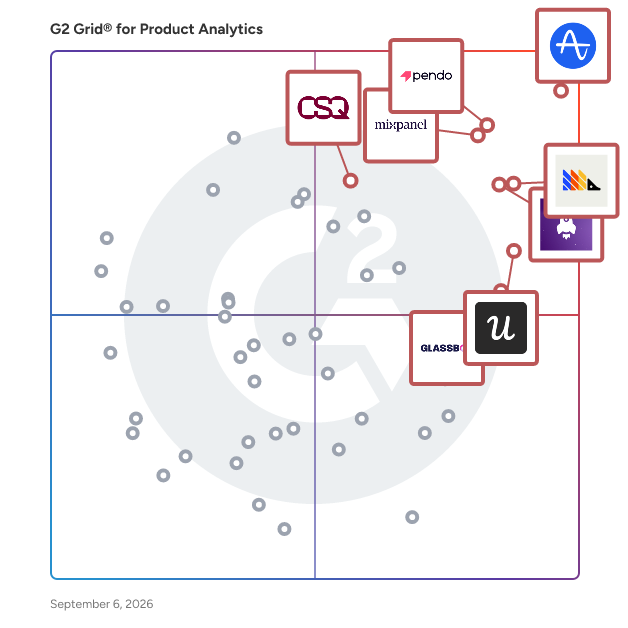
Userpilot: An incoming MCP server integration and straightforward setup make it easy for anyone on a team to pick up quickly.
What is the best product analytics software?
The category leaders tend to be the platforms with both the largest review base and consistently strong satisfaction across company sizes.
-
Amplitude Analytics: Carries the largest review volume in this category, with customizable dashboards, scheduled reporting, and AI-assisted charting that turns a plain-language request into a finished chart.
-
Mixpanel: Its event-based tracking model, paired with Flows and Funnels reports, gives immediate clarity on exactly where users drop off in a product.
-
PostHog: Bundles analytics, funnels, session recordings, feature flags, experiments, and surveys into one developer-friendly suite.
-
LogRocket: Session replay with a timeline scrub marker that correlates directly with log entries and network activity, making it fast to trace exactly where something broke.
What are the best product analytics software options for SaaS businesses?
Here are some top product analytics platforms that help SaaS companies drive data-informed product decisions:
-
Amplitude Analytics: Equips SaaS teams with advanced user segmentation and retention analysis to drive product-led growth strategies.
-
Mixpanel: Helps SaaS companies track feature adoption and conversion funnels to optimize the user journey and lifecycle.
-
LogRocket: Combines analytics with session replay and performance monitoring to give SaaS teams deep visibility into frontend issues.
-
Userpilot: Enables SaaS businesses to build no-code onboarding flows and analyze user behavior to boost product adoption.
-
Fullstory: Provides qualitative insights through heatmaps and session replays, helping SaaS teams reduce churn by improving UX.
Which product analytics software provides cohort analysis without SQL knowledge that your team will actually adopt?
The platforms teams stick with are the ones where building a cohort feels like a few clicks rather than a query someone has to write on your behalf.
-
Mixpanel: Lets anyone segment an event by user properties directly in the interface, so cohorts get built without waiting on a data team.
-
Amplitude Analytics: Its charting and segmentation tools are built to be modified on the fly, down to the exact level of detail someone is looking for.
-
PostHog: Turns raw event activity into cohort-level insight without feeling overly technical, even for less data-savvy team members.
Which product analytics software tracks user behavior without code instrumentation for your specific needs?
The strongest fits here are built around capturing events automatically rather than requiring a developer to hand-place tracking code for every action.
-
PostHog: Its autocapture feature picks up user interactions automatically, cutting down on the manual event-tagging work other tools require.
-
Pendo: Its no-code guide builder and visual tagging let non-developers define what gets tracked without touching the codebase.
-
Userpilot: Surfaces product adoption insights and lets teams define events visually, which shortens the path from question to answer.
Which product analytics software would you recommend?
The right recommendation depends on the specific job, but a few platforms come up again and again across very different use cases.
-
Amplitude Analytics: A solid default for teams that want deep behavioral analytics without building their own reporting layer from scratch.
-
PostHog: A strong pick for engineering-led teams that want analytics, flags, and experiments bundled into one developer-friendly tool.
-
Pendo: Worth considering when in-app guidance and adoption tracking matter as much as the underlying analytics.
Which product analytics tools get SaaS teams to a meaningful insight fastest without a dedicated analyst?
The platforms that win here treat "waiting on the data team" as the problem to solve, not a fact of life, turning what used to be a multi-day SQL ticket into something anyone on the product team can answer themselves in minutes.
-
Mixpanel: One reviewer described cutting their average insight-to-decision time from days to hours and reducing dependency on the data team by roughly 60% after switching from SQL-based reporting to self-serve funnels and retention analysis.
-
Amplitude Analytics: Reviewers highlight being able to rapidly answer questions that would otherwise require specialized SQL knowledge, unblocking marketing and product teams from having to file a ticket with the data team for basic questions.
-
Pendo: Its no-code guide builder and visual event tagging let product and customer success teams define what gets tracked and see the resulting insight without depending on engineering for every update.
Which product analytics software is most reliable, according to product teams?
Reliability, from a product team's perspective, tends to mean consistent performance under everyday, high-volume usage rather than a single uptime statistic.
-
Mixpanel: Reviewers describe performance as reliable even when working with large event datasets and complex reporting queries, without the platform slowing down day-to-day use.
-
Amplitude Analytics: Reviewers point to consistent real-time data flow that shortens the turnaround time for anomaly detection, which matters when a product team needs to trust what a dashboard is telling them in the moment.
-
Heap by Contentsquare: Its autocapture model is built to avoid the data gaps that come from manual event tagging, so product teams aren't left wondering whether a metric is incomplete rather than genuinely flat.
Small Business FAQs
What is the most affordable product analytics software for SMBs?
Within the small business segment of Product Analytics, the platforms that come up most often for value are the ones with a genuinely low cost of entry rather than usage-based pricing that scales unpredictably.
-
Lucky Orange: A low entry price stands out alongside a quick, easy way to capture consumer behavior insights.
-
PostHog: Its open-source model gives small teams a generous amount of functionality before cost becomes a real consideration.
-
TelemetryDeck: A newer name in this data set, though its setup is quick and straightforward, letting small teams start tracking behavior almost immediately without a big upfront investment.
What are the best product analytics tools for small tech startups?
Here are some of the most effective product analytics tools designed to support small tech startups:
-
Amplitude Analytics: Offers powerful behavioral analytics and retention tracking, helping startups refine product features based on user trends.
-
Mixpanel: Delivers real-time event tracking and funnel analysis to help lean teams make fast, data-backed decisions.
-
PostHog: An open-source analytics suite ideal for startups that want full control over user data and customizable tracking.
-
Pendo: Combines product analytics with in-app messaging and surveys — perfect for startups improving onboarding and UX.
-
Fullstory: Captures session replays and heatmaps to help startups visually understand friction points in their product experience.
Which product analytics platform is the most user-friendly for startups?
Ease of use matters most at this stage, since the person setting up tracking is often the same person building the product.
-
Dataroid: A smaller sample at the startup level so far, but its combined dashboards and in-app engagement tools come up repeatedly as easy to work with day to day.
-
Lucky Orange: A helpful account manager pairs with a genuinely quick way to capture behavior data without a complicated setup.
-
Custify: Still building out its startup-specific review base, though it's built to replace a scattered mess of spreadsheets with one place to track usage and health metrics.
Which product analytics tool is easiest to set up for small teams?
Setup speed is one of the more differentiated ratings in this category, and small teams generally do best with platforms that skip a long onboarding project.
-
Custify: A newer name at this scale, but its supportive team is described as responsive and hands-on with configuration and best practices from day one.
-
Lucky Orange: Fast to get running, with heatmaps and recordings available almost as soon as the tracking script is installed.
-
LogRocket: Pre-built templates make creating a first chart or dashboard quick rather than something that needs to be built from a blank canvas.
Which product analytics tool is best for mobile app startups?
Mobile-first teams need an SDK that handles app-specific events cleanly, rather than a tool built primarily around web tracking.
-
TelemetryDeck: A newer name in this data set, but it's built with a quick, straightforward setup that lets mobile teams start seeing interaction data almost right away.
-
Amplitude Analytics: Its mobile SDK feeds into the same behavioral analytics and retention tracking used for web, giving startups one consistent view across platforms.
-
Mixpanel: Its event-based tracking model works the same way on mobile as on web, so funnels and drop-off points stay comparable across both.
Enterprise FAQs
What is best-rated product analytics software for large enterprises?
Within the Enterprise segment of Product Analytics, a smaller set of platforms have the review volume from large organizations to back up a strong rating.
-
Dataroid: Holds up especially well at the enterprise level, with its all-in-one behavioral analytics and engagement approach scaling cleanly across large teams.
-
Nexthink: A smaller footprint in this data set, but its flexibility across analytics, automation, and workflows draws consistently strong marks from enterprise reviewers.
-
Statsig: Enterprise accounts point to the same clean experimentation setup that smaller teams rely on, just running at much higher volume.
What is the most reliable product analytics tool for enterprises?
Reliability at this scale tends to come down to support responsiveness, since large organizations need fast answers when tracking breaks somewhere in the pipeline.
-
Fullstory: Enterprise support ratings here are especially strong, alongside session replays that reviewers call the platform's biggest differentiator.
-
Contentsquare: Delivers clear, actionable insight into where users hit friction, backed by administrative controls built for larger teams.
-
Whatfix: A flexible, responsive team that understands enterprise requirements comes up often in reviews at this scale.
What is best-reviewed product analytics software for enterprise data stack integration?
Enterprise rollouts depend on a platform connecting cleanly into an existing data warehouse and application stack rather than running as an isolated tool.
-
Amplitude Analytics: Its broad integration ecosystem is a big part of why it holds up well even at large-organization scale.
-
LaunchDarkly: Integrates cleanly with both frontend and backend services, with reviewers noting fast, rarely-failing responses even under load.
-
Mixpanel: Enterprise-ready scale paired with seamless integrations into an existing data stack, without giving up the self-serve reporting smaller teams rely on.
Which product analytics platform is built for large-scale, high-volume event data?
At enterprise volume, the question shifts from "can it track this" to "can it hold up under trillions of events without sampling or dropping data."
-
Conviva: Built around full-census, un-sampled ingestion of trillions of daily events, acting more like an operational data platform than a cold storage warehouse.
-
Amplitude Analytics: Its large-enterprise review base reflects real experience running at high event volume without losing reporting speed.
-
Statsig: Reviewers describe experiment results coming back quickly and transparently even as the underlying event volume scales up.
What is the most secure product analytics platform for enterprise data governance?
Compliance-focused enterprise buyers tend to favor platforms with a track record inside regulated, security-conscious organizations and granular control over what gets tracked.
-
Nexthink: Used for analytics, automation, and workflows tied directly to Digital Employee Experience initiatives, with visibility built for IT governance needs.
-
LaunchDarkly: A concise, non-cluttered control layer for rolling features out gradually, which gives enterprise teams a governed way to manage what reaches production.
-
Contentsquare: Trusted by a large base of enterprise brands specifically, with administrative controls built for organizations managing customer experience data at scale.
Which product analytics platforms help protect data integrity during platform migrations?
Switching tracking plans, restructuring event taxonomy, or moving to a new analytics platform all risk breaking historical comparability if the underlying data model isn't handled carefully.
-
Heap by Contentsquare: Its autocapture model records every interaction from day one without pre-planned instrumentation, so questions added after a migration can still be answered from historical data instead of leaving a gap.
-
Amplitude Analytics: Reviewers note that event taxonomy and schema changes can ripple across charts, dashboards, and cohorts, which is part of why the platform pairs tracking with AI-enhanced data governance controls to keep data trustworthy as it evolves.
-
Mixpanel: Reviewers who've scaled usage across many teams stress standardizing event naming conventions early, since inconsistent tracking is the most common way data integrity breaks down as adoption grows.