Learn More About AI Agents For Business Operations
AI agents for business operations buying insights at a glance
AI agents for business operations software enable organizations to deploy intelligent, autonomous agents that handle conversations, automate workflows, and execute tasks across business functions, from customer support and sales outreach to internal knowledge retrieval and scheduling. As AI capabilities advance beyond simple chatbots into context-aware, multi-step reasoning systems, this category has become a central infrastructure for operations, IT, and customer experience teams that need to scale output without scaling headcount.
The best AI agents for business operations combine natural language processing, voice synthesis, tool integrations, and decision logic to enable independent action across channels and business systems. Buyers evaluating this category often also consider AI Chatbots and Contact Center Software when scoping their conversational automation stack.
Buyers across technology services, marketing, real estate, financial services, and automotive rely on AI agents for business automation to replace repetitive inbound and outbound communication tasks, accelerate customer onboarding, and maintain 24/7 availability without live agent coverage. Common use cases span AI agents for business operations, customer inquiries, social media, and sales features alike: AI-powered voice agents for inbound call handling, outbound appointment scheduling, customer support deflection via knowledge-base-driven chat agents, lead qualification, and internal process automation..
Teams managing structured, rules-based workflows often evaluate these tools alongside Robotic Process Automation (RPA) and Business Process Management (BPM) software to determine where autonomous AI agents add the most incremental value. The right AI agents for business platforms typically integrate directly into existing CRM, Help Desk, and Sales Engagement infrastructure, making integration compatibility a key procurement criterion alongside agent quality and latency.
Pricing across this category varies based on usage volume, typically measured in concurrent agent minutes, API calls, or active conversations, and the level of customization required. Voice-focused platforms often charge per minute of call time, while chat and workflow automation tools may charge on monthly active users or seats.
Enterprise tiers unlock advanced features such as custom LLM integrations, white-labeling, dedicated infrastructure, and compliance certifications. SMB-oriented plans offer flat-rate or usage-capped tiers with pre-built templates for faster deployment, often built on No-Code Development Platforms that allow non-technical teams to configure and launch agents without engineering support. Evaluating the total cost of ownership means accounting for prompt engineering effort, ongoing model tuning, and the internal technical resources required to maintain agent performance at scale.
Organizations processing large volumes of structured documents as part of their operations workflows may also find overlap with Intelligent Document Processing (IDP) software when scoping their full automation stack.
Based on G2 reviews, operations and IT teams evaluate AI agents for business operations by comparing integration depth, response latency, and ease of setup.
Top 5 FAQs from software buyers
- What is AI agents for business operations software, and how does it differ from a traditional chatbot or RPA tool?
- What features should I look for in the best AI agents for business operations?
- How do AI agents for business automation integrate with existing CRM, telephony, and helpdesk systems?
- How long does it take to deploy and tune an AI voice or chat agent for production use?
- How do intelligent virtual assistants handle multi-step workflows without human intervention?
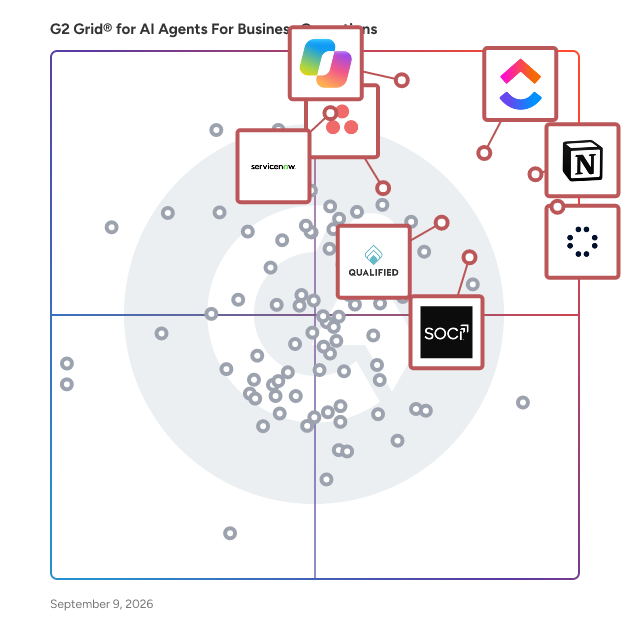
G2’s top-rated AI Agents for Business Operations software, based on verified reviews, includes Retell AI, Synthflow, Microsoft Copilot, Podium, and Sobot Omnichannel Suite. (Source 2)
What are the top-reviewed AI agents for business operations on G2?
Retell AI
-
Number of Reviews: 595
-
Satisfaction: 100
-
Market Presence: 61
-
G2 Score: 80
Synthflow
-
Number of Reviews: 654
-
Satisfaction: 100
-
Market Presence: 59
-
G2 Score: 79
Microsoft Copilot
-
Number of Reviews: 120
-
Satisfaction: 53
-
Market Presence: 93
-
G2 Score: 73
Podium
-
Number of Reviews: 86
-
Satisfaction: 66
-
Market Presence: 72
-
G2 Score: 69
Sobot Omnichannel Suite
-
Number of Reviews: 122
-
Satisfaction: 77
-
Market Presence: 55
-
G2 Score: 66
Satisfaction reflects user-reported ratings, including ease of use, support, and feature fit. (Source 2)
Market Presence scores combine review and external signals that indicate market momentum and footprint. (Source 2)
G2 Score is a weighted composite of Satisfaction and Market Presence. (Source 2)
Learn how G2 scores products. (Source 1)
What I Often See in AI Agents for Business Operations
Feedback Pros: What Users Consistently Appreciate
- Natural-sounding voice agents with low latency deliver human-like call experiences at scale
“What I like best about Retell AI is its real-time, natural-sounding voice conversations powered by advanced speech recognition and AI reasoning. It stands out because: Latency is low, so conversations flow without awkward pauses. Voice quality is human-like, making it ideal for replacing traditional IVRs or first-line reps. Custom workflows and memory allow bots to handle multi-turn conversations that feel personalized. It's easy to integrate into existing systems through APIs or telephony providers like Twilio or 3CX. The platform provides detailed analytics so you can refine performance and boost customer satisfaction.” - Savvy Matthew, Retell AI Review
- Well-documented APIs and workflow integrations enable fast deployment into existing tech stacks
“SynthFlow makes it incredibly fast to prototype realistic AI call agents. I love that you can design conversational logic, set variables, and connect APIs without any code. The interface feels intuitive, the testing flow is smooth, and the response accuracy has been better than I expected. It’s perfect for quick POCs or production-grade automation once you get familiar with the structure.” - Alex Petro, Synthflow Review
- Drag-and-drop no-code builders allow non-technical teams to configure and launch agents independently
“I really like Jotform AI Agents for its ease of setup and usage. Being someone with a technical background and having tested other drag-and-drop agent builders, I found the initial setup in Jotform seamless. The platform's ease of use allows me to quickly spin up a workflow automation or a chatbot/AI agent in minutes without writing lines of code. Additionally, having 24/7 customer support and the capability for automated workflow completions without human interference are significant benefits for me.” - Adeyemi Oyinlola, Jotform AI Agents Review
Cons: Where Many Platforms Fall Short
- Advanced configuration for custom LLM bridges and webhooks carries a steep learning curve for non-developers
“The learning curve for setting up a Custom LLM bridge is a bit steep for beginners, but the low latency and voice quality make the effort 100% worth it for high-volume users.” - Verified User, Retell AI Review
- Per-minute pricing becomes costly for high-volume deployments or teams with limited budgets
“The pricing model based on predefined minutes can be less flexible compared to other options that allow purchasing credits as needed.” - Melissa Camacho Marín, Synthflow Review
- Voice tone and emotion customization lacks granular controls for complex, regulated, or brand-specific use cases
“High costs for low-volume users, limited customization of voice models, and a lack of built-in HIPAA/PCI compliance for regulated industries.” - Verified User, Retell AI Review
My Expert Takeaway on AI Agents for Business Operations
AI agents for business operations software deliver their greatest value when organizations treat them as ongoing infrastructure rather than a one-time deployment. The best AI agents for business mature significantly after initial launch. Teams that invest in prompt tuning, integration depth, and feedback loops between agent outcomes and model behavior see substantially higher accuracy and user satisfaction over time.
The category earns strong usability scores across reviews, reflecting that modern platforms have prioritized accessibility: non-technical users can now configure and deploy functional agents without engineering support, which accelerates time-to-value considerably.
High-performing teams across technology services, marketing, and real estate use intelligent virtual assistants not just to deflect volume, but to create consistent, always-on experiences that their live teams cannot sustain on their own. The most effective deployments combine voice agents for real-time inbound handling with workflow automation layers that trigger follow-up actions without human involvement. Teams also frequently pair AI agents with AI Meeting Assistants and AI Writing Assistants to extend automation coverage into internal productivity workflows, reducing the manual effort across customer-facing interactions and back-office follow-through.
Two patterns stand out across high-growth verticals. First, technical teams and agencies building multi-client agent infrastructure prioritize platform API quality, white-labeling options, and concurrent session limits, capabilities that pricing models and architectural constraints can create meaningful product differentiation. Second, non-technical operators in SMB segments prioritize out-of-the-box templates, drag-and-drop configuration, and the speed of knowledge base ingestion. Quality of support scores well across reviews, which matters because both profiles require vendor responsiveness during setup, whether that means debugging a webhook integration or adjusting a knowledge base for improved answer accuracy. Teams that engage implementation support early consistently report faster deployment cycles and fewer post-launch tuning issues.
AI agents for business operations FAQs
Which AI agent platform is best for automating business workflows?
The best AI agent platform for automating business workflows depends on the complexity of your workflows, the systems your agents need to connect with, and whether your team has technical resources to manage custom configurations.
Key factors to evaluate include:
- Workflow builder flexibility, whether the platform supports multi-step, conditional logic, without requiring engineering cycles
- Native integrations with CRM, calendar, telephony, and helpdesk tools your team already uses
- Ability to trigger downstream actions automatically, such as CRM updates, appointment confirmations, or escalation routing
- Support for both voice and text channels within a single agent deployment
- Reliability and uptime guarantees for production-grade workflow automation
The best AI agents for business operations combine low-latency execution with enough configurability to handle the exceptions and edge cases that generic automation tools miss.
Which are the best AI agents for reducing manual workload in operations?
Operations teams evaluating AI agents for business automation typically prioritize platforms that can take ownership of high-volume, repetitive tasks end-to-end, not just assist with them.
Platforms commonly used for reducing manual operational workload include:
-
Retell AI - Deploys AI voice agents that handle inbound and outbound calls autonomously, eliminating manual call handling for appointment scheduling, lead qualification, and customer follow-up.
-
IBM watsonx Orchestrate - Enables enterprise operations teams to build and deploy AI agents that automate multi-step workflows across HR, procurement, and business operations without custom development.
-
ServiceNow AI Agents - Automates IT and business service workflows at scale, reducing manual ticket handling, approvals, and cross-functional task routing for large operations teams.
-
Bizagi - Combines business process automation with AI-driven workflow orchestration, helping operations teams reduce manual intervention across structured, rules-based processes.
-
ClickUp - Integrates AI assistance directly into project and task management workflows, reducing the manual coordination overhead for operations teams managing cross-functional work.
Which AI business operations tool delivers the fastest ROI?
ROI from AI agents for business operations is typically fastest when the tool targets a high-volume, clearly defined task that currently requires significant manual effort, such as inbound call handling, appointment booking, or tier-one support deflection.
Factors that accelerate time-to-ROI include:
- Out-of-the-box templates that reduce deployment time to days rather than weeks
- Usage-based pricing that aligns cost directly with output volume
- Measurable baselines, tasks per hour, response time, and call handle time make ROI straightforward to calculate
- Minimal prompt tuning is required before the agent performs reliably in production
- Strong implementation support that reduces the internal time investment during setup
Teams that deploy intelligent virtual assistants against a single, well-scoped use case consistently see faster payback periods than those attempting broad automation from day one.
Which are the top AI automation platforms for cross-department workflows?
Cross-department automation requires AI agents that can operate across multiple systems, hand off tasks between functions, and maintain context as a workflow moves from one team to another.
Platforms evaluated for cross-department AI automation typically include:
-
Microsoft Copilot - Embedded across Microsoft 365, enabling consistent AI assistance across sales, operations, HR, and finance without requiring separate tool deployments per team.
-
Kore.AI - Provides an enterprise-grade agent platform for building and orchestrating AI workflows across customer-facing and internal operations departments from a single environment.
-
IBM watsonx Orchestrate - Designed specifically for cross-functional workflow automation, connecting agents across HR, finance, procurement, and operations within a unified orchestration layer.
-
Joule - SAP's AI copilot, built to surface contextual intelligence and automate tasks across SAP business applications used by finance, HR, and supply chain teams simultaneously.
-
Guru centralizes organizational knowledge and surfaces it automatically within the tools teams already use, reducing the manual effort of cross-departmental information retrieval and handoffs.
Which AI operations assistant offers the best integration options?
Integration quality is one of the most important selection criteria for AI agents for business operations, since an agent that cannot connect reliably to your existing systems creates more manual work than it eliminates.
Key integration capabilities to evaluate include:
- Pre-built connectors for CRM platforms such as Salesforce, HubSpot, and Zoho
- API documentation quality and developer support for custom integrations
- Webhook support for triggering actions in external systems based on agent outcomes
- Native integrations with telephony providers, calendar systems, and helpdesk tools
- Support for middleware platforms such as Zapier or Make for teams without in-house engineering resources
The best AI agents for business with strong integration options treat connectivity as a core product feature rather than an add-on, offering both no-code connectors for common tools and well-documented APIs for custom workflows.
Which are the best AI tools for managing repetitive operational tasks?
Repetitive operational tasks, inbound call routing, appointment scheduling, FAQ responses, lead follow-up, and data entry represent the highest-ROI starting point for most AI agent deployments, because the volume is predictable and the success criteria are easy to define.
Some AI agents for business automation tools frequently used for repetitive task management include:
-
Retell AI - Purpose-built for high-volume voice task automation, handling repetitive inbound and outbound call workflows with low latency and natural-sounding responses.
-
Tidio - Automates repetitive customer-facing chat interactions, including FAQ responses, lead capture, and order status inquiries, with an accessible setup suited to SMB operations teams.
-
Fin by Intercom - Resolves repetitive customer support queries autonomously using knowledge base content, reducing the volume of tickets that require live agent handling.
-
Jotform AI Agents - Automates repetitive data collection and FAQ workflows by deploying form-embedded agents that handle common inquiries without manual intervention.
-
Observe.AI automates quality monitoring and post-interaction analysis for contact center operations, eliminating the manual effort required by repetitive call evaluation.
Most Popular FAQs
Which AI agent software has the best reviews?
Across the AI Agents For Business Operations category, where CEOs and founders make up a notable share of the most trusted user reviews, the strongest ratings tend to go to platforms that pair a specific, well-defined job with genuine ease of use, rather than the broadest feature list.
-
Retell AI: Reviewers point to its multiple voice and chat agent building modes and a depth of settings that other voice tools don't offer.
-
Qualified: Its Piper agent handles auto-routing, agentic conversations, and auto-meeting booking, which reviewers say delivered measurable value fast.
-
Airtable: Reviewers describe building everything from simple project planners to complex divisional performance monitors on top of it, thanks to its flexible custom interfaces.
-
Guru: Its automated verification workflows keep a knowledge base current by prompting subject matter experts to re-verify content on a set schedule.
What are the best custom AI agents for business operations?
The strongest custom options tend to be the platforms built to be configured around a specific workflow rather than used out of the box as-is.
-
HighLevel: An all-in-one AI, website, and marketing solution that reviewers use to automate answering calls their team would otherwise miss.
-
Genesys Cloud CX: Centralizes multiple communication channels into a single platform with real-time dashboards and AI-native contact center functions.
-
monday AI Work Platform: Handles everything from correcting formulas to chaining automations, which reviewers use to customize workflows without custom code.
-
Retell AI: Built for fully custom voice and chat agents, with granular configuration options and fast phone-call connection that reviewers say go beyond other voice AI tools.
Are AI agents actually driving real business results, or is it hype?
The data behind this category says results are real, but uneven. Among reviewers who tracked return on investment, about 85% reported full payback within a year, and just over half saw it in under six months; only a small fraction, around 2%, said they never got a full payback at all.
How much are enterprises really investing in AI agents?
Spending has increased rapidly, with analyst estimates indicating global expenditures on AI agent software exceeding twice those of the previous year. Enterprise budgets for generative AI have also more than tripled since 2024. The review data reflects this broader shift from experimental use to widespread adoption: companies with 1,000 or more employees make up a significant portion of reviews, alongside a consistent presence of small and mid-sized teams. This trend suggests that investments are spreading across various company sizes, rather than being limited to a few large early adopters.
Which AI agent is best for business?
The right answer depends on the job the agent needs to do, but a few platforms consistently post strong marks across a wide range of business use cases.
-
Atera: Combines remote access, ticket management, monitoring, and automation with an AI copilot that reviewers say cuts down manual technician work.
-
ClickUp: Reviewers, including project managers automating workflow across teams, describe it as flexible enough to configure folders, lists, and custom fields for organizing every task their team runs.
-
Qualified: Reviewers highlight how quickly it delivered measurable business value once its AI agent was integrated with their existing CRM.
-
Retell AI: Reviewers frequently credit its natural-sounding voice agents and quick phone-call setup for measurable gains in lead qualification.
What are the best AI customer service agents for multi-channel, high-volume support?
Teams fielding support requests across chat, voice, SMS, and social at once look for a single agent layer that can keep call and chat volumes steady as demand grows, rather than a separate tool for each channel.
-
Sobot Omnichannel Suite: Built specifically around unifying multiple support channels into one agent workspace, and one of G2's top-rated platforms in this category based on verified reviews.
-
Genesys Cloud CX: Centralizes high call and chat volume into one platform, with real-time dashboards that reviewers say make large-scale customer service manageable.
-
ServiceNow AI Agents: Reviewers describe fast, natural-language ticket creation that scales well across large support volumes.
-
Podium: Unifies SMS, webchat, and review responses into one inbox, a pairing reviewers cite for keeping high-volume, multi-channel customer conversations from getting lost between tools.
What are the best AI tools for Instagram management and lead organization for founders?
Founders running the marketing and sales side of their own business tend to need one place to catch Instagram DMs and comments and turn the ones that matter into tracked leads, rather than a social tool and a CRM that don't talk to each other.
-
HighLevel: Consolidates Instagram DM, SMS, and other messaging channels alongside its built-in CRM, so a comment or DM can turn into a tracked lead without switching apps. Reviewers specifically describe this as founders and small business owners managing leads end-to-end in one tool.
-
Hootsuite: Its unified inbox pulls Instagram messages, comments, and mentions into the same view as other social channels, which reviewers say makes it easier for a small team to stay on top of everything without checking each app separately.
-
SOCi: Reviewers describe it as time-efficient for busy small business owners managing social media, reviews, and lead capture across a single dashboard rather than juggling separate tools.
Small Business FAQs
What is the most affordable AI agent software for SMBs?
Within the small business segment of AI Agents For Business Operations, reviewers give the strongest price-to-value marks to platforms that bundle AI features into a plan they'd need anyway, rather than charging extra for the agent itself.
-
HubSpot Marketing Hub: Small teams point to its AI-assisted workflow creation and unified communication history as useful without a steep learning curve.
-
Guru: Small teams point to fast, accurate search across connected systems as good value for the price.
-
monday AI Work Platform: Small teams point to its flexibility for handling a range of daily tasks as solid value without a steep price jump.
What is the best AI agent software for startups?
Startups evaluating small business AI agents tend to favor platforms that solve one problem well without requiring a dedicated implementation team.
-
Aissist.io: Its context-ingestion engine draws on a company's own technical knowledge base rather than simple keyword matching, which reviewers say produces accurate first-draft responses.
-
Airtable: Its flexibility lets small teams build custom solutions for a wide range of problems without needing separate tools for each one.
-
Retell AI: Its fast setup and natural-sounding voice agents make it a common first AI agent to build for smaller teams without a dedicated dev team.
Which AI agent platform is the most user-friendly for startups?
Ease of use matters most at this stage, since the person configuring the agent is often the same person running the rest of the business.
-
Microsoft Copilot: Users highlight quick, well-structured content generation that summarizes technical information, which shortens the learning curve for new users.
-
Conversifi: Reviewers highlight that it automates LinkedIn outreach and follow-ups at scale while maintaining a personal touch, which eases the learning curve.
-
Airtable: Reviewers describe the interface as well-designed and intuitive enough to learn without a manual.
Which AI agent tool is easiest to set up for small teams?
Setup speed is one of the more differentiated ratings in this category, and small teams evaluating beginner friendly AI agents for business operations setup generally do best with platforms built around a guided, self-serve first experience.
-
Ringg AI: Its workflow builder is intuitive enough that reviewers with no AI background say they can set up a working voice agent quickly.
-
Synthflow: Reviewers describe its flow builder and initial setup as easy enough to get a voice agent running without a large team.
-
Qualified: Small teams point to a responsive, hands-on implementation process that gets its AI-powered routing and meeting-booking features live quickly.
Which AI voice agent is best for small business call handling?
Voice is one of the most active sub-categories in this space, and a handful of platforms specialize in it rather than treating phone calls as one channel among many.
-
Retell AI: Purpose-built for voice, with agents that connect to phone calls quickly and handle lead qualification and customer data collection.
-
Synthflow: Its flow builder is built specifically for voice agents, with reviewers describing setup as smooth from day one.
-
Ringg AI: Reviewers point to natural-sounding voice and low latency as reasons phone conversations feel realistic rather than robotic.
Enterprise FAQs
What is the best-rated AI agent software for large enterprises?
Within the Enterprise segment of AI Agents For Business Operations, the strongest ratings go to platforms with a track record of holding up as usage scales past a few dozen employees.
-
Qualified: Described as a highly engaged implementation team that gets its auto-routing and agentic conversation features integrated smoothly with existing systems like Salesforce.
-
Asana: Enterprise reviewers point to real-time visibility across teams as a reason it holds up as headcount grows.
-
Atera: Its AI copilot for technicians and per-technician pricing are reasons it holds up as teams scale.
What is the most reliable AI agent tool for enterprises?
Reliability at this scale tends to come down to consistency and administrative control, since large organizations need both to keep an agent trustworthy across many teams.
-
Guru: Its automated verification workflows are built to keep answers accurate and current rather than letting a knowledge base go stale, which enterprise reviewers rely on.
-
Airtable: A platform that balances flexibility with structure, bringing scattered work into one place rather than several disconnected tools.
-
Asana: Reviewers describe strong organization and real-time updates that keep every team member's work visible in one place.
What is best-reviewed AI agent software for enterprise system integration?
Enterprise rollouts depend on an agent plugging into systems that are already in place rather than becoming a disconnected side tool.
-
Microsoft Copilot: Its integration with Outlook and calendars lets reviewers surface emails and search results without switching apps, which reviewers cite as a reason it fits into existing enterprise systems.
-
ServiceNow AI Agents: Reviewers highlight how it understands a user's request and takes action based on existing business rules, tying directly into systems already in place.
-
Kore.AI: Its low-code interface and multi-channel integration make it easy to connect to enterprise systems without needing advanced programming experience.
Which AI agent platform is built for large-scale customer service deployments?
Scale, here, comes down to whether a platform can hold call and ticket volume steady as demand grows, without a drop in response quality.
-
Genesys Cloud CX: Built to centralize high call and chat volume into one platform, with real-time dashboards that reviewers say make large-scale customer service manageable.
-
ServiceNow AI Agents: Reviewers describe fast, natural-language ticket creation that scales well across large support volumes.
-
IBM watsonx Orchestrate: Reviewers point to its multi-agent setup for chaining workflows like procurement and HR without rebuilding each one from scratch, useful at large-organization scale.
What is the most secure AI agent platform for enterprise data governance?
Compliance-focused enterprise buyers tend to favor platforms with granular permissioning and a track record inside regulated, security-conscious organizations.
-
IBM watsonx Orchestrate: Its natural-language interface, paired with governed "Skills" lets enterprise teams automate cross-application tasks without heavy manual intervention or a loss of oversight.
-
Microsoft Copilot: Built on Microsoft's existing enterprise identity and compliance infrastructure, which reviewers point to when discussing data governance.
-
Box: Reviewers highlight granular, tiered permissions, like allowing viewing while blocking downloads, as a reason it fits enterprise governance needs.