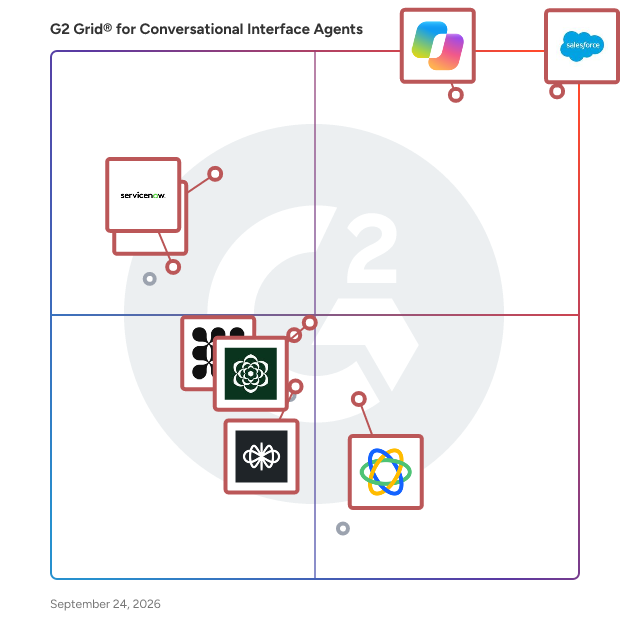
Salesforce Agentforce
Salesforce Agentforce is an enterprise agentic AI software platform that helps organizations build, deploy, manage, and govern AI agents that can autonomously assist customers, employees, and partners across digital and voice channels. Agentforce is designed for enterprises that want to operationalize AI agents at scale while maintaining control, security, and trust. It brings together humans, applications, AI models, and business data into a unified system where agents can reason, take action, and collaborate with people. The platform supports the full agent lifecycle—from creation and testing to deployment, supervision, and continuous improvement—using both low-code and pro-code tools. Agentforce is used by teams across customer service, sales, IT, operations, HR, marketing, and industry-specific workflows. Agentforce enables organizations to deploy AI agents that work continuously, execute business logic, and integrate with existing systems. Agents can handle structured and unstructured data, reason through complex tasks, and hand off to humans when needed. Key capabilities and components include: - Agent development and orchestration tools that support building, testing, deploying, supervising, and scaling AI agents using conversational, low-code, and pro-code experiences. - Hybrid reasoning architecture that combines deterministic workflows with large language model (LLM) reasoning to ensure predictable execution while handling nuance and natural language interactions. - Multichannel and voice support, allowing agents to engage users across web, mobile, chat, and phone with consistent behavior and brand-aligned voice experiences. - Intelligent Context processing, which extracts and structures information from unstructured and multimodal data sources so agents can respond accurately and take relevant actions. - Lifecycle management and supervision, including batch testing, performance monitoring, and tools to refine agent behavior over time. Agentforce includes built-in trust, governance, and security features to support enterprise requirements: - Configurable guardrails to reduce hallucinations, bias, and off-topic responses. - Data protection and governance controls such as grounding, access controls, auditability, and privacy safeguards. - Enterprise-grade reliability and compliance, built on the broader Salesforce platform. Common use cases include customer support automation, sales development, employee support, deep research tasks, coaching and learning, product recommendations, appointment scheduling, and event or attendee support. Agentforce can also be tailored for industry-specific workflows by leveraging existing data models, APIs, and business logic. Overall, Salesforce Agentforce is an enterprise agentic AI platform for organizations seeking to deploy trusted, autonomous digital labor that integrates with their existing systems and operates at scale.
Average Rating: 4.3/5.0
Total Reviews: 1,599
Who Is the Company Behind Salesforce Agentforce?
- Seller: Salesforce
- Company Website:
- Year Founded: 1999
- HQ Location: San Francisco, CA
-
Twitter: @salesforce
579,511 Twitter followers -
LinkedIn® Page: www.linkedin.com
89,711 employees on LinkedIn®
Who Uses This Product?
- Who Uses This: Salesforce Developer, Salesforce Administrator
- Top Industries: Information Technology and Services, Financial Services
- Company Size: 39% Medium, 32% Large
What Are Recent G2 Reviews of Salesforce Agentforce?
"Smart Automation That Makes Salesforce Work More Efficiently"
Rating: 5.0/5.0 stars
— Ashish B.
"Faster Customer Insights and Better Next Steps"
Rating: 4.5/5.0 stars
— Tridib C.
