# Best Conversational Marketing Software - Page 14

  *By [Yukta Rustagi](https://research.g2.com/insights/author/yukta-rustagi)*

   Conversational marketing software, also known as messenger marketing software, engages potential customers with personalized, one-on-one conversations en route to specific product recommendations or offers. Consumer brands leverage this technology to identify interested buyers on [social networks](https://www.g2.com/categories/social-networks) or product websites, answer concerns or questions, determine the best possible sales items, and transfer customers to [payment gateways](https://www.g2.com/categories/payment-gateway) or sales representatives to close transactions. Using built-in [chatbot](https://www.g2.com/categories/chatbots) and [artificial intelligence](https://www.g2.com/categories/artificial-intelligence) technology, sales departments can construct intelligent response flows that will guide visitors through helpful conversations at various touchpoints based on user activity and other details. Businesses can then follow up at a later time with interested customers who do not purchase on the spot, picking up the conversation where it left off. Conversational marketing platforms help provide a higher standard of customer service at scale and simplify the overall buying process for potential customers around the world at any time of day. Successful use of these platforms can also generate valuable, qualified leads, provide high-level insights into customer demographics and preferences, and accelerate the sales cycle.

Products in the conversational marketing category typically share features of or integrate with [live chat](https://www.g2.com/categories/live-chat) and [chatbot software](https://www.g2.com/categories/chatbots) to produce real-time, meaningful dialogues with customers at different points in the buying journey. A number of these solutions involve a combination of automated and live human involvement on the business side—for example, chatbots can ping the appropriate salesperson to take control at critical points in the conversation. These products may also integrate with messengers on major [social networks](https://www.g2.com/categories/social-networks) as well as [SMS](https://www.g2.com/categories/mobile-marketing) or [email](https://www.g2.com/categories/email); certain visitor behaviors or trends on company social profiles or websites can trigger conversations. Conversational marketing protects may sync with [e-commerce platforms](https://www.g2.com/categories/e-commerce-platforms) or [payment gateways](https://www.g2.com/categories/payment-gateway) to provide detailed product information or complete transactions, respectively. This technology may integrate with or share features of [bot platforms](https://www.g2.com/categories/bot-platforms) to create unique messaging applications suited to the user’s needs. Elements of customer engagement on social networks are comparable to those of [social customer service](https://www.g2.com/categories/bot-platforms) tools.

To qualify for inclusion in the Conversational Marketing category, a product must:

- Assist in the creation of intelligent messaging bots that engage visitors on one or more channels
- Provide tools for creating personalized response flows within conversations
- Direct interested buyers to sales reps or online stores for purchasing goods or services in the event of successful conversations
- Track customer journeys and allow for follow-ups from chatbots or sales representatives


## Category Overview

**Total Products under this Category:** 267


## Trust & Credibility Stats

**Why You Can Trust G2's Software Rankings:**

- 30 Analysts and Data Experts
- 73,300+ Authentic Reviews
- 267+ Products
- Unbiased Rankings

G2's software rankings are built on verified user reviews, rigorous moderation, and a consistent research methodology maintained by a team of analysts and data experts. Each product is measured using the same transparent criteria, with no paid placement or vendor influence. While reviews reflect real user experiences, which can be subjective, they offer valuable insight into how software performs in the hands of professionals. Together, these inputs power the G2 Score, a standardized way to compare tools within every category.


## Best Conversational Marketing Software At A Glance

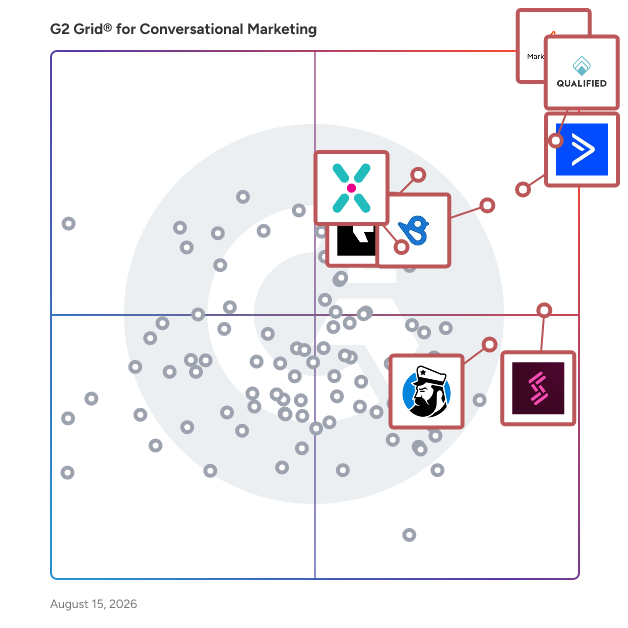
- **Leader:** [HubSpot Marketing Hub](https://www.g2.com/products/hubspot-marketing-hub/reviews)
- **Highest Performer:** [Textedly](https://www.g2.com/products/textedly/reviews)
- **Easiest to Use:** [Podium](https://www.g2.com/products/podium/reviews)
- **Top Trending:** [HighLevel](https://www.g2.com/products/highlevel/reviews)
- **Best Free Software:** [HubSpot Marketing Hub](https://www.g2.com/products/hubspot-marketing-hub/reviews)


---

**Sponsored**

### LiveChat

LiveChat is a comprehensive customer communication platform that enables businesses to connect with their website visitors and customers in real-time, driving sales, delivering support, and enhancing customer satisfaction. Designed for ecommerce teams, the platform boosts AOV, upsell, and overall ROI by engaging shoppers at the right moment and converting more traffic into revenue. AI and advanced analytics surface sales opportunities, automate routine conversations, and give clear visibility into performance. All essential tools - including AI automation, analytics, a customizable chat widget, and agent apps - come together in one easy-to-deploy, no-code platform that delivers value quickly. ✅ Benefits • Higher conversions by capturing visitor attention at key moments through proactive, real-time engagement. • Lower operational overhead and greater agent productivity thanks to managing all communication channels in one unified workspace. • Better business decisions and clearer performance insights driven by transparent reporting on conversions, lead quality, and sales opportunities. • Faster responses and more time for high-value conversations enabled by AI that automates routine work and supports agents with smart assistance. • Stronger customer engagement and higher average order value through chat experiences tailored to your brand and optimized for upsell. 💬 Key features • Chat tools and widget: Real-time, two-way conversations with visitors, supported by file sharing, chat archives, automated greetings (like sneak-peek and inactivity prompts), seamless chat transfer, and post-chat ratings. • Multi-channel messaging: Manage all conversations from a single workspace - one license covers unlimited websites and apps, plus Facebook Messenger, WhatsApp Business, and email. • AI and automation: Leverage built-in AI features, including Copilot, reply suggestions, chat summaries, and insights extracted from high-volume conversations to boost efficiency and speed. • Analytics and reporting: Access intuitive dashboards that track agent performance, conversions, customer behavior, and more, with robust filtering and easy data export. • Customization and integrations: Tailor the widget’s appearance, language, and brand voice, and extend capabilities with 200+ integrations across CRMs, ecommerce platforms, help desks, and automation tools. • Easy implementation: Add LiveChat to your site with a simple code snippet-no heavy development or complex setup required. • Security and support: Benefit from enterprise-grade security, reliable infrastructure, and 24/7/365 customer support to keep your communication running flawlessly. 🌎 Trusted by teams worldwide to drive growth Thousands of companies worldwide utilize LiveChat to deliver fast and personalized customer interactions. Over 40% of customers prefer brands that offer live chat, and businesses that consistently use it see higher conversion rates and stronger engagement. LiveChat helps teams work more efficiently, improve satisfaction, and drive measurable growth. Adding specific customer results - like increases in conversions or agent productivity - can further highlight its impact. About Us LiveChat was created by Text S.A., a global software company headquartered in Wrocław, Poland. For over two decades, we’ve been dedicated to building tools that help businesses communicate better with their customers. LiveChat serves companies in more than 150 countries - from growing ecommerce stores to established B2B SaaS organizations - empowering them to deliver fast, personal, and effective customer service.


[Visit website](https://www.g2.com/external_clickthroughs/record?secure%5Bad_program%5D=ppc&amp;secure%5Bad_slot%5D=category_product_list&amp;secure%5Bcategory_id%5D=1346&amp;secure%5Bdisplayable_resource_id%5D=1346&amp;secure%5Bdisplayable_resource_type%5D=Category&amp;secure%5Bmedium%5D=sponsored&amp;secure%5Bplacement_reason%5D=page_category&amp;secure%5Bplacement_resource_ids%5D%5B%5D=1346&amp;secure%5Bprioritized%5D=false&amp;secure%5Bproduct_id%5D=1856&amp;secure%5Bresource_id%5D=1346&amp;secure%5Bresource_type%5D=Category&amp;secure%5Bsource_type%5D=category_page&amp;secure%5Bsource_url%5D=https%3A%2F%2Fwww.g2.com%2Fcategories%2Fconversational-marketing%2Ff%2Flead-gathering&amp;secure%5Btoken%5D=0a3402622613a0715d7c729ef6cb9692713054849072d6a3daebbb3d3323113f&amp;secure%5Burl%5D=https%3A%2F%2Fwww.livechat.com%2F&amp;secure%5Burl_type%5D=free_trial)

---


## Parent Category

[Marketing Software](https://www.g2.com/categories/marketing)


## Related Categories

- [Live Chat Software](https://www.g2.com/categories/live-chat)
- [Chatbots Software](https://www.g2.com/categories/chatbots)
- [Conversational Support Software](https://www.g2.com/categories/conversational-support)


---

## Buyer Guide

### What You Should Know About Conversational Marketing Software

### What is Conversational Marketing Software?

Businesses today are focusing immensely on providing a better and authentic customer experience through conversational marketing tools. They aim to add a personal touch to their customer conversations to build trust and loyalty. Conversational marketing is a method of engaging with website visitors through personalized and real-time conversations with the help of targeted messaging, live chat, and intelligent chatbots. Real-time conversation enabled tools are also helping businesses glean accurate customer-related insights and focused targeting.

A conversational marketing tool is a powerful part of the tech stack of many B2B companies because it enables teams to engage with their most qualified prospects in real time, accelerate sales cycles, and close more deals. These tools are improving the marketing and sales fusion through an easy transition of qualified leads from marketing to sales, thus driving future growth for businesses.

Key Benefits of Conversational Marketing Software

- Creates a human buying experience with personalized and real-time conversations
- Engages, qualifies, and generates more leads at a quicker rate, shortening the sales cycle
- Helps gain valuable insights about customers and buyers
- Increases customer engagement and builds strong and valuable relationships

### Why Use Conversational Marketing Software?

Conversational marketing software helps businesses build relationships and create authentic experiences with customers and buyers with the power of real time conversations.

**Competitive edge —** For businesses to stay one step ahead of their competition, conversational marketing is an invaluable tool. From quicker and effective sales closures to discovering sharper customer insights, these tools are helping businesses grow tremendously.

Chatbots keep track of all the on-site visitors and engage with them through real-time personalized responses while notifying sales representatives of the most qualified leads and scheduling meetings for them. This ultimately shortens the sales cycle and produces more sales.

**Personalized and real-time interactive experience —** It may take weeks and sometimes months to build a relationship with a customer in a traditional marketing approach. Personalized and real-time conversations instantly build a bond with a website visitor and adds a personal touch to their buying experience. It induces a sense of trust and loyalty within customers and buyers.

**Shorter sales cycles —** Average sales cycles are very cumbersome and filled with many touchpoints, followed by the corresponding content that is supposed to push the prospect to the next milestone. Instead of making buyers go through impersonal communication methods like filling out time-consuming forms, an instant messaging technology can make the whole process shorter and simpler.

Conversational marketing tools like chatbots enable the sales team to get in touch with highly qualified leads quickly. They also help schedule on-spot sales meetings, notifying the sales representatives of a lead ready to talk.

**Ample amount of data —** Intelligent chatbots are highly personalized and allow marketers to ask more in-depth questions about their visitors. Chatbot-focused marketing produces a plethora of information about website visitors, which helps in understanding the needs and behavior of the consumer, allowing marketers to approach them with more personalized communication.

Chatbots integrate seamlessly with other applications, like [email marketing software](https://www.g2.com/categories/email-marketing), [CRM software](https://www.g2.com/categories/crm), [social media marketing software](https://www.g2.com/categories/social-media-marketing), etc., to build a comprehensive data reservoir.

**Marketing and sales fusion —** Conversational marketing tools help in leveraging unified marketing and sales efforts. Aligning marketing and sales has always been challenging. With Chatbots, the fusion of marketing and sales efforts is smoother and easier as it allows effortless transition of qualified leads from marketing to sales. Once a visitor establishes they are ready to speak to the sales team, the bot automatically notifies a salesperson. Chatbots also allow salespeople to access all the conversations to ensure their messaging is consistent with previous engagements. Advanced customer insights also play a major role in guiding prospects down the funnel which enables sales representatives to better understand possible opportunities and outcomes.

### Who Uses Conversational Marketing Software?

Conversational marketing tools are mainly used by customer service teams, sales teams, and marketing teams.

**Customer service teams —** Customer service teams use conversational marketing tools to communicate with website visitors that use the feature to ask questions or voice concerns. These tools allow customer service teams to be active throughout the day. Chatbots enabled with artificial intelligence (AI) help customer service teams by resolving simple questions quickly, giving them more time to tackle more complex queries.

**Sales teams —** Sales teams utilize conversational marketing tools to generate leads and move prospects faster up the sales funnel. Since the buyer is expressing interest in the company by initiating a conversation using the live chat feature, it’s a great opportunity to spark a sales conversation.

**Marketing teams —** Marketing teams use conversational marketing tools to understand what is happening on their website and create personalized experience for their most qualified prospects through lead data, instant communication, and chatbots. Consumer brands leverage this technology to identify interested buyers on social networks or product websites, answer concerns or questions, determine the best possible sales items, and transfer customers to payment gateways or sales representatives to close transactions. Using built-in chatbot and AI technology, sales departments are able to construct intelligent response flows that guide visitors through helpful conversations at various touchpoints based on user activity and other details. Businesses then follow up at a later time with interested customers who do not purchase on the spot, picking up the conversation from where it left off.

### Kinds of Conversational Marketing Software

**Website pop-ups —** Pop-ups are small windows that pop up on web pages or websites. Marketers use pop-ups on their website to gain visitor attention and increase engagement.

**Social messaging apps —** Social messaging apps are another effective way to engage customers. Social messaging apps allow businesses to interact with their existing and potential customers, giving them a very personalized experience.

**SMS —** Businesses also leverage the conversations enacted through text messages or via SMS to engage customers.

### Conversational Marketing Software Features

Products in the conversational marketing category typically share features of or integrate with live chat and chatbot software to produce real-time, meaningful dialogues with customers at different points in the buying journey.

**Personalized messaging —** Customers and buyers are seeking a highly personalized buying experience. This type of software allows for the customization and hyper-personalization of messaging as it pertains to a target audience.

**Live chat —** Real-time conversations with buyers and customers enable improved customer trust and loyalty as they keep them engaged and add a personal touch to their interactions through hyper-personalized experience. It also helps in discovering customer pain points and resolving issues faster. Employing a live chat tool improves and enhances the overall website experience.

**24/7 availability —** Chatbots never sleep, as such, they are available throughout the day to engage with new leads instantly. They help marketers never miss out on a lead and build a strong bottom line for the funnel.

**Reporting and analytics —** These tools include reporting based around specific and overall conversation results. They provide powerful insights into audience segments, consumer needs profiles, and sales performance to make faster decisions.

**Integrations —** These types of tools integrate with CRM software to power dashboards, workflows, and notification triggers, as well as marketing automation software to enable marketing campaign execution to targeted accounts.

**Sequencing —** This type of software helps with lead engagement even when buyers leave a website. With robust email tools and drip campaigns, they queue up a series of emails that give leads all the information they need to turn into customers. Every interaction with the content automatically triggers the perfect follow-up or next step.

**Lead generation —** Live chat is approachable for customers, so it is an easy way to begin a sales conversation. The informal nature of live chat makes a sales conversation more comfortable for the customer, presenting a great opportunity to initiate a sale.

**Cross-channel communication —** Conversations are enacted over social media, SMS, voice assistants, and pop-ups on websites. It allows marketers to reach out to their buyers or customers on the most relevant and preferred channels.

**Artifical intelligence (AI) —** Conversational AI prioritizes leads through lead scoring, market insights, and account-level insights with the help of AI technology. It engages leads in real time and provides them with a personalized customer experience through customized offers and communication.

[**Customer profiling**](https://www.g2.com/categories/conversational-marketing/f/profiles) **—** This feature allows creation and modification of customer profiles based on conversations. Customers are broken down into groups in terms of similar interests and goals. Marketers use customer profiling to identify common preferences and demographics of customers which ultimately helps them carve a better decision design.

Other features of conversational marketing software include [Lead Gathering](https://www.g2.com/categories/conversational-marketing/f/lead-gathering) and [Sales Conversions](https://www.g2.com/categories/conversational-marketing/f/sales-conversion).

### Trends Related to Conversational Marketing Software

Customers and buyers no longer need to wait for a response after filling out a form. Today, priorities for companies have moved towards providing highly optimized customer experience through the application of AI and natural language processing (NLP) enabled conversation marketing tools. Companies are focusing more on understanding their customer pain points and providing them with an unparalleled and personalized experience.

Chatbot technology, which has been around for quite some time, allows marketers to be continuously available without having to spend tons of money on operational costs. They are capable of answering a vast majority of standard user inquiries while routing the unanswered questions to human agents who possess a more in-depth knowledge of the problem. At the same time, chatbots are getting smarter over time because they learn from previous interactions and use that knowledge to answer future inquiries. Chatbots are very effective in producing the ROI from marketing efforts. Chatbots help turn anonymous traffic into a lead by initiating their interest in products and nurturing the customer and brand relationship.

**Messaging platforms —** Consumers prefer to communicate with brands via messaging, allowing conversational advertising to dominate messaging apps. For example, Facebook, Messenger, and WhatsApp have proven excellent in driving conversations that lead to sales; these platforms have proved to be the most natural way for marketers to reach out to their audiences.

**Hyper-personalization —** Highly optimized customer experience has, and continues to be, a focus area for marketers. Personalization is becoming crucial for engaging with consumers in a more human way. It also improves customer engagement and gives a professional interactive experience. Buyers tend to lose interest or drop out from a website within seconds because of non-personalized content or advertisements.

**Voice-driven interfaces —** Voice-enabled chatbots are enabling users to speak directly to the chatbots instead of tying their inquiries.

**Application of AI and NLP —** AI and NLP based chatbots are gaining popularity. They help with analyzing the customer’s behavior and search patterns and allow chatbots to act and respond faster than humans. An intelligent chatbot is one of the examples of AI in practice. Chatbots are programmed to be smart and intelligent with the help of AI and NLP technologies. High context-based chatbots are being developed that have to ability to remember details of past conversations and act accordingly. Voice recognition chatbot technology is becoming a powerful trend.

### Software and Services Related to Conversational Marketing Software

[**Conversational customer engagement software**](https://www.g2.com/categories/conversational-customer-engagement) **—** Conversational customer engagement software is an alternative approach to ticket-based customer service, using the customer and not the incident as the center of action. These solutions facilitate omnichannel customer service that recognizes individuals with an identity and a history, allowing customers to interact with and be identified by the software using any channel at any time.

[**Live chat software**](https://www.g2.com/categories/live-chat) **—** Live chat software allows companies to communicate with their website visitors in real time via chat windows. Customer service representatives utilize live chat software to provide support to users who have questions regarding products or website navigation. Support agents prompt user interaction with pop-up chat boxes or wait for visitors to proactively reach out with questions or concerns. Some features include reporting and analytics, interactive chat notifications, and conversation archiving.

[**Chatbots software**](https://www.g2.com/categories/chatbots) **—** Chatbots, which are often called virtual agents or virtual assistants, are used in place of a human to conduct specific tasks or provide information based on written or spoken requests. This functionality includes both external customer-facing requests and internal employee-facing requests. Chatbots allow users to interact with an application in a conversational manner, whether textually or audibly, to perform certain functions.

[**AI sales assistant software**](https://www.g2.com/categories/ai-sales-assistant) **—** AI sales assistants, also referred to as AI virtual sales assistants, are tools that assist sales representatives by automating tasks and processes via embedded AI. These tasks include lead qualification and follow-up, pipeline management, forecasting, meeting scheduling, and data entry. AI sales assistants are most commonly leveraged by sales and marketing teams to automate routine tasks and free up time to handle more complex and involved responsibilities.


---
## Frequently Asked Questions

### How can conversational marketing improve my lead conversion rates?

Conversational marketing can significantly enhance lead conversion rates by providing real-time engagement and personalized interactions. Tools like Drift and Intercom enable businesses to capture leads through chatbots and live chat features, which have been reported to increase conversion rates by up to 30%. Additionally, platforms such as HubSpot and ActiveCampaign offer automation capabilities that nurture leads effectively, leading to higher engagement and conversion. Users frequently highlight the importance of immediate responses and tailored communication in their reviews, emphasizing that these features directly contribute to improved lead conversion outcomes.


### How do conversational marketing tools handle multi-channel communication effectively?

Conversational marketing tools effectively handle multi-channel communication by integrating various platforms such as live chat, social media, and email into a unified interface. For instance, products like Drift and Intercom are noted for their robust multi-channel capabilities, allowing users to engage customers seamlessly across different touchpoints. Many users highlight features like automated responses and chatbots that maintain context across channels, enhancing user experience. Additionally, tools like HubSpot and ActiveCampaign provide analytics that track interactions across channels, ensuring consistent messaging and improved customer engagement.


### How does user experience differ among top conversational marketing solutions?

User experience among top conversational marketing solutions varies significantly. For instance, Drift scores highly for its intuitive interface and robust integration capabilities, while Intercom is praised for its user-friendly design and effective customer support. On the other hand, HubSpot&#39;s conversational tools are noted for their seamless CRM integration, enhancing user experience for sales teams. Many users report that ActiveCampaign excels in automation features, making it a favorite for marketers. Overall, while all solutions aim to enhance engagement, their unique strengths cater to different user needs and preferences.


### How do I ensure data privacy and compliance with conversational marketing tools?

To ensure data privacy and compliance with conversational marketing tools, prioritize platforms that offer robust security features such as end-to-end encryption and GDPR compliance. Tools like Drift, Intercom, and HubSpot are noted for their strong privacy policies and user-friendly compliance features. Users frequently highlight the importance of customizable data retention settings and consent management capabilities, which are essential for maintaining compliance with regulations. Additionally, look for tools that provide clear documentation and support for privacy-related inquiries, as this can enhance trust and transparency.


### How do pricing models vary across different conversational marketing platforms?

Pricing models for conversational marketing platforms vary significantly. For instance, Intercom offers tiered pricing based on features and user seats, while Drift provides a freemium model with additional costs for premium features. HubSpot employs a subscription-based model with different tiers based on the number of contacts and features. Many platforms also offer pay-as-you-go options, allowing businesses to scale costs with usage. Overall, the diversity in pricing structures reflects the varying needs of businesses, from startups to large enterprises.


### How scalable are conversational marketing tools for growing businesses?

Conversational marketing tools are generally scalable for growing businesses, with many users reporting positive experiences. For instance, tools like Drift and Intercom are noted for their robust integration capabilities, allowing businesses to expand their usage as they grow. Users highlight features such as automated chat responses and analytics that adapt to increasing customer interactions. Additionally, platforms like HubSpot and ActiveCampaign offer tiered pricing models that accommodate scaling needs, ensuring that businesses can access more advanced features as they expand.


### What are common use cases for conversational marketing in different industries?

Common use cases for conversational marketing span various industries. In e-commerce, businesses utilize chatbots for personalized shopping experiences and to reduce cart abandonment. In healthcare, conversational tools facilitate appointment scheduling and patient inquiries. The real estate sector employs chatbots to qualify leads and provide property information instantly. In the travel industry, companies use conversational marketing for booking assistance and customer support. Additionally, B2B companies leverage these tools for lead generation and nurturing, enhancing engagement through tailored interactions.


### What are the key features to look for in a conversational marketing tool?

Key features to look for in a conversational marketing tool include live chat functionality, chatbot capabilities, integration with CRM systems, analytics and reporting tools, and personalization options. Tools like Drift, Intercom, and HubSpot are noted for their robust live chat features, while ManyChat and Tidio excel in chatbot functionalities. Additionally, integration with platforms like Salesforce is crucial for seamless data flow, and analytics features help track engagement metrics, which are highly valued by users.


### What are the typical implementation timelines for conversational marketing solutions?

Implementation timelines for conversational marketing solutions typically range from a few weeks to several months, depending on the complexity of the deployment and the specific platform. For instance, products like Drift and Intercom often report average implementation times of 1 to 3 months, while others like HubSpot and ActiveCampaign may take 2 to 4 weeks for basic setups. User feedback indicates that factors such as team size, existing infrastructure, and customization needs significantly influence these timelines.


### What integrations should I consider for my existing tech stack?

When considering integrations for your conversational marketing tech stack, focus on tools like HubSpot, Intercom, Drift, and Zendesk. HubSpot is highly rated for its CRM capabilities and marketing automation, while Intercom excels in customer messaging and support. Drift is noted for its chatbots and lead generation features, and Zendesk offers robust customer service solutions. These integrations enhance user engagement, streamline communication, and improve overall customer experience.


### What level of customer support is typically offered by conversational marketing vendors?

Conversational marketing vendors typically offer varying levels of customer support, with many providing 24/7 support options. For instance, Drift and Intercom are noted for their robust customer service, including live chat and dedicated account managers. Other vendors like HubSpot and ActiveCampaign also emphasize strong customer support, often featuring extensive knowledge bases and community forums. Overall, users frequently highlight the importance of responsive support in their reviews, indicating that effective customer service is a key differentiator among these platforms.


### What metrics should I track to measure the success of conversational marketing?

To measure the success of conversational marketing, track metrics such as engagement rate, conversion rate, customer satisfaction score, and average response time. Engagement rate reflects user interaction levels, while conversion rate indicates how many conversations lead to desired actions. Customer satisfaction scores gauge user experience, and average response time assesses the efficiency of your responses. These metrics are critical for evaluating the effectiveness of your conversational marketing strategies.