Sponsored
Google Cloud Monitoring
Cloud Monitoring collects metric data and provides tools that let you monitor and visualize how your applications and services are performing.
Total Products under this Category: 152
Last updated: August 05, 2026
Why You Can Trust G2's Software Rankings:
G2's software rankings are built on verified user reviews, rigorous moderation, and a consistent research methodology maintained by a team of analysts and data experts. Each product is measured using the same transparent criteria, with no paid placement or vendor influence. While reviews reflect real user experiences, which can be subjective, they offer valuable insight into how software performs in the hands of professionals. Together, these inputs power the G2 Score, a standardized way to compare tools within every category.

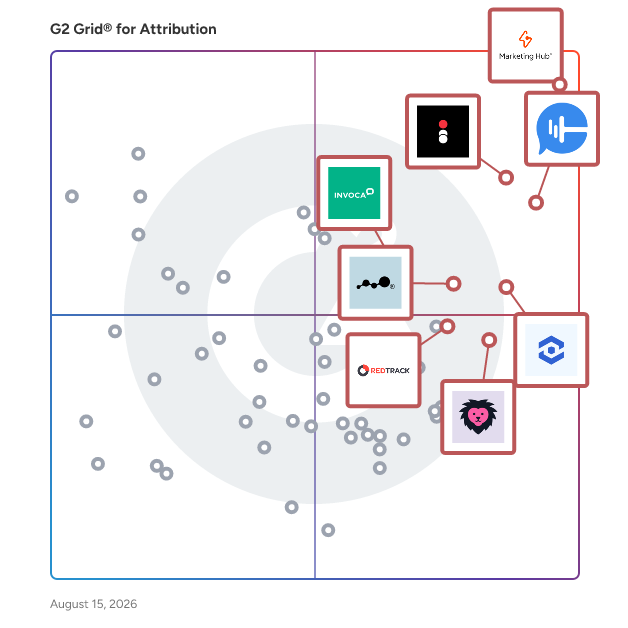
Highlighted products: HubSpot Marketing Hub, CallRail, impact.com, WhatConverts, Dreamdata, Fibbler, Invoca, and RedTrack.io.
Underlying data: [Grid® JSON](https://www.g2.com/categories/attribution/grids.json?focus%5B%5D=hubspot-marketing-hub&focus%5B%5D=callrail&focus%5B%5D=impact-com&focus%5B%5D=whatconverts&focus%5B%5D=dreamdata&focus%5B%5D=fibbler&focus%5B%5D=invoca&focus%5B%5D=redtrack-io)
Sponsored
Cloud Monitoring collects metric data and provides tools that let you monitor and visualize how your applications and services are performing.
Marketing Hub consolidates marketing tools and customer data into a unified platform, eliminating scattered point solutions and simplifying software management for modern marketing teams. Core Value Proposition: HubSpot's Marketing Hub solves three critical pain points stemming from disconnected software: fragmented customer data, inefficient execution, and wasted time on tool management. Built as part of the HubSpot CRM platform, Marketing Hub keeps customer data central to all marketing activities– enabling sales alignment and clear ROI tracking across the full platform. Key Capabilities: Unified Data Architecture: Marketing Hub stores all marketing tools and customer data on one platform. This eliminates data silos and provides complete customer context for personalized marketing at scale. Time Efficiency: Marketers save time previously spent switching between applications, reconciling data across systems, and troubleshooting integration issues that plague multi-tool marketing stacks. Smart CRM Integration: Because Marketing Hub operates as part of the HubSpot CRM platform rather than as a standalone tool, customer information, interaction history, and engagement data remain accessible within the marketing workflow without manual data transfer. Sales-Marketing Alignment: With the complete HubSpot CRM platform, marketing and sales teams work in alignment. Unified reporting ties marketing activities to revenue, proving ROI. Marketing Hub vs. Alternatives: Unlike individual marketing tools requiring manual integration and data transfer, Marketing Hub provides a native connection between email marketing, landing pages, social media management, and data analytics. This eliminates integration complexity and data sync challenges that fragment marketing operations. Marketing Hub delivers powerful capabilities without requiring extensive training, dedicated administrators, or technical implementation teams that complex enterprise platforms demand. Teams can adopt and use the system quickly, focusing on execution rather than software management. Who Should Use Marketing Hub: Marketing Hub serves marketing teams experiencing productivity loss from tool fragmentation, marketers requiring complete customer context for effective personalization, and organizations needing to demonstrate clear marketing ROI. The platform scales from small marketing teams to enterprise organizations without proportional increases in system complexity. Outcome: Marketing Hub enables marketers to save valuable time, provide personalized experiences that attract and convert the right customers at scale, and keep data at the center of everything they do– all while scaling their company, not complexity.
Average Rating: 4.4/5.0
Total Reviews: 14,260
AI-generated summary from verified user reviews
"Centralized Data Management with Outstanding AI Features"
Rating: 5.0/5.0 stars
— Jason N.
"Easy Navigation, Centralised Data, Powerful Filters, and Great Value in HubSpot Marketing Hub"
Rating: 5.0/5.0 stars
— Vikas G.
CallRail is the lead engagement platform that makes it easy for businesses to attract more leads, convert more customers, and optimize their marketing. Serving more than 220,000 businesses worldwide, CallRail’s AI-powered solutions help businesses attribute each call, text, chat and form to their marketing journey, use insights from their conversations to better understand their buyers, and eliminate missed opportunities with AI that can handle lead interactions 24/7.
Average Rating: 4.5/5.0
Total Reviews: 1,742
AI-generated summary from verified user reviews
"Voice Assist Is a Game Changer—Clean UI, Smooth Integrations, Solid Performance"
Rating: 4.5/5.0 stars
— Manind G.
"Effortless Call Tracking with AI Insights, Needs Setup Simplification"
Rating: 4.5/5.0 stars
— Kevin D.
Managing partnerships across multiple platforms kills efficiency and growth potential. impact.com eliminates this friction with the only comprehensive platform that unifies affiliate, creator, and advocacy programs. Access 250K+ quality partners, automate manual tasks, and track true incremental value—all while our expert team handles the heavy lifting from migration to optimization.
Average Rating: 4.4/5.0
Total Reviews: 2,352
AI-generated summary from verified user reviews
"Reliable Platform for Managing Affiliate Partnerships"
Rating: 5.0/5.0 stars
— Mithi S.
"Intuitive UI with Some Payment Method Frustrations"
Rating: 4.0/5.0 stars
— Jubayer H.
WhatConverts is an all-in-one lead tracking software for marketing agencies and their clients. WhatConverts automatically shows marketers and business owners how well their marketing is working. Use WhatConverts for call tracking, form tracking, and chat tracking for all leads. For PPC ads, WhatConverts offers keyword call tracking that reveals which campaigns work best. WhatConverts also has robust lead management and lead reporting. It's more than just call tracking software; it's a complete lead tracking, managing and reporting dashboard.
Average Rating: 4.9/5.0
Total Reviews: 314
AI-generated summary from verified user reviews
"Complete Tracking Stack with Rock-Solid Integrations and Fast, Reliable Support"
Rating: 5.0/5.0 stars
— Asim N.
"Excellent UX and a Well-Built Tracking Framework with significant unexplored potential."
Rating: 4.5/5.0 stars
— Luiz Henrique R.
Dreamdata is a B2B Attribution Platform that gives marketing teams the most complete view of their customer journey anywhere - so they always know what's working and where to invest next. Built for B2B marketers who need to show impact, Dreamdata lets you answer any question on marketing's revenue contribution instantly. Every number traces back to the source including those generated by AI. No waiting for Ops. No black-box reporting. Just numbers that you can stake your reputation on. Scalable Reporting: Measure the ROI of every GTM activity across your full customer journey - from first anonymous touch to closed deal. Campaign Optimization: See exactly which channels, campaigns, and content drive pipeline, so you know where to invest more and where to cut. Audience Targeting: Build dynamic audiences from your pipeline data and sync them directly to your ad platforms to target in-market accounts. Conversions Sync: Feed enriched pipeline data back to your ad platforms automatically, so your campaigns optimize for revenue not just clicks. Try Dreamdata with your own data before you commit.
Average Rating: 4.7/5.0
Total Reviews: 268
AI-generated summary from verified user reviews
"Game-changing customer journey visualization for B2B Marketing"
Rating: 4.5/5.0 stars
— Daria G.
"New Customer - Powerful platform with excellent onboarding"
Rating: 4.5/5.0 stars
— Adam C.
Fibbler helps you see which companies view or engage with your LinkedIn and Google Ads, connect them to pipeline and revenue in your CRM, and alert sales when it's time to reach out.
Average Rating: 4.9/5.0
Total Reviews: 32
AI-generated summary from verified user reviews
"Effortless Attribution Analysis with Fibbler"
Rating: 5.0/5.0 stars
— Anand V.
"One Stop Shop to get Pipeline Visibility for your LinkedIn ABM Program"
Rating: 5.0/5.0 stars
— Mithun R.
Which of your campaigns drive the best phone leads? Are you losing sales because of bad call experiences? Are you getting credit for all of your conversions? Invoca helps businesses drive revenue growth by unlocking new data from calls, so they can acquire and retain more customers for less money. With Invoca's revenue execution platform, businesses are driving unbelievable results: • Marketing teams — like the one at Rogers Communications — are driving up lead quality and driving down acquisition costs by 82% • Contact centers — like the one at MoneySolver — are boosting agent performance and conversion rates by 100% • Multi-location businesses — like Renewal by Andersen — are increasing appointments set over the phone by nearly 50% Invoca is trusted by the world’s top brands, including AutoNation, Flagstar Bank, Mayo Clinic, Orkin, Subaru, and Verizon, as well as: • 6 of the top 10 US health systems • 4 of the top 6 US mortgage lenders • 5 of the top 10 US property & casualty insurance companies • 5 of the top 7 US telecommunications companies To see more customer results, visit www.invoca.com/customers.
Average Rating: 4.5/5.0
Total Reviews: 926
AI-generated summary from verified user reviews
"Smarter Call Routing and Campaign Tracking That Boosts Efficiency"
Rating: 4.5/5.0 stars
— Prajwal E.
"Deep Call Insights and Proactive Support That Elevate Our Media Strategy"
Rating: 5.0/5.0 stars
— Verified User in Telecommunications
RedTrack is all-in-one performance marketing platform built for media buyers built on owned & AI-ready data. It brings ad tracking, conversion attribution, Conversion API (CAPI) integrations, and ad automation together in a single workspace. Instead of relying on third-party cookies and browser pixels, RedTrack runs on server-side and first-party tracking, capturing the conversions that pixels lose to ad blockers, privacy settings, and iOS restrictions, as raw, unsampled first-party data you own. That owned first-party data is then enriched and fed back to Meta, Google, TikTok, Snapchat, ChatGPT Ads, and other ad platforms through high-match-score Conversion API connections, so platform algorithms learn from accurate signals. RedTrack stays platform-agnostic — no single channel locks you in — with Shopify and WooCommerce integrations at the front of the stack. A built-in Match Quality Score shows you exactly how well your conversions are landing. And ad spend data refreshes every 5–30 minutes, right down to the ad level, so you get near real-time ROAS across every channel — the update frequency and granularity performance buyers actually run on. RedTrack is more than just a tracker. It's a full performance infrastructure layer. Beyond click and conversion tracking, RedTrack gives you a customer data layer with CDP and LTV reporting, in-platform data views that bring RedTrack's numbers right into your ad platform UI so you're not tab-hopping to read campaign performance, and partner and referral tracking, all on one screen. The automation is where the calm comes in. You set the rules, and RedTrack acts on the data you own: pausing the losers, scaling the winners, reallocating budget away from weak markets. The work keeps happening when you're not watching, so you're not refreshing a dashboard at 2am to catch a campaign burning budget. RedTrack fits three core users: 1. Affiliate and lead-gen media buyers who need click-level tracking, persistent click IDs across complex funnels, and automation rules to pause losers and scale winners. 2. DTC and eCommerce brands on Shopify and WooCommerce who need accurate multi-channel attribution and true ROAS, not platform-reported guesses. 3. Performance and lead-gen agencies managing multiple clients with shareable dashboards, multi-user access, and automated reporting. Buyers often evaluate RedTrack alongside Triple Whale, Voluum, Binom, Keitaro, ClickFlare, AnyTrack, and ThriveTracker. RedTrack's edge is combining click-level precision with business-level profit metrics in a cloud platform (no self-hosting to maintain) while giving you one clean, unified place to see what's actually making you money.
Average Rating: 4.5/5.0
Total Reviews: 38
AI-generated summary from verified user reviews
"Reliable tracking platform for serious advertisers"
Rating: 5.0/5.0 stars
— Ramūnas P.
Rating: 5.0/5.0 stars
— Andrei Z.
CTM helps businesses turn everyday conversations into growth. Trusted by more than 100,000 users worldwide, including leading brands like Tinuiti, Morgan & Morgan, Tutor Doctor, and ServiceMaster, CTM connects marketing performance to revenue outcomes, giving teams the clarity to see which campaigns drive conversions and the insight to optimize every customer touchpoint. The result: more efficient lead handling, higher conversion rates, and improved ROI. Powered by rich conversation analytics, CTM unifies fragmented call, text, chat, and form interactions into a single, actionable view of customer behavior. With deep integrations across leading marketing, advertising, and CRM platforms—and partnership opportunities for agencies, affiliates, and technology providers—CTM makes it simple to align data, teams, and results. Guided by our purpose to create a better human experience through technology, CTM empowers businesses to make every conversation count.
Average Rating: 4.5/5.0
Total Reviews: 727
AI-generated summary from verified user reviews
"CallTrackingMetrics the #1 call center VOIP software."
Rating: 5.0/5.0 stars
— Alex F.
"CallTrackingMetrics: A Strong Solution for Optimizing Call Tracking and Marketing Performance"
Rating: 4.5/5.0 stars
— Loganathan V.
Every-touch revenue attribution and advanced AI-driven revenue planning to enable every marketer—from CMO to channel manager—to discover customer journeys, impact digital transformations, and power company growth.
Average Rating: 4.7/5.0
Total Reviews: 142
"Aligning with my Marketing Goals"
Rating: 4.0/5.0 stars
— Kanhaiya B.
"Clearly Shows Which Marketing Efforts Drive Deals and Revenue"
Rating: 4.5/5.0 stars
— Akshay M.
ActiveCampaign is the autonomous marketing platform built to transform how marketers, agencies, and business owners work. Use Active Intelligence to power goal-aware automations and orchestrate personalized experiences across email, SMS, and WhatsApp. Effortlessly integrate with 1000+ apps, uncover deep performance insights, and optimize your workflows so you win every day. - Autonomous marketing Built on the foundation of marketing automation, fuel your marketing strategy and customer journeys with AI-driven execution, optimization, and insight at every step. - AI agents Run entire marketing campaigns through simple prompts, backed by Active Intelligence. - Cross-channel marketing Reach prospects and customers wherever they are, with email, SMS, WhatsApp, and more. - On-brand, personalized content Creative tools that deliver professional, conversion-ready designs for email and landing pages. - CRM Track, manage, and automate your sales process. - 1000+ apps & integrations Connect ActiveCampaign to your favorite tools.
Average Rating: 4.4/5.0
Total Reviews: 14,243
AI-generated summary from verified user reviews
"Powerful Automations and Reporting That Drive Strategic Decisions"
Rating: 4.5/5.0 stars
— Pamela S.
"User-Friendly Interface, Powerful Features, and Excellent Support"
Rating: 5.0/5.0 stars
— Omezine T.
CAKE has led the performance marketing industry with innovative solutions for advertisers, networks, and publishers to manage, measure, and optimize their digital marketing campaigns, in real-time. The company specializes in providing solutions for affiliate marketing, lead distribution, and ecommerce that create new revenue opportunities while ensuring data security and fostering profitable partnerships worldwide. Affiliate marketers waste valuable time on administrative tasks like providing performance reports to partners, sending campaign and creative assets, reconciling billing and paying partners, plus so much more. CAKE solves these challenges by enabling advertisers and affiliates to manage an entire performance marketing program in one platform.
Average Rating: 4.5/5.0
Total Reviews: 60
AI-generated summary from verified user reviews
"Great platform! Very intuitive. Amazing Customer Service!"
Rating: 5.0/5.0 stars
— Noy E.
"Modern all-in-one workspace with a lightweight UI and easy onboarding"
Rating: 5.0/5.0 stars
— Rahul c.
Factors.ai is an AI ABM built for B2B GTM teams. It helps teams identify high-intent accounts, understand how those accounts move across their website, CRM, ad platforms, and campaigns, and turn that activity into a qualified pipeline. At its core, Factors.ai is built on a strong first-party data foundation. The platform identifies more than 75% of companies visiting your website, the highest in the industry, and tracks how those accounts move across pages, channels, and campaigns. This gives marketing and sales teams a reliable account-level view of buyer activity, even when visitors never fill out forms. Factors also include LinkedIn AdPilot and Google AdPilot, purpose-built tools for running ABM on LinkedIn and Google. AdPilot activates high-intent accounts throughout your campaigns, helping teams reach the right companies, control ad exposure, and understand how advertising influences the pipeline. Factors.ai enriches this activity with third-party company and firmographic data to provide more context about visiting accounts and help teams understand which companies match their ideal customer profile. Teams use Factors.ai to understand which accounts are researching them and activate that data across marketing and sales workflows. Key capabilities include: • Scout agents: Agents automate your marketing and sales tasks like account research, email creation & reach-out, campaign optimization, list maintenance and so much more based on boundaries you define. • Scout assistant: Scout keeps an eye on your revenue pipeline and surfaces any anomalies, while helping you build your GTM playbook. Within seconds, Scout can answer questions on revenue dips, campaign performance, high-intent accounts, and anything you want to know about your pipeline. • Website visitor identification: Identify more than 75% of companies visiting your website and track how those accounts move across pages, campaigns, and channels. • First-party and third-party data enrichment: Combine website activity with firmographic and company data to better understand who visiting accounts are. • Account segmentation and targeting: Segment accounts based on ICP fit, intent signals, and engagement activity to prioritize outreach and campaigns. • Lead and account scoring: Score accounts based on firmographic attributes, engagement signals, and behavioral data to identify high-potential opportunities. • LinkedIn and Google ad activation: Automatically create audiences and improve ad targeting through LinkedIn AdPilot and Google AdPilot. More than 1,000 GTM teams, including Sprinklr, Freshworks, and Celonis, use Factors.ai to run ABM programs, optimize advertising, and generate pipeline faster. Explore Factors.ai in action: https://www.factors.ai/
Average Rating: 4.5/5.0
Total Reviews: 210
AI-generated summary from verified user reviews
Rating: 4.5/5.0 stars
— Sai K.
"Clear Account-Level Attribution and Easy High-Intent Audience Activation"
Rating: 4.0/5.0 stars
— Muthukumar A.
Constant Contact Advanced Automation helps you send the right message at the right time. From Social to SMS and email to ecommerce, we deliver tools to help you build deeper relationships with your audience. Our powerful digital marketing platform helps you be more efficient with your marketing so you can focus on your building your business. Engage Your Audience where They are with Multi-Channel Campaigns - Create comprehensive marketing campaigns with just a few clicks. Our Campaign Builder tool will help you launch a multi-channel campaign across email, social, and SMS to help you achieve your goals. Get Started Fast With Pre-Built Automation Templates - Setup your automations quickly with pre-built automation templates to help you send timely SMS and email messages. Easily Manage Your Contacts - Manage customer segments automatically using customer tags. Then, trigger automations based on how customers engage with your businesses. Automate Your Messaging - Deliver timely, relevant content with SMS and email marketing automation using our drag-and-drop Automation Path Builder. Make sure that your audience receives the right message, at the right time: automatically. Learn more at www.constantcontact.com
Average Rating: 4.4/5.0
Total Reviews: 938
AI-generated summary from verified user reviews
"Simple, All-in-One Marketing Platform with Easy Email Campaigns"
Rating: 4.0/5.0 stars
— Verified User in Oil & Energy
"Easy Set-Up, Multi-Domain Capability"
Rating: 5.0/5.0 stars
— James C.
AdRoll is a connected advertising platform designed to assist growth-oriented marketers in navigating the complexities of digital advertising. This comprehensive solution provides users with powerful artificial intelligence capabilities, flexible campaign management tools, and seamless integrations, all aimed at converting clicks into customers. By offering a full-funnel performance approach, AdRoll empowers mid-sized businesses to streamline their marketing efforts and achieve measurable results across various channels. Targeting a diverse audience, AdRoll serves industries such as ecommerce, technology, financial services, and education. The platform is particularly beneficial for marketers who seek to enhance their advertising strategies through multi-channel advertising and audience insights. With its robust analytics and reporting features, users can gain a deeper understanding of their target demographics, enabling them to tailor their campaigns for maximum impact. This data-driven approach allows businesses to make informed decisions that drive engagement and conversion rates. One of the standout features of AdRoll is its ability to provide cross-channel attribution, which helps marketers track the effectiveness of their campaigns across different platforms. This means that users can see how their advertising efforts on social media, search engines, and display networks contribute to overall performance. Additionally, for B2B teams, AdRoll offers Account-Based Marketing (ABM) capabilities, allowing for account-specific targeting and multi-touch campaigns that cater to the unique needs of individual buyers. This level of precision ensures that marketing efforts are not only broad-reaching but also highly relevant to potential customers. AdRoll's nearly two decades of data and award-winning support further enhance its value proposition. The platform is designed to help marketing teams operate more efficiently, enabling them to advertise smarter and move faster in a competitive landscape. By consolidating various marketing functions into one platform, AdRoll allows users to manage their advertising strategies with greater ease, ultimately leading to improved outcomes and business growth. The combination of advanced technology, user-friendly tools, and comprehensive support makes AdRoll a valuable resource for marketers looking to optimize their advertising efforts and drive success.
Average Rating: 4.1/5.0
Total Reviews: 765
AI-generated summary from verified user reviews
"Effortless Campaign Launch with Powerful Retargeting"
Rating: 4.0/5.0 stars
— Raad S.
"Fast Setup and Effective Retargeting That Drives Conversions"
Rating: 4.0/5.0 stars
— Muhammed Kawsar A.
Attribution software, or marketing attribution software, is used to determine the marketing tactics that are contributing to sales or conversions. Marketing teams use a variety of software and marketing tools to funnel prospects from product awareness all the way down to purchase. During this customer journey, prospects go through various channels or touchpoints; there is usually a point where a prospect goes from being interested to becoming a committed buyer. Attribution platforms allow marketers to determine which touchpoint or channel was most effective in convincing that prospect to become a committed buyer and finally make a purchase.
There are various attribution models that marketers use to determine which touchpoints are the most effective for their business, such as first-touch, last-touch, and multi-touch attribution. To choose a model, it is important for a business to evaluate their sales cycle and determine how much of it is done online and offline. For example, most e-commerce sites rely heavily on touchpoints such as display advertising and native advertising. Conversely, a local service such as an auto mechanic may prefer traditional methods like newspaper advertising. Ultimately, most organizations may utilize several attribution models to evaluate which marketing campaigns are the most effective. The best way to begin using attribution software is by mapping out a typical customer journey and identifying which channels and touchpoints are the most important for the particular business model.
Lastly, it’s important to note that attribution software should not be mistaken for mobile attribution software. Rather than focusing on which touchpoints convert a prospect into a buyer, mobile attribution software focuses specifically on the techniques that drove each user to install a mobile application. Mobile attribution provides insight into where each mobile application install came from across every marketing channel, device, and advertising network.
Since there are so many different touchpoints and channels that a buyer sifts through during the sales funnel, there are various types of attribution software to help determine the channel that influenced a purchase the most. Listed below are some of the types of attribution software:
Multi-touch attribution
Multi-touch attribution helps determine which touchpoint is the most responsible for a final sale. Rather than testing major sales channels, multi-touch attribution focuses on granular touchpoints such as marketing messages and native ads. For example, if a customer is searching for new phones on the internet, they may soon see ads from various phone companies. If a customer sees an ad for a phone they like and immediately proceeds to the company website, then marketers can accurately determine that particular ad is what influenced that buyer to come to the website. Multi-touch attribution is beneficial because it offers specific granular data for marketers rather than broad assumptions on what contributed to a sale.
Additionally, there are two major types of multi-touch attribution: first-touch attribution and last-touch attribution. First-touch attribution gives credit to the first marketing touchpoint as the most influential touchpoint that contributed to a sale. For example, if a customer’s first interaction with a company is by clicking on a display advertisement, then the display advertisement would be considered the most important touchpoint in a first-touch attribution model. Even if the customer went through various other touchpoints after clicking on the display advertisement, it wouldn’t matter in this model because the first touchpoint is considered the most important. Last-touch attribution is the complete opposite, where the last touchpoint is considered the most important. Let’s say a customer clicked on the display advertisement and then proceeded to a video advertisement before making the final purchase. In a last-touch attribution model, the video advertisement would be considered the most important touchpoint since this is the last touchpoint before the purchase.
There are other models of multi-touch attribution that consider all touchpoints equally important or weigh each touchpoint differently. The key takeaway is that attribution software allows marketers to choose from many different models to measure touchpoints and their importance. Marketers can play around with various models and choose the ones they consider most effective in their strategy.
Marketing mix modeling
Marketing mix modeling is a more complex type of attribution because it takes into account a variety of factors that contribute to a sale. The four major factors that marketing mix modeling focuses on include product, price, place, and promotion. Marketing mix modeling tries to find the optimal balance across these four marketing efforts to determine the weight of importance that should be given to each. This offers insight into which marketing channels are working and which ones are not.
From custom attribution modeling to conversion summary reports, attribution software provides all the necessary tools to track how buyers funneled through the customer journey and converted into a purchase.
Attribution modeling: Attribution modeling allows users to select from a variety of attribution models. Whether it’s single-touch or multi-touch attribution, users can select from a variety of attribution models that place varying importance on marketing touchpoints across the customer journey.
Cross-channel attribution: It’s important that marketers are able to use attribution software to connect campaigns across channels and fully understand a customer’s journey. Cross-channel attribution means that marketers can follow prospects and understand the different steps they take across the entire customer journey.
Offline attribution: Offline attribution allows users to track touchpoints through offline channels such as traditional ads, marketing events, or in-store promotions.
Dashboards: Marketing dashboards consolidate all data on touchpoints and marketing channel performance. This allows users to view and manage this data to evaluate which campaigns are working better than the others.
Promotion analysis: Promotion analysis tools allow users to measure the performance of sales and promotions. By evaluating how often users click on ads that display promotions or sales, users can evaluate the effectiveness of price cuts.
Integrations: It’s important for attribution software to integrate with different tools and systems, like CRM software and marketing automation software, to ensure that all marketing data is being utilized across the entire marketing strategy.
Spend optimization: Attribution platforms allows businesses to optimize spend across all marketing efforts. For example, marketers can use attribution software to pull cost data from all major ad platforms, correlate those costs to specific accounts, and then track revenue from touchpoints over time.
Personalized content: Marketers can utilize attribution software to present more effective personalized content to potential buyers. This software provides companies with visibility on how digital assets impact sales opportunities and revenue, which enables marketers to automatically optimize user journeys with personalized, revenue-driven recommendations.
Improved product development: This type of software enables businesses to improve product development through attribution data analysis. Contact-level attribution offers a unique insight into the needs and wants of customers, and this data can be referenced during product updates so teams can focus on the features and functionalities that matter most.
Revenue tracking: Attribution software allows marketers to accurately determine if sales and promotions are effective drivers of revenue. This type of software enables marketers to track, connect, and credit marketing efforts to their downstream revenue generation.
Attribution platforms are used across a wide variety of industries. From business to business software providers, as well as service industries, every business must evaluate the performance of their marketing efforts. With this in mind, attribution software is usually found within the marketing departments of these businesses. Below are some of the most common industries that take advantage of attribution software:
E-commerce: Any business that sells goods online can greatly benefit from using attribution software. E-commerce businesses generally funnel their consumers through many touchpoints and marketing channels, which makes it difficult to determine which ones contributed the most to a final sale. From native ads to video advertising, attribution software helps e-commerce businesses ascertain which channels are the most effective.
Retailers: While e-commerce businesses only have to focus on online conversions, retailers must focus on both online and offline conversions. Although it might be more difficult to track, retailers that log sales in store can gather customer information such as emails to target their marketing efforts on that particular customer. This can help track if promotional emails lead to customer conversions in stores.
Related solutions that can be used together with attribution software include:
CRM software: A CRM is usually one of the core products in a businesses’ software stack that helps them track and manage customer interactions in a single system of record. It houses all relevant customer data including contact information, history, and transaction summaries. It makes sense for users to integrate attribution software alongside CRM software to monitor how a certain deal closes in the sales funnel. Once that is recorded, users can also use customer information to reiterate back into the attribution process. This facilitates the use of customer information to understand products they like and send out personalized messages and offers. The two can work in tandem to complete sales on a more regular basis.
E-commerce platforms: It can be very beneficial to integrate attribution software with e-commerce platforms to more accurately track sales conversions. Every time a purchase is made online, users can then analyze if the product sales was due to a particular ad or any other marketing touchpoint.
Marketing automation software: Marketing automation software automates marketing actions or tasks, streamlines marketing workflows, and measures the outcomes of marketing campaigns. Since attribution software also focuses on measuring the outcome of marketing campaigns, it makes sense to integrate both marketing automation software and attribution software.
A lot of the issues that arise out of attribution software are due to incorrect attribution. This can be caused by biases in data or other factors. Here are some of the most common pitfalls to look out for.
Correlation-based biases: Correlation-based biases occur when marketers believe that certain marketing efforts caused a chain of events when they did not. For example, if attribution software picks up on clicking a display advertisement as being the first touchpoint in the customer journey when it was really a customer going to the physical store, then this can be an incorrect correlation. This may make marketers weigh more importance on display advertising, leading to misguided efforts.
In-market bias: In-market bias refers to customers who would have purchased a product whether or not they clicked on an advertisement in the first place. Once again, this can cause marketers to increase spend on display advertising because this is what they think caused the customer to make a purchase.
Integrations: There is an abundance of marketing touchpoints, or any interaction between the company and a potential buyer, that customers experience. These touchpoints could be any activity, from viewing marketing content mentioned on social media or attending a company’s virtual event or webinar. As the number of marketing touchpoints increases, it is even more imperative that all of a company’s marketing technology stack integrates with attribution software correctly so marketers can measure the impact of all these touchpoints.
Any company that invests in marketing efforts could benefit from purchasing attribution software. Attribution software assists businesses in determining the most appropriate channel to focus their marketing efforts on and the best time to reach buyers. Businesses don’t want to spend money on a particular marketing campaign or channel that isn’t driving results; attribution software helps solve that problem.
E-commerce: When a business sells products online, it is important to effectively market those products using various channels. Attribution marketing is imperative for e-commerce businesses to track their marketing campaign’s performance across various channels as many e-commerce brands have a multichannel digital marketing strategy.
When a company is ready to start evaluating different attribution tools, there are a few aspects that are important to consider.
Security: It’s important to choose an attribution software that is secure and will safely house customer data. Due to an increasing number of data privacy regulations, like the GDPR and CCPA, it is imperative that attribution software has exceptional security features.
Integrations: Ease and breadth of integrations is also an important factor to consider when choosing an attribution tool. There is an abundance of sources that attribution software pulls in data from, and that is contingent on having exceptional integrations with other types of software (i.e., CRM, marketing automation, email marketing, digital advertising, SEO, etc.).
Attribution sources: Varying attribution software specialize in certain types of attribution, so companies should evaluate which type of marketing activities they want to track and measure. Some attribution tools specialize in tracking offline marketing activities, mobile-only marketing activities, social media advertising activities, etc. When evaluating for which attribution tool is best for the organization, buyers must consider if they need a specialized or a general tool.
The cost for attribution software varies depending on multiple factors, including the amount of channels it supports, the breadth and ease of APIs and integrations, the robustness of reporting and drill-down capabilities, support hours, and the ability to set up custom attribution models.
While some attribution tools will include offline marketing activity channels, other attribution tools may charge extra to set up offline marketing attribution. Additionally, attribution tools that support multichannel methods may cost more as they enable marketers to see the ROI across all marketing channels, which can ensure marketing budgets are being allocated effectively. To measure the ROI of the attribution tool of choice, buyers should look at the drill down of every click, conversion, and budget allocation for all marketing campaigns and determine how these campaigns are performing against how much revenue is coming into the company.
How is Attribution Software Implemented?
There are multiple steps marketers should take before implementing attribution software. First, it’s important for marketers to evaluate what questions they want their attribution tool to answer. For example, if the director of customer success is involved in this decision process, it might be important to see if the attribution tool can measure the impact of marketing campaigns on customer renewals.
Then, during implementation, marketers should be ready to connect their other marketing technology. Marketers should think about all the tools that make these touchpoints possible so all the tools are communicating with each other. IT teams may need to help out when connecting various systems with the attribution tool that is selected. Finally, when implementing attribution software, marketers should keep in mind that it takes time to implement the attribution model that works best for a company. It will take time to understand and test which model is performing well against company goals.
Account-based marketing attribution
Some attribution tools specialize in account-based marketing attribution, which surfaces each touchpoint for each lead and contact under specific accounts. These tools help marketers better understand engagement with multiple contacts associated within an account or buying group, as well as gain complete visibility into touchpoints across contacts and leads within a matched account. Attribution tools with the specialization can also tie how much revenue each engagement within an account is worth and measure the progress of a customized account journey.
Offline tracking
Offline tracking, in combination with tracking digital channels, is becoming increasingly important for marketers. Tracking leads, conversions, and engagement from offline channels (i.e., events) alongside channels like digital advertising enables marketers to measure the effectiveness of all marketing touchpoints throughout a customer journey.