What I Often See in Professional Services Automation
Based on G2 reviews, buyers evaluating the leading professional services automation solutions weigh configurability, implementation effort, and how cleanly the platform absorbs the time-tracking, billing, and reporting workflows their teams already run. For consultants and agencies, reviewers consistently call out clean timesheet UX and accurate client invoicing as the workflow features that drive daily adoption across project-based service work. IT consulting firms and MSPs gravitate toward PSA apps that unify ticketing, RMM integration, and contract billing in a single operational hub for managed services delivery. Small IT consulting teams specifically prioritize implementation speed, predictable pricing, and out-of-the-box configurations over deep customization, since most cannot dedicate a full admin to ongoing platform tuning. The reviewer feedback below captures both sides of this tradeoff: what users consistently appreciate, and where leading platforms still fall short.
Feedback Pros: What Users Consistently Appreciate
- Flexible, flat-fee IT management with easy scripting and broad integrations
-
“Scripting things like new computer setups and installing third party software is very easy. As a one man shop with a break-fix/MSP hybrid model I also appreciate one flat fee, and not having to pay per seat. This makes it easy to throw a Syncro agent on all of my non-managed clients for basic monitoring and alerting, as well as ease of remote support in the future. The number of integrations with commonly used tech products is also helpful.” - Thomas K., Syncro Review
- Transformative, AI-powered operations with exceptional support
-
“Rocketlane has revolutionised out operations and reporting and we use it on a daily basis. It's user-friendly, it allows my Team to do things we've never been able to do before. The AI chat bot is one of the best I've seen and the Support Team who's ready to jump in if AI can't help is outstanding. They're very quick to respond. Our relationship with our CSM and TAM is great too - overall, it's a pleasure to work with Rocketlane!” - Maja B., Rocketlane Review
- Centralized ticketing, projects, and billing with strong RMM integration
-
“Autotask has become an essential part of our daily operations. By keeping all our tickets, projects, and billing centralized, it makes it much easier for our team to stay organized. The integration with Datto RMM functions smoothly, allowing us to connect technical work directly to the service desk. Although it takes a little time to get familiar with the layout, once you do, it proves to be a powerful system that significantly reduces administrative workload.” - Phillip P., Autotask Review
Cons: Where Many Platforms Fall Short
- Project and opportunity workflows feel rigid and complex to configure
-
“I find the project workflow in Autotask could use some updating to better align with our specific needs. Despite discussing this with Kaseya, it remains an area of concern. Additionally, my sales department is dissatisfied with how the opportunities feature functions, as it doesn't fully meet their needs. We are hoping for better guidance on its usage and improvements in managing and viewing opportunities across multiple resources. Moreover, the initial setup of Autotask was challenging due to its size and complexity, requiring a significant investment of time to establish a base configuration.” - David D., Autotask Review
- Confusing permission setup and unreliable tools impact daily workflow
-
“I find it quite challenging to configure different user permissions effectively. My boss has been trying to figure out my user account permissions for a long time, and yet I still cannot access certain aspects of the platform properly. This makes it quite annoying since some essential features remain out of reach, affecting my workflow. Furthermore, the backgrounding tools that I initially found useful have become increasingly unreliable over time. They don't consistently work, which is frustrating. Although I reached out to customer support to resolve these reliability issues, I did not have much success, which adds to the frustration.” - Mahmood I., Syncro Review
- Powerful platform with usability, customization, and support limitations
-
“My main dislike about SAP S/4HANA Cloud is that even though the system is powerful, the ease of use could still be improved. Some Fiori apps feel unintuitive at first and require extra training. Implementation also takes longer than expected because many processes need to fit into the standard, so customization options are limited. Customer support is helpful but sometimes slow to respond for complex issues. I use the system frequently, and while it offers a wide range of features, a few important ones still feel incomplete or require additional add-ons. Integration with other systems works well overall, but it can become complicated when dealing with non-SAP tools. So the platform is strong, but these areas still have room for improvement.” - Harsh J., SAP S/4HANA Cloud Review
My Expert Takeaway on Professional Services Automation Software
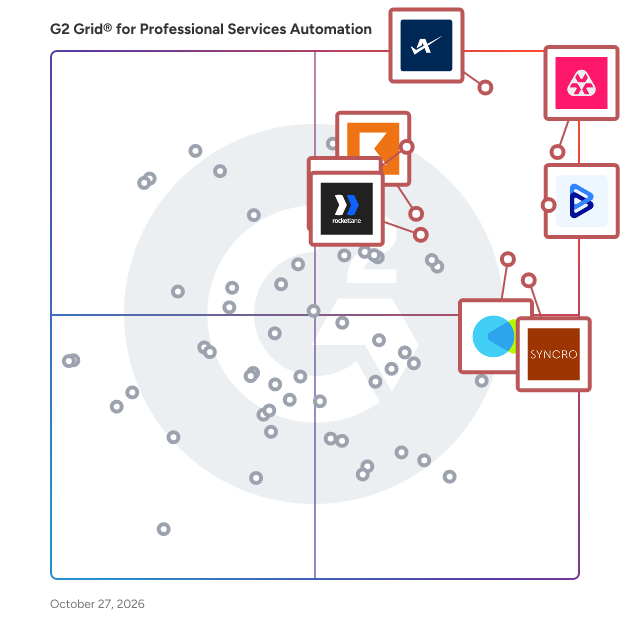
Across G2 reviews, professional services automation (PSA) delivers the most value when organizations treat it as an operating discipline rather than a set of loosely connected modules. High-performing teams establish clear ownership over resource planning, time capture, and billing rules early in the rollout, which reduces downstream friction and improves adoption across delivery, finance, and leadership. This pattern is reflected in the dataset, where day-to-day usability and vendor experience score strongly, while setup and administration tend to lag slightly.
Teams that achieve the best outcomes with PSA strike a balance between flexibility and governance. While advanced configuration and automation are powerful, ease of use remains a key differentiator for sustained adoption. In IT services and marketing agencies in particular, successful implementations standardize core templates, projects, roles, and rate cards before expanding into custom fields and advanced workflows. When PSA is tightly integrated across delivery, resourcing, and billing, it reduces handoffs and manual rework, becoming the system of record for utilization, margin, and forecasting.
For buyers evaluating the best professional services automation software, the core challenge is scaling delivery complexity without slowing teams down. The most effective PSA platforms support disciplined configuration upfront, then enable controlled expansion into deeper analytics, reporting, and integrations as organizational maturity grows. This approach improves trust in the data, minimizes administrative bottlenecks, and drives long-term adoption across services, finance, and executive stakeholders.
Professional Services Automation Software FAQs
What is professional services automation software?
Professional services automation (PSA) software helps service organizations run their delivery end-to-end, manage projects, schedule resources, capture time/expense, bill, and report on profitability. Instead of stitching spreadsheets and point tools together, PSA centralizes delivery data, allowing teams to forecast utilization, reduce revenue leakage, and standardize client reporting. It’s most common in consultancies, agencies, and IT services firms.
What are examples of PSA tools?
Examples of PSA tools include platforms built for project delivery operations: project + portfolio management, resource capacity planning, timesheets/expenses, invoicing, and margin reporting in one system. Some are services-first suites; others extend from ERP, CRM, or project management ecosystems. In practice, “best fit” depends on whether you need deep financials, lightweight delivery tracking, or strong integrations.
What is the best PSA software?
The best PSA software depends on how your services organization operates, staffing model, billing complexity, and margin tracking needs. On G2, tools like Kantata (formerly Mavenlink), Certinia (FinancialForce PSA), and BigTime are consistently rated highly for time tracking, resource forecasting, and billing accuracy. Buyers should compare satisfaction and Market Presence on G2, then validate fit through a real-world workflow pilot.
What is the difference between ERP and PSA?
ERP is primarily a finance-and-operations backbone (general ledger, procurement, inventory, company-wide financial controls). PSA is delivery-centric: planning and tracking services work (projects, staffing, timesheets, and client billing) often feeding clean operational data into the finance system. Some ERPs include PSA modules, but many teams adopt dedicated PSA when they need stronger utilization forecasting, delivery reporting, and services-specific workflows.
What is a professional services automation system?
A professional services automation system is the operational hub that standardizes how services are planned, delivered, and billed. It typically includes project templates, role-based staffing and utilization planning, timesheets/expenses, approvals, invoicing rules, and dashboards for revenue and margin. The goal is consistent delivery governance, allowing leadership to forecast capacity and profitability while teams spend less time on administration.