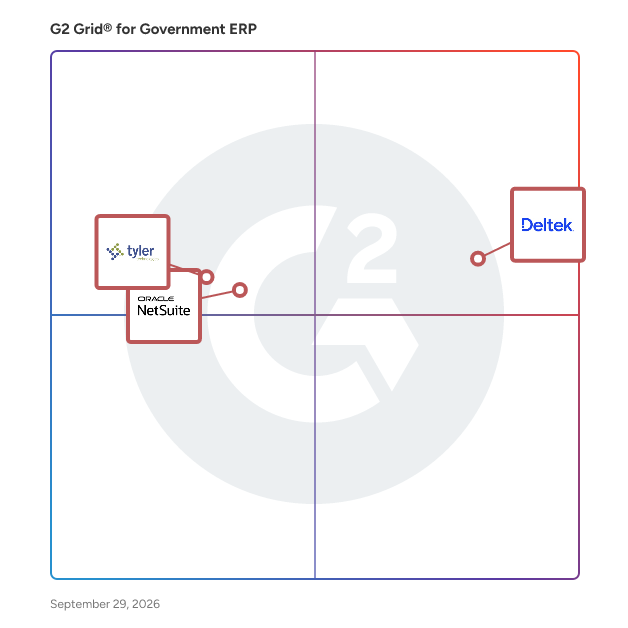
Deltek Costpoint
Deltek Costpoint is an ERP for government contractors that gives firms the speed, clarity, and control to manage complex contracts from pursuit through closeout. It connects financials, projects, procurement, and governance in a single system—purpose-built to support any contract type, from firm-fixed price to cost- plus. AI-powered intelligence is delivered through Dela, an AI orchestrator that automates contract creation, surfaces key insights, and answers questions on demand. Best for: Government contractors that need a single, governed ERP to manage FAR/DFARS- regulated workflows across multiple contract types and programs. Use cases: Track project costs, indirect rates, and funding in real time across contract types Automate time entry, expense reports, and approvals directly in Microsoft Teams or Outlook Prepare for DCAA audits with built-in traceability and 300+ pre-built reports Manage capture through closeout workflows from opportunity identification to final billing Forecast project performance using AI-powered predictive analytics from a single source of truth Key Features: Project-based financial management with indirect cost and rate controls Dela AI orchestrator — Ask Dela, Smart Summaries, and Dela Agents Role-based Command Center dashboards with real-time drill-down Capture and contract management integrated with GovWin IQ and ProPricer FedRAMP Moderate Equivalent cloud (GCCM) on the FedRAMP Marketplace Source-to-pay procurement with FAR/DFARS and CPSR support Time and expense entry across desktop, mobile, MS Outlook, and Teams Why GovCon contractors choose Costpoint: Purpose-built for regulated contract work. The project-based architecture, pre-configured FAR/DFARS controls, and DCAA-ready reports eliminate the manual workarounds that generic ERPs require. Audit-ready at any time. Costpoint GCCM meets FedRAMP Moderate Equivalency per DoD policy, with built-in traceability and security controls to support CMMC and DFARS 7012 compliance as a cloud service provider, enabling you to reduce audit prep time by up to 30%. Used by: Government contractors across defense, aerospace, technology, and professional services — from growing small businesses to large enterprise primes. 1,965 companies and 1.2 million users run on Costpoint, including 84% of the Top 25 Federal Contractors.
Average Rating: 4.2/5.0
Total Reviews: 667
Who Is the Company Behind Deltek Costpoint?
- Seller: Deltek
- Company Website:
- Year Founded: 1983
- HQ Location: Herndon, VA
-
Twitter: @Deltek
6,574 Twitter followers -
LinkedIn® Page: www.linkedin.com
4,828 employees on LinkedIn®
Who Uses This Product?
- Who Uses This: Accountant, Controller
- Top Industries: Defense & Space, Accounting
- Company Size: 51% Medium, 34% Large
What Do G2 Reviewers Say About Deltek Costpoint?
AI-generated summary from verified user reviews
Pros
- Users appreciate the ease of use in Deltek Costpoint, finding it helpful for timekeeping and expense reporting.
- Users find Deltek Costpoint extremely user-friendly, making implementation and navigation simple for everyone, even beginners.
- Users value the comprehensive reporting capabilities of Deltek Costpoint, effectively integrating critical data for informed decision-making.
- Users love the efficiency of Deltek Costpoint, benefiting from seamless navigation and streamlined planning processes.
- Users appreciate Deltek Costpoint for its effective management of specialized government contracting needs and robust accounting capabilities.
Cons
- Users often face user unfriendliness with Deltek Costpoint due to its outdated interface and confusing setup process.
- Users note the missing features in Deltek Costpoint, particularly in planning, timesheets, and billing formulas.
- Users find Deltek Costpoint's interface to be non-intuitive, leading to confusion and challenges during initial setup and usage.
- Users find the learning curve steep, with poor documentation and overwhelming customization complicating their experience.
- Users find Deltek Costpoint not user-friendly, struggling with its complexity and limited visibility for newcomers.
What Are Recent G2 Reviews of Deltek Costpoint?
"Good system but can be complicated. You have to use too many screens to do one function."
Rating: 4.0/5.0 stars
— Leslie R.
"Organized, User-Friendly, and Efficient"
Rating: 5.0/5.0 stars
— Jesse P.
