# Best iPaaS Software with Pre-Built Connectors Capabilities

  *By [Shalaka Joshi](https://research.g2.com/insights/author/shalaka-joshi)*

   Integration platform as a service ([iPaaS](https://www.g2.com/categories/ipaas)) solutions centralize the management, governance, and integration of cloud-based applications, enabling organizations to connect services, control integration flows, and rapidly scale functionality. These solutions streamline cloud-to-cloud connectivity, accelerate development, and reduce downtime by allowing teams to quickly add, remove, or modify integrations.

### Core Capabilities of iPaaS Solutions

To qualify for inclusion in the iPaaS category, a product must:

- Build, deploy, and manage integrations within the cloud
- Allow users to govern and manage integration flows
- Connect various cloud-to-cloud systems and solutions
- Consolidate cloud solutions into a single platform

### How iPaaS Solutions Differ from Other Tools

While related to [enterprise service bus (ESB)](https://www.g2.com/categories/enterprise-service-bus-esb) solutions, iPaaS offerings are typically cloud-based and support customer-facing application integrations, whereas ESB tools generally support internal data transfers and are deployed on-premises. Many iPaaS solutions also offer low-code or no-code environments, with some vendors providing advanced developer tooling for complex integration needs.

### Insights from G2 on iPaaS Solutions

Based on category trends on G2, the ease of building integrations, the speed of deploying new connections, and the flexibility to support both simple and complex workflows within a single cloud platform.


## Category Overview

**Total Products under this Category:** 312


## Trust & Credibility Stats

**Why You Can Trust G2's Software Rankings:**

- 30 Analysts and Data Experts
- 27,400+ Authentic Reviews
- 312+ Products
- Unbiased Rankings

G2's software rankings are built on verified user reviews, rigorous moderation, and a consistent research methodology maintained by a team of analysts and data experts. Each product is measured using the same transparent criteria, with no paid placement or vendor influence. While reviews reflect real user experiences, which can be subjective, they offer valuable insight into how software performs in the hands of professionals. Together, these inputs power the G2 Score, a standardized way to compare tools within every category.


---

**Sponsored**

### SAP Integration Suite

SAP Integration Suite (formerly SAP Cloud Platform Integration Suite) is an integration platform as a service (iPaaS) that allows the user to integrate on-premise and cloud-based applications and processes with tools and prebuilt content managed by SAP. With SAP Integration Suite, you can become future ready and scale up your integration capabilities to connect and contextualize experiences for customers, partners, and employees across the enterprise and extended ecosystems.


[Visit website](https://www.g2.com/external_clickthroughs/record?secure%5Bad_program%5D=paid_promo&amp;secure%5Bad_slot%5D=category_product_list&amp;secure%5Bcategory_id%5D=1182&amp;secure%5Bmedium%5D=sponsored&amp;secure%5Bprioritized%5D=false&amp;secure%5Bproduct_id%5D=6306&amp;secure%5Bresource_id%5D=1182&amp;secure%5Bresource_type%5D=Category&amp;secure%5Bsource_type%5D=category_page&amp;secure%5Bsource_url%5D=https%3A%2F%2Fwww.g2.com%2Fcategories%2Fipaas&amp;secure%5Btoken%5D=507ba31b9730a1c02e0dc5902fcf1805ca0a51f65ff8aa473268eea987fcc0c7&amp;secure%5Burl%5D=https%3A%2F%2Fwww.sap.com%2Fproducts%2Ftechnology-platform%2Fintegration-suite.html&amp;secure%5Burl_type%5D=paid_promos)

---

## Top-Rated Products (Ranked by G2 Score)
### 1. [Zapier](https://www.g2.com/products/zapier/reviews)
  Zapier is the #1 workflow automation platform for businesses that want to grow faster by maximizing the efficiency of their teams, tools, and processes without relying on development teams. With our new visual editor, free Filter and Formatter tasks for more control, and reduced task-based pricing, you&#39;re going love automating with Zapier. It&#39;s free to sign up —&amp;nbsp;no credit card required —&amp;nbsp;and creating your first workflow, what we call a &quot;Zap,&quot; is just a few clicks away. Since 2011, over 2 million business have turned to Zapier for their automation needs, including: lead management, sales pipeline, marketing campaigns, customer support, data management, project management, and tickets and incidents.


  **Average Rating:** 4.5/5.0
  **Total Reviews:** 1,989

**User Satisfaction Scores:**

- **Has the product been a good partner in doing business?:** 8.8/10 (Category avg: 9.1/10)
- **API Management:** 8.4/10 (Category avg: 8.7/10)
- **Reusable connectors:** 8.7/10 (Category avg: 8.9/10)
- **Cloud to Cloud:** 8.6/10 (Category avg: 8.9/10)


**Seller Details:**

- **Seller:** [Zapier](https://www.g2.com/sellers/zapier)
- **Year Founded:** 2011
- **HQ Location:** San Francisco, CA
- **Twitter:** @zapier (95,329 Twitter followers)
- **LinkedIn® Page:** https://www.linkedin.com/company/zapier (1,408 employees on LinkedIn®)

**Reviewer Demographics:**
  - **Who Uses This:** Owner, CEO
  - **Top Industries:** Marketing and Advertising, Information Technology and Services
  - **Company Size:** 70% Small-Business, 24% Mid-Market


#### Pros & Cons

**Pros:**

- Ease of Use (437 reviews)
- Automation (401 reviews)
- Integrations (337 reviews)
- Easy Integrations (294 reviews)
- Integration Capabilities (261 reviews)

**Cons:**

- Expensive (183 reviews)
- Pricing Issues (142 reviews)
- Complexity (141 reviews)
- Learning Curve (85 reviews)
- Limited Features (77 reviews)

### 2. [Celigo](https://www.g2.com/products/celigo/reviews)
  Celigo is the intelligent automation platform built for the AI era. An enterprise-ready iPaaS, Celigo helps organizations unify applications, automate complex operations, and scale digital ecosystems. The platform supports cloud integration, SaaS integration, enterprise application integration, and agentic automation under a single governance model. The platform is accessible to both business teams and developers — anyone can build, configure, and maintain integrations through natural language, while technical teams retain full control over architecture, security, and extensibility. Through an extensive library of 1,000+ prebuilt connectors, organizations can rapidly integrate systems such as ERP, CRM, ecommerce, finance, and support platforms — including NetSuite, Salesforce, SAP, Microsoft Dynamics, and Shopify — while maintaining flexibility for custom integrations and advanced API management. Celigo supports a wide range of enterprise integration scenarios including ERP integration, CRM integration, B2B integration, and EDI (electronic data interchange) workflows. These capabilities allow organizations to streamline supplier, partner, and customer data exchange while ensuring reliable data integration across internal and external systems. Built-in tools for data mapping, data transformation, and data synchronization ensure that information moves accurately and consistently between applications. What sets Celigo apart is its ability to span the full spectrum of automation — from deterministic, rules-based workflows to AI-driven decision-making — without requiring separate platforms or governance models. Celigo Agent Builder enables teams to create AI agents that reason and act across enterprise systems, with configurable guardrails that enforce business policy at runtime. Human-in-the-loop approvals ensure sensitive actions require explicit authorization before execution, and complete audit trails support compliance across every AI interaction. Celigo&#39;s MCP Server exposes enterprise capabilities through the Model Context Protocol, giving any AI agent — built inside Celigo or externally — secure, governed, auditable access to the full enterprise tech stack. This makes Celigo a foundational layer for enterprise AI orchestration, enabling organizations to connect external agents to internal systems without sacrificing control or visibility. Celigo Ora, the platform&#39;s natural language interface, makes the entire platform accessible through conversation. Anyone — including business teams without technical training — can build, modify, troubleshoot, and maintain integrations and automations by describing what they need in plain language. This eliminates the specialist bottleneck not just for building automations, but for ongoing maintenance and issue resolution as well. To accelerate deployment, Celigo offers fully managed Integration Apps and reusable integration templates that simplify common use cases such as order-to-cash automation, ecommerce integrations, and financial data flows. Centralized monitoring, runtime governance controls, and scalable architecture give enterprises full visibility into integration and automation processes while maintaining reliability and compliance. Designed for modern IT and operations teams, Celigo empowers enterprises to unify integration, automation, and AI on a single platform — scaling capacity without scaling headcount, and building a durable foundation for digital transformation across the entire application landscape.


  **Average Rating:** 4.6/5.0
  **Total Reviews:** 1,018

**User Satisfaction Scores:**

- **Has the product been a good partner in doing business?:** 9.2/10 (Category avg: 9.1/10)
- **API Management:** 9.2/10 (Category avg: 8.7/10)
- **Reusable connectors:** 9.4/10 (Category avg: 8.9/10)
- **Cloud to Cloud:** 9.4/10 (Category avg: 8.9/10)


**Seller Details:**

- **Seller:** [Celigo](https://www.g2.com/sellers/celigo)
- **Company Website:** https://www.celigo.com
- **Year Founded:** 2011
- **HQ Location:** Redwood City, California
- **Twitter:** @celigoinc (1,424 Twitter followers)
- **LinkedIn® Page:** https://www.linkedin.com/company/275831/ (766 employees on LinkedIn®)

**Reviewer Demographics:**
  - **Who Uses This:** NetSuite Administrator, IT Manager
  - **Top Industries:** Retail, Computer Software
  - **Company Size:** 58% Mid-Market, 37% Small-Business


#### Pros & Cons

**Pros:**

- Ease of Use (469 reviews)
- Integrations (299 reviews)
- Integration Capabilities (290 reviews)
- Easy Integrations (254 reviews)
- Customer Support (222 reviews)

**Cons:**

- Error Handling (108 reviews)
- Expensive (96 reviews)
- Learning Curve (92 reviews)
- Pricing Issues (70 reviews)
- Complexity (69 reviews)

### 3. [Workato](https://www.g2.com/products/workato/reviews)
  Workato is the #1-rated iPaaS and the leader in Enterprise MCP — the platform enterprises trust to unify integration, automation, and AI in one secure, cloud-native runtime. Trusted by over 12,000 customers including half the Fortune 500, Workato connects every system, process, and data source with 14,000+ pre-built connectors. What sets Workato apart: Enterprise MCP turns proven business processes into governed, agent-ready skills that any AI agent — Claude, ChatGPT, Cursor, or custom-built — can execute safely and predictably. No rip-and-replace required. Whether modernizing legacy integrations or deploying agentic AI at scale, Workato delivers the orchestration, governance, and trust needed in the enterprise.


  **Average Rating:** 4.7/5.0
  **Total Reviews:** 725

**User Satisfaction Scores:**

- **Has the product been a good partner in doing business?:** 9.4/10 (Category avg: 9.1/10)
- **API Management:** 8.8/10 (Category avg: 8.7/10)
- **Reusable connectors:** 9.1/10 (Category avg: 8.9/10)
- **Cloud to Cloud:** 9.0/10 (Category avg: 8.9/10)


**Seller Details:**

- **Seller:** [Workato](https://www.g2.com/sellers/workato)
- **Company Website:** https://www.workato.com
- **Year Founded:** 2013
- **HQ Location:** Mountain View, California
- **Twitter:** @Workato (3,599 Twitter followers)
- **LinkedIn® Page:** https://www.linkedin.com/company/3675685 (1,348 employees on LinkedIn®)

**Reviewer Demographics:**
  - **Who Uses This:** Software Engineer, Senior Software Engineer
  - **Top Industries:** Computer Software, Information Technology and Services
  - **Company Size:** 43% Mid-Market, 33% Enterprise


#### Pros & Cons

**Pros:**

- Ease of Use (366 reviews)
- Integrations (245 reviews)
- Easy Integrations (232 reviews)
- Automation (198 reviews)
- Features (195 reviews)

**Cons:**

- Complexity (83 reviews)
- Learning Curve (77 reviews)
- Missing Features (77 reviews)
- Data Limitations (76 reviews)
- Expensive (71 reviews)

### 4. [MuleSoft Anypoint Platform](https://www.g2.com/products/mulesoft-anypoint-platform/reviews)
  MuleSoft Anypoint Platform is the industry-leading integration and governance solution designed to connect any application, API, and AI agent across hybrid and multi-cloud environments. For nearly two decades, we have served as the integration backbone for the world’s most complex enterprises. Today, we are extending to the AI era. We allow organizations to move beyond AI sprawl into a unified architecture where legacy systems, modern APIs, and autonomous agents interact securely on a single, trusted foundation. Key capabilities and components include: Hybrid integration and connectivity, utilizing a library of hundreds of pre-built connectors and support for new AI protocols like MCP and A2A to provide AI agents with the tools they need to access and act within legacy ERPs, CRMs, and on-premise databases. MuleSoft Agent Fabric: Unified API and agent governance, applying the same rigorous security policies, cost controls, and traffic enforcement to AI models and agents that organizations already trust for their global API ecosystems through a single, federated control plane. Fabric also includes agent visibility and registry, offering a single source of truth to discover and observe any cross-ecosystem agent, ensuring complete transparency and the elimination of shadow AI. MuleSoft Vibes: Natural language design and management, providing a revamped experience where teams can use native natural language prompts to scaffold integrations, manage lifecycles, and stay ahead of technical sprawl using the AI tools they already prefer. Trusted runtime and compliance, delivering a fully managed, hybrid, or on-prem foundation that has been proven at scale for years, ensuring that every interaction is backed by enterprise-grade monitoring and human-in-the-loop security. Overall, MuleSoft Anypoint Platform is the enterprise platform for organizations seeking to bring visibility, trust, and orchestration to their APIs and AI agents.


  **Average Rating:** 4.5/5.0
  **Total Reviews:** 613

**User Satisfaction Scores:**

- **Has the product been a good partner in doing business?:** 8.8/10 (Category avg: 9.1/10)
- **API Management:** 9.5/10 (Category avg: 8.7/10)
- **Reusable connectors:** 9.0/10 (Category avg: 8.9/10)
- **Cloud to Cloud:** 9.2/10 (Category avg: 8.9/10)


**Seller Details:**

- **Seller:** [Salesforce](https://www.g2.com/sellers/salesforce)
- **Company Website:** https://www.salesforce.com/
- **Year Founded:** 1999
- **HQ Location:** San Francisco, CA
- **Twitter:** @salesforce (581,281 Twitter followers)
- **LinkedIn® Page:** https://www.linkedin.com/company/3185/ (88,363 employees on LinkedIn®)

**Reviewer Demographics:**
  - **Who Uses This:** Software Engineer, Senior Consultant
  - **Top Industries:** Information Technology and Services, Computer Software
  - **Company Size:** 57% Enterprise, 31% Mid-Market


#### Pros & Cons

**Pros:**

- Ease of Use (23 reviews)
- Integration Capabilities (23 reviews)
- Easy Integrations (20 reviews)
- Features (20 reviews)
- API Management (18 reviews)

**Cons:**

- Learning Curve (13 reviews)
- Expensive (12 reviews)
- Learning Difficulty (10 reviews)
- Steep Learning Curve (10 reviews)
- Difficult Learning (9 reviews)

### 5. [Boomi](https://www.g2.com/products/boomi/reviews)
  Boomi is the intelligent integration and automation company that drives transformation. The Boomi Platform enables businesses to connect applications, people, and data faster to eliminate digital fragmentation caused by the exponential growth of applications and data. Through a combination of Generative AI, prebuilt connectors to applications, low-code automation, recipes for common business processes, full API lifecycle management, and event-driven architecture for cloud and hybrid on-premises integration, the Boomi Platform provides the breadth and depth of support required for modern digital transformation in an easy-to-use platform with enterprise-grade security, scalability, and reliability.


  **Average Rating:** 4.4/5.0
  **Total Reviews:** 419

**User Satisfaction Scores:**

- **Has the product been a good partner in doing business?:** 8.8/10 (Category avg: 9.1/10)
- **API Management:** 8.8/10 (Category avg: 8.7/10)
- **Reusable connectors:** 9.5/10 (Category avg: 8.9/10)
- **Cloud to Cloud:** 9.3/10 (Category avg: 8.9/10)


**Seller Details:**

- **Seller:** [Boomi](https://www.g2.com/sellers/boomi)
- **Company Website:** https://boomi.com/
- **Year Founded:** 2000
- **HQ Location:** Chesterbrook, PA
- **Twitter:** @boomi (101,219 Twitter followers)
- **LinkedIn® Page:** https://www.linkedin.com/company/boomi-inc/ (2,874 employees on LinkedIn®)

**Reviewer Demographics:**
  - **Who Uses This:** Software Engineer, Senior Software Engineer
  - **Top Industries:** Information Technology and Services, Computer Software
  - **Company Size:** 46% Enterprise, 38% Mid-Market


#### Pros & Cons

**Pros:**

- Ease of Use (37 reviews)
- Integrations (37 reviews)
- Easy Integrations (34 reviews)
- Features (33 reviews)
- Integration Capabilities (32 reviews)

**Cons:**

- Complexity (13 reviews)
- Integration Issues (11 reviews)
- Learning Curve (11 reviews)
- Difficult Learning (10 reviews)
- Missing Features (10 reviews)

### 6. [HubSpot Data Hub](https://www.g2.com/products/hubspot-data-hub/reviews)
  Operations Hub connects, cleanses, and automates customer data across the HubSpot CRM, providing operations teams with tools to maintain data quality, ensure system integration, and streamline business processes. Core Value Proposition: Operations Hub addresses critical operational challenges: disconnected data across applications, manual data entry consuming team time, data quality issues undermining business decisions, and complex automation requirements existing tools cannot handle. The platform offers native integrations with other applications to create a more efficient, aligned, and agile business. Key Capabilities: Data Integration: Operations Hub connects contacts, leads, and company data between HubSpot and external applications bidirectionally and in real-time. This creates a unified customer data foundation rather than requiring manual data transfer. Data Quality Management: The platform includes tools that maintain a clean database, allowing operations teams to save hours of manual data validation and correction work. Process Automation: Operations Hub enables complex business process automation across systems, connecting trigger events in one application to automated actions in another. This streamlines internal workflows and reduces manual coordination. Unified Customer View: By connecting all customer data sources to the HubSpot CRM platform, Operations Hub creates a single source of truth that sales, marketing, and service teams can reference for customer interactions. Operations Hub vs. Alternatives: Unlike standalone integration platforms (iPaaS) requiring technical expertise to configure and maintain, Operations Hub provides native HubSpot integration with a visual interface designed for operations professionals rather than developers. This reduces implementation time and ongoing maintenance requirements. Operations Hub eliminates manual data entry and data validation by automating these workflows. The platform guarantees up-to-date data and maintains a clean database without constant manual intervention. Who Should Use Operations Hub: Operations Hub serves operations teams managing data across multiple systems, organizations experiencing data quality issues affecting business decisions, and companies needing to automate complex cross-system workflows without extensive technical resources. The platform enables business agility as organizations grow. Outcome: Operations Hub supercharges your HubSpot CRM with a complete toolkit to connect, clean, and automate customer data, uniting all customer data into one connected platform that results in a friction-free customer experience.


  **Average Rating:** 4.5/5.0
  **Total Reviews:** 557

**User Satisfaction Scores:**

- **Has the product been a good partner in doing business?:** 9.1/10 (Category avg: 9.1/10)
- **API Management:** 8.2/10 (Category avg: 8.7/10)
- **Reusable connectors:** 8.0/10 (Category avg: 8.9/10)
- **Cloud to Cloud:** 8.3/10 (Category avg: 8.9/10)


**Seller Details:**

- **Seller:** [HubSpot](https://www.g2.com/sellers/hubspot)
- **Company Website:** https://www.HubSpot.com
- **Year Founded:** 2006
- **HQ Location:** Cambridge, MA
- **Twitter:** @HubSpot (785,747 Twitter followers)
- **LinkedIn® Page:** https://www.linkedin.com/company/68529/ (11,979 employees on LinkedIn®)

**Reviewer Demographics:**
  - **Who Uses This:** CEO, Owner
  - **Top Industries:** Information Technology and Services, Marketing and Advertising
  - **Company Size:** 67% Small-Business, 29% Mid-Market


#### Pros & Cons

**Pros:**

- Ease of Use (119 reviews)
- Automation (90 reviews)
- Data Management (88 reviews)
- Integrations (65 reviews)
- Efficiency (48 reviews)

**Cons:**

- Limitations (58 reviews)
- Missing Features (40 reviews)
- Learning Curve (37 reviews)
- Expensive (33 reviews)
- Complexity (27 reviews)

### 7. [DBSync Cloud Workflow](https://www.g2.com/products/dbsync-cloud-workflow/reviews)
  Our platform is a powerful workflow automation solution that connects Salesforce, ERP, eCommerce, APIs, and popular databases to streamline business processes. Whether integrating ‘Cloud to Cloud’ or ‘Cloud to On-Premise’ applications, it eliminates manual data entry, reduces errors, and ensures seamless data flow. Automate essential workflows like Order-to-Cash, Procure-to-Pay, and payment integrations with real-time synchronization. Accelerate cloud adoption with pre-built templates and customizable API integrations, enabling quick deployment and flexibility. Designed for businesses of all sizes, our platform simplifies complex integrations, improves efficiency, and helps you scale with confidence.


  **Average Rating:** 4.8/5.0
  **Total Reviews:** 301

**User Satisfaction Scores:**

- **Has the product been a good partner in doing business?:** 9.5/10 (Category avg: 9.1/10)
- **API Management:** 9.2/10 (Category avg: 8.7/10)
- **Reusable connectors:** 9.2/10 (Category avg: 8.9/10)
- **Cloud to Cloud:** 9.3/10 (Category avg: 8.9/10)


**Seller Details:**

- **Seller:** [DBSync](https://www.g2.com/sellers/dbsync)
- **Year Founded:** 2009
- **HQ Location:** Brentwood, TN
- **Twitter:** @dbsync (385 Twitter followers)
- **LinkedIn® Page:** https://www.linkedin.com/company/2023044/ (114 employees on LinkedIn®)

**Reviewer Demographics:**
  - **Who Uses This:** Controller, Accounting Manager
  - **Top Industries:** Accounting, Construction
  - **Company Size:** 75% Small-Business, 25% Mid-Market


#### Pros & Cons

**Pros:**

- Customer Support (36 reviews)
- Syncing Efficiency (26 reviews)
- Ease of Use (15 reviews)
- Time-saving (15 reviews)
- Easy Integrations (11 reviews)

**Cons:**

- Complexity (7 reviews)
- Technical Issues (4 reviews)
- Integration Issues (3 reviews)
- Poor Notifications (3 reviews)
- Setup Difficulty (3 reviews)

### 8. [IBM App Connect](https://www.g2.com/products/ibm-app-connect/reviews)
  IBM App Connect allows businesses to easily connect applications and build integration flows with no-code approach, a catalog of pre-built connectors and common templates. It provides rapid access to business-critical information, while also securing and protecting, enabling businesses to more easily create new and engaging user experiences for their customers. Built-in AI with suggestive data mapping and transformation also speed up development and testing of hybrid integrations. IBM App Connect is available on AWS Marketplace.


  **Average Rating:** 4.4/5.0
  **Total Reviews:** 230

**User Satisfaction Scores:**

- **Has the product been a good partner in doing business?:** 8.2/10 (Category avg: 9.1/10)
- **API Management:** 9.2/10 (Category avg: 8.7/10)
- **Reusable connectors:** 9.5/10 (Category avg: 8.9/10)
- **Cloud to Cloud:** 9.5/10 (Category avg: 8.9/10)


**Seller Details:**

- **Seller:** [IBM](https://www.g2.com/sellers/ibm)
- **Year Founded:** 1911
- **HQ Location:** Armonk, NY
- **Twitter:** @IBM (709,023 Twitter followers)
- **LinkedIn® Page:** https://www.linkedin.com/company/1009/ (324,553 employees on LinkedIn®)
- **Ownership:** SWX:IBM

**Reviewer Demographics:**
  - **Who Uses This:** Cloud Architect, Software Engineer
  - **Top Industries:** Information Technology and Services, Computer Software
  - **Company Size:** 42% Enterprise, 40% Mid-Market


#### Pros & Cons

**Pros:**

- Automation (3 reviews)
- Integrations (3 reviews)
- Customization (2 reviews)
- Ease of Use (2 reviews)
- Easy Integrations (2 reviews)

**Cons:**

- Learning Curve (2 reviews)
- Complexity (1 reviews)
- Developer Dependency (1 reviews)
- Difficult Learning (1 reviews)
- Expensive (1 reviews)

### 9. [Azure Logic Apps](https://www.g2.com/products/azure-logic-apps/reviews)
  Azure Logic Apps is a cloud-based integration platform as a service (iPaaS) that enables organizations to automate and orchestrate workflows, integrating applications, data, systems, and services across enterprises or organizations. It provides a visual designer for building workflows without writing code, facilitating the creation of complex processes that connect disparate systems seamlessly. Key Features and Functionality: - Extensive Connector Library: Offers over 1,400 pre-built connectors for various services, including Salesforce, Office 365, SQL Server, and SAP, allowing easy integration with both cloud-based and on-premises applications. - Visual Workflow Designer: Provides a drag-and-drop interface for designing workflows, enabling users to build and manage processes without extensive coding knowledge. - Hybrid Connectivity: Supports integration across cloud and on-premises environments, ensuring secure and efficient data flow between systems. - Scalability and Reliability: Built on Azure&#39;s robust infrastructure, Logic Apps ensures high availability and scalability to meet varying business demands. - AI Integration: Facilitates the incorporation of AI capabilities into workflows through connectors like Azure OpenAI and Azure AI Search, enabling intelligent automation and decision-making processes. Primary Value and Solutions Provided: Azure Logic Apps addresses the challenge of integrating diverse systems and automating complex workflows without the need for extensive coding. By offering a comprehensive set of connectors and a user-friendly design interface, it empowers organizations to streamline operations, enhance productivity, and respond swiftly to changing business needs. The platform&#39;s scalability and hybrid connectivity ensure that businesses can build resilient and adaptable integration solutions, facilitating seamless communication between various applications and services.


  **Average Rating:** 4.3/5.0
  **Total Reviews:** 89

**User Satisfaction Scores:**

- **Has the product been a good partner in doing business?:** 8.7/10 (Category avg: 9.1/10)
- **API Management:** 8.0/10 (Category avg: 8.7/10)
- **Reusable connectors:** 7.9/10 (Category avg: 8.9/10)
- **Cloud to Cloud:** 8.6/10 (Category avg: 8.9/10)


**Seller Details:**

- **Seller:** [Microsoft](https://www.g2.com/sellers/microsoft)
- **Year Founded:** 1975
- **HQ Location:** Redmond, Washington
- **Twitter:** @microsoft (13,105,844 Twitter followers)
- **LinkedIn® Page:** https://www.linkedin.com/company/microsoft/ (227,697 employees on LinkedIn®)
- **Ownership:** MSFT

**Reviewer Demographics:**
  - **Who Uses This:** Software Engineer
  - **Top Industries:** Information Technology and Services, Computer Software
  - **Company Size:** 41% Enterprise, 32% Small-Business


#### Pros & Cons

**Pros:**

- Ease of Learning (1 reviews)
- Implementation Ease (1 reviews)
- Quick Setup (1 reviews)

**Cons:**

- Complexity (1 reviews)
- Slow Processing (1 reviews)

### 10. [Skyvia](https://www.g2.com/products/skyvia/reviews)
  Skyvia is a no-code cloud data integration and data pipeline platform that enables ETL, ELT, Reverse ETL, data migration, one-way and bi-directional data sync, workflow automation, real-time connectivity, and much more. Benefits of Using Skyvia: • Cost efficiency: With affordable, flexible pricing plans for each product, Skyvia suites for businesses of any size. • Ease of Use: Based on extensive customer feedback, ease of use is Skyvia&#39;s strongest quality. • Flexibility: Skyvia provides adaptable, no-code integration tools for both basic and advanced business scenarios. • Trust: Skyvia is trusted by thousands of data-driven organizations around the globe. With a vast library of 200+ connectors, Skyvia provides seamless integration among various cloud applications, databases, and data warehouses, including Salesforce, Dynamics CRM, QuickBooks Online, SQL Server, Amazon Redshift, Google BigQuery, and others.


  **Average Rating:** 4.8/5.0
  **Total Reviews:** 316

**User Satisfaction Scores:**

- **Has the product been a good partner in doing business?:** 9.3/10 (Category avg: 9.1/10)
- **API Management:** 9.4/10 (Category avg: 8.7/10)
- **Reusable connectors:** 9.6/10 (Category avg: 8.9/10)
- **Cloud to Cloud:** 9.4/10 (Category avg: 8.9/10)


**Seller Details:**

- **Seller:** [Devart](https://www.g2.com/sellers/devart)
- **Year Founded:** 1997
- **HQ Location:** Wilmington, Delaware, USA
- **Twitter:** @DevartSoftware (1,738 Twitter followers)
- **LinkedIn® Page:** https://www.linkedin.com/company/800325/ (254 employees on LinkedIn®)

**Reviewer Demographics:**
  - **Who Uses This:** CEO, CTO
  - **Top Industries:** Information Technology and Services, Computer Software
  - **Company Size:** 51% Small-Business, 40% Mid-Market


#### Pros & Cons

**Pros:**

- Ease of Use (50 reviews)
- Easy Integrations (34 reviews)
- Easy Setup (33 reviews)
- Setup Ease (31 reviews)
- Data Management (27 reviews)

**Cons:**

- Information Deficiency (8 reviews)
- Difficult Setup (7 reviews)
- Feature Limitations (7 reviews)
- Learning Curve (7 reviews)
- Poor Documentation (7 reviews)

### 11. [Integrately](https://www.g2.com/products/integrately/reviews)
  Integrately is a user-friendly automation platform that enables individuals and businesses to connect over 1,400 applications through more than 20 million ready-to-use, one-click automations. Designed to simplify workflow automation, Integrately allows users to set up integrations without any coding knowledge, making it accessible for both technical and non-technical users. By automating repetitive tasks, it helps users save time and enhance productivity. Key Features and Functionality: - One-Click Automations: Users can activate pre-built workflows with a single click, streamlining the setup process. - Extensive App Integration: Supports seamless connections with over 1,400 popular applications, including CRM systems, marketing tools, e-commerce platforms, and project management software. - SmartConnect: Automatically connects apps, reducing manual setup and configuration. - AI-Powered Workflow Suggestions: Provides intelligent recommendations for automations based on user needs. - Conditional Logic and Scheduling: Offers features like if/else paths, filters, and the ability to schedule or delay triggers for complex workflows. - Data Modification and Error Handling: Allows in-line data modifications and includes built-in error handling with auto-retry mechanisms. - User-Friendly Interface: Features a no-code visual flow designer, making it easy to create and manage workflows. Primary Value and Solutions Provided: Integrately addresses the challenge of manual, time-consuming tasks by offering an intuitive platform for automating workflows. Its extensive library of pre-made automations and support for a wide range of applications enable users to quickly set up integrations, thereby increasing operational efficiency. The platform&#39;s affordability and ease of use make it particularly beneficial for small businesses and startups looking to implement automation without significant investment or technical expertise. By reducing the complexity and time required for integration, Integrately empowers users to focus on more strategic activities, ultimately enhancing productivity and business performance.


  **Average Rating:** 4.7/5.0
  **Total Reviews:** 680

**User Satisfaction Scores:**

- **Has the product been a good partner in doing business?:** 9.5/10 (Category avg: 9.1/10)
- **API Management:** 8.9/10 (Category avg: 8.7/10)
- **Reusable connectors:** 9.1/10 (Category avg: 8.9/10)
- **Cloud to Cloud:** 9.0/10 (Category avg: 8.9/10)


**Seller Details:**

- **Seller:** [CompanyHub](https://www.g2.com/sellers/companyhub)
- **Year Founded:** 2015
- **HQ Location:** Nasik
- **LinkedIn® Page:** https://www.linkedin.com/company/10206297/ (26 employees on LinkedIn®)

**Reviewer Demographics:**
  - **Who Uses This:** Owner, CEO
  - **Top Industries:** Marketing and Advertising, Higher Education
  - **Company Size:** 92% Small-Business, 5% Mid-Market


#### Pros & Cons

**Pros:**

- Customer Support (47 reviews)
- Ease of Use (25 reviews)
- Automation (22 reviews)
- Easy Integrations (19 reviews)
- Integrations (17 reviews)

**Cons:**

- Complexity (10 reviews)
- Limited Integrations (5 reviews)
- Automation Issues (4 reviews)
- Integration Issues (4 reviews)
- Learning Curve (4 reviews)

### 12. [Appy Pie](https://www.g2.com/products/appy-pie/reviews)
  Appy Pie is a type of no-code AI app and website building software that helps users create, customize, and manage mobile applications and websites through prompt-based generation and visual editing tools. The platform is used by small businesses, entrepreneurs, educators, and teams that need to develop digital products without relying on traditional software development workflows. Appy Pie supports use cases such as building business apps, launching marketing websites, creating customer engagement tools, and developing internal mobile solutions. With the AI App Builder, users can begin by describing the type of app they want to create, including layout, design, and core functionality. The system generates an initial structure that can be refined over time. Appy Pie also includes an AI Website Builder that applies a similar approach to creating responsive websites based on user requirements. In addition to prompt-based creation, Appy Pie provides selection-based editing, where users can click on individual elements—such as text, buttons, images, or sections—and update them through targeted prompts. Visual drag-and-drop editing is also available for manual adjustments, allowing users to combine AI-assisted changes with direct design control. Key features and capabilities include: Prompt-based generation for initial app and website layouts Selection-based editing for updating specific elements without changing the full design Visual editing tools for manual customization and layout adjustments Support for building mobile apps and responsive websites in a no-code environment A hybrid workflow that enables ongoing refinement through both AI and interactive editing Appy Pie provides a structured way for users to build and evolve apps and websites while maintaining consistency across design and functionality.


  **Average Rating:** 4.7/5.0
  **Total Reviews:** 1,308

**User Satisfaction Scores:**

- **Has the product been a good partner in doing business?:** 9.2/10 (Category avg: 9.1/10)
- **API Management:** 9.4/10 (Category avg: 8.7/10)
- **Reusable connectors:** 9.3/10 (Category avg: 8.9/10)
- **Cloud to Cloud:** 9.6/10 (Category avg: 8.9/10)


**Seller Details:**

- **Seller:** [Appy Pie LLP](https://www.g2.com/sellers/appy-pie-llp)
- **Year Founded:** 2016
- **HQ Location:** Delhi
- **Twitter:** @AppyPieInc (17,184 Twitter followers)
- **LinkedIn® Page:** https://www.linkedin.com/company/2759360/ (217 employees on LinkedIn®)

**Reviewer Demographics:**
  - **Who Uses This:** CEO, Owner
  - **Top Industries:** Health, Wellness and Fitness, Education Management
  - **Company Size:** 87% Small-Business, 10% Mid-Market


#### Pros & Cons

**Pros:**

- Customer Support (57 reviews)
- Ease of Use (42 reviews)
- Helpful (39 reviews)
- Easy Setup (18 reviews)
- Simple (18 reviews)

**Cons:**

- Poor Customer Support (13 reviews)
- Expensive (10 reviews)
- Cost (8 reviews)
- Pricing Issues (8 reviews)
- Limited Features (7 reviews)

### 13. [Jitterbit](https://www.g2.com/products/jitterbit/reviews)
  For organizations ready to modernize and innovate, Jitterbit provides a unified AI-infused low-code platform for integration, orchestration, automation, and app development that accelerates business transformation, boosts productivity, and unlocks value. The Jitterbit Harmony platform, including iPaaS, API Manager, App Builder, and EDI, future-proofs operations, simplifies complexity, and drives innovation for organizations globally.


  **Average Rating:** 4.5/5.0
  **Total Reviews:** 575

**User Satisfaction Scores:**

- **Has the product been a good partner in doing business?:** 9.2/10 (Category avg: 9.1/10)
- **API Management:** 8.2/10 (Category avg: 8.7/10)
- **Reusable connectors:** 8.5/10 (Category avg: 8.9/10)
- **Cloud to Cloud:** 8.5/10 (Category avg: 8.9/10)


**Seller Details:**

- **Seller:** [Jitterbit](https://www.g2.com/sellers/jitterbit)
- **Company Website:** https://www.jitterbit.com
- **Year Founded:** 2003
- **HQ Location:** Alameda, CA
- **Twitter:** @jitterbit (3,658 Twitter followers)
- **LinkedIn® Page:** https://www.linkedin.com/company/695546/ (420 employees on LinkedIn®)

**Reviewer Demographics:**
  - **Who Uses This:** IT Manager, CEO
  - **Top Industries:** Information Technology and Services, Computer Software
  - **Company Size:** 51% Mid-Market, 26% Enterprise


#### Pros & Cons

**Pros:**

- Ease of Use (60 reviews)
- Customer Support (28 reviews)
- Integrations (27 reviews)
- Speed (26 reviews)
- Easy Integrations (23 reviews)

**Cons:**

- Learning Curve (23 reviews)
- Missing Features (22 reviews)
- Integration Issues (11 reviews)
- Complexity (10 reviews)
- Debugging Issues (9 reviews)

### 14. [TIBCO Integration (featuring Business Works and Flogo)](https://www.g2.com/products/tibco-integration-featuring-business-works-and-flogo/reviews)
  TIBCO Integration is used to connect diverse business solutions, data sources, and devices into a single, seamless system. TIBCO accelerates connectivity initiatives with low and no-code experiences engineered to reduce development time and costs. Users can implement the best-fit style of integration to address any app, data, IoT, B2B and mobile/web integration use case. TIBCO Integration can connect to virtually any endpoint across the IT ecosystem with 200+ pre-built connectors for a wide variety of business suites, databases and legacy technologies.


  **Average Rating:** 4.2/5.0
  **Total Reviews:** 156

**User Satisfaction Scores:**

- **Has the product been a good partner in doing business?:** 8.6/10 (Category avg: 9.1/10)
- **API Management:** 9.1/10 (Category avg: 8.7/10)
- **Reusable connectors:** 9.0/10 (Category avg: 8.9/10)
- **Cloud to Cloud:** 9.3/10 (Category avg: 8.9/10)


**Seller Details:**

- **Seller:** [Cloud Software Group](https://www.g2.com/sellers/cloud-software-group)
- **HQ Location:** Fort Lauderdale, FL
- **Twitter:** @cloudsoftware (123 Twitter followers)
- **LinkedIn® Page:** https://www.linkedin.com/company/cloudsoftwaregroup/ (9,677 employees on LinkedIn®)

**Reviewer Demographics:**
  - **Who Uses This:** Software Engineer, Consultant
  - **Top Industries:** Information Technology and Services, Computer Software
  - **Company Size:** 44% Enterprise, 42% Mid-Market


#### Pros & Cons

**Pros:**

- Ease of Use (3 reviews)
- Integrations (3 reviews)
- Customer Support (2 reviews)
- Easy Integrations (2 reviews)
- API Development (1 reviews)

**Cons:**

- Poor Documentation (2 reviews)
- Expensive (1 reviews)
- Insufficient Training (1 reviews)
- Lack of Functionality (1 reviews)
- Learning Curve (1 reviews)

### 15. [FME Platform](https://www.g2.com/products/fme-platform/reviews)
  FME, made by Safe Software, is the only All-Data, Any-AI Enterprise Integration Platform connecting all your data, applications, and AI services. All Data Velocities - Whether it’s batch, event, or stream processing, FME delivers you no-code business orchestration and automation. All Data Locations - Wherever your data is - in the cloud, on-premises, or both - FME matches your data landscape with processing, increasing scalability, agility, and security. All Data Types - From databases to business systems to IoT, you name it, we connect it. As the only integration platform with support for spatial data, FME delivers new insights so you can make better decisions and stay ahead of the competition. Any AI Technology - Power your workflows with the right data at the right time regardless of modality, location or data velocity. FME powers real-time, context-aware automation, scaling AI where and how you need it.


  **Average Rating:** 4.6/5.0
  **Total Reviews:** 95

**User Satisfaction Scores:**

- **Has the product been a good partner in doing business?:** 8.8/10 (Category avg: 9.1/10)
- **API Management:** 8.3/10 (Category avg: 8.7/10)
- **Reusable connectors:** 8.9/10 (Category avg: 8.9/10)
- **Cloud to Cloud:** 9.4/10 (Category avg: 8.9/10)


**Seller Details:**

- **Seller:** [Safe Software](https://www.g2.com/sellers/safe-software)
- **Company Website:** https://fme.safe.com/
- **Year Founded:** 1993
- **HQ Location:** British Columbia, Canada
- **Twitter:** @SafeSoftware (4,976 Twitter followers)
- **LinkedIn® Page:** https://www.linkedin.com/company/50027/ (343 employees on LinkedIn®)

**Reviewer Demographics:**
  - **Who Uses This:** GIS Analyst, GIS Technician
  - **Top Industries:** Information Technology and Services, Computer Software
  - **Company Size:** 40% Mid-Market, 29% Small-Business


#### Pros & Cons

**Pros:**

- Ease of Use (33 reviews)
- Data Management (19 reviews)
- Automation (18 reviews)
- Features (16 reviews)
- Data Transformation (15 reviews)

**Cons:**

- Complexity (10 reviews)
- Expensive (10 reviews)
- Learning Curve (7 reviews)
- Difficult Learning (6 reviews)
- Pricing Issues (6 reviews)

### 16. [Tray.ai](https://www.g2.com/products/tray-ai/reviews)
  Tray.ai offers a composable AI integration and automation platform that transforms AI into standout business performance. The Tray Universal Automation Cloud is an AI-ready platform that eliminates the need for disparate tools, enabling seamless integration and automation of complex business processes. Our platform supports all AI, integration, and automation initiatives from a single place. Developers benefit from a code-first, headless environment, freeing them from mundane tasks and allowing focus on business outcomes. The Tray Build IDE and AI Palette accelerate delivery for business technologists, providing easy access to 3rd party connectors and native AI capabilities. As enterprises strive for competitive advantage, our platform helps IT teams deploy AI effectively, connecting systems, automating processes, and integrating data to handle even the most demanding AI use cases. Built for high-change environments, Tray.ai excels in rapid prototyping, testing, and deployment. The fastest way to turn AI into business performance.™


  **Average Rating:** 4.5/5.0
  **Total Reviews:** 153

**User Satisfaction Scores:**

- **Has the product been a good partner in doing business?:** 9.0/10 (Category avg: 9.1/10)
- **API Management:** 7.8/10 (Category avg: 8.7/10)
- **Reusable connectors:** 9.2/10 (Category avg: 8.9/10)
- **Cloud to Cloud:** 8.7/10 (Category avg: 8.9/10)


**Seller Details:**

- **Seller:** [Tray.io](https://www.g2.com/sellers/tray-io)
- **Year Founded:** 2012
- **HQ Location:** San Francisco, CA
- **Twitter:** @tray (3,075 Twitter followers)
- **LinkedIn® Page:** https://www.linkedin.com/company/2659008/ (136 employees on LinkedIn®)

**Reviewer Demographics:**
  - **Top Industries:** Computer Software, Information Technology and Services
  - **Company Size:** 56% Mid-Market, 34% Small-Business


#### Pros & Cons

**Pros:**

- Easy Integrations (9 reviews)
- Ease of Use (7 reviews)
- Integrations (6 reviews)
- Automation (5 reviews)
- Connectors (5 reviews)

**Cons:**

- Missing Features (4 reviews)
- Complex Pricing (3 reviews)
- Expensive (3 reviews)
- Learning Curve (3 reviews)
- Poor Documentation (3 reviews)

### 17. [Recursyv](https://www.g2.com/products/recursyv/reviews)
  Recursyv are the Global Leaders in ITSM, Service Desk &amp; Help Desk &amp; CRM Integrations. We provide a fully Managed Integration Service to customers across all business verticals and geographies. Our platform ensures data is visible and usable in all your apps, be they Cloud or on premise. Based on a resilient Enterprise architecture, deployed in multiple datacentres globally, Recursyv can be deployed to connect one or many apps. We design and build each integration to meet your exact requirements, negating the need for you to learn any new systems, possess coding skills or use any of your own valuable resources. Our agile team obsess about integration and will have your data synchronising in hours/days not weeks/months as can be the norm. Our growing library of pre-defined templates can be used as a basis for your integration. We can connect any app, agnostic of API type, including internally written bespoke apps. Recursyv provide all of the implementation and management services including daily usage reports to every client. With our “set and forget” Managed Integration Service, your data will always be in the right app at the right time, reducing data entry, providing greater visibility of critical information and lessening the burden on your IT Teams. Recursyv - Leaders in Service Desk Integration


  **Average Rating:** 4.9/5.0
  **Total Reviews:** 39

**User Satisfaction Scores:**

- **Has the product been a good partner in doing business?:** 10.0/10 (Category avg: 9.1/10)
- **API Management:** 9.7/10 (Category avg: 8.7/10)
- **Reusable connectors:** 9.0/10 (Category avg: 8.9/10)
- **Cloud to Cloud:** 9.6/10 (Category avg: 8.9/10)


**Seller Details:**

- **Seller:** [Recursyv](https://www.g2.com/sellers/recursyv)
- **Year Founded:** 2016
- **HQ Location:** Addlestone, Surrey
- **Twitter:** @recursyv (125 Twitter followers)
- **LinkedIn® Page:** https://www.linkedin.com/company/15178454/ (5 employees on LinkedIn®)

**Reviewer Demographics:**
  - **Top Industries:** Information Technology and Services, Computer Software
  - **Company Size:** 67% Mid-Market, 26% Small-Business


#### Pros & Cons

**Pros:**

- Customer Support (6 reviews)
- Syncing Efficiency (4 reviews)
- Time-saving (3 reviews)
- Customization (2 reviews)
- Data Transfer (2 reviews)

**Cons:**

- Lack of Functionality (1 reviews)
- Troubleshooting Difficulty (1 reviews)

### 18. [Talend Cloud Data Integration](https://www.g2.com/products/talend-cloud-data-integration/reviews)
  Integrate all your cloud and on-premises data with a secure cloud integration platform-as-a-service (iPaaS). Talend Integration Cloud puts powerful graphical tools, prebuilt integration templates, and a rich library of components at your fingertips. Talend Cloud&#39;s suite of apps also provide market-leading data integrity and quality solutions, ensuring that you can make data-driven decisions with confidence.


  **Average Rating:** 4.3/5.0
  **Total Reviews:** 92

**User Satisfaction Scores:**

- **Has the product been a good partner in doing business?:** 8.4/10 (Category avg: 9.1/10)
- **API Management:** 5.0/10 (Category avg: 8.7/10)
- **Reusable connectors:** 5.8/10 (Category avg: 8.9/10)
- **Cloud to Cloud:** 4.2/10 (Category avg: 8.9/10)


**Seller Details:**

- **Seller:** [Qlik](https://www.g2.com/sellers/qlik)
- **Year Founded:** 1993
- **HQ Location:** Radnor, PA
- **Twitter:** @qlik (64,285 Twitter followers)
- **LinkedIn® Page:** https://www.linkedin.com/company/10162/ (4,529 employees on LinkedIn®)
- **Phone:** 1 (888) 994-9854

**Reviewer Demographics:**
  - **Who Uses This:** Software Analyst, Data Engineer
  - **Top Industries:** Pharmaceuticals, Information Technology and Services
  - **Company Size:** 64% Enterprise, 30% Mid-Market


### 19. [Integrate.io](https://www.g2.com/products/integrate-io/reviews)
  Integrate.io is a low-code data pipeline platform specializing in Operational ETL so companies can automate business processes and manual data preparation. Its four core use cases focus on: 1) File data preparation and B2B data sharing 2) Preparing and loading data to CRMs and ERPs such as Salesforce, NetSuite, and HubSpot 3) Powering data products with real-time database replication 4) Transforming and centralizing data to data warehouse for analytics


  **Average Rating:** 4.3/5.0
  **Total Reviews:** 210

**User Satisfaction Scores:**

- **Has the product been a good partner in doing business?:** 9.2/10 (Category avg: 9.1/10)
- **API Management:** 8.8/10 (Category avg: 8.7/10)
- **Reusable connectors:** 10.0/10 (Category avg: 8.9/10)
- **Cloud to Cloud:** 8.8/10 (Category avg: 8.9/10)


**Seller Details:**

- **Seller:** [Integrate.io](https://www.g2.com/sellers/integrate-io)
- **Year Founded:** 2012
- **HQ Location:** San Francisco, CA
- **Twitter:** @Integrateio (4,293 Twitter followers)
- **LinkedIn® Page:** https://www.linkedin.com/company/2709076/ (25 employees on LinkedIn®)

**Reviewer Demographics:**
  - **Who Uses This:** Data Engineer, Data Analyst
  - **Top Industries:** Information Technology and Services, Computer Software
  - **Company Size:** 50% Mid-Market, 32% Small-Business


#### Pros & Cons

**Pros:**

- Ease of Use (11 reviews)
- Customer Support (8 reviews)
- Easy Integrations (7 reviews)
- Features (7 reviews)
- Automation (6 reviews)

**Cons:**

- Learning Difficulty (4 reviews)
- Poor Documentation (4 reviews)
- Limited Integrations (3 reviews)
- API Issues (2 reviews)
- API Limitations (2 reviews)

### 20. [Flowgear](https://www.g2.com/products/flowgear/reviews)
  Connect Your Ecosystem in Minutes, Not Months. Stop letting complex integrations stall your growth. Flowgear provides a scalable integration platform to unify your Applications, Data, and APIs across cloud and on-premise environments. By combining an intuitive drag-and-drop visual designer with a massive library of prebuilt connectors, we empower both developers and business users to build enterprise-grade workflows instantly. From automating repetitive tasks to creating reusable data pipelines, Flowgear helps industry leaders eliminate operational friction and focus on what matters: productivity, profitability, and customer excellence.


  **Average Rating:** 4.5/5.0
  **Total Reviews:** 130

**User Satisfaction Scores:**

- **Has the product been a good partner in doing business?:** 9.1/10 (Category avg: 9.1/10)
- **API Management:** 8.8/10 (Category avg: 8.7/10)
- **Reusable connectors:** 9.1/10 (Category avg: 8.9/10)
- **Cloud to Cloud:** 8.6/10 (Category avg: 8.9/10)


**Seller Details:**

- **Seller:** [Flowgear](https://www.g2.com/sellers/flowgear)
- **Year Founded:** 2007
- **HQ Location:** Johannesburg, Gauteng
- **Twitter:** @flowgear (370 Twitter followers)
- **LinkedIn® Page:** https://www.linkedin.com/company/flowgear/ (34 employees on LinkedIn®)
- **Phone:** US: 1-800-940-0054 UK: 0-800-098-8164 South Africa: 0861-61-3569

**Reviewer Demographics:**
  - **Top Industries:** Information Technology and Services, Computer Software
  - **Company Size:** 50% Small-Business, 40% Mid-Market


#### Pros & Cons

**Pros:**

- Easy Integrations (8 reviews)
- Automation (5 reviews)
- Ease of Use (5 reviews)
- Integrations (4 reviews)
- Connectivity (3 reviews)

**Cons:**

- Difficult Learning (3 reviews)
- Learning Curve (3 reviews)
- Learning Difficulty (3 reviews)
- Poor Documentation (3 reviews)
- Expensive (2 reviews)

### 21. [Oracle Integration Cloud](https://www.g2.com/products/oracle-integration-cloud/reviews)
  Oracle Integration is an iPaaS which simplifies application integration of on-premises and cloud applications like: Oracle ERP, Oracle HCM, Oracle CX, industry leading applications on-premises and in the cloud. I provides the simplicity of a modern, cloud-based user experience and the intelligence of a self-driving, self-designing, and self-repairing integration system. Oracle Integration frees you from having to write manual integration code and let you focus on building innovative solutions for your business. The platform includes: prebuilt integrations, machine learning-based recommendations, and an extensive library of application adapters for secure, enterprise-grade connectivity. Oracle Integration is an iPaaS which simplifies application integration of on-premises and cloud applications like: Oracle ERP, Oracle HCM, Oracle CX, industry leading applications on-premises and in the cloud. I provides the simplicity of a modern, cloud-based user experience and the intelligence of a self-driving, self-designing, and self-repairing integration system. Oracle Integration frees you from having to write manual integration code and let you focus on building innovative solutions for your business. The platform includes: prebuilt integrations, machine learning-based recommendations, and an extensive library of application adapters for secure, enterprise-grade connectivity. The key capabilities and benefits include: -Increased business agility with visual, low-code process automation. -Services you need to be productive—anytime, anywhere, and on any device.&#39; -Faster integrations up to 6X faster with pre-built adapters for your SaaS and on-premises systems. -Visual development environment to creat and host business applications with a visual development environment -Business processes to create your apps. Link https://www.oracle.com/middleware/application-integration/ Oracle Named a Leader in Enterprise Integration PaaS https://www.oracle.com/corporate/pressrelease/gartner-enterprise-integration-paas-051319.html Video - What is App Integration https://www.youtube.com/watch?v=NxaZYMuRMGo Video - Create Web &amp; Mobile Apps https://www.youtube.com/watch?v=Z-b0ayPRhwY Video - Integrate Business Applications and Data https://www.youtube.com/embed/\_n3dEGJ7kko?autoplay=1 eBook https://cloud.oracle.com/opc/paas/ebooks/Oracle\_Integration\_Cloud.pdf


  **Average Rating:** 4.1/5.0
  **Total Reviews:** 27

**User Satisfaction Scores:**

- **Has the product been a good partner in doing business?:** 7.7/10 (Category avg: 9.1/10)
- **API Management:** 8.5/10 (Category avg: 8.7/10)
- **Reusable connectors:** 8.8/10 (Category avg: 8.9/10)
- **Cloud to Cloud:** 9.0/10 (Category avg: 8.9/10)


**Seller Details:**

- **Seller:** [Oracle](https://www.g2.com/sellers/oracle)
- **Year Founded:** 1977
- **HQ Location:** Austin, TX
- **Twitter:** @Oracle (827,310 Twitter followers)
- **LinkedIn® Page:** https://www.linkedin.com/company/1028/ (199,301 employees on LinkedIn®)
- **Ownership:** NYSE:ORCL

**Reviewer Demographics:**
  - **Top Industries:** Computer Software
  - **Company Size:** 42% Enterprise, 32% Mid-Market


#### Pros & Cons

**Pros:**

- Customer Support (1 reviews)
- Ease of Learning (1 reviews)
- Easy Integrations (1 reviews)
- Efficiency (1 reviews)
- Flexibility (1 reviews)

**Cons:**

- Complexity (1 reviews)

### 22. [Cleo Integration Cloud](https://www.g2.com/products/cleo-integration-cloud/reviews)
  Cleo Integration Cloud (CIC) is a powerful cloud-based integration platform created to design, build, operate, and optimize critical supply chain processes. Leading logistics, manufacturing, wholesale, and technology organizations trust CIC as their modern EDI and B2B integration platform to handle any mandate or complexity. CIC delivers end-to-end visibility across EDI, non-EDI, MFT, and API integrations, giving both technical and business users confidence to onboard partners faster, integrate applications seamlessly, and accelerate revenue-generating processes. With real-time control and transparency into every transaction, companies can manage exceptions quickly and maintain smooth operations . Cleo provides businesses with an AI-powered supply chain orchestration solution that offers end-to-end visibility and control to digitalize, automate, and orchestrate every supply workflow – from buying and selling to shipping and billing. Cleo offers complete flexibility and control over your B2B integration strategy with options for self-service, managed services, or a blended approach. Its no-code onboarding tools and pre-connected trading partner library enable new business connections in days instead of weeks or months. As supply chains evolve, complexity grows. Cleo Integration Cloud simplifies it all with an all-in-one supply chain orchestration platform for both EDI and API integrations, automating any process across ERP, TMS, WMS, and more.


  **Average Rating:** 4.4/5.0
  **Total Reviews:** 534

**User Satisfaction Scores:**

- **Has the product been a good partner in doing business?:** 8.9/10 (Category avg: 9.1/10)
- **API Management:** 9.1/10 (Category avg: 8.7/10)
- **Reusable connectors:** 8.7/10 (Category avg: 8.9/10)
- **Cloud to Cloud:** 8.9/10 (Category avg: 8.9/10)


**Seller Details:**

- **Seller:** [Cleo](https://www.g2.com/sellers/cleo)
- **Company Website:** https://www.cleo.com/
- **Year Founded:** 1976
- **HQ Location:** Rockford, IL
- **Twitter:** @CleoNeverStops (959 Twitter followers)
- **LinkedIn® Page:** https://www.linkedin.com/company/80901/ (557 employees on LinkedIn®)

**Reviewer Demographics:**
  - **Who Uses This:** EDI Analyst, IT Director
  - **Top Industries:** Transportation/Trucking/Railroad, Logistics and Supply Chain
  - **Company Size:** 52% Mid-Market, 30% Enterprise


#### Pros & Cons

**Pros:**

- Integration Capabilities (10 reviews)
- Customer Support (9 reviews)
- Easy Integrations (9 reviews)
- Connectivity (8 reviews)
- Efficiency (7 reviews)

**Cons:**

- Difficult Learning (7 reviews)
- Integration Issues (5 reviews)
- Complexity (4 reviews)
- Expensive (4 reviews)
- Lacking Features (4 reviews)

### 23. [Make](https://www.g2.com/products/integromat-by-celonis-make/reviews)
  Make is a leading visual AI automation platform. Make enables users connect different apps and services, automate tasks, create AI and agentic workflows, build AI agents, use model context protocol (MCP) and real time data processing into workflows. Use the playful drag-and-drop interface to connect apps in a few clicks, and build limitless workflows called scenarios. Make platform now supports over 3,000 integrations and allows customers to integrate anything with an API. Make platform offers agentic automation, a next-gen approach that enables AI-driven agents to autonomously handle complex tasks, adapting in real time to changing conditions. Set your scenarios to run instantly or per schedule, or watch the scenario run in real time whenever you need.


  **Average Rating:** 4.6/5.0
  **Total Reviews:** 271

**User Satisfaction Scores:**

- **Has the product been a good partner in doing business?:** 9.2/10 (Category avg: 9.1/10)
- **API Management:** 8.8/10 (Category avg: 8.7/10)
- **Reusable connectors:** 8.7/10 (Category avg: 8.9/10)
- **Cloud to Cloud:** 8.6/10 (Category avg: 8.9/10)


**Seller Details:**

- **Seller:** [Integromat by Celonis](https://www.g2.com/sellers/integromat-by-celonis)
- **Company Website:** https://www.integromat.com
- **Year Founded:** 2012
- **HQ Location:** Praha 8, Prague
- **Twitter:** @integromat (644 Twitter followers)
- **LinkedIn® Page:** https://www.linkedin.com/company/10589855/ (14 employees on LinkedIn®)

**Reviewer Demographics:**
  - **Who Uses This:** CEO, Founder
  - **Top Industries:** Marketing and Advertising, Computer Software
  - **Company Size:** 75% Small-Business, 20% Mid-Market


#### Pros & Cons

**Pros:**

- Automation (22 reviews)
- Ease of Use (20 reviews)
- Easy Integrations (11 reviews)
- Features (9 reviews)
- Integrations (9 reviews)

**Cons:**

- Error Handling (7 reviews)
- Learning Curve (7 reviews)
- Learning Difficulty (6 reviews)
- Complexity (5 reviews)
- Expensive (4 reviews)

### 24. [Martini](https://www.g2.com/products/martini/reviews)
  Martini™ is a modern, low code API centric platform for application development &amp; integration. With Martini™, you can: - Design, consume, and publish APIs. Apply security and usage rules to your APIs. Monitor API analytics. - Integrate internal applications and databases with cloud-based services, business partners, and customers. - Automate manual processes and workflows. Trigger automation from system events or human interaction. Martini™ can be deployed as a fully managed service on Toro Cloud™, on your private or public cloud, or as an on-premise deployment behind the corporate firewall. Martini™ also supports a hybrid deployment utilizing a combination of cloud and on-premise deployments.


  **Average Rating:** 4.7/5.0
  **Total Reviews:** 304

**User Satisfaction Scores:**

- **Has the product been a good partner in doing business?:** 9.3/10 (Category avg: 9.1/10)
- **API Management:** 9.8/10 (Category avg: 8.7/10)
- **Reusable connectors:** 9.6/10 (Category avg: 8.9/10)
- **Cloud to Cloud:** 9.4/10 (Category avg: 8.9/10)


**Seller Details:**

- **Seller:** [TORO Cloud](https://www.g2.com/sellers/toro-cloud)
- **Year Founded:** 2014
- **HQ Location:** North Sydney, New South Wales
- **Twitter:** @TORO_Cloud (300 Twitter followers)
- **LinkedIn® Page:** https://www.linkedin.com/company/3831316/ (39 employees on LinkedIn®)

**Reviewer Demographics:**
  - **Who Uses This:** Software Engineer, Senior Software Engineer
  - **Top Industries:** Computer Software, Information Technology and Services
  - **Company Size:** 87% Small-Business, 10% Mid-Market


### 25. [Tavio](https://www.g2.com/products/tavio/reviews)
  Tavio delivers unmatched value through our flexible models of engagement that can accommodate the needs of technology vendors, consultants, and end-client organizations depending on their technical capabilities and desired level of engagement. Our dual interface strategy empowers both technical teams and business users with tailored experiences—comprehensive developer tools alongside intuitive self-service options—eliminating integration bottlenecks that impede business agility. Organizations achieve remarkably faster outcomes with our Smart Connector Technology, reducing integration development time by up to 80% and accelerating time-to-value across the enterprise. While other solutions compromise on either power or simplicity, our enterprise-grade architecture maintains consistent performance regardless of scale, ensuring reliability even with the most demanding data volumes that challenge traditional solutions. Our platform&#39;s versatility is demonstrated through 3,000+ successful implementations spanning organizations from emerging businesses to global enterprises, providing consistent results where integration complexity has historically presented barriers. We empower clients with implementation flexibility—supporting both self-service independence and collaborative expert engagement—adapting to each organization&#39;s unique integration strategy and capabilities. Though we maintain specialized expertise in HR technology ecosystems, our comprehensive platform serves diverse industries, including healthcare, finance, and manufacturing, with equal effectiveness, providing integration solutions engineered for sustainable business growth.


  **Average Rating:** 4.8/5.0
  **Total Reviews:** 42

**User Satisfaction Scores:**

- **Has the product been a good partner in doing business?:** 9.9/10 (Category avg: 9.1/10)
- **API Management:** 9.7/10 (Category avg: 8.7/10)
- **Reusable connectors:** 9.4/10 (Category avg: 8.9/10)
- **Cloud to Cloud:** 9.7/10 (Category avg: 8.9/10)


**Seller Details:**

- **Seller:** [Tavio](https://www.g2.com/sellers/tavio)
- **Year Founded:** 2015
- **HQ Location:** Quebec
- **Twitter:** @CloudConnectors (159 Twitter followers)
- **LinkedIn® Page:** https://www.linkedin.com/company/10520284/ (1 employees on LinkedIn®)

**Reviewer Demographics:**
  - **Top Industries:** Computer Software
  - **Company Size:** 51% Enterprise, 30% Mid-Market


#### Pros & Cons

**Pros:**

- Customer Support (1 reviews)
- Implementation Ease (1 reviews)

**Cons:**

- Expensive (1 reviews)
- Learning Curve (1 reviews)
- Workflow Issues (1 reviews)


## Parent Category

[Cloud Data Integration Software](https://www.g2.com/categories/cloud-data-integration)


## Related Categories

- [On-Premise Data Integration Software](https://www.g2.com/categories/on-premise-data-integration)
- [API Management Tools](https://www.g2.com/categories/api-management)
- [ETL Tools](https://www.g2.com/categories/etl-tools)


---

## Buyer Guide

### What You Should Know About iPaaS Software

### iPaaS software buying insights at a glance

[iPaaS(Integration Platform as a Service)&amp;nbsp;software](https://www.g2.com/categories/ipaas) connects applications, systems, and data across cloud and on-premise environments, helping businesses automate workflows, reduce manual effort, and maintain data consistency at scale. These platforms offer features like prebuilt connectors, low-code design tools, real-time sync, and built-in monitoring.

Organizations use iPaaS to streamline operations by integrating CRM, ERP, e-commerce, marketing automation, and accounting platforms. Common use cases include automating order-to-cash workflows, syncing customer data between tools, and enabling non-technical users to build custom integrations.

iPaaS pricing varies widely by product and use case. Plans may be user-based or usage-based (e.g., by task volume or API calls). G2 data shows average annual pricing is approximately $558 per license, with starter tiers beginning as low as $9.60 per year and advanced enterprise editions reaching $1,560+ annually.

If you’re evaluating iPaaS software, consider your current tech stack, integration complexity, internal technical resources, and long-term scalability. Key questions to ask include:

- What pricing model is used—per user, per connector, or task-based?
- How intuitive is the platform for non-developers or business users?
- Which third-party integrations are natively supported?
- What support, onboarding, or documentation is included?
- Does the platform offer real-time sync, automation triggers, or API management?

G2’s top-rated iPaaS platforms currently include Celigo, Workato, Zapier, Albato, and DBSync Cloud Workflow.

### What is iPaaS software?

[Integration Platform as a Service (iPaaS) software](https://www.g2.com/categories/ipaas) is categorized on G2 as cloud-based platforms that connect applications, systems, and data across diverse environments—whether on-premises or in the cloud—without custom coding or middleware. These tools are built to streamline application and data integration by providing preconfigured connectors, low-code workflow builders, and centralized orchestration capabilities. iPaaS platforms enable both technical and non-technical users to create, deploy, and manage integrations that support everything from internal workflows to external partner ecosystems.

Modern organizations depend on a growing mix of SaaS and legacy systems to run operations across departments like marketing, finance, HR, and customer support. This growing technology stack increases the risk of data silos and operational inefficiencies. iPaaS tools resolve these challenges by serving as an intermediary integration layer that automates data flows, syncs processes, and accelerates digital transformation across the enterprise. Integration use cases typically include connecting CRMs to marketing platforms, syncing customer support data with order management systems, and aggregating data for analytics and reporting.

As companies adopt more specialized cloud applications, their need for robust, scalable integration solutions continues to grow. iPaaS platforms help future-proof operations by enabling reusable workflows, [API](https://www.g2.com/articles/what-is-an-api)-based connections, and real-time data movement. These platforms often include built-in monitoring, error handling, and security compliance features, ensuring performance and governance at scale.&amp;nbsp;

The global iPaaS market is experiencing significant growth, driven by the need for efficient integration solutions in a multi-cloud environment. According to MarketsandMarkets, the market size is projected to reach $13.9 billion by 2026, growing at a compound annual growth rate (CAGR) of 30.3% from 2021.&amp;nbsp;([_Source 1_](https://www.marketsandmarkets.com/Market-Reports/integration-platform-as-a-service-market-134216323.html))

G2 lists&amp;nbsp;236 iPaaS products, with 3888 verified reviews submitted over the past year, making it one of the platform&#39;s most actively explored and strategically important software categories. ([_Source 2_](https://documentation.g2.com/docs/research-scoring-methodologies))

### What are the top reviewed iPaaS tools on G2?

G2 evaluates iPaaS software solutions using a [proprietary scoring model](https://documentation.g2.com/docs/research-scoring-methodologies) that blends real-user feedback with market-level indicators. The result is a data-driven ranking system that helps software buyers identify top-performing tools based on the popularity of satisfaction ratings from review data. According to the most recent analysis, the following iPaaS solutions rank among the highest performers:

#### 1. [Celigo](https://www.g2.com/products/celigo/reviews)

- Number of Reviews: 417
- Satisfaction: 91
- Market Presence: 90
- G2 Score: 90

#### 2. [Workato](https://www.g2.com/products/workato/reviews)

- Number of Reviews: 338
- Satisfaction: 87
- Market Presence: 89
- G2 Score: 88

#### 3. [Zapier](https://www.g2.com/products/zapier/reviews)

- Number of Reviews: 739
- Satisfaction: 78
- Market Presence: 97
- G2 Score: 88

#### 4. [Albato](https://www.g2.com/products/albato/reviews)

- Number of Reviews: 460
- Satisfaction: 100
- Market Presence: 61
- G2 Score: 81

#### 5. [DBSync Cloud Workflow](https://www.g2.com/products/dbsync-cloud-workflow/reviews)

- Number of Reviews: 251
- Satisfaction: 98
- Market Presence: 62
- G2 Score: 80

These rankings are calculated by combining authentic user reviews with external market signals to reflect both customer experience and product reach:

- **User Satisfaction Score:** This metric captures how users rate a product based on usage and experience. It factors in the number and freshness of reviews, overall star ratings, and detailed feedback across key dimensions like ease of setup, reliability, support responsiveness, and integration capabilities. The score provides insight into how well a platform delivers on user expectations and advertised features. ([_Source 2_](https://documentation.g2.com/docs/research-scoring-methodologies))
- **Market Presence Score:** This component measures an iPaaS product&#39;s footprint in the software market. It includes company size, employee count, online visibility, domain authority, and brand engagement across digital channels. These indicators reflect the platform’s momentum and adoption across industries. ([_Source 2_](https://documentation.g2.com/docs/research-scoring-methodologies))
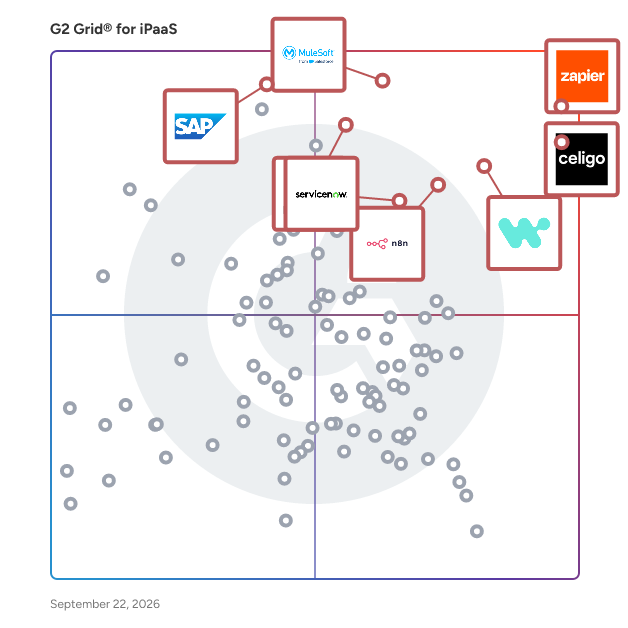
- **G2 Score:** The G2 Score is a weighted 0–100 index that combines User Satisfaction and Market Presence into a single benchmark. It forms the basis for each iPaaS product’s position in G2’s Grid® Reports and allows software buyers to compare tools through a balanced lens of qualitative experience and quantitative reach. ([_Source 2_](https://documentation.g2.com/docs/research-scoring-methodologies))

### iPaaS software pricing and cost considerations

iPaaS software pricing differs based on provider, product depth, infrastructure requirements, and usage complexity. Typical pricing tiers include:

- **Free tier:** Entry-level plans at no cost, often designed for small teams testing limited integrations or managing lightweight workflows.
- **Standard and mid-market tiers:** More robust functionality with scalable pricing structures that may depend on users, integrations, or data volume. These editions are designed for growing businesses looking to connect multiple systems and automate routine processes.
- **Enterprise-level tiers:** Full-featured plans offering advanced capabilities like custom API integrations, governance controls, higher throughput, and dedicated onboarding. These options are built for large organizations with complex environments and regulatory needs.

While some iPaaS platforms are priced per user, others follow consumption-based pricing, factoring in metrics like the number of connectors, integration tasks, or API calls. G2 data from 13 iPaaS software editions shows an average annual license cost of $558.41, with paid plans starting at just $9.60 per year. High-end solutions may reach up to $1,560 annually, depending on configuration and usage requirements. Several vendors also offer free versions with limited features.

Buyers should assess total cost considerations beyond license fees, such as integration development time, setup resources, support levels, and ongoing training. For hybrid environments or highly customized implementations, the need for additional IT staffing or professional services may also impact overall cost.

### Types of iPaaS software on G2

iPaaS solutions on G2 fall into several distinct types, each built to address specific integration challenges and business requirements:

- **Application-centric iPaaS:** These platforms connect widely used business systems such as CRM, ERP, and marketing automation tools. These solutions often overlap with application integration software, where users can automate workflows and eliminate manual data transfers between siloed platforms.
- **Data integration iPaaS:** Supports organizations handling large-scale data movement and transformation across analytics environments, data warehouses, and reporting tools. This category shares functionality with [ETL tools](https://www.g2.com/categories/etl-tools) and [data integration software](https://www.g2.com/categories/data-integration-tools), which are commonly used for consolidating customer or operational data from multiple sources.
- **API-focused iPaaS:** These are designed for developer-centric environments, enabling teams to build, publish, and manage APIs as part of their integration strategies. These tools frequently align with [API management solutions](https://www.g2.com/categories/api-management) and support organisations building extensible, microservice-based architectures.
- **Low-code/no-code iPaaS:** This platform makes integration accessible to non-technical users by offering drag-and-drop workflow builders and visual interface tools. It is often compared with products in [no-code development platforms](https://www.g2.com/categories/no-code-development-platforms) and [workflow automation](https://www.g2.com/categories/workflow-management), especially among small teams and business operations users.
- **Vertical-specific iPaaS solutions:** Address industry-level needs such as compliance, security, and domain-specific connectors. For example, [e-commerce integration software](https://www.g2.com/categories/e-commerce-data-integration) may benefit e-commerce teams, while finance departments may explore integration tools related to finance automation.
- **Enterprise-grade iPaaS:** These platforms serve complex, high-scale use cases involving multi-cloud infrastructure, custom development, and strict data governance. These solutions often intersect with adjacent categories like [cloud data integration](https://www.g2.com/categories/cloud-data-integration) and [master data management](https://www.g2.com/categories/master-data-management-mdm), where organizations require higher control and performance.

### Best iPaaS software features rated by G2 reviewers

Buyers evaluating iPaaS platforms on G2 can expect most leading solutions to include the following foundational capabilities:

- Reusable and [prebuilt connectors](https://www.g2.com/categories/ipaas/f/pre-built-connectors): Offers a library of pre-configured connectors and templates to simplify the process of linking commonly used applications. These built-in options reduce development time and promote faster deployment across systems.
- Visual flow designer: This tool enables users to build integration workflows through a visual interface with drag-and-drop functionality. It is especially useful for teams without coding expertise who need to automate processes quickly and intuitively.
- [Custom connector](https://www.g2.com/categories/ipaas/f/custom-connectors) Creation: For unique or less common systems, users can create custom connectors using existing APIs, enabling more tailored and flexible integration setups.
- [API design](https://www.g2.com/categories/ipaas/f/api-designer) and Testing Tools: Provides integrated tools to build, document, and test APIs within the platform itself. These capabilities support teams managing custom integrations or working with API-first architectures.
- Real-time integration support: Enables workflows to react instantly to events or data changes across systems. This helps maintain up-to-date records and supports time-sensitive business processes.
- Multi-tenant architecture: This architecture supports multiple users, departments, or business units on a shared infrastructure while keeping data securely segmented. It is ideal for large organizations with layered structures or external partners.

### Top iPaaS software benefits identified by G2 reviewers

Implementing an iPaaS solution effectively can enhance how organizations connect systems, automate workflows, and scale operations. Key advantages include:

**Flexibility, scalability, and expert support:** Users praise the ability to build complex automation with ease, supported by intuitive design and helpful customer success teams.

_“It’s an incredibly flexible and scalable platform that allows us to build tailored automation solutions with ease. The user-friendly interface makes it simple to work with, even for complex workflows. Additionally, the support from our Customer Success Manager has been fantastic! Whether it&#39;s setting up workshops or helping us refine our processes, they&#39;ve been instrumental in improving our ways of working.”-_ [_Christoffer A., Technical Implementation Engineer_](https://www.g2.com/products/workato/reviews/workato-review-10887783)_._

**Seamless integration between ERP, CRM, and e-commerce platforms:** iPaaS solutions are widely praised for connecting complex systems like NetSuite, Salesforce, and Shopify—allowing data to sync smoothly between storefronts, CRMs, and finance tools.

_“The tool’s integrator system is super helpful in getting all our Shopify &amp; Amazon orders into Netsuite properly. They also have amazing support, which has been a lifesaver as their app is very robust and complicated if you are new to middleware.”-_ [_Trey D., Senior Web Designer &amp; Shopify Expert_](https://www.g2.com/products/celigo/reviews/celigo-review-10885468)

**Quick automation of routine tasks with minimal setup:** Many users love how iPaaS tools handle repetitive tasks in the background—automating day-to-day processes with little configuration required.

_“What I appreciate most about the tool is its ease of use and intuitive interface. The most remarkable aspect is that you can build even very complex automation scenarios without any coding or development skills. This makes it a true game-changer for anyone looking to automate their workflows, regardless of their technical background.”–_ [_Luca R., Co-Founder_](https://www.g2.com/products/zapier/reviews/zapier-review-10849832)_&amp;nbsp;_

**Affordability and accessibility for small teams**

Some platforms stand out for making automation accessible to startups and small businesses without compromising on functionality.

_“Cost-effective and handles workflow integrations wel__l_.”[- Andrew R., ME](https://www.g2.com/products/albato/reviews/albato-review-10767774)

### Top iPaaS systems challenges identified by G2 reviewers

G2 user reviews reveal several recurring challenges associated with iPaaS platforms that can impact long-term success. While these tools are valued for their automation and integration capabilities, users have also flagged concerns around batch processing inefficiencies, complexity in interface logic, transparency of documentation, system limitations, and advanced workflow errors. Here&#39;s a breakdown of the most reported issues, with actionable ways to address them:

**1. Batch processing inefficiencies and overuse of tasks;** Reviewers mention that frequent task execution, particularly in batch processing, can result in higher costs or processing delays.

- **Essential questions to ask your iPaaS vendor:** How does your platform handle batch processing and task allocation? Are there controls to minimize unnecessary executions?
- **How to overcome the challenge:** Ask the vendor to walk you through task triggers and volume management. Choose platforms that allow conditional task logic and usage reporting to avoid task inflation.

**2. Unclear error messages and limited troubleshooting context:** Several users note that when workflows break, the system doesn’t always make it obvious what went wrong or how to fix it.

- **Essential questions to ask your iPaaS vendor:** Do your logs include detailed error messages and troubleshooting hints? Can errors trigger alerts or recommendations?
- **How to overcome the challenge:** Prioritize platforms with centralized error dashboards, detailed logs, and contextual help when failures occur.

**3. Performance lag or slowness during execution:** Some integrations experience delays when processing large amounts of data or handling high-traffic periods, slowing down business workflows.

- **Essential questions to ask your iPaaS vendor:** How does your platform handle large-volume data loads? Are there benchmarks or performance SLAs?
- **How to overcome the challenge:** Test your largest use cases during the trial period. Ask vendors for system capacity specs and examples from high-volume clients.

**4. User role confusion and limited permission management:** Users in larger organizations note that it&#39;s difficult to assign the right level of access or manage role-based permissions effectively.

- **&amp;nbsp;Essential questions to ask your iPaaS vendor:** Does your platform offer granular role-based access control? Can roles be customized across departments?
- &amp;nbsp; **How to overcome the challenge:** Request a demo of the permissions module. Ensure your vendor supports audit logging and access restrictions for sensitive workflows.

### What is iPaaS software used for?

Insights from iPaaS user reviews highlight several core business applications:

- **Automating cross-platform workflows:** Companies use iPaaS tools to replace manual handoffs between software systems. Reviewers describe setting up event-based automation that triggers actions across tools without human involvement.
- **Linking back-end systems with customer-facing platforms:** iPaaS software helps bridge operational systems like ERPs with e-commerce and CRM platforms. Users often reference use cases where order data, customer info, or billing details are automatically synced between tools like Shopify, NetSuite, and Salesforce.
- **Maintaining consistent records across tools:** Organizations rely on iPaaS to keep multiple systems in sync—ensuring that customer, employee, or financial data stays accurate as it moves between departments or business units.
- **Enabling teams to manage integrations independently:** Many reviews mention that business users outside of IT, such as those in operations or finance, can set up and manage integrations through visual interfaces, reducing dependency on developers.
- **Standardizing internal processes across departments:** iPaaS platforms help unify data flow between different tools used across teams, minimizing disconnects and streamlining how information is shared and processed company-wide.

### Who uses iPaaS solutions?

Users of iPaaS platforms come from a variety of professional backgrounds, often playing key roles in managing digital operations, automation strategies, or cross-platform integrations. G2 review data shows that frequent users include individuals in leadership and growth roles, such as founders, company heads, marketing leads, and business owners. These users are typically involved in shaping system workflows or improving operational efficiency across departments.

The software is especially common among companies operating in dynamic, tool-heavy environments. Prominent industries include digital marketing, SaaS development, IT consulting, retail commerce, and financial technology. These organizations often depend on multiple platforms to run day-to-day operations and turn to iPaaS solutions to connect them with minimal technical overhead.

### Common iPaaS software integrations

Our analysis of G2 user reviews surfaced key software categories that are frequently integrated through iPaaS platforms to streamline operations, reduce manual work, and unify business systems:

- **Enterprise resource planning (ERP) systems:** [ERP](https://www.g2.com/categories/erp-systems) integrations allow companies to automate the exchange of data related to orders, inventory, and billing, reducing manual intervention and improving cross-departmental coordination.
- **Customer relationship management (CRM) platforms:** Integrating iPaaS with [CRM software](https://www.g2.com/categories/crm) helps businesses synchronize contact records, deal updates, and customer activity across sales and support platforms, ensuring consistency across the customer lifecycle.&amp;nbsp;
- **E-commerce platforms and online storefronts:** Retail businesses integrate iPaaS with [e-commerce platforms](https://www.g2.com/categories/e-commerce-platforms) to automate order syncing, update inventory in real-time, and manage fulfilment workflows without manual effort.
- **Accounting platforms:** Many users integrate [accounting software](https://www.g2.com/categories/accounting) to automatically sync invoices, payments, and revenue records across finance, sales, and operations. View products in the Accounting Software category.
- **Marketing automation tools:** Integrating iPaaS with [marketing automation software](https://www.g2.com/categories/marketing-automation) supports real-time syncing of campaign data, audience segments, and lead intelligence across marketing and CRM systems.
- **Project and task management systems:** iPaaS users commonly connect with [project management software](https://www.g2.com/categories/project-management) to route tasks, update statuses, and align project workflows across product, support, and engineering teams.
- **Spreadsheets and reporting tools:** Integrations with [spreadsheet tools](https://www.g2.com/categories/spreadsheets) allow teams to feed data into reports, build dashboards, or log key events without manual data entry.

### Future of iPaaS software

The Integration Platform as a Service (iPaaS) landscape is evolving rapidly as businesses increase their reliance on digital tools, cloud infrastructure, and automation. Based on recent market analysis and expert commentary, several key trends are shaping the future of iPaaS:

- **Wider adoption of AI and machine learning:** Modern iPaaS platforms are beginning to embed AI and ML capabilities to enhance data mapping, error detection, and process optimization. These technologies can identify patterns in integration workflows and suggest automation opportunities, enabling smarter and more proactive integration management **.** ([_Source 3_](https://www.aonflow.com/blog/the-future-of-ipaas-trends-and-predictions-for-2024-and-beyond/))
- **The rise of low-code and no-code integration tools:** As businesses aim to democratize integration development, iPaaS vendors are increasingly offering low-code or no-code tools. These features allow business users to create integrations using visual interfaces, reducing reliance on developers and speeding up deployment. ([_Source 3_](https://www.aonflow.com/blog/the-future-of-ipaas-trends-and-predictions-for-2024-and-beyond/))
- **Support for hybrid and multi-cloud environments:** With the shift toward distributed IT infrastructure, organizations are embracing hybrid and multi-cloud strategies. iPaaS platforms are evolving to provide flexible deployment options, supporting data and process flows across various cloud providers and on-prem systems. ([_Source 4_](https://blog.tbrc.info/2025/03/ipaas-market-size-2/))
- **Enhanced focus on security and compliance:** Data protection remains a top priority for businesses integrating across platforms. iPaaS vendors are strengthening their offerings with built-in encryption, identity management, and compliance frameworks to meet standards like GDPR, HIPAA, and SOC 2. ([_Source 3_](https://www.aonflow.com/blog/the-future-of-ipaas-trends-and-predictions-for-2024-and-beyond/))

### Sources

1. [Integration Platform as a Service Market](https://www.marketsandmarkets.com/Market-Reports/integration-platform-as-a-service-market-134216323.html), Markets And Markets
2. G2 reviews data: Rankings in this guide are based on feedback from verified G2 users—people with direct experience using the software. Each product is evaluated using three core factors: user satisfaction scores, market presence, and real-time popularity. Only reviews published within the past 12 months are considered to ensure the data reflects current user sentiment. For a complete overview of the scoring process, see [G2’s full scoring methodology](https://documentation.g2.com/docs/research-scoring-methodologies).
3. [The Future of iPaaS: Trends and Predictions for 2024 and Beyond](https://www.aonflow.com/blog/the-future-of-ipaas-trends-and-predictions-for-2024-and-beyond/), Aonflow
4. [**Latest Global Market Insights**](https://blog.tbrc.info/2025/03/ipaas-market-size-2/), The Business Research Company