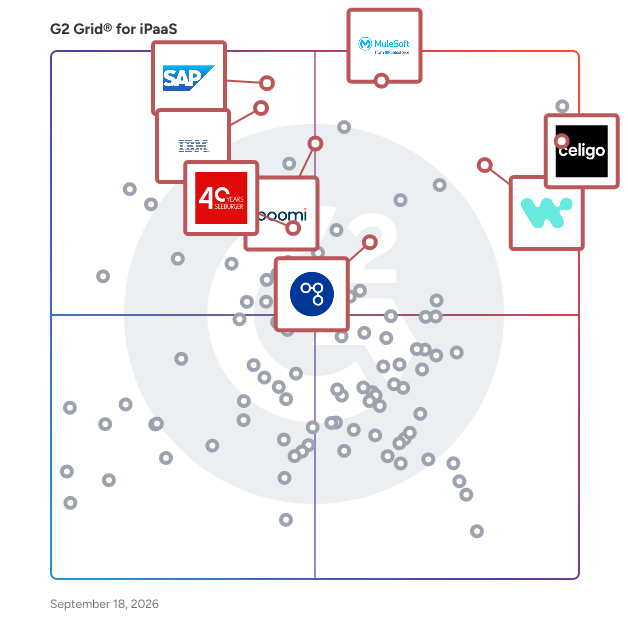
  # Best iPaaS Software for Small Business - Page 2

  *By [Shalaka Joshi](https://research.g2.com/insights/author/shalaka-joshi)*

   Products classified in the overall iPaaS category are similar in many regards and help companies of all sizes solve their business problems. However, small business features, pricing, setup, and installation differ from businesses of other sizes, which is why we match buyers to the right Small Business iPaaS to fit their needs. Compare product ratings based on reviews from enterprise users or connect with one of G2&#39;s buying advisors to find the right solutions within the Small Business iPaaS category.

In addition to qualifying for inclusion in the iPaaS Software category, to qualify for inclusion in the Small Business iPaaS Software category, a product must have at least 10 reviews left by a reviewer from a small business.


    ---
## What Are the Most Common Questions About iPaaS Software?
*AI-generated · Last updated: May 26, 2026*
  ### Which iPaaS is best for linking my business apps together?
  Based on G2 reviews, [Zapier](https://www.g2.com/products/zapier) stands out most often for linking business apps together because verified users repeatedly describe it as the bridge between tools that do not natively connect. According to verified users, it helps automate repetitive work, sync data across teams, and connect marketing, CRM, spreadsheets, calendars, support tools, and notifications without heavy coding. G2 reviewers mention that it is approachable for beginners while still supporting more advanced workflows, filters, webhooks, and multi-step automations. Common benefits include less manual entry, faster handoffs, and smoother information flow across business systems, though some reviewers note that more advanced setups can take time to troubleshoot.


  ### What leading iPaaS providers for app integrations?
  Based on G2 reviews, buyers evaluating leading iPaaS providers for app integrations often focus on products that reduce manual work, connect many business systems, and support a mix of ease of use and flexibility. According to verified users, Zapier is frequently praised for connecting everyday business apps and automating repetitive tasks without requiring deep technical resources. G2 reviewers also mention Celigo for ERP and ecommerce integrations, especially where NetSuite, Shopify, and Salesforce need to stay in sync. Workato is highlighted for low-code recipe building and broad connector coverage, while MuleSoft Anypoint Platform is commonly associated with larger API-led integration programs. Reviewers generally compare these tools on usability, troubleshooting, scalability, and how well they fit existing workflows.

**Here are some of the top-rated products on G2:**

- [Zapier](https://www.g2.com/products/zapier) – often used to connect everyday business apps and automate repetitive cross-platform tasks
- [Celigo](https://www.g2.com/products/celigo) – commonly used for ERP, ecommerce, and custom flow integrations with less manual work
- [Workato](https://www.g2.com/products/workato) – suited to low-code workflow automation across enterprise apps and business processes


  ### What what&#39;s the top iPaaS for automating software workflows?
  Based on G2 reviews, buyers looking for a top iPaaS for automating software workflows consistently mention automation depth, app coverage, and ease of setup. According to verified users, Zapier is widely used to automate repetitive tasks such as moving data between CRM, forms, spreadsheets, calendars, help desks, and marketing tools. G2 reviewers mention that it helps teams reduce manual work, improve consistency, and create multi-step workflows without needing custom APIs for every process. At the same time, some reviews note a learning curve when workflows become more complex or highly interconnected. Overall, recent feedback most often centers on workflow automation speed, broad integration support, and the ability to keep business processes running with less hands-on effort.

**Here are some of the top-rated products on G2:**

- [Zapier](https://www.g2.com/products/zapier) – frequently used to automate multi-step workflows across marketing, CRM, and productivity apps
- [Celigo](https://www.g2.com/products/celigo) – helpful for workflow automation tied to ERP, ecommerce, and order-related processes
- [Workato](https://www.g2.com/products/workato) – often chosen for low-code automation of end-to-end business workflows


  ### What best iPaaS for small business software integration?
  Based on G2 reviews, small businesses often prioritize fast setup, simple maintenance, and strong app coverage when choosing iPaaS software. According to verified users, Zapier is frequently described as useful for smaller teams because it helps connect common business apps, automate recurring tasks, and reduce manual work without requiring a large technical team. G2 reviewers mention benefits such as easier lead routing, client communication, intake automation, and syncing information between systems that otherwise would not connect. Some reviewers also say it helps lean teams maximize efficiency and save hours of administrative effort. While more advanced setups can become complex, recent feedback suggests it remains a practical option for small businesses needing broad integration support.

**Here are some of the top-rated products on G2:**

- [Zapier](https://www.g2.com/products/zapier) – useful for small teams automating intake, lead routing, reminders, and app-to-app syncing
- [Boomi](https://www.g2.com/products/boomi) – supports low-code integrations and data movement across business systems
- [Workato](https://www.g2.com/products/workato) – helps automate repetitive tasks and connect finance, CRM, and internal tools


  ### Which integration service is best for syncing business software?
  Based on G2 reviews, [Zapier](https://www.g2.com/products/zapier) is the product most often associated with syncing business software because reviewers repeatedly describe it as a practical way to move data between apps and keep workflows updated automatically. According to verified users, it helps connect systems that normally would not communicate, reduces manual entry, and keeps records consistent across marketing, CRM, reporting, and operational tools. G2 reviewers mention use cases such as syncing leads, updating spreadsheets, sending notifications, and passing information between platforms in the background. Buyers should note that while the core syncing experience is often seen as straightforward, some reviews mention that troubleshooting can become harder as workflows grow in complexity.


  ### What best platform for integrating various business apps?
  Based on G2 reviews, the best platform for integrating various business apps is usually the one that balances broad connector coverage with workflow flexibility. According to verified users, Zapier is often highlighted for connecting many day-to-day business tools and automating routine processes across teams. G2 reviewers mention that it is commonly used to connect CRM, spreadsheets, calendars, help desks, forms, marketing apps, and communication tools, helping businesses reduce repetitive work and improve consistency. Reviews also note that it supports both simpler automations and more advanced logic such as filters, branching, and webhooks. For buyers comparing iPaaS software, recent feedback suggests ease of setup and breadth of integrations are the main reasons it is often shortlisted.

**Here are some of the top-rated products on G2:**

- [Zapier](https://www.g2.com/products/zapier) – widely used for linking common business apps and automating everyday workflows
- [Workato](https://www.g2.com/products/workato) – supports cross-department automation with low-code recipe building
- [Boomi](https://www.g2.com/products/boomi) – useful for integrating enterprise apps, ERP systems, and data flows


  ### What best service for integrating multiple SaaS applications?
  Based on G2 reviews, a best service for integrating multiple SaaS applications should make it easier to connect cloud tools, automate updates, and reduce dependency on manual transfers. According to verified users, Zapier is commonly praised for connecting a wide range of SaaS products and helping information move smoothly between them. G2 reviewers mention automating tasks like syncing leads, moving records between apps, triggering notifications, and updating marketing or sales systems without custom coding for every handoff. Reviews also point to strong adoption among teams that need quick setup and dependable app-to-app workflows. Some users note that advanced, highly customized scenarios can still require extra care, but the overall recent sentiment emphasizes convenience and broad SaaS coverage.

**Here are some of the top-rated products on G2:**

- [Zapier](https://www.g2.com/products/zapier) – often used to connect multiple SaaS tools and automate routine updates between them
- [Workato](https://www.g2.com/products/workato) – supports end-to-end SaaS workflow automation with low-code recipes
- [Boomi](https://www.g2.com/products/boomi) – helps unify data and integrations across SaaS and enterprise applications


  ### What top-rated integration platforms for software apps?
  Based on G2 reviews, top-rated integration platforms for software apps are usually judged on how reliably they move data, connect systems, and simplify ongoing maintenance. According to verified users, Zapier is repeatedly cited for everyday app integrations and workflow automation, while Celigo is often associated with ERP and ecommerce scenarios that need more structured synchronization. G2 reviewers mention Workato for business process automation across departments, and MuleSoft Anypoint Platform for organizations that need broader API-led integration patterns. Reviewers consistently call out ease of implementation, app compatibility, troubleshooting experience, and long-term scalability as the main factors shaping satisfaction. For buyers researching iPaaS software, recent reviews suggest different tools stand out depending on workflow complexity and technical requirements.

**Here are some of the top-rated products on G2:**

- [Zapier](https://www.g2.com/products/zapier) – well suited for software app integrations that reduce repetitive manual work
- [Celigo](https://www.g2.com/products/celigo) – frequently used for connecting ERP, ecommerce, and business application data
- [MuleSoft Anypoint Platform](https://www.g2.com/products/mulesoft-anypoint-platform) – favored for API-led integrations across complex enterprise systems


  ### What best-reviewed iPaaS for enterprise app integration?
  Based on G2 reviews, enterprise app integration buyers often emphasize governance, scalability, and the ability to connect many systems without creating point-to-point complexity. According to verified users, MuleSoft Anypoint Platform is frequently associated with enterprise integration because reviewers highlight reusable APIs, centralized governance, monitoring, and support for integrating legacy and modern systems. G2 reviewers mention strengths such as API lifecycle coverage, secure deployment options, and reusable assets that improve consistency across projects. At the same time, some reviews note that setup complexity and learning curve can be higher than with lighter-weight tools. Overall, recent verified feedback positions it as a strong fit for organizations needing structured enterprise-grade integration rather than only simple app automation.

**Here are some of the top-rated products on G2:**

- [MuleSoft Anypoint Platform](https://www.g2.com/products/mulesoft-anypoint-platform) – designed for API-led enterprise integrations across legacy, cloud, and modern systems
- [Boomi](https://www.g2.com/products/boomi) – supports enterprise app integration with low-code process building and broad connectors
- [Workato](https://www.g2.com/products/workato) – used for automating enterprise workflows and connecting department-level systems


  ### What most reliable iPaaS solutions for medium-sized businesses?
  Based on G2 reviews, medium-sized businesses often look for iPaaS software that is dependable, manageable without a huge integration team, and broad enough to support future growth. According to verified users, Zapier is often seen as reliable for keeping common business apps connected and reducing manual work, especially for teams that need quick wins. G2 reviewers also mention Boomi for stable runtime and app integration across growing organizations, while Celigo is noted for dependable ERP and ecommerce-related workflows. Reliability in recent reviews usually comes down to smooth background processing, easier troubleshooting, and fewer manual handoffs. Buyers evaluating options should match the platform’s strength to their environment, whether that is app automation, ERP synchronization, or broader business process integration.

**Here are some of the top-rated products on G2:**

- [Zapier](https://www.g2.com/products/zapier) – reliable for medium-sized teams connecting everyday business tools and automating routine tasks
- [Boomi](https://www.g2.com/products/boomi) – recognized for stable integrations and runtime support across business systems
- [Celigo](https://www.g2.com/products/celigo) – dependable for syncing ERP, ecommerce, and operational workflows with less manual effort


## How Many iPaaS Software Products Does G2 Track?
**Total Products under this Category:** 313

### Category Stats (Jun 2026)
- **Average Rating**: 4.52/5 (↓0.01 vs May 2026) The average rating of products in this category, based on all submitted ratings
- **New Reviews This Quarter**: 527
- **Buyer Segments**: Small-Business 49% │ Mid-Market 35% │ Enterprise 16% Represents the distribution of reviewers across all products in this category.
- **Top Trending Product**: Microsoft D365FO Connector for ADP Workforce Now® (+0.333) - Among all products in this category, Microsoft D365FO Connector for ADP Workforce Now® recorded the largest rating increase compared to last month
*Last updated: June 01, 2026*

  
## How Does G2 Rank iPaaS Software Products?

**Why You Can Trust G2's Software Rankings:**

- 30 Analysts and Data Experts
- 28,100+ Authentic Reviews
- 313+ Products
- Unbiased Rankings

G2's software rankings are built on verified user reviews, rigorous moderation, and a consistent research methodology maintained by a team of analysts and data experts. Each product is measured using the same transparent criteria, with no paid placement or vendor influence. While reviews reflect real user experiences, which can be subjective, they offer valuable insight into how software performs in the hands of professionals. Together, these inputs power the G2 Score, a standardized way to compare tools within every category.


---

**Sponsored**

### Omatic Software

Omatic Cloud is the nonprofit integration and data platform, built for everyday nonprofit users by nonprofit professionals who understand your workflows. Nonprofits juggle more systems than ever, creating data inconsistencies across systems. By supporting workflows across fundraising, program management, and financial reporting, Omatic Cloud helps you unlock the power of data to inform decisions, engage supporters, and scale your mission. Omatic Cloud provides: - App connectors for nonprofit tools - Bulk data imports (flat files) into CRM &amp; accounting tools - Data transformation - Data mapping &amp; routing - Data validation &amp; deduplication - And much more! Omatic is backed by a world-class support team, providing hands-on implementation &amp; training to help you get integrations live. Founded in 2002 and headquartered in Charleston, SC, we serve more than 3k social impact customers across Healthcare, Cause &amp; Cure, Higher Ed, K-12, Family &amp; Human Services, Arts &amp; Cultural, and Faith-Based Orgs.


[Visit website](https://www.g2.com/external_clickthroughs/record?secure%5Bad_program%5D=ppc&amp;secure%5Bad_slot%5D=category_product_list&amp;secure%5Bcategory_id%5D=1182&amp;secure%5Bdisplayable_resource_id%5D=1182&amp;secure%5Bdisplayable_resource_type%5D=Category&amp;secure%5Bmedium%5D=sponsored&amp;secure%5Bplacement_reason%5D=page_category&amp;secure%5Bplacement_resource_ids%5D%5B%5D=1182&amp;secure%5Bprioritized%5D=false&amp;secure%5Bproduct_id%5D=42995&amp;secure%5Bresource_id%5D=1182&amp;secure%5Bresource_type%5D=Category&amp;secure%5Bsource_type%5D=category_page&amp;secure%5Bsource_url%5D=https%3A%2F%2Fwww.g2.com%2Fcategories%2Fipaas%2Fenterprise&amp;secure%5Btoken%5D=168f779a8163ec5fb1bdbb74f27fec47301fc8ebc223b9c9dd3ea82fd195602f&amp;secure%5Burl%5D=https%3A%2F%2Fomaticsoftware.com%2F%3Futm_source%3Dreview-site%26utm_medium%3Dg2%26utm_campaign%3Dpaid&amp;secure%5Burl_type%5D=custom_url)

---

    
## iPaaS Software Features & Capabilities

### What are the Best iPaaS Software with EDI?
Provides Integrations to EDI service providers.

**Top-rated iPaaS Software for EDI:**
- [Zapier](https://www.g2.com/products/zapier/reviews)
- [Celigo](https://www.g2.com/products/celigo/reviews)
- [Workato](https://www.g2.com/products/workato/reviews)
[Explore iPaaS Software with EDI](https://www.g2.com/categories/ipaas/f/edi)

### What are the Best iPaaS Software with Security Standards?
Comply to key industry standards like SOC 2, ISO 27001, PCI DSS, HIPAA etc to protect and safeguard data.

**Top-rated iPaaS Software for Security Standards:**
- [Zapier](https://www.g2.com/products/zapier/reviews)
- [Celigo](https://www.g2.com/products/celigo/reviews)
- [Workato](https://www.g2.com/products/workato/reviews)
[Explore iPaaS Software with Security Standards](https://www.g2.com/categories/ipaas/f/security-standards)

### What are the Best iPaaS Software with Hybrid?
Supports deployment of integration apps both on-premisis and cloud environments/

**Top-rated iPaaS Software for Hybrid:**
- [n8n](https://www.g2.com/products/n8n/reviews)
- [Boomi](https://www.g2.com/products/boomi/reviews)
- [IBM webMethods Hybrid Integration](https://www.g2.com/products/ibm-webmethods-hybrid-integration-2025-12-05/reviews)
[Explore iPaaS Software with Hybrid](https://www.g2.com/categories/ipaas/f/hybrid)

### What are the Best iPaaS Software with Custom Connectors?
Provides the ability to create connectors from existing services and APIs in catalog.

**Top-rated iPaaS Software for Custom Connectors:**
- [Zapier](https://www.g2.com/products/zapier/reviews)
- [Celigo](https://www.g2.com/products/celigo/reviews)
- [Workato](https://www.g2.com/products/workato/reviews)
[Explore iPaaS Software with Custom Connectors](https://www.g2.com/categories/ipaas/f/custom-connectors)

### What are the Best iPaaS Software with Reusable connectors?
Provides prebuilt, reusable connectors and workflows for all user integration requirements.

**Top-rated iPaaS Software for Reusable connectors:**
- [Zapier](https://www.g2.com/products/zapier/reviews)
- [Celigo](https://www.g2.com/products/celigo/reviews)
- [n8n](https://www.g2.com/products/n8n/reviews)
[Explore iPaaS Software with Reusable connectors](https://www.g2.com/categories/ipaas/f/reusable-connectors)


  ## What Are the Top-Rated iPaaS Software Products in 2026?
### 1. [hotglue](https://www.g2.com/products/hotglue/reviews)
  hotglue is a developer-first embedded iPaaS founded by engineers to help B2B SaaS companies like Chargebee, Instructure, and SpotOn offer integrations in their product with other platforms. Based out of Washington DC, our team focuses on providing robust integration solutions that developers actually want to use. Our platform offers pre-built connectors to hundreds of SaaS applications (like Salesforce, NetSuite, Quickbooks, and more) while maintaining code-level control, custom transformations, and complete white-labeling capabilities. We handle the authentication, infrastructure, and connection UI while giving developers the flexibility they need. hotglue transforms integrations from engineering challenges into sales advantages for early-stage B2B SaaS companies. We enable teams to rapidly deploy customer-facing integrations that feel native to your product, helping close deals faster with significantly less engineering effort.


  **Average Rating:** 4.9/5.0
  **Total Reviews:** 34
**How Do G2 Users Rate hotglue?**

- **Has the product been a good partner in doing business?:** 9.9/10 (Category avg: 9.1/10)
- **API Management:** 9.8/10 (Category avg: 8.7/10)
- **Reusable connectors:** 9.6/10 (Category avg: 8.9/10)
- **Cloud to Cloud:** 9.3/10 (Category avg: 8.9/10)

**Who Is the Company Behind hotglue?**

- **Seller:** [hotglue](https://www.g2.com/sellers/hotglue)
- **Company Website:** https://hotglue.com/
- **Year Founded:** 2019
- **HQ Location:** Washington , US
- **Twitter:** @hotgluexyz (120 Twitter followers)
- **LinkedIn® Page:** https://www.linkedin.com/company/hotglue/ (20 employees on LinkedIn®)

**Who Uses This Product?**
  - **Who Uses This:** CTO
  - **Top Industries:** Computer Software
  - **Company Size:** 94% Small-Business, 3% Enterprise


#### What Are hotglue's Pros and Cons?

**Pros:**

- Integration Capabilities (8 reviews)
- Integrations (7 reviews)
- Customer Support (6 reviews)
- Easy Integrations (6 reviews)
- Implementation Ease (5 reviews)

**Cons:**

- Difficult Configuration (2 reviews)
- Poor Documentation (2 reviews)
- Complex Interface (1 reviews)
- Complexity Issues (1 reviews)
- Complex Onboarding (1 reviews)

### 2. [Robocorp](https://www.g2.com/products/robocorp/reviews)
  Developers from hobbyist to enterprise operators use Robocorp to build and operate Python workers that run seamlessly anywhere at any scale.


  **Average Rating:** 4.6/5.0
  **Total Reviews:** 187
**How Do G2 Users Rate Robocorp?**

- **Has the product been a good partner in doing business?:** 9.3/10 (Category avg: 9.1/10)
- **API Management:** 5.0/10 (Category avg: 8.7/10)
- **Reusable connectors:** 6.7/10 (Category avg: 8.9/10)
- **Cloud to Cloud:** 6.7/10 (Category avg: 8.9/10)

**Who Is the Company Behind Robocorp?**

- **Seller:** [Robocorp](https://www.g2.com/sellers/robocorp)
- **Year Founded:** 2019
- **HQ Location:** San Francisco, US
- **Twitter:** @RobocorpInc (1,388 Twitter followers)
- **LinkedIn® Page:** https://www.linkedin.com/company/robocorp/ (10 employees on LinkedIn®)

**Who Uses This Product?**
  - **Who Uses This:** Software Engineer, RPA Developer
  - **Top Industries:** Information Technology and Services, Computer Software
  - **Company Size:** 42% Small-Business, 31% Enterprise


#### What Are Robocorp's Pros and Cons?

**Pros:**

- Automation (1 reviews)
- Automation Ease (1 reviews)
- Automation Features (1 reviews)
- Ease of Use (1 reviews)
- Flexibility (1 reviews)

**Cons:**

- Expensive (1 reviews)
- Limited Features (1 reviews)
- Missing Features (1 reviews)
- Performance Issues (1 reviews)

### 3. [MuleSoft Anypoint Platform](https://www.g2.com/products/mulesoft-anypoint-platform/reviews)
  MuleSoft Anypoint Platform is the industry-leading integration and governance solution designed to connect any application, API, and AI agent across hybrid and multi-cloud environments. For nearly two decades, we have served as the integration backbone for the world’s most complex enterprises. Today, we are extending to the AI era. We allow organizations to move beyond AI sprawl into a unified architecture where legacy systems, modern APIs, and autonomous agents interact securely on a single, trusted foundation. Key capabilities and components include: Hybrid integration and connectivity, utilizing a library of hundreds of pre-built connectors and support for new AI protocols like MCP and A2A to provide AI agents with the tools they need to access and act within legacy ERPs, CRMs, and on-premise databases. MuleSoft Agent Fabric: Unified API and agent governance, applying the same rigorous security policies, cost controls, and traffic enforcement to AI models and agents that organizations already trust for their global API ecosystems through a single, federated control plane. Fabric also includes agent visibility and registry, offering a single source of truth to discover and observe any cross-ecosystem agent, ensuring complete transparency and the elimination of shadow AI. MuleSoft Vibes: Natural language design and management, providing a revamped experience where teams can use native natural language prompts to scaffold integrations, manage lifecycles, and stay ahead of technical sprawl using the AI tools they already prefer. Trusted runtime and compliance, delivering a fully managed, hybrid, or on-prem foundation that has been proven at scale for years, ensuring that every interaction is backed by enterprise-grade monitoring and human-in-the-loop security. Overall, MuleSoft Anypoint Platform is the enterprise platform for organizations seeking to bring visibility, trust, and orchestration to their APIs and AI agents.


  **Average Rating:** 4.5/5.0
  **Total Reviews:** 646
**How Do G2 Users Rate MuleSoft Anypoint Platform?**

- **Has the product been a good partner in doing business?:** 8.8/10 (Category avg: 9.1/10)
- **API Management:** 9.6/10 (Category avg: 8.7/10)
- **Reusable connectors:** 9.0/10 (Category avg: 8.9/10)
- **Cloud to Cloud:** 9.1/10 (Category avg: 8.9/10)

**Who Is the Company Behind MuleSoft Anypoint Platform?**

- **Seller:** [Salesforce](https://www.g2.com/sellers/salesforce)
- **Company Website:** https://www.salesforce.com/
- **Year Founded:** 1999
- **HQ Location:** San Francisco, CA
- **Twitter:** @salesforce (580,421 Twitter followers)
- **LinkedIn® Page:** https://www.linkedin.com/company/3185/ (83,223 employees on LinkedIn®)

**Who Uses This Product?**
  - **Who Uses This:** Software Engineer, Senior Software Engineer
  - **Top Industries:** Information Technology and Services, Computer Software
  - **Company Size:** 57% Enterprise, 31% Mid-Market


#### What Are MuleSoft Anypoint Platform's Pros and Cons?

**Pros:**

- Ease of Use (113 reviews)
- Integration Capabilities (101 reviews)
- Integrations (99 reviews)
- API Management (96 reviews)
- Easy Integrations (92 reviews)

**Cons:**

- Expensive (57 reviews)
- Pricing Issues (38 reviews)
- Learning Curve (31 reviews)
- Learning Difficulty (29 reviews)
- Steep Learning Curve (26 reviews)

### 4. [MindCloud](https://www.g2.com/products/mindcloud/reviews)
  MindCloud is an enterprise-grade integration platform as a service (iPaaS) that enables organizations to streamline, automate, and scale mission-critical business processes. By leveraging modern APIs, prebuilt connectors, and a user-friendly no-code interface, MindCloud simplifies software integration and removes the traditional trade-off between powerful functionality and ease of use. The platform provides secure, reliable connectivity across CRM, ERP, HRIS, accounting, and other operational systems, allowing teams to orchestrate complex workflows and unify data without extensive engineering resources. With MindCloud, organizations can synchronize data in real time, automate cross-application workflows, and standardize API-driven processes across their technology stack. Common use cases include financial and accounting automation, employee onboarding across HR and payroll systems, e-commerce and fulfillment integrations, and unified customer data management supporting sales, service, and marketing operations. The platform’s flexible design makes it ideal for both straightforward integrations and large-scale digital transformation initiatives. For organizations seeking additional support, MindCloud provides a fully managed, white-glove integration service that includes scoping, architectural design, implementation, monitoring, and ongoing optimization. This ensures reliable execution and reduces operational overhead, allowing internal teams to focus on high-value strategic work rather than troubleshooting complex data workflows. MindCloud’s modern architecture is built to scale alongside evolving enterprise environments. AI-assisted features automatically surface insights, optimize performance, and mitigate operational risks, while preconfigured connectors accelerate deployment timelines and reduce development costs. By prioritizing reliability, adaptability, security, and ease of use, MindCloud empowers organizations to manage, monitor, and evolve critical integrations effectively—from initial setup through long-term operations—making it a comprehensive solution for enterprise integration and automation.


  **Average Rating:** 4.9/5.0
  **Total Reviews:** 51
**How Do G2 Users Rate MindCloud?**

- **Has the product been a good partner in doing business?:** 9.6/10 (Category avg: 9.1/10)
- **API Management:** 9.2/10 (Category avg: 8.7/10)
- **Reusable connectors:** 9.0/10 (Category avg: 8.9/10)
- **Cloud to Cloud:** 8.9/10 (Category avg: 8.9/10)

**Who Is the Company Behind MindCloud?**

- **Seller:** [MindCloud](https://www.g2.com/sellers/mindcloud)
- **Company Website:** https://mindcloud.co/
- **Year Founded:** 2021
- **HQ Location:** Clearwater, US
- **LinkedIn® Page:** https://www.linkedin.com/company/yourmindcloud/ (66 employees on LinkedIn®)

**Who Uses This Product?**
  - **Top Industries:** Manufacturing
  - **Company Size:** 53% Small-Business, 37% Mid-Market


#### What Are MindCloud's Pros and Cons?

**Pros:**

- Customer Support (28 reviews)
- Integration Capabilities (27 reviews)
- Integrations (23 reviews)
- Easy Integrations (20 reviews)
- Ease of Use (19 reviews)

**Cons:**

- Learning Curve (5 reviews)
- Learning Difficulty (5 reviews)
- Difficult Learning (4 reviews)
- Difficult Setup (4 reviews)
- Poor Customer Support (4 reviews)

### 5. [Jitterbit](https://www.g2.com/products/jitterbit/reviews)
  For organizations ready to modernize and innovate, Jitterbit provides a unified AI-infused low-code platform for integration, orchestration, automation, and app development that accelerates business transformation, boosts productivity, and unlocks value. The Jitterbit Harmony platform, including iPaaS, API Manager, App Builder, and EDI, future-proofs operations, simplifies complexity, and drives innovation for organizations globally.


  **Average Rating:** 4.5/5.0
  **Total Reviews:** 586
**How Do G2 Users Rate Jitterbit?**

- **Has the product been a good partner in doing business?:** 9.2/10 (Category avg: 9.1/10)
- **API Management:** 8.2/10 (Category avg: 8.7/10)
- **Reusable connectors:** 8.5/10 (Category avg: 8.9/10)
- **Cloud to Cloud:** 8.6/10 (Category avg: 8.9/10)

**Who Is the Company Behind Jitterbit?**

- **Seller:** [Jitterbit](https://www.g2.com/sellers/jitterbit)
- **Company Website:** https://www.jitterbit.com
- **Year Founded:** 2003
- **HQ Location:** Alameda, CA
- **Twitter:** @jitterbit (3,661 Twitter followers)
- **LinkedIn® Page:** https://www.linkedin.com/company/695546/ (432 employees on LinkedIn®)

**Who Uses This Product?**
  - **Who Uses This:** IT Manager, CEO
  - **Top Industries:** Information Technology and Services, Computer Software
  - **Company Size:** 51% Mid-Market, 25% Enterprise


#### What Are Jitterbit's Pros and Cons?

**Pros:**

- Ease of Use (26 reviews)
- Customer Support (20 reviews)
- Integrations (17 reviews)
- Easy Integrations (15 reviews)
- Integration (15 reviews)

**Cons:**

- Missing Features (14 reviews)
- Learning Curve (11 reviews)
- Integration Issues (8 reviews)
- Complexity (7 reviews)
- Slow Performance (7 reviews)

### 6. [Alloy Automation](https://www.g2.com/products/alloy-alloy-automation/reviews)
  The Agentic AI Infrastructure Platform for Product and Engineering Teams Alloy Automation helps product and engineering teams power real-world AI capabilities by connecting their agents and applications to hundreds of critical business systems through the Model Context Protocol (MCP) and Connectivity API (CAPI). Together, they form the foundation of Alloy’s agentic infrastructure — enabling secure, context-aware, and scalable access to data and actions across every part of your tech stack. Connectivity API (CAPI) provides unified, programmatic access to over 400 SaaS, fintech, commerce, and ERP systems. It standardizes integration complexity through a single, reliable API that handles OAuth, schema mapping, retries, versioning, and monitoring — so developers can move faster without reinventing the wheel. With CAPI, you can embed real-time data flows and bi-directional sync into your product or agent framework in days instead of months. The Model Context Protocol (MCP) Registry allows teams to create and host MCP servers that bridge AI agents with real-world systems. Each MCP server provides secure, remote-hosted access to tools and data sources with built-in permissioning, authentication, and contextual metadata. Agents can discover, interpret, and execute tasks across connected systems — from CRMs and ERPs to payment and fulfillment platforms — all through a standardized, agent-native interface. Alloy also includes real-time monitoring and observability, offering full visibility into execution logs, data flow reliability, and performance across integrations and agentic actions. Optional headless UI components make it easy to embed agent or integration experiences directly into your product for a seamless, branded experience. Leading SaaS and enterprise companies — including Typeform, Xero, Mastercard, and UPS — rely on Alloy to accelerate their integration roadmaps, reduce engineering overhead, and enable AI agents to take meaningful, real-world action. Whether you’re enabling an AI agent to automate customer onboarding, trigger payments, or reconcile data, Alloy helps you go live in weeks instead of quarters.


  **Average Rating:** 4.7/5.0
  **Total Reviews:** 49
**How Do G2 Users Rate Alloy Automation?**

- **Has the product been a good partner in doing business?:** 9.8/10 (Category avg: 9.1/10)
- **API Management:** 9.1/10 (Category avg: 8.7/10)
- **Reusable connectors:** 8.9/10 (Category avg: 8.9/10)
- **Cloud to Cloud:** 8.9/10 (Category avg: 8.9/10)

**Who Is the Company Behind Alloy Automation?**

- **Seller:** [Alloy](https://www.g2.com/sellers/alloy-bf281c40-e363-4dcc-905e-10f2b5eb9c10)
- **Company Website:** https://runalloy.com/
- **Year Founded:** 2019
- **HQ Location:** New York, NY
- **LinkedIn® Page:** https://www.linkedin.com/company/alloy-automation/ (31 employees on LinkedIn®)

**Who Uses This Product?**
  - **Top Industries:** Computer Software, Information Technology and Services
  - **Company Size:** 51% Small-Business, 49% Mid-Market


#### What Are Alloy Automation's Pros and Cons?

**Pros:**

- Ease of Use (16 reviews)
- Customer Support (14 reviews)
- Easy Integrations (13 reviews)
- Integrations (11 reviews)
- Time-saving (7 reviews)

**Cons:**

- Difficult Setup (3 reviews)
- Learning Curve (3 reviews)
- Missing Features (3 reviews)
- Poor Integration (3 reviews)
- UI Design Issues (3 reviews)

### 7. [RudderStack](https://www.g2.com/products/rudderstack/reviews)
  RudderStack is the leading warehouse native CDP designed to help organizations efficiently collect, unify, and activate customer data across various channels. This end-to-end solution empowers data teams to streamline their data management processes, enabling businesses to leverage insights for growth and improved customer engagement. By integrating seamlessly with existing systems, RudderStack facilitates a comprehensive view of customer interactions, which is crucial for informed decision-making. Targeted primarily at data teams, RudderStack serves a diverse range of industries, including retail, finance, healthcare, media and technology. Its user-friendly interface and robust capabilities make it suitable for organizations looking to enhance their data strategy without the need for extensive technical expertise. Key features of RudderStack include its ability to integrate with various data sources and destinations, ensuring that organizations can centralize their customer data effectively. The platform supports a wide array of integrations with popular tools and services, allowing users to connect their existing tech stack effortlessly. Additionally, RudderStack offers advanced data transformation capabilities, enabling teams to clean and enrich their data before utilizing it for analytics or marketing campaigns. One of the standout benefits of RudderStack is its warehouse-native architecture, which allows businesses to store their customer data directly in their data warehouse. This approach not only enhances data security but also provides organizations with greater control over their data. By eliminating the need for third-party data storage solutions, RudderStack helps businesses reduce costs and improve data accessibility. Furthermore, the platform&#39;s flexibility allows for real-time data updates, ensuring that teams are always working with the most current information. Overall, RudderStack is a powerful tool for organizations aiming to harness the full potential of their customer data. With its comprehensive features and focus on unifying data from various sources, it stands out in the competitive landscape of customer data platforms, making it a valuable asset for businesses looking to drive growth and enhance customer experiences. Over 30,000 sites and apps run RudderStack including Crate &amp; Barrel, Foot Locker, Glassdoor, Stripe, Allbirds, and more. RudderStack acquired Blendo in 2020


  **Average Rating:** 4.7/5.0
  **Total Reviews:** 51
**How Do G2 Users Rate RudderStack?**

- **Has the product been a good partner in doing business?:** 9.5/10 (Category avg: 9.1/10)
- **API Management:** 7.5/10 (Category avg: 8.7/10)
- **Reusable connectors:** 9.2/10 (Category avg: 8.9/10)
- **Cloud to Cloud:** 10.0/10 (Category avg: 8.9/10)

**Who Is the Company Behind RudderStack?**

- **Seller:** [RudderStack](https://www.g2.com/sellers/rudderstack)
- **Company Website:** https://www.rudderstack.com
- **Year Founded:** 2019
- **HQ Location:** San Francisco, California
- **Twitter:** @RudderStack (1,692 Twitter followers)
- **LinkedIn® Page:** https://www.linkedin.com/company/rudderlabs/about (129 employees on LinkedIn®)

**Who Uses This Product?**
  - **Who Uses This:** Data Engineer
  - **Top Industries:** Computer Software, Information Technology and Services
  - **Company Size:** 54% Mid-Market, 46% Small-Business


#### What Are RudderStack's Pros and Cons?

**Pros:**

- Ease of Use (18 reviews)
- Customer Support (16 reviews)
- Easy Integration (11 reviews)
- Easy Setup (9 reviews)
- Easy Integrations (8 reviews)

**Cons:**

- Learning Curve (10 reviews)
- Limited Customization (5 reviews)
- Complexity (4 reviews)
- Insufficient Guidance (4 reviews)
- Onboarding Difficulties (4 reviews)

### 8. [IFTTT](https://www.g2.com/products/ifttt/reviews)
  Automate, save time, and get more done with IFTTT. Easily connect 1,000+ apps and devices to create time-saving workflows—no code required. Join a community of over 30 million creators, smart home enthusiasts, and small business owners that use IFTTT to save multiple hours out of a typical day. IFTTT’s simple no-code interface, combined with 1,000+ of today&#39;s most popular business, personal and smart home apps, allows you to quickly create sophisticated automations. Discover the power of automation while on the go with location based features, notifications and widgets. Download the mobile app for iOS and Android today. We offer a free plan, as well as a fully featured trial. How IFTTT works: IFTTT links two or more apps with automations called Applets. Choose a trigger, pick an action, and customize it to your needs. You can enable 100,000s of ready-made Applets or create your own in minutes. Key features: • Connect to 1,000+ apps, services, and devices: Integrate with Google Workspace, Microsoft 365, task management, calendar, and communication platforms. • Use IFTTT on the go: Our popular mobile apps for iOS and Android allow you to connect your apps to widgets, custom notifications to your phone, and location-based triggers. • Increase your productivity: Automations are easy to set up, personalize, and you can get started with your first Applet in minutes. Here are a few ideas to get you started: • Write once then cross post to multiple social networks • Connect and control every aspect of your smart home • Create and summarize content with IFTTT AI • Use IFTTT Location to trigger work and smart home automations • Automate even more apps with IFTTT Webhooks Links: • How to create your first Applet (automation): https://ifttt.com/explore/how-to-connect-your-first-applet • Help center: https://help.ifttt.com/hc/en-us • Top Applets on IFTTT: https://ifttt.com/explore/top-applets-on-ifttt


  **Average Rating:** 4.5/5.0
  **Total Reviews:** 116
**How Do G2 Users Rate IFTTT?**

- **Has the product been a good partner in doing business?:** 9.0/10 (Category avg: 9.1/10)
- **API Management:** 9.0/10 (Category avg: 8.7/10)
- **Reusable connectors:** 9.3/10 (Category avg: 8.9/10)
- **Cloud to Cloud:** 8.6/10 (Category avg: 8.9/10)

**Who Is the Company Behind IFTTT?**

- **Seller:** [IFTTT](https://www.g2.com/sellers/ifttt)
- **Year Founded:** 2010
- **HQ Location:** San Francisco, CA
- **Twitter:** @IFTTT (142,472 Twitter followers)
- **LinkedIn® Page:** https://www.linkedin.com/company/1785718/ (45 employees on LinkedIn®)

**Who Uses This Product?**
  - **Top Industries:** Marketing and Advertising, Information Technology and Services
  - **Company Size:** 71% Small-Business, 22% Mid-Market


#### What Are IFTTT's Pros and Cons?

**Pros:**

- Automation (2 reviews)
- Simple (2 reviews)
- Workflow Automation (2 reviews)
- Affordable (1 reviews)
- Analytics (1 reviews)

**Cons:**

- Limited Customization (2 reviews)
- Connection Issues (1 reviews)
- Connectivity Issues (1 reviews)
- Limited Features (1 reviews)

### 9. [Make](https://www.g2.com/products/integromat-by-celonis-make/reviews)
  Make is a leading visual AI automation platform. Make is the platform to build, manage, and scale all your automations and AI agents in one visual landscape. Connect 3,000+ apps, automate complex processes, create AI and agentic workflows, and use model context protocol (MCP) to scale your automations. Use the visual drag-and-drop scenario builder to link apps in a few clicks. Build limitless scenarios that run exactly the way your business needs them to. Make supports any app with an API, so it’s made to fit your tech stack. And with Make AI Agents, your scenarios don&#39;t just run – they adapt. Agentic automation lets AI-driven agents handle complex tasks, while responding to changing conditions in real time. Set your scenarios to run on a schedule, trigger them instantly, or watch them run live whenever you need full visibility into what&#39;s happening. Make’s transparent logic means you’ll be able to see, manage, and control your automations every step of the way.


  **Average Rating:** 4.6/5.0
  **Total Reviews:** 308
**How Do G2 Users Rate Make?**

- **Has the product been a good partner in doing business?:** 9.2/10 (Category avg: 9.1/10)
- **API Management:** 8.8/10 (Category avg: 8.7/10)
- **Reusable connectors:** 8.7/10 (Category avg: 8.9/10)
- **Cloud to Cloud:** 8.6/10 (Category avg: 8.9/10)

**Who Is the Company Behind Make?**

- **Seller:** [Integromat by Celonis](https://www.g2.com/sellers/integromat-by-celonis)
- **Company Website:** https://www.integromat.com
- **Year Founded:** 2012
- **HQ Location:** Praha 8, Prague
- **Twitter:** @integromat (646 Twitter followers)
- **LinkedIn® Page:** https://www.linkedin.com/company/10589855/ (13 employees on LinkedIn®)

**Who Uses This Product?**
  - **Who Uses This:** CEO, Founder
  - **Top Industries:** Marketing and Advertising, Computer Software
  - **Company Size:** 77% Small-Business, 18% Mid-Market


#### What Are Make's Pros and Cons?

**Pros:**

- Automation (22 reviews)
- Ease of Use (20 reviews)
- Easy Integrations (11 reviews)
- Features (9 reviews)
- Integrations (9 reviews)

**Cons:**

- Error Handling (7 reviews)
- Learning Curve (7 reviews)
- Learning Difficulty (6 reviews)
- Complexity (5 reviews)
- API Issues (4 reviews)

### 10. [SnapLogic Intelligent Integration Platform (IIP)](https://www.g2.com/products/snaplogic-intelligent-integration-platform-iip/reviews)
  The SnapLogic Platform is an agentic integration and automation solution designed to assist enterprise teams in connecting applications, data sources, and APIs while orchestrating AI-powered workflows across both cloud and on-premises environments. Established in 2006 and headquartered in San Mateo, California, SnapLogic serves a diverse range of industries, including financial services, pharmaceuticals, manufacturing, software, and higher education, with a global presence across North America, Europe, and Asia Pacific. Targeted primarily at IT teams, data engineers, and integration specialists, the SnapLogic Platform addresses the critical need for seamless data movement between systems, automation of business processes, and governance of AI agent activities at scale. The platform supports various use cases, including application integration, data pipeline management, API lifecycle management, legacy system modernization, and enterprise AI orchestration. This versatility makes it a valuable tool for organizations looking to enhance their operational efficiency and data accessibility. Key features of the SnapLogic Platform include a visual, low-code pipeline builder that allows teams to create, test, and deploy integrations without the need for extensive coding knowledge. This drag-and-drop designer significantly reduces reliance on developer resources, enabling quicker project turnaround. Additionally, the platform boasts a pre-built Snaps connector library, offering over 1,000 reusable connectors for various enterprise applications, databases, cloud services, and data platforms. This extensive library supports both simple and complex integration patterns, streamlining the integration process. Another notable feature is SnapGPT, an AI co-pilot integrated into the platform that assists users in generating integration pipelines, suggesting data mappings, and troubleshooting issues using natural language inputs. This innovative tool enhances user experience and efficiency, making it easier for teams to navigate the complexities of integration. The platform also includes robust API management tools for creating, publishing, securing, and monitoring APIs, facilitating the exposure and consumption of data services across internal and external systems. Moreover, SnapLogic enables agentic workflow automation, allowing users to design and orchestrate AI agents that execute multi-step business processes. With built-in support for the Model Context Protocol (MCP), organizations can effectively manage agent interactions across various models and tools. The platform also supports data integration and transformation for batch, real-time, and streaming data pipelines, equipped with capabilities for mapping, enrichment, and transformation of both structured and unstructured data. Centralized monitoring and governance features provide a unified dashboard for tracking pipeline performance, managing access controls, and ensuring auditability across all integration and automation activities. The SnapLogic Platform addresses common challenges organizations face when scaling their technology operations: fragmented data across disconnected systems, high integration development costs, and the complexity of deploying AI in regulated or mission-critical environments. By providing a unified platform for both traditional integration and agentic automation, it reduces reliance on custom-coded connectors and enables teams to build and manage integrations without requiring deep software engineering expertise.


  **Average Rating:** 4.4/5.0
  **Total Reviews:** 371
**How Do G2 Users Rate SnapLogic Intelligent Integration Platform (IIP)?**

- **Has the product been a good partner in doing business?:** 8.8/10 (Category avg: 9.1/10)
- **API Management:** 8.4/10 (Category avg: 8.7/10)
- **Reusable connectors:** 8.9/10 (Category avg: 8.9/10)
- **Cloud to Cloud:** 8.5/10 (Category avg: 8.9/10)

**Who Is the Company Behind SnapLogic Intelligent Integration Platform (IIP)?**

- **Seller:** [SnapLogic](https://www.g2.com/sellers/snaplogic)
- **Company Website:** https://www.snaplogic.com
- **Year Founded:** 2006
- **HQ Location:** San Mateo, CA
- **Twitter:** @SnapLogic (7,349 Twitter followers)
- **LinkedIn® Page:** https://www.linkedin.com/company/210766/ (317 employees on LinkedIn®)

**Who Uses This Product?**
  - **Who Uses This:** Data Engineer, Consultant
  - **Top Industries:** Information Technology and Services, Computer Software
  - **Company Size:** 46% Enterprise, 36% Mid-Market


#### What Are SnapLogic Intelligent Integration Platform (IIP)'s Pros and Cons?

**Pros:**

- Ease of Use (77 reviews)
- Easy Integrations (70 reviews)
- Integrations (54 reviews)
- User Interface (50 reviews)
- Automation (40 reviews)

**Cons:**

- Performance Issues (29 reviews)
- Poor Performance (25 reviews)
- Error Reporting (22 reviews)
- Technical Difficulties (22 reviews)
- Complexity (20 reviews)

### 11. [Martini](https://www.g2.com/products/martini/reviews)
  Martini™ is a modern, low code API centric platform for application development &amp; integration. With Martini™, you can: - Design, consume, and publish APIs. Apply security and usage rules to your APIs. Monitor API analytics. - Integrate internal applications and databases with cloud-based services, business partners, and customers. - Automate manual processes and workflows. Trigger automation from system events or human interaction. Martini™ can be deployed as a fully managed service on Toro Cloud™, on your private or public cloud, or as an on-premise deployment behind the corporate firewall. Martini™ also supports a hybrid deployment utilizing a combination of cloud and on-premise deployments.


  **Average Rating:** 4.7/5.0
  **Total Reviews:** 304
**How Do G2 Users Rate Martini?**

- **Has the product been a good partner in doing business?:** 9.3/10 (Category avg: 9.1/10)
- **API Management:** 9.8/10 (Category avg: 8.7/10)
- **Reusable connectors:** 9.6/10 (Category avg: 8.9/10)
- **Cloud to Cloud:** 9.4/10 (Category avg: 8.9/10)

**Who Is the Company Behind Martini?**

- **Seller:** [TORO Cloud](https://www.g2.com/sellers/toro-cloud)
- **Year Founded:** 2014
- **HQ Location:** North Sydney, New South Wales
- **Twitter:** @TORO_Cloud (300 Twitter followers)
- **LinkedIn® Page:** https://www.linkedin.com/company/3831316/ (37 employees on LinkedIn®)

**Who Uses This Product?**
  - **Who Uses This:** Software Engineer, Senior Software Engineer
  - **Top Industries:** Computer Software, Information Technology and Services
  - **Company Size:** 87% Small-Business, 10% Mid-Market


### 12. [APPSeCONNECT](https://www.g2.com/products/appseconnect/reviews)
  APPSeCONNECT is an Integration Platform as a Service (iPaaS) solution designed to facilitate seamless and instantaneous integration of various business applications, including eCommerce platforms, Customer Relationship Management (CRM) systems, and Enterprise Resource Planning (ERP) systems. This platform ensures smooth communication between disparate software systems, enabling users to automate workflows, synchronize data across platforms, and streamline operational procedures for organizations of all sizes. Targeted at businesses across various sectors such as retail, manufacturing, distribution, and customer service, APPSeCONNECT is particularly beneficial for companies with complex software ecosystems that require reliable connectivity solutions to support growth. The platform provides a robust integration framework that enhances operational efficiency and responsiveness to market demands, allowing organizations to adapt quickly to changing business environments. APPSeCONNECT showcases its versatility through a range of specific use cases. For example, e-commerce businesses can automate the integration of orders, inventory, and customer information across platforms like Shopify, Magento, and SAP. Companies can also link ERP systems such as Microsoft Dynamics and SAP Business One to other business applications for real-time data synchronization. Furthermore, integrating CRMs like Salesforce, Zoho CRM, and HubSpot ensures a consistent flow of information between marketing, sales, and service teams. The platform also supports data consolidation from various sources, providing a unified view of business operations for effective reporting and analytics, while automating workflows to reduce manual intervention and enhance productivity. Key features of APPSeCONNECT include over 200 pre-built connectors for popular applications, allowing for quick and straightforward integration. Its low-code/no-code interface, featuring a drag-and-drop ProcessFlow designer, empowers users to create and manage integrations without extensive technical expertise. Real-time data synchronization ensures that all integrated systems maintain the most current information, which is crucial for informed decision-making. The platform is both scalable and flexible, adapting to the evolving needs of businesses as they grow, and it allows for customization of integration flows to meet specific requirements. Furthermore, APPSeCONNECT prioritizes security and compliance, adhering to industry-standard protocols such as GDPR, ISO 27001, and SOC 2 Type II, ensuring safe data handling. By facilitating smooth software integration, APPSeCONNECT serves as a powerful tool that enables companies to optimize their digital ecosystems, enhance operational effectiveness, and drive growth. Its comprehensive features and adaptability make it a valuable asset for organizations looking to improve their integration capabilities and streamline their business processes.


  **Average Rating:** 4.5/5.0
  **Total Reviews:** 145
**How Do G2 Users Rate APPSeCONNECT?**

- **Has the product been a good partner in doing business?:** 8.9/10 (Category avg: 9.1/10)
- **API Management:** 8.8/10 (Category avg: 8.7/10)
- **Reusable connectors:** 9.3/10 (Category avg: 8.9/10)
- **Cloud to Cloud:** 8.7/10 (Category avg: 8.9/10)

**Who Is the Company Behind APPSeCONNECT?**

- **Seller:** [APPSeCONNECT Corp](https://www.g2.com/sellers/appseconnect-corp)
- **Company Website:** https://www.appseconnect.com/
- **Year Founded:** 2022
- **HQ Location:** Frisco, Texas
- **Twitter:** @appseconnect (1,784 Twitter followers)
- **LinkedIn® Page:** https://www.linkedin.com/company/appseconnectcorp/ (95 employees on LinkedIn®)

**Who Uses This Product?**
  - **Who Uses This:** IT Manager
  - **Top Industries:** Retail, Wholesale
  - **Company Size:** 64% Small-Business, 34% Mid-Market


#### What Are APPSeCONNECT's Pros and Cons?

**Pros:**

- Customer Support (16 reviews)
- Integrations (16 reviews)
- Integration Capabilities (14 reviews)
- Easy Integrations (13 reviews)
- Implementation Ease (12 reviews)

**Cons:**

- Learning Curve (7 reviews)
- Complexity (6 reviews)
- Integration Issues (6 reviews)
- Slow Performance (5 reviews)
- Error Handling (4 reviews)

### 13. [Prismatic](https://www.g2.com/products/prismatic/reviews)
  Prismatic is the integration platform purpose-built for B2B software companies to build integrations faster with AI and deliver them at scale, without the infrastructure overhead. The only embedded iPaaS that empowers both developers and non-developers with tools for the complete integration lifecycle, Prismatic includes code-native and low-code building options, deployment and management tooling, and self-serve customer tools. Prismatic&#39;s unparalleled versatility lets teams deliver any integration from simple to complex in one powerful platform. SaaS companies worldwide, from startups to Fortune 500s, trust Prismatic to help connect their products to the other products their customers use.


  **Average Rating:** 4.8/5.0
  **Total Reviews:** 231
**How Do G2 Users Rate Prismatic?**

- **Has the product been a good partner in doing business?:** 9.8/10 (Category avg: 9.1/10)
- **API Management:** 9.0/10 (Category avg: 8.7/10)
- **Reusable connectors:** 9.5/10 (Category avg: 8.9/10)
- **Cloud to Cloud:** 9.1/10 (Category avg: 8.9/10)

**Who Is the Company Behind Prismatic?**

- **Seller:** [Prismatic](https://www.g2.com/sellers/prismatic)
- **Company Website:** https://prismatic.io/
- **Year Founded:** 2019
- **HQ Location:** Sioux Falls, US
- **Twitter:** @prismatic_io (3,081 Twitter followers)
- **LinkedIn® Page:** https://www.linkedin.com/company/prismatic-io (73 employees on LinkedIn®)

**Who Uses This Product?**
  - **Who Uses This:** Software Engineer, Product Manager
  - **Top Industries:** Computer Software, Information Technology and Services
  - **Company Size:** 52% Small-Business, 40% Mid-Market


#### What Are Prismatic's Pros and Cons?

**Pros:**

- Easy Integrations (31 reviews)
- Integrations (26 reviews)
- Customer Support (25 reviews)
- Integration Capabilities (20 reviews)
- Ease of Use (19 reviews)

**Cons:**

- Learning Curve (12 reviews)
- Missing Features (12 reviews)
- Limited Integrations (6 reviews)
- Difficult Learning (5 reviews)
- Complexity (4 reviews)

### 14. [TIBCO Integration (featuring Business Works and Flogo)](https://www.g2.com/products/tibco-integration-featuring-business-works-and-flogo/reviews)
  TIBCO Integration is used to connect diverse business solutions, data sources, and devices into a single, seamless system. TIBCO accelerates connectivity initiatives with low and no-code experiences engineered to reduce development time and costs. Users can implement the best-fit style of integration to address any app, data, IoT, B2B and mobile/web integration use case. TIBCO Integration can connect to virtually any endpoint across the IT ecosystem with 200+ pre-built connectors for a wide variety of business suites, databases and legacy technologies.


  **Average Rating:** 4.2/5.0
  **Total Reviews:** 155
**How Do G2 Users Rate TIBCO Integration (featuring Business Works and Flogo)?**

- **Has the product been a good partner in doing business?:** 8.6/10 (Category avg: 9.1/10)
- **API Management:** 9.1/10 (Category avg: 8.7/10)
- **Reusable connectors:** 9.0/10 (Category avg: 8.9/10)
- **Cloud to Cloud:** 9.3/10 (Category avg: 8.9/10)

**Who Is the Company Behind TIBCO Integration (featuring Business Works and Flogo)?**

- **Seller:** [Cloud Software Group](https://www.g2.com/sellers/cloud-software-group)
- **HQ Location:** Fort Lauderdale, FL
- **Twitter:** @cloudsoftware (124 Twitter followers)
- **LinkedIn® Page:** https://www.linkedin.com/company/cloudsoftwaregroup/ (9,527 employees on LinkedIn®)

**Who Uses This Product?**
  - **Who Uses This:** Software Engineer, Consultant
  - **Top Industries:** Information Technology and Services, Computer Software
  - **Company Size:** 44% Enterprise, 42% Mid-Market


#### What Are TIBCO Integration (featuring Business Works and Flogo)'s Pros and Cons?

**Pros:**

- Ease of Use (3 reviews)
- Integrations (3 reviews)
- Customer Support (2 reviews)
- Easy Integrations (2 reviews)
- API Development (1 reviews)

**Cons:**

- Poor Documentation (2 reviews)
- Expensive (1 reviews)
- Insufficient Training (1 reviews)
- Lack of Functionality (1 reviews)
- Learning Curve (1 reviews)

### 15. [Syncari](https://www.g2.com/products/syncari/reviews)
  Syncari is an AI-ready, Agentic MDM platform that unifies, governs, and activates trusted data across all your systems, domains, and cloud infrastructure. Built for enterprises navigating the complexity of multi-agent environments and AI-driven operations, Syncari automates core data management workflows—from data modeling and lineage to validation and remediation—without needing heavy IT resources. At the heart of Syncari is its patented multi-directional sync, delivering real-time, bi-directional data consistency across CRMs, ERPs, cloud platforms, and data warehouses—without custom code or middleware. Syncari ensures continuously clean, synchronized, and governed data flows throughout your enterprise and is always ready for analytics, AI models, and operational use. Whether you&#39;re powering AI copilots, managing complex entity relationships, or standardizing data pipelines, Syncari helps you move beyond just managing data—to activating it. Why Syncari? -Syncari Agentic MDM™: Designed for orchestrating trusted data across AI agents and teams -Patented Multi-Directional Sync: Real-time updates across all connected platforms -Agentic Ops: Schema sync, field mapping, DQ enforcement, and remediation -Entity Resolution: Consolidate and deduplicate records across domains -Composable + Cloud-First: Built to plug into your existing SaaS and data stack -Low-Code / No-Code: Accessible to IT, data teams, RevOps, and business users alike Core Capabilities Unify, Sync, Automate, Activate, Model, Catalog, Lineage, Transform, Standardize, Verify, Remediate, Observe, Report, Consume Top Use Cases - Customer Master: Build a unified customer profile across GTM systems - Product Master: Align and enrich product data across eCommerce and ERP - Hierarchy Master: Govern legal entities, accounts, and territories - Analytics MDM: Push AI-ready data into BI tools and ML workflows - Data Products: Operationalize governed datasets for internal and external use - Data Quality: Automatically identify, validate, standardize, and remediate data issues across systems - MDM for Snowflake: Sync and manage master data directly inside Snowflake - MDM for GCP: Connect, unify, and activate trusted data in BigQuery and GCP tools - MDM for Your Data Warehouse: Maintain clean, governed, query-ready data across your cloud warehouse infrastructure -MCP Server for your unified data


  **Average Rating:** 4.8/5.0
  **Total Reviews:** 41
**How Do G2 Users Rate Syncari?**

- **Has the product been a good partner in doing business?:** 10.0/10 (Category avg: 9.1/10)
- **API Management:** 10.0/10 (Category avg: 8.7/10)
- **Reusable connectors:** 9.8/10 (Category avg: 8.9/10)
- **Cloud to Cloud:** 9.0/10 (Category avg: 8.9/10)

**Who Is the Company Behind Syncari?**

- **Seller:** [Syncari](https://www.g2.com/sellers/syncari)
- **Year Founded:** 2019
- **HQ Location:** Newark, California
- **Twitter:** @syncari (235 Twitter followers)
- **LinkedIn® Page:** https://www.linkedin.com/company/syncari/ (51 employees on LinkedIn®)

**Who Uses This Product?**
  - **Top Industries:** Computer Software, Information Technology and Services
  - **Company Size:** 51% Mid-Market, 44% Small-Business


### 16. [Patchworks](https://www.g2.com/products/patchworks/reviews)
  Patchworks is an integration platform as a service (iPaaS) for B2C and B2B e-commerce businesses with the vision of helping retailers of all sizes integrate a best of breed technology stack as quickly and as easily as possible. Born in the cloud, Patchworks provides a powerful, user-friendly platform to connect systems via our low-code/no-code interface through a combination of pre-built connectors and process flows, which can be made available via our Patchworks ‘Blueprints’. Patchworks connects key eCommerce systems, storefronts, marketplaces, ERPs, CRMs, and fulfilment solutions, allowing retailers to simplify technology stack integration and do away with point to point vendor specific apps. Patchworks automates the flow of data across organisations, allowing them to scale without the overwhelming operations, streamline their operations, resources and reduce costs. With Patchworks, users can enjoy smoother operations, quicker time-to-market, and significant cost savings, all while ensuring a robust and scalable, ISO27001 certified, infrastructure that grows with their business. Hundreds of retailers, brands and partners are using the Patchworks platform, customers include the likes of: Castore, Belstaff, Bluebella, Gymshark, Westwing, In The Style, Maniere De Voir, Emma Bridgewater, Huel, The Couture Club, AYBL, Arne, Patta, Lounge Underwear, Mint Velvet, Mr Marvis and many more.


  **Average Rating:** 4.7/5.0
  **Total Reviews:** 53
**How Do G2 Users Rate Patchworks?**

- **Has the product been a good partner in doing business?:** 9.6/10 (Category avg: 9.1/10)
- **API Management:** 9.1/10 (Category avg: 8.7/10)
- **Reusable connectors:** 9.1/10 (Category avg: 8.9/10)
- **Cloud to Cloud:** 9.3/10 (Category avg: 8.9/10)

**Who Is the Company Behind Patchworks?**

- **Seller:** [Patchworks](https://www.g2.com/sellers/patchworks)
- **Company Website:** https://www.patchworks.co.uk/
- **Year Founded:** 2014
- **HQ Location:** United Kingdom
- **LinkedIn® Page:** https://www.linkedin.com/company/patchworks/ (72 employees on LinkedIn®)

**Who Uses This Product?**
  - **Top Industries:** Apparel &amp; Fashion, Information Technology and Services
  - **Company Size:** 54% Small-Business, 41% Mid-Market


#### What Are Patchworks's Pros and Cons?

**Pros:**

- Ease of Use (12 reviews)
- Customer Support (10 reviews)
- Issue Resolution (9 reviews)
- Easy Integrations (7 reviews)
- Efficiency (5 reviews)

**Cons:**

- Complexity (4 reviews)
- Limited Customization (4 reviews)
- Poor Customer Support (4 reviews)
- Poor Support (4 reviews)
- Setup Difficulties (4 reviews)

### 17. [FME Platform](https://www.g2.com/products/fme-platform/reviews)
  FME, made by Safe Software, is the only All-Data, Any-AI Enterprise Integration Platform connecting all your data, applications, and AI services. All Data Velocities - Whether it’s batch, event, or stream processing, FME delivers you no-code business orchestration and automation. All Data Locations - Wherever your data is - in the cloud, on-premises, or both - FME matches your data landscape with processing, increasing scalability, agility, and security. All Data Types - From databases to business systems to IoT, you name it, we connect it. As the only integration platform with support for spatial data, FME delivers new insights so you can make better decisions and stay ahead of the competition. Any AI Technology - Power your workflows with the right data at the right time regardless of modality, location or data velocity. FME powers real-time, context-aware automation, scaling AI where and how you need it.


  **Average Rating:** 4.6/5.0
  **Total Reviews:** 124
**How Do G2 Users Rate FME Platform?**

- **Has the product been a good partner in doing business?:** 8.8/10 (Category avg: 9.1/10)
- **API Management:** 8.3/10 (Category avg: 8.7/10)
- **Reusable connectors:** 9.3/10 (Category avg: 8.9/10)
- **Cloud to Cloud:** 9.2/10 (Category avg: 8.9/10)

**Who Is the Company Behind FME Platform?**

- **Seller:** [Safe Software](https://www.g2.com/sellers/safe-software)
- **Company Website:** https://fme.safe.com/
- **Year Founded:** 1993
- **HQ Location:** British Columbia, Canada
- **Twitter:** @SafeSoftware (4,972 Twitter followers)
- **LinkedIn® Page:** https://www.linkedin.com/company/50027/ (342 employees on LinkedIn®)

**Who Uses This Product?**
  - **Who Uses This:** GIS Analyst, Data Analyst
  - **Top Industries:** Information Technology and Services, Computer Software
  - **Company Size:** 50% Mid-Market, 29% Small-Business


#### What Are FME Platform's Pros and Cons?

**Pros:**

- Ease of Use (33 reviews)
- Data Management (19 reviews)
- Automation (18 reviews)
- Features (16 reviews)
- Data Transformation (15 reviews)

**Cons:**

- Complexity (10 reviews)
- Expensive (10 reviews)
- Learning Curve (7 reviews)
- Difficult Learning (6 reviews)
- Pricing Issues (6 reviews)

### 18. [Cyclr](https://www.g2.com/products/cyclr/reviews)
  Cyclr is a native embedded Integration Platform as a Service (iPaaS) solution designed specifically for B2B SaaS companies seeking to integrate and automate workflows directly within their products. This innovative platform provides organizations with the necessary tools to build, publish, and maintain customer-ready integrations and automations, all while enhancing the user experience through a streamlined interface. Targeted primarily at B2B SaaS providers, Cyclr caters to businesses that require efficient and effective integration solutions to connect with various applications and services. With over 600 pre-built application connectors available, along with the capability to create proprietary connectors, Cyclr simplifies the integration process. This is particularly beneficial for companies looking to enhance their product offerings by providing seamless connectivity to popular tools and services used by their customers. The platform&#39;s visual drag-and-drop builder allows teams to create workflows without extensive technical expertise, making it accessible for a broader range of users. One of the standout features of Cyclr is its fully white-label integration marketplace, which enables companies to deliver a branded experience to their users. This feature allows businesses to maintain their identity while providing robust integration capabilities. Additionally, Cyclr offers API and Custom UI functionalities, allowing for the creation of bespoke front-end solutions tailored to specific business needs. This flexibility ensures that organizations can provide a unique and cohesive experience for their customers. Cyclr also addresses concerns related to data security and infrastructure management. Users can deploy the platform on shared AWS infrastructure across various regions (UK, EU, or USA) or opt for a private instance within their own AWS or Azure environments. This choice allows companies to maintain control over data processing and architecture, aligning with their compliance and security requirements. Furthermore, with features like AI Orchestration and Managed Connector Platform (MCP) as a Service, Cyclr enables secure connections between AI models and customer tools, standardizing endpoints and simplifying authentication and data access. Overall, Cyclr stands out in the iPaaS category by providing a comprehensive suite of tools that facilitate integration and automation while prioritizing user experience and data security. Its robust features and flexibility make it an ideal solution for B2B SaaS companies looking to enhance their product offerings and streamline their integration processes.


  **Average Rating:** 4.7/5.0
  **Total Reviews:** 77
**How Do G2 Users Rate Cyclr?**

- **Has the product been a good partner in doing business?:** 9.6/10 (Category avg: 9.1/10)
- **API Management:** 8.9/10 (Category avg: 8.7/10)
- **Reusable connectors:** 8.8/10 (Category avg: 8.9/10)
- **Cloud to Cloud:** 8.9/10 (Category avg: 8.9/10)

**Who Is the Company Behind Cyclr?**

- **Seller:** [Cyclr](https://www.g2.com/sellers/cyclr)
- **Company Website:** https://cyclr.com
- **Year Founded:** 2013
- **HQ Location:** London, GB
- **Twitter:** @cyclr (719 Twitter followers)
- **LinkedIn® Page:** https://www.linkedin.com/company/10066377/ (37 employees on LinkedIn®)

**Who Uses This Product?**
  - **Who Uses This:** CEO
  - **Top Industries:** Computer Software, Marketing and Advertising
  - **Company Size:** 49% Mid-Market, 48% Small-Business


#### What Are Cyclr's Pros and Cons?

**Pros:**

- Automation (1 reviews)
- Automation Ease (1 reviews)
- Connectors (1 reviews)
- Customer Support (1 reviews)
- Data Transfer (1 reviews)

**Cons:**

- Inaccuracy (1 reviews)
- Integration Issues (1 reviews)
- Limited Integrations (1 reviews)
- Unclear Documentation (1 reviews)

### 19. [Flowgear](https://www.g2.com/products/flowgear/reviews)
  Connect Your Ecosystem in Minutes, Not Months. Stop letting complex integrations stall your growth. Flowgear provides a scalable integration platform to unify your Applications, Data, and APIs across cloud and on-premise environments. By combining an intuitive drag-and-drop visual designer with a massive library of prebuilt connectors, we empower both developers and business users to build enterprise-grade workflows instantly. From automating repetitive tasks to creating reusable data pipelines, Flowgear helps industry leaders eliminate operational friction and focus on what matters: productivity, profitability, and customer excellence.


  **Average Rating:** 4.5/5.0
  **Total Reviews:** 130
**How Do G2 Users Rate Flowgear?**

- **Has the product been a good partner in doing business?:** 9.1/10 (Category avg: 9.1/10)
- **API Management:** 8.8/10 (Category avg: 8.7/10)
- **Reusable connectors:** 9.1/10 (Category avg: 8.9/10)
- **Cloud to Cloud:** 8.6/10 (Category avg: 8.9/10)

**Who Is the Company Behind Flowgear?**

- **Seller:** [Flowgear](https://www.g2.com/sellers/flowgear)
- **Year Founded:** 2007
- **HQ Location:** Johannesburg, Gauteng
- **Twitter:** @flowgear (367 Twitter followers)
- **LinkedIn® Page:** https://www.linkedin.com/company/flowgear/ (34 employees on LinkedIn®)
- **Phone:** US: 1-800-940-0054 UK: 0-800-098-8164 South Africa: 0861-61-3569

**Who Uses This Product?**
  - **Top Industries:** Information Technology and Services, Computer Software
  - **Company Size:** 50% Small-Business, 40% Mid-Market


#### What Are Flowgear's Pros and Cons?

**Pros:**

- Easy Integrations (6 reviews)
- Automation (4 reviews)
- Connectivity (3 reviews)
- Connectors (3 reviews)
- Ease of Use (3 reviews)

**Cons:**

- Learning Difficulty (3 reviews)
- Poor Documentation (3 reviews)
- Difficult Learning (2 reviews)
- Learning Curve (2 reviews)
- Limited Functionality (2 reviews)

### 20. [Amplify Platform](https://www.g2.com/products/amplify-platform/reviews)
  Amplify is a comprehensive platform for intelligent data integration, designed to facilitate seamless interactions and integrations across various systems and environments. This solution caters to organizations aiming to enhance their data management capabilities, streamline processes, and foster innovation through effective API management and AI enablement. With its robust architecture, Amplify supports a wide range of use cases, making it a valuable asset for businesses focused on optimizing their digital transformation efforts. The Amplify platform consists of four key products: Amplify API Management (APIM), Amplify Fusion, Amplify Engage, and Amplify AI Gateway. Each component is tailored to address specific integration challenges faced by businesses today. Amplify API Management streamlines the API lifecycle, allowing organizations to manage their APIs securely and efficiently from design to implementation. This product is particularly beneficial for teams looking to enhance collaboration between internal and external stakeholders while expanding their market reach. Amplify Fusion empowers both business and IT teams by providing low-code/no-code tools that simplify the creation and governance of integration flows. This feature transforms integration from a potential bottleneck into a value-driving process. With event-based integrations and a visual interface, users can design business processes that enhance productivity and efficiency. The out-of-the-box connectors enable business users to build integrations with minimal training, reducing reliance on IT departments and allowing for quicker responses to changing business needs. Amplify Engage accelerates API adoption by offering a marketplace for curated API products. This component allows organizations to package, govern, and monetize their APIs effectively. By identifying unsecured APIs and validating compliance, Amplify Engage ensures that digital initiatives are accelerated while maintaining security. The platform encourages adoption across various integration patterns and vendor platforms, giving developers the autonomy to choose the tools that best suit their needs, thus fostering a culture of innovation. Lastly, Amplify AI Gateway provides a secure framework for scaling AI initiatives across business units. Acting as a bridge between experimentation and production-grade intelligence, it ensures that organizations can manage data, costs, and compliance effectively. Features such as MCP server creation, prompt guards, and LLM orchestration allow businesses to implement robust AI solutions while maintaining security and governance. Overall, Amplify stands out in the data integration landscape by offering a unified solution that spans clouds, vendors, and systems. Its focus on security, ease of use, and scalability makes it a vital tool for organizations looking to evolve their architecture without the need for extensive overhauls.


  **Average Rating:** 4.4/5.0
  **Total Reviews:** 102
**How Do G2 Users Rate Amplify Platform?**

- **Has the product been a good partner in doing business?:** 9.1/10 (Category avg: 9.1/10)
- **API Management:** 9.2/10 (Category avg: 8.7/10)
- **Reusable connectors:** 9.4/10 (Category avg: 8.9/10)
- **Cloud to Cloud:** 8.9/10 (Category avg: 8.9/10)

**Who Is the Company Behind Amplify Platform?**

- **Seller:** [Axway](https://www.g2.com/sellers/axway)
- **Company Website:** https://www.axway.com
- **Year Founded:** 2001
- **HQ Location:** Scottsdale, AZ
- **LinkedIn® Page:** https://www.linkedin.com/company/162610/ (1,654 employees on LinkedIn®)
- **Ownership:** 74SW.PA

**Who Uses This Product?**
  - **Who Uses This:** Software Engineer
  - **Top Industries:** Information Technology and Services, Computer Software
  - **Company Size:** 46% Mid-Market, 32% Small-Business


#### What Are Amplify Platform's Pros and Cons?

**Pros:**

- Ease of Use (34 reviews)
- Integration Capabilities (27 reviews)
- API Management (22 reviews)
- Customer Support (18 reviews)
- Features (17 reviews)

**Cons:**

- Integration Issues (10 reviews)
- Difficult Learning (9 reviews)
- Complexity (8 reviews)
- Difficult Configuration (8 reviews)
- Learning Difficulty (8 reviews)

### 21. [Informatica Cloud Data Integration](https://www.g2.com/products/informatica-cloud-data-integration/reviews)
  Cloud Data Integration (CDI) is a comprehensive, AI-powered ETL and ELT solution designed to easily move, transform, and synchronize data between various sources and target systems across any cloud, anywhere, at scale. Built on a modern technology stack, CDI offers easy, efficient and cost-effective data ingestion, transformation, synchronization, and replication for a multi-cloud and serverless world for everyone and everywhere. It covers diverse integration patterns, ensuring you have well-architected and seamlessly automated data pipelines for all your advanced analytics and AI needs.


  **Average Rating:** 4.3/5.0
  **Total Reviews:** 101
**How Do G2 Users Rate Informatica Cloud Data Integration?**

- **Has the product been a good partner in doing business?:** 8.5/10 (Category avg: 9.1/10)
- **API Management:** 7.8/10 (Category avg: 8.7/10)
- **Reusable connectors:** 8.9/10 (Category avg: 8.9/10)
- **Cloud to Cloud:** 8.8/10 (Category avg: 8.9/10)

**Who Is the Company Behind Informatica Cloud Data Integration?**

- **Seller:** [Informatica](https://www.g2.com/sellers/informatica)
- **Company Website:** https://www.informatica.com
- **Year Founded:** 1993
- **HQ Location:** Redwood City, CA
- **Twitter:** @Informatica (99,721 Twitter followers)
- **LinkedIn® Page:** https://www.linkedin.com/company/3858/ (2,802 employees on LinkedIn®)

**Who Uses This Product?**
  - **Who Uses This:** Data Engineer
  - **Top Industries:** Information Technology and Services, Computer Software
  - **Company Size:** 61% Enterprise, 30% Mid-Market


#### What Are Informatica Cloud Data Integration's Pros and Cons?

**Pros:**

- Ease of Use (3 reviews)
- Efficiency (2 reviews)
- Simple (2 reviews)
- Time-saving (2 reviews)
- Automation (1 reviews)

**Cons:**

- Complexity (1 reviews)
- Complex Usability (1 reviews)
- Debugging Difficulty (1 reviews)
- Difficult Setup (1 reviews)
- Error Messages (1 reviews)

### 22. [Azure Logic Apps](https://www.g2.com/products/azure-logic-apps/reviews)
  Azure Logic Apps is a cloud-based integration platform as a service (iPaaS) that enables organizations to automate and orchestrate workflows, integrating applications, data, systems, and services across enterprises or organizations. It provides a visual designer for building workflows without writing code, facilitating the creation of complex processes that connect disparate systems seamlessly. Key Features and Functionality: - Extensive Connector Library: Offers over 1,400 pre-built connectors for various services, including Salesforce, Office 365, SQL Server, and SAP, allowing easy integration with both cloud-based and on-premises applications. - Visual Workflow Designer: Provides a drag-and-drop interface for designing workflows, enabling users to build and manage processes without extensive coding knowledge. - Hybrid Connectivity: Supports integration across cloud and on-premises environments, ensuring secure and efficient data flow between systems. - Scalability and Reliability: Built on Azure&#39;s robust infrastructure, Logic Apps ensures high availability and scalability to meet varying business demands. - AI Integration: Facilitates the incorporation of AI capabilities into workflows through connectors like Azure OpenAI and Azure AI Search, enabling intelligent automation and decision-making processes. Primary Value and Solutions Provided: Azure Logic Apps addresses the challenge of integrating diverse systems and automating complex workflows without the need for extensive coding. By offering a comprehensive set of connectors and a user-friendly design interface, it empowers organizations to streamline operations, enhance productivity, and respond swiftly to changing business needs. The platform&#39;s scalability and hybrid connectivity ensure that businesses can build resilient and adaptable integration solutions, facilitating seamless communication between various applications and services.


  **Average Rating:** 4.3/5.0
  **Total Reviews:** 89
**How Do G2 Users Rate Azure Logic Apps?**

- **Has the product been a good partner in doing business?:** 8.7/10 (Category avg: 9.1/10)
- **API Management:** 8.0/10 (Category avg: 8.7/10)
- **Reusable connectors:** 7.9/10 (Category avg: 8.9/10)
- **Cloud to Cloud:** 8.6/10 (Category avg: 8.9/10)

**Who Is the Company Behind Azure Logic Apps?**

- **Seller:** [Microsoft](https://www.g2.com/sellers/microsoft)
- **Year Founded:** 1975
- **HQ Location:** Redmond, Washington
- **Twitter:** @microsoft (13,095,907 Twitter followers)
- **LinkedIn® Page:** https://www.linkedin.com/company/microsoft/ (231,632 employees on LinkedIn®)
- **Ownership:** MSFT

**Who Uses This Product?**
  - **Who Uses This:** Software Engineer
  - **Top Industries:** Information Technology and Services, Computer Software
  - **Company Size:** 41% Enterprise, 32% Small-Business


#### What Are Azure Logic Apps's Pros and Cons?

**Pros:**

- Ease of Learning (1 reviews)
- Implementation Ease (1 reviews)
- Quick Setup (1 reviews)

**Cons:**

- Complexity (1 reviews)
- Slow Processing (1 reviews)

### 23. [Frends](https://www.g2.com/products/frends/reviews)
  Frends is a European low-code integration platform as a service (iPaaS) that enables organizations to connect applications, automate workflows, and manage APIs across cloud and on-premises environments. Designed for both developers and business technologists, Frends helps streamline system communication, reduce integration complexity, and support real-time operations. The platform supports a wide range of use cases including ERP modernization, cloud migration, business process automation, and data synchronization between legacy and modern systems. With a graphical interface based on BPMN 2.0 and built-in AI capabilities, Frends makes it easier to build, monitor, and manage integration processes without heavy reliance on custom code. Frends is built on Microsoft .NET and integrates natively with a wide range of systems including Microsoft Dynamics, Salesforce, SAP, and various industry-specific tools. Frends is used across industries such as public sector, utilities, manufacturing, finance, and retail. It is particularly suited for IT teams seeking to unify integration, automation, and API management into a single tool while maintaining compliance and security in distributed environments. Key capabilities include: - Building and managing integrations visually with BPMN 2.0 to accelerate development and collaboration - Automating business processes and system tasks with reusable, scalable workflows - Monitoring integrations in real-time to reduce downtime and improve operational visibility - Managing APIs and connections securely with full version control and access management - Leveraging AI assistance to configure integrations, generate documentation, and streamline onboarding --- Frends has been recognized in the Gartner® Magic Quadrant™ for Enterprise iPaaS and ranks consistently as a G2 High Performer across usability, setup, and implementation. The platform enables faster time-to-value, reduces reliance on custom development, and gives teams the tools to adapt quickly to change, making it a preferred integration solution for organizations in Europe and beyond.


  **Average Rating:** 4.5/5.0
  **Total Reviews:** 137
**How Do G2 Users Rate Frends?**

- **Has the product been a good partner in doing business?:** 9.1/10 (Category avg: 9.1/10)
- **API Management:** 8.3/10 (Category avg: 8.7/10)
- **Reusable connectors:** 8.6/10 (Category avg: 8.9/10)
- **Cloud to Cloud:** 8.7/10 (Category avg: 8.9/10)

**Who Is the Company Behind Frends?**

- **Seller:** [FRENDS](https://www.g2.com/sellers/frends)
- **Company Website:** https://frends.com
- **Year Founded:** 1988
- **HQ Location:** Espoo, Uusimaa, Finland
- **Twitter:** @FRENDSplatform (214 Twitter followers)
- **LinkedIn® Page:** https://www.linkedin.com/company/frends-app/ (309 employees on LinkedIn®)

**Who Uses This Product?**
  - **Top Industries:** Information Technology and Services, Oil &amp; Energy
  - **Company Size:** 54% Mid-Market, 25% Enterprise


#### What Are Frends's Pros and Cons?

**Pros:**

- Ease of Use (27 reviews)
- Features (17 reviews)
- Easy Integrations (16 reviews)
- Integrations (16 reviews)
- Integration Capabilities (13 reviews)

**Cons:**

- Missing Features (9 reviews)
- UX Improvement (8 reviews)
- Limited Features (7 reviews)
- Difficult Learning (6 reviews)
- Integration Issues (5 reviews)

### 24. [Whalesync](https://www.g2.com/products/whalesync/reviews)
  Whalesync is a powerful data integration platform that lets you two-way sync data between your CRM (Salesforce, HubSpot, etc.) and other apps (Airtable, Postgres, etc.).


  **Average Rating:** 4.9/5.0
  **Total Reviews:** 20
**How Do G2 Users Rate Whalesync?**

- **Has the product been a good partner in doing business?:** 9.7/10 (Category avg: 9.1/10)
- **API Management:** 7.5/10 (Category avg: 8.7/10)
- **Reusable connectors:** 9.8/10 (Category avg: 8.9/10)
- **Cloud to Cloud:** 10.0/10 (Category avg: 8.9/10)

**Who Is the Company Behind Whalesync?**

- **Seller:** [Whalesync](https://www.g2.com/sellers/whalesync)
- **Year Founded:** 2021
- **HQ Location:** Miami, US
- **LinkedIn® Page:** https://www.linkedin.com/company/whalesync (9 employees on LinkedIn®)

**Who Uses This Product?**
  - **Company Size:** 60% Small-Business, 30% Mid-Market


#### What Are Whalesync's Pros and Cons?

**Pros:**

- Syncing Efficiency (12 reviews)
- Ease of Use (9 reviews)
- Efficiency (6 reviews)
- Automation (5 reviews)
- Customer Support (5 reviews)

**Cons:**

- Limited Integrations (2 reviews)
- Access Management (1 reviews)
- API Complexity (1 reviews)
- Connectivity Issues (1 reviews)
- Error Clarity (1 reviews)

### 25. [ElectroNeek: RPA and AI Platform](https://www.g2.com/products/electroneek-rpa-and-ai-platform/reviews)
  ElectroNeek is an Intelligent Automation Platform transforming business process management in enterprises by integrating AI bots with employee workflows, automating routines, and helping humans to focus on more creative and strategic tasks. ElectroNeek provides a wide range of exciting low-code automation tools based on RPA, IDP, AI and GPT-4 (Conversational and Generative) technologies.


  **Average Rating:** 4.6/5.0
  **Total Reviews:** 116
**How Do G2 Users Rate ElectroNeek: RPA and AI Platform?**

- **Has the product been a good partner in doing business?:** 8.4/10 (Category avg: 9.1/10)
- **API Management:** 9.2/10 (Category avg: 8.7/10)
- **Reusable connectors:** 9.0/10 (Category avg: 8.9/10)
- **Cloud to Cloud:** 8.6/10 (Category avg: 8.9/10)

**Who Is the Company Behind ElectroNeek: RPA and AI Platform?**

- **Seller:** [ElectroNeek Robotics](https://www.g2.com/sellers/electroneek-robotics)
- **Year Founded:** 2019
- **HQ Location:** Austin, TX
- **Twitter:** @electroNeek (319 Twitter followers)
- **LinkedIn® Page:** https://www.linkedin.com/company/electroneek (54 employees on LinkedIn®)

**Who Uses This Product?**
  - **Top Industries:** Information Technology and Services, Computer Software
  - **Company Size:** 61% Small-Business, 29% Mid-Market


    ## What Is iPaaS Software?
  [Cloud Data Integration Software](https://www.g2.com/categories/cloud-data-integration)
  ## What Software Categories Are Similar to iPaaS Software?
    - [On-Premise Data Integration Software](https://www.g2.com/categories/on-premise-data-integration)
    - [API Management Tools](https://www.g2.com/categories/api-management)
    - [ETL Tools](https://www.g2.com/categories/etl-tools)

  
---

## How Do You Choose the Right iPaaS Software?

### What You Should Know About iPaaS Software

### iPaaS software buying insights at a glance

[iPaaS(Integration Platform as a Service)&amp;nbsp;software](https://www.g2.com/categories/ipaas) connects applications, systems, and data across cloud and on-premise environments, helping businesses automate workflows, reduce manual effort, and maintain data consistency at scale. These platforms offer features like prebuilt connectors, low-code design tools, real-time sync, and built-in monitoring.

Organizations use iPaaS to streamline operations by integrating CRM, ERP, e-commerce, marketing automation, and accounting platforms. Common use cases include automating order-to-cash workflows, syncing customer data between tools, and enabling non-technical users to build custom integrations.

iPaaS pricing varies widely by product and use case. Plans may be user-based or usage-based (e.g., by task volume or API calls). G2 data shows average annual pricing is approximately $558 per license, with starter tiers beginning as low as $9.60 per year and advanced enterprise editions reaching $1,560+ annually.

If you’re evaluating iPaaS software, consider your current tech stack, integration complexity, internal technical resources, and long-term scalability. Key questions to ask include:

- What pricing model is used—per user, per connector, or task-based?
- How intuitive is the platform for non-developers or business users?
- Which third-party integrations are natively supported?
- What support, onboarding, or documentation is included?
- Does the platform offer real-time sync, automation triggers, or API management?

G2’s top-rated iPaaS platforms currently include Celigo, Workato, Zapier, Albato, and DBSync Cloud Workflow.

### What is iPaaS software?

[Integration Platform as a Service (iPaaS) software](https://www.g2.com/categories/ipaas) is categorized on G2 as cloud-based platforms that connect applications, systems, and data across diverse environments—whether on-premises or in the cloud—without custom coding or middleware. These tools are built to streamline application and data integration by providing preconfigured connectors, low-code workflow builders, and centralized orchestration capabilities. iPaaS platforms enable both technical and non-technical users to create, deploy, and manage integrations that support everything from internal workflows to external partner ecosystems.

Modern organizations depend on a growing mix of SaaS and legacy systems to run operations across departments like marketing, finance, HR, and customer support. This growing technology stack increases the risk of data silos and operational inefficiencies. iPaaS tools resolve these challenges by serving as an intermediary integration layer that automates data flows, syncs processes, and accelerates digital transformation across the enterprise. Integration use cases typically include connecting CRMs to marketing platforms, syncing customer support data with order management systems, and aggregating data for analytics and reporting.

As companies adopt more specialized cloud applications, their need for robust, scalable integration solutions continues to grow. iPaaS platforms help future-proof operations by enabling reusable workflows, [API](https://www.g2.com/articles/what-is-an-api)-based connections, and real-time data movement. These platforms often include built-in monitoring, error handling, and security compliance features, ensuring performance and governance at scale.&amp;nbsp;

The global iPaaS market is experiencing significant growth, driven by the need for efficient integration solutions in a multi-cloud environment. According to MarketsandMarkets, the market size is projected to reach $13.9 billion by 2026, growing at a compound annual growth rate (CAGR) of 30.3% from 2021.&amp;nbsp;([_Source 1_](https://www.marketsandmarkets.com/Market-Reports/integration-platform-as-a-service-market-134216323.html))

G2 lists&amp;nbsp;236 iPaaS products, with 3888 verified reviews submitted over the past year, making it one of the platform&#39;s most actively explored and strategically important software categories. ([_Source 2_](https://documentation.g2.com/docs/research-scoring-methodologies))

### What are the top reviewed iPaaS tools on G2?

G2 evaluates iPaaS software solutions using a [proprietary scoring model](https://documentation.g2.com/docs/research-scoring-methodologies) that blends real-user feedback with market-level indicators. The result is a data-driven ranking system that helps software buyers identify top-performing tools based on the popularity of satisfaction ratings from review data. According to the most recent analysis, the following iPaaS solutions rank among the highest performers:

#### 1. [Celigo](https://www.g2.com/products/celigo/reviews)

- Number of Reviews: 417
- Satisfaction: 91
- Market Presence: 90
- G2 Score: 90

#### 2. [Workato](https://www.g2.com/products/workato/reviews)

- Number of Reviews: 338
- Satisfaction: 87
- Market Presence: 89
- G2 Score: 88

#### 3. [Zapier](https://www.g2.com/products/zapier/reviews)

- Number of Reviews: 739
- Satisfaction: 78
- Market Presence: 97
- G2 Score: 88

#### 4. [Albato](https://www.g2.com/products/albato/reviews)

- Number of Reviews: 460
- Satisfaction: 100
- Market Presence: 61
- G2 Score: 81

#### 5. [DBSync Cloud Workflow](https://www.g2.com/products/dbsync-cloud-workflow/reviews)

- Number of Reviews: 251
- Satisfaction: 98
- Market Presence: 62
- G2 Score: 80

These rankings are calculated by combining authentic user reviews with external market signals to reflect both customer experience and product reach:

- **User Satisfaction Score:** This metric captures how users rate a product based on usage and experience. It factors in the number and freshness of reviews, overall star ratings, and detailed feedback across key dimensions like ease of setup, reliability, support responsiveness, and integration capabilities. The score provides insight into how well a platform delivers on user expectations and advertised features. ([_Source 2_](https://documentation.g2.com/docs/research-scoring-methodologies))
- **Market Presence Score:** This component measures an iPaaS product&#39;s footprint in the software market. It includes company size, employee count, online visibility, domain authority, and brand engagement across digital channels. These indicators reflect the platform’s momentum and adoption across industries. ([_Source 2_](https://documentation.g2.com/docs/research-scoring-methodologies))
- **G2 Score:** The G2 Score is a weighted 0–100 index that combines User Satisfaction and Market Presence into a single benchmark. It forms the basis for each iPaaS product’s position in G2’s Grid® Reports and allows software buyers to compare tools through a balanced lens of qualitative experience and quantitative reach. ([_Source 2_](https://documentation.g2.com/docs/research-scoring-methodologies))

### iPaaS software pricing and cost considerations

iPaaS software pricing differs based on provider, product depth, infrastructure requirements, and usage complexity. Typical pricing tiers include:

- **Free tier:** Entry-level plans at no cost, often designed for small teams testing limited integrations or managing lightweight workflows.
- **Standard and mid-market tiers:** More robust functionality with scalable pricing structures that may depend on users, integrations, or data volume. These editions are designed for growing businesses looking to connect multiple systems and automate routine processes.
- **Enterprise-level tiers:** Full-featured plans offering advanced capabilities like custom API integrations, governance controls, higher throughput, and dedicated onboarding. These options are built for large organizations with complex environments and regulatory needs.

While some iPaaS platforms are priced per user, others follow consumption-based pricing, factoring in metrics like the number of connectors, integration tasks, or API calls. G2 data from 13 iPaaS software editions shows an average annual license cost of $558.41, with paid plans starting at just $9.60 per year. High-end solutions may reach up to $1,560 annually, depending on configuration and usage requirements. Several vendors also offer free versions with limited features.

Buyers should assess total cost considerations beyond license fees, such as integration development time, setup resources, support levels, and ongoing training. For hybrid environments or highly customized implementations, the need for additional IT staffing or professional services may also impact overall cost.

### Types of iPaaS software on G2

iPaaS solutions on G2 fall into several distinct types, each built to address specific integration challenges and business requirements:

- **Application-centric iPaaS:** These platforms connect widely used business systems such as CRM, ERP, and marketing automation tools. These solutions often overlap with application integration software, where users can automate workflows and eliminate manual data transfers between siloed platforms.
- **Data integration iPaaS:** Supports organizations handling large-scale data movement and transformation across analytics environments, data warehouses, and reporting tools. This category shares functionality with [ETL tools](https://www.g2.com/categories/etl-tools) and [data integration software](https://www.g2.com/categories/data-integration-tools), which are commonly used for consolidating customer or operational data from multiple sources.
- **API-focused iPaaS:** These are designed for developer-centric environments, enabling teams to build, publish, and manage APIs as part of their integration strategies. These tools frequently align with [API management solutions](https://www.g2.com/categories/api-management) and support organisations building extensible, microservice-based architectures.
- **Low-code/no-code iPaaS:** This platform makes integration accessible to non-technical users by offering drag-and-drop workflow builders and visual interface tools. It is often compared with products in [no-code development platforms](https://www.g2.com/categories/no-code-development-platforms) and [workflow automation](https://www.g2.com/categories/workflow-management), especially among small teams and business operations users.
- **Vertical-specific iPaaS solutions:** Address industry-level needs such as compliance, security, and domain-specific connectors. For example, [e-commerce integration software](https://www.g2.com/categories/e-commerce-data-integration) may benefit e-commerce teams, while finance departments may explore integration tools related to finance automation.
- **Enterprise-grade iPaaS:** These platforms serve complex, high-scale use cases involving multi-cloud infrastructure, custom development, and strict data governance. These solutions often intersect with adjacent categories like [cloud data integration](https://www.g2.com/categories/cloud-data-integration) and [master data management](https://www.g2.com/categories/master-data-management-mdm), where organizations require higher control and performance.

### Best iPaaS software features rated by G2 reviewers

Buyers evaluating iPaaS platforms on G2 can expect most leading solutions to include the following foundational capabilities:

- Reusable and [prebuilt connectors](https://www.g2.com/categories/ipaas/f/pre-built-connectors): Offers a library of pre-configured connectors and templates to simplify the process of linking commonly used applications. These built-in options reduce development time and promote faster deployment across systems.
- Visual flow designer: This tool enables users to build integration workflows through a visual interface with drag-and-drop functionality. It is especially useful for teams without coding expertise who need to automate processes quickly and intuitively.
- [Custom connector](https://www.g2.com/categories/ipaas/f/custom-connectors) Creation: For unique or less common systems, users can create custom connectors using existing APIs, enabling more tailored and flexible integration setups.
- [API design](https://www.g2.com/categories/ipaas/f/api-designer) and Testing Tools: Provides integrated tools to build, document, and test APIs within the platform itself. These capabilities support teams managing custom integrations or working with API-first architectures.
- Real-time integration support: Enables workflows to react instantly to events or data changes across systems. This helps maintain up-to-date records and supports time-sensitive business processes.
- Multi-tenant architecture: This architecture supports multiple users, departments, or business units on a shared infrastructure while keeping data securely segmented. It is ideal for large organizations with layered structures or external partners.

### Top iPaaS software benefits identified by G2 reviewers

Implementing an iPaaS solution effectively can enhance how organizations connect systems, automate workflows, and scale operations. Key advantages include:

**Flexibility, scalability, and expert support:** Users praise the ability to build complex automation with ease, supported by intuitive design and helpful customer success teams.

_“It’s an incredibly flexible and scalable platform that allows us to build tailored automation solutions with ease. The user-friendly interface makes it simple to work with, even for complex workflows. Additionally, the support from our Customer Success Manager has been fantastic! Whether it&#39;s setting up workshops or helping us refine our processes, they&#39;ve been instrumental in improving our ways of working.”-_ [_Christoffer A., Technical Implementation Engineer_](https://www.g2.com/products/workato/reviews/workato-review-10887783)_._

**Seamless integration between ERP, CRM, and e-commerce platforms:** iPaaS solutions are widely praised for connecting complex systems like NetSuite, Salesforce, and Shopify—allowing data to sync smoothly between storefronts, CRMs, and finance tools.

_“The tool’s integrator system is super helpful in getting all our Shopify &amp; Amazon orders into Netsuite properly. They also have amazing support, which has been a lifesaver as their app is very robust and complicated if you are new to middleware.”-_ [_Trey D., Senior Web Designer &amp; Shopify Expert_](https://www.g2.com/products/celigo/reviews/celigo-review-10885468)

**Quick automation of routine tasks with minimal setup:** Many users love how iPaaS tools handle repetitive tasks in the background—automating day-to-day processes with little configuration required.

_“What I appreciate most about the tool is its ease of use and intuitive interface. The most remarkable aspect is that you can build even very complex automation scenarios without any coding or development skills. This makes it a true game-changer for anyone looking to automate their workflows, regardless of their technical background.”–_ [_Luca R., Co-Founder_](https://www.g2.com/products/zapier/reviews/zapier-review-10849832)_&amp;nbsp;_

**Affordability and accessibility for small teams**

Some platforms stand out for making automation accessible to startups and small businesses without compromising on functionality.

_“Cost-effective and handles workflow integrations wel__l_.”[- Andrew R., ME](https://www.g2.com/products/albato/reviews/albato-review-10767774)

### Top iPaaS systems challenges identified by G2 reviewers

G2 user reviews reveal several recurring challenges associated with iPaaS platforms that can impact long-term success. While these tools are valued for their automation and integration capabilities, users have also flagged concerns around batch processing inefficiencies, complexity in interface logic, transparency of documentation, system limitations, and advanced workflow errors. Here&#39;s a breakdown of the most reported issues, with actionable ways to address them:

**1. Batch processing inefficiencies and overuse of tasks;** Reviewers mention that frequent task execution, particularly in batch processing, can result in higher costs or processing delays.

- **Essential questions to ask your iPaaS vendor:** How does your platform handle batch processing and task allocation? Are there controls to minimize unnecessary executions?
- **How to overcome the challenge:** Ask the vendor to walk you through task triggers and volume management. Choose platforms that allow conditional task logic and usage reporting to avoid task inflation.

**2. Unclear error messages and limited troubleshooting context:** Several users note that when workflows break, the system doesn’t always make it obvious what went wrong or how to fix it.

- **Essential questions to ask your iPaaS vendor:** Do your logs include detailed error messages and troubleshooting hints? Can errors trigger alerts or recommendations?
- **How to overcome the challenge:** Prioritize platforms with centralized error dashboards, detailed logs, and contextual help when failures occur.

**3. Performance lag or slowness during execution:** Some integrations experience delays when processing large amounts of data or handling high-traffic periods, slowing down business workflows.

- **Essential questions to ask your iPaaS vendor:** How does your platform handle large-volume data loads? Are there benchmarks or performance SLAs?
- **How to overcome the challenge:** Test your largest use cases during the trial period. Ask vendors for system capacity specs and examples from high-volume clients.

**4. User role confusion and limited permission management:** Users in larger organizations note that it&#39;s difficult to assign the right level of access or manage role-based permissions effectively.

- **&amp;nbsp;Essential questions to ask your iPaaS vendor:** Does your platform offer granular role-based access control? Can roles be customized across departments?
- &amp;nbsp; **How to overcome the challenge:** Request a demo of the permissions module. Ensure your vendor supports audit logging and access restrictions for sensitive workflows.

### What is iPaaS software used for?

Insights from iPaaS user reviews highlight several core business applications:

- **Automating cross-platform workflows:** Companies use iPaaS tools to replace manual handoffs between software systems. Reviewers describe setting up event-based automation that triggers actions across tools without human involvement.
- **Linking back-end systems with customer-facing platforms:** iPaaS software helps bridge operational systems like ERPs with e-commerce and CRM platforms. Users often reference use cases where order data, customer info, or billing details are automatically synced between tools like Shopify, NetSuite, and Salesforce.
- **Maintaining consistent records across tools:** Organizations rely on iPaaS to keep multiple systems in sync—ensuring that customer, employee, or financial data stays accurate as it moves between departments or business units.
- **Enabling teams to manage integrations independently:** Many reviews mention that business users outside of IT, such as those in operations or finance, can set up and manage integrations through visual interfaces, reducing dependency on developers.
- **Standardizing internal processes across departments:** iPaaS platforms help unify data flow between different tools used across teams, minimizing disconnects and streamlining how information is shared and processed company-wide.

### Who uses iPaaS solutions?

Users of iPaaS platforms come from a variety of professional backgrounds, often playing key roles in managing digital operations, automation strategies, or cross-platform integrations. G2 review data shows that frequent users include individuals in leadership and growth roles, such as founders, company heads, marketing leads, and business owners. These users are typically involved in shaping system workflows or improving operational efficiency across departments.

The software is especially common among companies operating in dynamic, tool-heavy environments. Prominent industries include digital marketing, SaaS development, IT consulting, retail commerce, and financial technology. These organizations often depend on multiple platforms to run day-to-day operations and turn to iPaaS solutions to connect them with minimal technical overhead.

### Common iPaaS software integrations

Our analysis of G2 user reviews surfaced key software categories that are frequently integrated through iPaaS platforms to streamline operations, reduce manual work, and unify business systems:

- **Enterprise resource planning (ERP) systems:** [ERP](https://www.g2.com/categories/erp-systems) integrations allow companies to automate the exchange of data related to orders, inventory, and billing, reducing manual intervention and improving cross-departmental coordination.
- **Customer relationship management (CRM) platforms:** Integrating iPaaS with [CRM software](https://www.g2.com/categories/crm) helps businesses synchronize contact records, deal updates, and customer activity across sales and support platforms, ensuring consistency across the customer lifecycle.&amp;nbsp;
- **E-commerce platforms and online storefronts:** Retail businesses integrate iPaaS with [e-commerce platforms](https://www.g2.com/categories/e-commerce-platforms) to automate order syncing, update inventory in real-time, and manage fulfilment workflows without manual effort.
- **Accounting platforms:** Many users integrate [accounting software](https://www.g2.com/categories/accounting) to automatically sync invoices, payments, and revenue records across finance, sales, and operations. View products in the Accounting Software category.
- **Marketing automation tools:** Integrating iPaaS with [marketing automation software](https://www.g2.com/categories/marketing-automation) supports real-time syncing of campaign data, audience segments, and lead intelligence across marketing and CRM systems.
- **Project and task management systems:** iPaaS users commonly connect with [project management software](https://www.g2.com/categories/project-management) to route tasks, update statuses, and align project workflows across product, support, and engineering teams.
- **Spreadsheets and reporting tools:** Integrations with [spreadsheet tools](https://www.g2.com/categories/spreadsheets) allow teams to feed data into reports, build dashboards, or log key events without manual data entry.

### Future of iPaaS software

The Integration Platform as a Service (iPaaS) landscape is evolving rapidly as businesses increase their reliance on digital tools, cloud infrastructure, and automation. Based on recent market analysis and expert commentary, several key trends are shaping the future of iPaaS:

- **Wider adoption of AI and machine learning:** Modern iPaaS platforms are beginning to embed AI and ML capabilities to enhance data mapping, error detection, and process optimization. These technologies can identify patterns in integration workflows and suggest automation opportunities, enabling smarter and more proactive integration management **.** ([_Source 3_](https://www.aonflow.com/blog/the-future-of-ipaas-trends-and-predictions-for-2024-and-beyond/))
- **The rise of low-code and no-code integration tools:** As businesses aim to democratize integration development, iPaaS vendors are increasingly offering low-code or no-code tools. These features allow business users to create integrations using visual interfaces, reducing reliance on developers and speeding up deployment. ([_Source 3_](https://www.aonflow.com/blog/the-future-of-ipaas-trends-and-predictions-for-2024-and-beyond/))
- **Support for hybrid and multi-cloud environments:** With the shift toward distributed IT infrastructure, organizations are embracing hybrid and multi-cloud strategies. iPaaS platforms are evolving to provide flexible deployment options, supporting data and process flows across various cloud providers and on-prem systems. ([_Source 4_](https://blog.tbrc.info/2025/03/ipaas-market-size-2/))
- **Enhanced focus on security and compliance:** Data protection remains a top priority for businesses integrating across platforms. iPaaS vendors are strengthening their offerings with built-in encryption, identity management, and compliance frameworks to meet standards like GDPR, HIPAA, and SOC 2. ([_Source 3_](https://www.aonflow.com/blog/the-future-of-ipaas-trends-and-predictions-for-2024-and-beyond/))

### Sources

1. [Integration Platform as a Service Market](https://www.marketsandmarkets.com/Market-Reports/integration-platform-as-a-service-market-134216323.html), Markets And Markets
2. G2 reviews data: Rankings in this guide are based on feedback from verified G2 users—people with direct experience using the software. Each product is evaluated using three core factors: user satisfaction scores, market presence, and real-time popularity. Only reviews published within the past 12 months are considered to ensure the data reflects current user sentiment. For a complete overview of the scoring process, see [G2’s full scoring methodology](https://documentation.g2.com/docs/research-scoring-methodologies).
3. [The Future of iPaaS: Trends and Predictions for 2024 and Beyond](https://www.aonflow.com/blog/the-future-of-ipaas-trends-and-predictions-for-2024-and-beyond/), Aonflow
4. [**Latest Global Market Insights**](https://blog.tbrc.info/2025/03/ipaas-market-size-2/), The Business Research Company


