Learn More About Job Search Sites
Job search sites software buying insights at a glance
Job search sites software helps employers and candidates connect more efficiently by combining job listings, search functionality, candidate discovery, and application workflows in one place. These platforms bring together core capabilities such as job posting, resume search, skill or location filtering, job alerts, and employer visibility, making it easier for hiring teams to attract relevant applicants and for job seekers to find roles that better match their experience and goals. In practice, Job search sites act as more than listing boards; they help move both sides of the hiring process from initial discovery to application and candidate engagement with less friction.
As hiring becomes more competitive and both employers and applicants expect faster, more relevant matches, Job search sites have become increasingly important for teams that need reach, search precision, and efficient applicant discovery. Buyers typically turn to these tools to address issues such as low applicant quality, inefficient sourcing, limited role visibility, and excessive time spent sorting through irrelevant matches. Based on G2 data, products in this category perform well overall, with an average star rating of 4.42/5 and an average likelihood to recommend of 8.83/10. Ease of use is also strong at 6.41/7, with respondents rating meets requirements at 6.21/7 and quality of support at 6.24/7.
The clearest buying pattern I see is that teams evaluating the best Job search sites want both broad access to candidates or opportunities and enough relevance to avoid wasted time. That is why the best Job search sites and platforms are often judged on search quality, recommendation accuracy, and how easily they help users move from browsing to action. When comparing Job search site software, the strongest option is usually the one that consistently surfaces the right opportunities or candidates quickly, not simply the one with the most listings.
Common use cases I see most often include posting jobs across broad or niche talent pools, searching resume databases to identify qualified candidates, filtering applicants by skills, location, or experience, surfacing recommended roles and alerts for job seekers, and supporting employer branding or candidate outreach inside the same workflow.
From a pricing standpoint, this category spans free access for job seekers, paid employer posting models, subscriptions, and higher-cost packages for broader reach or resume database access, which aligns with review feedback that value is often tied to candidate quality and search precision rather than posting volume alone. The best job search sites and best job search platforms stand out when they help users spend less time sorting through noise and more time acting on relevant matches.
Top 5 FAQs from software buyers
- What are Job search sites used for?
- Which job search platforms are best for niche hiring?
- How do the best Job search sites improve candidate quality?
- What should employers compare before buying job search platforms?
- How do Job search sites handle resume search and application tracking?
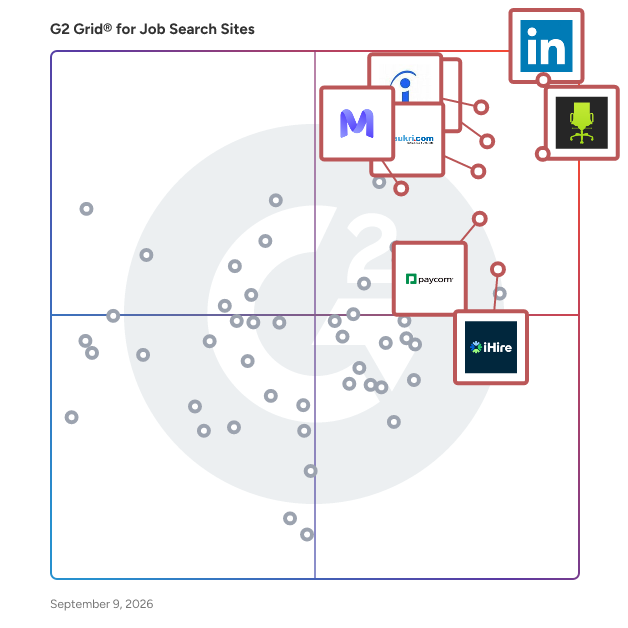
G2’s top-rated Job search sites software, based on verified reviews, includes LinkedIn Job Search, ZipRecruiter, Indeed Hiring Platform, and Monster
What are the top-reviewed job search sites on G2?
LinkedIn Job Search
- Number of Reviews: 1001
- Satisfaction: 97
- Market Score: 97
- G2 score: 97
ZipRecruiter
- Number of Reviews: 1199
- Satisfaction: 98
- Market Score: 92
- G2 score: 95
Indeed Hiring Platform
- Number of Reviews: 555
- Satisfaction: 83
- Market Score: 97
- G2 score: 90
Monster
- Number of Reviews: 169
- Satisfaction: 83
- Market Score: 94
- G2 score: 89
Naukri.com
- Number of Reviews: 172
- Satisfaction: 87
- Market Score: 88
- G2 score: 87
Satisfaction score reflects how positively users rate and feel about a product based on review-driven signals (beyond just a star average). (Source 2)
Market Presence score reflects a product’s reach and strength in the market using signals like market share, seller size, and broader visibility/impact indicators. (Source 2)
G2 Score is calculated as a proprietary composite that (in simplified terms) averages Satisfaction and Market Presence to rank products within a category. (Source 2)
Learn how G2 scores products. (Source 1)
What I Often See in Job Search Sites
Feedback Pros: What Users Consistently Appreciate
- Resume databases and search filters uncover niche candidates faster
“Huge candidate reach – Indeed has one of the largest job-seeker databases, which helps roles get visibility quickly. Easy job posting – Posting jobs is simple and fast, even for non-technical users.Strong resume search – Recruiters can search resumes using keywords, locations, experience, and filters.”
- Sarath S., Indeed Hiring Platform Review
- Company insights and connections improve application targeting decisions
“What I like most about LinkedIn Job Search is how it brings networking and job discovery together in one place. It not only highlights relevant openings based on my profile and skills, but also lets me see mutual connections, company insights, and recruiter activity. The “Easy Apply” feature saves time, and the personalized job recommendations help surface opportunities that closely match my experience. I also appreciate being able to research companies, view employee profiles, and engage with industry content, which makes the job search feel more strategic and intentional rather than purely transactional.”
- Devang B., LinkedIn Job Search Review
- Personalized alerts surface relevant openings without endless scrolling
“Naukri has one of the biggest collections of resumes and job postings, which increases the chance of finding relevant opportunities or talent.Recruiters and job seekers appreciate the advanced filters—skills, experience, location, salary, industry—which make searches faster and more accurate.Job seekers receive regular alerts based on their profile, helping them stay updated on new openings.”
- Sarath S., Naukri.com Review
Cons: Where Many Platforms Fall Short
- Duplicate or outdated listings clutter searches and waste time
“The job recommendations aren't as tailored as I would like, and some job postings seem outdated. Job recommendations should be tailored to job title and function.”
- Kailing C., Monster Review
- Weak filtering returns irrelevant applicants or mismatched job alerts
“I don't like the filtering options and screening questions. It doesn't show options like '24 hrs ago' or 'today,' which should be changed. Also, the screening questions are too long and need to be minimized.”
- Lohitha S., Indeed Hiring Platform Review
- Missing salary, role, or employer details reduces trust
“The biggest frustration with LinkedIn Job Search is how noisy and repetitive it can feel. Common pain points — you often see the same job posted multiple times by different recruiters, some recommendations feel off‑target even when your profile is clear, “easy Apply” can attract huge applicant pools making it harder to stand out, salary information is inconsistent or missing on many listings and It’s useful, but those rough edges can make the search feel less efficient than it should be.”
- Essameldin M., LinkedIn Job Search Review
My Expert Takeaway on Job Search Sites in 2026
Based on G2 data, tools in the Job search sites category show a strong performance profile across the metrics that usually matter most for everyday adoption: a 4.42/5 average star rating, 8.83/10 likelihood to recommend, 6.41/7 ease of use, 6.24/7 quality of support, and 6.21/7 meets requirements. That mix suggests that most users find these platforms dependable for regular recruiting and job discovery workflows, and that the category is mature enough to deliver value without requiring a steep learning curve.
Where the strongest teams stand out is in how they use these platforms to improve relevance, not just reach. The best results tend to come when recruiters and hiring teams treat job search platforms as active sourcing and screening systems rather than simple posting destinations. They rely on better search logic, tighter filtering, and fresher candidate or role data to reduce wasted effort, and they pay close attention to how efficiently users can move from discovery to action. I also see heavier adoption in industries such as Staffing and Recruiting, Information Technology and Services, Computer Software, and Hospital & Health Care, where hiring volume is higher and poor-fit matches create real workflow drag.
If you’re deciding whether Job search site software is worth the investment, my biggest advice is to validate three things early: how relevant the search results or candidate matches are, how current and complete listings or profiles stay over time, and whether the platform helps your team act on qualified opportunities faster. Teams that get this right usually end up with Job search sites software that improves sourcing efficiency and candidate discovery. Teams that overlook it often end up with more volume, but not necessarily better hiring outcomes.
Job Search Sites Software FAQs
What are Job search sites?
Job search sites are platforms that help employers publish openings and help candidates discover, filter, and apply to relevant roles in one place. This category includes products used for job posting, candidate discovery, search filtering, and application workflows, which is why modern Job search sites function more like end-to-end job discovery and hiring platforms than simple listing boards.
What are the best sites for finding a job?
The best sites for finding a job usually depend on the kind of role you want, but three strong options are LinkedIn Job Search for personalized recommendations and company context, ZipRecruiter for broad reach and fast application discovery, and Naukri.com for easy filtering and straightforward applications. LinkedIn reviewers highlight filters, company visibility, and alumni/network context; ZipRecruiter emphasizes resume access, candidate matching, and easy screening; and Naukri.com reviewers call out wide listings, role/location filters, and a simple application flow.
How do you use Job search sites?
The most effective way to use Job search sites is to start with a complete profile or resume, apply filters for role, location, experience, and job type, then turn on alerts so relevant openings come to you automatically. In practice, these platforms work best when users narrow the search with strong filters, review company and role details before applying, and use alerts or saved searches to avoid repeating the same manual search every day.
What are the best Job search sites for tech professionals?
For tech professionals, the strongest fits are usually LinkedIn Job Search, and ZipRecruiter. LinkedIn Job Search is useful for professionals who want tailored filters plus employer and network context; and ZipRecruiter is a strong option for broad technical hiring because reviewers mention AI matching and efficient candidate screening for specialized roles.
What are the most effective job boards for service industry positions?
For service industry hiring, the most effective boards are usually the ones with broad reach, fast posting, and easy screening, which makes Indeed Hiring Platform, ZipRecruiter, and Monster the safest recommendations. Indeed is often used for reaching a large candidate pool quickly and managing screening in one place, ZipRecruiter is strong for distributing jobs widely and simplifying applicant review, and Monster is frequently praised for helping teams find qualified candidates fast with straightforward search tools.
Sources
Researched and written by Grace Savides
Last updated on: March 16, 2026