Learn More About Idea Management Software
What is Idea Management Software?
Idea management software, also called innovation management software, structures the process of gathering insights on products and then organizing and managing those ideas for improvement or development. Feedback can be solicited from employees, stakeholders, customers, or multiple groups with the aim of improving a product or brainstorming.
Idea management software is a step up from the traditional office suggestion box. It enables companies of all sizes to continuously innovate and grow by deliberately leading the ideation process, and the highest rated enterprise idea management platforms are increasingly judged on whether they support sustainable innovation rather than a single burst of early enthusiasm that fades after the first campaign. Idea management software facilitates the full transparency of a company, as anyone who has access to the database can track ideas from inception to implementation. Ideas are collected from all areas of the organization, beyond specialized departments such as R&D, product management, and marketing. These products can integrate with enterprise feedback management software to allow users to manage both internally and externally sourced recommendations.
What are the Common Features of Idea Management Software?
Based on G2 reviews, employees and external stakeholders evaluate idea management software by comparing idea ranking accuracy, workflow customization, and ease of administration. Innovation management software can vary widely in how much structure it provides to the idea generation and collection process. Some products provide rigid scaffolding to every step of the innovation process. Others offer more open-ended methods and tools for users to develop ideas more organically. Below are some examples of features commonly found in idea management software from across the spectrum.
Ranking: Most idea management software allow users to vote on the ideas they like best, either within a given idea campaign or of those presented from a suggestion box. This will then rank the ideas, letting the strongest or most popular float to the top for consideration.
Commenting: Some solutions offer commenting capability, which allows users to provide feedback on ideas in real time. Comments can lead to more in-depth discussions about ideas, refining and polishing them into viable options.
Idea campaigns: Idea campaigns are often a staple feature in idea management tools. Users can create a dedicated campaign to rally ideas for a particular goal or challenge, and others can respond with their ideas within a given campaign. This consolidates ideas for a given topic in one centralized space where they can be evaluated and weighed against one another.
Suggestion box: While some idea management tools are essentially dedicated suggestion boxes, some will offer a suggestion box as an additional feature. These suggestion boxes can be internal, external, or both.
Gamification: Gamification features are sometimes utilized in idea management software to increase employee engagement and incentivize employees to get involved in the brainstorming process.
Templates: Some products will offer a variety of templates, sometimes customizable, to help launch a brainstorming or whiteboard session. Templates can help to provide structure to the idea management process, which is particularly useful for large enterprises.
Project planning: Some products will allow users to build out project plans and tasks natively inside the software based on generated ideas. Other software will provide the same functionality by integrating with an outside project management software.
Surveys: Surveys are a great method to take the pulse of an organization, and many innovation management solutions employ a survey feature so users can quickly gauge how their employees feel about recent changes.
Forums: Forum discussions can serve as an excellent space for the discussion and deliberation of ideas. Some idea management tools provide features akin to an online forum where ideas can be discussed more in depth internally.
Mind mapping: Mind mapping tools enable individuals or groups to diagram their thought process, allowing them to track and visualize their brainstorming sessions from start to finish.
What are the Benefits of Idea Management Software?
Innovation management software can benefit nearly any company with employees or external stakeholders. By allowing more individuals to contribute to an ideation session, a company can crowdsource ideas and recommendations for ways to improve processes, solve business issues, and enhance a company’s performance. Below are some of the key benefits of idea management software:
Promote efficiency and transparency: Idea management software allows users to track the progress of an idea from inception to its final form. This software assists with managing ideas and preventing information from getting lost amongst clutter. It can also help reduce the duplication of already-suggested ideas.
Prioritize innovation: Innovation management software assists an organization with achieving its strategic goals by identifying new products and services, discovering new markets for existing products, and acting on consumer feedback. Overall, these benefits will assist an organization in achieving a competitive advantage.
Empower stakeholders: Innovation management software supplies organizations with the ability to empower their customers and employees alike. By prioritizing internal and external communication, organizations can promote the application of "wisdom of the crowd" expertise to business operations. Additionally, by encouraging innovation and transparency within an organization, employees are empowered to proactively improve their work processes. Organizations can also utilize idea management software to validate and reward employee engagement, creativity, and inspire the cultivation of innovative ideas.
Reduce costs: Idea management software can be used to reduce costs by finding ways to eliminate waste or improve existing processes. Additionally, utilizing stakeholder perspectives is a great way to avoid the costs of outsourcing.
Who Uses Idea Management Software?
From a startup to a large corporation, the appeal of innovation management software is that it can be implemented in any type or size of business. Whether it be an externally or internally facing product, rigid or freeform, companies benefit from having a space where insiders can make recommendations. Employees and external stakeholders, such as customers or investors, will have a unique perspective on the products and services they contribute to or purchase, and businesses would be wise to harness their input to improve their offerings.
Employees: There is an advantage to considering employee perspectives when it comes to decision making. Employees contribute knowledge, skills, and experience—all of which are invaluable to a company. Allowing employees to partake in brainstorming and decision making processes can save a company time and money. By leveraging internal insight, a company may reduce outsourcing previously needed for assisting with business concerns. Additionally, inviting employees to participate in collaborative decision-making processes can lead to feelings of empowerment, boosted morale, and overall higher employee satisfaction.
External stakeholders: Whether an individual is a customer or an investor, they are affected by a company’s decisions. Allowing external stakeholders to provide feedback and ideas directly is a great way to get an outside perspective as well as ensure stakeholders feel valued. Outside perspectives can shed light on overlooked concerns and offer a novel problem-solving approach.
Software Related to Idea Management Software
Related solutions that can be used together with idea management software include:
Knowledge management software: Knowledge management software and idea management systems have some overlap in functionality, in that both facilitate the collection and organization of internally and externally sourced information. However, innovation management tools handle feedback to bolster company transparency and innovation, while knowledge management offers a knowledge base for teams to reference and retrieve documentation regarding company information or answers to common questions.
Note-taking management software: Note-taking management software often offers some of the same features found in idea management solutions. Some note-taking tools will provide mind mapping functionality or more structured workflows for penning down ideas. However, note-taking management tools are more freeform in their offering and are much less structured. Additionally, note-taking software usually cannot support the same number of collaborators that idea management software can.
Challenges with Idea Management Software
Software can come with their own set of challenges. Below are some examples of issues a buyer may face when utilizing idea management software:
Identifying relevant ideas: With a large influx of submissions, it’s always possible that some relevant and useful information may be overlooked. Some idea management software products may not allow the user to limit the number of submissions or may not provide filtering and searching features. If this is a potential concern, it’s important to look into products that offer advanced searching functionality.
Assessing feedback: When idea management software is utilized to gather feedback, some systems may have an idea ranking feature to arrange comments based on popularity. Popularity could be calculated by the level of engagement the user’s idea gets among collaborators and their historical participation. Typically, the higher their engagement and participation, the more popular their submission may be. This can misrepresent the value or relevancy of the feedback. The best way to avoid this is to choose a product that features an intuitive voting or ranking system.
Customization: Some idea management platforms don’t offer extensive customization options. This can make it difficult for users to tailor the tool to suit their industry, simplify ideation sessions, or personalize privacy settings.
Integration: Limited integration capability within other software platforms has been a pain point for some buyers of innovation management software. Buyers looking to incorporate this type of software into their existing systems should thoroughly explore the integration functionality of a product before purchasing.
How to Buy Idea Management Software
Requirements Gathering (RFI/RFP) for Idea Management Software
Regardless of where a company is at in the purchasing process, G2.com can help inform buyers of the market and assist them in selecting the best software for their needs.
The first step in deciding which kind of innovation management software to consider is to assess the needs of the business as a whole. Does the organization already use this kind of software? If so, what works and what doesn’t? Is this the first time the organization will be using idea management software? If that’s the case, buyers will need to determine how they plan to implement this software and what features the organization will need. Some points to consider are given below:
External vs. internal idea generation: Does the organization plan on using this tool internally, externally, or both?
Company size: Buyers will need to ensure that the products they are looking at will suit the size and need of the organization. When purchasing software, it’s important to ensure the product has the appropriate scalability to adapt to changing needs.
Compare Idea Management Software Products
Create a long list
The first step to finding the perfect software is to create a preliminary list of products that fit the buyer’s general needs. The next step is to narrow down the list by selecting specific features that are must-haves or requirements for the buyer. G2.com provides information about the best idea management software, allowing buyers to filter options as well as user reviews to help narrow down the product list to a more relevant selection.
Create a short list
Creating a short list of software products is an important step in the buying process. While it may be daunting to filter through various products, users can get help by utilizing G2’s “Compare” feature. This feature will take products of choice and display them side by side so the buyer can easily determine which software ticks the important boxes on the list.
Conduct demos
Once the buyer has narrowed down the product list, the next step is to conduct a demo. Demos allow buyers to see a product and its features in more detail. To ensure a buyer gets the most out of a demo, it’s important to go in prepared. Buyers should have a business scenario ready that will fully test each product in consideration. Additionally, buyers should inquire about cost, vendor support, and any concerns they have about the product. Adequate preparation will make it easier for a buyer to compare products after demos have been completed.
Selection of Idea Management Software
Choose a selection team
Idea management software can be utilized by employees, management, and external stakeholders. Therefore, it’s important to choose a selection team that will be able to assess a product from each standpoint. A good starting point would be to select three to five team members with different roles to participate in this process. The more varied a selection team is, the better a company can assess how well a product will meet their needs.
Negotiation
Once the selection team has narrowed down their software picks, it’s time to discuss customization options, pricing, and the type of support needed from the vendor. It’s always important to address pricing options, even when they are listed on a vendor’s website. Many software vendors will provide discounts and custom pricing options based on what the buyer is looking to purchase.
Final decision
Once a buyer has made the final decision on a product and is ready to move forward with a purchase, it is recommended to conduct a final demo, inquire about a trial run, and determine what the next steps are if the product doesn’t ultimately fit their needs. These steps can provide a buyer with an additional sense of security and confidence when making a final decision.
Idea Management Software Trends
Remote workforce
Digital collaboration software has been increasing in popularity over the past year due to the COVID-19 pandemic. With many teams working remotely, companies are looking at ways to innovate and enhance their remote workspace. Utilizing idea management software is a great way for a company to drive employee engagement, enhance visibility, and ensure that employees are feeling connected and valued while working virtually.
Consumer expectations
As outlined above, idea management software is an excellent tool for maintaining employee engagement and satisfaction. Moreso, it’s a resourceful way for a business to stay connected with its customer base. Since the start of the pandemic, consumers have become more aware of their purchasing decisions. For example, many consumers are now invested in the way a business is handling safety measures and treating their employees during COVID-19.
Aside from ethics, consumers have changed their purchasing habits to prioritize the health and safety of themselves and their families. Companies can utilize idea management software to crowdsource ideas from their customers to ensure they are meeting their expectations. Additionally, crowdsourcing ideas and suggestions from customers can help a business with its continuous improvement strategy and fuel a culture of innovation.
Idea Management Software FAQs
Most Popular FAQs
Which idea management software has the best reviews?
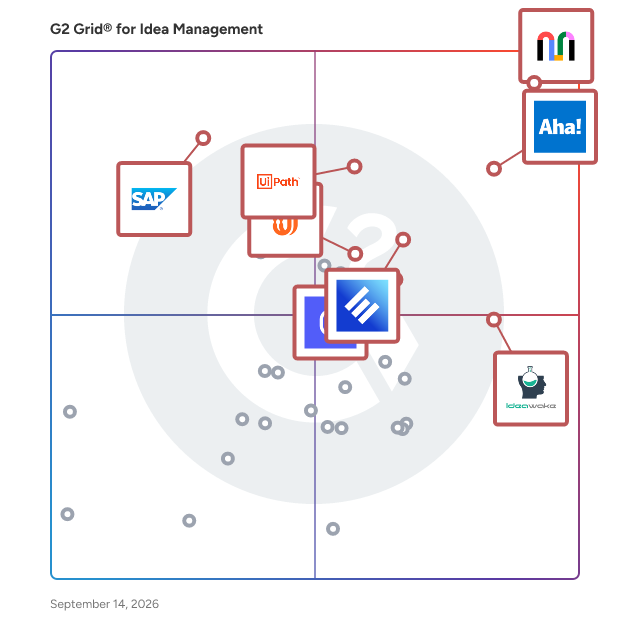
Across the Idea Management category, where the most trusted platforms, per user reviews, tend to be the ones that don't require a training session to get started, the strongest ratings tend to go to platforms that pair a clean, easy submission process with genuinely fast, helpful support.
-
Aha!: Carries solid review volume at a high rating, with the timeliness and quality of its customer support team specifically called out across years of use.
-
Yumana: Keeps everything related to innovation projects in one place, with a responsive support team that comes up consistently in reviews.
-
InspireIP: A smaller sample so far, but it eliminates the friction from early-stage innovation, letting teams capture and collaborate on ideas without any training required.
What is the best free idea management software?
A handful of platforms in this category genuinely offer a usable free tier rather than just a trial.
-
Canny: Runs on a free-forever plan with limited features, and comes up often for good value alongside solid integrations.
-
Mural: Its free tier allows unlimited members with a cap on active boards, giving small teams real functionality before any budget conversation is needed.
-
Sideways 6: Offers a free Lite plan for up to 10 users, built around empowering every employee to become an innovator rather than relying on a traditional suggestion box.
Which idea management solutions provide the strongest vendor support for distributed and remote workforce management?
Support quality matters more than usual for distributed teams, since there's no one down the hall to ask when something isn't working.
-
Mural: Built specifically for distributed teams to ideate and brainstorm together, turning what used to be a dry remote session into something genuinely collaborative.
-
Aha!: Years of consistently outstanding customer support, with bugs typically addressed and fixed quickly no matter where the reporting team is located.
-
Yumana: A responsive support team backs a platform used year-round, which matters for teams spread across time zones checking in on projects asynchronously.
What are the best idea management platforms for companies prioritizing employee self-service capabilities and administrative automation?
The platforms that fit this best are the ones where a non-technical employee can configure and launch something without waiting on IT.
-
HYPE Innovation Management: A new campaign can be built from zero in under 10 minutes, with dynamic customization and different access settings that admins configure themselves.
-
Aha!: Customizable portals come with SSO included on every plan, and automatic theme clustering handles organization that would otherwise take manual admin work.
-
InspireIP: A smaller sample so far, but it's built to be ridiculously easy to use, no training sessions, no lengthy manuals, just open it and go.
What is the best idea and innovation management software?
Idea management tools focus on capturing and evaluating raw submissions, while innovation management covers the fuller lifecycle, from ideation through business case development and execution. The platforms that span both tend to look different from a pure ideation tool.
-
Craft.io: Its Launch-to-Initiative-to-Epic hierarchy carries an idea all the way into product development, giving leadership visibility across the full lifecycle rather than stopping at submission.
-
Ideawake: Pairs idea capture with a dedicated review process, routing submissions to the right stakeholders for action instead of leaving them in a static list.
-
SoftExpert Suite: A newer name in this data set, though its variety of integrated modules centralizes innovation management alongside broader digital transformation and compliance processes in one system.
What are the best idea management platforms for companies prioritizing employee self-service capabilities and administrative automation?
The platforms that fit this best are the ones where a non-technical employee, or an executive who just wants a quick, intuitive dashboard view without asking IT for a report, can configure and check on something without waiting on anyone else.
-
HYPE Innovation Management: A new campaign can be built from zero in under 10 minutes, with dynamic customization and different access settings that admins configure themselves.
-
Aha!: Customizable portals come with SSO included on every plan, and automatic theme clustering handles organization that would otherwise take manual admin work.
-
Ideanote: Its real-time dashboards track KPIs, idea status, engagement levels, and innovation ROI directly, giving executives a self-service view of program impact without needing a custom report built for them.
-
InspireIP: A smaller sample so far, but it's built to be ridiculously easy to use, no training sessions, no lengthy manuals, just open it and go.
Do idea management tools integrate with payroll or benefits systems?
Not directly. Idea management platforms are built to integrate with collaboration and productivity tools, intranets, Microsoft Teams, Slack, Jira, not with payroll or benefits administration systems, which fall outside what this category is designed to do.
-
Sideways 6: Runs directly inside Microsoft Teams and intranet platforms like Interact, which is where employee-facing HR communication often already lives, even though it isn't a payroll or benefits integration itself.
-
Ideanote: Connects to over 2,000 tools via Zapier and Microsoft Power Automate, which can bridge to HR systems indirectly for notifications or data syncing, though this is general workflow automation rather than a native payroll or benefits connector.
-
Aha!: Integrates with Slack, Jira, and Salesforce natively, reflecting the same pattern across this category: deep ties to product and collaboration tools, and no direct line into HRIS, payroll, or benefits platforms.
Small Business FAQs
What is the most affordable idea management software for SMBs?
Within the small business segment of Idea Management, the platforms that come up most often for value are the ones that don't require a large add-on budget to get real functionality.
-
Craft.io: Flexible fields and views, paired with outstanding onboarding and support, are what keep it a strong value pick for small businesses.
-
HYPE Innovation Management: A smaller footprint so far, but its team stays involved well past initial setup rather than disappearing after implementation.
-
Yumana: A user-friendly interface paired with a strong back end gives small teams solid functionality without a steep price to get started.
What is the best idea management software for startups?
Startups evaluating small business idea management tools tend to prioritize a platform a lean team can run without a dedicated innovation manager.
-
Aha!: Among startup-sized accounts, it posts some of the strongest satisfaction scores in the category, backed by native integrations with tools like Slack and Jira a small team likely already uses.
-
InspireIP: Solves the fragmented idea capture and low visibility that hits early-stage teams hardest, without requiring any training to get going.
-
Craft.io: Configurable enough to match a startup's own way of working from day one, rather than forcing a rigid process onto a small team.
Which idea management platform is the most user-friendly for startups?
Ease of use matters most at this stage, since the person managing ideation is often juggling several other roles too.
-
Aha!: A built-in AI assistant and automatic theme clustering keep the platform approachable even without a dedicated admin to manage it.
-
InspireIP: The first time using it typically requires no more than opening it up, no five-menu hunt to find what you need.
-
Mural: An incredibly collaborative, visual platform for brainstorming sessions, with straightforward export features that turn inputs into usable files.
Which idea management tool is easiest to set up for small teams?
Setup speed is one of the more differentiated ratings in this category, and small teams generally do best with a platform that's live the same day.
-
HYPE Innovation Management: A new campaign can go from zero to built in under 10 minutes, with no special instruction needed for end users to get started.
-
InspireIP: Frictionless enough that a first-time user can start capturing ideas immediately, without a training session standing between signup and real use.
-
Canny: Straightforward to use and integrates well into an existing stack, which keeps setup light for a small team.
Which idea management tool is best for customer feedback and feature request collection?
Some idea management needs are really about capturing input from customers rather than employees, and a few platforms are built specifically around that use case.
-
Canny: Makes it simple to submit feedback and upvote existing suggestions, so teams can see at a glance how popular a request already is.
-
UserVoice: A smaller sample so far, but it centralizes feedback into easy-to-understand overviews, including a monthly contributor insights report.
-
Aha!: Helps teams triage incoming ideas and turn them into customer-facing roadmaps, keeping feedback and product planning in the same place.
Which idea management software has the best reviews for small HR and people teams trying to scale an ideas program?
The challenge for a small HR or people team isn't launching an ideas program; it's keeping it running once it grows past the first few campaigns without adding headcount to manage it.
-
Sideways 6: Built specifically around the problem of programs becoming "unwieldy and difficult to execute with impact" as they scale, with automated communications, tracking, and reviewing built in, so a small team isn't manually chasing updates as participation grows.
-
Ideanote: Positioned around launching a fully customized innovation program in days rather than months, which matters when a lean HR team doesn't have the bandwidth for a long implementation before seeing results.
-
Yumana: A responsive support team and a single home for innovation projects give a small team the structure to grow a program without it fragmenting across spreadsheets and email threads.
Enterprise FAQs
What is best-rated idea management software for large enterprises?
Within the Enterprise segment of Idea Management, a smaller set of platforms have the review volume from large organizations to back up a strong rating.
-
Mural: Holds up especially well at the enterprise level, with the same collaborative, visual approach that works for smaller teams scaling cleanly across larger ones.
-
Craft.io: The same configurability and clear hierarchy that work for smaller teams carry over at enterprise scale, keeping cross-functional stakeholders aligned on how ideas progress.
-
HYPE Innovation Management: A smaller footprint at this scale so far, but its dynamic customization and access controls hold up as more departments get added.
What is the most reliable idea management tool for enterprises?
Reliability at this scale tends to come down to support responsiveness, since large organizations need fast answers when an innovation program spans many departments at once.
-
Yumana: Enterprise accounts report support scores among the strongest in the category, consistent with the responsive team smaller users describe too.
-
HYPE Innovation Management: A team that stays engaged well past go-live comes up repeatedly as a reason larger organizations trust it long-term.
-
Aha!: Support ratings hold up at scale, with the same quick bug-fix turnaround that smaller teams rely on holding steady for bigger accounts.
What is best-reviewed idea management software for enterprise remote and distributed teams?
Enterprise-scale distributed teams need the same vendor responsiveness that smaller remote teams rely on, just spread across far more locations and time zones.
-
Mural: Its purpose-built design for distributed ideation holds up at enterprise scale, keeping large, spread-out teams working from the same visual space.
-
Aha!: Consistently fast support response times matter more once a distributed team spans multiple regions and time zones simultaneously.
-
Yumana: Keeping all innovation projects in one place is especially valuable for enterprise teams checking in asynchronously rather than meeting live.
Which idea management platforms best support employee self-service and administrative automation at enterprise scale?
At enterprise volume, self-service needs to hold up across many departments configuring their own campaigns simultaneously, not just one admin managing a single instance.
-
HYPE Innovation Management: Different access settings per department let large organizations decentralize campaign creation without losing central oversight.
-
Aha!: SSO included on every plan removes a common enterprise IT bottleneck, while automatic theme clustering cuts down manual admin work as volume grows.
-
Qmarkets Impact-Driven Innovation Software: A smaller footprint so far, but its simple graphic style makes it easy for non-technical stakeholders to analyze and visualize submissions themselves.
Which idea management platform is best for large-scale, enterprise-wide innovation programs?
At true enterprise scale, the priority shifts to a single platform that replaces scattered spreadsheets and slide decks across the whole organization.
-
SoftExpert Suite: A smaller sample so far, but its variety of integrated modules centralizes innovation management alongside compliance and digital transformation processes in one system.
-
Ideawake: Helps organizations capture ideas from across the entire company, review them with a dedicated innovation team, and act on the best ones at scale.
-
ITONICS: A smaller footprint so far, but it replaces spreadsheets and slides entirely, bringing radar, matrix, and other visualization tools into one place for innovation and new product development.