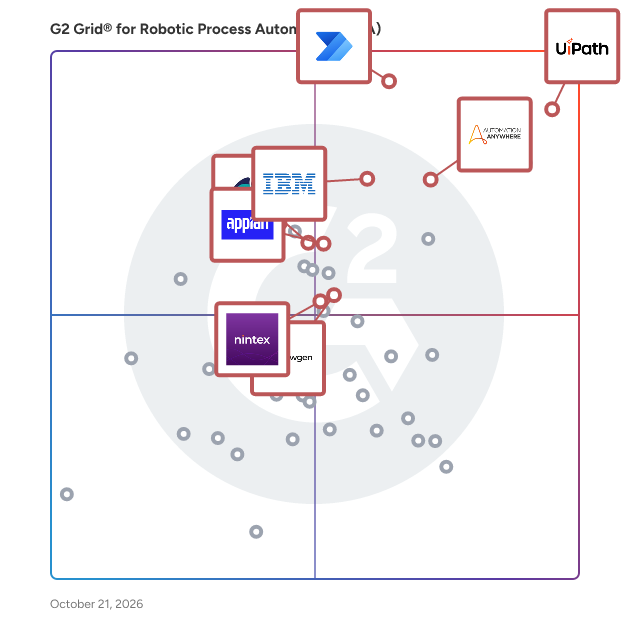
# Best Enterprise Robotic Process Automation (RPA) Software

  *By [Bijou Barry](https://research.g2.com/insights/author/bijou-barry)*

   Products classified in the overall Robotic Process Automation (RPA) category are similar in many regards and help companies of all sizes solve their business problems. However, enterprise business features, pricing, setup, and installation differ from businesses of other sizes, which is why we match buyers to the right Enterprise Business Robotic Process Automation (RPA) to fit their needs. Compare product ratings based on reviews from enterprise users or connect with one of G2&#39;s buying advisors to find the right solutions within the Enterprise Business Robotic Process Automation (RPA) category.

In addition to qualifying for inclusion in the Robotic Process Automation (RPA) Software category, to qualify for inclusion in the Enterprise Business Robotic Process Automation (RPA) Software category, a product must have at least 10 reviews left by a reviewer from an enterprise business.


---

**Sponsored**

### Resolve

Resolve is creating the future of agentic automation and orchestration for IT teams to drive resilience, agility, and innovation across the business. The Resolve platform gives IT and network operations teams time back to focus on strategic priorities with automation and orchestration capabilities that reduce alert noise by up to 80%, resolve incidents in minutes instead of hours, and scale operations efficiently. Forward-thinking global enterprises trust Resolve to drive operational efficiency and scale autonomous IT and network operations. Learn more at resolve.io.


[Visit company website](https://www.g2.com/external_clickthroughs/record?secure%5Bad_program%5D=ppc&amp;secure%5Bad_slot%5D=category_product_list&amp;secure%5Bcategory_id%5D=1206&amp;secure%5Bdisplayable_resource_id%5D=1206&amp;secure%5Bdisplayable_resource_type%5D=Category&amp;secure%5Bmedium%5D=sponsored&amp;secure%5Bplacement_reason%5D=page_category&amp;secure%5Bplacement_resource_ids%5D%5B%5D=1206&amp;secure%5Bprioritized%5D=false&amp;secure%5Bproduct_id%5D=30506&amp;secure%5Bresource_id%5D=1206&amp;secure%5Bresource_type%5D=Category&amp;secure%5Bsource_type%5D=category_page&amp;secure%5Bsource_url%5D=https%3A%2F%2Fwww.g2.com%2Fcategories%2Frobotic-process-automation-rpa%2Fenterprise&amp;secure%5Btoken%5D=e287814bc10f22e141042a8137a0b8077cc9cff8bf44e89dea4fc1929c7c9149&amp;secure%5Burl%5D=https%3A%2F%2Fresolve.io%2Frequest-demo&amp;secure%5Burl_type%5D=custom_url)

---

## Top-Rated Products (Ranked by G2 Score)
  ### 1. [UiPath Agentic Automation](https://www.g2.com/products/uipath-agentic-automation/reviews)
  UiPath (NYSE: PATH) is a global leader in agentic automation, empowering enterprises to harness the full potential of AI agents to autonomously execute and optimize complex business processes. The UiPath Platform™ uniquely combines controlled agency, developer flexibility, and seamless integration to help organizations scale agentic automation safely and confidently. Committed to security, governance, and interoperability, UiPath supports enterprises as they transition into a future where automation delivers on the full potential of AI to transform industries. For more information, visit www.uipath.com. Agentic testing is an AI-powered approach to software quality assurance that leverages autonomous agents to generate, execute, and evolve tests across the entire testing lifecycle. By partnering intelligent agents with human testers, agentic testing dramatically increases test coverage, accelerates release cycles, improves system resilience, and enables continuous testing at enterprise scale. It empowers teams to shift from manual, reactive testing to proactive, scalable quality engineering—driving faster innovation with higher confidence.


  **Average Rating:** 4.6/5.0
  **Total Reviews:** 5,826

**User Satisfaction Scores:**

- **Visual Editor:** 9.1/10 (Category avg: 8.5/10)
- **Quality of Support:** 8.8/10 (Category avg: 9.1/10)
- **Custom Automation:** 8.9/10 (Category avg: 8.8/10)
- **Collaboration:** 8.9/10 (Category avg: 8.6/10)


**Seller Details:**

- **Seller:** [UiPath](https://www.g2.com/sellers/uipath)
- **Company Website:** https://www.uipath.com
- **Year Founded:** 2005
- **HQ Location:** New York
- **Twitter:** @UiPath (107,817 Twitter followers)
- **LinkedIn® Page:** https://www.linkedin.com/company/1523656/ (5,074 employees on LinkedIn®)

**Reviewer Demographics:**
  - **Who Uses This:** RPA Developer, Software Engineer
  - **Top Industries:** Information Technology and Services, Computer Software
  - **Company Size:** 52% Enterprise, 29% Mid-Market


#### Pros & Cons

**Pros:**

- Automation (383 reviews)
- Ease of Use (369 reviews)
- Automation Focus (300 reviews)
- Automation Ease (254 reviews)
- Efficiency (194 reviews)

**Cons:**

- Expensive (157 reviews)
- Learning Curve (146 reviews)
- Complexity (92 reviews)
- Missing Features (90 reviews)
- Pricing Issues (74 reviews)

  ### 2. [Microsoft Power Automate](https://www.g2.com/products/microsoft-power-automate/reviews)
  Optimize business processes across your organization with a cloud-first, comprehensive automation platform, powered by low-code and AI. Modernize and integrate operations at scale, maintain visibility and control with enterprise-grade governance, monitor and protect your data, and continuously improve with process insights.


  **Average Rating:** 4.4/5.0
  **Total Reviews:** 1,017

**User Satisfaction Scores:**

- **Visual Editor:** 8.3/10 (Category avg: 8.5/10)
- **Quality of Support:** 8.0/10 (Category avg: 9.1/10)
- **Custom Automation:** 8.1/10 (Category avg: 8.8/10)
- **Collaboration:** 8.0/10 (Category avg: 8.6/10)


**Seller Details:**

- **Seller:** [Microsoft](https://www.g2.com/sellers/microsoft)
- **Company Website:** https://www.microsoft.com/
- **Year Founded:** 1975
- **HQ Location:** Redmond, Washington
- **Twitter:** @microsoft (13,090,464 Twitter followers)
- **LinkedIn® Page:** https://www.linkedin.com/company/microsoft/ (227,697 employees on LinkedIn®)

**Reviewer Demographics:**
  - **Who Uses This:** Software Engineer, RPA Developer
  - **Top Industries:** Information Technology and Services, Computer Software
  - **Company Size:** 33% Mid-Market, 32% Enterprise


#### Pros & Cons

**Pros:**

- Ease of Use (382 reviews)
- Automation (317 reviews)
- Easy Integrations (294 reviews)
- Integrations (292 reviews)
- Process Automation (247 reviews)

**Cons:**

- Complexity (208 reviews)
- Slow Performance (102 reviews)
- Bugs (96 reviews)
- Expensive (96 reviews)
- Software Bugs (95 reviews)

  ### 3. [Automation Anywhere Agentic Process Automation](https://www.g2.com/products/automation-anywhere-agentic-process-automation/reviews)
  Automation Anywhere is the global leader in Agentic Process Automation (APA), transforming how organizations put AI to work. Our platform combines specialized AI agents, generative AI, and end-to-end process automation—including process discovery, RPA, document processing, and advanced analytics—all built on a foundation of security and governance. We empower businesses worldwide to unlock productivity, elevate customer experiences, and drive new revenue streams. Guided by our vision to fuel the future of work, we unleash human potential through Agentic AI-powered automation. Learn more at https://www.automationanywhere.com.


  **Average Rating:** 4.5/5.0
  **Total Reviews:** 4,010

**User Satisfaction Scores:**

- **Visual Editor:** 8.7/10 (Category avg: 8.5/10)
- **Quality of Support:** 8.7/10 (Category avg: 9.1/10)
- **Custom Automation:** 8.6/10 (Category avg: 8.8/10)
- **Collaboration:** 8.6/10 (Category avg: 8.6/10)


**Seller Details:**

- **Seller:** [Automation Anywhere](https://www.g2.com/sellers/automation-anywhere)
- **Company Website:** https://www.AutomationAnywhere.com
- **Year Founded:** 2003
- **HQ Location:** San Jose, CA
- **Twitter:** @AutomationAnywh (55,131 Twitter followers)
- **LinkedIn® Page:** https://www.linkedin.com/company/208639/ (3,967 employees on LinkedIn®)

**Reviewer Demographics:**
  - **Who Uses This:** RPA Developer, Software Engineer
  - **Top Industries:** Information Technology and Services, Computer Software
  - **Company Size:** 59% Enterprise, 23% Mid-Market


#### Pros & Cons

**Pros:**

- Ease of Use (84 reviews)
- Automation (71 reviews)
- Efficiency (43 reviews)
- Automation Ease (42 reviews)
- User Interface (42 reviews)

**Cons:**

- Expensive (28 reviews)
- Learning Curve (27 reviews)
- Missing Features (25 reviews)
- Software Bugs (22 reviews)
- Bot Issues (20 reviews)

  ### 4. [Appian](https://www.g2.com/products/appian/reviews)
  Appian is a software company that automates business processes. The Appian Platform includes everything you need to design, automate, and optimize even the most complex processes, from start to finish. The world&#39;s most innovative organizations trust Appian to improve their workflows, unify data, and optimize operations—resulting in better growth and superior customer experiences. For more information, visit [www.appian.com](http://www,appian.com?utm_source=g2). [Nasdaq: APPN] ANALYST REPORTS Appian is proud to once again be named a Leader by Gartner for Enterprise Low-Code Application Platforms. Access report via: https://ap.pn/3d8RYQJ Appian, A Clear Leader in Nucleus Research’s 2020 Value Matrix for Low-Code Application Platforms. View report via: https://ap.pn/3jH7OmY


  **Average Rating:** 4.5/5.0
  **Total Reviews:** 421

**User Satisfaction Scores:**

- **Visual Editor:** 8.6/10 (Category avg: 8.5/10)
- **Quality of Support:** 8.5/10 (Category avg: 9.1/10)
- **Custom Automation:** 8.3/10 (Category avg: 8.8/10)
- **Collaboration:** 8.6/10 (Category avg: 8.6/10)


**Seller Details:**

- **Seller:** [Appian](https://www.g2.com/sellers/appian)
- **Company Website:** https://www.appian.com
- **Year Founded:** 1999
- **HQ Location:** McLean, Virginia
- **Twitter:** @Appian (16,311 Twitter followers)
- **LinkedIn® Page:** https://www.linkedin.com/company/8088/ (2,444 employees on LinkedIn®)

**Reviewer Demographics:**
  - **Who Uses This:** Manager, Consultant
  - **Top Industries:** Financial Services, Banking
  - **Company Size:** 58% Enterprise, 28% Mid-Market


#### Pros & Cons

**Pros:**

- Ease of Use (38 reviews)
- Automation (29 reviews)
- Low Code (26 reviews)
- AI Technology (24 reviews)
- Artificial Intelligence (23 reviews)

**Cons:**

- Limited Features (15 reviews)
- Expensive (13 reviews)
- Limited Flexibility (12 reviews)
- Complexity (11 reviews)
- Limited Customization (11 reviews)

  ### 5. [IBM Robotic Process Automation (RPA)](https://www.g2.com/products/ibm-robotic-process-automation-rpa/reviews)
  IBM’s market-leading, AI-powered IBM® Robotic Process Automation (RPA) technology is a complete task automation software that enables clients to automate more of their time-consuming, tedious and repetitive work. To help clients get started quickly and automate more business and IT processes at scale, as the demands of their business grow, IBM RPA offers simple licensing and deployment options. Software robots, or bots, can act on AI insights to complete tasks with no lag time and enable you to achieve digital transformation.


  **Average Rating:** 4.7/5.0
  **Total Reviews:** 273

**User Satisfaction Scores:**

- **Visual Editor:** 9.1/10 (Category avg: 8.5/10)
- **Quality of Support:** 9.2/10 (Category avg: 9.1/10)
- **Custom Automation:** 9.1/10 (Category avg: 8.8/10)
- **Collaboration:** 8.9/10 (Category avg: 8.6/10)


**Seller Details:**

- **Seller:** [IBM](https://www.g2.com/sellers/ibm)
- **Year Founded:** 1911
- **HQ Location:** Armonk, NY
- **Twitter:** @IBM (708,000 Twitter followers)
- **LinkedIn® Page:** https://www.linkedin.com/company/1009/ (324,553 employees on LinkedIn®)
- **Ownership:** SWX:IBM

**Reviewer Demographics:**
  - **Who Uses This:** Developer, Software Engineer
  - **Top Industries:** Information Technology and Services, Telecommunications
  - **Company Size:** 42% Small-Business, 37% Mid-Market


#### Pros & Cons

**Pros:**

- Ease of Use (2 reviews)
- Bot Creation (1 reviews)
- Process Simplification (1 reviews)
- Workflow Management (1 reviews)

**Cons:**

- Difficult Setup (1 reviews)

  ### 6. [NewgenONE Digital Transformation Platform](https://www.g2.com/products/newgenone-digital-transformation-platform/reviews)
  Transform your business with NewgenONE, an intelligent enterprise orchestration platform, featuring a suite of cutting-edge technologies—from task automation to mission-critical, content-rich applications and advanced workflow orchestration. Effortlessly integrate your existing systems and devices into a seamless ecosystem that ensures personalized, efficient experiences across the board. Build powerful applications at lightning speed with NewgenONE, a completely native low-code platform. Enjoy seamless scalability, robust security, and built-in governance and compliance, all while accelerating automation across your enterprise. Automate thousands of enterprise-wide processes and stay ahead of the competition with rapid, innovative solutions.


  **Average Rating:** 4.5/5.0
  **Total Reviews:** 89

**User Satisfaction Scores:**

- **Visual Editor:** 8.7/10 (Category avg: 8.5/10)
- **Quality of Support:** 8.4/10 (Category avg: 9.1/10)
- **Custom Automation:** 9.4/10 (Category avg: 8.8/10)
- **Collaboration:** 9.0/10 (Category avg: 8.6/10)


**Seller Details:**

- **Seller:** [Newgen](https://www.g2.com/sellers/newgen)
- **Year Founded:** 1992
- **HQ Location:** Mclean, VA
- **Twitter:** @newgensoftware (3,362 Twitter followers)
- **LinkedIn® Page:** https://www.linkedin.com/company/newgen (5,283 employees on LinkedIn®)

**Reviewer Demographics:**
  - **Top Industries:** Banking, Financial Services
  - **Company Size:** 59% Enterprise, 22% Mid-Market


#### Pros & Cons

**Pros:**

- Automation (1 reviews)
- Automation Efficiency (1 reviews)
- Automation Features (1 reviews)
- Automation Focus (1 reviews)
- Cloud Services (1 reviews)

**Cons:**

- Bug Issues (1 reviews)
- Bugs (1 reviews)
- Complexity (1 reviews)
- Complex Setup (1 reviews)
- Difficult Configuration (1 reviews)

  ### 7. [BotCity](https://www.g2.com/products/botcity/reviews)
  BotCity is an enterprise platform for Python governance, built for the new reality where Python runs everywhere, especially on endpoints. Our Sentinel Agent shows you every Python script running across your company and what it’s doing, in real time, including scripts created by business users that operate outside traditional IT, Security, and Compliance processes. When Python touches company data, including internal databases, internal APIs, and shared drives, Sentinel captures audit-ready evidence: what ran, where, when, by whom, and what it accessed. Instead of trying to block Python and still missing what runs, Sentinel focuses on visibility and control over real execution. It complements your existing security stack, including EDR, SIEM, and DLP, by governing what those tools typically do not make explicit: Python behavior, dependencies, and data access patterns at the endpoint. BotCity extends governance beyond endpoints to production operations through its ecosystem, enabling end-to-end governance from Shadow Python discovery to standardized, scalable execution. Best fit for: Enterprise teams using Python across engineering, data, automation, and business functions who need governance, audit evidence, and risk visibility without slowing down innovation. Note on AI agents: Python-based agents are also detected and governed when they run on endpoints.


  **Average Rating:** 4.8/5.0
  **Total Reviews:** 162

**User Satisfaction Scores:**

- **Visual Editor:** 8.4/10 (Category avg: 8.5/10)
- **Quality of Support:** 9.4/10 (Category avg: 9.1/10)
- **Custom Automation:** 9.3/10 (Category avg: 8.8/10)
- **Collaboration:** 9.1/10 (Category avg: 8.6/10)


**Seller Details:**

- **Seller:** [BotCity](https://www.g2.com/sellers/botcity)
- **Company Website:** https://documentation.botcity.dev/
- **Year Founded:** 2018
- **HQ Location:** San Francisco, US
- **Twitter:** @BotcityDev (632 Twitter followers)
- **LinkedIn® Page:** https://www.linkedin.com/company/botcity/ (51 employees on LinkedIn®)

**Reviewer Demographics:**
  - **Who Uses This:** RPA Developer, Desenvolvedor RPA
  - **Top Industries:** Information Technology and Services, Computer Software
  - **Company Size:** 39% Mid-Market, 36% Enterprise


#### Pros & Cons

**Pros:**

- Automation (2 reviews)
- Ease of Use (2 reviews)
- Efficiency Optimization (2 reviews)
- Flexibility (2 reviews)
- Intuitive (2 reviews)

**Cons:**

- Learning Curve (2 reviews)
- Steep Learning Curve (2 reviews)
- Automation Difficulty (1 reviews)
- Developer Challenges (1 reviews)
- Limited Features (1 reviews)

  ### 8. [SS&amp;C Blue Prism Intelligent Automation Platform](https://www.g2.com/products/ss-c-blue-prism-intelligent-automation-platform/reviews)
  SS&amp;C Blue Prism’s intelligent automation platform (IAP) connects a unified workforce of people and digital resources with systems, cognitive tools, applications and technologies, including an ecosystem of ready-made automations. The combination of these automation technologies, including business process management, robotic process automation and artificial intelligence, automate business processes and streamline decision making across organizations. A digital workforce increases process efficiency, reduces operating costs and returns millions of hours to staff to focus on higher-value work. Intelligent automation removes tedious and manual work, dramatically improving efficiency and boosting employee satisfaction with paths to career growth. Implemented at scale, the potential of intelligent automation is unlocked and delivers transformational business value by helping organizations unify their workforce, transforming journeys and scaling enterprise wide.


  **Average Rating:** 4.5/5.0
  **Total Reviews:** 347

**User Satisfaction Scores:**

- **Visual Editor:** 8.8/10 (Category avg: 8.5/10)
- **Quality of Support:** 8.6/10 (Category avg: 9.1/10)
- **Custom Automation:** 8.8/10 (Category avg: 8.8/10)
- **Collaboration:** 8.4/10 (Category avg: 8.6/10)


**Seller Details:**

- **Seller:** [SS&amp;C Blue Prism](https://www.g2.com/sellers/ss-c-blue-prism)
- **Year Founded:** 2001
- **HQ Location:** Windsor, CT
- **Twitter:** @SSCTechnologies (4,799 Twitter followers)
- **LinkedIn® Page:** https://www.linkedin.com/company/blue-prism-limited/ (1,020 employees on LinkedIn®)
- **Ownership:** NASDAQ: SSNC

**Reviewer Demographics:**
  - **Who Uses This:** RPA Developer, Software Engineer
  - **Top Industries:** Information Technology and Services, Computer Software
  - **Company Size:** 55% Enterprise, 27% Mid-Market


#### Pros & Cons

**Pros:**

- Ease of Use (48 reviews)
- Automation (36 reviews)
- Automation Ease (21 reviews)
- Efficiency (20 reviews)
- Features (20 reviews)

**Cons:**

- Learning Curve (15 reviews)
- Missing Features (14 reviews)
- Complexity (12 reviews)
- Expensive (11 reviews)
- Integration Issues (11 reviews)

  ### 9. [Nintex](https://www.g2.com/products/nintex-nintex/reviews)
  Nintex helps companies unlock the power of endless possibilities with agentic business orchestration. Today, more than 7,000 public and private sector organizations across 100+ countries turn to the Nintex platform to automate how work gets done, remove friction from business processes, and unlock the full potential of their people. Nintex CE allows organizations to govern how people, systems, and AI work together: combining the speed and innovation of easy, low-code application development, with the flexibility of workflow orchestration, and the intelligence of AI agents to build solutions that solve their unique business challenges. Nintex K2 allows organizations to get advanced orchestration, control, and scalability, while keeping data securely on-premises to meet the exacting standards of highly regulated entities or those with strict data sovereignty requirements. Harness powerful on-prem automation, rich application development, and complex case management with full control.


  **Average Rating:** 4.3/5.0
  **Total Reviews:** 1,271

**User Satisfaction Scores:**

- **Visual Editor:** 9.0/10 (Category avg: 8.5/10)
- **Quality of Support:** 8.1/10 (Category avg: 9.1/10)
- **Custom Automation:** 9.0/10 (Category avg: 8.8/10)
- **Collaboration:** 9.2/10 (Category avg: 8.6/10)


**Seller Details:**

- **Seller:** [Nintex](https://www.g2.com/sellers/nintex)
- **Company Website:** https://www.nintex.com
- **Year Founded:** 2006
- **HQ Location:** Bellevue, WA
- **LinkedIn® Page:** https://www.linkedin.com/company/258303/ (1,222 employees on LinkedIn®)

**Reviewer Demographics:**
  - **Who Uses This:** Business Analyst, Salesforce Administrator
  - **Top Industries:** Information Technology and Services, Financial Services
  - **Company Size:** 48% Enterprise, 40% Mid-Market


#### Pros & Cons

**Pros:**

- Ease of Use (37 reviews)
- Workflow Management (19 reviews)
- Automation (18 reviews)
- Easy Setup (17 reviews)
- Versatility (16 reviews)

**Cons:**

- Limited Features (17 reviews)
- Learning Curve (13 reviews)
- Complexity (9 reviews)
- Expensive (9 reviews)
- Limited Customization (9 reviews)

  ### 10. [Laiye RPA](https://www.g2.com/products/laiye-rpa/reviews)
  Developed by Laiye, a leading RPA+AI firm, Laiye RPA is one of the few RPA solutions with advanced AI capabilities. Laiye RPA can automate manual and repetitive tasks, freeing the staff to apply their skillset and expertise on high-value and cognitively stimulating tasks. Laiye RPA is easy to grasp and can be learnt within a few hours. It comes with over 400 pre-set commands which can be used for all types of projects, including those with a series of complex processes. Equipped with AI capabilities and OCR functionality, Laiye RPA is applicable in a wide variety of areas ranging from data entry to invoice processing. Many organisations have already adopted Laiye RPA to automate tasks in a range of sectors including Finance, Logistics, Telecommunications, Healthcare, and more.


  **Average Rating:** 4.8/5.0
  **Total Reviews:** 91

**User Satisfaction Scores:**

- **Visual Editor:** 9.1/10 (Category avg: 8.5/10)
- **Quality of Support:** 9.4/10 (Category avg: 9.1/10)
- **Custom Automation:** 8.6/10 (Category avg: 8.8/10)
- **Collaboration:** 8.7/10 (Category avg: 8.6/10)


**Seller Details:**

- **Seller:** [laiye](https://www.g2.com/sellers/laiye)
- **Year Founded:** 2015
- **HQ Location:** Beijing, Beijing
- **Twitter:** @laiye (1 Twitter followers)
- **LinkedIn® Page:** https://www.linkedin.com/company/laiye/ (463 employees on LinkedIn®)

**Reviewer Demographics:**
  - **Top Industries:** Information Technology and Services, Computer Software
  - **Company Size:** 33% Small-Business, 32% Enterprise


  ### 11. [PIX RPA](https://www.g2.com/products/pix-rpa/reviews)
  PIX RPA is an intelligent automation platform that combines RPA, AI, and BPM to help businesses automate processes, improve efficiency, and scale operations. Advantages of PIX RPA Platform: - Built-in IDP for intelligent document automation; - Enterprise-ready platform with robust scalability; - PROM Framework for flexible process modeling; - Integrated AI support for smarter decision-making; - Centralized orchestration with BPM tools; - Multi-platform compatibility for diverse systems. PIX Platform Components: - PIX Studio: Tool for creating and designing software robots; - PIX Robot: Execution module that runs automated algorithms; - PIX Master (On-premise &amp; Cloud): Administration console to manage multiple robots and processes; - PIX Runner: Application for running and operating robots on a user’s device; - PIX Converter: Tool for automated migration of UiPath projects to PIX RPA; - PIX Analytics Module: A new component that enables real-time monitoring of automation results and evaluation of PIX RPA implementation impact through advanced data visualizations and performance insights; - PIX Smart Module: Intelligent add-on that enhances automation capabilities through AI-driven decision-making, adaptive process optimization, and predictive analytics. Key Benefits: - Faster automation speed than traditional methods; - Accelerated process execution with improved quality; - Enhanced compliance and reduced operational risks; - Higher employee satisfaction through task automation; - Quick ROI with scalable and intelligent automation.


  **Average Rating:** 4.8/5.0
  **Total Reviews:** 233

**User Satisfaction Scores:**

- **Visual Editor:** 9.1/10 (Category avg: 8.5/10)
- **Quality of Support:** 9.4/10 (Category avg: 9.1/10)
- **Custom Automation:** 9.1/10 (Category avg: 8.8/10)
- **Collaboration:** 8.9/10 (Category avg: 8.6/10)


**Seller Details:**

- **Seller:** [PIX Robotics](https://www.g2.com/sellers/pix-robotics)
- **Year Founded:** 2018
- **HQ Location:** Dubai, AE
- **LinkedIn® Page:** https://www.linkedin.com/company/pix-rpa-platform/ (68 employees on LinkedIn®)

**Reviewer Demographics:**
  - **Who Uses This:** Estudiante, Desarrollador
  - **Top Industries:** Computer Software, Information Technology and Services
  - **Company Size:** 68% Small-Business, 19% Mid-Market


#### Pros & Cons

**Pros:**

- Ease of Use (18 reviews)
- Automation (12 reviews)
- Intuitive (11 reviews)
- User Interface (11 reviews)
- Features (9 reviews)

**Cons:**

- Missing Features (6 reviews)
- Integration Issues (4 reviews)
- Lacking Features (3 reviews)
- Limited Features (3 reviews)
- Difficult Learning (2 reviews)

  ### 12. [ServiceNow Workflow Data Fabric](https://www.g2.com/products/servicenow-workflow-data-fabric/reviews)
  Workflow Data Fabric is the AI‑ready data foundation of the ServiceNow AI Platform. It connects to any data—structured, unstructured, and streaming—contextualizes it with business meaning and governance, and controls it with lineage and policies so employees and AI agents can confidently act on real‑time information to prevent disruptions, resolve requests faster, and optimize operations—all on one platform. How Workflow Data Fabric turns data into instant action Connect Unify data from systems like Salesforce, SAP, Workday, data lakes, and event streams in real time without duplication or fragile point‑to‑point integrations. With Zero Copy Connectors, Stream Connect, External Content Connectors, and Integration Hub, WDF simplifies architecture and cuts integration cost and time. Contextualize Give data business meaning and make it trustworthy with an active Data Catalog, embedded governance, and lineage. Use Knowledge Graph to map relationships (e.g., customers, assets, orders) so AI agents and workflows understand context and make accurate decisions in the flow of work. Control Apply policies, permissions, and compliance guards across connected sources so the right people and AI agents access the right data, at the right time, with full auditability and traceability—no more shadow copies or opaque pipelines.


  **Average Rating:** 4.3/5.0
  **Total Reviews:** 102

**User Satisfaction Scores:**

- **Visual Editor:** 8.7/10 (Category avg: 8.5/10)
- **Quality of Support:** 8.4/10 (Category avg: 9.1/10)
- **Custom Automation:** 8.9/10 (Category avg: 8.8/10)
- **Collaboration:** 8.7/10 (Category avg: 8.6/10)


**Seller Details:**

- **Seller:** [ServiceNow](https://www.g2.com/sellers/servicenow)
- **Company Website:** https://www.servicenow.com/
- **Year Founded:** 2004
- **HQ Location:** Santa Clara, CA
- **Twitter:** @servicenow (53,880 Twitter followers)
- **LinkedIn® Page:** https://www.linkedin.com/company/29352/ (32,701 employees on LinkedIn®)

**Reviewer Demographics:**
  - **Who Uses This:** Software Engineer
  - **Top Industries:** Information Technology and Services, Computer Software
  - **Company Size:** 43% Enterprise, 31% Mid-Market


#### Pros & Cons

**Pros:**

- Ease of Use (37 reviews)
- Integrations (34 reviews)
- Automation (30 reviews)
- Efficiency Improvement (26 reviews)
- Data Management (25 reviews)

**Cons:**

- Complex Setup (23 reviews)
- Difficult Setup (17 reviews)
- Expensive (15 reviews)
- Slow Performance (14 reviews)
- Complexity (13 reviews)

  ### 13. [SAP Build](https://www.g2.com/products/sap-build-2025-08-18/reviews)
  SAP Build is a unified low-code development platform that empowers everyone—from business experts to professional developers—to create and innovate faster. It combines three powerful components: SAP Build Apps (for visual app development), SAP Build Process Automation (for workflow and robotic process automation/RPA), and SAP Build Work Zone (for creating engaging business sites). Built on the SAP Business Technology Platform (BTP) and powered by the Joule AI copilot, SAP Build accelerates digital transformation by allowing fusion teams to develop enterprise applications and extensions that adhere to the clean core strategy, ensuring scalability and compliance across the organization.


  **Average Rating:** 4.3/5.0
  **Total Reviews:** 116

**User Satisfaction Scores:**

- **Visual Editor:** 9.4/10 (Category avg: 8.5/10)
- **Quality of Support:** 8.6/10 (Category avg: 9.1/10)
- **Custom Automation:** 8.7/10 (Category avg: 8.8/10)
- **Collaboration:** 9.2/10 (Category avg: 8.6/10)


**Seller Details:**

- **Seller:** [SAP](https://www.g2.com/sellers/sap)
- **Company Website:** https://www.sap.com/
- **Year Founded:** 1972
- **HQ Location:** Walldorf
- **Twitter:** @SAP (297,024 Twitter followers)
- **LinkedIn® Page:** https://www.linkedin.com/company/sap/ (141,341 employees on LinkedIn®)

**Reviewer Demographics:**
  - **Who Uses This:** Software Engineer, Associate Software Engineer
  - **Top Industries:** Information Technology and Services, Computer Software
  - **Company Size:** 44% Enterprise, 32% Mid-Market


#### Pros & Cons

**Pros:**

- Ease of Use (53 reviews)
- Automation (46 reviews)
- Low Code (39 reviews)
- App Development (33 reviews)
- Integrations (32 reviews)

**Cons:**

- Integration Issues (27 reviews)
- Limited Customization (24 reviews)
- Limited Features (24 reviews)
- Slow Performance (22 reviews)
- Learning Curve (21 reviews)

  ### 14. [akaBot](https://www.g2.com/products/akabot/reviews)
  Akabot (FPT Corporation) is a pioneering Intelligent Automation Ecosystem for enterprises, leveraging Agentic Automation, RPA, AI, IDP, Machine Learning, Process Mining, etc. for operational optimization. With its global presence in 21 countries, serving 4,000+ customers (updated by end of 2024), Akabot has been recognized as 2024 Gartner® Peer Insights™ Voice of the Customer for Robotics Process Automation, Major Contender by Everest (RPA) Products PEAK Matrix® Assessment, etc. As a cost-effective, one-stop shop solution with industry-specific expertise &amp; 24/7 support, Akabot is an enterprise&#39;s reliable digital transformation partner not only to get quick wins but also ensure long-term success.assessment, implementation, 24/7 operation, maintenance, and training.


  **Average Rating:** 4.6/5.0
  **Total Reviews:** 193

**User Satisfaction Scores:**

- **Visual Editor:** 8.3/10 (Category avg: 8.5/10)
- **Quality of Support:** 9.4/10 (Category avg: 9.1/10)
- **Custom Automation:** 8.3/10 (Category avg: 8.8/10)
- **Collaboration:** 8.2/10 (Category avg: 8.6/10)


**Seller Details:**

- **Seller:** [FPT Information System](https://www.g2.com/sellers/fpt-information-system)
- **Year Founded:** 1994
- **HQ Location:** Hanoi
- **Twitter:** @fpt_software (2,211 Twitter followers)
- **LinkedIn® Page:** https://www.linkedin.com/company/fpt-information-system/ (2,632 employees on LinkedIn®)

**Reviewer Demographics:**
  - **Who Uses This:** Accountant, Senior Accountant
  - **Top Industries:** Consumer Goods, Banking
  - **Company Size:** 62% Enterprise, 24% Mid-Market


  ### 15. [SAP Business Technology Platform](https://www.g2.com/products/sap-business-technology-platform/reviews)
  SAP Business Technology Platform (SAP BTP) is a multi-cloud platform-as-a-Service optimized to work with SAP solutions. It is a unified platform of technologies SAP uses for its own innovation, to extend and integrate business applications, and to infuse artificial intelligence and context-aware business data. SAP BTP brings together intelligent enterprise applications with database and data management, analytics, integration and extension capabilities into one platform for both cloud and hybrid environments, including hundreds of prebuilt business content and integrations for faster time-to-value. It can be used to create personalized experiences across business processes, build applications, analytics, and integrations faster, and to run mission-critical innovation confidently on major cloud providers&#39; infrastructure fully managed by SAP. SAP BTP offers a range of capabilities and services that: - offers fit-for-purpose tools and services that are optimized for SAP applications along with composable bespoke business processes - provides an open environment with pre-built connectors to 3rd party apps and the availability to run on leading hyperscaler IaaS Clouds (AWS, Azure, GCP, etc.) connects AI &amp; ML into business processes to enhance intelligence, automation, and productivity - delivers security and improved insights by keeping contextual data close to core business processes and applications - enables future-proofing by keeping core systems clean, greatly reducing technical debt to take advantage of cloud economics


  **Average Rating:** 4.4/5.0
  **Total Reviews:** 385

**User Satisfaction Scores:**

- **Visual Editor:** 8.3/10 (Category avg: 8.5/10)
- **Quality of Support:** 8.5/10 (Category avg: 9.1/10)
- **Custom Automation:** 8.1/10 (Category avg: 8.8/10)
- **Collaboration:** 8.1/10 (Category avg: 8.6/10)


**Seller Details:**

- **Seller:** [SAP](https://www.g2.com/sellers/sap)
- **Company Website:** https://www.sap.com/
- **Year Founded:** 1972
- **HQ Location:** Walldorf
- **Twitter:** @SAP (297,024 Twitter followers)
- **LinkedIn® Page:** https://www.linkedin.com/company/sap/ (141,341 employees on LinkedIn®)

**Reviewer Demographics:**
  - **Who Uses This:** Software Engineer, System Engineer
  - **Top Industries:** Information Technology and Services, Computer Software
  - **Company Size:** 39% Enterprise, 36% Mid-Market


#### Pros & Cons

**Pros:**

- Ease of Use (132 reviews)
- Integrations (128 reviews)
- Easy Integrations (115 reviews)
- Features (103 reviews)
- Data Management (78 reviews)

**Cons:**

- Learning Curve (97 reviews)
- Complexity (88 reviews)
- Expensive (69 reviews)
- Learning Difficulty (68 reviews)
- Difficult Learning (57 reviews)

  ### 16. [Tungsten TotalAgility](https://www.g2.com/products/tungsten-totalagility/reviews)
  The Industry’s Only Low‑Code, Integrated, End‑to‑End Intelligent Automation Solution Tungsten TotalAgility is a powerful all-in-one solution that combines document and process intelligence using the industry&#39;s leading capture, OCR, and process orchestration technology. Harness the Tungsten Intelligent Automation Platform, Tungsten TotalAgility, to go beyond AI-powered RPA by unlocking document intelligence, connecting disparate systems, and orchestrating human and digital workers to execute and automate workflows across your high-value business processes. • Document Intelligence: Apply cognitive capture and artificial intelligence to unstructured data to  automate and extract information and unlock data insights. • Process Orchestration: Orchestrate digital workflows in collaboration with users, systems , and data. • Connected Systems: Bring together your critical business systems— enterprise applications, legacy systems, mobile, chatbots, and more—across internal and external business processes. :: Successful Organizations Rely on TotalAgility :: Tungsten TotalAgility® streamlines building and deploying intelligent process automation so you can expand human and digital workforce capacity. Receive, execute, route, and report on workflow tasks from a single platform. Why customers choose TotalAgility? • Industry-leading document intelligence: Our intelligent document processing technology processes documents and data with the highest accuracy and speed. • Low-code automation: Powerful tools to build, deploy and accelerate enterprise automation. • End-to-end business process handling: A central intelligent automation platform to handle dynamic tasks, trigger automated rules and deploy on-demand workforce capacity. • Mobile engagement: Deliver enhanced customer experiences across any channel and any device.


  **Average Rating:** 4.3/5.0
  **Total Reviews:** 42

**User Satisfaction Scores:**

- **Visual Editor:** 8.7/10 (Category avg: 8.5/10)
- **Quality of Support:** 8.3/10 (Category avg: 9.1/10)
- **Custom Automation:** 7.9/10 (Category avg: 8.8/10)
- **Collaboration:** 8.7/10 (Category avg: 8.6/10)


**Seller Details:**

- **Seller:** [Tungsten Automation](https://www.g2.com/sellers/tungsten-automation)
- **Year Founded:** 1985
- **HQ Location:** Irvine, US
- **Twitter:** @TungstenAI (6,446 Twitter followers)
- **LinkedIn® Page:** https://www.linkedin.com/company/tungstenautomation/ (1,513 employees on LinkedIn®)

**Reviewer Demographics:**
  - **Top Industries:** Banking, Information Technology and Services
  - **Company Size:** 53% Enterprise, 31% Mid-Market


  ### 17. [Automate®](https://www.g2.com/products/automate/reviews)
  Automate® is a robotic process automation (RPA) solution designed to help users streamline repetitive manual tasks across various business processes. By utilizing no-code features, Automate® makes RPA accessible to individuals and organizations regardless of their coding experience. This user-friendly approach allows businesses to enhance efficiency and productivity by automating tasks that would otherwise require significant manual effort. The target audience for Automate® includes businesses of all sizes looking to optimize their operations. From small teams focusing on specific tasks to large enterprises aiming for comprehensive automation across multiple departments, Automate® caters to a wide range of use cases. Organizations can start with automating a single task within one department and gradually scale their automation efforts to encompass enterprise-wide workflows. This flexibility enables users to adapt their automation strategies as their needs evolve, ensuring that they can keep pace with the fast-changing business landscape. Key features of Automate® include its intuitive drag-and-drop interface, which allows users to create automation workflows without any programming knowledge. This feature is particularly beneficial for organizations that want to empower their employees to take part in automation initiatives without the need for extensive training. Additionally, Automate® supports integration with various applications and systems, enabling users to automate virtually any IT or business process seamlessly. This capability not only enhances operational efficiency but also reduces the risk of human error, leading to more reliable outcomes. Another significant advantage of Automate® is its ability to scale automation efforts across the organization. As businesses grow and their processes become more complex, Automate® can adapt to meet these challenges. The solution is part of Fortra’s comprehensive portfolio, which aims to simplify the automation landscape by providing integrated products that address various organizational needs. This holistic approach ensures that users have access to a suite of tools designed to streamline and secure their operations throughout their automation journey. In summary, Automate® stands out in the RPA category by offering an accessible, scalable, and flexible solution for automating repetitive tasks. Its no-code features, extensive integration capabilities, and alignment with Fortra’s broader automation strategy make it a valuable asset for organizations looking to enhance their efficiency and adapt to the evolving demands of the business environment.


  **Average Rating:** 4.5/5.0
  **Total Reviews:** 155

**User Satisfaction Scores:**

- **Visual Editor:** 8.6/10 (Category avg: 8.5/10)
- **Quality of Support:** 8.5/10 (Category avg: 9.1/10)
- **Custom Automation:** 8.9/10 (Category avg: 8.8/10)
- **Collaboration:** 8.2/10 (Category avg: 8.6/10)


**Seller Details:**

- **Seller:** [Fortra](https://www.g2.com/sellers/fortra)
- **Company Website:** https://www.fortra.com/
- **Year Founded:** 1982
- **HQ Location:** Eden Prairie, Minnesota
- **Twitter:** @fortraofficial (2,743 Twitter followers)
- **LinkedIn® Page:** https://www.linkedin.com/company/fortra (1,738 employees on LinkedIn®)

**Reviewer Demographics:**
  - **Top Industries:** Information Technology and Services, Financial Services
  - **Company Size:** 53% Mid-Market, 23% Small-Business


#### Pros & Cons

**Pros:**

- Automation (15 reviews)
- Ease of Use (13 reviews)
- Automation Ease (11 reviews)
- Efficiency (7 reviews)
- Efficiency Optimization (7 reviews)

**Cons:**

- Slow Performance (9 reviews)
- Complexity (7 reviews)
- Software Bugs (6 reviews)
- Update Issues (5 reviews)
- Workflow Complexity (5 reviews)

  ### 18. [Bizagi](https://www.g2.com/products/bizagi/reviews)
  Bizagi is a low-code process automation platform. It enables organizations to orchestrate processes and create modern apps. The most important use case is often for complex long running processes and areas where compliance and auditability is crucial. Importantly, as an Azure-native PaaS, Bizagi has taken full advantage of Microsoft and OpenAI&#39;s market-leading AI capabilities, and quickly embedded advanced AI functionality right at the heart of its platform. This means customers can easily activate AI Agents and AI Workers inside business processes and unlock new levels of efficiency and business insight - all while maintaining the data security and governance that&#39;s needed in complex enterprise processes. The platform streamlines operations by connecting people, applications, robots, and information. This approach empowers businesses to automate workflows and enhance collaboration between IT and business teams, ultimately driving efficiency and productivity across various departments. Targeted towards enterprises of all sizes, Bizagi is particularly beneficial for organizations looking to improve their process management capabilities without the need for extensive coding knowledge. The platform is ideal for business analysts, process owners, and IT professionals who seek to create, manage, and optimize workflows quickly and effectively. With its user-friendly interface, Bizagi facilitates the rapid development of applications that can adapt to changing business needs, making it a valuable tool for organizations in dynamic industries. Key features of Bizagi include its cloud-native architecture, which ensures scalability and accessibility from anywhere, and its robust integration capabilities that allow seamless connections with existing systems and applications. The platform also offers a visual process modeling tool that simplifies the design of workflows, enabling users to map out processes intuitively. Additionally, Bizagi supports collaboration through real-time feedback and communication tools, fostering a culture of teamwork and innovation. Bizagi&#39;s pricing model sets it apart from others in the market. Its consumption-based pricing enables customers to start small at a lower initial investment, and then scale over time as needed. This makes transformation programs more accessible and reduces risk. Additionally, this model creates a better correlation between cost and the value delivered. Bizagi is fully driven to help you deliver platform adoption and maximum business value. Importantly, there are no limits on the number of users or apps within any subscription and with the ability to include suppliers and partners at no additional cost, customers are free to experiment, creating new apps and automations without incurring any immediate cost. The benefits of using Bizagi extend beyond just process automation. By enabling faster adoption of new technologies and methodologies, organizations can achieve quicker time-to-market for their products and services. The platform&#39;s flexibility allows businesses to adapt their processes in response to market changes, ensuring they remain competitive. Furthermore, with a community of millions of users and a proven track record with over 400 enterprises, including major brands like Adidas, Unilever, and DHL, Bizagi stands out as a reliable choice for organizations seeking to enhance their operational efficiency and drive digital transformation.


  **Average Rating:** 4.6/5.0
  **Total Reviews:** 283

**User Satisfaction Scores:**

- **Visual Editor:** 8.9/10 (Category avg: 8.5/10)
- **Quality of Support:** 8.3/10 (Category avg: 9.1/10)
- **Custom Automation:** 8.3/10 (Category avg: 8.8/10)
- **Collaboration:** 8.9/10 (Category avg: 8.6/10)


**Seller Details:**

- **Seller:** [Bizagi](https://www.g2.com/sellers/bizagi)
- **Company Website:** https://www.bizagi.com
- **Year Founded:** 1989
- **HQ Location:** 1775 Tysons Blvd, 5th Floor, Tysons, VA, 22102
- **Twitter:** @bizagi (5,742 Twitter followers)
- **LinkedIn® Page:** https://www.linkedin.com/company/2652230/ (438 employees on LinkedIn®)

**Reviewer Demographics:**
  - **Who Uses This:** Business Analyst
  - **Top Industries:** Information Technology and Services, Banking
  - **Company Size:** 44% Mid-Market, 30% Enterprise


#### Pros & Cons

**Pros:**

- Ease of Use (110 reviews)
- Efficiency (45 reviews)
- Intuitive (45 reviews)
- Automation (44 reviews)
- Process Automation (43 reviews)

**Cons:**

- Missing Features (30 reviews)
- Performance Issues (27 reviews)
- Learning Curve (25 reviews)
- Slow Performance (23 reviews)
- Complexity (22 reviews)

  ### 19. [AutomationEdge](https://www.g2.com/products/automationedge/reviews)
  AutomationEdge Hyperautomation Platform is an integrated approach to enable digital transformation across business functions. It combines the elements of automation, Artificial Intelligence, Robotic Process Automation, ETL, Machine Learning, integration and smart analytics to enable end-to-end workflows that go beyond RPA. AutomationEdge helps organizations automate not only mundane, repetitive, rule-based tasks but also complex, cross-functional tasks across the enterprise whether in the front office, middle office or back office. It also offers a library of reusable pre-built robots/adaptors at AutomationEdge Bot Store, to quicken the development cycle. The store includes pre-built automation for IT, HR, Finance, Accounting, Marketing, spreadsheet processing, ERP, CRM, AML, etc. AutomationEdge has already delivered its innovative solution to large multinationals globally like American Express, Capita, Coty, ICICI Lombard, HDFC Life, Smart Dubai Government, Mashreq Bank and Genpact to name a few. AutomationEdge is listed in all leading marketplaces including Salesforce AppExchange, BMC Marketplace, ServiceNow Store, Cherwell Marketplace, ZenDesk Marketplace and more.


  **Average Rating:** 4.6/5.0
  **Total Reviews:** 72

**User Satisfaction Scores:**

- **Visual Editor:** 8.8/10 (Category avg: 8.5/10)
- **Quality of Support:** 8.9/10 (Category avg: 9.1/10)
- **Custom Automation:** 8.9/10 (Category avg: 8.8/10)
- **Collaboration:** 8.3/10 (Category avg: 8.6/10)


**Seller Details:**

- **Seller:** [AutomationEdge](https://www.g2.com/sellers/automationedge)
- **Year Founded:** 2015
- **HQ Location:** Houston, Texas
- **Twitter:** @AutomationEdge (422 Twitter followers)
- **LinkedIn® Page:** https://www.linkedin.com/company/10390971/ (554 employees on LinkedIn®)

**Reviewer Demographics:**
  - **Top Industries:** Information Technology and Services, Computer Software
  - **Company Size:** 49% Mid-Market, 39% Enterprise


#### Pros & Cons

**Pros:**

- Ease of Use (2 reviews)
- Intuitive (2 reviews)
- Automation (1 reviews)
- Bot Creation (1 reviews)
- Ease of Learning (1 reviews)

**Cons:**

- Complexity (1 reviews)
- Lack of Guidance (1 reviews)
- Learning Curve (1 reviews)
- Steep Learning Curve (1 reviews)

  ### 20. [Fluency](https://www.g2.com/products/fluency-fluency/reviews)
  Fluency is the first Digital Advertising Operating System (OS) that transforms paid media operations challenges into breakthrough outcomes by centralizing all major campaign execution workflows into a single solution. The AI-powered platform eliminates the most time and resource-intensive aspects of campaign execution, and automates campaigns across all major digital ad channels - including walled gardens and the open web. As a result, advertisers can activate, automate, and analyze any number of campaigns with unprecedented efficiency, working at a scale not previously achievable. Fluency powers nearly $3b in annual media spend. Its user base supports more than 250,000+ monthly campaigns for brands with 50,000+ locations. In 2025, the company ranked #1,278 on the Inc 5000, marking its third year in a row on the list. With a founding team that’s worked in online advertising since 1998, Fluency has certified partnerships with many major ad publishers and was named a finalist for the Technology Innovation in the 2024 Amazon Ads Partner Awards.


  **Average Rating:** 4.4/5.0
  **Total Reviews:** 232

**User Satisfaction Scores:**

- **Visual Editor:** 6.9/10 (Category avg: 8.5/10)
- **Quality of Support:** 9.1/10 (Category avg: 9.1/10)
- **Custom Automation:** 8.1/10 (Category avg: 8.8/10)
- **Collaboration:** 8.5/10 (Category avg: 8.6/10)


**Seller Details:**

- **Seller:** [Fluency](https://www.g2.com/sellers/fluency)
- **Company Website:** https://www.fluency.inc/
- **Year Founded:** 2017
- **HQ Location:** Burlington, Vermont
- **LinkedIn® Page:** https://www.linkedin.com/company/fluencyinc/ (122 employees on LinkedIn®)

**Reviewer Demographics:**
  - **Who Uses This:** Marketing Scientist, Account Manager
  - **Top Industries:** Marketing and Advertising, Automotive
  - **Company Size:** 51% Mid-Market, 26% Small-Business


#### Pros & Cons

**Pros:**

- Ease of Use (102 reviews)
- Efficiency (67 reviews)
- Campaign Management (61 reviews)
- Customer Support (61 reviews)
- Budget Management (59 reviews)

**Cons:**

- Learning Curve (45 reviews)
- Steep Learning Curve (32 reviews)
- Software Bugs (29 reviews)
- Navigation Issues (25 reviews)
- Error Issues (19 reviews)

  ### 21. [Aiwozo](https://www.g2.com/products/aiwozo/reviews)
  Aiwozo is an advanced AI-driven automation platform developed by Quale Infotech Pvt. Ltd., which combines Artificial Intelligence, Generative AI, and Intelligent Process Automation (IPA) to streamline business processes. Aiwozo&#39;s ease of use allows organizations to adopt the new technology much faster with minimal or no technical support, reduce costs, improve accuracy, and enhance productivity. For more information, visit www.aiwozo.com


  **Average Rating:** 4.5/5.0
  **Total Reviews:** 314

**User Satisfaction Scores:**

- **Visual Editor:** 8.6/10 (Category avg: 8.5/10)
- **Quality of Support:** 8.7/10 (Category avg: 9.1/10)
- **Custom Automation:** 8.5/10 (Category avg: 8.8/10)
- **Collaboration:** 8.4/10 (Category avg: 8.6/10)


**Seller Details:**

- **Seller:** [Quale Infotech](https://www.g2.com/sellers/quale-infotech)
- **Year Founded:** 2017
- **HQ Location:** Gurgaon, Haryana
- **Twitter:** @QualeInfotech (22 Twitter followers)
- **LinkedIn® Page:** https://www.linkedin.com/company/qualeinfotech/ (61 employees on LinkedIn®)

**Reviewer Demographics:**
  - **Who Uses This:** RPA Developer, Software Engineer
  - **Top Industries:** Information Technology and Services, Computer Software
  - **Company Size:** 44% Small-Business, 39% Enterprise


  ### 22. [Pega Platform](https://www.g2.com/products/pega-platform/reviews)
  Pega is a powerful low-code platform that builds agility into the world’s leading organizations so they can adapt to change. Clients use our AI-powered decisioning and workflow automation to solve their most pressing business challenges – from personalizing engagement to automating service to streamlining operations. Since 1983, we’ve built our scalable and flexible architecture to help people focus on what matters most, so they can meet today’s customer demands while continuously transforming for tomorrow. Experience the simplicity and power of the Pega Platform today: https://www.pega.com/platform-guided-tour


  **Average Rating:** 4.2/5.0
  **Total Reviews:** 197

**User Satisfaction Scores:**

- **Visual Editor:** 8.5/10 (Category avg: 8.5/10)
- **Quality of Support:** 8.2/10 (Category avg: 9.1/10)
- **Custom Automation:** 8.9/10 (Category avg: 8.8/10)
- **Collaboration:** 9.2/10 (Category avg: 8.6/10)


**Seller Details:**

- **Seller:** [Pegasystems](https://www.g2.com/sellers/pegasystems)
- **Year Founded:** 1983
- **HQ Location:** Cambridge, MA
- **Twitter:** @pega (45,091 Twitter followers)
- **LinkedIn® Page:** https://www.linkedin.com/company/pegasystems (5,522 employees on LinkedIn®)
- **Ownership:** NASDAQ:PEGA

**Reviewer Demographics:**
  - **Who Uses This:** Senior Software Engineer, Consultant
  - **Top Industries:** Information Technology and Services, Banking
  - **Company Size:** 68% Enterprise, 20% Mid-Market


#### Pros & Cons

**Pros:**

- Customer Support (3 reviews)
- Data Management (3 reviews)
- Ease of Use (3 reviews)
- Features (3 reviews)
- Integrations (3 reviews)

**Cons:**

- Limitations (2 reviews)
- Limited Features (2 reviews)
- Outdated Interface (2 reviews)
- Poor Interface Design (2 reviews)
- Poor UI (2 reviews)

  ### 23. [Robocorp](https://www.g2.com/products/robocorp/reviews)
  Developers from hobbyist to enterprise operators use Robocorp to build and operate Python workers that run seamlessly anywhere at any scale.


  **Average Rating:** 4.6/5.0
  **Total Reviews:** 188

**User Satisfaction Scores:**

- **Visual Editor:** 8.3/10 (Category avg: 8.5/10)
- **Quality of Support:** 9.0/10 (Category avg: 9.1/10)
- **Custom Automation:** 8.8/10 (Category avg: 8.8/10)
- **Collaboration:** 8.5/10 (Category avg: 8.6/10)


**Seller Details:**

- **Seller:** [Robocorp](https://www.g2.com/sellers/robocorp)
- **Year Founded:** 2019
- **HQ Location:** San Francisco, US
- **Twitter:** @RobocorpInc (1,391 Twitter followers)
- **LinkedIn® Page:** https://www.linkedin.com/company/robocorp/ (11 employees on LinkedIn®)

**Reviewer Demographics:**
  - **Who Uses This:** Software Engineer, RPA Developer
  - **Top Industries:** Information Technology and Services, Computer Software
  - **Company Size:** 42% Small-Business, 31% Enterprise


#### Pros & Cons

**Pros:**

- Automation (1 reviews)
- Automation Ease (1 reviews)
- Automation Features (1 reviews)
- Ease of Use (1 reviews)
- Flexibility (1 reviews)

**Cons:**

- Expensive (1 reviews)
- Limited Features (1 reviews)
- Missing Features (1 reviews)
- Performance Issues (1 reviews)

  ### 24. [Rocketbot](https://www.g2.com/products/rocketbot/reviews)
  Rocketbot is an Intelligent Business Agent platform that enables organizations to design, deploy, and operate autonomous processes with full visibility and control. By combining RPA, AI, and orchestration, Rocketbot transforms repetitive operations into scalable, agent-driven workflows, while keeping humans in control of critical decisions. Built to adapt to any environment (cloud, hybrid, or on-premise), Rocketbot centralizes automation, data, and execution into a single operational layer. A key differentiator is the ability to orchestrate multiple processes simultaneously while maintaining visibility and control over execution. This accelerates response times, reduces operational friction, and enhances teams&#39; ability to focus on high-value decision-making. Instead of relying on manual efforts or fragmented operations, companies can move toward a more fluid, consistent execution that is ready for growth. Rocketbot is also built to scale alongside the organization. Its value proposition enables different business areas to actively participate in building and evolving solutions, without turning every advancement into an exclusive burden for IT. Consequently, operations gain speed, as well as structure, traceability, and adaptability—three critical factors for any company aiming to grow without losing control. In this context, Rocketbot delivers more than just efficiency; it provides a technological foundation for better operations. By connecting agents, processes, and systems under a unified orchestration logic, the platform helps transform operational complexity into a competitive advantage. The result is a company better equipped to execute, scale, and respond intelligently to market demands. Rocketbot Agentic Ecosystem: Saturn Studio: The core of Rocketbot. A next-generation orchestration layer where AI agents, RPA, and business logic converge to execute end-to-end processes with human-in-the-loop capabilities when needed. AI Studio: Extracts and structures data from unstructured sources such as documents, emails, and audio, turning raw information into ready-to-use inputs for automated workflows. RPA Studio: A powerful development environment to build scalable and reliable bots, enhanced by a rich ecosystem of reusable components. Orchestrator: Provides centralized governance, scheduling, and real-time monitoring of your digital workforce. Xperience: Enables teams to quickly design user-facing interfaces and forms, connecting people with automated processes in a simple and flexible way.


  **Average Rating:** 4.6/5.0
  **Total Reviews:** 484

**User Satisfaction Scores:**

- **Visual Editor:** 8.6/10 (Category avg: 8.5/10)
- **Quality of Support:** 9.0/10 (Category avg: 9.1/10)
- **Custom Automation:** 8.9/10 (Category avg: 8.8/10)
- **Collaboration:** 8.5/10 (Category avg: 8.6/10)


**Seller Details:**

- **Seller:** [Rocketbot](https://www.g2.com/sellers/rocketbot)
- **Year Founded:** 2018
- **HQ Location:** Santiago, Region Metropolitana de Santiago
- **Twitter:** @Rocketbot_es (47 Twitter followers)
- **LinkedIn® Page:** https://www.linkedin.com/company/rocketrobot/ (74 employees on LinkedIn®)

**Reviewer Demographics:**
  - **Who Uses This:** RPA Developer, Desarrollador RPA
  - **Top Industries:** Information Technology and Services, Computer Software
  - **Company Size:** 56% Small-Business, 35% Mid-Market


#### Pros & Cons

**Pros:**

- Ease of Use (19 reviews)
- Automation (9 reviews)
- Intuitive (8 reviews)
- Automation Ease (7 reviews)
- Customer Support (6 reviews)

**Cons:**

- Poor Documentation (3 reviews)
- Automation Difficulty (2 reviews)
- Bot Issues (2 reviews)
- Difficult Setup (2 reviews)
- Insufficient Learning Resources (2 reviews)

  ### 25. [WorkFusion AI Digital Agents](https://www.g2.com/products/workfusion-ai-digital-agents/reviews)
  WorkFusion is a pioneer in AI agents for financial crime compliance (FCC). Its AI Agents are purpose-built workers that augment compliance teams in level 1 analyst functions for anti-money laundering (AML), adverse media monitoring, sanctions screening alert review, customer onboarding, Know Your Customer (KYC), transaction monitoring (TM) and customer service. WorkFusion’s AI solutions are technology controls that mitigate risk, solve talent challenges, increase workforce capacity, save money, enhance employee and customer experience, and improve compliance posture. For more information visit workfusion.com.


  **Average Rating:** 4.4/5.0
  **Total Reviews:** 22

**User Satisfaction Scores:**

- **Visual Editor:** 8.9/10 (Category avg: 8.5/10)
- **Quality of Support:** 8.1/10 (Category avg: 9.1/10)
- **Custom Automation:** 10.0/10 (Category avg: 8.8/10)
- **Collaboration:** 8.3/10 (Category avg: 8.6/10)


**Seller Details:**

- **Seller:** [WorkFusion](https://www.g2.com/sellers/workfusion)
- **Year Founded:** 2010
- **HQ Location:** New York, NY
- **Twitter:** @workfusion (3,426 Twitter followers)
- **LinkedIn® Page:** https://www.linkedin.com/company/2627405/ (230 employees on LinkedIn®)

**Reviewer Demographics:**
  - **Top Industries:** Information Technology and Services
  - **Company Size:** 72% Enterprise, 17% Small-Business


## Parent Category

[Process Automation Software](https://www.g2.com/categories/process-automation)


## Related Categories

- [Low-Code Development Platforms](https://www.g2.com/categories/low-code-development-platforms)
- [Process Mining Tools](https://www.g2.com/categories/process-mining-tools)
- [Digital Process Automation (DPA) Software](https://www.g2.com/categories/digital-process-automation-dpa)


---

## Buyer Guide

### What You Should Know About Robotic Process Automation (RPA) Software

### What is RPA Software?

Robotic process automation (RPA) may sound intimidating and ominous, but in reality, it is an extremely practical solution for traditionally time-consuming tasks. The purpose of RPA tools is to automate processes that have always required a human to physically perform the task but do not necessarily require strategic thinking.

RPA isn’t necessarily a new concept. In the early 2000s, emerging technologies like artificial intelligence (AI), workflow automation, and screen scraping were explored to reduce time spent on simple tasks. The combination of these technologies gave way to RPA—a more efficient method of automation.

**What Does RPA Stand For?**

RPA stands for ”robotic process automation.” However, when deployed properly, it is anything but robotic. Sellers have added and are continuing to add advanced features such as machine learning, natural language processing (NLP), and process mining in order to streamline the automation process.

#### What Types of RPA Software Exist?

There are a couple of different types and use cases of RPA, but each helps an organization streamline their business. Although all of these tools automate processes, they differ in terms of how hands-on one must be with the automation.

**Attended automation**

Attended automation is aimed at tasks that can be augmented by software robots but still requires human intervention in one way or another. During instances of attended automation, users have bots that run in the background while they perform their normal tasks; however, the bots are triggered by human actions and work in collaboration with a human employee. These actions performed by the bots help simplify workflows for the human, empowering them to focus more on the critical, strategic task at hand. This can include assisting a customer on the phone or creating financial reports, among many other uses.

**Unattended automation**

Unattended automation is used during processes that require no human intervention. Businesses can deploy robots to run particular functions without paying an employee to carry out the task and be assured that there won’t be human errors that will throw off the entire process. Unattended bots are scheduled by the administrator of RPA software and run essentially unnoticed by company employees. Some processes that are commonly automated with unattended bots include generating financial reports or laborious data entry.

### What are the Common Features of RPA Software?

RPA software can facilitate the creation of the robots themselves, the workflows and processes that bots will ultimately carry out, and the management and deployment of those bots. Across those three areas of RPA tools, there are a number of common features:

**Drag-and-drop workflows:** Many RPA solutions allow users to build workflows with drag-and-drop visual editors. There is no need to code actions for the bots to perform. This benefits administrators who do not have a highly technical background. Instead, they can create flowchart-like visualizations that outline each step in a process that will eventually be performed by a bot.

**Workflow recording:** Another way RPA tools help simplify the building of processes is by allowing users to record themselves performing manual tasks. The software robots can mimic the exact actions performed by the user and perform the repeatable tasks usually conducted by a human employee.

**Prebuilt templates:** To make it easier on RPA developers and administrators, many tools offer prebuilt workflow templates so that users can quickly and efficiently build processes for bots to act on. These templates are a part of the drag and drop and workflow recording environment to ensure simplicity for users.

**Computer vision:** Most RPA vendors have AI and machine learning capabilities embedded within their tools. These deep learning features may include computer vision, which can help to identify images as well as words in documents through [optical character recognition (OCR)](https://www.g2.com/categories/ocr). This feature is important as it allows the system to “see” and understand documents.

**Natural language understanding (NLU):** Other machine learning capabilities include NLU, a subset of NLP. With this functionality, the software can read and “understand” words and use that knowledge to more intelligently automate processes. For example, a media organization could use these NLU capabilities to detect spelling errors in a journalist’s work. If a spelling error were detected, it could route the work to an editor. If no spelling errors were detected, it could route the work to the publishing division.

**Integrations:** Companies often implement RPA tools to perform tasks inside other types of business applications, including CRMs, ERP systems, and accounting software, among many others. The ability to integrate and work in conjunction with these systems is an important feature for RPA software.

**Bot scheduling:** Being able to schedule out bot deployments in advance is a critical feature of RPA software. Users can set the bot to start the process by using triggers such as the timing of an event or a specific human action.

**Analytics:** Not only is deployment and scheduling of robots important, but being able to track the performance of bots is a critical aspect of RPA software. Many RPA solutions offer analytics and dashboards to ensure the bots are conducting processes correctly and efficiently.

Many robotic process automation software tools will also offer the following features:

- [Custom automation capabilities](https://www.g2.com/categories/robotic-process-automation-rpa/f/custom-automation)
- [Data and product security capabilities](https://www.g2.com/categories/robotic-process-automation-rpa/f/data-and-product-security)
- [Scalability capabilities](https://www.g2.com/categories/robotic-process-automation-rpa/f/scalability)
- [Machine learning capabilities](https://www.g2.com/categories/robotic-process-automation-rpa/f/machine-learning)
- [OCR capabilities](https://www.g2.com/categories/robotic-process-automation-rpa/f/ocr)
- [NLP capabilities](https://www.g2.com/categories/robotic-process-automation-rpa/f/nlp)

### What are the Benefits of RPA Software?

There are a number of reasons to use RPA tools, but the main reason is so companies can save time and resources, freeing up their employees to perform more strategic, business-critical tasks. Automation is becoming a key aspect of overall digital transformation, and RPA software has the ability to streamline process automation for businesses. By deploying bots to rapidly perform repetitive tasks, companies have the luxury of prioritizing work and projects that require human brainpower.

Automation software is most valuable for manual, time-consuming tasks such as data entry that may take hours of time and hundreds of clicks on a computer for a human employee to complete. The bots deployed in RPA tools can perform these laborious tasks in a fraction of the time that humans can. Not only does this save businesses employee time, but it also saves them money by not having to pay for human labor.

Additionally, RPA bots can cut down on human error when performing certain tasks. For example, when generating financial reports based on general ledger data, ensuring precise accuracy is critical. Inputting even one incorrect number can throw off budgeting and forecasting projections and mislead stakeholders. By leveraging RPA software, users can ensure that human error is taken out of this process entirely and eliminate this particular risk. One important note—RPA software is not a substitute for a business’ IT infrastructure. Instead, RPA sits on top and acts as a complement to existing systems.

**Efficiency:** At any business, processes often develop to include multiple people and multiple steps. Although humans can work together to improve these processes, RPA can help to make them more efficient. For example, HR professionals frequently need to upload identification documents for new employees. Then they might need to copy information from those documents and input it into [human resource management systems](https://www.g2.com/categories/human-resource-management-systems). This HR employee can use RPA to remove steps and make this easier. In this case, all they would need to do would be to upload the relevant documents, and the bot could proceed to input the information into various systems and programs.

**Accuracy:** As smart and capable as humans are, they make mistakes. When trained properly, RPA bots can imitate human actions perfectly. That is, if a human allows RPA software to capture his screen and clicks, the bot can subsequently copy that action and repeat it infinitely, The flipside of this should be considered as well: if RPA software is trained poorly on poor processes, the bot will copy this as well, leading to the repetition of bad work.

**Return on investment (ROI):** RPA software is a tool that streamlines work and, when done correctly, leads to fewer errors. As such, it can have tremendous ROI. Improved work leads to improved outcomes, which can easily lead to increased revenue. It should be noted that there are ethical considerations around this. Namely, to what extent should a company reorganize their business, deploying RPA bots as opposed to human employees?&amp;nbsp;

### Who Uses RPA Software?

Traditionally, RPA tools are used by mid-market and enterprise-sized companies. Larger companies tend to have more siloed departments, and when repetitive business actions need to become integrated to be efficient, RPA software is an easy solution. However, small businesses can also reap the benefits of RPA technology, as, after all, they have repetitive processes as well.

Within companies, RPA tools are frequently leveraged by operations and IT administrators, and even CIOs, but can expand to really any department that needs to automate business processes. Some companies may have dedicated business analysts or process directors who ensure that internal processes are as streamlined as possible. Here are some department-specific examples:

**Human resources (HR):** One of the more tiresome tasks in business admin is the procurement process, or the process of planning, monitoring, and purchasing a good or service. Using RPA software, businesses can automate many of the administrative tasks associated with procurement. For example, robots can be deployed to monitor inventory levels and trigger a response when inventory is low. Spending too much time on invoice processing? Using RPA with OCR capabilities, robots can scan and extract invoice data accurately and post it to the accounting system.

**Sales:** RPA software can help automate actions performed by a sales team, specifically when it comes to contract creation and approval. Many RPA tools offer document management features specifically built for contract creation. Once a sales representative convinces a prospect to buy, the next step in the workflow is to send a contract.&amp;nbsp;

**Supply chain:** Once a deal is finalized, the next step in a workflow may be to ship the goods purchased. If a document is signed, RPA software can help place the exact order bought by the customer. This is where the tool goes from working with a business’ [CRM software](https://www.g2.com/categories/crm) to working with their [supply chain software](https://www.g2.com/categories/supply-chain-logistics). The order is automatically entered into a company’s [ERP](https://www.g2.com/categories/erp) system and the goods are manufactured and shipped.

**Accounting:** Now that the goods are shipped and received, the accounting department needs to note the exact exchange of goods (i.e., how much was shipped, how much did they pay for it, etc.). This information can be inputted into an accounting system using RPA software.&amp;nbsp;

RPA can be easily integrated with a business’ accounting software. One of the benefits of this integration is faster invoice processing. First, bots will be deployed using OCR to scan and extract structured data from invoices. Then, they’ll assemble the data in a template and run it through an ERP system to validate the invoices. Invalidated invoices will be archived for a human operator to send back to the customer.

### Is It Difficult to Learn How to Use RPA Software?

RPA technologies are designed to be simple to use and train for non-developers, and improvements are being made by RPA companies each release to allow for an even greater number of tasks to be completed as easily as possible. With that being said, the difficulty of RPA is almost entirely dependent on the existing systems your company relies on, and the complexity of tasks and processes that you wish to use RPA to automate. While most tasks can be trained through simple screen recording, there will always be more customized solutions required by each business that need more complex logic or programming to accomplish.&amp;nbsp;&amp;nbsp;

### What are the Alternatives to RPA Software?

Alternatives to RPA software can replace this type of software, either partially or completely:

[Business process management (BPM) software](https://www.g2.com/categories/business-process-management): Both RPA software and BPM software can be implemented simultaneously by a business to perform different functions of process automation. However, a business might also decide to go with one or the other. BPM software, which has been around for some time, is used to analyze processes at a very high level, while RPA tools perform those processes. Users may even use a BPM tool to outline and brainstorm processes that go across teams and departments and then implement an RPA tool to carry out those tasks.

#### Software Related to Robotic Process Automation (RPA) Software

Related solutions that can be used together with RPA software include:

[Process mining software](https://www.g2.com/categories/process-mining): While RPA carries out workflows and processes instead of a human employee, process mining software monitors those processes to ensure that steps are not being skipped or bypassed. Additionally, it can help operations leaders and RPA administrators better understand each unique step in a process. It can help identify gaps or vulnerabilities within the overall process and streamline as necessary. A number of RPA tools include process mining features, helping to assess which processes are best to automate.

[Business process simulation software](https://www.g2.com/categories/business-process-simulation): Similar to process mining, business process simulation software allows businesses to assess business processes. This software provides more robust tools for simulating these processes and is focused on testing and validating what-if scenarios. It provides tools for creating models as well as visualizing the models and outcomes. It’s typically used by executives, managers, and external consultants looking to get a better understanding of a company’s business processes. It can also be used by consultants to help companies.

### Challenges with RPA Software

Software solutions can come with their own set of challenges. It must always be kept in mind that RPA, like any other digital transformation or automation solution, is not a magic bullet. Therefore, keep these pitfalls and issues in mind:

Integrations: One concern that users of RPA software should be aware of is the type of software that RPA tools can integrate with to automate processes. Often, companies will deploy RPA tools on top of ERP systems, contact center infrastructure tools, or accounting software, among many other types of software. If the software that a business is hoping to automate processes within is not compatible with the RPA tool of their choice, then there is no point in purchasing that specific product.&amp;nbsp;

Compatibility: Buyers should go as far as to ensure that the RPA solution can run on either Windows or MacOS, or any other operating system they may run at their business. Many RPA tools are platform agnostic and can work across many different software vendors; however, it is always best to double check when buying RPA software.

Unexpected costs: Just as with any software solution, it is important to consider all the potential costs involved. With RPA software, users might discover that they end up spending more than they thought they would. For example, after purchasing it, they might subsequently decide to purchase [process mining software](https://www.g2.com/categories/process-mining) or external consultants in order to properly determine the right processes to automate.&amp;nbsp;

### Which Companies Should Buy RPA Software?

Each industry can benefit in some way from RPA software and implementing an automation strategy. Here are five industry examples where the benefits of RPA are paying off:

Healthcare: Shifts at the hospital can be mentally and physically draining, and the last thing a med tech needs is to stay up on repetitive, low-priority tasks. RPA software can easily keep medical records up to date, automate order entry, decision support, and claim processing. This could free up time for med techs, allowing them to accomplish more throughout the day.

Finance: Accurate credit scoring and fraud detection are some of the more tedious but necessary tasks in the financial services industry. Fortunately, many bots can be deployed at once to comb through accounts and transaction data to detect fraudulent behavior. In banking, RPA software is successfully reducing the need for pricey human analysts through the automation of account closures, direct debit cancellations, audit reports, and much more.

Telecommunications: Telecommunications companies are always looking to improve their processes and bring the best and fastest services to their customers. As such RPA can help them streamline their work. For example, it can help cut down the time employees spend on data entry. A customer could input their information onto the website of a network provider. With little to no human feedback, that information could be inputted into various systems, such as a CRM, [email marketing software](https://www.g2.com/categories/email-marketing), and more. Also, with NLU capabilities, RPA bots can intelligently understand feedback from a customer and send a response based on that feedback.

### How to Buy RPA Software

#### Requirements Gathering (RFI/RFP) for Robotic Process Automation (RPA) Software&amp;nbsp;

When looking to deploy an RPA solution, it is important to start from the beginning. In other words, a business should begin by conducting an overview of business processes. If a company is just starting out and looking to purchase their first RPA software, or wherever a business is in its buying process, g2.com can help select the best option. As mentioned above, one should also consider the related and ancillary software and services one might one to deploy alongside RPA, such as process mining software or RPA consulting services.&amp;nbsp;

Taking a holistic overview of the business systems and processes will help businesses to identify pain points. This will help them to figure out which software to buy (e.g., if it can effectively handle the business’ processes) and to develop buying criteria. A carefully created checklist can help in determining the necessary and nice-to-have features, such as features, budget, integrations, number of users, security requirements, cloud or on-premises solutions, and more.

A request for information (RFI) can be useful, especially if the deployment is large in scale and scope. By producing this, a business can be well placed to gather information from sellers. Depending on the scope of the deployment, it might be helpful to produce an RFI, a one-page list with a few bullet points describing what is needed from RPA software.

#### Compare Robotic Process Automation (RPA) Software Products

**Create a long list**

Evaluating vendors should start with a long list, which will help to determine whether or not a given solution is a good fit. Buyers should create a broad list of tools that align with their business goals. So that there is a level playing field, it is important to ask the same set of questions to each seller.

**Create a short list**

Next, a whittling down should take place. Through pointed questions, demos, and trials, one can go from a long list to a short one. Although this will differ for each business and use case, three to five products is typically a good number. With this list in hand, businesses can produce a matrix to compare the features and pricing of the various solutions.

**Conduct demos**

To ensure the comparison is thoroughgoing, the user should demo each solution on the short list with the same use case and datasets. This will allow the business to evaluate like for like and see how each vendor stacks up against the competition.

#### Selection of Robotic Process Automation (RPA) Software&amp;nbsp;

**Choose a selection team**

Before getting started, it&#39;s crucial to create a winning team that will work together throughout the entire process, from identifying pain points to implementation. The software selection team should consist of members of the organization who have the right interest, skills, and time to participate in this process. A good starting point is to aim for three to five people who fill roles such as the main decision maker, project manager, process owner, system owner, or staffing subject matter expert, as well as a technical lead, IT administrator, or security administrator. In smaller companies, the vendor selection team may be smaller, with fewer participants multitasking and taking on more responsibilities.

**Negotiation**

Just because something is written on a company’s pricing page, does not mean it is fixed (although some companies will not budge). It is imperative to open up a conversation regarding pricing and licensing. For example, the vendor may be willing to give a discount for multi-year contracts or for recommending the product to others.

**Final decision**

After this stage, and before going all in, it is recommended to roll out a test run or pilot program to test adoption with a small sample size of users. If the tool is well used and well received, the buyer can be confident that the selection was correct. If not, it might be time to go back to the drawing board.

### What Does Robotic Process Automation (RPA) Software Cost?

Generally, RPA software will require a license (priced either annually or monthly). In addition, one will often pay extra per bot, with unattended bots being more expensive than attended ones.&amp;nbsp;

#### Return on Investment (ROI)

Since RPA will frequently take the place of humans’ tasks (or their jobs), one must analyze and compare the cost of deploying bots versus having humans do the same tasks. Although the extent to which the software impacts the company’s bottom line is a key indicator of success, it should not be the only one. One must also investigate the ethical ROI, or the moral impact job displacement will have.

### Implementation of RPA Software

**How is Robotic Process Automation (RPA) Software Implemented?**

Robots are generally low-cost to deploy, and as we learned earlier, they’re quite simple to program tasks since no deep software knowledge is required. However, like any piece of software, it’s always advised to have a human operator on-hand to intervene and troubleshoot when necessary. The same goes for RPA software, especially when dealing with mass automation. In order to determine which processes should be automated, one can use process mining (which can be included in the RPA software) or external consultants.

**Who is Responsible for Robotic Process Automation (RPA) Software Implementation?**

Although some RPA solutions require significant IT support, most solutions can be deployed directly by business leaders. These business leaders will have the best visibility into their team’s processes. For more complex deployments, one will likely need support from the IT team. The IT team might also be involved in regard to security. Since RPA software can get access to the most sensitive information, IT might get involved in order to test how secure the software is.

**What Does the Implementation Process Look Like for Robotic Process Automation (RPA) Software?**

Do not jump into the deep end. When one seeks to automate their processes, start with a deep analysis of those processes. It need not start with expensive software or an external team. It can begin with pen and paper or on a whiteboard, digital or otherwise. The company, or team, can pinpoint the most broken processes or those which are ripe for automation, such as the most repetitive ones. Only after this hard work can the actual automation begin.

**When Should You Implement Robotic Process Automation (RPA) Software?**

Many solutions provide free trials that can be used to test the effectiveness of the technology. This can help a business determine whether or not the solution is right for them. If the decision has been made to deploy RPA, it is key that it does not get siloed into one department, or else its very deployment may lead to further complication and confusion around processes.

### What Are the Most Common Programming Languages for RPA Software?

While programming skills are not a required prerequisite for using RPA technologies, they can help with training for some of the more advanced functions by bridging the gap between human processes and computer language. The specific programming language being used by a given RPA software solution is determined by the base language the application was built on, but some of the more common languages include: Java, Python, C++, C#, Visual Basic, and SQL and JavaScript. The language you need is based on both the type of task to perform, and the base language of your RPA software.&amp;nbsp;

### Robotic Process Automation (RPA) Software Trends

**Artificial intelligence (AI)**

RPA vendors are striving to implement elements of AI and machine learning into their solutions to allow bots to learn and better understand the functions they are performing. However, most RPA solutions already use some form of computer vision (image recognition) or NLP to carry out their tasks.&amp;nbsp;

These AI capabilities allow RPA tools to visually watch processes and carry them out on their own, without human intervention. As with most AI initiatives, the use cases in RPA software are relatively raw. However, to achieve true automation, the two technologies will need to work seamlessly. This will help businesses with their overall digital transformation.

**Process mining**

As previously mentioned, the starting place for RPA must be with the processes themselves. Therefore, more and more RPA players are either partnering with or incorporating (through acquisitions or development) process mining features into their software. This helps buyers use the software in the most optimized way possible, since they are being led to automate the processes which have the highest potential for automation. It is also beneficial to the sellers, as the more processes they can help their customers automate, the more money they can get.

### What Risks Are Associated with Deploying RPA Software?

While RPA software can be a valuable tool in automating a company’s most tedious processes, and saving employee time - it is not without its risks. The first risk to be aware of with RPA tools is the initial assumptions and expectations for the tool - many companies approach RPA as a magic solution that will be able to perform any function, sometimes with the assumption that it can replace entire teams of people at a company. This approach can lead to disappointment by company leaders, low perceived ROI from the tools, and even loss of top talent and institutional knowledge from a business. To mitigate this risk, companies adopting RPA should start small by automating just a few key processes, have realistic expectations for what the tools can accomplish, and dedicate time to plan how teams performing current processes will adapt to their new modified functions post RPA. RPA should not be implemented simply to cut costs by reducing full-time employees (FTEs), but rather leveraged as a way to allow those FTEs to focus on the strategic and creative aspects of their roles.

The second inherent challenge of RPA is providing clear communication to teams about the responsibilities they used to have (and have shifted to RPA), versus the responsibilities they still have alongside RPA. This challenge appears when RPA is first adopted, but also during the changes to underlying software and systems that the RPA tool has been trained on. Using RPA can mean that these core business processes become less transparent to non-technical leaders and managers, and a business that uses RPA for these tasks often requires specialists to determine what went wrong when changing over to a new system or tool. As the complexity and scope of RPA solutions increase, the risks increase as well.&amp;nbsp;

While there are risks associated with RPA, most companies gain much more value from process automation than they risk with the scenarios above, however by understanding the risks of utilizing RPA, and setting clear and realistic expectations for your company’s leadership and execution teams, your business will be all the more likely to benefit from the amazing benefits that robotic process automation has to offer.


