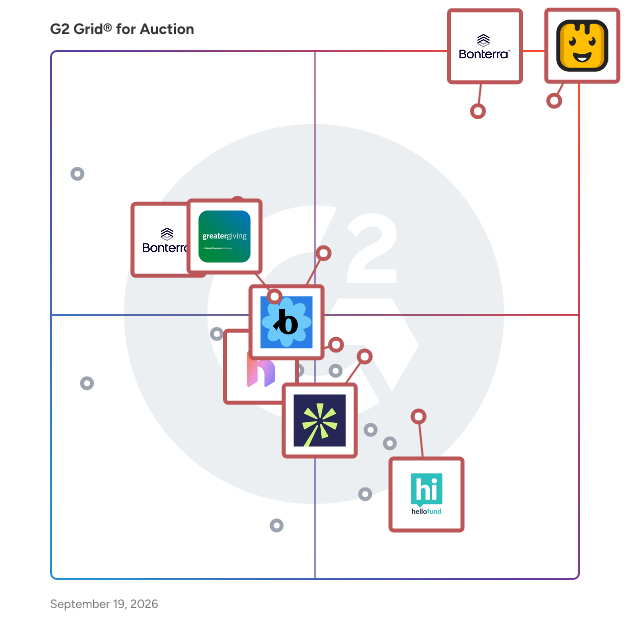
G2 takes pride in showing unbiased reviews on user satisfaction in our ratings and reports. We do not allow paid placements in any of our ratings, rankings, or reports. Learn about our scoring methodologies.
Givebutter is the most-loved nonprofit fundraising platform, empowering millions of changemakers to raise more, pay less, and give better. Nonprofits use Givebutter to replace multiple categories of t
Givebutter is a fundraising platform designed to help nonprofits collect support online, manage donations, and run fundraising campaigns. Reviewers frequently mention the ease of use, quick setup, and the platform's ability to integrate with other common platforms, making it a practical tool for managing donations and fundraising campaigns. Users reported issues with the campaign editor, stating that small layout changes require trial and error, and the flow of setting up different options can feel scattered, leading to extra clicks during the initial few edits.
Raise more and reach more donors with OneCause fundraising software. Day in and day out, we put your cause at the center of everything we do. Our easy-to-use fundraising platform is designed to meet y
Handbid’s fundraising platform powers online auctions, mobile bidding, peer-to-peer fundraisers, crowdfunding, and text to donate. Handbid includes integrated ticketing, registration, live streaming,
Reach your fundraising goals, connect with supporters, and advance your mission with Bonterra Network for Good all-in-one fundraising software. Overwhelmed by messy spreadsheets, toggling between a
Bonterra Network for Good is a platform that facilitates donor management, fundraising events, and real-time tracking of donations. Users like the platform's ability to provide historical donor data, manage fundraising events, track donations in real time, and facilitate timely communication with donors, with some users appreciating the user-friendly experience and the platform's automation features. Reviewers mentioned issues with the platform's user-friendliness, particularly in the event space and in pulling stats, the reliability of the system, limitations in customization options for the donation page and email creation software, and a limitation on the number of users.
Run impressive events that delight donors and exceed goals—without the complexity. Give your supporters impactful experiences they’ll remember, whether online, in person, or both (hybrid). Get profess
Greater Giving, a Global Payments company, is dedicated to providing technology solutions to the nonprofit community in order to improve their fundraising efforts. Greater Giving offers integrated
Giveffect is the leading fundraising, events, online donations, offline gift tracking, volunteer management, donor management and constituent relationship management software for nonprofits - and more
Giveffect is a platform that integrates donor management, fundraising, volunteer coordination, and marketing automation into a single system for nonprofit organizations. Users like the integrated system of Giveffect, which allows them to track donors, donations, volunteers, grants, and leads all in one place, and appreciate the responsive customer support and the ease of use of the platform. Users mentioned that Giveffect has a steep learning curve due to its comprehensive feature set, lacks some desired features such as a repeating campaign option and partial refund, and has some issues with household reporting and data integration.
Accelevents is a modern, enterprise-ready event management platform built for organizations that need flexibility, speed, and reliability across every phase of the event lifecycle. The platform sup
Accelevents is a platform for creating and managing hybrid, in-person, and online events, with features for adding sponsors and attendees, managing entry tickets, and tracking user behavior. Users like the intuitive platform, the efficient handling of data and roster collection, the registration and resource sharing features, the integration with Zoom, and the responsive 24/7 support. Users reported difficulties in keeping up with frequent updates, wished for more flexible customization options, and found the mobile experience and initial use of the software to be challenging.
SchoolAuction.net is an easy-to-use fundraising event software platform built to help schools and nonprofits plan, manage, and run successful fundraising events—from gala auctions to online campaigns
Givergy is on a mission to help organizations raise more funds and change charitable giving worldwide. As a certified B Corporation with an award-winning fundraising platform, Givergy offers a range
Inspire and engage donors with our smart, simple online fundraising, event, and donor management tools. GiveSmart is the easy-to-use, innovative, and modern online fundraising and donor managemen
HelloFund is an auction and event management platform built specifically for private schools, Catholic schools, and mission-driven nonprofits running high-impact fundraising events. Designed for ga
CharityAuctions is a cloud-based fundraising and auction management software platform designed for nonprofits, schools, and community organizations. The platform helps users create, manage, and promot
Auctria makes live, silent or online auction fundraisers easy & affordable for groups large and small. Handle ticket sales, bids, purchases & donations.Track donors & items. Produce printe
ClickBid is a premier event fundraising platform designed to assist nonprofits in streamlining operations during fundraising events. This comprehensive solution caters to various fundraising activitie
All auction software falls into one of two main segments: for-profit auctions and nonprofit auctions. For-profit auctions are run by auction houses and other businesses as a primary source of revenue, while nonprofit auctions are either run specifically for charity or used as a means of raising funds for the nonprofit itself. While these uses are distinct, there are tools that are able to encompass the needs of both.
More and more online and mobile auction features are employed during live or silent auctions. This allows much of the paperwork to be stored within the tool itself and makes it much easier for participants to place bids at their convenience. Rather than writing a bid on a sheet at a silent auction and circling back around to check on a bid’s status, bidders are enabled to place bids on their mobile phone and be notified when they win or are outbid. For the auction organizers, it is that much easier to see the overall performance and easily collect payments.
For organizers of fundraising events (especially charity events), silent or live auctions are often the preferred approach, so it is much easier to have an auction software that also contains ticketing and other event planning features. Charity auctions may take many forms, hence these tools are often both robust and flexible.
Regardless of whether the auction is for charity or profit, online auctions are an easily managed method of hosting an auction. While it may be difficult to assure the quality of high-end items, the ability to create an auction site, place bids in real time, automatically determine the maximum bid, and manage an unlimited number of bids makes the online forum worthwhile.
Online auction software and silent auction software are also extremely helpful for organizations that only do occasional fundraising. From creating an auction event to building an auction website, some platforms can handle all aspects of auction management so organizers can focus on building interest for the auction itself.
Key Benefits of Auction Software
Auction management software—if not online auction software—helps maintain records as well as organize the auction itself. Web-based software helps build online auctions, while auction houses may be more concerned with inventory management and accounting than highest or lowest unique bidders.
Online auctions, however, present a multitude of challenges. Creating multiple auctions at once may prove difficult, but some auction platforms are equipped to create custom websites for one or multiple auctions. Whether it is a penny auction (which requires bidders to pay their bid upfront, whether they win or lose) or a more traditional auction, online auction software keeps both organized and helps auctions run smoothly with little input.
Nonprofit organizations utilize auctions widely and there are many different solutions available for different needs. Auctions are a proven fundraising method so auction software is commonplace in the nonprofit world. Fundraising is already difficult; auction software makes the process of running an auction easy and simple so organizers can focus more on their work.
Auctioneers — Auctioneers can refer to either a contracted auction business or any business seeking to sell an array of items. An auction business may be an auction house that hosts live auctions, or it may be an auction site for online bidding. Almost any auction platform will allow users to adjust the auction format and create an auction design that fits their needs. From livestock auctions to high-end art and antiques, anyone whose business model revolves around bidding on products can benefit from using auction software.
Nonprofits — While auctioneers conduct auctions to sell inventory and generate profit, nonprofits use specifically designed auction software that enables them to conduct auctions as a fundraising event. This typically would be a silent auction that includes a live portion during a gala event, as well as an online listing for donors to bid remotely. Nonprofits use this type of software to manage event registration, auction listings, donation processing, and event communications. Nonprofits can make use of for-profit auction products, however, they benefit greatly from the added functionality that nonprofit auction or event fundraising software offers to enhance donor or guest experience.
Auction software falls into two general categories: for-profit auctions and nonprofit auctions. Within those two main categories, there are several different kinds of auction software that may be helpful. Many auction platforms may support multiple kinds of auctions, making them versatile enough to support a variety of needs.
For-profit auctions:
Live auctions — Live auctions are still widely used and require their own specialized features. Many of them involve maintaining records and catalogs in real time so auctioneers have the most up-to-date information. Live auction software may also help manage online and phone bidders during a live auction.
Online auctions — There are many different kinds of online auctions, which differ mainly in how the winner is determined. Highest and lowest unique bidder auctions choose (usually automatically) the bidder who is the only person to bid the highest or lowest amount. However users would like their auction to function, there is likely a software solution that to help them create it.
Nonprofit auctions:
Silent auctions — Silent auctions are a mainstay of fundraisers and are typically a manual affair for both guests and organizers alike. Silent auction software, however, makes it much simpler by allowing participants to place bids using their phones or computers and then notifying bidders if or when they have been outbid. Organizers can then easily process payments and keep track of what was sold to whom. This removes the tedious process of managing paper bid sheets and manual bid updates for guests.
Fundraising event auctions — Fundraising or charity events may use more than one type of auction to secure donations. With fundraising event software, organizers can run multiple kinds of auctions, manage ticketing and attendance, and collect donations all in one place. Fundraising event auction software encompasses aspects of event management platforms or event registration & ticketing software, while also primarily allowing organizers to run and manage fundraising auctions easily and efficiently.
Auction software may contain a multitude of features, all of which help auction organizers build and run a variety of auctions both online and offline.
Bidder profiles or registration — For organizers running an online auction, registering bidders is crucial for knowing who bought what, and where each item should be delivered. If bidders also have the ability to create a profile, auction owners can gain insight into bidders’ habits and which products are more popular than others. These kinds of analytics help with details such as price optimization and auction timing, as well as monitoring bidder behavior and weeding out bots or other security risks. Registration is also beneficial to the bidders, as they don’t have to keep entering information such as their address and payment information each time they place a bid. For a live auction, bidder registration makes auction resolution much smoother if payment, contact information, and other important details are collected upfront.
Bidding styles — The advantage of auction software is that the bidding style can be set at the beginning of an auction; all bidding information is then filtered through these rules to determine an outcome. For instance, an online auction can easily become a lowest unique bidder auction with little to no work on the part of the organizer, with the winner automatically chosen at the end of the auction given the set parameters.
Inventory management — Auctions wouldn’t exist without inventory, so it’s crucial to have up-to-date, accurate information about what is and is not available. For live auctions, lots can be easily cataloged and maintained before and after the auction. For online auctions, inventory is managed in real time as auctions close, so nothing is sold more than once. Some products also allow for printable listings to be designed for guests to refer to during a live or silent auction.
Payment collection and processing — For online auctions especially, gathering payment is a crucial step. With most auction software, this is easy, since many tools include built-in payment gateways. Security goes hand in hand with payment, so most auction tools with a payment gateway will have some kind of security measure to ensure customer information is safe. Some online platforms may allow customers to add payment information to their profile, making it easier for all parties to complete the transaction.
Website design — Both live and online auction tools may contain features that allow organizers to create custom websites for their auction. Whether that’s simply an informational website or a fully online auction, that depends on both the tool and the user. The advantages of having a custom auction website are huge. Websites help tremendously with marketing and creating interest, especially for a charity event. If the auction is occurring entirely online, a website is a major requirement.
Photo gallery — Both online auctions and live auctions can benefit from photo galleries showing the items being auctioned. Online auctions especially require this function, as customers will likely not see the actual product until it arrives if they win the auction. Photo galleries allow organizers to post multiple photos of each item so bidders can get a full idea of what they are buying.
Event management — Some auction software contains event planning features that are especially useful for planning fundraiser events that feature auctions. Guest ticketing and registration is a major component of this feature, making it easy to manage attendance. Custom websites also play a part in this, making it easy for people to register for the event and buy tickets online. They can even potentially view the auction lots and make advance bids, helping organizers estimate how many donations they will receive.
Mobile bidding — Modern auction software allows for guests to make bids via text message and can receive automated updates whenever they are outbid. Auctioneers can also utilize a mobile interface to send mass notifications to auction attendees and monitor auction statuses.
Donation collection — Specifically for nonprofit auction products, bidders can make general donations to the organization in addition to bidding on specific auction listings. Some products allow for organizations to redirect bidders directly to a website donation page, while others will collect payment and segment it from auction revenue when nonprofits pull end-of-auction financial reports.
Reporting — Once auctions are concluded, users can pull financial and inventory reports for accounting purposes. These are useful to ensure all bids are collected before items are shipped (for online auctions) and can provide year-over-year performance analysis for auctions.
For the most part, auction software can be configured to work for standard auctions, regardless of being for-profit or nonprofit. Buyers, however, should be aware of specialized auction products that may not suit their needs, particularly in the case of reverse auctions or automobile auctions. Reverse auctions commonly refer to the procurement process for businesses, in which the roles of buyer and seller are reversed. Public sector agencies most commonly utilize these to receive service bids from interested parties. Dedicated software solutions manage the procurement auction process, but these would not be usable by those seeking to run a traditional auction for listing items.
In the case of automobile auctions, standard auction products may lack the functionality to list all the required information when listing cars for interested buyers. Specialized auto auction marketplaces are designed to comply with legal compliance when selling and purchase automobiles. Other automotive software contains auction products specifically for selling automobiles.