# Best Marketing Analytics Tools - Page 33

  *By [Emma Stein](https://research.g2.com/insights/author/emma-stein)*

   Marketing analytics software encompasses tools and processes that enable an organization to manage, evaluate, and control its marketing efforts by measuring marketing performance. These solutions simplify and optimize a business’s marketing strategies and activities. With the use of marketing analytics software, businesses can improve their return-on-investment (ROI) by identifying effective marketing methods and adjusting campaigns to maximize conversions and sales.

Marketing analytics considers marketing efforts across all channels and audiences, including email marketing, social media, digital advertising, and web analytics. Marketing analytics software is usually offered as a standalone solution. These products source campaign data through integrations with a company’s marketing technology stack, including [marketing automation software](https://www.g2.com/categories/marketing-automation), [CRM software](https://www.g2.com/categories/crm), [digital advertising software](https://www.g2.com/categories/digital-advertising), and [digital analytics software](https://www.g2.com/categories/digital-analytics). However, many all-in-one marketing platforms, such as marketing automation products, include built-in reporting features.

Marketing analytics solutions source data from marketing tools, and their core functionality is to analyze marketing campaign-oriented information. Some companies opt to use [analytics platforms](https://www.g2.com/categories/analytics-platforms) or [embedded business intelligence software](https://www.g2.com/categories/embedded-business-intelligence) instead, which can also provide insights into company data from a variety of other sources in addition to marketing data.

To qualify for inclusion in the Marketing Analytics category, a product must:

- Collect data on marketing campaigns distributed across a variety of media channels
- Monitor marketing campaigns and targeted audiences to identify the results
- Analyze the results and compile data of marketing campaigns
- Integrate with sales, marketing, and other analytics software through which users can source marketing data
- Visualize marketing campaign performance via an analytics dashboard or similar visualization features, including data such as key performance indicators, clicks, ROI, or other marketing engagement statistics


## Category Overview

**Total Products under this Category:** 529


## Trust & Credibility Stats

**Why You Can Trust G2's Software Rankings:**

- 30 Analysts and Data Experts
- 65,400+ Authentic Reviews
- 529+ Products
- Unbiased Rankings

G2's software rankings are built on verified user reviews, rigorous moderation, and a consistent research methodology maintained by a team of analysts and data experts. Each product is measured using the same transparent criteria, with no paid placement or vendor influence. While reviews reflect real user experiences, which can be subjective, they offer valuable insight into how software performs in the hands of professionals. Together, these inputs power the G2 Score, a standardized way to compare tools within every category.


## Best Marketing Analytics Software At A Glance

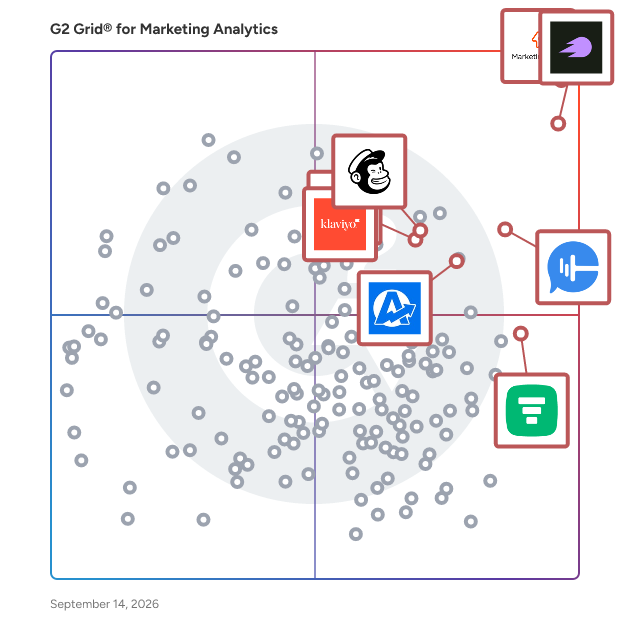
- **Leader:** [HubSpot Marketing Hub](https://www.g2.com/products/hubspot-marketing-hub/reviews)
- **Highest Performer:** [Trackdesk](https://www.g2.com/products/trackdesk/reviews)
- **Easiest to Use:** [Evam](https://www.g2.com/products/evam/reviews)
- **Top Trending:** [Klaviyo](https://www.g2.com/products/klaviyo/reviews)
- **Best Free Software:** [HubSpot Marketing Hub](https://www.g2.com/products/hubspot-marketing-hub/reviews)


---

**Sponsored**

### Contentful

Contentful is a digital experience platform (DXP) designed for marketers, developers, and digital teams who need to build, personalize, and deliver impactful experiences across every channel—quickly and at scale. By combining its headless CMS with native, contextual AI, Contentful enables rapid creation, seamless management, and consistent omnichannel delivery of on-brand, data-driven content. Contentful empowers teams to adapt, reuse, personalize, and publish modular content and design components without reliance on developers, enabling rapid iteration and real-time targeting, experimentation, and optimization at the component level. Complemented by a robust ecosystem, and built on an infinitely-extensible, API-first platform, Contentful gives teams the freedom to easily build or deploy new experiences and integrations quickly to meet the ever-evolving needs of their brand. Trusted by global market leaders, Contentful is engineered for enterprise reliability, extensibility, and future-proof growth—helping organizations maximize ROI and outperform in today’s competitive digital landscape.


[Book a Demo](https://www.g2.com/external_clickthroughs/record?secure%5Bad_program%5D=ppc&amp;secure%5Bad_slot%5D=category_product_list&amp;secure%5Bcategory_id%5D=624&amp;secure%5Bdisplayable_resource_id%5D=624&amp;secure%5Bdisplayable_resource_type%5D=Category&amp;secure%5Bmedium%5D=sponsored&amp;secure%5Bplacement_reason%5D=page_category&amp;secure%5Bplacement_resource_ids%5D%5B%5D=624&amp;secure%5Bprioritized%5D=false&amp;secure%5Bproduct_id%5D=4941&amp;secure%5Bresource_id%5D=624&amp;secure%5Bresource_type%5D=Category&amp;secure%5Bsource_type%5D=category_page&amp;secure%5Bsource_url%5D=https%3A%2F%2Fwww.g2.com%2Fcategories%2Fmarketing-analytics%2Fsmall-business&amp;secure%5Btoken%5D=5fcb8d1f3df1e314d83517e6076c63ea374daa74a4b5fbc7c6a3db16c53f5296&amp;secure%5Burl%5D=https%3A%2F%2Fwww.contentful.com%2Fproducts%2Fpersonalization%2F%3Fnt_experiences%3D9BZdShPA4TYFUwHsEmNZi%3D0%26utm_source%3Dg2%26utm_medium%3Dpaid%26utm_campaign%3Dfy27-q1-global-inbound_competitor&amp;secure%5Burl_type%5D=book_demo)

---


## Parent Category

[Marketing Software](https://www.g2.com/categories/marketing)


## Related Categories

- [Digital Analytics Software](https://www.g2.com/categories/digital-analytics)
- [Marketing Automation Software](https://www.g2.com/categories/marketing-automation)
- [Attribution Software](https://www.g2.com/categories/attribution)


---

## Buyer Guide

### What You Should Know About Marketing Analytics Software

### What is Marketing Analytics Software?

Marketing analytics software helps businesses gather data from multiple sources and channels to identify which marketing initiatives are performing well and which have room for improvement. Leveraging marketing analytics software is imperative when calculating ROI on marketing campaigns, which help optimize digital marketing spend. Finally, with the help of marketing analytics tools, marketers can operate more efficiently by learning how to better allocate their time.

Marketing metrics and marketing analytics are completely different, and it’s important to note the distinction. Marketers are inundated with metrics, or data points, that they can use to dictate marketing activities and boost customer satisfaction. However, without analytics, marketers won’t be able to take that next step. Marketing analytics puts those metrics into context, turning them into actionable insights and helping drive revenue.

#### What Types of Marketing Analytics Software Exist?

While the overall goal of a marketing analytics platform is to help marketers measure and optimize marketing performance, the methods and tools used to accomplish this goal can vary from product to product. Selecting the optimal software for a business is a matter of finding a product that integrates well with their existing technology stack.

[**Standalone solutions**](https://www.g2.com/categories/marketing-analytics/f/standalone)

Standalone marketing analytics tools connect to multiple data sources and marketing channels to measure campaign performance. These products typically integrate with [marketing automation software](https://www.g2.com/categories/marketing-automation), [CRM software](https://www.g2.com/categories/crm), [digital advertising software](https://www.g2.com/categories/digital-advertising), and [digital analytics software](https://www.g2.com/categories/digital-analytics). Standalone platforms collect and consolidate marketing campaign data from these disparate sources, enabling marketers to analyze campaign performance across channels and audiences. While standalone products may include tools for optimizing digital ads, they do not provide built-in capabilities for executing omnichannel marketing campaigns.

[**All-in-one marketing suites**](https://www.g2.com/categories/marketing-analytics/f/all-in-one-marketing-suite)

All-in-one marketing suites help marketers plan, execute, and measure cross-channel marketing campaigns. In addition to marketing analytics, these end-to-end solutions provide features for implementing marketing campaigns through email, social media, display ads, landing pages, and more. All-in-one marketing suites can include marketing automation software and [account-based marketing](https://www.g2.com/categories/account-based-marketing) platforms.

### Which software is best for marketing metrics analysis?

Selecting the best software for marketing metrics analysis depends on your business size, specific needs, and the features that you want to achieve your goals. Here are some of G2&#39;s top contenders, each excelling in different areas:

- [HubSpot Analytics](https://www.g2.com/products/hubspot-marketing-hub/reviews): Best for inbound marketing analytics, lead tracking, and email campaign performance.
- [AgencyAnalytics](https://www.g2.com/products/agencyanalytics/reviews): Best for client reporting across multiple channels.
- [Supermetrics](https://www.g2.com/products/supermetrics/reviews): Best for data integration across 150+ platforms and trusted by major brands.

### What are the Common Features of Marketing Analytics Software?

To bolster accountability and help marketers seize more control over their company&#39;s strategic revenue generation goals, marketers need to have the ability to measure the performance of their entire marketing funnel. Below are some marketing analytics software features that help leverage marketing data to drive actionable results.

**Data collection:** Before analyzing data and turning it into actionable insights, marketers will need to use marketing analytics solution to collect data on all of their marketing campaigns. This type of software can collect data on the campaigns distributed across a variety of channels. This data is essential to kickstart the process of collecting insights into the customers’ and prospects’ preferences and history.

**Return on investment (ROI):** Marketers have numerous metrics to potentially analyze, which can often lead to data paralysis. Marketing analytics software helps marketers make sense of all those metrics and determine the effectiveness and ROI of marketing campaigns. Marketers must not only optimize marketing strategies but also prove and improve ROI to present to executive leaders within their company. The ROI measurement feature within the marketing analytics tools can quantify the outcome of every marketing investment users make.

**Reports and dashboards:** It’s imperative to not only analyze data but to also showcase analysis within a report to present the findings. Marketing analytics software help generate visualizations and reports for the entire marketing funnel from acquisition to close. These reports and custom dashboards gather closed-loop reporting on all marketing initiatives. Within some reporting features, users can drill down into specific data points or filter by certain criteria to uncover trends and take action for future campaigns. Marketing analytics software enable marketers to track all of this data in one place to easily analyze and share with the rest of their team and company. Finally, this feature will empower marketers to make accurate forecasting decisions for their future marketing goals and strategies.

**Attribution reports:** Attribution reporting helps analyze touchpoints or marketing channels that should receive credit for a conversion. There are various attribution models that marketing analytics software can provide, including last interaction attribution, first click attribution, and multi-touch attribution models that consist of linear attribution, time decay attribution, and position-based attribution. The last interaction attribution model gives credit to the last traffic source that resulted in the conversion of a consumer. First click attribution models are the opposite of that, wherein it gives all the credit to the first channel a consumer visited.

Multi-touch attribution uses weighted modeling to be able to allocate credit across multiple channels, campaigns, and touchpoints. Linear attribution is a form of multi-touch attribution that distributes credit evenly across every touchpoint in the buyer journey. Time decay attribution gives more credit to the touchpoints closest to the buyer’s conversion and less credit to the prior touchpoint. Finally, position-based attribution gives credit to two key touchpoints: the first touch that gets the visitor in the door and the last touch when a lead converts. These two touches get 40% of the credit and the remaining touchpoints equally split the remaining 20%.

**Multichannel tracking:** To be able to paint a complete picture around marketing campaign effectiveness, it’s important to gather and analyze data across a variety of marketing channels. Multichannel tracking helps collect marketing performance data across numerous marketing channels, such as email, social media, SMS, display ads, search engine marketing, and landing pages, to allow marketers to deliver targeted and timely marketing content to their intended audience.

### What are the Benefits of Marketing Analytics Software?

Businesses of all sizes and across all industries can benefit from marketing analytics software because it empowers them to make better decisions about digital marketing strategies. Executive leadership teams expect a story behind metrics, or reasoning to back up marketing decisions. Marketing analytics tools enable a business to measure their key performance indicators (KPIs) and provide the reasoning to back up marketing choices. This results in a better understanding of what channels to use and why, along with effective resource allocation.

**Actionable insights:** Marketing analytics software empowers marketers to make informed, proactive decisions around their marketing strategy. Actionable insights infer strategic and tactical next steps, which will allow users to set marketing goals before they even start collecting any data. That can directly tie back to their business objectives to prove ROI. Actionable insights answer questions such as:

- What is the marketing channel that should be focused on?
- What content is resonating well with the target audience?
- How should a business prioritize their marketing budget next year?

**Real-time insights:** An enormous benefit that comes from marketing analytics is the ability to take in-the-moment data on how customers or prospects are interacting with their brand and make decisions in real time. Real-time data has completely changed how marketers interact with their consumers, as they can immediately target a consumer’s preferences based on their current interactions and conversations. Marketing analytics software allows companies to leverage real-time data, enabling them to then adjust marketing strategy and demonstrate expertise in a specific area or topic. Some marketing analytics products incorporate machine learning to gain even deeper insights from data in real time.

### Who Uses Marketing Analytics Software?

Unsurprisingly, marketers find the greatest benefit from using marketing analytics tools. A company’s entire marketing team must take a holistic view of their marketing analytics, as it will drive decisions that impact the overall marketing strategy within a business. Social media marketers and digital marketers are two main roles that examine marketing analytics, although other specialized marketers would also benefit from marketing analytics software to optimize their campaigns, including field marketers, event marketers, marketing generalists, etc. Marketing analytics software helps any marketer address three essential areas of marketing performance management: optimization, attribution, and justification.

For small or new businesses that may not have the resources to hire an in-house marketing team, a marketing agency would also be able to use marketing analytics software to align with a company’s goals. Marketing agencies can leverage marketing analytics tools to inform a business on where their marketing dollars would be best used, as well as present an ROI analysis for any campaigns deployed by the agency.

### What are some popular marketing analytics platforms for businesses?

Whether your company is a [small business](https://www.g2.com/categories/marketing-analytics/small-business) or an [enterprise](https://www.g2.com/categories/marketing-analytics/enterprise), these are some popular marketing analytics platforms that are versatile for all businesses:

- [Google Analytics (GA4)](https://www.g2.com/products/google-analytics/reviews): Features website traffic analysis, user behavior, and conversion tracking. Fit for all business sizes.
- [Mixpanel](https://www.g2.com/products/mixpanel/reviews): Focuses on product and user behavior analytics. Powerful tool for product-led strategies at any scale.
- [Semrush:](https://www.g2.com/products/semrush/reviews) Used for domain comparisons, keyword research, competitor ad analysis, and historical data access. Fit for SMBs up to enterprise-level companies.

### What are the Alternatives to Marketing Analytics Software?

Alternatives to marketing analytics software can replace this type of software, either partially or completely:

[Analytics platforms](https://www.g2.com/categories/analytics-platforms) **:** Analytics platforms, also known as business intelligence (BI) platforms, help businesses assemble, manage, and analyze business data to uncover actionable insights. While analytics platforms can be used to analyze digital marketing data, these products often provide a much more robust set of features for modeling, blending, and discovering large datasets. Analytics platforms are typically used by data analysts or business analysts, while marketing analytics software is designed to be easier for marketing professionals to use.

[Digital analytics software](https://www.g2.com/categories/digital-analytics) **:** Digital analytics software, also known as web analytics software, tracks website visitors, measures web traffic, and helps determine how visitors are finding and interacting with websites and landing pages. This type of software also aims to optimize customer experiences and does so by measuring and analyzing metrics like web sessions, unique visitors, user entry, and exit pages. Marketers can use digital analytics software to track clicks and conversion rates on performance marketing campaigns.

#### Software Related to Marketing Analytics Software

Related solutions that can be used together with marketing analytics software include:

[Customer journey analytics](https://www.g2.com/categories/customer-journey-analytics) **:** Marketing analytics is an important part of understanding and improving the customer journey. Customer journey analytics software takes this a step further by enabling marketers to visualize customer behavior across channels and optimize future customer interactions. These products combine customer data with marketing insights to create a 360-degree view of customers and the customer journey.

[Social media analytics software](https://www.g2.com/categories/social-media-analytics) **:** This type of software, like marketing analytics, helps companies gain a better understanding of consumers’ desires and responsiveness but gathers and reports on data solely related to social media accounts. Social media analytics software can help track how people engage with the content users post on social media in terms of likes, comments, and shares.

[SEO software](https://www.g2.com/categories/seo) **:** Search engine optimization (SEO) software offers a variety of tools to help businesses improve their rankings in search engines. Some marketing analytics products may include features of SEO software like rank tracking.

[Content analytics software](https://www.g2.com/categories/content-analytics) **:** Any visitor interactions with their published content, including blogs, articles, on-demand webinars, etc., can be measured and interpreted to help gain visibility to drive future content marketing strategies. Metrics measured by content analytics software include page views and shares, outbound clicks, search rankings, and average time spent on individual posts. Additionally, content analytics software can help users stay on top of the most recent and popular content published by their competitors.

[Attribution software](https://www.g2.com/categories/attribution) **:** Marketing attribution reports are available within some marketing analytics software. Similarly, attribution software can be used by companies to help determine how actions, events, or touchpoints throughout the customer lifecycle contribute to the success of marketing efforts. This type of software commonly integrates with software solutions used by sales, marketing, or public relations departments, like CRM, marketing automation, email marketing, email tracking, demand generation, or sales analytics tools.

### Challenges with Marketing Analytics Software

Implementing a new software solution can come with its own set of challenges, and marketing analytics software is no exception. Before purchasing a product, it’s imperative to be aware of the potential issues that may arise and how to address them.

**Data volume and accuracy:** Even with marketing analytics tools, if the metrics users are analyzing aren’t accurate, they won’t gain valuable insights. If businesses use third-party data, they run the risk of gathering inaccurate data since they won’t have a direct relationship with those users. Additionally, with so many channels, activities, and methods of gathering data, the sheer quantity of data can be overwhelming. As digital marketing continues to grow, marketers are producing more data than ever before. Marketing analytics software helps marketers analyze large amounts of data from social media platforms, email marketing, website analytics, and CRM systems, to name a few.

**Privacy concerns:** More often than not, anything related to data is going to bring with it privacy concerns. Consumers are warier now about how their personal data is being collected and used. Marketing analytics tools collect data on everyone in their marketing funnel, from first interaction to conversion, and throughout those touchpoints, marketers can gain an abundance of metrics that will provide competitive advantages. It’s important to stay abreast of new data privacy laws and restrictions and how they can impact marketing analytics.

### How to Buy Marketing Analytics Software

#### Requirements Gathering (RFI/RFP) for Marketing Analytics Software

Whether a company is purchasing marketing analytics software for the first time or looking to replace their current system, G2.com can assist them with the selection process.

First, buyers should evaluate the need for marketing analytics software and determine what functionality will be most useful for the business. For example:

- What are their business’ goals in purchasing a marketing analytics product?
- What are the marketing channels they want to track now and in the future?
- Does the product need to integrate with any other software?
- What analytics features, if any, are already available in their current marketing technology stack?
- What is their budget?

#### Compare Marketing Analytics Software Products

**Create a long list**

Based on the list of requirements, buyers should create a long list of no more than 10 products that appear to meet the business needs. Consulting online review sites is a great way to start the long list. G2’s marketing analytics software category can help buyers find the highest rated or most popular products based on reviews from verified customers.

**Create a short list**

After creating a long list, buyers should narrow down their selections by eliminating the products that won’t meet their business needs. Pricing, integrations, and customer support may be factors that contribute to a product’s suitability.

**Conduct demos**

Once a short list of about three to five products is ready, companies should begin reaching out to vendors to schedule demos. Demos allow buyers to take a closer look at each product’s functionality and ease of use. This may also be the first opportunity to glimpse each vendor’s onboarding style and service levels.

#### Selection of Marketing Analytics Software

**Choose a selection team**

When it comes to purchasing a marketing analytics solution, the selection team should primarily consist of executives, managers, and individual contributors in the marketing department. The selection team should also consist of a project manager to coordinate efforts and ensure the process runs smoothly.&amp;nbsp;

**Negotiation**

Before signing a contract, buyers should make sure to negotiate for the best price and ask about any discounts for which their business may qualify. This is also the time to discuss implementation and onboarding services and payment plans.

**Final decision**

In the days and months after signing the contract, buyers should monitor the company’s progress with the new marketing analytics product. Is the product working as intended? Have employees fully adopted the product’s features? Will the product scale with the company’s growth? If the answer to any of these questions is “no,” the buyer should consider raising the concerns with the vendor. If they are unable to resolve these issues, it may be time to look for alternatives.

### Marketing Analytics Software Trends

**AI-powered optimization**

As artificial intelligence (AI) becomes more widely available and less costly to implement, many marketing analytics vendors are enhancing their products with AI optimization. By incorporating [machine learning](https://learn.g2.com/machine-learning) into marketing analytics, these AI-powered products enable marketers to process vast amounts of data and make predictions about marketing campaigns. Products leverage AI in different ways, such as optimizing marketing spend or adjusting bids on pay-per-click campaigns to improve ROI.

### Marketing Analytics Tools FAQs

### Most Popular FAQs

#### Which Marketing Analytics Tools have the best reviews?

Based on thousands of verified G2 reviews, these marketing analytics platforms consistently earn the highest ratings across real user experiences:

- [Trackdesk](https://www.g2.com/products/trackdesk/reviews) — An affiliate and partnership tracking platform that gives marketing teams full visibility into partner-driven revenue, praised for its intuitive setup, reliable tracking accuracy, and strong customer support responsiveness.
- [WhatConverts](https://www.g2.com/products/whatconverts/reviews) — A lead tracking and attribution platform built for marketing agencies and performance teams, consistently top-rated for its ability to connect phone calls, form fills, and chat leads back to specific campaigns and keywords.
- [Evam](https://www.g2.com/products/evam/reviews) — A real-time customer journey analytics and engagement platform that enables marketers to build event-driven personalization at scale, earning high marks from enterprise reviewers for its flexibility and data processing speed.
- [Clarisights](https://www.g2.com/products/clarisights/reviews) — A marketing reporting and analytics platform built for performance marketing teams, recognized for unifying cross-channel data into fast, actionable dashboards without requiring SQL or engineering support.

#### What are marketing analytics tools?

Marketing analytics tools are software platforms that collect, organize, and interpret data from marketing campaigns, channels, and customer interactions to help teams understand what&#39;s working, what isn&#39;t, and where to invest next. At their core, they solve a fundamental visibility problem: marketing activity generates data across dozens of disconnected channels—paid search, email, social, affiliate, organic, and more—and without a dedicated analytics layer, it&#39;s impossible to see how those channels interact, which touchpoints drive conversions, and how marketing spend translates into revenue.&amp;nbsp;

Modern marketing analytics tools range in scope from single-channel attribution platforms that track call or form conversions, to cross-channel data aggregators that pull from APIs and ad platforms, to full customer journey analytics engines that model multi-touch attribution and predict future behavior. The most capable platforms combine data ingestion, visualization, and AI-powered insight generation in one place—enabling marketers to move from reporting on the past to making data-driven decisions about the future.

#### Which software is best for marketing metrics analysis?

Marketing metrics analysis requires tools that can ingest data from multiple sources, surface the right KPIs without overwhelming users, and generate insights that inform real decisions rather than just produce reports. These platforms are consistently top-rated by marketing analysts and performance marketers on G2:

- [Semrush](https://www.g2.com/products/semrush/reviews) — A comprehensive digital marketing analytics suite covering SEO, PPC, content, and competitive intelligence, widely used by marketing teams that need a unified view of organic and paid performance metrics in one platform.
- [AgencyAnalytics](https://www.g2.com/products/agencyanalytics/reviews) — A marketing reporting platform designed for agencies that aggregates metrics from over 80 data sources into customizable dashboards and white-labeled client reports, reducing reporting time significantly.
- [Dreamdata](https://www.g2.com/products/dreamdata/reviews) — A B2B revenue attribution platform that maps every marketing touchpoint to pipeline and revenue, giving marketing teams the metrics they need to prove ROI and make confident budget allocation decisions.
- [Dataslayer.ai](https://www.g2.com/products/dataslayer-ai/reviews) — A data connector and reporting tool that pipes marketing platform data directly into Google Sheets, Looker Studio, and BigQuery, enabling analysts to build custom metric dashboards without engineering dependency.

#### What are the best tools for analyzing marketing performance?

Analyzing marketing performance end-to-end—from impression to revenue—requires tools that bridge the gap between campaign execution data and business outcomes. These platforms earn the strongest marks from performance marketers and marketing ops professionals on G2:

- [HubSpot Marketing Hub](https://www.g2.com/products/hubspot-marketing-hub/reviews) — An all-in-one marketing platform with built-in analytics that connects campaign performance to contact activity, pipeline influence, and revenue, making it the default performance analysis tool for teams already running HubSpot CRM.
- [Singular](https://www.g2.com/products/singular/reviews) — A marketing analytics and attribution platform for mobile and multi-channel campaigns, combining cost aggregation, ROI analytics, and fraud detection to give performance marketing teams a complete view of campaign efficiency across every channel.
- [CleverTap](https://www.g2.com/products/clevertap/reviews) — A customer engagement and retention analytics platform that gives mobile-first marketing teams deep behavioral insights, funnel analysis, and segmentation capabilities to optimize campaigns based on how users actually interact with products.
- [CallRail](https://www.g2.com/products/callrail/reviews) — A call tracking and conversation analytics platform that closes the attribution gap for businesses where phone calls are a primary conversion, linking inbound calls back to specific campaigns, keywords, and landing pages.

#### Leading marketing analytics software solutions

The marketing analytics category spans a wide range of use cases—from affiliate tracking and call attribution to full customer journey modeling and AI-powered campaign optimization. These platforms represent the most broadly adopted and consistently well-reviewed solutions across the G2 category:

- [HubSpot Marketing Hub](https://www.g2.com/products/hubspot-marketing-hub/reviews) — The most widely reviewed marketing analytics platform on G2, offering integrated campaign tracking, contact-level reporting, and revenue attribution built into a full marketing automation suite used by teams of all sizes.
- [Semrush](https://www.g2.com/products/semrush/reviews) — A market-leading digital intelligence platform that combines SEO analytics, competitive research, paid ad analysis, and content performance tracking, making it a foundational tool for marketing teams focused on search-driven growth.
- [WebEngage](https://www.g2.com/products/webengage/reviews) — A customer data and engagement analytics platform popular across Asia-Pacific markets, combining behavioral analytics, journey orchestration, and campaign performance measurement for consumer-facing digital businesses.
- [GetResponse](https://www.g2.com/products/getresponse/reviews) — A marketing platform with strong analytics capabilities across email, automation, and landing pages, frequently cited by marketers for its clear performance dashboards and actionable campaign insights.

### Small Business FAQs

#### What is the most affordable Marketing Analytics Tool for SMBs?

Small businesses need marketing analytics that deliver real visibility into campaign performance without enterprise-level pricing or complex implementation. Based on G2 review data from companies under 200 employees, these platforms offer the strongest value for cost-conscious teams:

- [AgencyAnalytics](https://www.g2.com/products/agencyanalytics/reviews) — A marketing reporting platform with transparent, agency-friendly pricing that small businesses and freelance marketers use to consolidate analytics from multiple channels into a single dashboard without paying for tools they don&#39;t need.
- [GetResponse](https://www.g2.com/products/getresponse/reviews) — An all-in-one marketing platform with competitive pricing that bundles email analytics, automation reporting, and campaign performance dashboards into a single subscription accessible to small business budgets.
- [Dataslayer.ai](https://www.g2.com/products/dataslayer-ai/reviews) — A data connector tool with accessible pricing that lets small marketing teams pull analytics from Google Ads, Meta, and other platforms directly into Google Sheets or Looker Studio—without needing a dedicated analytics engineer.
- [Coefficient](https://www.g2.com/products/coefficient/reviews) — A spreadsheet-native data connector that syncs marketing and CRM data directly into Google Sheets or Excel, offering an affordable analytics layer for small teams that already work in spreadsheets and don&#39;t want to invest in a dedicated BI tool.

#### What is the best Marketing Analytics Tool for startups?

Startups need marketing analytics that set up quickly, connect to the tools they&#39;re already using, and surface actionable insights without requiring a dedicated data team. These platforms are consistently top-rated by startup and early-stage company reviewers on G2:

- [Trackdesk](https://www.g2.com/products/trackdesk/reviews) — A fast-deploying affiliate and partnership tracking platform built for startups launching partner programs, with no setup complexity and clear revenue attribution that lets early-stage marketing teams prove channel ROI from day one.
- [WhatConverts](https://www.g2.com/products/whatconverts/reviews) — A lead tracking and attribution platform that startup marketing teams use to close the gap between ad spend and actual leads, connecting campaigns to real conversions across calls, forms, and chat without requiring engineering work.
- [Dreamdata](https://www.g2.com/products/dreamdata/reviews) — A B2B revenue attribution platform designed for growth-stage SaaS teams that need to understand which marketing activities are actually driving pipeline, with integrations to HubSpot, Salesforce, and ad platforms that startups commonly use.
- [Detrics](https://www.g2.com/products/detrics/reviews) — A marketing analytics platform that aggregates data from all major advertising and analytics platforms into a unified dashboard, helping startup marketing teams eliminate manual reporting and focus on performance optimization.

#### Which Marketing Analytics Tool is the most user-friendly for startups?

Ease of use is critical for startup teams where the person doing analytics is often also running campaigns—there&#39;s no room for tools that require deep technical expertise or lengthy onboarding. These platforms earn the highest ease-of-use scores from startup-stage reviewers on G2:

- [WhatConverts](https://www.g2.com/products/whatconverts/reviews) — Startup reviewers consistently highlight WhatConverts for its intuitive setup and clean reporting interface, noting that non-technical marketers can get meaningful attribution insights running within hours of connecting their ad accounts.
- [AgencyAnalytics](https://www.g2.com/products/agencyanalytics/reviews) — A reporting platform praised by small teams for its drag-and-drop dashboard builder and pre-built integrations that make building a full marketing analytics view accessible to users without a data or analytics background.
- [Swydo](https://www.g2.com/products/swydo/reviews) — A marketing reporting tool designed around simplicity, with automated report templates and clean visualizations that startup marketers cite for making cross-channel performance reporting fast and easy to share with stakeholders.
- [Coefficient](https://www.g2.com/products/coefficient/reviews) — A Google Sheets and Excel-native analytics connector that startup teams find immediately intuitive because it works inside a tool they already know, syncing live marketing data without requiring a new platform to learn.

#### What is the best marketing analytics tool for eCommerce businesses?

eCommerce marketing teams need analytics that connect ad spend to actual purchase behavior—tracking attribution across paid social, search, email, and affiliates while accounting for the complexity of multi-session purchase journeys. Explore purpose-built options on G2&#39;s[marketing analytics tools for small businesses](https://www.g2.com/categories/marketing-analytics/small-business) page. These platforms earn the highest marks from eCommerce marketers on G2:

- [Klaviyo](https://www.g2.com/products/klaviyo/reviews) — An email and SMS marketing platform with deep eCommerce analytics built in, connecting campaign performance directly to product revenue, customer lifetime value, and purchase behavior data from Shopify, WooCommerce, and other platforms.
- [Singular](https://www.g2.com/products/singular/reviews) — A cross-channel attribution and ROI analytics platform popular with eCommerce and mobile-first brands for its ability to unify paid performance data across every channel and surface true cost-per-acquisition at a granular level.
- [Chargeflow](https://www.g2.com/products/chargeflow/reviews) — An AI-powered chargeback automation and analytics platform used by eCommerce businesses to track dispute patterns, identify fraud trends, and recover lost revenue from chargebacks without manual intervention.
- [Mouseflow](https://www.g2.com/products/mouseflow/reviews) — A behavioral analytics platform that gives eCommerce teams heatmaps, session recordings, and funnel analytics to understand how visitors interact with product pages and identify friction points that are costing conversions.

#### What marketing analytics tools are best for marketing agencies?

Marketing agencies need analytics platforms that handle multi-client reporting efficiently, white-label client-facing dashboards, and connect to the wide variety of ad platforms and CRM tools their clients use—without requiring a dedicated data engineer for each account. Explore top-rated options on G2&#39;s[small business marketing analytics tools](https://www.g2.com/categories/marketing-analytics/small-business) page:

- [AgencyAnalytics](https://www.g2.com/products/agencyanalytics/reviews) — The most widely adopted marketing reporting platform for agencies on G2, offering 80+ integrations, white-labeled dashboards, and automated client report delivery that agencies use to cut monthly reporting time while maintaining a professional client experience.
- [Swydo](https://www.g2.com/products/swydo/reviews) — A marketing reporting tool built specifically for agency workflows, with automated report scheduling, customizable templates, and multi-client data management that lets account managers produce consistent, on-brand reports at scale.
- [Dataslayer.ai](https://www.g2.com/products/dataslayer-ai/reviews) — A data connector that agency analysts use to pull client marketing data directly into Google Sheets and Looker Studio, enabling fully custom reporting without paying for a full BI platform for every client account.
- [Adreil](https://www.g2.com/products/adriel/reviews) — A creative analytics and ad performance platform that agencies use to monitor campaign performance across all client accounts in a unified workspace, with AI-powered anomaly detection that flags underperforming creatives before they waste budget.

### Enterprise FAQs

#### What is the best-rated Marketing Analytics Tool for tech enterprises?

Technology companies at enterprise scale have distinct analytics requirements: complex multi-touch B2B buying journeys, long sales cycles involving multiple stakeholders, and a need to connect marketing activity directly to pipeline and revenue in a CRM. Based on G2 review data from IT and software companies at enterprise scale, these platforms earn the strongest ratings:

- [HockeyStack](https://www.g2.com/products/hockeystack/reviews) — A revenue attribution and analytics platform purpose-built for B2B SaaS companies, combining multi-touch attribution, account-level journey mapping, and pipeline influence reporting that tech enterprise marketing teams use to justify spend and optimize go-to-market strategy.
- [RevSure](https://www.g2.com/products/revsure/reviews) — An AI-powered pipeline analytics and marketing attribution platform that tech enterprise revenue teams use to predict pipeline health, understand funnel conversion rates, and attribute marketing influence on deals at every stage.
- [CaliberMind](https://www.g2.com/products/calibermind/reviews) — A B2B marketing analytics platform that unifies data from CRM, MAP, and ad platforms to deliver account-based attribution, funnel analytics, and marketing-to-revenue reporting for enterprise demand generation teams.
- [Dreamdata](https://www.g2.com/products/dreamdata/reviews) — A B2B revenue attribution platform that tech enterprise marketing teams use to model multi-touch attribution across complex buying journeys, connecting every digital touchpoint to closed revenue in a way that finance and leadership can trust.

#### What is the most reliable Marketing Analytics Tool for enterprises?

Enterprise reliability in marketing analytics means consistent data accuracy, stable API connections to major ad platforms and CRM systems, and reporting that finance and executive teams can depend on for budget decisions. These platforms earn the strongest trust signals from large enterprise reviewers for data integrity and platform stability:

- [HubSpot Marketing Hub](https://www.g2.com/products/hubspot-marketing-hub/reviews) — The most broadly deployed enterprise marketing analytics platform on G2, with a track record of stable performance at scale, consistent reporting across marketing, sales, and service data, and enterprise-grade security that large organizations require.
- [Adobe Customer Journey Analytics](https://www.g2.com/products/adobe-customer-journey-analytics/reviews) — An enterprise analytics platform within the Adobe Experience Cloud that processes customer data at massive scale across online and offline touchpoints, trusted by large enterprises for its data governance capabilities and integration with the broader Adobe ecosystem.
- [Agentforce Marketing (formerly Salesforce Marketing Cloud)](https://www.g2.com/products/agentforce-marketing-formerly-salesforce-marketing-cloud/reviews) — Salesforce&#39;s enterprise marketing analytics and automation platform, relied upon by large organizations for its deep CRM integration, robust data management capabilities, and long-term enterprise support commitments.
- [SAP Engagement Cloud (formerly SAP Emarsys)](https://www.g2.com/products/sap-engagement-cloud-formerly-sap-emarsys/reviews) — An enterprise customer engagement and marketing analytics platform backed by SAP&#39;s infrastructure, used by large consumer brands for reliable campaign orchestration, performance measurement, and customer lifecycle analytics at scale.

#### What is the best-reviewed Marketing Analytics Tool for enterprise app integration?

Integration breadth and reliability determine whether a marketing analytics platform can serve as a genuine source of truth for enterprise marketing teams running complex stacks of ad platforms, CRM tools, data warehouses, and marketing automation systems. These platforms are most frequently cited by enterprise reviewers for their integration capabilities:

- [Clarisights](https://www.g2.com/products/clarisights/reviews) — A performance marketing analytics platform with 100+ pre-built data connectors that enterprise reviewers consistently highlight for fast, reliable integration with paid media platforms, CRM systems, and data warehouses, enabling cross-channel performance views without engineering overhead.
- [Singular](https://www.g2.com/products/singular/reviews) — A marketing analytics and attribution platform with an extensive integration library spanning mobile measurement partners, ad networks, and analytics tools, praised by enterprise mobile and performance marketing teams for its connector reliability and data completeness.
- [MoEngage](https://www.g2.com/products/moengage/reviews) — A customer engagement and analytics platform with broad native integrations to CDPs, data warehouses, mobile SDKs, and communication channels, used by enterprise consumer brands to unify engagement data across every customer touchpoint.
- [Demandbase One](https://www.g2.com/products/demandbase-one/reviews) — An account-based marketing analytics platform with deep Salesforce, LinkedIn, and intent data integrations, used by enterprise B2B marketing teams to connect account-level engagement signals to pipeline and revenue data across their go-to-market stack.

#### What is the best marketing analytics tool for enterprise B2B revenue attribution?

B2B revenue attribution is one of the hardest problems in enterprise marketing analytics—long sales cycles, multiple stakeholders, and touchpoints spread across months make it nearly impossible to assign credit accurately without a purpose-built platform. Explore how top platforms compare on G2&#39;s[enterprise marketing analytics tools](https://www.g2.com/categories/marketing-analytics/enterprise) page. These platforms are most highly rated by enterprise B2B marketing and revenue operations teams:

- [HockeyStack](https://www.g2.com/products/hockeystack/reviews) — A revenue attribution platform that enterprise B2B marketing teams use to model the full account journey from first touch to closed-won, with account-level analytics that connect every marketing touchpoint to pipeline influence and revenue in a way that aligns with how sales and finance think about growth.
- [RevSure](https://www.g2.com/products/revsure/reviews) — An AI-powered pipeline and attribution analytics platform that enterprise marketing and RevOps teams use to predict funnel outcomes, understand conversion rates by segment and channel, and attribute marketing&#39;s contribution to revenue with statistical rigor.
- [Dreamdata](https://www.g2.com/products/dreamdata/reviews) — A B2B revenue attribution platform that enterprise teams use to move beyond last-touch and first-touch attribution models, offering data-driven and time-decay attribution across the full buying journey with direct CRM integration for revenue validation.
- [CaliberMind](https://www.g2.com/products/calibermind/reviews) — A marketing analytics platform that enterprise demand generation and RevOps teams use to understand the true influence of marketing programs on pipeline, with flexible attribution models and account-based reporting that map to enterprise GTM structures.

#### How do enterprise marketing teams use analytics to prove ROI to the C-suite?

Proving marketing ROI to executive leadership requires more than campaign-level metrics—it demands a clear, credible link between marketing spend and business outcomes such as pipeline, revenue, and customer acquisition cost. The most effective enterprise marketing teams build this case using platforms that connect marketing data directly to CRM and financial systems, model multi-touch attribution across long B2B buying cycles, and surface insights in formats that resonate with CFOs and CEOs rather than just marketing directors.&amp;nbsp;

Platforms like[](https://www.g2.com/products/hubspot-marketing-hub/reviews)[HubSpot Marketing Hub](https://www.g2.com/products/hubspot-marketing-hub/reviews),[](https://www.g2.com/products/clarisights/reviews)[Clarisights](https://www.g2.com/products/clarisights/reviews), and[](https://www.g2.com/products/demandbase-one/reviews)[Demandbase One](https://www.g2.com/products/demandbase-one/reviews) are frequently cited by enterprise reviewers for enabling exactly this kind of executive-ready reporting—moving marketing analytics from a channel optimization tool to a strategic business intelligence asset. For a structured comparison of enterprise-tier options, G2&#39;s[enterprise marketing analytics tools](https://www.g2.com/categories/marketing-analytics/enterprise) page provides side-by-side ratings across integration, reliability, and analytics depth.

Last updated on April 23, 2026


