Best Business Process Management Software

How Many Business Process Management Software Products Does G2 Track?

Total Products under this Category: 487

Category Stats (Nov 2026)

  • Average Rating: 4.52/5 The average rating of products in this category, based on all submitted ratings
  • Top Trending Product: Ultimus Digital Process Automation Suite (+3.97%) - Among all products in this category, Ultimus Digital Process Automation Suite recorded the largest rating increase compared to last month

Last updated: November 01, 2026

How Does G2 Rank Business Process Management Software Products?

Why You Can Trust G2's Software Rankings:

  • 30 Analysts and Data Experts
  • 20,800+ Authentic Reviews
  • 487+ Products
  • Unbiased Rankings

G2's software rankings are built on verified user reviews, rigorous moderation, and a consistent research methodology maintained by a team of analysts and data experts. Each product is measured using the same transparent criteria, with no paid placement or vendor influence. While reviews reflect real user experiences, which can be subjective, they offer valuable insight into how software performs in the hands of professionals. Together, these inputs power the G2 Score, a standardized way to compare tools within every category.

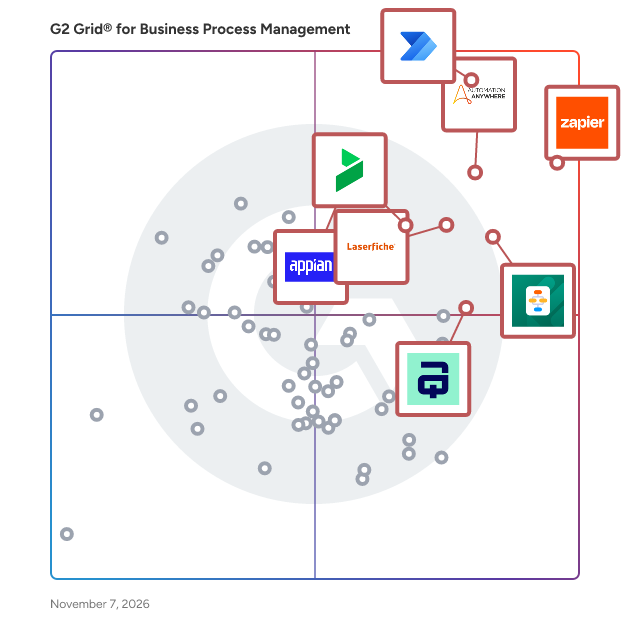
G2 Grid® for Business Process Management Software

G2 Grid® for Business Process Management Software plotting products by satisfaction and market presence

Highlighted products: Microsoft Power Automate, Zapier, Automation Anywhere Agentic Process Automation, Jotform Workflows, Laserfiche, Bizagi, Appian, and AuraQuantic.

Underlying data: [Grid® JSON](https://www.g2.com/categories/business-process-management/grids.json?focus%5B%5D=microsoft-power-automate&focus%5B%5D=zapier&focus%5B%5D=automation-anywhere-agentic-process-automation&focus%5B%5D=jotform-workflows&focus%5B%5D=laserfiche&focus%5B%5D=bizagi&focus%5B%5D=appian&focus%5B%5D=auraquantic)

Microsoft Power Automate

Optimize business processes across your organization with a cloud-first, comprehensive automation platform, powered by low-code and AI. Modernize and integrate operations at scale, maintain visibility and control with enterprise-grade governance, monitor and protect your data, and continuously improve with process insights.

Average Rating: 4.4/5.0

Total Reviews: 1,042

How Do G2 Users Rate Microsoft Power Automate?

  • Intelligence: 7.9/10 (Category avg: 8.4/10)
  • Has the product been a good partner in doing business?: 8.7/10 (Category avg: 9.1/10)
  • Process Overview: 8.5/10 (Category avg: 8.9/10)
  • Process Analysis: 8.2/10 (Category avg: 8.7/10)

Who Is the Company Behind Microsoft Power Automate?

  • Seller: Microsoft
  • Year Founded: 1975
  • HQ Location: Redmond, Washington
  • LinkedIn® Page: www.linkedin.com
    232,750 employees on LinkedIn®
  • Ownership: MSFT
  • Phone: +1 (877) 276-2464

Who Uses This Product?

  • Who Uses This: Software Engineer, RPA Developer
  • Top Industries: Information Technology and Services, Computer Software
  • Company Size: 34% Medium, 33% Large

What Do G2 Reviewers Say About Microsoft Power Automate?

AI-generated summary from verified user reviews

Pros
  • Users appreciate the ease of setup with Microsoft Power Automate, enhancing efficiency in managing workflows and data transfers.
  • Users value the streamlined automation in Microsoft Power Automate, enhancing efficiency and reducing manual workloads significantly.
  • Users enjoy the easy integrations with various software, enhancing data transfer and workflow management seamlessly.
  • Users value the extensive integrations of Microsoft Power Automate, enhancing seamless connectivity across various platforms and applications.
  • Users value the efficiency of process automation in Power Automate, streamlining workflows and enhancing productivity effortlessly.
Cons
  • Users find the complexity of Microsoft Power Automate challenging, making maintenance and troubleshooting difficult for intricate workflows.
  • Users often experience slow performance with Power Automate, particularly when managing complex workflows with many actions.
  • Users find bugs and debugging challenges in Power Automate frustrating, impacting their ability to manage complex workflows effectively.
  • Users find the pricing model confusing, especially when needing advanced flows and premium connectors, which can be costly.
  • Users face software bugs that lead to frustrating debugging and vague error messages, complicating flow management.

What Are Recent G2 Reviews of Microsoft Power Automate?

What Are G2 Users Discussing About Microsoft Power Automate?

Zapier

Zapier is the #1 workflow automation platform for businesses that want to grow faster by maximizing the efficiency of their teams, tools, and processes without relying on development teams. With our new visual editor, free Filter and Formatter tasks for more control, and reduced task-based pricing, you're going love automating with Zapier. It's free to sign up — no credit card required — and creating your first workflow, what we call a "Zap," is just a few clicks away. Since 2011, over 2 million business have turned to Zapier for their automation needs, including: lead management, sales pipeline, marketing campaigns, customer support, data management, project management, and tickets and incidents.

Average Rating: 4.5/5.0

Total Reviews: 2,115

How Do G2 Users Rate Zapier?

  • Intelligence: 10.0/10 (Category avg: 8.4/10)
  • Has the product been a good partner in doing business?: 8.8/10 (Category avg: 9.1/10)
  • Process Overview: 10.0/10 (Category avg: 8.9/10)

Who Is the Company Behind Zapier?

  • Seller: Zapier
  • Company Website:
  • Year Founded: 2011
  • HQ Location: San Francisco, CA
  • LinkedIn® Page: www.linkedin.com
    1,521 employees on LinkedIn®

Who Uses This Product?

  • Who Uses This: Owner, CEO
  • Top Industries: Marketing and Advertising, Information Technology and Services
  • Company Size: 70% Small, 24% Medium

What Do G2 Reviewers Say About Zapier?

AI-generated summary from verified user reviews

Pros
  • Users value the ease of use with Zapier, relishing its seamless implementation and AI-powered integrations.
  • Users value Zapier for its powerful automation capabilities, simplifying tasks with AI tools like Copilot and Agents.
  • Users appreciate the extensive integrations of Zapier, enhancing workflow efficiency with advanced AI features like Copilot.
  • Users value easy integrations with Zapier, enhanced by AI capabilities that simplify workflow setups and increase reliability.
  • Users love the integration capabilities of Zapier, enjoying seamless connections between AI tools and various apps.
Cons
  • Users find Zapier expensive compared to newer AI tools that offer similar automation features at a lower cost.
  • Users feel that Zapier's pricing can be high for small businesses, despite its valuable automation capabilities.
  • Users find Zapier's complexity overwhelming, as the multitude of options can make setting up integrations challenging.
  • Users note a challenging learning curve with Zapier, particularly when setting up complex workflows and logic.
  • Users note the limited features of Zapier, particularly lack of triggers and user caps that hinder larger initiatives.

What Are Recent G2 Reviews of Zapier?

What Are G2 Users Discussing About Zapier?

Automation Anywhere Agentic Process Automation

Automation Anywhere Agentic Process Automation (APA) is an enterprise platform that orchestrates AI agents, RPA bots, APIs, documents, and human expertise as a single governed system of work. APA transforms what is possible with automation — orchestrating every instrument of work across every system, with execution grounded in process expertise, and end-to-end process governance across every agent, every step, and every decision. It turns individual capabilities into compounded business transformation. With the APA platform, you can optimize what already runs your business and expand into what has never been feasible before. What's inside the platform Process Reasoning Engine (PRE) — the decision layer. Goal-driven AI agents plan, act, adapt, and self-correct in real time as conditions change. Mozart Orchestrator — a unified composer that manages decisions, dependencies, context, and exceptions across agents, automations, documents, and APIs. AI Agent Studio — a low-code workspace for building AI agents on foundational models from Amazon Bedrock, Google Vertex AI, Azure OpenAI, OpenAI, and others. Automator AI — generative AI–powered automation development across any application, cloud or on-premises. Document Automation — processes unstructured documents at over 95% accuracy, and 5x faster with Cloud Extraction Service for large-scale extraction. Process Discovery — surfaces bottlenecks and identifies what to automate next. Automation Co-Pilot — triggers multi-step agentic workflows in natural language, inside the applications teams already use. Governance built in, not bolted on Every agent, action, and decision runs inside enterprise controls: fine-grained role-based access control (RBAC), AES-256 encryption at rest, TLS in transit, native audit logs with SIEM integration, and human-in-the-loop oversight. Automation Anywhere maintains SOC 1 Type 2, SOC 2 Type 2, ISO 27001, ISO 22301, and HITRUST certifications, and supports GDPR compliance. Proven in production 1,500+ live APA deployments, 400M+ automations run per year, and 1.8M+ unique AI agent executions across 26 global regions. Bancolombia — 1,300% ROI in the first year and a 50% increase in customer service efficiency JBS — $1M and 125,000 hours saved in IT Granite Telecom — $635,000 in monthly savings and 15,000 hours saved per month Ricoh — 500 days of operational time saved per month SoftBank Corp. — 85% reduction in recruitment hours Who it's for Enterprise operations, IT, finance, HR, customer service, and shared services teams in banking, insurance, healthcare, life sciences, manufacturing, telecommunications, and the public sector — wherever complex, cross-system work has to run reliably and be governed. Learn more at https://www.automationanywhere.com.

Average Rating: 4.5/5.0

Total Reviews: 4,177

How Do G2 Users Rate Automation Anywhere Agentic Process Automation?

  • Intelligence: 9.2/10 (Category avg: 8.4/10)
  • Has the product been a good partner in doing business?: 8.7/10 (Category avg: 9.1/10)
  • Process Overview: 9.1/10 (Category avg: 8.9/10)
  • Process Analysis: 8.9/10 (Category avg: 8.7/10)

Who Is the Company Behind Automation Anywhere Agentic Process Automation?

  • Seller: Automation Anywhere
  • Company Website:
  • Year Founded: 2003
  • HQ Location: San Jose, CA
  • LinkedIn® Page: www.linkedin.com
    2,327 employees on LinkedIn®

Who Uses This Product?

  • Who Uses This: RPA Developer, Software Engineer
  • Top Industries: Information Technology and Services, Computer Software
  • Company Size: 58% Large, 23% Medium

What Do G2 Reviewers Say About Automation Anywhere Agentic Process Automation?

AI-generated summary from verified user reviews

Pros
  • Users appreciate the ease of use in Automation Anywhere, highlighting its intuitive interface and helpful features for automation.
  • Users appreciate the ease of use of Automation Anywhere, highlighting its intuitive interface and reliable automation capabilities.
  • Users value the efficiency of Automation Anywhere, noting significant reductions in manual work and boosted productivity.
  • Users value the automation ease of Automation Anywhere, noting its user-friendly features that simplify bot creation and management.
  • Users highly value the intuitive interface of Automation Anywhere, which simplifies bot creation and enhances productivity.
Cons
  • Users feel that the pricing of Automation Anywhere can be expensive, limiting accessibility for smaller teams and startups.
  • Users find a steep learning curve in Automation Anywhere, complicating onboarding and impacting initial setup and debugging.
  • Users note a lack of information in solutions, which can hinder the overall effectiveness of Automation Anywhere.
  • Users often face software bugs that hinder smooth operation and complicate bot deployment and debugging processes.
  • Users experience challenges with bot issues, including complex UI and slow performance during automation processes.

What Are Recent G2 Reviews of Automation Anywhere Agentic Process Automation?

What Are G2 Users Discussing About Automation Anywhere Agentic Process Automation?

AI can help you find the answers. G2 helps you trust them.

Connect G2 to Claude or ChatGPT for answers grounded in G2's trusted reviews, comparisons, and pricing from real user insights.

How it works

Jotform Workflows

Jotform Workflows is a powerful no-code automation platform that makes it easy to streamline, manage, and optimize your business processes from end to end. Using an intuitive drag-and-drop builder, you can design custom workflows that match your exact needs — whether you’re routing approvals, collecting payments, assigning tasks, or automating repetitive steps across your organization. Jotform Workflows eliminates manual work, reduces errors, and helps teams move faster by keeping every process consistent, transparent, and fully automated. With 200+ professionally designed workflow templates, getting started is effortless. Choose a ready-made workflow for HR, finance, operations, customer service, education, healthcare, or any other use case, and customize it to fit your processes. Workflows can include conditional logic, automated notifications, role-based approvals, and dynamic routing rules that adapt to each form submission, ensuring the right steps happen at the right time. For organizations that rely on payments, Jotform Workflows supports automated payment collection and processing through 40+ trusted payment gateways, including PayPal, Square, and Stripe. You can trigger payments based on user selections, approval steps, or predefined conditions, helping you collect funds quickly and accurately without manual intervention. Seamless integration is at the heart of Jotform Workflows. Connect your workflows to 200+ popular apps — including Slack, Google Sheets, Airtable, HubSpot, Trello, and more — to automatically sync data, create tasks, notify team members, or update external systems in real time. This creates a fully connected ecosystem where every submission triggers the right actions across your tools. Jotform Workflows also includes powerful task management capabilities. Create tasks, assign them to team members, track progress, and automate follow-ups based on form responses or workflow conditions. This centralizes all activity into one organized workspace, giving teams full visibility into what needs to happen next. All workflow data is automatically stored and organized in Jotform Tables and Jotform Inbox. View submissions as spreadsheets, calendars, or cards, manage permissions for team members, and respond to approvals or requests quickly from any device. This ensures complete oversight and helps teams make informed decisions faster. With robust automation, deep integrations, secure data handling, and a no-code builder anyone can use, Jotform Workflows empowers organizations of all sizes to create efficient, scalable, and fully automated processes — without relying on developers or technical expertise.

Average Rating: 4.5/5.0

Total Reviews: 704

How Do G2 Users Rate Jotform Workflows?

  • Intelligence: 9.2/10 (Category avg: 8.4/10)
  • Has the product been a good partner in doing business?: 8.9/10 (Category avg: 9.1/10)
  • Process Overview: 8.5/10 (Category avg: 8.9/10)
  • Process Analysis: 8.4/10 (Category avg: 8.7/10)

Who Is the Company Behind Jotform Workflows?

  • Seller: Jotform
  • Company Website:
  • Year Founded: 2006
  • HQ Location: San Francisco, California
  • LinkedIn® Page: www.linkedin.com
    925 employees on LinkedIn®

Who Uses This Product?

  • Who Uses This: Owner, Founder
  • Top Industries: Non-Profit Organization Management, Education Management
  • Company Size: 66% Small, 28% Medium

What Do G2 Reviewers Say About Jotform Workflows?

AI-generated summary from verified user reviews

Pros
  • Users appreciate the ease of use of Jotform Workflows, enhancing daily tasks and simplifying HR processes effortlessly.
  • Users appreciate the automation in Jotform Workflows, enhancing efficiency and simplifying communication and approvals.
  • Users value the ease of form creation in Jotform Workflows, enhancing workflow efficiency and simplifying approvals.
  • Users appreciate the process automation of Jotform Workflows, significantly enhancing efficiency and reducing manual work.
  • Users enjoy the high level of customization in Jotform Workflows, allowing tailored setups to meet individual needs.
Cons
  • Users find the learning curve challenging due to the complexity of workflows and lack of guidance.
  • Users often find the complexity of workflows in Jotform Workflows challenging, especially with PDF creation and conditional logic.
  • Users find the missing features like chat, stable Arabic support, and table functionalities limit their experience significantly.
  • Users find form issues problematic, particularly around limited report downloads and difficulties in formatting and editing forms.
  • Users note integration issues with Jotform Workflows, particularly with Google Sheets and Asana, causing manual updates and difficulties.

What Are Recent G2 Reviews of Jotform Workflows?

Laserfiche

Get work done faster with Laserfiche, the leading SaaS provider of AI-powered document management and process automation. Through powerful workflows, electronic forms, document management and analytics, Laserfiche accelerates processes across the enterprise. ✓ Organize Your Content with AI-Powered Document Management Optimize your operations and increase team productivity with AI-powered document management. Centralize your content, improve collaboration and maintain audit trails to support compliance needs. ✓ Boost Your Productivity with Intelligent Automation Increase efficiency by automating tasks with low-code process automation and prebuilt solution templates. Work smarter and shift your team’s focus to higher priority strategic goals. ✓ Unify Your Systems with Powerful Integrations Laserfiche is the backbone connecting hundreds of mission-critical applications. Users can access relevant documents from a single location, eliminating the need to search across multiple platforms. ✓ Elevate Your Work with Laserfiche AI Laserfiche AI enables organizations to simplify their work, take control of processes and supercharge productivity — all without losing sight of critical data privacy and security standards.

Average Rating: 4.7/5.0

Total Reviews: 1,209

How Do G2 Users Rate Laserfiche?

  • Intelligence: 8.5/10 (Category avg: 8.4/10)
  • Has the product been a good partner in doing business?: 9.2/10 (Category avg: 9.1/10)
  • Process Overview: 8.9/10 (Category avg: 8.9/10)
  • Process Analysis: 8.7/10 (Category avg: 8.7/10)

Who Is the Company Behind Laserfiche?

  • Seller: Laserfiche
  • Company Website:
  • Year Founded: 1976
  • HQ Location: Long Beach, California
  • LinkedIn® Page: www.linkedin.com
    400 employees on LinkedIn®

Who Uses This Product?

  • Who Uses This: Deputy City Clerk, Business Systems Analyst
  • Top Industries: Government Administration, Education Management
  • Company Size: 60% Medium, 25% Large

What Do G2 Reviewers Say About Laserfiche?

AI-generated summary from verified user reviews

Pros
  • Users find Laserfiche's ease of use empowering, enabling self-service implementation and efficient process management.
  • Users value the easy process automation with Laserfiche, enhancing efficiency and reducing errors across departments.
  • Users appreciate the automation of form processes with Laserfiche, enhancing efficiency and document management.
  • Users value the robust and flexible workflow automation in Laserfiche, enhancing efficiency and integration with other systems.
  • Users commend the easy training and onboarding capabilities of Laserfiche, enhancing team efficiency and document management.
Cons
  • Users experience a challenging learning curve with Laserfiche, making initial navigation and feature usage difficult.
  • Users experience a small learning difficulty with Laserfiche, particularly when adapting to metadata fields and workflows.
  • Users find the missing features in Laserfiche hinder their experience and highlight the need for better resources.
  • Users express concern over update issues, highlighting difficulty in keeping up with the rapid growth of Laserfiche.
  • Users report performance issues with Laserfiche, including slow form builds and delayed feature implementations.

What Are Recent G2 Reviews of Laserfiche?

What Are G2 Users Discussing About Laserfiche?

Bizagi

Bizagi is an enterprise platform for business orchestration and AI automation, enabling organizations to design, automate, and run complex end-to-end processes that bring together people, AI agents, systems, and data. Unlike point AI tools, Bizagi is the operational layer where AI, processes, and enterprise systems work together: governed, auditable, and production-ready. Built on more than two decades of enterprise process expertise, Bizagi brings the depth of operational knowledge that newer AI platforms simply have not had time to develop. That foundation is what makes Bizagi's AI story credible where others are still experimental. Bizagi's native AI capabilities are built directly into the platform. AI Agents are reusable, GenAI-powered assistants configured in the AI Hub, capable of content generation, document analysis, classification, summarization, and more. They can be invoked from processes, interfaces, or other agents, and integrate via connectors and Model Context Protocol to reach internal and external systems. AI Workers automate repetitive tasks inside forms and workflows by analyzing rules, field history, and process context, operating in supervised or more autonomous modes and improving through reinforcement learning. Ask Ada, Bizagi's conversational analytics assistant, lets users query business data in natural language and receive answers, charts, and insights, all within Bizagi's role and permission model and grounded in both process data and enterprise documents through a built-in RAG knowledge layer. Governance is central, not optional. Bizagi runs on Microsoft Azure with Private OpenAI integration, keeping sensitive data within a secure perimeter. AI features require deliberate configuration and deployment. Generative AI capabilities are intentionally built into workflows rather than casually enabled, and Data Domains, Personas, and Bizagi's role model control precisely what any AI capability can access and how results can be used. Customers see results fast. Stone Coast Fund Services reduced processing time by 80% across more than 25,000 annual service requests, going live in six weeks. Bizagi's AI Ignite packages take organizations from zero to live AI Agents or AI Assistants in approximately seven weeks, combining software and professional services to de-risk early projects. With over 1,000 enterprise implementations across financial services, manufacturing, healthcare, and government, Bizagi is named in the 2025 Gartner Magic Quadrant for Business Orchestration and Automation Technologies (BOAT), Microsoft Certified for AI in Financial Services and Manufacturing, and a G2 leader across Agentic AI, AI Agents for Business Operations, BPM, and Digital Process Automation. Customers include DHL, Unilever, Caterpillar, and Old Mutual. For more information, visit bizagi.com.

Average Rating: 4.6/5.0

Total Reviews: 316

How Do G2 Users Rate Bizagi?

  • Intelligence: 7.9/10 (Category avg: 8.4/10)
  • Has the product been a good partner in doing business?: 8.6/10 (Category avg: 9.1/10)
  • Process Overview: 9.1/10 (Category avg: 8.9/10)
  • Process Analysis: 9.0/10 (Category avg: 8.7/10)

Who Is the Company Behind Bizagi?

  • Seller: Bizagi
  • Company Website:
  • Year Founded: 1989
  • HQ Location: 1775 Tysons Blvd, 5th Floor, Tysons, VA, 22102
  • LinkedIn® Page: www.linkedin.com
    439 employees on LinkedIn®

Who Uses This Product?

  • Who Uses This: SDET, Business Analyst
  • Top Industries: Information Technology and Services, Computer Software
  • Company Size: 45% Medium, 28% Small

What Do G2 Reviewers Say About Bizagi?

AI-generated summary from verified user reviews

Pros
  • Users find Bizagi intuitive and practical, allowing quick and efficient creation of flowcharts and diagrams.
  • Users highlight the efficiency of Bizagi, streamlining team efforts and simplifying process management effectively.
  • Users praise Bizagi for its intuitive design, making process sketching and corrections straightforward and efficient.
  • Users value the automation capabilities of Bizagi, enhancing productivity and simplifying complex workflows for all business sizes.
  • Users value the efficiency in workflow management provided by Bizagi, streamlining complex processes effortlessly.
Cons
  • Users find missing features in Bizagi, particularly the lack of AI capabilities and compatibility with other software.
  • Users experience performance issues with upgrades and advanced features, affecting efficiency and smooth operation in Bizagi.
  • Users find the learning curve steep for advanced features, making it challenging for non-technical users.
  • Users find that slow performance affects their experience, particularly when utilizing advanced features of Bizagi.
  • Users find Bizagi's complexity frustrating, particularly with slow performance and a steep learning curve for customization.

What Are Recent G2 Reviews of Bizagi?

What Are G2 Users Discussing About Bizagi?

AuraQuantic

AuraQuantic is an enterprise No-Code Business Process Management (BPM) and Digital Process Automation (DPA) platform designed to help organizations design, automate, and orchestrate end-to-end business processes without complex coding. As a powerful Business Orchestration and Automation Platform, AuraQuantic connects people, data, and enterprise systems to streamline operations across the entire organization. Built for both business and IT teams, AuraQuantic enables rapid creation of workflow-driven applications through visual modeling and centralized governance. Organizations use the platform to standardize operations, eliminate manual tasks, and gain real-time visibility with full traceability—making it ideal for scalable Business Process Automation (BPA) and enterprise digital transformation. Key capabilities include: - Visual workflow design and rule-based automation - Real-time dashboards and performance monitoring - Seamless integration with ERP, CRM, SharePoint, legacy systems, databases, and APIs - Centralized data orchestration across departments - Enterprise-grade security, scalability, and governance controls A key differentiator is AuraQuantic’s embedded Artificial Intelligence (AI) and AI agents, which enhance automation through: - AI-powered document processing and intelligent data extraction - Predictive analytics and automated decision rules - Smart task routing and contextual recommendations - Dynamic workflow optimization By combining no-code application development, advanced BPM functionality, AI-driven automation, and enterprise orchestration, AuraQuantic enables organizations to reduce costs, increase productivity, strengthen compliance, and enhance customer-facing processes across industries such as finance, healthcare, education, manufacturing, and public administration.

Average Rating: 4.9/5.0

Total Reviews: 69

How Do G2 Users Rate AuraQuantic?

  • Intelligence: 9.5/10 (Category avg: 8.4/10)
  • Has the product been a good partner in doing business?: 9.9/10 (Category avg: 9.1/10)
  • Process Overview: 9.9/10 (Category avg: 8.9/10)
  • Process Analysis: 9.9/10 (Category avg: 8.7/10)

Who Is the Company Behind AuraQuantic?

  • Seller: AuraQuantic
  • Company Website:
  • Year Founded: 2002
  • HQ Location: Miami, FL
  • LinkedIn® Page: www.linkedin.com
    126 employees on LinkedIn®

Who Uses This Product?

  • Top Industries: Insurance
  • Company Size: 54% Medium, 39% Large

What Do G2 Reviewers Say About AuraQuantic?

AI-generated summary from verified user reviews

Pros
  • Users value the automation efficiency of AuraQuantic, enabling easy process automation without needing technical skills.
  • Users value the real-time automation tracking of AuraQuantic, which provides clarity and peace of mind in operations.
  • Users appreciate the peace of mind AuraQuantic provides, allowing real-time visibility into business processes and progress.
  • Users value the customization options in AuraQuantic, enabling tailored automation processes and enhanced user experience.
  • Users value the ease of use in AuraQuantic, enjoying real-time visibility into processes and reduced anxiety.
Cons
  • Users find the complexity of AuraQuantic challenging, requiring significant effort to fully understand and utilize its capabilities.
  • Users find the learning curve steep, requiring significant mental effort to navigate AuraQuantic's complex features effectively.
  • Users find the learning difficulty of AuraQuantic challenging, requiring significant mental effort to master its capabilities.
  • Users find the steep learning curve challenging, requiring significant mental effort to master AuraQuantic effectively.

What Are Recent G2 Reviews of AuraQuantic?

What Are G2 Users Discussing About AuraQuantic?

Appian

Appian is an enterprise AI process automation platform that helps organizations orchestrate, automate, and transform complex end-to-end workflows. The platform connects AI models, enterprise systems, data sources, digital workers, and human teams to accelerate operations, reduce operational costs, and manage enterprise risk. Built primarily for large enterprises and government entities, Appian supports mission-critical applications across core business functions like financial services, insurance, pharmaceuticals, and public sector operations. Key Features and Capabilities Deterministic Process Orchestration: Provides a structured workflow layer that coordinates AI agents, automated rules, legacy systems, and human workers to ensure predictable and reliable execution of enterprise tasks. Data Fabric Technology: Unifies enterprise data across disparate systems into a virtualized data model without needing to migrate or replicate underlying databases, delivering real-time operational context to AI agents and end users. Enterprise AI Control & Governance: Incorporates built-in guardrails, full auditability, and monitoring tools to maintain policy compliance, enforce row-level security, and eliminate unauthorized actions. Spec-Driven Development: Combines visual process modeling with AI-assisted application creation, allowing business analysts and developers to collaborate on visual plans and deploy applications with pre-configured scalability and high availability. Flexible AI Deployment: Supports a portfolio approach to digital workers by integrating native AI features, external frontier models, and traditional automation tools like business rules and Robotic Process Automation (RPA). By operating as an agility layer over existing legacy systems, the platform enables organizations to modernize operational software without undergoing disruptive core replacements. Built-in process intelligence allows teams to continually monitor performance metrics, pinpoint workflow bottlenecks, and optimize overall business efficiency.

Average Rating: 4.5/5.0

Total Reviews: 460

How Do G2 Users Rate Appian?

  • Intelligence: 7.9/10 (Category avg: 8.4/10)
  • Has the product been a good partner in doing business?: 8.8/10 (Category avg: 9.1/10)
  • Process Overview: 8.5/10 (Category avg: 8.9/10)
  • Process Analysis: 8.4/10 (Category avg: 8.7/10)

Who Is the Company Behind Appian?

  • Seller: Appian
  • Company Website:
  • Year Founded: 1999
  • HQ Location: McLean, Virginia
  • LinkedIn® Page: www.linkedin.com
    2,652 employees on LinkedIn®
  • Ownership: NASDAQ:APPN

Who Uses This Product?

  • Who Uses This: Manager, Consultant
  • Top Industries: Financial Services, Banking
  • Company Size: 55% Large, 28% Medium

What Do G2 Reviewers Say About Appian?

AI-generated summary from verified user reviews

Pros
  • Users find Appian's ease of use exceptional, enhancing application delivery and process adaptation with AI-driven features.
  • Users value the built-in automation of Appian, enhancing efficiency and simplifying complex business process management.
  • Users value the easy application building in Appian, appreciating its AI features and support for rapid deployment.
  • Users value the advanced AI integration in Appian, enhancing efficiency and simplifying process orchestration effectively.
  • Users appreciate the advanced AI integration in Appian, enhancing productivity with its low-code platform and features.
Cons
  • Users feel Appian has limited features for customization, leading to frustrations with interface design and branding.
  • Users find the licensing costs for Appian to be high, which may deter smaller teams from using it.
  • Users find Appian's limited flexibility restricts custom UI design and complex logic, requiring specific expertise for deep customization.
  • Users find the complexity of Appian frustrating, particularly with customization and debugging challenges affecting usability.
  • Users find the limited customization of Appian frustrating, especially for tailored UI and complex requirements.

What Are Recent G2 Reviews of Appian?

What Are G2 Users Discussing About Appian?

Quixy

Quixy is a cloud-based, user-friendly platform that empowers users without coding skills to create enterprise-grade applications ten times faster using a simple drag-and-drop design. Built for today’s dynamic business environment, Quixy allows businesses to build and manage enterprise applications quickly and effortlessly, enhancing efficiency, transparency, and productivity across operations. With a wide range of pre-built solutions for various use cases such as CRM, Project Management, HRMS, and more. Quixy simplifies application development and helps organizations stay agile while meeting their unique needs. The platform also integrates a seamless cloud database, enterprise-grade security, regulatory compliance, and a scalable infrastructure to support global business operations. Schedule a Demo at https://quixy.com/get-demo/

Average Rating: 5.0/5.0

Total Reviews: 129

How Do G2 Users Rate Quixy?

  • Intelligence: 9.8/10 (Category avg: 8.4/10)
  • Has the product been a good partner in doing business?: 9.9/10 (Category avg: 9.1/10)
  • Process Overview: 9.9/10 (Category avg: 8.9/10)
  • Process Analysis: 9.8/10 (Category avg: 8.7/10)

Who Is the Company Behind Quixy?

  • Seller: Quixy
  • Year Founded: 2019
  • HQ Location: Hyderabad, Telangana
  • LinkedIn® Page: www.linkedin.com
    225 employees on LinkedIn®

Who Uses This Product?

  • Who Uses This: Senior Software Engineer, Associate Software Engineer
  • Top Industries: Computer Software, Information Technology and Services
  • Company Size: 62% Medium, 23% Small

What Do G2 Reviewers Say About Quixy?

AI-generated summary from verified user reviews

Pros
  • Users find Quixy’s easy and fast workflow automation invaluable, significantly reducing manual tasks and boosting overall performance.
  • Users praise Quixy for its effortless workflow automation, significantly reducing manual tasks and enhancing overall efficiency.
  • Users find Quixy to be incredibly easy to use, streamlining workflow automation with a user-friendly no-code platform.
  • Users commend Quixy for its efficiency in automation, significantly saving time and reducing manual workloads.
  • Users value the efficiency improvement from Quixy, simplifying workflow automation and significantly reducing manual tasks.
Cons
  • Users report performance issues with Quixy, including low refresh speed and occasional missed notifications.
  • Users report that the refresh speed can be slow and occasionally leads to missed notifications.
  • Users experience slow loading times which can interrupt their workflow, despite finding other aspects satisfactory.
  • Users experience slow performance with Quixy, specifically related to low refresh speeds and occasional buffering.
  • Users report experiencing slow refresh speeds and missed notifications, which can hinder their overall experience with Quixy.

What Are Recent G2 Reviews of Quixy?

What Are G2 Users Discussing About Quixy?

Success.co EOS Traction software

Success.co is the next gen software to run EOS®. Our three uniques are: 1. Modern, fast, and intuitive: Software that’s a joy to use, zero load times thanks to our BlitzSync™ tech, and a human-first approach to customer support. 2. Deeply integrated: with the tools you actually use: calendars, mobile, and desktop app. Seamlessly connected. 3. EOS® pure: We stay true to EOS® tools and language while giving back to the community that shaped us. We’ve walked the EOS® path. Success.co was born from a team who used EOS® to scale our previous company. We’ve lived it, we believe in it, and we’ve seen the impact firsthand. We love EOS® implementers and their work. In fact, we built Success.co in collaboration with a panel of experienced EOS Implementers®. That's why our platform stays 100% true to the EOS Model®. Success.co isn’t just software - it’s our mission. We’re building something enduring, for teams that are doing the same.

Average Rating: 4.9/5.0

Total Reviews: 35

How Do G2 Users Rate Success.co EOS Traction software?

  • Intelligence: 7.5/10 (Category avg: 8.4/10)
  • Has the product been a good partner in doing business?: 9.7/10 (Category avg: 9.1/10)
  • Process Overview: 10.0/10 (Category avg: 8.9/10)
  • Process Analysis: 10.0/10 (Category avg: 8.7/10)

Who Is the Company Behind Success.co EOS Traction software?

Who Uses This Product?

  • Company Size: 80% Small, 11% Medium

What Are Recent G2 Reviews of Success.co EOS Traction software?

Pega Platform

Pega is a powerful low-code platform that builds agility into the world’s leading organizations so they can adapt to change. Clients use our AI-powered decisioning and workflow automation to solve their most pressing business challenges – from personalizing engagement to automating service to streamlining operations. Since 1983, we’ve built our scalable and flexible architecture to help people focus on what matters most, so they can meet today’s customer demands while continuously transforming for tomorrow. Experience the simplicity and power of the Pega Platform today: https://www.pega.com/platform-guided-tour

Average Rating: 4.2/5.0

Total Reviews: 199

How Do G2 Users Rate Pega Platform?

  • Intelligence: 8.8/10 (Category avg: 8.4/10)
  • Has the product been a good partner in doing business?: 8.3/10 (Category avg: 9.1/10)
  • Process Overview: 9.2/10 (Category avg: 8.9/10)
  • Process Analysis: 8.5/10 (Category avg: 8.7/10)

Who Is the Company Behind Pega Platform?

  • Seller: Pegasystems
  • Year Founded: 1983
  • HQ Location: Cambridge, MA
  • LinkedIn® Page: www.linkedin.com
    5,547 employees on LinkedIn®
  • Ownership: NASDAQ:PEGA
  • Phone: +1 (617) 374 9600

Who Uses This Product?

  • Who Uses This: Senior Software Engineer, Consultant
  • Top Industries: Information Technology and Services, Banking
  • Company Size: 68% Large, 20% Medium

What Do G2 Reviewers Say About Pega Platform?

AI-generated summary from verified user reviews

Pros
  • Users value the helpful customer support, enhancing their experience and facilitating integration with existing systems.
  • Users value the automation of complicated processes in Pega Platform, enhancing efficiency without the need for coding.
  • Users appreciate the ease of use of Pega Platform, allowing automation and integration without extensive coding knowledge.
  • Users value the easy integration and user-friendly interface of Pega Platform, enabling non-developers to enhance operations.
  • Users value the seamless integrations of Pega Platform for effective data handling and system orchestration.
Cons
  • Users face strict customization limitations in Pega Platform, hindering the ability to create desired user interfaces.
  • Users face limited features in Pega Platform, making customization challenging and restricting desired UI designs.
  • Users find the interface outdated, making customization difficult and leading to a frustrating user experience.
  • Users struggle with poor interface design, feeling restricted by stringent customization and outdated UI elements in Pega Platform.
  • Users are frustrated with the poor UI of Pega Platform, feeling constrained by strict customization limitations.

What Are Recent G2 Reviews of Pega Platform?

What Are G2 Users Discussing About Pega Platform?

Camunda

Camunda is the enterprise platform for agentic orchestration, enabling organizations to coordinate AI agents, people, and systems across complex, end-to-end business processes. With built-in governance, auditability, and human oversight, Camunda gives enterprises the control they need to move AI from pilots to production — safely and at scale. Trusted by over 750 organizations worldwide, including 9 of top 10 US banks, Camunda helps enterprises boost operational efficiency, accelerate time-to-value, and deliver better customer experiences. Recognized as a Visionary in the Gartner Magic Quadrant™ for BOAT 2025 and rated 5/5 in Orchestration by Forrester. For more information, visit camunda.com.

Average Rating: 4.5/5.0

Total Reviews: 318

How Do G2 Users Rate Camunda?

  • Intelligence: 7.6/10 (Category avg: 8.4/10)
  • Has the product been a good partner in doing business?: 8.7/10 (Category avg: 9.1/10)
  • Process Overview: 8.7/10 (Category avg: 8.9/10)
  • Process Analysis: 8.4/10 (Category avg: 8.7/10)

Who Is the Company Behind Camunda?

  • Seller: Camunda
  • Company Website:
  • Year Founded: 2008
  • HQ Location: Berlin, Deutschland
  • LinkedIn® Page: www.linkedin.com
    712 employees on LinkedIn®

Who Uses This Product?

  • Who Uses This: Software Engineer
  • Top Industries: Banking, Financial Services
  • Company Size: 45% Large, 31% Medium

What Do G2 Reviewers Say About Camunda?

AI-generated summary from verified user reviews

Pros
  • Users value the ease of use of Camunda, facilitating quick and efficient process setup and management.
  • Users value the flexible automation capabilities of Camunda, enhancing workflows and integrating AI effectively into processes.
  • Users appreciate the incredible flexibility of Camunda, enabling dynamic AI integration and support for various use cases.
  • Users appreciate the ease of process orchestration in Camunda, benefiting from seamless integration and clear BPMN modeling.
  • Users value the seamless integrations of Camunda, enhancing workflows across diverse technologies and ensuring flexibility.
Cons
  • Users find the complexity of Camunda challenging, especially regarding setup and the steep learning curve for newcomers.
  • Users find Camunda's steep learning curve challenging, particularly for non-technical stakeholders and installation issues.
  • Users often face setup difficulties with Camunda, especially newcomers who struggle with installation and configuration.
  • Users find Camunda's difficult learning curve challenging, particularly for non-technical stakeholders and advanced use cases.
  • Users find Camunda to be expensive, with complex pricing that complicates understanding total costs for various use cases.

What Are Recent G2 Reviews of Camunda?

What Are G2 Users Discussing About Camunda?

Cflow

Cflow is a leading AI-powered approval automation platform that empowers key decision makers with actionable data for making informed business decisions. Trusted by a 100,000+ user base spanning SMBs, mid-market, and Enterprise companies, Cflow is the highest-rated choice for unstoppable, no-code workflow automation. Complex workflows with multiple approval levels can be effectively automated within minutes using the visual workflow builder. Cflow takes paperless offices to the next level by providing intelligent document processing and document management features that include AI-powered OCR, Auto-classification, Fuzzy Search Mapping, Document Designer, Integrated electronic signatures, and role-based access control. SEYARC AI in Cflow turns data into decisions instantly by automating data entry, form filling, document reading, and insights. Cflow’s core value proposition lies in its ability to automate processes and deliver results in days, not months. Backed by SOC 2 Type 2, ISO 27001, GDPR, and HIPAA compliance, Cflow delivers enterprise-grade security that Global businesses require.

Average Rating: 4.7/5.0

Total Reviews: 195

How Do G2 Users Rate Cflow?

  • Intelligence: 9.5/10 (Category avg: 8.4/10)
  • Has the product been a good partner in doing business?: 9.6/10 (Category avg: 9.1/10)
  • Process Overview: 9.5/10 (Category avg: 8.9/10)
  • Process Analysis: 9.6/10 (Category avg: 8.7/10)

Who Is the Company Behind Cflow?

  • Seller: Cavintek Inc
  • Company Website:
  • Year Founded: 2011
  • HQ Location: Fremont, US
  • LinkedIn® Page: www.linkedin.com
    59 employees on LinkedIn®

Who Uses This Product?

  • Top Industries: Information Technology and Services, Marketing and Advertising
  • Company Size: 46% Medium, 41% Small

What Do G2 Reviewers Say About Cflow?

AI-generated summary from verified user reviews

Pros
  • Users commend the ease of use of Cflow, facilitating quick approvals and smooth team coordination effortlessly.
  • Users value the automation capabilities of Cflow, simplifying workflows and enhancing efficiency in approvals and notifications.
  • Users value the effortless workflow management in Cflow, enhancing visibility and speeding up the approval process.
  • Users value the automation efficiency of Cflow, which simplifies and streamlines workflow processes effectively.
  • Users value the process automation capabilities of Cflow, streamlining approvals and workflows efficiently without coding.
Cons
  • Users experience performance issues with Cflow, including slow transitions and unresponsive mobile layout, affecting usability.
  • Users experience slow performance in Cflow, especially during transitions and when multiple workflows are active.
  • Users find the learning curve steep during initial setup, particularly with rule and approval configurations.
  • Users find that Cflow offers limited advanced customization, impacting flexibility and deeper integrations for complex workflows.
  • Users experience occasional slow loading when multiple workflows are active, which can hinder their app usage.

What Are Recent G2 Reviews of Cflow?

Emakin

Emakin is a Low-Code/No-Code Business Process Management (BPM) platform that helps organisations design, automate and manage business processes without the need for extensive software development. The platform provides a visual environment where users can model workflows, integrate systems and monitor operations, enabling faster adaptation to business, operational and regulatory changes across different departments. Emakin is used by companies of all sizes, particularly in sectors such as finance, insurance, retail, healthcare, manufacturing, pharmaceutical and education. It helps them streamline routine work, eliminate manual errors and achieve consistent process execution across teams. Emakin combines workflow automation, case management and analytics capabilities within a unified system that promotes collaboration and shared visibility between business and IT users. Key capabilities include • Visual process and form design – model and configure workflows and user interfaces through an intuitive drag and drop environment • Case management and task tracking – gain full visibility into ongoing operations, monitor progress, manage exceptions and track performance indicators efficiently • Integration hub – connect enterprise systems and data sources through APIs, databases and web services for seamless interoperability • Decision and rules management – configure business rules and decision models to ensure consistent, transparent and rule based operations • Analytics and reporting – access real time dashboards and detailed insights into process performance, bottlenecks and compliance metrics Emakin enables organisations to optimise their workflows, shorten turnaround times and maintain control over complex processes. It serves as a comprehensive platform for digital transformation, supporting approvals, service requests, compliance workflows and other enterprise-wide operations with agility and precision.

Average Rating: 4.9/5.0

Total Reviews: 28

How Do G2 Users Rate Emakin?

  • Intelligence: 8.7/10 (Category avg: 8.4/10)
  • Has the product been a good partner in doing business?: 9.8/10 (Category avg: 9.1/10)
  • Process Overview: 10.0/10 (Category avg: 8.9/10)
  • Process Analysis: 9.8/10 (Category avg: 8.7/10)

Who Is the Company Behind Emakin?

  • Seller: Emakin
  • Year Founded: 2010
  • HQ Location: Dublin City, IE
  • LinkedIn® Page: www.linkedin.com
    13 employees on LinkedIn®

Who Uses This Product?

  • Top Industries: Computer Software
  • Company Size: 61% Small, 25% Large

What Do G2 Reviewers Say About Emakin?

AI-generated summary from verified user reviews

Pros
  • Users appreciate the intuitive visual workflow designer of Emakin, enhancing speed in process development and management.
  • Users highlight the easy integrations in Emakin, simplifying connections with ERP, CRM, and custom services.
  • Users appreciate the strong flexibility of Emakin, enabling smooth integration and customization for diverse business needs.
  • Users commend Emakin for its robust integration capabilities, enhancing workflow management and financial visibility across systems.
  • Users highlight Emakin's low-code speed with developer-level control, enabling efficient workflow management and seamless integrations.
Cons
  • Users face a significant learning curve with Emakin, particularly those unfamiliar with BPM tools and advanced customizations.
  • Users find the limited customization options restricts flexibility and requires extra effort for advanced adjustments.
  • Users face a learning curve and coding challenges with Emakin, especially those new to BPM tools.
  • Users note that limited features in customization options hinder flexibility for different user groups and modules.
  • Users feel that improving missing features and providing more templates would enhance overall usability and adoption.

What Are Recent G2 Reviews of Emakin?

What Are G2 Users Discussing About Emakin?

Ultimus Digital Process Automation Suite

Ultimus a only low-code business process automation platform that tackles complex, mission critical projects – without long, expensive professional service engagements, custom programming workarounds, high maintenance costs, and slow performance at scale. Enterprises around the world use Ultimus to automate key processes such as account opening, credit approval, purchase-to-pay and order-to-cash, vendor and employee onboarding and offboarding, case management and customer support, benefits provisioning, and quote configuration - or any request and approval use case. Unlike many low-code platforms that focus on simple, departmental workflows, Ultimus is designed to automate sophisticated enterprise-scale business processes. Its composable architecture, reusable components, and rule-based process engine help organizations deliver scalable solutions faster. Of course, it's not enough to just develop a solution, you have to take into account scalability, performance, and usability once the solutions are in production. Our platform includes a unique technology that ensures fast user response times, even with tens of thousands of users, as well as an intuitive, high productivity Portal that puts all your tools, tasks, and processes in one place according to your defined role. Ultimus recommends that prospective customers being their buying journey by testing with a real-life scenario, such as a proof-of-concept (POC). In many cases, Ultimus can produce a fully functional, near production ready solution without charge in a matter of days - and provide prospective customers with solution access during their evaluation.

Average Rating: 4.6/5.0

Total Reviews: 24

How Do G2 Users Rate Ultimus Digital Process Automation Suite?

  • Has the product been a good partner in doing business?: 9.2/10 (Category avg: 9.1/10)

Who Is the Company Behind Ultimus Digital Process Automation Suite?

  • Seller: Ultimus
  • Year Founded: 1994
  • HQ Location: New York, US
  • LinkedIn® Page: www.linkedin.com
    185 employees on LinkedIn®

Who Uses This Product?

  • Top Industries: Banking
  • Company Size: 42% Medium, 38% Large

What Are Recent G2 Reviews of Ultimus Digital Process Automation Suite?

What Are G2 Users Discussing About Ultimus Digital Process Automation Suite?

Bijou Barry
BB
Researched and written by Bijou Barry
Updated October 3, 2024

Learn More About Business Process Management Software

What is Business Process Management (BPM) Software?

Business process management (BPM) is the practice of streamlining and improving business activities to more efficiently perform specific business actions. Often these business actions require cross-team collaboration and consist of many moving parts, whether they are software systems or human intervention. There are many BPM software products that can help companies achieve the ultimate goal of seamless workflow automation. BPM tools often provide process modeling, execution, and analysis functionality to help business managers ensure that the processes they need done are working efficiently and effectively. The possibilities are vast and varied: this software can be used for a host of different use cases, such as invoicing, marketing, and accounting.

With business process automation solutions, businesses are able to improve and increase collaboration and be on the road toward automation. Through detailed mappings of processes and tools for managing workflows, professionals can get a birds-eye view of their business operations and thereby have a clear understanding of how they can optimize them. 

What Types of Business Process Management (BPM) Software Exist?

There are a few different types and use cases of BPM software, but each helps an organization streamline workflows. Although all of these tools capture business processes and give users the ability to automate them, they differ in terms of their ability for users to create standalone applications on top of these processes.

Standard BPM software

With standard BPM software, users get full control over their business processes, providing them with tools for monitoring execution performance and analyzing their current goals, workflows, and more. It should be noted that BPM solutions do not exist in isolation from a company’s broader software stack. On the contrary, it is key for them to integrate into various other tools, such as CRM software and ERP software. With proper integration, users are able to better understand the company’s manifold processes in order to optimize or automate them. 

Digital process automation (DPA)

DPA is a subset of BPM and refers to those products which include all of the core functionality of BPM software, but also allow users to create standalone applications on top of business processes. For example, a retail company can use digital process automation to analyze how sales representatives are selling their products across various regions, such as how they input pipeline data into spreadsheets, send emails to prospects, and more. Then, an administrator can create an application which the salespeople can use to streamline and automate this process, helping them become more efficient.

What are the Common Features of Business Process Management (BPM) Software?

The following are some core features within BPM software that can help companies in defining, automating, and reporting on processes that are intended to help optimize businesses to deliver on company goals.

Real-time process monitoring: Keeping track of the manifold processes a business has can be difficult, especially when doing so in real time across various systems. With properly deployed BPM software in place, users can monitor these processes in real time. This provides the benefit of being able to rigorously test variations and changes to these processes. For example, a business can test the effect of routing all of their support cases to a particular individual or system. If it is found that this is not working well, they can iterate and test different options, all while keeping a close eye on their BPM monitoring feature for insight.

Document automation: Forms and documents are ubiquitous across businesses, such as onboarding documents for new employees, contracts for customers or vendors, and surveys. Manually inputting and analyzing data from these sources can be time consuming and tedious. BPM software can assist in automating this process, whether that be in part or in total. For example, one can use BPM to automate inputting data from new employees’ personal documents onto the company’s core HR software. 

BPM tools will differ in regards to how much intelligence, or natural language understanding, they have built in. Thus, although most solutions will have optical character recognition (OCR) built-in, some will also provide the ability to understand documents. This would allow it to “read” documents and, for example, summarize the text therein or recognize key terms in order to input them into other documents or systems.

Process automation: Automating processes and workflows does not happen overnight. BPM software provides features for facilitating this automation through process design and execution. In other words, users can use this software to not just document processes, but to also create them ex nihilo and to automate them, often via a drag-and-drop interface.

In regards to how this is facilitated, many BPM products have a library in which to keep previously used or designed workflows for future use. In addition, some tools provide templates for common use cases, such as accounts payable, employee onboarding, and procurement. Users can adopt and adapt these templates for their particular needs and use case.

Other Features of Business Process Management Software: Document generation, Finance, Low-code app development, No-code app development, Process analysis

Specific Subject Matters: Human resources

What are the Benefits of Business Process Management (BPM) Software?

Companies purchase BPM software because they need to solve some type of operational objective in a streamlined and efficient way. BPM software allows users to easily build unique workflows, assess the necessary steps required to carry out the objective, and integrate all the different solutions involved in the process. The actions that need to be carried out are usually time consuming and complex, so finding a way to automate these business processes can be very beneficial to any company. Additionally, BPM solutions can provide insights into the efficiency of processes. BPM tools can help identify bottlenecks and unnecessary process steps, and they even help hold employees accountable for their actions.

Increased efficiency: Using BPM solutions ensures that tasks are carried out in the most efficient manner possible. The processes are set up in an optimal way so that businesses are not wasting resources and employees are not wasting time, steps are not being skipped, and all actions are being performed as they should be; therefore, all tasks are being performed to their fullest.

Enhanced productivity: If companies are properly taking advantage of BPM tools, that means that they are saving their employees’ time through automation. By streamlining and automating the tedious tasks, workers have more time to focus on business-critical tasks instead of working on the time-consuming ones.

Improved collaboration: Businesses can easily get siloed, with business units working on their own, focused on their own goals and metrics. Although they all strive to improve the broader business, collaboration between departments can be difficult. A key benefit for BPM software is providing a bird’s eye view of all of a company’s processes, across its departments. With one source of truth in place, interdepartmental conversations become easier and more fruitful.

Who Uses Business Process Management (BPM) Software?

Traditionally, BPM tools are used by mid-market and enterprise-sized companies. Larger companies tend to have more siloed departments, and when business actions need to become integrated to be efficient, BPM software is an easy solution. It is much rarer for small businesses to need a dedicated tool for workflow management.

Within companies, BPM tools are frequently leveraged by operations and IT administrators but can expand to really any department that needs to automate business processes. Some companies may have dedicated business analysts or process directors who ensure that internal processes are as streamlined as possible. Here are some department-specific examples:

Sales: BPM software can help automate actions performed by a sales team, specifically when it comes to contract creation and approval. Many BPM tools offer document management features specifically built for contract creation. Once a sales representative convinces a prospect to buy, the next step in the workflow is to send a contract. Based on the particular specifications of the deal, a contract can be created using BPM tools.

Supply chain: Once a deal is finalized, the next step in a workflow may be to ship the goods purchased. If a document is signed, BPM software can help place the exact order bought by the customer. This is where the tool goes from working with a business’ CRM to working with their supply chain software. The order is automatically entered into a company’s ERP system and the goods are manufactured and shipped.

Accounting: Now that the goods are shipped and received, the accounting department needs to note the exact exchange of goods (i.e., how much was shipped, how much did they pay for it, etc.). This information can be inputted into an accounting system using BPM software.

What are the Alternatives to Business Process Management (BPM) Software?

Alternatives to BPM software can replace this type of software, either partially or completely:

Workflow management software: Businesses should have a clear idea regarding what they are trying to achieve to determine the type of software they are looking for. Thus, if a business is looking for a more lightweight solution for facilitating workflow, workflow management software might be the best fit. This software helps to define and manage sequences of business activities and tasks and is more beneficial for small and medium-sized businesses with a low to medium complexity level of their operations.

Robotic process automation (RPA) software: If a business is looking to automate routine tasks, RPA might be a good option. RPA provides robots that mimic clicks and other activity on the computer screen and facilitates the automation of a host of tasks, such as invoicing and employee onboarding. These virtual agents perform actions following these workflows both with and without human supervision or intervention.

Rapid application development (RAD) software: Businesses should understand that they can pursue different avenues to achieve automation. Instead of BPM or in addition to it, users should investigate RAD software, such as the form of low-code and no-code development platforms. With this software, businesses are able to develop software quickly with minimal coding, reducing the need for extensive coding experience. Some of these tools are purpose-built for process automation. 

Software Related to Business Process Management (BPM) Software

The following solutions can be used in conjunction with BPM tools to create end-to-end business process automation and further advance digital transformation:

Robotic process automation (RPA) software: RPA software is somewhat of an automation advancement born from BPM. RPA software allows businesses to build and train bots to carry out tedious tasks. By providing both supervised and unsupervised automation, RPA software helps to take BPM one step further, in terms of seamless workflow automation and process execution. RPA tools may be used side by side or in lieu of BPM solutions.

Process mining software: While BPM tools help to set up workflows and automation, process mining software helps to monitor the automation and ensure the processes are being carried out correctly. Process mining software helps find where processes are falling short, which steps are being skipped, and how effective the processes are to the overall business objective. These tools can monitor event logs to make sure that employees are following all of the necessary steps or if they are skipping certain tasks. With the help of machine learning, process mining software can often inform business analysts of unnecessary steps that can streamline business processes.

Challenges with Business Process Management (BPM) Software

Software solutions can come with their own set of challenges. Especially when it comes to BPM solutions, which integrates and connects to systems across the organization, it is important to pay attention to the following core issues:

Return on investment (ROI): The biggest issue with BPM software is understanding the ROI. It is hard to measure the exact level of productivity and efficiency gained from BPM tools, which can make gaining traction and internal adoption a struggle.

Integration: Integration is another concern, especially with the rapid frequency that companies add new software solutions. However, with SaaS products becoming the norm, the ease of integrating disparate software products across departments is becoming easier. If a business is using legacy, on-premises solutions, it can be challenging and expensive to make the theoretical processes work seamlessly in practice.

Which Companies Should Buy Business Process Management (BPM) Software?

The implementation of artificial intelligence (AI) can have a positive impact on businesses across a host of different industries. Here are some examples:

Financial services: Within financial institutions, such as banks, brokerage firms, and credit unions, it is common for a host of different systems to be used. They can benefit from a BPM tool that can help them get a better understanding of their business processes and the use of these various systems across the business. As an industry that is heavily regulated, BPM can be particularly beneficial, since it can assist in auditing company processes.

Healthcare: For many healthcare-related organizations, software can help with processes such as inputting data related to new patients and processing insurance claims. This assists in analyzing the efficiency of current processes and improving them. Through the automation and streamlining of processes, healthcare companies can lower risk and costs, and make their billing and collections smarter.

Government: It is commonly said that governmental organizations are inefficient. This stereotype is attributed to the fact that these organizations might be using legacy technology, as well as disparate tools across departments. The effects of this inefficiency are not trivial. With BPM software, governmental organizations can streamline and automate their workflows.

How to Buy Business Process Management (BPM) Software

Requirements Gathering (RFI/RFP) for Business Process Management (BPM) Software

When looking to deploy a BPM solution, it is important to start from the beginning. In other words, a business should begin by conducting an overview of business processes. If a company is just starting out and looking to purchase their first BPM software, or wherever a business is in its buying process, g2.com can help select the best option.

Taking a holistic overview of the business systems and processes will help businesses to identify pain points. This will help them to figure out which software to buy (e.g., if it can effectively handle the business’ processes) and to develop buying criteria. A carefully created checklist can help in determining the necessary and nice-to-have features, such as features, budget, integrations, number of users, security requirements, cloud or on-premises solutions, and more.

A request for information (RFI) can be useful, especially if the deployment is large in scale and scope. By producing this, a business can be well placed to gather information from sellers. Depending on the scope of the deployment, it might be helpful to produce an RFI, a one-page list with a few bullet points describing what is needed from a BPM software.

Compare Business Process Management (BPM) Software Products

Create a long list

Evaluating vendors should start with a long list, which will help to determine whether or not a given solution is a good fit. Buyers should create a broad list of tools that align with their business goals. So that there is a level playing field, it is important to ask the same set of questions to each seller.

Create a short list

Next, a whittling down should take place. Through pointed questions, demos, and trials, one can go from a long list to a short one. Although this will differ for each business and use case, three to five products are typically a good number. With this list in hand, businesses can produce a matrix to compare the features and pricing of the various solutions.

Conduct demos

To ensure the comparison is thoroughgoing, the user should demo each solution on the short list with the same use case and datasets. This will allow the business to evaluate like for like and see how each vendor stacks up against the competition.

Selection of Business Process Management (BPM) Software

Choose a selection team

Before getting started, it's crucial to create a winning team that will work together throughout the entire process, from identifying pain points to implementation. The software selection team should consist of members of the organization who have the right interest, skills, and time to participate in this process. A good starting point is to aim for three to five people who fill roles such as the main decision maker, project manager, process owner, system owner, or staffing subject matter expert, as well as a technical lead, IT administrator, or security administrator. In smaller companies, the vendor selection team may be smaller, with fewer participants multitasking and taking on more responsibilities.

Negotiation

Just because something is written on a company’s pricing page, does not mean it is fixed (although some companies will not budge). It is imperative to open up a conversation regarding pricing and licensing. For example, the vendor may be willing to give a discount for multi-year contracts or for recommending the product to others.

Final decision

After this stage, and before going all in, it is recommended to roll out a test run or pilot program to test adoption with a small sample size of users. If the tool is well used and well received, the buyer can be confident that the selection was correct. If not, it might be time to go back to the drawing board.