# Best Digital Experience Platforms (DXP) for Small Business

  *By [Gauri Pawsey](https://research.g2.com/insights/author/gauri-pawsey)*

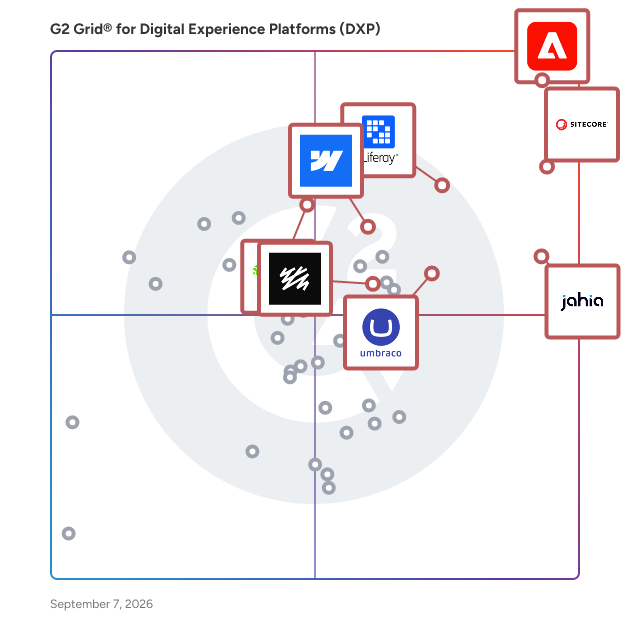
   Products classified in the overall Digital Experience Platforms (DXP) category are similar in many regards and help companies of all sizes solve their business problems. However, small business features, pricing, setup, and installation differ from businesses of other sizes, which is why we match buyers to the right Small Business Digital Experience Platforms (DXP) to fit their needs. Compare product ratings based on reviews from enterprise users or connect with one of G2&#39;s buying advisors to find the right solutions within the Small Business Digital Experience Platforms (DXP) category.

In addition to qualifying for inclusion in the Digital Experience Platforms (DXP) category, to qualify for inclusion in the Small Business Digital Experience Platforms (DXP) category, a product must have at least 10 reviews left by a reviewer from a small business.


## Category Overview

**Total Products under this Category:** 98


## Trust & Credibility Stats

**Why You Can Trust G2's Software Rankings:**

- 30 Analysts and Data Experts
- 11,800+ Authentic Reviews
- 98+ Products
- Unbiased Rankings

G2's software rankings are built on verified user reviews, rigorous moderation, and a consistent research methodology maintained by a team of analysts and data experts. Each product is measured using the same transparent criteria, with no paid placement or vendor influence. While reviews reflect real user experiences, which can be subjective, they offer valuable insight into how software performs in the hands of professionals. Together, these inputs power the G2 Score, a standardized way to compare tools within every category.


---

**Sponsored**

### Contentful

Contentful is a digital experience platform (DXP) designed for marketers, developers, and digital teams who need to build, personalize, and deliver impactful experiences across every channel—quickly and at scale. By combining its headless CMS with native, contextual AI, Contentful enables rapid creation, seamless management, and consistent omnichannel delivery of on-brand, data-driven content. Contentful empowers teams to adapt, reuse, personalize, and publish modular content and design components without reliance on developers, enabling rapid iteration and real-time targeting, experimentation, and optimization at the component level. Complemented by a robust ecosystem, and built on an infinitely-extensible, API-first platform, Contentful gives teams the freedom to easily build or deploy new experiences and integrations quickly to meet the ever-evolving needs of their brand. Trusted by global market leaders, Contentful is engineered for enterprise reliability, extensibility, and future-proof growth—helping organizations maximize ROI and outperform in today’s competitive digital landscape.


[Visit website](https://www.g2.com/external_clickthroughs/record?secure%5Bad_program%5D=ppc&amp;secure%5Bad_slot%5D=category_product_list&amp;secure%5Bcategory_id%5D=1414&amp;secure%5Bdisplayable_resource_id%5D=1414&amp;secure%5Bdisplayable_resource_type%5D=Category&amp;secure%5Bmedium%5D=sponsored&amp;secure%5Bplacement_reason%5D=page_category&amp;secure%5Bplacement_resource_ids%5D%5B%5D=1414&amp;secure%5Bprioritized%5D=false&amp;secure%5Bproduct_id%5D=4941&amp;secure%5Bresource_id%5D=1414&amp;secure%5Bresource_type%5D=Category&amp;secure%5Bsource_type%5D=category_page&amp;secure%5Bsource_url%5D=https%3A%2F%2Fwww.g2.com%2Fcategories%2Fdigital-experience-platforms-dxp%2Fsmall-business&amp;secure%5Btoken%5D=9852b6e65a443828664a69abdc9c2235308f93765f6b6a3df5516281d6e88a46&amp;secure%5Burl%5D=https%3A%2F%2Fwww.contentful.com%2Fproducts%2Fpersonalization%2F%3Fnt_experiences%3D9BZdShPA4TYFUwHsEmNZi%3D0%26utm_source%3Dg2%26utm_medium%3Dpaid%26utm_campaign%3Dfy27-q1-global-inbound_competitor&amp;secure%5Burl_type%5D=book_demo&amp;secure%5Bvisitor_segment%5D=180)

---

## Top-Rated Products (Ranked by G2 Score)
### 1. [Adobe Experience Manager](https://www.g2.com/products/adobe-experience-manager/reviews)
  Built on an AI-powered foundation, Adobe Experience Manager is a comprehensive suite of composable content services that empowers your team to create and deliver the right across websites, mobile apps, and other touchpoints -- all at scale. Adobe Experience Manager includes content and asset management, digital forms and guides, and a learning management system. Essential products within Adobe Experience Manager include: • Experience Manager Sites: Empowers brands to design and deliver personalized digital experiences at scale — fast, seamless, and built to adapt to whatever comes next. • Experience Manager Assets: A customizable Digital Assets Management system that lets you easily discover, govern, and activate millions of assets so you can deliver and scale personalized experiences. Adobe’s native AI in AEM Assets is uniquely trained on your brand’s data, voice, and creative DNA—learning from your metadata, content patterns, and regional nuances across brands and geographies. • Experience Manager Forms: End-to-end digital enrollment solution to create, manage, publish and update digital forms and customer communications integrated with back-end processes and systems of record • Learning Manager: A learning management system (LMS) that makes it easy to integrate trainings into your brands’ websites and apps. • Experience Manager Guides: A component content management system for managing and scaling documentation, knowledge, and support content.


  **Average Rating:** 4.2/5.0
  **Total Reviews:** 643

**User Satisfaction Scores:**

- **Web Analytics:** 8.4/10 (Category avg: 8.1/10)
- **Audience Insights:** 8.2/10 (Category avg: 8.1/10)
- **Campaign Tracking:** 8.2/10 (Category avg: 8.1/10)
- **Has the product been a good partner in doing business?:** 8.3/10 (Category avg: 9.1/10)


**Seller Details:**

- **Seller:** [Adobe](https://www.g2.com/sellers/adobe)
- **Company Website:** https://adobe.com
- **Year Founded:** 1982
- **HQ Location:** San Jose, CA
- **Twitter:** @Adobe (959,279 Twitter followers)
- **LinkedIn® Page:** https://www.linkedin.com/company/1480/ (41,539 employees on LinkedIn®)

**Reviewer Demographics:**
  - **Who Uses This:** Software Engineer, Consultant
  - **Top Industries:** Information Technology and Services, Marketing and Advertising
  - **Company Size:** 48% Enterprise, 26% Small-Business


#### Pros & Cons

**Pros:**

- Ease of Use (160 reviews)
- Content Management (141 reviews)
- Features (122 reviews)
- Customization (97 reviews)
- Integrations (85 reviews)

**Cons:**

- Learning Curve (119 reviews)
- Complex Usability (113 reviews)
- Difficult Learning (111 reviews)
- Expensive (81 reviews)
- Steep Learning Curve (77 reviews)

### 2. [Jahia DXP](https://www.g2.com/products/jahia-dxp/reviews)
  Jahia is a content management system (CMS) and digital experience platform (DXP) designed to assist organizations in creating modern websites and portals. This robust solution is particularly well-suited for businesses operating in multisite and multilingual environments, enabling them to manage diverse content and user experiences efficiently. Jahia streamlines the content management process, allowing users to focus on delivering engaging digital experiences rather than getting bogged down by technical complexities. Targeted at enterprises and organizations that require a flexible and scalable solution, Jahia caters to a wide range of industries, including retail, finance, and education. Its capabilities are ideal for teams that need to manage multiple websites or portals while ensuring consistency in branding and user experience across different languages and regions. Jahia’s user-friendly interface and powerful features make it an attractive option for content creators, marketers, and IT professionals alike, facilitating collaboration and enhancing productivity. One of the standout features of Jahia is its emphasis on personalization and A/B testing, which are essential for optimizing user engagement and conversion rates. The platform allows organizations to leverage customer data effectively, enabling them to create tailored experiences that resonate with their target audiences. By integrating advanced analytics and insights, Jahia empowers users to make informed decisions about content strategies and marketing efforts, ultimately driving better results. In addition to its core functionalities, Jahia offers 10,000+ no-code integrations, making it a versatile addition to any tech stack. This extensive library of integrations allows users to connect with various third-party applications and services seamlessly, enhancing the platform&#39;s capabilities without requiring extensive coding knowledge. This flexibility ensures that organizations can adapt and evolve their digital strategies as needed, making Jahia a future-proof solution for content management and digital experiences. Overall, Jahia stands out in the CMS and DXP landscape by providing a comprehensive, user-friendly platform that simplifies content management while enhancing personalization and user engagement. Its ability to support multisite and multilingual contexts, combined with a wealth of integrations, positions Jahia as a valuable tool for organizations looking to create impactful digital experiences.


  **Average Rating:** 4.4/5.0
  **Total Reviews:** 598

**User Satisfaction Scores:**

- **Web Analytics:** 8.4/10 (Category avg: 8.1/10)
- **Audience Insights:** 8.5/10 (Category avg: 8.1/10)
- **Campaign Tracking:** 8.4/10 (Category avg: 8.1/10)
- **Has the product been a good partner in doing business?:** 8.9/10 (Category avg: 9.1/10)


**Seller Details:**

- **Seller:** [Jahia](https://www.g2.com/sellers/jahia)
- **Company Website:** https://www.jahia.com
- **Year Founded:** 2002
- **HQ Location:** Geneva, Switzerland
- **Twitter:** @Jahia (5,737 Twitter followers)
- **LinkedIn® Page:** https://www.linkedin.com/company/103891/ (71 employees on LinkedIn®)

**Reviewer Demographics:**
  - **Who Uses This:** Product Owner, Business Analyst
  - **Top Industries:** Insurance, Information Technology and Services
  - **Company Size:** 33% Enterprise, 32% Small-Business


#### Pros & Cons

**Pros:**

- Ease of Use (130 reviews)
- Content Management (107 reviews)
- Flexibility (95 reviews)
- Integrations (94 reviews)
- Intuitive (94 reviews)

**Cons:**

- Learning Curve (129 reviews)
- Steep Learning Curve (71 reviews)
- Difficult Learning (61 reviews)
- Complexity (59 reviews)
- Technical Expertise Required (54 reviews)

### 3. [Webflow](https://www.g2.com/products/webflow/reviews)
  Webflow is the AI-native Website Experience Platform that empowers teams to build, manage, and optimize visually stunning websites and web apps with the speed, security, and scalability today’s leading brands demand. With a visual, composable CMS at its core, Webflow unites marketers, designers, and developers on a single platform built for performance and precision. Built for the intelligent web era, Webflow combines AI-powered creation, automation, and optimization to help companies drive measurable growth and deliver high-performing digital experiences, anywhere their brand lives. Today, more than 300,000 of the world’s leading companies and over 2,000 Certified Webflow Partners trust Webflow to power exceptional, enterprise-grade web experiences at scale.


  **Average Rating:** 4.4/5.0
  **Total Reviews:** 968

**User Satisfaction Scores:**

- **Web Analytics:** 8.0/10 (Category avg: 8.1/10)
- **Audience Insights:** 7.7/10 (Category avg: 8.1/10)
- **Campaign Tracking:** 7.6/10 (Category avg: 8.1/10)
- **Has the product been a good partner in doing business?:** 8.9/10 (Category avg: 9.1/10)


**Seller Details:**

- **Seller:** [Webflow](https://www.g2.com/sellers/webflow)
- **Company Website:** https://webflow.com
- **Year Founded:** 2012
- **HQ Location:** San Francisco, California
- **Twitter:** @webflowapp (1 Twitter followers)
- **LinkedIn® Page:** https://www.linkedin.com/company/3502352/ (1,641 employees on LinkedIn®)

**Reviewer Demographics:**
  - **Who Uses This:** Founder, Graphic Designer
  - **Top Industries:** Design, Marketing and Advertising
  - **Company Size:** 69% Small-Business, 22% Mid-Market


#### Pros & Cons

**Pros:**

- Ease of Use (278 reviews)
- Design Flexibility (180 reviews)
- Features (170 reviews)
- Intuitive (166 reviews)
- Flexibility (152 reviews)

**Cons:**

- Learning Curve (109 reviews)
- Limited Features (105 reviews)
- Missing Features (97 reviews)
- Expensive (82 reviews)
- Steep Learning Curve (80 reviews)

### 4. [Umbraco](https://www.g2.com/products/umbraco/reviews)
  Umbraco is a leading open-source .NET Core CMS with over 700,000 active installs worldwide and a vibrant community of over 220,000 members. Since its inception on February 16, 2005, Umbraco has remained an open-source project backed by a dedicated commercial company. At Umbraco, we pride ourselves on staying at the forefront of technology. Our alignment with Microsoft’s .NET release schedule ensures that Umbraco is always up-to-date with the latest .NET version. Umbraco CMS offers unparalleled flexibility, giving you full control over your website and its features. Beyond the core CMS, we provide two unique products to cater to your specific needs: Umbraco Cloud: The ideal environment for your Umbraco projects, featuring Azure Cloud hosting, automated upgrades, and streamlined workflows to maximize your productivity and project potential. Umbraco Heartcore: Our headless CMS option, equipped with fully managed APIs, GraphQL support, CDN capabilities, and more, providing a robust solution for omnichannel content delivery. Why choose Umbraco? Developers appreciate Umbraco for its flexibility and scalability. It integrates seamlessly with your code, allowing you to create a website that looks, feels, and operates exactly as you envision. With open-source code and APIs, Umbraco is easily extendable and adaptable to meet diverse requirements. For content editors and marketers, Umbraco delivers an exceptional editing experience. Our CMS includes intuitive features and workflows designed to enhance content creation and management. If you have specific needs, Umbraco’s backend can be customized by developers to fit perfectly. Our mission is to provide a platform that empowers you to manage your projects your way. By keeping our system open and adaptable, we ensure that Umbraco remains relevant and efficient for a wide range of project requirements.


  **Average Rating:** 4.5/5.0
  **Total Reviews:** 933

**User Satisfaction Scores:**

- **Web Analytics:** 7.7/10 (Category avg: 8.1/10)
- **Audience Insights:** 7.3/10 (Category avg: 8.1/10)
- **Campaign Tracking:** 7.4/10 (Category avg: 8.1/10)
- **Has the product been a good partner in doing business?:** 8.8/10 (Category avg: 9.1/10)


**Seller Details:**

- **Seller:** [Umbraco](https://www.g2.com/sellers/umbraco)
- **Company Website:** https://umbraco.com
- **Year Founded:** 2005
- **HQ Location:** Odense
- **Twitter:** @umbraco (3,520 Twitter followers)
- **LinkedIn® Page:** https://www.linkedin.com/company/804354/ (182 employees on LinkedIn®)

**Reviewer Demographics:**
  - **Who Uses This:** Software Engineer, Developer
  - **Top Industries:** Computer Software, Information Technology and Services
  - **Company Size:** 51% Small-Business, 35% Mid-Market


#### Pros & Cons

**Pros:**

- Ease of Use (109 reviews)
- Content Management (67 reviews)
- Intuitive (55 reviews)
- Features (51 reviews)
- Customizability (44 reviews)

**Cons:**

- Learning Curve (26 reviews)
- Limited Features (23 reviews)
- Poor Usability Design (22 reviews)
- Difficult Usability (19 reviews)
- Editor Limitations (19 reviews)

### 5. [Sanity](https://www.g2.com/products/sanity/reviews)
  The Content Operating System—a fully customizable all-code backend for content-driven websites and apps. Power all your content operations from a single platform with a feature-rich content workspace, interactive visual editing, serverless functions, AI agent, and the database optimized for content. Learn more: https://www.sanity.io/ Try it out: https://www.sanity.io/get-started Join the community: https://snty.link/community Get work-ready: https://www.sanity.io/learn Questions? hello@sanity.io


  **Average Rating:** 4.7/5.0
  **Total Reviews:** 901

**User Satisfaction Scores:**

- **Web Analytics:** 7.0/10 (Category avg: 8.1/10)
- **Audience Insights:** 6.1/10 (Category avg: 8.1/10)
- **Campaign Tracking:** 6.3/10 (Category avg: 8.1/10)
- **Has the product been a good partner in doing business?:** 9.2/10 (Category avg: 9.1/10)


**Seller Details:**

- **Seller:** [Sanity.io](https://www.g2.com/sellers/sanity-io)
- **Company Website:** https://www.sanity.io
- **Year Founded:** 2018
- **HQ Location:** San Francisco, California
- **Twitter:** @sanity_io (14,864 Twitter followers)
- **LinkedIn® Page:** https://www.linkedin.com/company/18400536/ (277 employees on LinkedIn®)

**Reviewer Demographics:**
  - **Who Uses This:** Software Engineer, Web Developer
  - **Top Industries:** Computer Software, Information Technology and Services
  - **Company Size:** 73% Small-Business, 18% Mid-Market


#### Pros & Cons

**Pros:**

- Customizability (93 reviews)
- Features (85 reviews)
- Flexibility (84 reviews)
- Ease of Use (81 reviews)
- Customization (76 reviews)

**Cons:**

- Learning Curve (66 reviews)
- Learning Difficulty (32 reviews)
- Poor Documentation (26 reviews)
- Lack of Tutorials (21 reviews)
- Missing Features (20 reviews)

### 6. [Sitecore Digital Experience Platform](https://www.g2.com/products/sitecore-digital-experience-platform/reviews)
  Sitecore is a global leader in AI-enabled digital experience software. Its next-generation platform, SitecoreAI, helps brands plan, create, personalize, and deliver content across every channel — websites, apps, social, and beyond. By unifying content management, customer data, and personalization into one intelligent system, it makes marketing faster, smarter, and more connected. At its core are agentic tools and studios that let marketers and developers collaborate with AI responsibly and effectively. Trusted by thousands of global brands and supported by one of the world’s largest digital experience communities, Sitecore helps organizations design experiences for the world beyond the website, with the flexibility of customizable SaaS and the scale of a global ecosystem. Discover more at www.sitecore.com. Sitecore is a registered trademark of Sitecore Corporation A/S in the USA and other countries. All other brand names, product names, or trademarks belong to their respective holders.


  **Average Rating:** 4.1/5.0
  **Total Reviews:** 526

**User Satisfaction Scores:**

- **Web Analytics:** 7.8/10 (Category avg: 8.1/10)
- **Audience Insights:** 7.7/10 (Category avg: 8.1/10)
- **Campaign Tracking:** 7.8/10 (Category avg: 8.1/10)
- **Has the product been a good partner in doing business?:** 7.9/10 (Category avg: 9.1/10)


**Seller Details:**

- **Seller:** [Sitecore](https://www.g2.com/sellers/sitecore)
- **Company Website:** https://www.sitecore.com/
- **Year Founded:** 2001
- **HQ Location:** San Francisco, CA
- **Twitter:** @Sitecore (19,493 Twitter followers)
- **LinkedIn® Page:** https://www.linkedin.com/company/sitecore/ (1,764 employees on LinkedIn®)

**Reviewer Demographics:**
  - **Who Uses This:** Web Developer, Digital Marketing Manager
  - **Top Industries:** Information Technology and Services, Hospital &amp; Health Care
  - **Company Size:** 52% Enterprise, 34% Mid-Market


#### Pros & Cons

**Pros:**

- Features (74 reviews)
- Ease of Use (65 reviews)
- Flexibility (52 reviews)
- Content Management (48 reviews)
- Customizability (46 reviews)

**Cons:**

- Learning Curve (46 reviews)
- Expensive (33 reviews)
- Complexity (26 reviews)
- Steep Learning Curve (22 reviews)
- Difficult Usability (19 reviews)

### 7. [Kentico](https://www.g2.com/products/kentico/reviews)
  One platform, endless possibilities. Kentico is a content management system and commerce platform, with built-in digital marketing and AI capabilities that help deliver personalized customer experiences through websites, microsites, emails, and other digital channels. It consolidates marketing tools to improve efficiency, drive stronger customer engagement, and reach business goals faster. Reduce the complexity of your marketing technologies and take control of your content across your websites, microsites, emails, and other digital channels.


  **Average Rating:** 4.4/5.0
  **Total Reviews:** 329

**User Satisfaction Scores:**

- **Web Analytics:** 8.8/10 (Category avg: 8.1/10)
- **Audience Insights:** 8.9/10 (Category avg: 8.1/10)
- **Campaign Tracking:** 8.7/10 (Category avg: 8.1/10)
- **Has the product been a good partner in doing business?:** 8.5/10 (Category avg: 9.1/10)


**Seller Details:**

- **Seller:** [Kentico](https://www.g2.com/sellers/kentico-0d41184f-32ba-4fc4-bd87-729931e5b980)
- **Company Website:** https://www.kentico.com/
- **Year Founded:** 2004
- **HQ Location:** Brno
- **Twitter:** @Kentico (12,432 Twitter followers)
- **LinkedIn® Page:** https://www.linkedin.com/company/373060/ (212 employees on LinkedIn®)

**Reviewer Demographics:**
  - **Who Uses This:** Software Engineer, Software Developer
  - **Top Industries:** Information Technology and Services, Marketing and Advertising
  - **Company Size:** 41% Mid-Market, 33% Small-Business


#### Pros & Cons

**Pros:**

- Content Management (21 reviews)
- Ease of Use (21 reviews)
- Features (12 reviews)
- Customer Support (9 reviews)
- Personalization (9 reviews)

**Cons:**

- Expensive (8 reviews)
- Limited Features (5 reviews)
- Learning Curve (4 reviews)
- Limited Customization (4 reviews)
- Complex Customization (3 reviews)

### 8. [Liferay Digital Experience Platform](https://www.g2.com/products/liferay-liferay-digital-experience-platform/reviews)
  Liferay DXP helps companies deliver personalized and connected digital experiences across a broad range of channels, including customer portals, websites, intranets, mobile apps, and connected devices. We offer a flexible platform that’s designed to integrate seamlessly into your existing enterprise applications (ex. CRM, ERP, MAP), so you can create a unified experience for your users, while also preserving your investment in existing technologies. And we provide your business users with the intuitive CMS, user analytics, and site management tools they need to launch, test and optimize digital experiences quickly for faster go-to-market.


  **Average Rating:** 4.4/5.0
  **Total Reviews:** 74

**User Satisfaction Scores:**

- **Web Analytics:** 3.3/10 (Category avg: 8.1/10)
- **Audience Insights:** 7.5/10 (Category avg: 8.1/10)
- **Campaign Tracking:** 5.0/10 (Category avg: 8.1/10)
- **Has the product been a good partner in doing business?:** 8.5/10 (Category avg: 9.1/10)


**Seller Details:**

- **Seller:** [Liferay](https://www.g2.com/sellers/liferay)
- **Company Website:** https://www.liferay.com
- **Year Founded:** 2004
- **HQ Location:** Diamond Bar, CA
- **Twitter:** @Liferay (9,188 Twitter followers)
- **LinkedIn® Page:** https://www.linkedin.com/company/83609/ (1,146 employees on LinkedIn®)

**Reviewer Demographics:**
  - **Who Uses This:** Software Engineer
  - **Top Industries:** Information Technology and Services, Computer Software
  - **Company Size:** 39% Mid-Market, 33% Enterprise


#### Pros & Cons

**Pros:**

- Customizability (1 reviews)
- Customization (1 reviews)
- Customization Options (1 reviews)
- Flexibility (1 reviews)
- Scalability (1 reviews)

**Cons:**

- Error Issues (1 reviews)
- Outdated Documentation (1 reviews)
- Poor Customer Support (1 reviews)
- Poor Documentation (1 reviews)
- Tagging Issues (1 reviews)

### 9. [Storyblok](https://www.g2.com/products/storyblok/reviews)
  Storyblok is a headless CMS that enables marketers and developers to create with joy and succeed in the AI-driven content era. It empowers you to deliver structured and consistent content everywhere: websites, apps, AI search, and beyond. Legendary brands like Virgin Media O2, Oatly, and TomTom use Storyblok to make a bigger, faster market impact. It’s Joyful Headless™, and it changes everything.


  **Average Rating:** 4.5/5.0
  **Total Reviews:** 563

**User Satisfaction Scores:**

- **Web Analytics:** 8.1/10 (Category avg: 8.1/10)
- **Audience Insights:** 8.0/10 (Category avg: 8.1/10)
- **Campaign Tracking:** 8.1/10 (Category avg: 8.1/10)
- **Has the product been a good partner in doing business?:** 8.9/10 (Category avg: 9.1/10)


**Seller Details:**

- **Seller:** [Storyblok](https://www.g2.com/sellers/storyblok)
- **Company Website:** https://www.storyblok.com
- **Year Founded:** 2017
- **HQ Location:** Linz, Oberösterreich
- **Twitter:** @storyblok (9,254 Twitter followers)
- **LinkedIn® Page:** https://www.linkedin.com/company/17989065/ (292 employees on LinkedIn®)

**Reviewer Demographics:**
  - **Who Uses This:** Software Engineer, Frontend Developer
  - **Top Industries:** Computer Software, Information Technology and Services
  - **Company Size:** 56% Small-Business, 30% Mid-Market


#### Pros & Cons

**Pros:**

- Ease of Use (111 reviews)
- Intuitive (71 reviews)
- Content Management (69 reviews)
- Features (60 reviews)
- Easy Setup (48 reviews)

**Cons:**

- Learning Curve (37 reviews)
- Expensive (22 reviews)
- Missing Features (19 reviews)
- Lack of Features (18 reviews)
- Pricing Issues (18 reviews)

### 10. [Progress Sitefinity](https://www.g2.com/products/progress-sitefinity/reviews)
  Progress Sitefinity is a cloud-first content management system (CMS) and digital experience platform (DXP) used to build, manage and personalize websites, portals and other digital properties. It is adopted by mid-market and enterprise organisations that operate multi-site, multilingual or regulated digital estates and need to balance marketing autonomy with IT governance and developer flexibility. Primary use cases include corporate websites, member and customer portals, authenticated experiences, integration-heavy workflows and consolidation of fragmented CMS deployments. Sitefinity supports marketing, development and IT teams through a shared platform model with role-appropriate tools and permissions. Key capabilities include: - Multisite, multilingual and multi-brand management with governance controls and workflows - Native customer data platform (Sitefinity Insight) for segmentation, analytics and personalization - 1,000+ prebuilt connectors and open APIs, Sitefinity Cloud platform integrates with your MarTech stack, CRM and enterprise systems in hours—not weeks - Extensibility using .NET and ASP.NET Core for custom development and composable architectures Sitefinity also incorporates generative and retrieval-augmented capabilities through Progress® Agentic RAG, enabling dynamic assembly of experiences from approved content to reduce manual production work while maintaining accuracy, compliance and brand standards. Additional operational benefits and deployment considerations: - Standardization and consolidation of CMS estates across business units or regions - Support for marketing, development and IT workflows without requiring a headless-only approach - Structured content for regulated or high-volume publishing environments - Deployment on-premises or as a managed cloud service on Microsoft Azure, reducing maintenance and providing security, scaling and compliance


  **Average Rating:** 4.0/5.0
  **Total Reviews:** 468

**User Satisfaction Scores:**

- **Web Analytics:** 8.0/10 (Category avg: 8.1/10)
- **Audience Insights:** 8.0/10 (Category avg: 8.1/10)
- **Campaign Tracking:** 7.7/10 (Category avg: 8.1/10)
- **Has the product been a good partner in doing business?:** 8.0/10 (Category avg: 9.1/10)


**Seller Details:**

- **Seller:** [Progress Software](https://www.g2.com/sellers/progress-software)
- **Company Website:** https://www.progress.com/
- **Year Founded:** 1981
- **HQ Location:** Burlington, MA.
- **Twitter:** @ProgressSW (48,845 Twitter followers)
- **LinkedIn® Page:** https://www.linkedin.com/company/progress-software/ (4,205 employees on LinkedIn®)

**Reviewer Demographics:**
  - **Who Uses This:** Web Developer, Marketing Manager
  - **Top Industries:** Information Technology and Services, Non-Profit Organization Management
  - **Company Size:** 48% Mid-Market, 28% Small-Business


#### Pros & Cons

**Pros:**

- Content Management (10 reviews)
- Ease of Use (10 reviews)
- Customizability (7 reviews)
- Features (5 reviews)
- Customer Support (4 reviews)

**Cons:**

- Expensive (5 reviews)
- Pricing Issues (5 reviews)
- Limited Features (4 reviews)
- Content Management (3 reviews)
- Data Migration (3 reviews)

### 11. [Kontent.ai](https://www.g2.com/products/kontent-ai/reviews)
  Kontent.ai is the world’s first Agentic CMS and the only platform that helps organizations intelligently operate content at scale. By embedding AI agents into content workflows, Kontent.ai empowers organizations to automate operations, enforce governance, and accelerate time to market, without adding headcount. Kontent.ai features two core AI capabilities. The AI Agent is activated through natural language prompts and can execute complex tasks such as launching large-scale campaigns, restructuring content in bulk, or supporting content migrations, reducing the need for developer involvement.  Expert Agents operate as always-on, fully customizable digital teammates. Once created by using a natural language prompt, they trigger automatically, eliminating manual steps and ensuring consistency across processes. They can support business specific use cases, from enforcing brand and compliance standards to content audits and localization. You can integrate them with your existing tech stack to extend automation beyond the CMS and coordinate actions across systems. Multiple agents can also be combined to work together, eliminating workflow steps in complex tasks and reducing operational complexity.  Kontent.ai Agentic CMS helps you: - Expand to new markets faster - Improve team productivity - Reduce compliance risk - Improve content performance With a demonstrated ROI of 320%, Kontent.ai customers, including WebMD Ignite, Elanco, Zurich Insurance, PPG, and Oxford University, see measurable improvements in content velocity, operational efficiency, and risk reduction. Kontent.ai is a Microsoft partner recognized by Gartner and Forrester. Learn more at kontent.ai. 


  **Average Rating:** 4.3/5.0
  **Total Reviews:** 173

**User Satisfaction Scores:**

- **Web Analytics:** 7.6/10 (Category avg: 8.1/10)
- **Audience Insights:** 7.9/10 (Category avg: 8.1/10)
- **Campaign Tracking:** 7.3/10 (Category avg: 8.1/10)
- **Has the product been a good partner in doing business?:** 9.0/10 (Category avg: 9.1/10)


**Seller Details:**

- **Seller:** [Kontent.ai](https://www.g2.com/sellers/kontent-ai-002cd013-3ff3-42c4-af22-40e7fe42fb3c)
- **Year Founded:** 2015
- **HQ Location:** Brno
- **Twitter:** @Kontent_ai (3,905 Twitter followers)
- **LinkedIn® Page:** https://www.linkedin.com/company/kontentai/ (131 employees on LinkedIn®)

**Reviewer Demographics:**
  - **Who Uses This:** Developer
  - **Top Industries:** Computer Software, Information Technology and Services
  - **Company Size:** 42% Mid-Market, 38% Small-Business


#### Pros & Cons

**Pros:**

- Ease of Use (10 reviews)
- Content Management (9 reviews)
- Customer Support (8 reviews)
- Easy Integrations (7 reviews)
- Intuitive (7 reviews)

**Cons:**

- Learning Curve (4 reviews)
- Limited Features (4 reviews)
- Missing Features (4 reviews)
- CMS Limitations (3 reviews)
- Steep Learning Curve (3 reviews)

### 12. [Bloomreach](https://www.g2.com/products/bloomreach-bloomreach/reviews)
  Bloomreach is the agentic platform for personalization. Powering autonomous search, conversational shopping, and autonomous marketing, Bloomreach personalizes the entire customer experience. From retail to financial services, hospitality to gaming, businesses create experiences that drive higher growth and lasting loyalty. Bloomreach drives personalization for 1,400+ brands around the world, including American Eagle, Sonepar, and Pandora. The target audience for Bloomreach encompasses commerce businesses of all sizes that are looking to optimize customer interactions and drive sales growth. Its suite of products is particularly beneficial for marketers, content creators, and ecommerce managers who aim to improve customer engagement and conversion rates. Bloomreach is well-suited for brands operating across multiple channels, as it provides a cohesive strategy to connect with customers effectively. Use cases include personalized marketing campaigns, enhanced product discovery, streamlined content management, and AI-driven customer service, making it a versatile tool for various business needs. Key features of Bloomreach include its Engagement platform, which offers robust marketing automation capabilities that enable businesses to deliver personalized messages and offers based on customer behavior. The Discovery solution enhances the search experience on ecommerce sites, ensuring that customers can easily find products that match their interests. Additionally, the Content product functions as a headless content management system (CMS), allowing for flexible content delivery across various platforms. The Clarity tool, an AI-powered conversational shopping assistant, further enriches the customer experience by facilitating real-time interactions and support. The integration of Loomi, Bloomreach&#39;s AI for ecommerce, significantly amplifies the platform&#39;s capabilities by enabling rapid data processing and analysis. This results in new pathways for customers to engage with products, ultimately leading to increased profitability and accelerated business growth. Bloomreach is designed to simplify complex tasks, offering advanced customer journeys, social ad retargeting, omnichannel support, and AI-powered optimization. This comprehensive feature set provides a holistic view of the customer, optimizing experiences across all channels. The platform is also cost-effective and faster to deploy compared to competitors, reducing reliance on third-party solutions and lowering the total cost of ownership. With high ratings in customer reviews, Bloomreach is recognized for the quality of its user guides, support, and overall reliability, making it a valuable asset for businesses seeking to enhance their ecommerce strategies.


  **Average Rating:** 4.6/5.0
  **Total Reviews:** 754

**User Satisfaction Scores:**

- **Web Analytics:** 8.3/10 (Category avg: 8.1/10)
- **Audience Insights:** 8.4/10 (Category avg: 8.1/10)
- **Campaign Tracking:** 8.7/10 (Category avg: 8.1/10)
- **Has the product been a good partner in doing business?:** 9.1/10 (Category avg: 9.1/10)


**Seller Details:**

- **Seller:** [Bloomreach](https://www.g2.com/sellers/bloomreach)
- **Company Website:** https://www.bloomreach.com
- **Year Founded:** 2009
- **HQ Location:** Mountain View, CA
- **Twitter:** @bloomreach_tm (10,407 Twitter followers)
- **LinkedIn® Page:** https://www.linkedin.com/company/bloomreach/ (1,124 employees on LinkedIn®)

**Reviewer Demographics:**
  - **Who Uses This:** CRM Manager, Marketing Manager
  - **Top Industries:** Retail, Marketing and Advertising
  - **Company Size:** 49% Mid-Market, 28% Small-Business


#### Pros & Cons

**Pros:**

- Ease of Use (116 reviews)
- Features (106 reviews)
- Helpful (94 reviews)
- Customer Support (90 reviews)
- Customer Engagement (79 reviews)

**Cons:**

- Learning Curve (91 reviews)
- Learning Difficulty (61 reviews)
- Missing Features (59 reviews)
- Limited Features (54 reviews)
- Difficult Learning (51 reviews)

### 13. [Neptune DXP](https://www.g2.com/products/neptune-dxp/reviews)
  Neptune DXP is a no-code/low-code application development platform specifically designed to facilitate the creation and management of applications within the SAP ecosystem and beyond. This innovative solution empowers users to develop, run, and orchestrate modern applications with ease, significantly accelerating the development process compared to traditional methods. By leveraging its unique capabilities, organizations can streamline their operations and enhance their agility in an ever-evolving technological landscape. Targeted primarily at enterprises that utilize SAP systems or integrate SAP with various Software as a Service (SaaS) applications, Neptune DXP caters to a diverse range of professionals, including IT departments, business analysts, and application developers. The platform is particularly advantageous for organizations seeking to improve operational efficiency, as it allows users with limited coding experience to create applications, thereby broadening access to app development within the organization. This democratization of development fosters collaboration between technical and non-technical teams, driving innovation and responsiveness. One of the standout features of Neptune DXP is its ability to seamlessly integrate SAP and non-SAP systems, ensuring that organizations can maximize their existing investments while adopting new technologies. This integration capability is crucial for enterprises that rely on a mix of legacy systems and modern applications. Additionally, Neptune DXP is built with enterprise-grade governance in mind, providing the necessary security and compliance measures that large organizations require to navigate complex regulatory environments effectively. The platform&#39;s performance metrics are particularly impressive, enabling users to build applications up to ten times faster while reducing development effort by as much as 80%. This level of efficiency not only accelerates time-to-market for new applications but also allows teams to allocate resources more effectively, ultimately driving productivity. With a robust user base of over 850 customers and 4 million users, Neptune DXP has established a strong presence in the market, supported by a network of more than 100 certified partners who assist with implementation and integration. In summary, Neptune DXP distinguishes itself in the no-code/low-code platform category by combining AI capabilities with a solid SAP-native foundation. This unique positioning enables enterprises to harness the power of artificial intelligence while maintaining control over their application development processes. By adopting Neptune DXP, organizations can drive innovation, enhance productivity, and achieve their digital transformation objectives more efficiently.


  **Average Rating:** 4.5/5.0
  **Total Reviews:** 213

**User Satisfaction Scores:**

- **Web Analytics:** 8.4/10 (Category avg: 8.1/10)
- **Audience Insights:** 8.2/10 (Category avg: 8.1/10)
- **Campaign Tracking:** 8.0/10 (Category avg: 8.1/10)
- **Has the product been a good partner in doing business?:** 9.0/10 (Category avg: 9.1/10)


**Seller Details:**

- **Seller:** [Neptune Software](https://www.g2.com/sellers/neptune-software)
- **Company Website:** https://www.neptune-software.com/
- **Year Founded:** 2011
- **HQ Location:** Oslo, Oslo
- **Twitter:** @NeptSoft (1,282 Twitter followers)
- **LinkedIn® Page:** https://www.linkedin.com/company/neptune-software/ (186 employees on LinkedIn®)

**Reviewer Demographics:**
  - **Who Uses This:** Software Engineer, Consultant
  - **Top Industries:** Information Technology and Services, Computer Software
  - **Company Size:** 41% Enterprise, 32% Small-Business


#### Pros & Cons

**Pros:**

- Ease of Use (6 reviews)
- Low Code (4 reviews)
- Low Coding (4 reviews)
- Mobile Apps (4 reviews)
- Customer Support (3 reviews)

**Cons:**

- Learning Curve (5 reviews)
- Expertise Required (3 reviews)
- Learning Difficulty (3 reviews)
- Steep Learning Curve (3 reviews)
- Complexity (2 reviews)

### 14. [Core dna](https://www.g2.com/products/core-dna/reviews)
  Core dna is a unified Digital Orchestration Platform that converges Hybrid Headless CMS, Ecommerce, and Enterprise AI into a single-tenant environment. Beyond traditional AI agents, core dna features a native Model Context Protocol (MCP) layer. This enables enterprise teams to create complex, multi-site workflows and digital experiences using natural language within a secure, governed environment. By embedding AI at the infrastructure level rather than through third-party plugins, core dna ensures that every autonomous action is grounded in your specific enterprise regulations, permissions, and user hierarchies. Core Capabilities for 2026 - MCP-Driven Workflow Creation: Use natural language to build and deploy enterprise-grade workflows. Because the platform natively supports MCP, AI agents can &quot;discover&quot; your custom entities and data structures (like ERP data or franchise logic) without manual mapping or custom development. - Autonomous Page &amp; Experience Reconstitution: Our AI orchestration agent doesn&#39;t just translate text; it rebuilds entire page layouts component-by-component across 100+ languages. This process is fully governed, allowing for instant &quot;staging&quot; and human verification before launch. - Hybrid Headless with API Governance: Get the flexibility of a headless architecture with the stability of a managed SaaS. All functionality, from commerce and SEO to the MCP layer is native to the core dna stack, ensuring Upgrade-Preserved stability and eliminating the &quot;plugin-break&quot; cycle. - Enterprise-Ready AI Context: Unlike generic AI tools, core dna’s AI operates within your &quot;Corporate Guardrails.&quot; It understands granular permissions, regional compliance, and brand standards, ensuring that AI-generated actions are always secure and compliant. Why Enterprise Teams Choose core dna 1. The End of &quot;Plugin Anxiety&quot;: Most platforms (like WordPress or Shopify) rely on a fragile web of 3rd-party plugins. core dna is a Zero-Plugin platform. All features, including our advanced AI agents and MCP servers, are part of the core engine, meaning your site will never break during a platform update. 2. Natural Language Operations: Empower non-technical marketers and ecommerce managers to perform complex tasks, like &quot;Create a regional promotion for all NYC stores with 10% off walnut furniture&quot;, directly through the MCP interface. The system handles the API calls, permission checks, and layout adjustments automatically. 3. Strategic Multi-Site Scaling: Orchestrate hundreds of sub-sites or franchise locations from a single master dashboard. Use AI to push global brand updates while allowing local agents to adapt pricing and content for specific regional markets.


  **Average Rating:** 4.5/5.0
  **Total Reviews:** 13

**User Satisfaction Scores:**

- **Web Analytics:** 7.8/10 (Category avg: 8.1/10)
- **Audience Insights:** 7.2/10 (Category avg: 8.1/10)
- **Campaign Tracking:** 7.4/10 (Category avg: 8.1/10)
- **Has the product been a good partner in doing business?:** 9.4/10 (Category avg: 9.1/10)


**Seller Details:**

- **Seller:** [Core dna Services](https://www.g2.com/sellers/core-dna-services)
- **Year Founded:** 2000
- **HQ Location:** Boston, Massachusetts
- **Twitter:** @coredna (3,027 Twitter followers)
- **LinkedIn® Page:** https://www.linkedin.com/company/3610696/ (18 employees on LinkedIn®)

**Reviewer Demographics:**
  - **Company Size:** 85% Small-Business, 15% Mid-Market


### 15. [Hygraph](https://www.g2.com/products/hygraph/reviews)
  Whatever you imagine – whether it’s a global news platform, an ecommerce experience, a learning app, a content hub, or something entirely unique – you can build it with Hygraph. Hygraph is the leading headless CMS for enterprises building content-rich websites, apps, and digital products. It gives teams the tools to create, manage, and deliver structured content anywhere – across web, mobile, or any other platform. With a powerful GraphQL API, flexible content modeling, and fine-grained permissions, both developers and content teams can move faster and work better together. Hygraph is built to handle complex content needs while staying easy to use, so your team can focus on delivering great digital experiences.


  **Average Rating:** 4.4/5.0
  **Total Reviews:** 711

**User Satisfaction Scores:**

- **Web Analytics:** 8.2/10 (Category avg: 8.1/10)
- **Audience Insights:** 8.0/10 (Category avg: 8.1/10)
- **Campaign Tracking:** 7.8/10 (Category avg: 8.1/10)
- **Has the product been a good partner in doing business?:** 9.0/10 (Category avg: 9.1/10)


**Seller Details:**

- **Seller:** [Hygraph](https://www.g2.com/sellers/hygraph)
- **Company Website:** https://hygraph.com/
- **Year Founded:** 2017
- **HQ Location:** Berlin
- **Twitter:** @hygraph (5,113 Twitter followers)
- **LinkedIn® Page:** https://www.linkedin.com/company/18152461/ (65 employees on LinkedIn®)

**Reviewer Demographics:**
  - **Who Uses This:** Software Engineer, Web Developer
  - **Top Industries:** Computer Software, Information Technology and Services
  - **Company Size:** 65% Small-Business, 28% Mid-Market


#### Pros & Cons

**Pros:**

- Ease of Use (132 reviews)
- Content Management (90 reviews)
- API Integration (81 reviews)
- Integrations (73 reviews)
- Flexibility (72 reviews)

**Cons:**

- Learning Curve (86 reviews)
- Learning Difficulty (42 reviews)
- Expensive (37 reviews)
- Difficult Usability (36 reviews)
- Pricing Issues (32 reviews)

### 16. [WordPress VIP](https://www.g2.com/products/wordpress-vip/reviews)
  WordPress VIP is the agile content platform leading a powerful enterprise ecosystem for an array of global brands including Salesforce, Merck, Condé Nast, and Facebook. As we fit seamlessly across your organization, have the ease, flexibility, and freedom you need to scale the digital experiences that drive your growth. WordPress VIP offers content management, enterprise commerce, and content analytics. Our platform provides best-in-class content creation agility combined with the insights to understand and optimize the impact of those digital experiences. We go beyond support: we provide expertise. Our team has been delivering the largest WordPress deployments for more than a decade, and will guide your team with architecture, integrations, plugins, agencies, and more. Say farewell to software bloat, lock-ins, and pricey marketing clouds. Select the technologies that actually solve your customer experience needs. And discover how quickly you see ROI with the agile CMS that powers 40% of the internet and 30% of the F100.


  **Average Rating:** 4.5/5.0
  **Total Reviews:** 53

**User Satisfaction Scores:**

- **Web Analytics:** 9.4/10 (Category avg: 8.1/10)
- **Audience Insights:** 8.3/10 (Category avg: 8.1/10)
- **Campaign Tracking:** 8.3/10 (Category avg: 8.1/10)
- **Has the product been a good partner in doing business?:** 9.5/10 (Category avg: 9.1/10)


**Seller Details:**

- **Seller:** [Automattic Inc.](https://www.g2.com/sellers/automattic-inc)
- **Year Founded:** 2005
- **HQ Location:** San Francisco, CA
- **Twitter:** @automattic (57,138 Twitter followers)
- **LinkedIn® Page:** https://www.linkedin.com/company/58194/ (4,058 employees on LinkedIn®)

**Reviewer Demographics:**
  - **Top Industries:** Computer Software, Information Technology and Services
  - **Company Size:** 64% Small-Business, 31% Mid-Market


#### Pros & Cons

**Pros:**

- Cloud Hosting (1 reviews)
- Ease of Management (1 reviews)
- Ease of Use (1 reviews)
- Intuitive (1 reviews)
- Management Ease (1 reviews)

**Cons:**

- Expensive (1 reviews)
- Poor Customer Support (1 reviews)

### 17. [Optimizely One](https://www.g2.com/products/optimizely-one/reviews)
  Optimizely One is an AI-powered digital experience platform that unifies content, experimentation, personalization, and analytics—with AI at the core. Built on a modern, cloud-native and extensible architecture, Optimizely One is a single, fully-unified platform that powers every stage of the marketing lifecycle—from content planning and creation, to publishing and personalization, to experimentation and warehouse-native analytics. And with Optimizely Opal, the agent orchestration platform for marketing, deeply embedded across the entire suite, teams can deploy AI agents to automate workflows and accelerate results. Ready to learn more? Contact us to see how Optimizely can transform your digital experience. Why Optimizely •10,000+ brands run on Optimizely globally, including Salesforce, Zoom, and Capital One •6× Leader in the Gartner Magic Quadrant for Digital Experience Platforms (2020–2025) •Leader in The Forrester Wave™: Digital Experience Platforms, Q4 2025 — highest possible scores across 15 criteria including content management, agent orchestration framework, brand-aligned content generation, experience experimentation and personalization, and more •1,500 employees and 700+ partners worldwide •Enterprise-grade security, scalability, and compliance


  **Average Rating:** 4.2/5.0
  **Total Reviews:** 53

**User Satisfaction Scores:**

- **Web Analytics:** 6.7/10 (Category avg: 8.1/10)
- **Audience Insights:** 7.3/10 (Category avg: 8.1/10)
- **Campaign Tracking:** 7.2/10 (Category avg: 8.1/10)
- **Has the product been a good partner in doing business?:** 7.8/10 (Category avg: 9.1/10)


**Seller Details:**

- **Seller:** [Optimizely](https://www.g2.com/sellers/optimizely-a5a01825-75d4-4ab9-84c1-3a421d75af81)
- **Year Founded:** 1994
- **HQ Location:** New York
- **Twitter:** @Optimizely (28,825 Twitter followers)
- **LinkedIn® Page:** https://www.linkedin.com/company/optimizely/ (1,613 employees on LinkedIn®)

**Reviewer Demographics:**
  - **Top Industries:** Computer Software
  - **Company Size:** 40% Mid-Market, 31% Enterprise


#### Pros & Cons

**Pros:**

- Customization (3 reviews)
- Personalization (2 reviews)
- Team Collaboration (2 reviews)
- A/B Testing (1 reviews)
- Automation (1 reviews)

**Cons:**

- Learning Difficulty (2 reviews)
- Complex Features (1 reviews)
- Difficult Learning (1 reviews)
- Difficult Usability (1 reviews)
- Initial Difficulty (1 reviews)

### 18. [Siteglide](https://www.g2.com/products/siteglide/reviews)
  Siteglide is a Digital Experience Platform (DXP) that helps Digital Agencies build and manage User-First Experiences such as Online Courses, Marketplaces, Membership Sites and Customer Portals.


  **Average Rating:** 4.8/5.0
  **Total Reviews:** 30

**User Satisfaction Scores:**

- **Web Analytics:** 10.0/10 (Category avg: 8.1/10)
- **Audience Insights:** 10.0/10 (Category avg: 8.1/10)
- **Campaign Tracking:** 10.0/10 (Category avg: 8.1/10)
- **Has the product been a good partner in doing business?:** 9.8/10 (Category avg: 9.1/10)


**Seller Details:**

- **Seller:** [Siteglide Ltd.](https://www.g2.com/sellers/siteglide-ltd)
- **Year Founded:** 2012
- **HQ Location:** Aldermaston, Berkshire
- **Twitter:** @Siteglide (11,212 Twitter followers)
- **LinkedIn® Page:** https://www.linkedin.com/company/siteglide/ (7 employees on LinkedIn®)

**Reviewer Demographics:**
  - **Top Industries:** Marketing and Advertising, Design
  - **Company Size:** 93% Small-Business, 3% Enterprise


### 19. [Acquia Digital Experience Platform](https://www.g2.com/products/acquia-digital-experience-platform/reviews)
  Acquia Digital Experience Platform (DXP) is a powerful, enterprise-grade solution designed to help organizations build, manage, and optimize personalized, omnichannel digital experiences. Built on open-source Drupal, Acquia DXP combines content management, customer data, personalization, and marketing automation into one unified platform. With Acquia Drupal Cloud, teams can create and manage content at scale, while Site Studio enables faster time-to-market through low-code site building. Acquia Customer Data Platform (CDP) centralizes customer data from various sources, providing a 360-degree view that drives segmentation, personalization, and predictive analytics. Marketers can deliver tailored experiences across web, email, and mobile using Acquia Campaign Studio and Personalization tools, while integrated A/B testing and analytics help optimize performance. Teams can also ensure site accessibility by optimizing content with Acquia Web Governance, all while boosting site visibility and engagement across all platforms with Acquia Content Optimization. The platform also supports multi-site management, enterprise security, GDPR/CCPA compliance, and integrates easily with leading tools like Salesforce and Marketo. Trusted by top global brands, Acquia DXP empowers businesses to create consistent, data-driven digital experiences that boost customer engagement, retention, and revenue. Whether you’re in B2B, B2C, or the public sector, Acquia offers the flexibility and scalability to meet your digital transformation goals.


  **Average Rating:** 4.3/5.0
  **Total Reviews:** 207

**User Satisfaction Scores:**

- **Web Analytics:** 7.9/10 (Category avg: 8.1/10)
- **Audience Insights:** 8.3/10 (Category avg: 8.1/10)
- **Campaign Tracking:** 7.8/10 (Category avg: 8.1/10)
- **Has the product been a good partner in doing business?:** 8.6/10 (Category avg: 9.1/10)


**Seller Details:**

- **Seller:** [Acquia](https://www.g2.com/sellers/acquia)
- **Company Website:** https://www.acquia.com
- **Year Founded:** 2007
- **HQ Location:** Boston, MA
- **Twitter:** @Acquia (45,024 Twitter followers)
- **LinkedIn® Page:** https://www.linkedin.com/company/167056/ (1,102 employees on LinkedIn®)

**Reviewer Demographics:**
  - **Who Uses This:** Drupal Developer
  - **Top Industries:** Information Technology and Services, Computer Software
  - **Company Size:** 34% Small-Business, 33% Mid-Market


#### Pros & Cons

**Pros:**

- Customer Support (5 reviews)
- Seamless Integration (5 reviews)
- Ease of Use (4 reviews)
- Helpful (4 reviews)
- Personalization (4 reviews)

**Cons:**

- Learning Curve (3 reviews)
- Poor Customer Support (3 reviews)
- Dependency Issues (2 reviews)
- Developer Dependency (2 reviews)
- Expensive (2 reviews)


## Parent Category

[Content Management Systems](https://www.g2.com/categories/content-management)


## Related Categories

- [E-Commerce Platforms](https://www.g2.com/categories/e-commerce-platforms)
- [Web Content Management Software](https://www.g2.com/categories/web-content-management)
- [Enterprise Content Management (ECM) Systems](https://www.g2.com/categories/enterprise-content-management-ecm)
- [Digital Asset Management Software](https://www.g2.com/categories/digital-asset-management)
- [Headless CMS Software](https://www.g2.com/categories/headless-cms)
- [E-Commerce Personalization Software](https://www.g2.com/categories/e-commerce-personalization)
- [WebOps Platforms](https://www.g2.com/categories/webops-platforms)


---

## Buyer Guide

### What You Should Know About Digital Experience Platforms (DXP)

### **What Does DXP Stand For?**

DXP stands for digital experience platform. DXPs are truly an all-encompassing software system that connects data and content with customers to create a seamless personalized digital customer experience. DXPs have tools that interact with all customer touchpoints, so they have components such as content hubs, CRM, UX and UI design tools, DevOps, digital asset management, data security, and more.

The development of DXPs arose out of a disconnect between customer data and how it can be leveraged in marketing channels such as websites, social media platforms, advertisements, and customer touchpoints such as customer service, e-commerce platforms, and so on.&amp;nbsp;

DXPs cover a lot of ground in terms of the functionality they provide, and each of the component pieces of a DXP are often full-fledged software themselves. These pieces include, but aren’t limited to, hybrid or headless CMS software, personalization software, marketing automation software, CRM software, data management platforms (DMP), digital analytics software, various translation and localization tools, and other assorted content management systems.

DXPs are relatively new, and most major competitors in the market arose in the past decade. There is room for fluctuation as the market settles, and market experts are watching the space closely as DXP vendors prioritize specific features, acquire other software solutions to fold into their product, and settle on definitions of the category.

#### What Types of Digital Experience Platforms (DXP) Exist?

DXPs must provide extensive feature coverage to achieve the cross-channel customer experience optimization they are intended for. As a result, vendors leverage one of two models to include all the necessary features in their solution. Both models have advantages and disadvantages depending on what software the business is already using, so buyers need to ensure their desired DXP fits with their existing software stack.

**Open DXPs**

Open DXPs may be thought of as connective tissue that integrates multiple best-of-breed solutions, allowing users to orchestrate their marketing strategy with the best available point solutions. Leveraging an open DXP is especially attractive to businesses that are already using some of the software components integrated into a given offering. The main appeal of an open DXP is the ability to use the best-of-breed solutions for the individual components needed for a DXP.

However, that strength can also be a drawback for some companies. Since open DXPs consist of multiple, integrated point solutions, users must have a strong understanding of each to get the most out of the larger DXP ecosystem. If a business hasn’t leveraged many marketing tools or content management systems in the past, jumping right into an open DXP may be challenging. Businesses considering an open DXP should ensure their workforce is either already familiar with the individual component pieces of software, or be prepared to offer comprehensive training on each solution.

**Closed DXPs**

Closed DXPs are all-in-one platforms that include all the individual pieces of a DXP in a single, unified system offered by one provider. While open DXPs integrate multiple solutions to achieve all the functionality needed for a full DXP, closed DXP providers offer a one-stop shop where buyers find all the features they need in one platform. Since all-in-one DXPs are a closed ecosystem, these types of solutions are helpful to companies that thus far haven’t invested much in their marketing stack or those looking to consolidate their stack.

As is the case with open DXPs, all-in-one solutions aren’t without potential issues. Since all the components of a closed DXP are developed and maintained by one provider, there isn’t a guarantee that the individual pieces are of best-in-class quality. Closed DXPs also host far fewer integrations with other software (ultimately, to incentivize users to utilize as much of the platform as possible). This is particularly disruptive for companies with an established marketing software stack.

### **DXP Platform Features&amp;nbsp;**

As mentioned previously, DXPs are made up of an integrated set of technologies, each with its own granular feature set, meaning they have dozens of features. Listed below are the component software within DXPs and their role within the DXP ecosystem.

1. **Hybrid or headless CMS** : Hybrid or headless CMS is a foundational component that DXPs are built on. With headless CMS, users are not required to create bespoke front ends for applications when planning and designing content delivery. This streamlined, device-agnostic content delivery allows businesses to focus their effort on the content itself and how it can be personalized and optimized.
2. **Personalization** : Efficient digital experience personalization is the overall goal of DXPs. The personalization tools within DXPs are effective because they provide direct access to multiple repositories of customer and user data. Since businesses often keep that kind of information in many disparate, disconnected silos, other personalization solutions can struggle with effectiveness. DXPs streamline personalization by integrating all these data repositories into the systems that deliver content.
3. **Marketing automation** : The digital marketing automation arm of DXPs handles broad-reaching marketing orchestration by pulling customer and user data from CRMs and data management platforms, delivering experiences across multiple channels, and pulling content from various content storage repositories.
4. **Digital asset management (DAM)**: DAM tools are content management systems that specifically handle the storage and delivery of marketing collateral. DAMs are a pivotal component within DXPs since other pieces, like marketing automation tools, pull content from them when orchestrating content campaigns.
5. **Data management platform (DMP)**: DXPs include a DMP within their offering to house customer and user data. DMPs sometimes integrate with customer relationship management (CRM) solutions to intake more customer data. DXPs are heavily reliant on the data housed within this component to create personalized content in real-time.
6. **Translation and localization** : DXPs include translation and localization tools, which are useful when businesses attempt to personalize digital experiences based on a user’s preferred location or language.
7. **E-commerce platforms** : Many DXPs also provide all the functions of an e-commerce platform, allowing businesses to run an online store within the same platform that maintains the rest of their digital presence. E-commerce websites provide many features that regular web content management software does not, like integrations with inventory management, search and navigation, and payment gateways.
8. **Digital analytics** : Gathering and applying analytics are key components within DXPs. Businesses leverage digital analytics to measure content performance and user experience, which are then used to further refine their digital experiences.

### Platform Benefits

**Potential consolidation of the marketing software stack** : Depending on solution type, industry, and size of the business, a DXP can eliminate the need for some of its individual marketing technologies. A DXP has multiple functionalities, so these platforms offer all the features of the necessary individual software, but on a unified system, making this type of solution helpful for companies that haven’t invested a lot into their marketing technology stack or for those that want to consolidate their stack.

**Optimal content usage** : Businesses strive for repeat customers, and one method of accomplishing this is via personalized content that keeps bringing customers back. Once businesses have a deeper understanding of who their customers are, what content they’re looking for, and where they are in the buying process, they can use a DXP to leverage this data to provide personalized content across numerous channels based on context, interaction history, preferences, and several other factors. In this way, DXPs ensure that the entire customer lifecycle is consistent.&amp;nbsp;

**Single control center** : DXPs allow for the control of all related business processes on a single platform, eliminating the need to switch between multiple software to perform different tasks. This makes it easier to track user behavior across various touchpoints, analyze this data, and deliver relevant content, allowing for time optimization, cost savings, and improved customer satisfaction.

### Professional &amp; Industry Cases

The solutions offered by DXPs are particularly pertinent to two departments within a business: product or development teams and marketing teams. The components in a DXP may be separated into those that create and maintain websites, apps, portals, etc., and those that create, house, deliver and analyze marketing materials. There is a significant overlap between these pieces in terms of relevancy to specific teams. While other departments like sales or customer service leverage parts of a DXP (e.g., a CRM component), developers and marketing professionals are the most likely users to leverage a DXP with a major hands-on approach.

**Developers** : One of the core components of a DXP is the hybrid or headless CMS which allows developers to create and maintain digital experiences that are device agnostic. Headless CMS are called such because they don’t provide a static front-end delivery, allowing the delivery of content to websites, desktop apps, mobile apps, and more without requiring the development of unique front ends for each. Within a DXP, developers are often tasked with creating the channels through which content will be delivered, and since DXPs utilize headless CMS, they don’t have to worry about tailor-making front-end outputs for each.

**Marketers** : The majority of components inside DXPs are primarily used by marketing professionals. Key pieces include marketing automation, digital asset management software, and personalization and segmentation. While developers handle creating marketing channels like websites and apps, marketers are tasked with creating and delivering a steady stream of personalized content through those channels. DXPs offer marketers a full suite of tools for the endeavor, including a centralized hub for customer and user data, repositories for content and assets, and myriad tools to ensure experiences are timely and personalized.

### What’s the best digital experience platform for small businesses?

For SMBs aiming to deliver engaging digital experiences without complex infrastructure, [top-rated small business digital experience platforms](https://www.g2.com/categories/digital-experience-platforms-dxp/small-business) include:

- [Webflow](https://www.g2.com/products/webflow/reviews) offers a visual web development platform that empowers marketing teams to build, manage, and optimize websites without coding. Its intuitive interface and responsive design capabilities make it ideal for small businesses seeking agility and control.
- [Sanity](https://www.g2.com/products/sanity/reviews) provides a headless CMS that enables real-time collaboration and structured content delivery across channels. Its flexibility and developer-friendly approach cater to small businesses looking to scale their digital presence.
- [Kentico](https://www.g2.com/products/kentico/reviews) delivers an integrated marketing platform with content management, digital marketing, and commerce tools. Its scalability and user-friendly interface help small businesses create personalized customer journeys.

### What’s the best digital experience platform for medium-sized companies?

For medium-sized businesses aiming to unify content, commerce, and customer engagement, top digital experience platforms on G2 include:

- [Sitecore Digital Experience Platform](https://www.g2.com/products/sitecore-digital-experience-platform/reviews) offers a composable, enterprise-grade solution that integrates content management, personalization, commerce, and analytics. Its AI-driven features and headless capabilities are ideal for medium-sized companies scaling across multiple channels.
- [Jahia DXP](https://www.g2.com/products/jahia-dxp/reviews) combines content management and customer data management. It supports headless and traditional delivery, empowering medium-sized businesses to create personalized digital experiences with easy integration into existing tech stacks.
- [Bloomreach](https://www.g2.com/products/bloomreach-bloomreach/reviews) focuses on commerce-driven digital experiences, offering AI-powered search, merchandising, and content management. Its intuitive interface and integration-friendly design help medium-sized companies drive personalized shopping and content experiences at scale.

### What&#39;s the best DXP provider for interactive apps?

For organizations developing interactive applications that require seamless integration, real-time personalization, and robust content management, leading DXPs based on G2 reviews include:

- [Adobe Experience Manager (AEM)](https://www.g2.com/products/adobe-experience-manager/reviews) offers a comprehensive suite that combines content management, digital asset management, and personalization tools. With its robust APIs and integration capabilities, AEM enables developers to create dynamic, interactive applications.[&amp;nbsp;](https://business.adobe.com/resources/reports/gartner-mq-digital-experience-platforms-2025.html?utm_source=chatgpt.com)
- [Liferay Digital Experience Platform](https://www.g2.com/products/liferay-liferay-digital-experience-platform/reviews) is known for its flexibility and scalability. It offers a modular architecture suitable for developing interactive applications. With features like user segmentation, content targeting, and integration with various backend systems, Liferay supports the creation of personalized and engaging user experiences.
- [Optimizely One](https://www.g2.com/products/optimizely-one/reviews) focuses on experimentation and optimization, providing tools for A/B testing, personalization, and content management. Its capabilities allow developers to build interactive applications that can be continuously tested and refined to enhance user engagement.

### Alternatives

Alternatives to DXPs can replace this type of software, either partially or completely:

[WebOps platforms:](https://www.g2.com/categories/webops-platforms) WebOps platforms hone in on the rapid development capabilities found in DXPs, but remove some of the bulkier aspects of DXPs. Development-focused businesses are more likely to leverage WebOps platforms over DXPs since the former provides all of the comprehensive web and application development tools without the marketing-focused solutions in the latter.

[Web content management systems (WCMS):](https://www.g2.com/categories/web-content-management) DXPs were born out of the limitations posed by traditional web content management systems (WCMS). A WCMS is used to create and manage content and uses API-first architecture to deploy content through multiple channels. A DXP does everything a WCMS does, just on a larger scale. With a DXP, businesses can sync, manage and push content across channels, such as web, mobile, customer portals, IoT devices, billboards, and more. Further, a DXP can establish intranets and manage microsites.&amp;nbsp;

### Platform Challenges

**Onboarding and implementation** : DXPs are packed full of features, and fully understanding how to effectively leverage all the pieces of one may be a challenge. Without comprehensive cross-team training, businesses could find themselves paying a lot of money for a tool their team doesn’t use to its full potential. All teams utilizing a DXP should be given training on their specific components, and how all these pieces affect and interact with one another. Efficient cross-team communication and collaboration are essential to get the most out of a DXP.

**Buyer&#39;s remorse** : If a business decides it wants to move away from a DXP once it is already implemented, this can be complicated. Since the DXP manages so many of the business’s workflow processes and links within and between teams, eliminating a DXP once it&#39;s in place can be time-consuming and costly.

### How to Buy

#### Requirements Gathering (RFI/RFP) for Digital Experience Platforms (DXP)

Purchasing a DXP is a significant decision that needs to be made carefully as the chosen product is likely to be a costly investment and a long-term decision. Once it is decided that an organization needs a DXP, here are additional areas to evaluate:

**Business goals to be achieved** : A DXP shouldn’t be leading the conversation. A DXP should underpin the business objectives, with specific attention to marketing goals, and should aid in executing the strategies put in place by the business. Businesses should think about the foundational capabilities needed to meet their specific goals, which will help when searching for a DXP.

**Understanding marketing needs** : Each business has their unique way of curating digital experiences for their customers—types of marketing campaigns, content creation, publishing environment, etc. Understanding the nuances of the business’s workflows will help in choosing a DXP that integrates well with the existing ways of working.

**Current marketing technology stack** : Doing a thorough audit of the business’s current martech stack is integral before purchasing a digital experience platform as a DXP will come integrated with a lot of martech functionality. It’s important to make note of what software is in the stack, who uses various parts of the stack, and existing integrations within the stack. Having this holistic view of the current martech situation will also help with the deployment and adoption of the DXP.

#### Compare Digital Experience Platforms (DXP) Products (Long List vs. Short List)

**Create a long list**

There is a good amount of options when it comes to digital experience platform software. Once buyers understand the requirements, they should search for DXP vendors by browsing the internet. Most product websites will have a ‘Features’ page that will provide a high-level picture of what the software encompasses. G2.com is a good place to start.

**Create a shortlist**

Next, buyers should research further into the long list of solutions to create a shortlist. There is lots of research (articles and videos) that explain and review different products from different perspectives. Buyers should find research that caters to their industry. G2.com’s ‘Compare’ feature will help to stack software up side by side to compare specific features and learn how real users rate them.

**Conduct demos**

Demos are a great way to get a first-hand look at potential solutions and ask the right questions to determine which product is right for the organization. Demos are a great opportunity to ask the vendor to do a walkthrough of how the product addresses different use cases—how would a marketer get used out of the product versus a developer? Buyers should prepare for each demo by having a standard list of questions and clarifications to ask each vendor. &amp;nbsp;

#### Selection of Digital Experience Platforms (DXP)

**Choose a selection team**

Members of both the development team and the marketing team should be part of the selection process since these teams will be interacting with the DXP the most.&amp;nbsp;

**Negotiation**

At this stage, it is important to discuss pricing and ask if any discounts are available, whether it be for purchasing a larger number of licenses or for a longer duration. Buyers should explore payment options and implementation and onboarding services at this time as well.&amp;nbsp;

**Final decision**

Now that buyers know which DXP solution they want to purchase, they should ask for a trial run of the product to test how it will be implemented and adopted by their teams. If it can be well integrated with existing technology and the teams receive it well, the buyer can be confident that the purchase will be successful.

### Digital Experience Platforms (DXP) Trends

**Transparent customer data management:** To deliver seamless personalized digital experiences, businesses rely heavily on customer data, whether it be geolocation, personal preferences, past purchases, or other factors. However, there has been concern over customer data collection in recent years because businesses failed to use this data responsibly. Research shows that customers hesitate to share personal data if they do not trust a company. Responsible data collection and usage practices are integral to building customer trust and loyalty, and consequently integral to providing customers with seamless digital experiences.

[**Personalization in digital experiences is a must**](https://www.g2.com/articles/2021-digital-transformation-dx-trends) **:** Personalization is no longer just nice to have when it comes to content and online shopping experiences. Customers expect personalization in each part of their shopping journeys, from receiving marketing emails to browsing online to post-purchase periods. Personalization leads to higher rates of conversion and repeat purchases.


