# Best Enterprise Risk Management (ERM) Software - Page 5

  *By [Lauren Worth](https://research.g2.com/insights/author/lauren-worth)*

   Enterprise risk management (ERM) software helps businesses identify, assess, and manage organization-wide risks across financial, legal, strategic, and operational domains. These tools centralize risk information, support repeatable risk assessment and prioritization, and deliver executive-level reporting aligned with board oversight and strategic objectives.

### Core Capabilities of Enterprise Risk Management (ERM) Software

To qualify for inclusion in the Enterprise Risk Management (ERM) category, a product must:

- Centralize and manage enterprise-wide risks across multiple domains — financial, legal, strategic, and operational — in a unified risk register
- Enable enterprise risk assessments and prioritization, including scoring and visualization such as heat maps
- Align risks to business objectives and support configurable risk thresholds, customizable risk frameworks, or tolerance levels
- Provide executive-level reporting or dashboards on enterprise risk posture
- Support ongoing governance workflows, including risk ownership, mitigation tracking, and periodic review

### Common Use Cases for Enterprise Risk Management (ERM) Software

ERM software supports a range of risk management activities across the organization. Common use cases include monitoring risk appetite and tolerance levels, assigning risk ownership to business unit leaders, tracking mitigation actions over time, ensuring compliance with frameworks such as COSO ERM and ISO 31000, and providing continuous oversight of risks that affect strategic, financial, operational, and compliance objectives.

### How Enterprise Risk Management (ERM) Software Differs from Other Tools

ERM software is distinct from narrower risk and compliance tools. Unlike cybersecurity tools, which focus on digital security and privacy risks, ERM governs risk across the entire organization. It also differs from [security compliance](https://www.g2.com/categories/security-compliance) tools, which help organizations document adherence to security frameworks and pass audits. Similarly, while [operational risk management](https://www.g2.com/categories/operational-risk-management) focuses on risks stemming from human behavior, processes, or external events, ERM takes a broader organizational view. ERM software often integrates with environmental, quality, and safety management solutions to align governance, risk, and compliance functions.

### Insights from G2 on Enterprise Risk Management (ERM) Software

Based on category trends on G2, centralized risk tracking, strong audit and compliance workflows, and the ability to communicate risk across business units stand out as primary strengths. Integrated GRC capabilities help maintain organizational integrity and prevent costly operational or legal incidents.


## How Many Enterprise Risk Management (ERM) Software Products Does G2 Track?
**Total Products under this Category:** 87

### Category Stats (May 2026)
- **Average Rating**: 4.49/5 (↑0.01 vs Apr 2026)
- **New Reviews This Quarter**: 96
- **Buyer Segments**: Enterprise 46% │ Mid-Market 29% │ Small-Business 26%
- **Top Trending Product**: SimpleRisk (+0.042)
*Last updated: May 18, 2026*

  
## How Does G2 Rank Enterprise Risk Management (ERM) Software Products?

**Why You Can Trust G2's Software Rankings:**

- 30 Analysts and Data Experts
- 8,200+ Authentic Reviews
- 87+ Products
- Unbiased Rankings

G2's software rankings are built on verified user reviews, rigorous moderation, and a consistent research methodology maintained by a team of analysts and data experts. Each product is measured using the same transparent criteria, with no paid placement or vendor influence. While reviews reflect real user experiences, which can be subjective, they offer valuable insight into how software performs in the hands of professionals. Together, these inputs power the G2 Score, a standardized way to compare tools within every category.

  
## Top Enterprise Risk Management (ERM) Software at a Glance
| # | Product | Rating | Best For | What Users Say |
|---|---------|--------|----------|----------------|
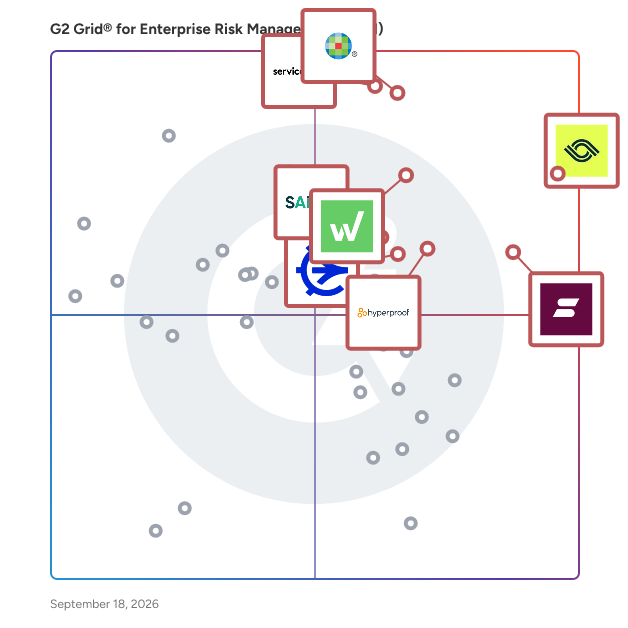
| 1 | [Optro](https://www.g2.com/products/optro/reviews) | 4.6/5.0 (1,584 reviews) | Workflow-contextual compliance tool discovery | "[All-in-One Compliance Management That Saves Time and Reduces Errors](https://www.g2.com/survey_responses/optro-review-12266491)" |
| 2 | [Workiva](https://www.g2.com/products/workiva-workiva/reviews) | 4.5/5.0 (2,128 reviews) | Linked risk-to-control testing with audit trails | "[Streamlined Reporting with Room for Improvement](https://www.g2.com/survey_responses/workiva-review-4678942)" |
| 3 | [Sprinto](https://www.g2.com/products/sprinto-inc/reviews) | 4.8/5.0 (1,623 reviews) | Automated control monitoring with continuous evidence collection | "[Streamlined ISO 27001 Compliance with Excellent Support](https://www.g2.com/survey_responses/sprinto-review-12712194)" |
| 4 | [ServiceNow Governance, Risk, and Compliance (GRC)](https://www.g2.com/products/servicenow-governance-risk-and-compliance-grc/reviews) | 4.2/5.0 (103 reviews) | ServiceNow-native integrated risk-control-policy traceability | "[Single platform for enterprise-wide risk visibility](https://www.g2.com/survey_responses/servicenow-governance-risk-and-compliance-grc-review-12759445)" |
| 5 | [LogicGate Risk Cloud](https://www.g2.com/products/logicgate-risk-cloud/reviews) | 4.6/5.0 (188 reviews) | No-code ERM workflows with interconnected risk views | "[Streamlined GRC Tool with Excellent Training Resources](https://www.g2.com/survey_responses/logicgate-risk-cloud-review-12799613)" |
| 6 | [SAP Risk Management](https://www.g2.com/products/sap-risk-management/reviews) | 4.2/5.0 (77 reviews) | SAP-native SOD conflict and compliance tracking | "[Centralized, Smart, and Secure Risk Management with SAP](https://www.g2.com/survey_responses/sap-risk-management-review-11027090)" |
| 7 | [Hyperproof](https://www.g2.com/products/hyperproof/reviews) | 4.5/5.0 (215 reviews) | Cross-framework risk-to-control evidence mapping | "[Hyperproof Keeps Us Audit-Ready with Real-Time Visibility and Automation](https://www.g2.com/survey_responses/hyperproof-review-12770337)" |
| 8 | [Ncontracts](https://www.g2.com/products/ncontracts-ncontracts/reviews) | 4.7/5.0 (178 reviews) | Cross-module GRC with built-in regulatory templates | "[Centralized Contracts with User-Friendly Interface](https://www.g2.com/survey_responses/ncontracts-review-12432305)" |
| 9 | [IBM OpenPages](https://www.g2.com/products/ibm-openpages/reviews) | 4.2/5.0 (66 reviews) | Audit-ready GRC with risk-control matrix workflows | "[Transforms Risk Management and Compliance](https://www.g2.com/survey_responses/ibm-openpages-review-12242779)" |
| 10 | [SAI360](https://www.g2.com/products/sai360/reviews) | 4.1/5.0 (114 reviews) | Cross-linked risk-control-audit registers enterprise-wide | "[Questionnaire Templates and AI Response Mapping Make Vendor Requests Effortless](https://www.g2.com/survey_responses/sai360-review-12692842)" |

  
## Which Enterprise Risk Management (ERM) Software Is Best for Your Use Case?

- **Leader:** [Optro](https://www.g2.com/products/optro/reviews)
- **Highest Performer:** [Complyance](https://www.g2.com/products/complyance-complyance/reviews)
- **Easiest to Use:** [Sprinto](https://www.g2.com/products/sprinto-inc/reviews)
- **Top Trending:** [ServiceNow Governance, Risk, and Compliance (GRC)](https://www.g2.com/products/servicenow-governance-risk-and-compliance-grc/reviews)
- **Best Free Software:** [Sprinto](https://www.g2.com/products/sprinto-inc/reviews)

  
## Which Type of Enterprise Risk Management (ERM) Software Tools Are You Looking For?
  - [Enterprise Risk Management (ERM) Software](https://www.g2.com/categories/enterprise-risk-management-erm) *(current)*
  - [Audit Management Software](https://www.g2.com/categories/audit-management)
  - [Regulatory Change Management Software](https://www.g2.com/categories/regulatory-change-management)
  - [IT Risk Management Software](https://www.g2.com/categories/it-risk-management)
  - [Business Continuity Management Software](https://www.g2.com/categories/business-continuity-management-software)
  - [Operational Risk Management Software](https://www.g2.com/categories/operational-risk-management)
  - [Policy Management Software](https://www.g2.com/categories/policy-management)
  - [Security Compliance Software](https://www.g2.com/categories/security-compliance)

  
---

**Sponsored**

### Protecht

Overview: Protecht ERM is a comprehensive enterprise risk management platform that helps organizations identify, assess, monitor, and respond to risks that could impact strategic objectives and performance. It provides a single, integrated system to manage risk across the enterprise, enabling better decision-making and stronger organizational resilience. Designed to scale with organizational complexity, Protecht ERM supports both day-to-day risk management and board-level oversight, helping teams move from fragmented risk processes to a connected, enterprise-wide view of risk. Who it’s for: Protecht ERM is used by organizations across regulated and non-regulated industries, including financial services, government, education, and critical infrastructure. It is well suited to: - Risk and compliance teams managing complex risk environments - Executives and boards requiring clear, reliable risk insight - Organizations with regulatory, operational resilience, or third-party risk obligations - Businesses seeking to replace spreadsheets or disconnected point solutions The platform supports organizations of all sizes, from growing teams to large, multi-entity enterprises. Key features: Protecht ERM offers a robust set of capabilities to support proactive and structured risk management, including: - Dynamic risk assessments that adapt to changing business and risk conditions - Key risk indicators that provide early warning signals and ongoing risk monitoring - Incident and issue management to capture, analyze, and learn from events - Integrated risk domains including ERM, vendor risk, IT and cyber risk, operational resilience, and business continuity - Configurable workflows and reporting to align with organisational frameworks and governance models What sets Protecht ERM apart: Protecht ERM delivers a truly integrated approach to risk management, connecting multiple risk disciplines within a single platform. This eliminates silos, improves data consistency, and provides a clearer understanding of how risks interrelate across the organization. By combining strong configurability with enterprise-grade governance and reporting, Protecht ERM helps organizations embed risk awareness into everyday decision-making and elevate risk from a compliance activity to a strategic capability. Summary: Protecht ERM is a powerful, flexible platform for organizations looking to mature their enterprise risk management practices. By unifying risk data, strengthening oversight, and enabling proactive risk response, Protecht ERM helps organizations manage uncertainty with confidence while supporting sustainable growth and innovation.


[Visit website](https://www.g2.com/external_clickthroughs/record?secure%5Bad_program%5D=ppc&amp;secure%5Bad_slot%5D=category_product_list&amp;secure%5Bcategory_id%5D=1447&amp;secure%5Bdisplayable_resource_id%5D=1447&amp;secure%5Bdisplayable_resource_type%5D=Category&amp;secure%5Bmedium%5D=sponsored&amp;secure%5Bplacement_reason%5D=page_category&amp;secure%5Bplacement_resource_ids%5D%5B%5D=1447&amp;secure%5Bprioritized%5D=false&amp;secure%5Bproduct_id%5D=42210&amp;secure%5Bresource_id%5D=1447&amp;secure%5Bresource_type%5D=Category&amp;secure%5Bsource_type%5D=category_page&amp;secure%5Bsource_url%5D=https%3A%2F%2Fwww.g2.com%2Fcategories%2Fenterprise-risk-management-erm&amp;secure%5Btoken%5D=845572d802ed2161000cd0b0a0b9dd974021cbbe1c508cd0954088d29f6ff16e&amp;secure%5Burl%5D=https%3A%2F%2Fwww.protechtgroup.com%2Fdemo%3Futm_medium%3Dreferral%26utm_campaign%3Dglobal_brd_bofu_profile_g2pilot_feb2026%26utm_source%3Dg2&amp;secure%5Burl_type%5D=book_demo)

---


    ## What Is Enterprise Risk Management (ERM) Software?
  [Governance, Risk &amp; Compliance Software](https://www.g2.com/categories/governance-risk-compliance)
  ## What Software Categories Are Similar to Enterprise Risk Management (ERM) Software?
    - [Audit Management Software](https://www.g2.com/categories/audit-management)
    - [Regulatory Change Management Software](https://www.g2.com/categories/regulatory-change-management)
    - [IT Risk Management Software](https://www.g2.com/categories/it-risk-management)
    - [Business Continuity Management Software](https://www.g2.com/categories/business-continuity-management-software)
    - [Operational Risk Management Software](https://www.g2.com/categories/operational-risk-management)
    - [Policy Management Software](https://www.g2.com/categories/policy-management)
    - [Security Compliance Software](https://www.g2.com/categories/security-compliance)

  
---

## How Do You Choose the Right Enterprise Risk Management (ERM) Software?

### What You Should Know About GRC Platforms

### What are GRC Platforms?

Governance, risk management, and compliance (GRC) platforms aim to provide all or most of the features required to manage various types of risk and compliance that may impact the operations of a company. This type of software is used across multiple departments, from HR and accounting to IT and logistics. Each department faces specific risks, such as privacy and security for IT, supplier risk for logistics, or financial fraud for accounting. To address these challenges, companies need to stay up to date with all related laws and regulations enforced by local, national, and international authorities. A more proactive way to deal with risk is to implement industry standards and internal policies that regulate business operations and aim to prevent problems before they happen.

To implement and monitor regulations, standards, and policies, companies require a single data repository for compliance information and an integrated system to define workflows and audits at the company level.

**Key Benefits of GRC Platforms**

- Reduces costs of noncompliance, which are direct (such as fines or penalties) or indirect (lost revenue)
- Enforces regulations and internal policies to mitigate risks and limit their negative impact on the company
- Improves alignment across the company as well as externally, to ensure that employees and business partners comply with regulations and policies
- Keeps compliance data up to date which is particularly difficult for global companies that need to comply with changing national and international regulations

### Why Use GRC Platforms?

Companies may choose between using separate systems for various types of risk and compliance or adopting GRC platforms to centralize compliance management.

**Compliance with laws, standards, and internal policies —** Depending on their industry and type of activity, companies may need to comply with all kinds of laws and industry standards. Additionally, companies may define their own rules that are implemented and enforced internally or across their partner networks. To manage all the information about regulations, standards, and policies as well as the procedures to ensure compliance, companies need a single data repository and an integrated system.

**Risk mitigation —** To deal with risks, companies need to know what challenges they may be facing and how to address them. Identifying risks and their potential impact on the company help businesses prepare in advance and avoid major disruptions.

**Brand protection —** Compliance isn’t only about following regulations. Compliance violations such as data breaches also impact the reputation of the business. Customers and partners avoid buying from or working with companies that are repeatedly breaking the law or failing to comply with industry standards.

### Who Uses GRC Platforms?

All employees benefit directly or indirectly from using GRC platforms. While this type of software is used mostly internally, partners may also use it to access compliance information and submit audit results.

**Compliance officers —** Compliance officers and managers are responsible for defining and implementing processes and workflows that ensure compliance with any regulations related to the operations of the company. They also monitor enforcement and identify opportunities for improvement to prevent noncompliance and mitigate risk.

**Department managers —** Each department needs to comply with different regulations and managers need to be aware of which laws and standards apply to their team.

**Executives —** Executives use GRC platforms to define internal policies, find regulatory information related to their department, and monitor the enforcement of laws and policies.

### Kinds of GRC Platforms

**GRC suites —** GRC suites are made of multiple software products that are used in various combinations. Each of them usually specialize in one or a few of the main GRC features, such as policy management, regulatory change management, compliance learning, or risk management. Companies using GRC suites may choose to implement all or only some of the components mentioned above, with the option to scale up (add new components) or scale down (remove components). The main benefit of GRC suites is that they provide better integration between the components of the suite and are developed and supported by the same vendor.

**Best-of-breed GRC software —** This type of software provides multiple modules for GRC that are delivered as part of a single product and cannot be sold and used separately. Best-of-breed GRC software is highly beneficial to mid-market companies that don’t need advanced features to manage risk and compliance.

### GRC Platforms Features

GRC platforms include most or all of the features described below, either as modules of a single integrated system or as separate products that are part of a suite.

**Regulatory change management —** Regulatory information changes constantly and companies need to ensure that they comply with the most recent changes. GRC platforms gather compliance data from multiple sources and provide users with the latest updates that may impact their work.

**Policy management —** Companies use internal policies to define and implement their own rules that are not covered by laws and regulations. A few examples are social media policies and procedures to deal with inappropriate behavior in the workplace.

**Risk management —** Noncompliance is only one of the many risks that businesses have to deal with. Other important risks are business disruptions caused by unforeseen events such as natural phenomena, pandemics, or economic downturns. While risks cannot be completely avoided, companies should prepare by defining contingency plans and procedures to react quickly.

**Audit management —** Companies need to review the procedures and workflows they put in place to ensure compliance. Audits are generally performed regularly (monthly or yearly) to monitor how internal policies and regulations are enforced across the company. Also, audits are conducted when the business is impacted by exceptional situations such as mergers and acquisitions or major market changes.

**Risk and compliance reporting —** Reporting and analytics are critical to monitor compliance and identify risks. In some cases such as highly regulated industries, dashboards providing real-time information are essential to help companies react quickly. Compliance data also helps businesses identify opportunities for improvement of workflows and procedures.

**Third-party and supplier risk management —** Companies working with suppliers and contractors need to protect themselves from any risky or illegal activities performed by their partners. A few examples are privacy breaches or money laundering which may not directly impact the company but may damage its brand.

Other Features of GRC Platforms: [Crisis management](https://www.g2.com/categories/grc-platforms/f/crisis-management), [Learning](https://www.g2.com/categories/grc-platforms/f/learning), [Recovery plans](https://www.g2.com/categories/grc-platforms/f/recovery-plans), [Regulatory certifications](https://www.g2.com/categories/grc-platforms/f/regulatory-certifications), [Risk methodology](https://www.g2.com/categories/grc-platforms/f/risk-methodology)

### Trends Related to GRC Platforms

**Globalization —** As businesses become more global, companies are facing new challenges, the most important being keeping up to date with regulations from multiple geographical locations. Compliance information constantly changes and companies need to ensure they have the latest details so they are able to adapt quickly. Working with partners and contractors is also challenging from a compliance perspective. While third-party companies like vendors and suppliers are responsible for noncompliance, the companies they work with may also be impacted. For instance, a software reseller that exposes client data will hurt the brand of the software vendor.

**Specialization —** As compliance becomes increasingly difficult to manage, some vendors choose to focus exclusively on one or a few types of regulations. For example, many vendors focus on IT and security compliance, which is beneficial for companies dealing with this type of risk. The drawback of specialization is that buyers with complex needs may need to buy and use separate software products from different vendors. There are also point solutions that only cover very specific compliance, such as general data protection regulation (GDPR) or anti-money laundering.

### Potential Issues with GRC Platforms

**Complexity —** As vendors try to cover multiple types of compliance, they either acquire and develop new tools that aren’t always fully integrated with their core offering. Even when all functionality is delivered on the same platform, the multitude of modules and their features make GRC platforms difficult to use.

**Price —** Complicated software is also expensive to buy and maintain. GRC suites are expensive when companies use most or all of their components. While best-of-breed GRC software is more affordable, companies adopting it overspend because they are obligated to purchase the whole software rather than only investing in he features that they need. Also, since GRC platforms aren’t always delivered in the cloud, companies may need to invest in IT infrastructure and personnel to host and maintain the software.

### Software and Services Related to GRC Platforms

Since GRC software is useful to any department of a company, it needs to integrate with other business software. Some of the most common integrations are listed below.

[**Environmental, quality and safety management**](https://www.g2.com/categories/environmental-quality-and-safety-management) **—** Some vendors provide suites that combine GRC and EQHS but these are the exception to the rule. All other GRC platforms usually integrate with quality management software (QMS) and environmental health and safety (EHS) software to streamline compliance in industries like retail and manufacturing.

[**Security**](https://www.g2.com/categories/security) **and** [**data privacy**](https://www.g2.com/categories/data-privacy) **—** While GRC platforms usually include modules or features for IT risk management, advanced requirements for security and privacy aren’t always covered. It is therefore important to integrate GRC platforms with software for application and network security as well as data privacy management.

[**Training eLearning software**](https://www.g2.com/categories/training-elearning) **—** GRC software often includes training materials for compliance purposes but does not always provide features to create new learning content. As such, most GRC platforms integrate with LMS and course authoring software.

[**Corporate social responsibility (CSR) software**](https://www.g2.com/categories/corporate-social-responsibility-csr) **—** While CSR can be defined and implemented separately from compliance and internal policies, it is often part of the GRC strategy of a company. Since CSR is self regulating rather than enforced by law, companies adopting it need to define internal policies to implement it.

### What is the best enterprise risk management platform for startups?

Based on expert G2 reviews, these are some of the best [Enterprise Risk Management platforms for startups](https://www.g2.com/categories/enterprise-risk-management-erm/small-business):

- [IMB OpenPages](https://www.g2.com/products/ibm-openpages/reviews)
- [AuditBoard](https://www.g2.com/products/auditboard/reviews)
- [Sprinto](https://www.g2.com/products/sprinto-inc/reviews)
- [Workiva](https://www.g2.com/products/workiva-workiva/reviews)
- [LogicManager](https://www.g2.com/products/logicmanager/reviews)

These ERM platforms offer a balance of affordability, ease of use, and features that can support growth strategies at any scale.

### Which ERM software is best for financial services?

Selecting the best ERM software for financial services depends on your business size, specific needs, and features that you want to achieve your goals. Here are some of G2&#39;s top contenders, each excelling in different areas:

- [LogicGate Risk Cloud](https://www.g2.com/products/logicgate-risk-cloud/reviews): is a flexible ERM software with customizable workflows and advanced risk quantification. Ideal for financial organizations seeking automation and scalability
- [Scrut Automation](https://www.g2.com/products/scrut-automation/reviews): is a leanding compliance automation platform designed for fast-growing businesses looking to streamline security, risk and compliance without disrupting operations.
- [Camms GRC](https://www.g2.com/products/camms-grc/reviews): offers strong ERM solutions, with Quantivate specifically tailored for banks and Camms known for ease of use and strong GRC capabilities
- [MetricStream](https://www.g2.com/products/metricstream-enterprise-risk-management/reviews): leverages AI for predictive risk analytics and scenario modeling, with deep support for industry-specific compliance and ideal for large enteprises with complex risk profiles.