# Best ERP Systems - Page 34

  *By [Nathan Calabrese](https://research.g2.com/insights/author/nathan-calabrese)*

   Enterprise resource planning (ERP) systems manage, control, and organize daily business operations and workflows. Employees in production, manufacturing, accounting, finance, HR, and supply chain use the [best ERP systems](https://learn.g2.com/best-erp-software) to support process automation, control input data, and optimize business operations to save resources. Some examples of ERP systems are Oracle Netsuite and SAP ERP.

ERP implementation helps with account payables (AP) automation, advanced reporting, and management for financial companies. In the healthcare sector, ERP enhances patient care by automating records and storing accurate data for each patient. Human resources uses ERP for payroll processing, time tracking, and employee benefits. Retail industries might use ERP to automate invoices, run customer discounts, and increase sales productivity.

The organized structure of ERP software combines data from different departments and breaks down silos to help every team access necessary data and metrics securely. Real-time reporting and analytical dashboards keep you updated on each department&#39;s performance and productivity.

Daily workflows, customer relationship management processes, inventory management and procurement, demand forecasting, and strategic decision-making join under ERPs to keep you up-to-date about team agendas and notify you of task progress. This way, you better understand which teams need resources immediately and which can wait.

ERP software covers a wide range of functionalities. Still, if you find gaps, you can integrate it with other tools like [CRM software](https://www.g2.com/categories/crm), [professional services automation software](https://www.g2.com/categories/professional-services-automation), or project-based ERP systems to achieve a magnified view of product manufacturing and distribution.

ERP systems provide a variety of modules, and while each business has unique requirements, most ERP systems offer the following:

- Accounting features like general ledger, accounts payable/receivable, budgeting, and cash management 
- Human resources (HR) functionality such as recruiting and payroll, or integration with HR and payroll solutions 
- Basic sales and customer management features or integration with CRM solutions 
- Functions to create different types of quotes, sales orders, and returns 
- Purchasing workflows and purchase order management 
- Inventory and warehouse management software including picking, packing, and shipping 
- Advanced supply chain modules like demand planning and transportation management for distribution companies 
- Production modules that include bill of materials (BOM), manufacturing resource planning (MRP), and quality management features for manufacturing companies 
- Reporting and analytics for all the modules included in the ERP solution 


## Category Overview

**Total Products under this Category:** 661


## Trust & Credibility Stats

**Why You Can Trust G2's Software Rankings:**

- 30 Analysts and Data Experts
- 25,000+ Authentic Reviews
- 661+ Products
- Unbiased Rankings

G2's software rankings are built on verified user reviews, rigorous moderation, and a consistent research methodology maintained by a team of analysts and data experts. Each product is measured using the same transparent criteria, with no paid placement or vendor influence. While reviews reflect real user experiences, which can be subjective, they offer valuable insight into how software performs in the hands of professionals. Together, these inputs power the G2 Score, a standardized way to compare tools within every category.


## Best ERP Systems At A Glance

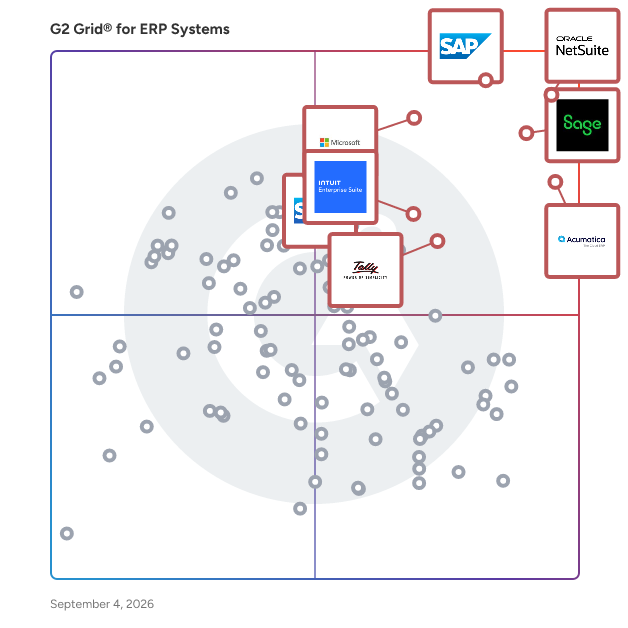
- **Leader:** [NetSuite](https://www.g2.com/products/netsuite/reviews)
- **Highest Performer:** [ePROMIS ERP](https://www.g2.com/products/epromis-erp/reviews)
- **Easiest to Use:** [BizAutomation Cloud ERP](https://www.g2.com/products/bizautomation-cloud-erp/reviews)
- **Top Trending:** [Odoo ERP](https://www.g2.com/products/odoo-odoo-erp/reviews)
- **Best Free Software:** [Microsoft Dynamics 365 Business Central](https://www.g2.com/products/microsoft-microsoft-dynamics-365-business-central/reviews)


## Parent Category

[ERP Software](https://www.g2.com/categories/erp)


## Related Categories

- [Accounting Software](https://www.g2.com/categories/accounting)
- [Discrete ERP Software](https://www.g2.com/categories/discrete-erp)
- [Distribution ERP Software](https://www.g2.com/categories/distribution-erp)


---

## Buyer Guide

### What is an ERP System?

### What are Enterprise Resource Planning (ERP) Systems?

Enterprise resource planning (ERP) evolved from materials requirements planning (MRP) software, which was created in the 1960s for large companies that needed to manage complex manufacturing operations. MRP was used mainly to identify, allocate, and track resources such as raw materials, parts, ingredients, and labor. As technology became more accessible, vendors added features for the back office (accounting and HR) and front office (sales and CRM). While initially, only enterprises could afford to invest in ERP, it is now more affordable and widely used by small and medium-sized businesses.

ERP evolved through organic development or mergers and acquisitions. The result was often a mix of multiple products that were more or less integrated and sold as a package or separately.

- Organic development strategies were adopted by vendors who focused exclusively on creating and improving their offering. Some vendors focused on one product only, while others created multiple solutions and sometimes different editions of the same product for different purposes. For instance, an ERP solution can be delivered as a light version for small businesses and as an enterprise edition for large companies.
- Acquisitions are the most common strategy vendors use to expand into new markets and deliver new features. The primary challenge with acquiring software is that it is difficult to integrate all products into a single offering. While some vendors combined multiple products into one, most ERP solutions acquired are still sold as standalone systems.
- Mergers are rare in the ERP market, and they usually happen when two vendors join forces to complement each other’s offering. This can lead to a sophisticated package of multiple systems with overlapping functionality.
- Partnerships allow vendors to offer additional functionality without investing in developing it. When vendors partner, they provide standard integration between their products, which makes it easier for companies to use them together.

### What does ERP stand for?&amp;nbsp;

ERP stands for enterprise resource planning, which means it’s a tool that defines, schedules, and tracks current tasks and critical processes. It supports companies’ automation, manufacturing, production, supply chain, and distribution processes.&amp;nbsp;

Moreover, an ERP system integrates all the functional units of your organization into one. The software can be personalized based on departmental key performance indicators (KPIs) as well.

As discussed above, ERP systems typically include modules for finance, human resources, marketing and sales, accounting and bookkeeping, logistics and supply chain, and customer service. Its main goal is perfecting processes, improving efficiency, and helping maintain a repository of apps and workflows so teams can view progress, update goals, and keep productivity up.

### What types of ERP systems exist?&amp;nbsp;

ERP systems differ based on the source code of the system and its availability to customers and partners.&amp;nbsp;

- Software development: Depending on who develops and manages the system, some ERP vendors have full control of the product and only allow partners to create apps or extensions. Other ERP providers rely on resellers to add entire modules and change the source code.
- General purpose ERP: These ERP systems are specific to a particular industry. They can be customized to suit the needs and use cases of various industries.
- Industry-specific ERP: Also known as vertical ERP, these systems provide functionality to a limited number of industries. The vendors specialize because generic solutions do not apply to niche industries with specific challenges.
- Small and mid-size business (SMB) ERP: Designed for smaller teams with renewable resources, these ERP systems offer basic workflow automation at an affordable price.
- Cloud ERP: These solutions are hosted on the cloud so you can expand your business infrastructure to support growing volumes of data at a cost-effective price plan. It provides data storage, scalability, and reduced scope of vulnerabilities.
- On-premises ERP: Traditional on-premise systems are installed locally on a business server. They’re set up to store, modify, and retrieve data for internal teams and their project input. Due to package deployment, this may incur higher upfront installation costs.
- Open source ERP: Users can download these free ERP services from the internet or smartphone marketplaces like PlayStore or App Store. These solutions offer basic features that access and modify business workflows.
- ERP for specific functions: These solutions trigger functionalities for departments like finance, human resources, or supply chain management. They are modular and can be integrated into broader ERP systems for businesses.
- Mobile ERP: &amp;nbsp;Mobile ERP solutions enable geolocation tracking, data access, and management via mobiles and other gadgets. Leading ERP service vendors offer a mobile-compatible version of their desktop ERP software.

### Which ERP platform is best for managing app development projects?

For app development projects requiring an ERP platform that can handle your business goals, like resource planning, team collaboration, project tracking, and more, G2 offers a list of options. Some options that could meet your project goals are:

- [NetSuite](https://www.g2.com/products/netsuite/reviews): ideal for mid-to-large enterprises, it offers comprehensive financial management, multi-language and currency support, and scalable services.
- [SAP Business One](https://www.g2.com/products/sap-business-one/reviews): offers tools for project planning, resource management, and budgeting. Its integration with financial and customer relationship management modules ensures cohesive project tracking and management
- [Microsoft Dynamics 365 Business Central:](https://www.g2.com/products/microsoft-microsoft-dynamics-365-business-central/reviews) combines project management and financial management functionalities, providing tools for project planning, resource allocation, and cost tracking, essential for app development projects.&amp;nbsp;

### ERP systems examples across industries&amp;nbsp;

Different ERP systems have different working mechanisms. Examples of some ERP systems deployed across various industries for process optimization and workflow management are below.

- ERP for manufacturing: Manufacturing professionals choose their ERP systems based on the production types of the finished products and the way they’re made. Manufacturers can use [discrete ERP software](https://www.g2.com/categories/discrete-erp) to learn about spare parts, raise raw material requests, and stay in contact with suppliers for any other needs. It helps maintain bills of materials (BOM), batch processing of orders, and details of stock-keeping units (SKUs).
- Engineering-to-order[ERP software](https://www.g2.com/categories/eto-erp): Engineering-to-order (ETO) manufacturers customize their products to create personalized work for a limited number of customers or sometimes even for individual customers. Standard products (like heavy equipment and fixed assets) can be sold without modifications, but you may need to customize them based on the customer&#39;s demand. These kinds of tools use proposal and project management and quote-to-order (QTO) to deliver elaborate projects and monitor production.
- Distribution ERP software: The core of the distribution business is purchasing products, storage, and delivery from the supplier to the customers. While most ERP systems offer purchasing, inventory, and shipping features, that doesn’t necessarily make them a relevant choice for distribution companies. With distribution ERP systems, companies can buy products from manufacturers and resell them to other companies or consumers. These dedicated tools provide basic warehouse management, route planning, yard and dock management, and freight management.
- Professional services automation software: Also known as ERP for professional services or PSA, this software is designed to address the specific needs of industries like consulting, design and architecture, IT services, legal and financial services, or training and development. These companies all rely extensively on specific knowledge and a professionalized workforce. PSAs help them manage project portfolios and front and back office work for sales, marketing, billing, and accounting.
- [Construction ERP software](https://www.g2.com/categories/construction-erp): Construction software handles projects for residential or industrial buildings and infrastructure. Typical construction software doesn’t always include back-office functions like accounting, so vendors created ERP systems for this industry. ERP for construction delivers all the modules needed to manage operations.
- [Education ERP software](https://www.g2.com/categories/education-erp): Education ERP software helps manage student admissions, student journeys, and academic profiles. It is mostly used by educational institutions for K-12 or colleges and universities. The education ERP integrates with [accounting software](https://www.g2.com/categories/accounting)to support finances like school fee payments, course payments, and exam registration fee payments.
- ERP for public sector undertaking (PSUs): Government or [public sector software](https://www.g2.com/categories/public-sector) focuses on managing the services provided to citizens and on maintaining public infrastructure such as roads, buildings, airports, and so on. Since most point solutions for government agencies only cover some requirements, ERP vendors created specific products for this industry.
- ERP for [healthcare operations](https://www.g2.com/categories/health-care-operations): Healthcare software can cover multiple requirements, like medical scheduling and billing, practice management, and electronic health records (EHR). ERP systems also cover the needs of specialists, such as optometrists, physical therapists, or chiropractors. All these products are usually sold separately and require integration with accounting or sales software, which is why vendors adapted their products for healthcare.

### Benefits of ERP systems&amp;nbsp;

ERP systems help perfect business functions across all departments. Managers and executives use it to monitor essential projects in real-time, and all employees appreciate how easy it is to access important data. More advantages are detailed here.&amp;nbsp;

- Single source of truth: ERP systems store all company information in one place to prevent duplication and inconsistency in data quality. A single data repository also ensures that users&#39; changes are reflected in the database, and everyone in the company can find the most up-to-date information.
- Visibility: Since all ERP users share the same system, they can access any data point that will support their productivity. Customer-facing employees can also retrieve details about orders, transactions, or inventory availability. Finally, accountants can track all data on costs and profitability for each team, business unit, and location.
- Automation and productivity: ERP systems can replace multiple types of software, add-ons, point solutions, spreadsheets, or office tools used by company departments. This allows workers to spend less time switching between systems and focus more on operations. ERP also allows companies to define and implement business-wide processes, which increases productivity and helps address accountability issues.
- Cost savings and resource optimization: By unifying key aspects of business, ERP software becomes a smart way to cut costs while retaining your ROI. The solution works with any operating system and can be adapted to any user interface.
- Regulatory compliance and risk management: ERP systems comply with industry rules and regulations, local and federal laws, legal policies, and tax and compliance rules for any industry with a specific code of conduct.
- Increased customer satisfaction: ERP systems provide a bird’s-eye view into your business goals, processes, tasks, and deadlines, which helps you stay aware of the smallest details and work toward raising your customer satisfaction score.

### Features of ERP systems&amp;nbsp;

The following core features of ERP systems can help users manage customer relationships, plan operations, and monitor costs and profitability.

- Accounting: ERP systems support all accounting processes, from creating a general ledger (GL) to automating [payroll](https://www.g2.com/categories/erp-systems/f/payroll) and making invoices. It also helps process payments, generate financial statements, and conduct financial close. Some ERP systems include advanced features such as multicurrency, foreign exchange, [multi-entity management](https://www.g2.com/categories/erp-systems/f/multi-entity-consolidation) for global companies, project accounting for project-oriented firms, and fixed asset depreciation.
- Front office management: While every ERP system has some sales and marketing features, the level of support for front office functionality varies significantly from one product to another. Some vendors develop modules for these features, while others prefer to integrate their ERP systems with [CRM software](https://www.g2.com/categories/crm) and [marketing automation software](https://www.g2.com/categories/marketing-automation) to ease the workload of sales and revenue teams.
- Back office management: ERP also supervises [payroll platforms](https://www.g2.com/categories/payroll), human resources (HR), maintenance, and regulatory compliance. These modules are delivered in multiple ways, such as standard functionality, add-ons, or integration. For instance, ERP systems include a module for workforce management and integration with [recruitment software](https://www.g2.com/categories/recruiting). Similarly, buyers must integrate ERP with computerized maintenance management systems (CMMS) or enterprise asset management (EAM) software to automate maintenance operations.
- Logistics and supply chain support: These features help companies manage their raw materials, components, and finished goods. Manufacturers need to buy, store, and optimize the use of raw materials such as fabric for fashion or parts for equipment manufacturing. ERP systems help forecast demand and find the best price-to-quality ratio components. It also tracks shipping to customers, from suppliers, and between multiple warehouses or production facilities.
- Production: Production management functionality is the core of any ERP system for manufacturing companies. This module covers bills of materials (BOM), material resource planning (MRP), master production schedules (MPS), work in process (WIP), and quality control. Production managers use these features to monitor all stages of the manufacturing cycle, identify defective products through [inspections](https://www.g2.com/categories/erp-systems/f/inspections), and track the shop floor equipment and personnel&#39;s status.
- Reporting and analytics: ERP reporting and analytics provide statistics on all activities managed using the system. When companies use separate [human resource management software (HRMS),](https://www.g2.com/categories/human-resource-management-systems) it needs to be pushed to ERP to transfer data between them. For instance, to estimate the demand for a job, recruiters need multiple data types from different systems, such as candidate history from HRMS, applications from job portals, and documents from[document management systems](https://www.g2.com/categories/document-management).&amp;nbsp;
- Integration: Even though all departments can use ERP, buyers prefer a comprehensive, standalone CRM system over a light module as a part of an ERP system. Therefore, integrating ERP and other software is essential for data consistency free of duplicated data entries.
- Platform: The success of an ERP system depends on the technology used to create, store, and manage it. A service-oriented architecture offers more flexibility and allows buyers to customize the software. Similarly, the database that stores all business information should keep data secure, allow users to back up the data, and facilitate integration with other data sources.

### Cost of ERP systems&amp;nbsp;

Choosing the right, affordable plan helps you maintain your return on investment (ROI). Most ERP systems follow a tiered package structure for small- and mid-size enterprise-level services. The tiered structure offers different functionalities at varying price points.

The cost of an ERP system depends on the software providers’ license and subscription plan. Vendors offer per-user licensing, flat-rate pricing, and subscription models. You can inquire about custom quotes through each provider’s website.

To negotiate the right cost, look out for the business infrastructure, number of users, customization, user support, and user adoption processes within your organization.

### Software and services related to ERP systems&amp;nbsp;

These software platforms and services related to ERP systems are used for specific industries..&amp;nbsp;

- Product lifecycle management (PLM): Companies use [PLM](https://www.g2.com/categories/plm) to design complex products and structures, such as a conveyor system for a warehouse. Most ERP systems for manufacturing integrate with PLM to transfer product data between the two. A few vendors sell ERP and PLM solutions, but most offer preconfigured integration with the most popular PLM products.
- [Enterprise asset management (EAM) software](https://www.g2.com/categories/enterprise-asset-management-eam): Asset-intensive companies use EAM to track fixed assets, monitor their performance, and plan maintenance operations. While some ERP systems include maintenance or asset depreciation functionality, large companies using complex equipment across multiple locations still require EAM for advanced features like predictive maintenance.
- [Supply chain management software](https://www.g2.com/categories/supply-chain-management): This software manages logistics operations across the entire supply chain. Distributors and wholesalers often use supply chain suites with their ERP system to ensure full visibility and control over their supply chain.
- HR software: [HR](https://www.g2.com/categories/hr) and talent management tools provide functionality beyond standard ERP systems. This includes HR-related needs like recruiting, [performance management](https://www.g2.com/categories/performance-management), and employee engagement. Even when an ERP has a payroll or workforce management module, its features may not be sufficient for global companies or large organizations. These types of businesses may need a separate system to manage human resources.
- CRM software: [CRM](https://www.g2.com/categories/crm) is frequently employed to complement an ERP system&#39;s sales and marketing features. A few features, like marketing campaign automation and lead generation aren’t always included in ERP software. Companies that use both systems must be careful to avoid lead duplication, which creates confusion.
- [Business intelligence (BI) software](https://www.g2.com/categories/business-intelligence): While all ERP products have analytics modules, advanced features such as forecasting or predictive analytics aren’t always included. Companies that need those things use separate business intelligence (BI) software that gathers and analyzes data from the ERP system and other data sources.

### What&#39;s the best ERP software for service-based business?

When choosing, consider your specific requirements around project management, resource scheduling, time tracking, billing, and reporting. Explore some of these popular options:&amp;nbsp;

- [Sage Intacct](https://www.g2.com/products/sage-intacct/reviews) - Provides deep accounting capabilities with applications such as general ledger, accounts payable, receivable, cash management, and order management. It supports a variety of industries.
- [SAP S/4HANA Cloud](https://www.g2.com/products/sap-s-4hana-cloud/reviews) - Offers modular cloud ERP software powered by AI and analytics that supports real-time operations from any location.
- [Acumatica](https://www.g2.com/products/acumatica/reviews) - Cloud ERP is designed for small and mid-sized businesses with open APIs for rapid integrations and resources-based licensing rather than user-based.

### ERP systems trends

Some new age trends are trending in the ERP industry.:

- Industry 4.0: Digital transformation in manufacturing can be achieved using intelligent technology such as the internet of things (IoT), [virtual reality](https://www.g2.com/categories/virtual-reality), and [augmented reality](https://www.g2.com/categories/augmented-reality). While ERP doesn’t manage these technologies, the system must exchange data with hardware (sensors and fixed assets) and software (IoT management and digital twins).
- Artificial intelligence (AI): AI can analyze large amounts of complex data, identify trends, and suggest opportunities to improve operations. [Robotic processing automation (RPA)](https://www.g2.com/categories/robotic-process-automation-rpa) creates bots that perform basic tasks quickly and efficiently and some ERP vendors use [voice recognition](https://www.g2.com/categories/voice-recognition), which simulates a conversation between computers and human users.
- Microservices: Vendors use microservice software architecture more often for its flexible solutions. Unlike monolithic ERP systems, microservices allow buyers to implement and use collections of software modules from different products.

Want to keep up with the latest ERP trends? Check out the [Best ERP Software](https://www.g2.com/articles/best-erp-software) for 2024!

_Written and researched by_ [_Gabriel Gheorghiu_](https://learn.g2.com/author/gabriel-gheorghiu)

_Reviewed and edited by_ [_Aisha West_](https://www.linkedin.com/in/westeawest/)