Learn More About Accounting Software
Accounting Software software buying insights at a glance
Accounting software helps organizations record financial transactions, manage general ledgers, reconcile accounts, and generate accurate financial reports. These systems allow finance teams to automate recurring accounting processes, track invoices and expenses, and maintain financial records across finance and operational systems. As businesses manage increasing transaction volumes and demand clearer financial visibility, accounting software is becoming essential infrastructure for organizations that want to run finance operations efficiently. For many buyers, the best accounting software now ranks among the top systems for financial decision-making across the business.
Organizations adopt accounting software products to simplify financial management, reduce manual work, and gain clearer insight into performance. Across user reviews, buyers often highlight benefits such as streamlined reconciliations, automated invoicing, improved reporting, and centralized transaction tracking. The top accounting software platforms stand out when they balance usability with financial depth, acting as an operational hub that connects accounting workflows with payroll, ERP, tax, and reporting systems.
Pricing varies based on company size, transaction complexity, and available modules. Many accounting software tools offer subscription pricing, while some top accounting systems use quote-based pricing for more complex deployments. Organizations evaluating the best accounting software also consider implementation effort, integrations, and reporting capabilities when estimating the total cost of ownership.
Top 5 FAQs from software buyers:
- What features should I look for in the best accounting software for a growing finance team?
- How do accounting software platforms help automate bookkeeping and financial workflows?
- What makes accounting software easy to implement and learn for finance teams?
- How scalable are accounting software platforms as a business grows??
- How do modern accounting systems support real-time financial visibility and reporting?
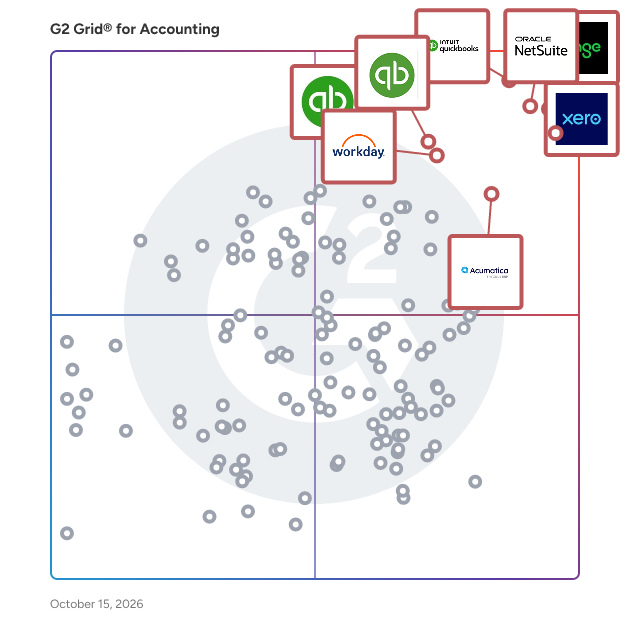
G2’s top-rated accounting software, based on verified reviews, include Sage Intacct, NetSuite, Xero, and QuickBooks Online.
What are the top-reviewed Accounting Software on G2?
Sage Intacct
- Number of Reviews: 3,350
- Satisfaction: 98
- Market Score: 93
- G2 Score: 95
NetSuite
- Number of Reviews: 3,125
- Satisfaction: 95
- Market Score: 95
- G2 Score: 95
Xero
- Number of Reviews: 1,231
- Satisfaction: 99
- Market Score: 88
- G2 Score: 93
QuickBooks Online
- Number of Reviews: 3,375
- Satisfaction: 84
- Market Score: 99
- G2 Score: 91
Microsoft Dynamics 365 Business Central
- Number of Reviews: 566
- Satisfaction: 73
- Market Score: 94
- G2 Score: 83
Satisfaction reflects user-reported ratings across various factors, including ease of use, feature fit, and quality of support. (Source 2)
Market Presence scores are calculated based on review volume, third-party signals, and overall market visibility. (Source 2)
G2 Score is a weighted composite of Satisfaction and Market Presence. (Source 2)
Learn how G2 scores products. (Source 1)
What I Often See in Accounting Software
Feedback Pros: What Users Consistently Appreciate
- Managing multiple entities and bulk financial uploads is significantly easier
-
“Being able to keep multiple tabs open for different entities within the same login is a game changer. I also really appreciate how quickly I can move between modules. The custom reports are extremely helpful once you know how to use them. The CSV uploads for checking accounts, 1099 transaction updates, adding bills, adding invoices, adding GLs, adding vendors, and adding customers are amazing and make those updates much easier to manage.” - Levi S., Sage Intacct review
- Finance operations become centralized with automation and real-time reporting
-
“NetSuite is powerful because it brings accounting, billing, purchasing, and financial reporting into one unified system, creating a single source of truth for the business. For finance teams, it helps automate key processes such as invoicing, revenue recognition, and approvals, which reduces manual work and helps cut down on errors. The platform is also highly scalable, allowing companies to grow from startup to enterprise without needing to switch ERPs along the way. NetSuite offers strong real-time reporting and dashboards as well, giving leadership clear visibility into overall financial performance. On top of that, its ability to integrate with tools like Salesforce and other operational systems makes it a solid backbone for a modern SaaS tech stack.” - Grant H., NetSuite review
- Deep integrations reduce duplicate entry across finance workflows
-
“It has a good easy to use interface and all the functions are easy to find. It has a good help system to get you through using those features that are not so obvious. The import bills functions by email is really useful for me and saves a lot of time over manually entering data.” - Andrew A., Xero review
Cons: Where Many Platforms Fall Short
- Reporting accuracy concerns and complex usability
-
“I feel like the reporting dashboards are never 100% accurate or fully trustworthy. The way the information is laid out, along with the recent updates, felt unnecessary and made things harder to follow. Overall, it isn’t very user-friendly unless you’ve had training or have been using it for a long time. Customer support is lacking.” - Danielle P., QuickBooks Online review
- Interface feels dense for new users and lacks in-app guidance
-
“The interface can feel dense at first, especially for new users who aren't familiar with ERP-style screens. Some actions take a few extra clicks, and onboarding would be smoother with more in app guidance for non technical users.” - Avyan S., Acumatica review
- Some workflows require multiple steps and have a learning curve
-
“One thing I dislike about Sage Intacct is that some processes are not as intuitive as they could be, especially for new users. Certain tasks require several steps or navigating through multiple menus, which can take time to learn. Customizing reports and configurations can also require a deeper understanding of the system, so there can be a learning curve for teams that are new to the platform.” - Marcus G., Sage Intacct review
My Expert Takeaway on Accounting Software
Accounting software delivers the most value when organizations treat it as a financial workflow system rather than just a tool for recording transactions. The strongest platforms combine accounting functionality with reconciliations, reporting, invoicing, and integrations across finance systems, allowing teams to manage financial processes with less manual work.
Review sentiment reflects strong adoption across the category. In this dataset, accounting software holds a 4.39 average star rating, with strong usability signals including 6.32 Ease of Use, 6.13 Ease of Setup, and 6.17 Quality of Support. Likelihood to recommend is also high at 8.78 out of 10, suggesting that many buyers see operational improvements after implementation.
Friction typically appears as reporting complexity increases or integrations expand. Teams that struggle often underestimate the effort required to configure reporting, reconciliations, and connections with other finance systems.
The best accounting software vendors succeed when they balance automation with financial control. As organizations scale financial operations and transaction volumes, accounting software is becoming essential infrastructure for modern finance teams.
Accounting Software FAQs
How to choose the right accounting software for your business?
Choosing the right accounting software starts with evaluating workflow complexity, including invoicing, reconciliation, reporting, approvals, inventory, and entity structure. Buyers should compare ease of use, implementation effort, support quality, and integration capabilities to ensure the platform can scale with financial operations.
What is accounting software?
Accounting software helps businesses record financial transactions, manage financial records, generate reports, reconcile accounts, and monitor cash flow. These platforms streamline processes such as invoicing, ledger management, and financial reporting while improving visibility into business performance.
Which accounting automation software is best?
There is no single solution that fits every organization. Highly rated and widely reviewed accounting software options include Sage Intacct, NetSuite, Xero, QuickBooks Online, and Acumatica. The best choice typically depends on transaction volume, reporting complexity, operational needs, and finance team maturity.
Which accounting software is the easiest to use?
Ease of use varies depending on company size and financial process complexity. However, several accounting software products are frequently highlighted for their intuitive interfaces and streamlined workflows, including FloQast, Xero, DualEntry, finally and FreshBooks. Platforms that consistently score well typically offer simple navigation, reliable bank feeds, straightforward invoicing, and accessible reporting features that help finance teams complete routine tasks efficiently.
What's the best accounting solution for a growing business?
The best accounting solution for a growing business is one that supports current financial processes while scaling with increasing operational complexity. Platforms such as Sage Intacct, NetSuite, and Acumatica are commonly considered strong options for growing businesses because they provide advanced reporting, integrations, approval workflows, and multi-entity capabilities that support expansion without requiring a full system replacement.
What are the top accounting softwares with cloud storage for enterprises?
Top accounting software with cloud storage for enterprises includes NetSuite, Sage Intacct, and SAP Cloud ERP (formerly SAP S/4HANA Cloud). These platforms provide cloud-based deployments, centralized financial data storage, advanced reporting, and integrations with other enterprise systems, helping large organizations manage complex financial operations while maintaining scalability and accessibility.