Automate bookkeeping with Dext, invoice to payment. AI captures, extracts & codes receipts/invoices, syncs to Xero, QBO & 36+ platforms. You stay in control. 12,000+ firms trust Dext.
Manage your bookkeeping workflows from invoice to payment in one AI-powered platform. Our intelligent, cloud-based bookkeeping automation platform is built for accountants, bookkeepers, and growing businesses.
It connects document capture, extraction, categorisation, approvals, expenses and payments in one workflow, powered by AI built specifically for bookkeeping, not generic AI, so your business gets accurate, real-time financial data with you in control.
More than 700,000 businesses and 12,000+ accounting firms trust Dext. Each year, the platform processes over 350 million financial documents at over 99% extraction accuracy, and connects to more than 11,500 banks, platforms, and accounting systems worldwide.
How Dext works
1. Capture invoices and receipts – Snap a photo, upload a PDF, forward by email or WhatsApp, or connect a data feed.
2. Extract key data with AI – Reads supplier, amount, tax, due date and more.
3. Categorise and enrich automatically – AI suggests categories, descriptions, and payment methods, learning from how your business or practice works.
4. Sync with accounting software – Send accurate data to Xero, QuickBooks, Sage, and 36+ platforms.
5. Approve and pay – Manage the full accounts payable workflow, with built-in approvals and security checks.
6. Reconcile transactions – Automatic matching keeps accounts accurate and up to date.
Receipt capture and submission options:
Capture data however you prefer: snap a photo, submit receipts individually or in bulk, calculate mileage using GPS, and manage expense claims from the mobile app, or send documents by email, WhatsApp, Dropbox, drag-and-drop, or direct bank feed.
Bookkeeping automation, AI and accounts payable
Supplier rules and smart splits automate categorisation and posting, while AI Assist, Dext's agentic AI, learns how you work and suggests smarter automations, transparent, optional and fully auditable. Nothing publishes without review and sign-off. Dext manages the rest of the accounts payable workflow too: approvals and supplier payments, with built-in security checks.
Integrations and ecosystem
Dext connects to more than 11,500 banks, e-commerce platforms and payment systems, syncing with 36+ accounting platforms including Xero, QuickBooks and Sage, plus Amazon, Shopify, Stripe and PayPal. This removes duplicate entry and supports every business type.
Expense management
Digital approval workflows and automated reimbursements simplify expense management for businesses and firms alike. Multi-level approvals, real-time spend visibility, multi-currency support and mileage tracking are all built in.
Reliability and accuracy
Dext matches transactions with bank feeds automatically, catching duplicates and flagging missing documents, delays and bottlenecks before they become problems, no spreadsheets or manual checks needed.
Security and compliance
All data is stored in the EU, encrypted at every stage, with least-privilege access. Dext is ISO/IEC 27001 certified and GDPR-compliant, with a live Trust Centre available anytime. Dext never sells customer data, every supplier is vetted, and the platform maintains over 99.99% uptime.
Recognition and ratings
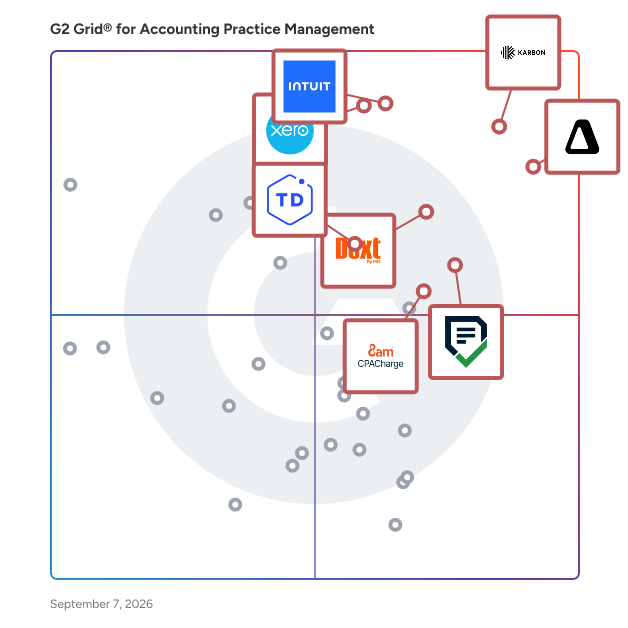
- 30 G2 Leader Badges across six categories in the Fall 2026 Report: Expense Management, Invoice Management, OCR, Mileage Tracking, Accounting Practice Management, and Travel & Expense.
- Xero App Partner of the Year (UK and US, 2024)
- QuickBooks Developer Spotlight 2024
- SME News Best Cloud-Based Accounting Software 2023
- Rated 4.7 stars on Trustpilot, 4.8 stars on the App Store, and 4.5 stars on Google Play
FAQs
Does Dext integrate with accounting software? Yes. Dext integrates directly with Xero, QuickBooks, Sage, and 36+ accounting platforms, plus more than 11,500 banks, platforms, and systems worldwide.
Is Dext just a receipt capture or OCR tool? No. Dext has evolved beyond receipt capture and OCR into a full intelligent bookkeeping automation platform, managing the complete workflow from invoice to payment, with AI at its core.
Does Dext support e-invoicing? In France, Dext is one of the first government-certified Aggregated Platforms (PA) for e-invoicing, trusted by more than 2,000 accounting firms and 290,000 businesses, and has won five Gold Medals at France's Palmarès du Monde du Chiffre (a leading awards program for the French accounting industry).
Start your 14-day free trial today and experience intelligent bookkeeping automation with Dext.
Average Rating: 4.6/5.0
Total Reviews: 376
How Do G2 Users Rate Dext?
-
Has the product been a good partner in doing business?: 9.2/10 (Category avg: 9.1/10)
-
Reporting: 8.8/10 (Category avg: 7.9/10)
-
New Client: 9.0/10 (Category avg: 8.5/10)
-
Job Status: 8.3/10 (Category avg: 8.7/10)
Who Is the Company Behind Dext?
-
Seller: IRIS Software Group
-
Company Website:
-
Year Founded: 1978
-
HQ Location: Alpharetta, GA
-
Twitter: @IRISSoftwareGrp
1,340 Twitter followers
-
LinkedIn® Page: www.linkedin.com
3,115 employees on LinkedIn®
Who Uses This Product?
-
Who Uses This: Director, Accountant
-
Top Industries: Accounting, Financial Services
-
Company Size: 88% Small, 11% Medium
What Do G2 Reviewers Say About Dext?
AI-generated summary from verified user reviews
Pros
- Users praise the ease of use of Dext, noting its user-friendly interface that simplifies billing and invoicing.
- Users appreciate how Dext's time-saving automation significantly reduces manual work and enhances efficiency with easy syncing.
- Users value the automation capabilities of Dext, significantly reducing manual work and saving time and effort.
- Users value the automation efficiency of Dext, saving time and ensuring accurate data capture for documents.
- Users value the efficiency of Dext, appreciating its speed and automation for seamless bookkeeping.
Cons
- Users express frustration with pricing issues, citing unexpected fees and dissatisfaction with customer service regarding contracts.
- Users report major billing issues, experiencing unauthorized charges and poor customer service from Dext regarding their plans.
- Users experience occasional slow processing when reading documents or fetching data, though it typically performs well.
- Users report approval issues with Dext, emphasizing difficulties in plan changes and unexpected charges without consent.
- Users consistently find Dext to be expensive, with unexpected charges and inadequate support contributing to frustrations.
What Are G2 Users Discussing About Dext?