# Best Single Sign-On (SSO) Software - Page 11

  *By [Brandon Summers-Miller](https://research.g2.com/insights/author/brandon-summers-miller)*


   Single sign-on (SSO) solutions are authentication tools that allows users to sign into multiple applications or databases with a single set of credentials. Federation is the linking of IT systems, organizations, and personal identities with credentials and repositories. The [best SSO solutions](https://learn.g2.com/best-sso-software) serve to simplify identification processes and create an uninhibited feel when working to access applications, portals, and servers. The software is designed to provide users with access to multiple applications or datasets without requiring multiple logins.

The goal of SSO software is not only to improve ease of use while navigating across applications but also to minimize work for IT administrators and developers by centralizing access management. SSO products effectively join the desired applications and route logins through an SSO server. These solutions often include features such as dashboards for simplified navigation, application clouds, directory integration, and mobile applications for remote access.

There is some crossover between SSO software and solution types such as [cloud identity and access management software](https://www.g2.com/categories/cloud-identity-and-access-management), [password management software](https://www.g2.com/categories/password-management), and [user provisioning/governance software](https://www.g2.com/categories/user-provisioning-governance), but single sign-on products focus mainly on secure enterprise access to servers, applications, and databases rather than the management of data or passwords.

To qualify for inclusion in the SSO category, a product must:

- Allow users access to multiple applications or databases through one portal
- Automate authentication to prevent multiple logins
- Centralize authentication servers across applications
- Provide secure access to applications and data
- Integrate login access to business applications


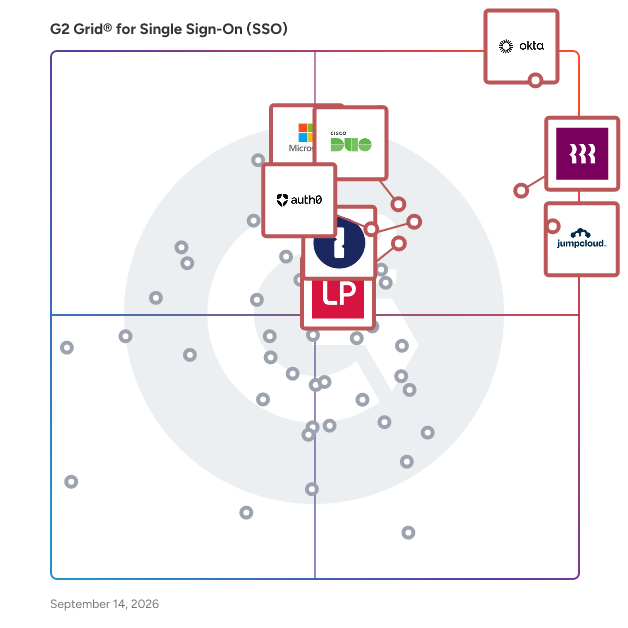
## Top Single Sign-On (SSO) Solutions at a Glance
| # | Product | Rating | Best For | What Users Say |
|---|---------|--------|----------|----------------|
| 1 | [Okta](https://www.g2.com/products/okta/reviews) | 4.5/5.0 (1,211 reviews) | SSO with automated provisioning across SaaS | "[Strong Security Without Sacrificing User Experience](https://www.g2.com/survey_responses/okta-review-12974377)" |
| 2 | [Rippling IT](https://www.g2.com/products/rippling-it/reviews) | 4.7/5.0 (1,036 reviews) | HR-integrated SSO with automated provisioning | "[All-in-One HR and IT Platform That Streamlines Onboarding, Payroll, and Automation](https://www.g2.com/survey_responses/rippling-it-review-12933562)" |
| 3 | [JumpCloud](https://www.g2.com/products/jumpcloud/reviews) | 4.5/5.0 (3,859 reviews) | Cloud directory SSO with cross-platform MDM | "[Centralization and real-time remote support with simple mass deployment](https://www.g2.com/survey_responses/jumpcloud-review-12972998)" |
| 4 | [Microsoft Entra ID](https://www.g2.com/products/microsoft-entra-id/reviews) | 4.5/5.0 (872 reviews) | Microsoft ecosystem SSO with conditional access | "[Microsoft Entra is one of best Modern and Robust Cloud Identity and Access Management Platform](https://www.g2.com/survey_responses/microsoft-entra-id-review-12609554)" |
| 5 | [Cisco Duo](https://www.g2.com/products/cisco-duo/reviews) | 4.5/5.0 (500 reviews) | MFA-enabled SSO with SAML flexibility | "[Cisco DUO has been our most reliable 2FA solution so far](https://www.g2.com/survey_responses/cisco-duo-review-12662471)" |
| 6 | [1Password](https://www.g2.com/products/1password/reviews) | 4.6/5.0 (1,780 reviews) | Team password vaults with granular access control | "[Making Daily Credential Management More Structured](https://www.g2.com/survey_responses/1password-review-12865207)" |
| 7 | [Auth0](https://www.g2.com/products/auth0/reviews) | 4.3/5.0 (263 reviews) | Developer-first SSO with extensible authentication workflows | "[Fast to Integrate, Scales Well, and Affordable for MVPs](https://www.g2.com/survey_responses/auth0-review-12849763)" |
| 8 | [Zscaler Private Access](https://www.g2.com/products/zscaler-private-access/reviews) | 4.4/5.0 (133 reviews) | Zero Trust application access replacing VPNs | "[Zscaler Private Access: Stable, Secure VPN Alternative That Streamlines Daily Work](https://www.g2.com/survey_responses/zscaler-private-access-review-12629828)" |
| 9 | [LastPass](https://www.g2.com/products/lastpass/reviews) | 4.5/5.0 (2,031 reviews) | Password vault with secure credential sharing | "[Stress-Free Password Management with Seamless Autofill and Sync](https://www.g2.com/survey_responses/lastpass-review-12845237)" |
| 10 | [Citrix Secure Private Access](https://www.g2.com/products/citrix-citrix-secure-private-access/reviews) | 4.5/5.0 (70 reviews) | VPN-less SSO with zero-trust remote access | "[Strong Security, Minor Connection Hiccups](https://www.g2.com/survey_responses/citrix-secure-private-access-review-12952066)" |

  
## How Many Single Sign-On (SSO) Solutions Products Does G2 Track?
**Total Products under this Category:** 171

### Category Stats (Jun 2026)
- **Average Rating**: 4.4/5 The average rating of products in this category, based on all submitted ratings
- **New Reviews This Quarter**: 229
- **Buyer Segments**: Mid-Market 44% │ Small-Business 34% │ Enterprise 22% Represents the distribution of reviewers across all products in this category.
- **Top Trending Product**: miniOrange Identity &amp; Access Management (+2.27%) - Among all products in this category, miniOrange Identity &amp; Access Management recorded the largest rating increase compared to last month
*Last updated: June 09, 2026*

  
## How Does G2 Rank Single Sign-On (SSO) Solutions Products?

**Why You Can Trust G2's Software Rankings:**

- 30 Analysts and Data Experts
- 17,700+ Authentic Reviews
- 171+ Products
- Unbiased Rankings

G2's software rankings are built on verified user reviews, rigorous moderation, and a consistent research methodology maintained by a team of analysts and data experts. Each product is measured using the same transparent criteria, with no paid placement or vendor influence. While reviews reflect real user experiences, which can be subjective, they offer valuable insight into how software performs in the hands of professionals. Together, these inputs power the G2 Score, a standardized way to compare tools within every category.

  
## Which Single Sign-On (SSO) Solutions Is Best for Your Use Case?

- **Leader:** [Okta](https://www.g2.com/products/okta/reviews)
- **Highest Performer:** [Descope](https://www.g2.com/products/descope/reviews)
- **Easiest to Use:** [Rippling IT](https://www.g2.com/products/rippling-it/reviews)
- **Top Trending:** [Rippling IT](https://www.g2.com/products/rippling-it/reviews)
- **Best Free Software:** [JumpCloud](https://www.g2.com/products/jumpcloud/reviews)

  
---

**Sponsored**

### JumpCloud

JumpCloud® delivers a unified identity, device, and access management platform that makes it easy to securely manage identities, devices, and access across your organization. With JumpCloud, IT teams and MSPs enable users to work securely from anywhere and manage their Windows, Apple, Linux, and Android devices from a single platform.


[Visit website](https://www.g2.com/external_clickthroughs/record?secure%5Bad_program%5D=ppc&amp;secure%5Bad_slot%5D=category_product_list&amp;secure%5Bcategory_id%5D=254&amp;secure%5Bdisplayable_resource_id%5D=254&amp;secure%5Bdisplayable_resource_type%5D=Category&amp;secure%5Bmedium%5D=sponsored&amp;secure%5Bplacement_reason%5D=page_category&amp;secure%5Bplacement_resource_ids%5D%5B%5D=254&amp;secure%5Bprioritized%5D=false&amp;secure%5Bproduct_id%5D=36316&amp;secure%5Bresource_id%5D=254&amp;secure%5Bresource_type%5D=Category&amp;secure%5Bsource_type%5D=category_page&amp;secure%5Bsource_url%5D=https%3A%2F%2Fwww.g2.com%2Fcategories%2Fsingle-sign-on-sso&amp;secure%5Btoken%5D=0f714aefb104428afcc65e1cbd69962de04e36ea0a042aae25124b8d8c842666&amp;secure%5Burl%5D=https%3A%2F%2Fjumpcloud.com%2Flp%2Funified-enpoint-management-g2%3Futm_source%3DG2-Paid%26utm_medium%3DPaid-Directory%26utm_content%3DSSO%26utm_campaign%3DG2Clicks&amp;secure%5Burl_type%5D=custom_url)

---

  
    ## What Is Single Sign-On (SSO) Solutions?
  [Identity Management Software](https://www.g2.com/categories/identity-management)
  ## What Software Categories Are Similar to Single Sign-On (SSO) Solutions?
    - [User Provisioning and Governance Tools](https://www.g2.com/categories/user-provisioning-and-governance-tools)
    - [Identity and Access Management (IAM) Software](https://www.g2.com/categories/identity-and-access-management-iam)
    - [Multi-Factor Authentication (MFA) Software](https://www.g2.com/categories/multi-factor-authentication-mfa)
    - [Risk-Based Authentication Software](https://www.g2.com/categories/risk-based-authentication-rba)
    - [Customer Identity and Access Management (CIAM) Software](https://www.g2.com/categories/customer-identity-and-access-management-ciam)
    - [Biometric Authentication Software](https://www.g2.com/categories/biometric-authentication)
    - [Passwordless Authentication Software](https://www.g2.com/categories/passwordless-authentication)

  
---

## How Do You Choose the Right Single Sign-On (SSO) Solutions?

### What You Should Know About Single Sign-On Solutions

### What are Single Sign-On (SSO) Solutions?

Single sign-on (SSO) solutions are user authentication solution that helps companies secure access to business applications and assets. It does so while also providing end users with a convenient, easy-to-use portal that requires them only to sign in and authenticate once to access multiple corporate applications and resources.&amp;nbsp;

SSO solutions share authentication sessions between a trusted identity provider, which manages digital identities and applications. In practice, commonly, an identity provider requires the user to log in and authenticate; the identity provider then shares this authentication session with other applications by passing digitally signed tokens for the receiving application to verify that it is coming from a trusted provider before granting the user with access to the application. If the user identity token is accepted, the user is automatically granted access to the application.

Companies use SSO software mainly to improve security and enhance the end-user sign-on experience, whether that be internal employees, end customers, or corporate business partners. SSO solutions also centralizes user access management, thus reducing the security management burden on administrators. Using an SSO solution, IT administrators can reduce or eliminate common time-consuming tasks like password resets. SSO products contain features that benefit both end users and administrators. For end users, this includes an easy-to-use user portal, intuitive authentication, and often a mobile application. For administrators, these solutions often include an identity directory or directory integrations, multiple multi-factor authentication (MFA) methods, audit features, and prebuilt application integrations.&amp;nbsp;

**What Does SSO Stand For?**

SSO most commonly stands for single sign-on. The acronym SSO is less frequently used to describe same sign-on, which is different from single sign-on; same sign-on does not rely on trusted tokens, but rather credential sharing. Rarely, the acronym SSO is used to describe single sign-out.

Other common acronyms people may encounter regarding SSO products include:

FIM: federated identity management, of which SSO is a part

IAM: identity and access management

IdP: identity provider

JWT: JSON Web Token, a protocol commonly used in business-to-consumer (B2C) SSO applications

LDAP: lightweight directory access protocol, an open protocol used for directory services authentication

MFA: multi-factor authentication

OIDC: OpenID Connect, an authentication protocol

OAuth: an open standard authentication protocol

SAML: Security Assertion Markup Language, an open standard used for SSO solutions

#### What Types of Single Sign-On (SSO) Solutions Exist?

**Business to employee (B2E)**

Companies use B2E SSO solutions to securely manage their employees’ access to corporate accounts, provide an easy-to-use user experience, and reduce user need for IT administrators services.

**Business to business (B2B)**

Companies use B2B SSO solutions to enable their business partners and corporate customers to best utilize the company’s services, using the partner or corporate customer’s preferred identity providers.

**Business to consumer (B2C) or customer identity and access management (CIAM)**

In B2C or CIAM use cases, customers are able to sign into other accounts and connect them to the business’ app to provide an SSO experience. Most commonly, customers authenticate using social media identity providers like Facebook or Google enabling them access to connected accounts. **&amp;nbsp;**

### What are the Common Features of Single Sign-On (SSO) Solutions?

The following are some core features within SSO solutions that can help users and administrators.

**User portal:** User portals provide an intuitive, easy-to-use end-user interface.

**Mobile app:** Many SSO solutions offer a mobile app for end users to both authenticate and access the SSO solution from their mobile devices.

**MFA methods:** Most SSO providers offer multiple authentication methods to end users, from software or hardware token-based authentication, to mobile push, passwordless authentication, biometric authentication, or one-time passcodes (OTPs).&amp;nbsp;

**Adaptive or contextual access:** Some SSO software offers advanced authentication tools, such as adaptive or contextual access. Using machine learning to understand a user’s contextual use of the SSO product, such as location, IP address, time, and other real-time factors to create a user baseline profile. This profile is then used to determine anomalous access activity to prevent access when risk is deemed too high.

**Directory or integration:** To assist with user provisioning and management, SSO solutions either integrate with standard directories, such as Microsoft Active Directory, LDAP-based directories, or Google Cloud Directory or offer their own cloud directories built into the SSO software.

**Prebuilt integration application catalog:** SSO solutions commonly provide prebuilt integrations to widely used SaaS applications, which are available on an application catalog.

**Role management:** SSO solutions assist administrators with user provisioning and assigning permissions based on user role for access control.

**Audit features** : Audit features provide administrators audit logs to monitor user access.

### What are the Benefits of Single Sign-On (SSO) Solutions?

**Increases security:** The main benefit of using an SSO solution is for securing user access to company applications and other resources through user authentication.

**Reduces password authentication risk:** Since users must only sign in and authenticate once to access multiple applications, SSO solutions reduce the risks associated with poor password management and using only a single factor for authentication.

**Saves users time and frustration:** SSO solutions reduce the number of logins end users such as employees or customers must remember and SSO solutions reduce user frustration when switching between multiple applications once authenticated.

**Saves administrators time and money:** Users can access their accounts in one centralized location, reducing the number of calls to administrators for password resets, saving time and, therefore money on labor costs.

**Seamless experience across assets:** SSO solutions reduce login friction for end users once authenticated and give them access to multiple accounts.&amp;nbsp;

**Centralizes consumer profiles:** SSO software consolidates end-user experiences in one tool to provide a centralized view of end-user or customer data.

### Who Uses Single Sign-On (SSO) Solutions?

**Systems administrators:** Systems administrators are responsible for deploying and managing a company’s SSO solutions.

**Employees:** Employees are end users of SSO solutions in a B2E use case to sign on and authenticate with the user portal to access their corporate accounts.

**Customers:** Customers are end users of SSO solutions in a B2C use case and sign in and authenticate using an identity provider, often a social media account, to access a business’ applications.

**Business contacts:** Companies may use SSO software to enable their business partners and corporate customers to securely authenticate and access the company’s assets, often with multiple identity providers.

#### Software Related to Single Sign-On (SSO) Solutions

Related solutions that can be used together with SSO software include:

[Identity and access management (IAM) software](https://www.g2.com/categories/identity-and-access-management-iam) **:** For employee use cases, IAM software offers broader identity solutions, of which SSO is often a part. IAM software authenticates users, provides access to systems and data based on company policies, tracks user activity, and provides reporting tools to ensure employees comply with company policies and regulations.

[Customer identity and access management (CIAM) software](https://www.g2.com/categories/customer-identity-and-access-management-ciam) **:** For customer use cases, CIAM software provides robust identity functionality. CIAM software enables businesses to centralize and manage customer identities, preferences, and profile information at scale while offering customers self-registration options.

[Password manager software](https://www.g2.com/categories/password-manager) **:** Password managers are secure repositories that store individual user passwords, much like a vault. SSO solutions differs from password managers because SSO software provides authentication before granting a trusted token, not an actual password, for access to an application.&amp;nbsp;

[SaaS operations management software](https://www.g2.com/categories/saas-operations-management) **:** SaaS operations management software tools enable businesses to manage, govern, and secure their SaaS product portfolios; many of these tools integrate with SSO solutions to manage user permissions. **&amp;nbsp;&amp;nbsp;&amp;nbsp;**

[SaaS spend management software](https://www.g2.com/categories/saas-spend-management) **:** This software enables companies to manage SaaS utilization to identify cost savings. Many of these tools integrate with SSO software to manage end-user utilization of SaaS subscriptions.

### Challenges with Single Sign-On (SSO) Solutions

Software solutions can come with their own set of challenges. Issues to consider include:&amp;nbsp;

**Legacy applications** : SSO tools may not integrate with legacy applications; a solution to overcome this may include password vaulting tools within the SSO software to provide the end user with ease of use, despite not technically functioning as SSO regarding authentication.&amp;nbsp;

**High availability:** It is important that the SSO provider has high availability to avoid users being locked out of their systems; with applications managed centrally with an SSO solution, any downtime can prevent end users from accessing their applications and resources. If a company has mission-critical applications that must be available 24/7, many companies will not integrate these tools with SSO providers and instead log in and authenticate separately.

### Which Companies Should Buy Single Sign-On (SSO) Solutions?

All companies can benefit from securing their login process to corporate assets.

**Companies securing employees:** Companies of all sizes that want to secure their employees’ access to corporate applications use SSO solutions.

**Companies securing customers:** Companies that want to enable their customers to provide self service to securely authenticate and login to applications use SSO solutions.

**Companies securing partners:** Companies that want to secure their partners and contractors access to corporate applications use SSO solutions.

### How to Buy Single Sign-On (SSO) Solutions

#### Requirements Gathering (RFI/RFP) for Single Sign-On (SSO) Software

Prior to selecting an SSO software service provider or solution, buyers must consider what factors are important to the company, which may include:

**End-user use case:** Buyers must determine their end users—whether employees, customers, or business partners—to determine what kind of SSO solution works best for these constituencies.

**Cloud vs. on-premises application support:** The buyer should determine what applications and company resources will be connected to the SSO software. For applications that need high availability (24/7), they may not wish to connect those in case of downtime with the SSO provider. Many SSO providers offer prebuilt integrations with the most popular business software. If the business has applications that are custom-built, legacy, or on-premises, those may need integrations built to connect with the SSO. Another workaround would be to use a password vault within an SSO solution for legacy applications that are difficult to connect.

**Federation protocols** : If the organization needs to integrate with multiple identity providers outside of the organization, especially for authenticating business partners, FIM can achieve this. Federation protocols include SAML 1.1, SAML2, WS-Federation, OAuth2, OpenID Connect, WS-Trust, and other protocols.

**Authentication type** : The company should ensure that the authentication types its employees, customers, or partners will use are supported by the SSO solution of choice. This may include software or hardware-token-based authentication for employees and OTPs via email, SMS, or phone for customers, among many other authentication methods. Many SSO solutions now offer contextual or risk-based authentication measures to learn user behaviors, identify patterns, and thus provide risk-based assessments when the authentication process does not meet typical patterns.&amp;nbsp;

**Mobile app** : If end users will access corporate applications from mobile devices, ensure the SSO software provider’s mobile app meets particular business needs.&amp;nbsp;

**Developer support** : Buyers must ensure the SSO provider has the developer support the team requires, including software development kits (SDKs) and application programming interface (API) lifecycle management functions, particularly for B2C SSO use cases.&amp;nbsp;

**Meets security standards** : SSO is a security tool providing users with authenticated access to their company resources. It is important that the SSO service provider meet security standards that are important to the company, which may include ISO 27017, ISO 27018, ISO 27001, SOC 2 Type 2, and others.&amp;nbsp;

#### Compare Single Sign-On Software (SSO) Products

**Create a long list**

Buyers should create a long list of software solutions by researching on g2.com, by reading real-user reviews, seeing how vendors compare on G2 Grid® reports, and saving the software selections to “My List” to reference them in the future. Using g2.com, users can learn about which solutions are most often used in the geographic market and which ones are best for every business segment size—whether that is for small, medium, and enterprise businesses.

**Create a short list**

After creating a long list of vendors, buyers must do further research to narrow down the selections. Using g2.com’s compare feature, they can stack specific software up side by side to learn about how real users of the software rate their functionality. G2 also has quarterly reports showcasing users’ perception of return on investment (in months),&amp;nbsp;the software provider’s average implementation time in months, usability scores, and many other factors.

**Conduct demos**

Up next is time to demo the products. Many vendors enable buyers to contact them directly from g2’s website by clicking the “Get a quote” button on their product profile. Buyers must prepare for each demo by having a standard list of questions and clarifications to ask each vendor.&amp;nbsp;

#### Selection of Single Sign-On (SSO) Solutions&amp;nbsp;

**Choose a selection team**

Single sign-on solutions impact users across the business—from employees, customers, business partners, IT teams, infosec teams, and more. The company’s software selection team should include people representative of these groups. They must start with three to five people to join the selection committee and clearly define project roles.&amp;nbsp;

**Negotiation**

It is important to know how many licenses are needed, as pricing often depends on the number of licenses the buyer purchases and the length of time they purchase it for. Often buyers can get discounts if they purchase large blocks of licenses for a longer duration. They must be sure to negotiate not just on price, but also implementation. Companies may be able to get free or reduced implementation services or ongoing support, as well.

**Final decision**

Before making a final choice, buyers should check if they can get a trial run of the product to test adoption with a small sample size of users. If the tool is well used and well received, the buyer can be confident that the selection was correct.