Best Payment Gateways

Subhransu Sahu
SS
Researched and written by Subhransu Sahu

Payment gateways automate the payment transaction process between shoppers and merchants, securely transmitting transaction information to banks. E-commerce businesses depend on payment gateways to ensure that payment information is passed securely from the customer to the merchant and payment processor. This type of software is used by e-commerce managers to accept payments on multiple channels and by finance professionals to track payment performance.

This type of software should not be confused with payment processing software, which focuses on business to business (B2B) payments. Payment gateways integrate with e-commerce platforms, shopping cart software, and subscription management software to process payments for the goods and services sold using these solutions.

To qualify for inclusion in the Payment Gateways category, a product must:

Accept online payments from credit and debit cards, mobile wallets, or BNPL services
Connect the e-commerce website to a payment processor for online transactions
Transmit payment information securely from buyers to payment processors
Support business to consumer (B2C) and B2B payments
Integrate with financial systems and retail point of sale (POS) solutions
Support multiple use cases such as e-commerce, POS, or cross-border transactions
Show More
Show Less

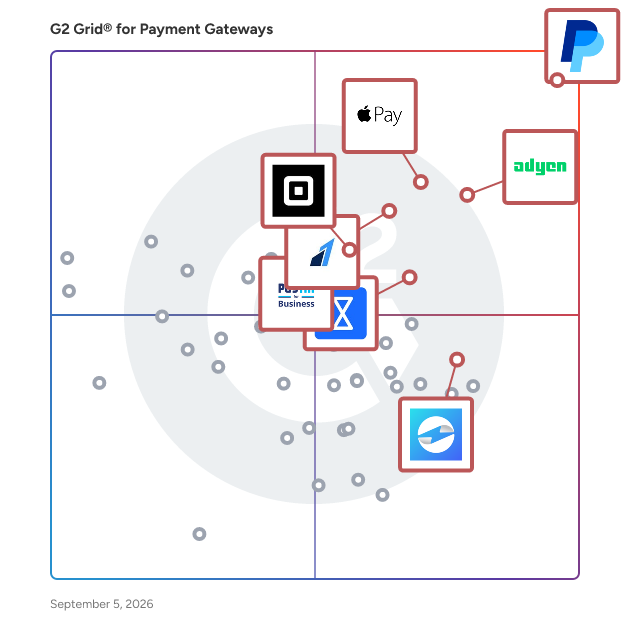
Best Payment Gateways At A Glance

Highest Performer:
Easiest to Use:
Top Trending:
Best Free Software:
Show LessShow More
Easiest to Use:
Top Trending:
Best Free Software:

G2 takes pride in showing unbiased reviews on user satisfaction in our ratings and reports. We do not allow paid placements in any of our ratings, rankings, or reports. Learn about our scoring methodologies.

No filters applied
348 Listings in Payment Gateways Available
(2,681)4.4 out of 5
2nd Easiest To Use in Payment Gateways software
View top Consulting Services for PayPal Payments
Entry Level Price:$0 per month
G2 Advertising
Sponsored
G2 Advertising
Get 2x conversion than Google Ads with G2 Advertising!
G2 Advertising places your product in premium positions on high-traffic pages and on targeted competitor pages to reach buyers at key comparison moments.
(104)4.7 out of 5
8th Easiest To Use in Payment Gateways software
View top Consulting Services for NMI Gateway
(103)4.8 out of 5
3rd Easiest To Use in Payment Gateways software
View top Consulting Services for EBizCharge
Entry Level Price:Starting at $49.00
Entry Level Price:$25 Monthly Gateway
Entry Level Price:Contact Us

Learn More About Payment Gateways

What are Payment Gateways?

Most major e-commerce platforms and payment gateways have plug-ins and extensions to make integrations easier. Conversely, less popular solutions in this space will require more work to integrate with one another. Fortunately, almost every major e-commerce platform makes it clear which payment gateways can be integrated with their software. Businesses using open source e-commerce platforms can leverage the developer community for specialized extensions and plug-ins for payment gateway integrations.

Often, payment gateways come in two flavors: hosted and integrated. Hosted payment gateways are easy to set up and require little maintenance on the part of the e-commerce store owner. Additionally, PCI compliance and data security become the responsibility of the payment gateway with hosted products, saving e-commerce businesses time and money. However, hosted options redirect customers away from the business’ website and to a payment processing page. This can be confusing for customers and as well as negatively affect conversion rates.

Integrated payment gateways require more time to implement but lead to higher conversion rates, as customers never leave the e-commerce site to complete a purchase. Integrated payment gateways can be limited by which e-commerce tools their API integrates with. Furthermore, integrated payment gateways will often require the e-commerce store to have a merchant account to accept credit card payments.

One major business problem solved is payment collection, a necessary element of an e-commerce website. In addition, payment gateways provide deep insights into granular transaction management, another common business problem.

Key Benefits of Payment Gateways

  • Accept online payments through your e-commerce business
  • Accept multiple currencies and payment methods
  • Process payments securely without risking the security of payment information
  • Prevent unauthorized payments with fraud protection mechanisms
  • Quickly handle customer returns and refunds

Why Use Payment Gateways?

“How can I easily and securely collect payments from customers on my e-commerce website?" This is the primary problem that payment gateway software resolves. Many businesses are familiar with the difficulties and cost of setting up custom payment solutions to collect and process credit card information. Payment gateway software resolves those frustrations with easy setup at a relatively low cost. Additionally, some payment gateway products allow users to upload their own branding onto the gateway. This ensures visitors aren’t redirected to a third-party website.

Additionally, an important feature of payment gateway software is its ability to detect, identify, and react to fraudulent activity. Payment gateways help ensure the safety and encryption of their customers’ sensitive information and the compliance of their e-commerce business to payment card industry (PCI) regulations.

Payment gateway software also allows users to rectify any outstanding errors and complete refunds based on the product’s database of transaction information. The database of customer transactions is crucial for users to keep track of invoices, reports, and cash flow, helping e-commerce businesses with forecasting. In addition to the database, some payment gateways also provide analytics and insights about transactions, enhancing business forecasting and improving things like customer profiles and the ability for the e-commerce company to accurately upsell or cross-sell.

Minimizing fraud — Payment gateways allow payments to be encrypted to ensure the security of the payer’s information as well as verifying payments to avoid fraud. Unauthorized payments will result in a notification, allowing the user to reject the payment before it goes through. Fraud protection filters may include high-risk countries, email service provider risk, high risk BIN, account number velocity, high item number, shipping/billing mismatch, AVS failure, CSC failure, and others.

Receiving payments in multiple ways — Users can set up recurring payments, subscriptions, split payments, and one-time payments as necessary. Users can also create peer-to-peer payments as needed. This flexibility allows users to fit their payment structure to their business model or customer needs.

Scalability — As a business grows, so do its payment needs. Payment gateway software makes it easy to scale by adding features as needed and integration with multiple e-commerce stores.

Who Uses Payment Gateways?

E-commerce businesses of all sizes depend on easy-to-use payment gateways to seamlessly guide a website visitor from browsing to buying. Businesses turn to payment gateway software to automate payment transactions and ensure the security and encryption of those transactions. In turn, payment gateways integrate with e-commerce platforms and tools like subscription management software.

E-commerce businesses — E-commerce businesses are both the most common and most obvious use for payment gateways. These businesses need a way to collect payments online in a way that is convenient for themselves and their customers. With payment gateways, payments are instantaneous and protected for both parties.

Charities and nonprofits — The ability to instantaneously make donations online is hugely important for charities and other nonprofits who are held to strict reporting and taxation standards. From a nonregulatory standpoint, donors are also more likely to donate to a charity or nonprofit if it is fast and convenient to do so.

Individual consumers — Peer-to-peer features of payment gateways make it easy for individual users to make fast, easy payments to their friends, family, and individual contractors. Using a smartphone, anyone can make a payment to another user of the same software quickly and securely. No need to hound your friends for pizza money, you can simply send a request or single-time invoice with the exact amount they owe you.

Payment Gateway Features

Payment gateways primarily provide payment processing tools that allow users to send and receive credit card payments as well as online payments directly from a bank account. Given the variety of payment options available, as well as the myriad ways that payments can be structured, there can be a lot of variety among online payment systems. Some may even integrate with a physical credit card terminal, providing businesses that operate both in-person and online with a means to accept payments using one tool. However, payment gateways include a variety of features to help businesses run smoothly both on- and offline.

Reporting — Data should be every business’ best friend, and payment gateways provide crucial data on each transaction made through the platform. This can make it easy to track how and where money is entering and leaving the business, helping better predict future performance. This also provides an added security measure of visibility into where money is going and whether it was an authorized transaction.

This data can also provide crucial demographic information so businesses can be more aware of who and where their customer base is.

Manual payment entry — Manual payment entry allows a business the option to take down payment information provided over the phone or in person and put it into the payment gateway, creating a larger amount of flexibility. This can also help businesses facilitate returns or refunds requested over the phone.

PCI compliance — Payment card industry (PCI) regulations ensure the security of credit card users online by enforcing strict security requirements. These include protecting cardholder data, maintaining a vulnerability management program, implementing strong access control measures, regularly monitoring and testing networks, and maintaining an information security policy. Luckily, most payment gateways have this already baked in, making it easy for users.

Fraud protection — Fraud can be a huge concern when buying and selling online, and most payment gateways already have safeguards in place to protect their users. Many payment gateways use a variety of fraud prevention tools, ensuring 360-degree protection for all users.

Two-factor authentication — Two-factor authentication is a method that enables users to keep their account extra secure. After signing into the platform using a browser, the second form of authentication will either email or text the user a code that they can then input to ensure that they are the owner of the account. This way, users can prevent unauthorized access to their account.

Internationalization — International support can come in the form of both language and foreign currency support. By supporting multiple languages and currencies, businesses can receive payments from around the world and make their business truly global. By having this built into the payment gateway, businesses can avoid dealing with foreign banks and other entities that they may not be equipped to do business with.

Additional Payment Gateway Features

E-commerce software integration — Integration with your business’ e-commerce solution can make it much easier for both you and your customers. Customers can easily make a purchase without leaving your store, making it less likely that you will lose customers due to inconvenience. But the main advantage is data integration, which makes it easy to process payments and track each transaction. This can help with inventory management, accounting, and more in the long run.

Accounting software integration — Integration with your accounting software makes it easy to track incoming and outgoing finances, as well as track invoices and other financial data.

Recurring billing — Many payment gateways allow users to set up recurring payments of invoices for ongoing services. By having this information within the payment gateway itself, it gives customers the option to set up automatic payments.

Accepted credit and debit cards — Payment gateways often have a variety of credit cards and payment methods they accept. Merchants can often choose from that list of accepted payment options which methods they will accept, giving them control.

Other Features of Payment Gateways: B2B, Mobile, Retail

Potential Issues with Payment Gateways

Integrations — While your e-commerce platform may be one of the biggest deciding factors when choosing a payment gateway, there are other software integrations to keep in mind as well. Subscription management tools are often paired with payment gateways to manage recurring payments from customers. Additionally, shopping cart tools will need to be considered, as they allow customers to select items for purchase and generate a total amount to be charged through the payment gateway.

Currencies and payment type — Payment gateways are limited by the countries and currencies they support. This often requires e-commerce businesses to use more than one payment gateway to cater to more customers. Additionally, tools in this category are limited by the payment methods they accept: credit cards, ACH payments, split payments, etc. It’s important to understand where your customers are and the payment methods they use before integrating a new payment gateway with your e-commerce store.

Transaction fees — Most payment gateways will charge a small processing fee for each transaction. This fee can be either a flat rate or a small percentage and is often determined by the number of transactions your e-commerce business processes each month. Small businesses usually pay a lower rate than enterprise-level e-commerce businesses. Monthly and initiation fees are also common for most payment gateways.