# Best Online Course Providers - Page 18

  *By [Emma Stein](https://research.g2.com/insights/author/emma-stein)*

   Online course providers offer massive open online courses (or MOOCs) and other organized courses that can be taken online. Students who enroll in an online course generally complete a series of lessons and take assessments to prove their mastery of the material. Depending on the subject and the coursework, some online course providers may offer certifications to students upon completion. While many online course providers offer free classes, some require a paid monthly subscription or a one-time fee for students to access a larger or more advanced selection of courses. Other online course providers may charge for certificates of completion or for enterprise access to courses.

The courses offered via online course providers span a wide range of subjects, including coding, data science, marketing, graphic design, software skills, and career development. Some online course providers have smaller course catalogs, perhaps offering lessons focused on specific technical skills development, while other providers offer large catalogs comprising hundreds of different topics.

To qualify for inclusion in the Online Course Providers category, a services provider must:

- Offer self-paced online course content
- Include a set curriculum organized into lessons, modules, or topics
- Evaluate learner progress via skill assessments


  ## How Many Online Course Providers Products Does G2 Track?
**Total Products under this Category:** 375

  
## How Does G2 Rank Online Course Providers Products?

**Why You Can Trust G2's Software Rankings:**

- 30 Analysts and Data Experts
- 17,300+ Authentic Reviews
- 375+ Products
- Unbiased Rankings

G2's software rankings are built on verified user reviews, rigorous moderation, and a consistent research methodology maintained by a team of analysts and data experts. Each product is measured using the same transparent criteria, with no paid placement or vendor influence. While reviews reflect real user experiences, which can be subjective, they offer valuable insight into how software performs in the hands of professionals. Together, these inputs power the G2 Score, a standardized way to compare tools within every category.

  
## Which Online Course Providers Is Best for Your Use Case?

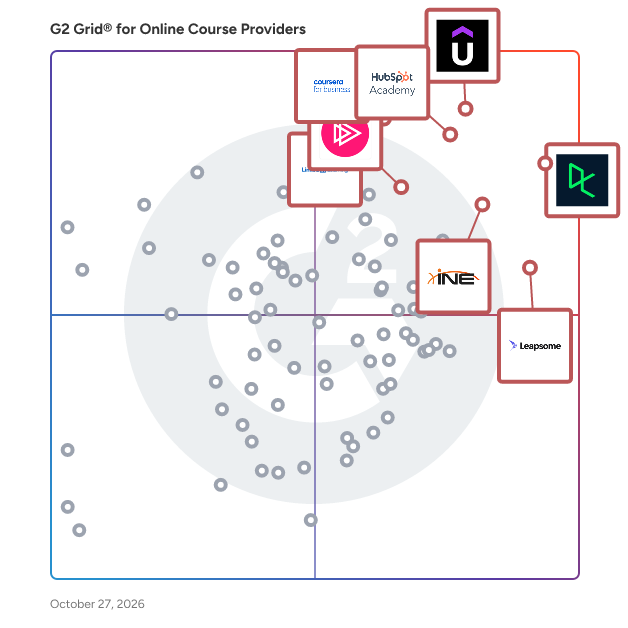
- **Leader:** [DataCamp](https://www.g2.com/products/datacamp/reviews)
- **Highest Performer:** [CustomGuide](https://www.g2.com/products/customguide/reviews)
- **Easiest to Use:** [Whizlabs](https://www.g2.com/products/whizlabs/reviews)
- **Top Trending:** [Coursera for Business](https://www.g2.com/products/coursera-for-business/reviews)
- **Best Free Software:** [Corporate Finance Institute](https://www.g2.com/products/corporate-finance-institute/reviews)

  
---

**Sponsored**

### Go1

Go1 is a comprehensive employee training solution specifically designed for Learning and Development (L&amp;D) leaders who prioritize a people-first approach in their organizations. The Go1 platform enables L&amp;D professionals to efficiently deliver tailored learning content to employees, ensuring that the right resources are accessible at the right moment. By leveraging advanced AI-enhanced discovery and curation tools, Go1 simplifies the process of finding and deploying relevant educational materials from over 250 industry-leading content providers. The target audience for Go1 includes L&amp;D leaders and HR professionals who are focused on enhancing employee skills and knowledge. With the ever-evolving landscape of workplace learning, these professionals require a solution that not only aggregates high-quality content but also integrates seamlessly with existing learning ecosystems. Key features of Go1 include its extensive library of content, which spans various topics and formats, allowing organizations to cater to different learning preferences. The platform&#39;s AI-driven tools enhance the user experience by providing personalized recommendations, ensuring that employees receive content that is relevant to their roles and career aspirations. Additionally, Go1&#39;s integration capabilities with over 70 leading learning platforms and workplace applications enable organizations to utilize the platform within their existing infrastructure, minimizing disruption and maximizing efficiency. By centralizing learning resources, L&amp;D leaders can streamline their training initiatives, improve employee engagement, and foster a culture of continuous learning. The platform&#39;s ability to deliver timely and relevant content not only enhances the learning experience but also contributes to improved performance and productivity within teams. Overall, Go1 stands out in the L&amp;D landscape by offering a robust, user-friendly solution that aligns with the needs of modern organizations striving for effective employee development.


[Visit website](https://www.g2.com/external_clickthroughs/record?secure%5Bad_program%5D=ppc&amp;secure%5Bad_slot%5D=category_product_list&amp;secure%5Bcategory_id%5D=329&amp;secure%5Bdisplayable_resource_id%5D=329&amp;secure%5Bdisplayable_resource_type%5D=Category&amp;secure%5Bmedium%5D=sponsored&amp;secure%5Bplacement_reason%5D=page_category&amp;secure%5Bplacement_resource_ids%5D%5B%5D=329&amp;secure%5Bprioritized%5D=false&amp;secure%5Bproduct_id%5D=137989&amp;secure%5Bresource_id%5D=329&amp;secure%5Bresource_type%5D=Category&amp;secure%5Bsource_type%5D=category_page&amp;secure%5Bsource_url%5D=https%3A%2F%2Fwww.g2.com%2Fcategories%2Fonline-course-providers&amp;secure%5Btoken%5D=daca61acd08c9173f7b71161ff97c442b8429787ad4633f82bd61fe4967a3405&amp;secure%5Burl%5D=https%3A%2F%2Fwww.go1.com%2Fg2-landing-page&amp;secure%5Burl_type%5D=book_demo)

---

  
    ## What Is Online Course Providers?
  [Education Software](https://www.g2.com/categories/education)
  ## What Software Categories Are Similar to Online Course Providers?
    - [Course Authoring Software](https://www.g2.com/categories/course-authoring)
    - [Corporate Learning Management Systems](https://www.g2.com/categories/corporate-learning-management-systems)
    - [Online Learning Platforms](https://www.g2.com/categories/online-learning-platform)
    - [Virtual IT Labs Software](https://www.g2.com/categories/virtual-it-labs)
    - [Learning Experience Platforms (LXP)](https://www.g2.com/categories/learning-experience-platforms-lxp)
    - [eLearning Content Software](https://www.g2.com/categories/elearning-content)
    - [Technical Skills Development Software](https://www.g2.com/categories/technical-skills-development)

  
---

## How Do You Choose the Right Online Course Providers?

### What You Should Know About Online Course Providers

### What are Online Course Providers?

Online course providers deliver educational course content to students across a wide range of subjects, from academic subjects like physics to technical areas like web development. With thousands of different courses available online, users in many different stages in life — from [K-12 school students](https://www.g2.com/categories/online-course-providers/f/k-12) to seasoned professionals — can find an online course to help advance their education or career. Businesses turn to online course providers as an efficient way to ensure employees have the skills they need to pursue their [personal career goal](https://learn.g2.com/career-development-plan) as well as key business objectives.

The content offered by online course providers can vary depending on the provider. Some online course providers specialize in content geared toward [technical fields](https://www.g2.com/categories/technical-skills-development) such as web development, artificial intelligence, or data science. Others partner with well-known universities to offer courses in biology, statistics, finance, digital marketing, or project management. Some courses focus less on education in a specific field and more on professional competencies or “soft&quot; skills, such as improving communication skills, learning how to effectively lead a team, or strategies for being productive at work.

Online courses frequently include interactive content like videos and practice projects. At the end of the course, users typically take an assessment that measures whether the user mastered the material. Once a user has completed a course or a series of courses, they may earn a badge or certificate that can be posted on social media or added to their resume.

**Key Benefits of Online Course Providers:**

- Expand employee skill sets
- Boost worker productivity and performance
- Increase employee engagement and reduce turnover
- Create new career pathways for workers

### Why Use Online Course Providers?

The biggest reason for a company to use online course providers is to help the company’s employees improve their skills in areas that will benefit the individual worker as well as the business as a whole. Technical fields like coding and [artificial intelligence](https://www.g2.com/categories/artificial-intelligence) are rapidly evolving, so having employees take online courses to learn the latest developments is a cost-effective way to ensure the company is able to implement the latest technologies in their industry. Other less technical subjects can also be important if a company’s leaders notice their workers have a knowledge gap. For example, if a manager is struggling with giving their direct reports effective feedback, they might want to take a course on managing teams that could help address that need.

More generally, access to online courses can lead to increased employee engagement and retention. Professionals who feel like the company cares about their personal development will be more effective at work and more likely to stay if they feel they have a path to [advance their career](https://learn.g2.com/career-growth). Earning credentials through online courses also gives employees a chance to share what they have accomplished, ideally creating a culture of learning throughout the company.

### Who Uses Online Course Providers?

Just about any individual can sign up for an online course, from high school and college students to mid-career professionals. Universities make online courses available to their students, faculty, and alumni. Companies use online course providers as one piece of their employee training program. For businesses, the main users of the software will usually be company leaders, team leaders, and employees.

**Company leaders —** How executives use online course providers vary depending on their goals. They may be users themselves and could complete courses on relevant topics, like communication or management. Leaders who manage the company’s online learning subscription may take a hands-off approach that allows employees to decide which courses interest them and would be most useful. Other leaders may want a more structured approach, where they determine which specific competencies they would like to build across the company and create a company-wide learning plan with required courses for different groups of employees. Tracking features in online learning platforms allow leaders to analyze how employees use the software, including how employees perform on assessments, allowing the company to adjust its plans as necessary.

**Managers and team leaders —** Managers use online course providers’ tracking features to monitor the progress their direct reports make on their learning paths. If a manager discovers a specific learning need that an employee has, they can recommend or assign a course to that employee that helps address that knowledge gap. These learning experiences can serve as a starting point for discussions about employees’ career aspirations and the goals they have for themselves.

**Students —** Individual employees across a company are usually the main consumers of online courses within an organization, though individual students can also sign up to take courses outside of work. Their needs and interests vary widely across a business, depending on the employee’s role and which skills they need. For example, a digital marketing specialist is probably going to need different courses than an IT administrator. Regardless of the field the employees study, many course providers offer badges or certifications that individual employees can display on social media profiles, potentially leading them to new career opportunities within their existing company or elsewhere.

### Kinds of Online Course Providers

The main distinction between online course providers is in the types of courses they offer. Some online course providers will focus on one area of online courses while others offer all of these paths. Examples of course offerings might include some of the following.

[**Technical fields**](https://www.g2.com/categories/technical-skills-development) **—** IT management, coding, artificial intelligence, web development, data science, and cybersecurity.

[**Digital marketing**](https://www.g2.com/categories/online-course-providers/f/marketing) **—** Social media strategy, content marketing, traffic optimization, email marketing, and inbound marketing.

[**Academic subjects**](academic) **—** Math, literature, design, architecture, robotics, engineering, chemistry, history, music, and economics.

[**Business management**](https://www.g2.com/categories/online-course-providers/f/business) **—** Leadership, finance, entrepreneurship, negotiation, emotional intelligence, and project management.

[**Career skills**](https://www.g2.com/categories/online-course-providers/f/career-development) **and personal well-being —** Public speaking, writing, productivity, exercise, nutrition, and time management.

### Online Course Provider Features

Besides the course content, online course providers typically offer some of the following features.

**Course library and learning paths —** Most tools have a library function that allows users to browse different courses. Courses are often grouped into paths, with several courses about the same topic bundled together. Users also have the ability to create a customized learning path, based on their interests and desired skills.

**Mobile apps —** For learning on the go, online course providers often present content on a mobile application, which might also allow the user to download the course so it can be accessed even when not connected to the internet. This flexibility means users can view course content and complete assessments at times that they might otherwise not be able to.

**Skill assessments —** Quizzes to test a user’s mastery of the material may come at different points in an online course. A pre-assessment shows what the user knows at the beginning, which may change the content of the course to skip over topics that the user already mastered. A short quiz after a lesson can serve as a check for understanding and indicate whether a user should redo a section if they didn’t show a grasp of key skills. An assessment at the end of the course reflects overall mastery of the topic. If the user receives a passing score, many course providers offer badges or certifications they can display.

**Analytics —** Most online course providers for businesses have a way of tracking how employees use the software. Managers can see which staffers are enrolled in courses, completion rates, and scores on assessments. Company leaders can use this data to gain insight into how employees spend time on the courses and which skills they master, opening up opportunities for coaching, or making adjustments to the company’s training strategy.

**Video —** A growing number of online courses offer videos as a key element of the course content in an effort to make the courses more engaging. Sometimes, a host guides the user through lessons, showing examples and visuals on the video. For courses on computer-based skills, a video might show a screencast of someone performing the task on the computer, like how to use an email marketing tool.

**Projects —** Real-world projects help users apply abstract course concepts to an applicable task they might do in the real world. Online courses offer these exercises as assessments or optional chances to get more practice with a skill. For example, a course in business administration might describe a business problem and encourage the user to come up with a solution.

**Certifications —** As proof of their learning, users who pass a course’s assessment can earn badges or certifications that indicate which skills they’ve acquired. Those badges can then be added to a user’s LinkedIn profile or promoted on their resume. Some course providers even partner with schools and universities to offer online coursework that can be counted towards a master’s degree at that institution.

**APIs —** Application programming interface integrations enable online courses to connect to other software that a company uses, such as a learning management system or a reporting tool. Data integrations make courses more accessible and allow managers to effectively track and analyze data generated by employees completing learning activities.

Other Online Course Providers: [Computer programming](https://www.g2.com/categories/online-course-providers/f/computer-programming), [Corporate](https://www.g2.com/categories/online-course-providers/f/corporate), [Higher education](https://www.g2.com/categories/online-course-providers/f/higher-education), [IT operations](https://www.g2.com/categories/online-course-providers/f/it-operations),

### Trends Related to Online Course Providers

**The importance of certifications —** With dozens of competitors offering online courses, companies offering the courses are trying to distinguish themselves in part by the kinds of credentials they award to employees who successfully complete the courses. Certifications can range from a badge earned by passing a single course’s assessment to a multi-course “mini-degree.&quot; These credentials go by a variety of names, depending on the provider—[Udacity](https://www.g2.com/products/udacity/reviews)’s Nanodegree, [edX](https://www.g2.com/products/edx/reviews)’s MicroMasters, or [Coursera](https://www.g2.com/products/coursera/reviews)’s MasterTrack certificates. Some online course products are also backed by well-known university partners, potentially giving the certification some additional credibility.

**Social learning —** Sharing learning experiences with others is a proven way of processing the material and making learning more sticky. Online course providers sometimes offer discussion forums where users can ask questions and get responses from the instructor or peers. Instructors on some platforms can create cohorts of students to build a sense of community among users taking courses about the same topic.

**Video-based instruction —** [Khan Academy](https://www.g2.com/products/khan-academy/reviews), which caters to young learners, was one of the early pioneers of delivering video-based courses online. As the popularity of streaming video has grown, nearly every online course provider integrates video content into the learning experiences they present to users. Video can be used in a variety of ways in online courses, including lecturing, demonstrations, screencasting, or showing documentary film clips.

### Potential Issues with Online Course Providers

**Missing real-world application —** Learning abstract concepts about programming or business is different than actually putting those into practice. While some course providers have informative content about a topic, some fall short in terms of giving users a chance to put that knowledge into practice through real-world simulations or exercises. If online courses don’t integrate meaningful opportunities to apply the skills they teach, users may find themselves unprepared to actually use those skills at work once they finish the course.

**Lack of standardization for certifications —** While students can earn certifications, badges, and certificates for completing online courses, the value of those credentials is less certain. There are few universal standards for online learning credentials, so it can be hard to determine exactly what someone has learned by the badge on their social media profile. How much stock people put in a credential from an online course provider will likely come down to that platform’s history and reputation for quality content. Having the backing of well-known institutions can add credibility. Course providers with solid track records are more likely to have their credentials recognized by top employers.
### Software and Services Related to Online Course Providers

[**Technical Skills development software**](https://www.g2.com/categories/technical-skills-development) **—** These platforms offer online courses that deliver training in technical areas, such as coding, IT, and cybersecurity.

[**Corporate LMS**](https://www.g2.com/categories/corporate-lms) **—** Online course providers often integrate with corporate LMS systems so managers and HR trainers have an easy way to distribute course content to employees.

[**Business intelligence software**](https://www.g2.com/categories/business-intelligence) **—** Reporting APIs allow business intelligence software to extract and analyze relevant learning data from the online courses that employees have completed. Managers and HR professionals can use this aggregated data to analyze strengths and weaknesses on different teams, how much progress employees have made toward completing courses, and whether the company is on track to meet its learning goals.

[**Messaging platforms**](https://www.g2.com/categories/business-instant-messaging) **—** Integrations with messaging platforms help facilitate alerts for users and make online courses more accessible.


---
## What Are the Most Common Questions About Online Course Providers?

### How customizable are the course creation tools in online course platforms?

The course creation tools in online course platforms vary significantly in customization options. For instance, Thinkific offers extensive customization with a user-friendly drag-and-drop interface, allowing users to tailor course layouts and content. Teachable provides moderate customization, focusing on ease of use but with limited design flexibility. Kajabi stands out with advanced customization features, enabling users to create highly personalized course experiences. In contrast, Udemy offers minimal customization, primarily focusing on a standardized course format. Overall, the level of customization ranges from basic to highly flexible, depending on the platform.


### How do online course providers ensure compliance with educational standards?

Online course providers ensure compliance with educational standards by integrating features such as accreditation tracking, curriculum mapping, and assessment tools. For instance, platforms like Teachable and Thinkific offer customizable course structures that align with industry standards, while Udemy provides user feedback mechanisms to enhance course quality. Additionally, providers like Coursera collaborate with accredited institutions to deliver recognized certifications, ensuring their courses meet educational benchmarks. These features are frequently highlighted in user reviews, emphasizing their importance in maintaining compliance.


### How do online course providers facilitate mobile learning experiences?

Online course providers enhance mobile learning experiences by offering responsive design, enabling seamless access across devices. Platforms like Thinkific and Teachable provide mobile apps or mobile-optimized websites, allowing learners to engage with content anytime, anywhere. User reviews highlight features such as offline access and push notifications for course updates, which facilitate continuous learning. Additionally, platforms like Kajabi and Podia emphasize user-friendly interfaces that enhance navigation on mobile devices, ensuring that learners can easily track their progress and access materials on the go.


### How do online course providers handle student engagement and retention?

Online course providers enhance student engagement and retention through various strategies. Platforms like Teachable and Thinkific offer interactive features such as quizzes and discussion forums, which foster community interaction. Additionally, providers like Kajabi and Udemy utilize personalized learning paths and progress tracking to keep students motivated. User reviews highlight the importance of gamification elements, such as badges and leaderboards, in maintaining student interest. Furthermore, regular feedback mechanisms and support systems are emphasized by users as critical for improving retention rates.


### How do pricing models vary among online course providers?

Pricing models among online course providers vary significantly. For instance, platforms like Udemy typically operate on a pay-per-course basis, allowing users to purchase individual courses at varying prices, often ranging from $10 to $200. In contrast, Coursera offers subscription models where users pay monthly fees for access to a broader range of courses, generally around $39 to $79 per month. Skillshare utilizes a membership model, charging an annual fee for unlimited access to courses, typically around $168 per year. These diverse pricing strategies cater to different user preferences and learning needs.


### How scalable are online course providers for growing businesses?

Online course providers demonstrate significant scalability for growing businesses, with platforms like Thinkific, Teachable, and Kajabi offering robust features to support expansion. Users report that Thinkific excels in customization and user experience, making it suitable for scaling operations. Teachable is noted for its ease of use and marketing tools, which facilitate growth. Kajabi stands out with its all-in-one solution, integrating marketing and course delivery, appealing to businesses looking to scale efficiently. Overall, these platforms provide essential tools and flexibility to accommodate increasing user demands.


### What are common use cases for online course providers in different industries?

Common use cases for online course providers span various industries, including education, where platforms like Udemy and Coursera facilitate skill development and certification; corporate training, with providers such as LinkedIn Learning and Skillshare offering employee upskilling; and healthcare, where platforms like MedBridge provide specialized training for professionals. Additionally, the technology sector utilizes platforms like Pluralsight for technical skill enhancement, while creative industries leverage platforms like MasterClass for artistic development.


### What are the key features to look for in an online course provider?

Key features to look for in an online course provider include a user-friendly interface, robust course creation tools, comprehensive analytics for tracking learner progress, mobile accessibility, and strong customer support. Additionally, features like customizable branding options, integration capabilities with other tools, and a variety of content formats (videos, quizzes, etc.) are highly valued. Providers such as Thinkific, Teachable, and Kajabi are noted for their strong offerings in these areas, with users highlighting the importance of ease of use and effective marketing tools.


### What are the typical onboarding processes for new users of online course providers?

Typical onboarding processes for online course providers often include guided tutorials, user-friendly dashboards, and initial setup wizards. For instance, platforms like Teachable and Thinkific emphasize step-by-step walkthroughs to help users create their first course quickly. Additionally, many providers offer extensive knowledge bases and customer support to assist new users. Reviews indicate that platforms such as Kajabi and Udemy provide personalized onboarding sessions, enhancing user engagement and satisfaction during the initial stages.


### What integrations should I consider when choosing an online course platform?

When choosing an online course platform, consider integrations with tools like Zoom for live classes, Google Drive for file storage, and Salesforce for CRM capabilities. Platforms such as Teachable, Thinkific, and Kajabi frequently highlight these integrations in user reviews, indicating their importance for enhancing user experience and operational efficiency. Additionally, integration with payment processors like PayPal and Stripe is crucial for seamless transactions, as noted by users across various platforms.


### What reporting and analytics features do online course providers offer?

Online course providers typically offer a range of reporting and analytics features, including learner progress tracking, course completion rates, engagement metrics, and assessment results. For instance, platforms like Teachable provide detailed insights into student performance and course effectiveness, while Thinkific emphasizes customizable reporting options. Kajabi offers advanced analytics for marketing and sales performance, and Udemy Business includes team performance metrics. Additionally, platforms like LearnDash and Podia focus on user engagement analytics, helping educators refine their courses based on data-driven insights.


### What user support options are typically available with online course providers?

Online course providers typically offer a range of user support options, including live chat, email support, and extensive knowledge bases. For instance, platforms like Teachable and Thinkific provide 24/7 customer support, while Udemy offers community forums and email assistance. Additionally, many providers feature tutorial videos and FAQs to help users navigate their services. The availability of these support options can significantly enhance the user experience, as noted in user reviews highlighting the importance of responsive customer service.