Best Text Analysis Software

How Many Text Analysis Software Products Does G2 Track?

Total Products under this Category: 274

Category Stats (Nov 2026)

  • Average Rating: 4.52/5 (↑0.01 vs Oct 2026) The average rating of products in this category, based on all submitted ratings
  • Top Trending Product: VizRefra (+0.66%) - Among all products in this category, VizRefra recorded the largest rating increase compared to last month

Last updated: November 01, 2026

How Does G2 Rank Text Analysis Software Products?

Why You Can Trust G2's Software Rankings:

  • 30 Analysts and Data Experts
  • 12,100+ Authentic Reviews
  • 274+ Products
  • Unbiased Rankings

G2's software rankings are built on verified user reviews, rigorous moderation, and a consistent research methodology maintained by a team of analysts and data experts. Each product is measured using the same transparent criteria, with no paid placement or vendor influence. While reviews reflect real user experiences, which can be subjective, they offer valuable insight into how software performs in the hands of professionals. Together, these inputs power the G2 Score, a standardized way to compare tools within every category.

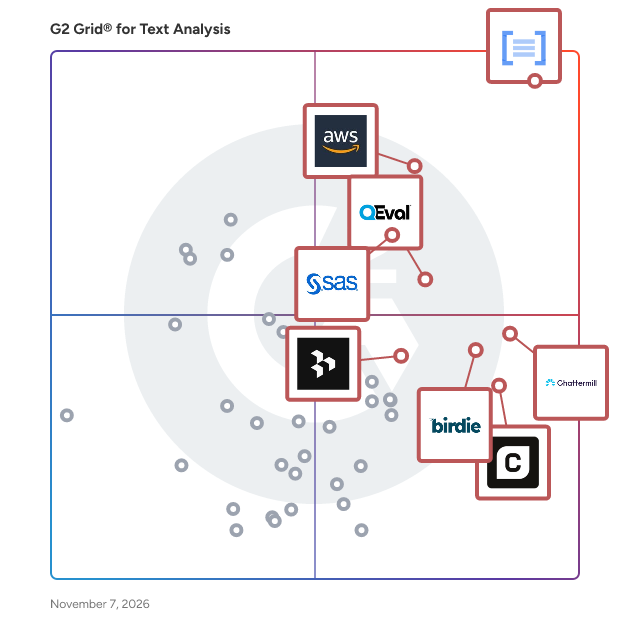
G2 Grid® for Text Analysis Software

G2 Grid® for Text Analysis Software plotting products by satisfaction and market presence

Highlighted products: Google Cloud Natural Language API, Amazon Comprehend, Chattermill, SAS Viya, QEval, Birdie, Caplena, and Dovetail.

Underlying data: [Grid® JSON](https://www.g2.com/categories/text-analysis/grids.json?focus%5B%5D=google-cloud-natural-language-api&focus%5B%5D=amazon-comprehend&focus%5B%5D=chattermill&focus%5B%5D=sas-sas-viya&focus%5B%5D=qeval&focus%5B%5D=birdie-ai-birdie&focus%5B%5D=caplena&focus%5B%5D=dovetail-research-pty-ltd-dovetail)

Google Cloud Natural Language API

Derive insights from unstructured text using Google machine learning.

Average Rating: 4.3/5.0

Total Reviews: 180

How Do G2 Users Rate Google Cloud Natural Language API?

  • Has the product been a good partner in doing business?: 8.3/10 (Category avg: 9.1/10)
  • Custom Extension: 8.5/10 (Category avg: 8.2/10)
  • Compositionality: 8.8/10 (Category avg: 8.3/10)
  • Pre-Built Parameterization: 8.2/10 (Category avg: 8.4/10)

Who Is the Company Behind Google Cloud Natural Language API?

  • Seller: Google
  • Year Founded: 1998
  • HQ Location: Mountain View, CA
  • LinkedIn® Page: www.linkedin.com
    301,144 employees on LinkedIn®
  • Ownership: NASDAQ:GOOG
  • Phone: +1 (650) 253-0000

Who Uses This Product?

  • Who Uses This: Software Engineer
  • Top Industries: Information Technology and Services, Computer Software
  • Company Size: 58% Small, 23% Medium

What Do G2 Reviewers Say About Google Cloud Natural Language API?

AI-generated summary from verified user reviews

Pros
  • Users value the database upload capability of Google Cloud Natural Language API, enhancing decision-making for healthcare services.
  • Users appreciate the ability to handle large databases effortlessly with Google Cloud Natural Language API, enhancing decision-making.
  • Users commend the database integration capability of Google Cloud Natural Language API, enhancing decision-making in healthcare services.
Cons
  • Users find the API not user-friendly, stating it's often difficult to understand and use effectively.

What Are Recent G2 Reviews of Google Cloud Natural Language API?

What Are G2 Users Discussing About Google Cloud Natural Language API?

Amazon Comprehend

Amazon Comprehend is a natural language processing (NLP) service that uses machine learning to find insights and relationships in text. Amazon Comprehend identifies the language of the text; extracts key phrases, places, people, brands, or events; understands how positive or negative the text is; and automatically organizes a collection of text files by topic.

Average Rating: 4.3/5.0

Total Reviews: 85

How Do G2 Users Rate Amazon Comprehend?

  • Has the product been a good partner in doing business?: 8.4/10 (Category avg: 9.1/10)
  • Custom Extension: 7.9/10 (Category avg: 8.2/10)
  • Compositionality: 8.5/10 (Category avg: 8.3/10)
  • Pre-Built Parameterization: 8.2/10 (Category avg: 8.4/10)

Who Is the Company Behind Amazon Comprehend?

Who Uses This Product?

  • Top Industries: Information Technology and Services, Accounting
  • Company Size: 41% Medium, 40% Small

What Do G2 Reviewers Say About Amazon Comprehend?

AI-generated summary from verified user reviews

Pros
  • Users value the data insight capabilities of Amazon Comprehend, simplifying the extraction of key phrases without ML expertise.
  • Users value the valuable insights and ease of use provided by Amazon Comprehend in content creation.
  • Users appreciate the ease of use of Amazon Comprehend, enabling insights without requiring machine learning experience.
  • Users appreciate the valuable insights provided by Amazon Comprehend, enhancing their understanding of various text sources.
  • Users value the insightful text analysis of Amazon Comprehend, facilitating easy extraction and robust data protection.
Cons
  • Users note that accuracy issues arise without sufficient training data, leading to higher costs for analysis.
  • Users note that the product can be expensive, particularly with high data volume requirements for accurate insights.
  • Users face challenges with insufficient training, leading to low accuracy and increased costs for data analysis.

What Are Recent G2 Reviews of Amazon Comprehend?

Chattermill

Chattermill is the AI-native customer feedback analysis and voice of customer platform that unifies fragmented feedback and surfaces what to act on first. Built for the agentic era, it's used by CX, Voice of Customer (VoC), product, support, and insights teams at enterprise brands who need to turn scattered feedback into a clear next move, not another dashboard nobody opens. Chattermill connects to 100+ feedback channels, including surveys, reviews, support tickets, conversations, and social media. It translates and transcribes feedback in 100+ languages, enriches every signal with context (customer ID, channel, location), and classifies each piece of feedback with Lyra, Chattermill's proprietary AI model. Lyra combines aspect-based sentiment analysis, supervised learning, and large language models, so categorization stays consistent even at high volume. Once feedback is organized, teams get metrics tracking for NPS, CSAT, and sentiment, precision insights that point to specific issues and opportunities, AI summaries backed by real customer quotes, impact analysis that shows what's actually moving key metrics, and anomaly detection that flags spikes before they escalate. Reports and dashboards make it easy to share findings and keep every team working from the same picture. Chattermill also connects directly into AI agents through MCP and Skills, so teams can query verified customer intelligence from Claude, ChatGPT, or any MCP-compatible agent without leaving their workflow. Lyra Agent, Chattermill's natively-integrated CX agent, works in the background to surface high-impact insights on its own. Uber, HelloFresh, Booking.com, Tesco, JustEat, and H&M use Chattermill to understand their customers. Uber has 400+ users across CX, product, and operations. HelloFresh used it to launch 7 new brands built around what customers were asking for. Footasylum cut contacts per transaction by 42.8%. Chattermill is SOC 2 Type II and ISO 27001 certified, and compliant with GDPR and CCPA. G2 has recognized Chattermill as a Grid Leader and Momentum Leader in Feedback Analytics.

Average Rating: 4.4/5.0

Total Reviews: 246

How Do G2 Users Rate Chattermill?

  • Has the product been a good partner in doing business?: 9.1/10 (Category avg: 9.1/10)
  • Custom Extension: 7.9/10 (Category avg: 8.2/10)
  • Compositionality: 7.7/10 (Category avg: 8.3/10)
  • Pre-Built Parameterization: 8.0/10 (Category avg: 8.4/10)

Who Is the Company Behind Chattermill?

  • Seller: Chattermill
  • Year Founded: 2015
  • HQ Location: London
  • LinkedIn® Page: www.linkedin.com
    74 employees on LinkedIn®
  • Ownership: Private

Who Uses This Product?

  • Who Uses This: Energy Specialist, energy specialist
  • Top Industries: Retail, Financial Services
  • Company Size: 47% Medium, 45% Large

What Do G2 Reviewers Say About Chattermill?

AI-generated summary from verified user reviews

Pros
  • Users appreciate the ease of use of Chattermill, enabling quick access to insightful customer feedback.
  • Users appreciate the organized and categorized feedback in Chattermill, streamlining their ability to analyze customer insights effectively.
  • Users value the ease of use and quick insights from Chattermill, making customer feedback analysis efficient and straightforward.
  • Users value the easy generation of insights from Chattermill, enabling quick analysis of customer feedback trends.
  • Users value the easy-to-use insights analysis of Chattermill, facilitating quick understanding of customer feedback trends.
Cons
  • Users find the platform not intuitive, as it can be overwhelming and requires patience to navigate effectively.
  • Users find the complex usability of Chattermill challenging, requiring patience and a steep learning curve to navigate effectively.
  • Users face issues with inaccuracy in sentiment analysis and unreliable data changes, impacting overall trust in reports.
  • Users feel the insufficient information can lead to overwhelming experiences and redundancy in feedback tagging.
  • Users find AI limitations in Chattermill, as data accuracy and reporting capabilities fall short of expectations.

What Are Recent G2 Reviews of Chattermill?

What Are G2 Users Discussing About Chattermill?

AI can help you find the answers. G2 helps you trust them.

Connect G2 to Claude or ChatGPT for answers grounded in G2's trusted reviews, comparisons, and pricing from real user insights.

How it works

SAS Viya

SAS Viya is a cloud-native data and AI platform that enables teams to build, deploy and scale explainable AI that drives trusted, confident decisions. It unites the entire data and AI life cycle and empowers teams to innovate quickly while balancing speed, automation and governance by design. Viya unifies data management, advanced analytics and decisioning in a single platform, so organizations can move from experimentation to production with confidence, delivering measurable business impact that is secure, explainable and scalable across any environment. Key capabilities required to deliver trusted decisions include: • End-to-end clarity across the data and AI life cycle, with built-in lineage, auditability and continuous monitoring to support defensible decisions. • Governance by design, enabling consistent oversight across data, models and decisions to reduce risk and accelerate adoption. • Explainable AI at scale, so insights and outcomes can be understood, validated and trusted by business and regulators alike. • Operationalized analytics, ensuring value continues beyond deployment through monitoring, retraining and life cycle management. • Flexible, cloud-native deployment, allowing organizations to start anywhere and scale everywhere while maintaining control.

Average Rating: 4.3/5.0

Total Reviews: 793

How Do G2 Users Rate SAS Viya?

  • Has the product been a good partner in doing business?: 8.2/10 (Category avg: 9.1/10)
  • Custom Extension: 7.4/10 (Category avg: 8.2/10)
  • Compositionality: 8.2/10 (Category avg: 8.3/10)
  • Pre-Built Parameterization: 7.7/10 (Category avg: 8.4/10)

Who Is the Company Behind SAS Viya?

  • Seller: SAS Institute
  • Company Website:
  • Year Founded: 1976
  • HQ Location: Cary, NC
  • LinkedIn® Page: www.linkedin.com
    15,122 employees on LinkedIn®
  • Phone: 1-800-727-0025

Who Uses This Product?

  • Who Uses This: Student, Biostatistician
  • Top Industries: Pharmaceuticals, Banking
  • Company Size: 34% Small, 33% Large

What Do G2 Reviewers Say About SAS Viya?

AI-generated summary from verified user reviews

Pros
  • Users enjoy the ease of use of SAS Viya, thanks to its simple syntax and integrated features for analytics.
  • Users commend SAS Viya for its powerful and sophisticated features that enhance data analysis and collaboration across teams.
  • Users value the powerful analytics and integration features of SAS Viya, significantly enhancing data analysis capabilities.
  • Users value the powerful data analysis capabilities of SAS Viya, enhancing efficiency and integration for various tasks.
  • Users value the modern, intuitive user interface of SAS Viya, enhancing productivity with seamless navigation and integration.
Cons
  • Users find the learning difficulty of SAS Viya challenging, especially for beginners due to its complexity and limited resources.
  • Users find SAS Viya has a steep learning curve, making it challenging for newcomers to grasp effectively.
  • Users find SAS Viya's complexity and steep learning curve challenging, hindering effective use and self-learning opportunities.
  • Users find the difficult learning curve of SAS Viya challenging, especially for beginners seeking easier comprehension.
  • Users find the licensing costs of SAS Viya to be prohibitively expensive, especially for features they don't use.

What Are Recent G2 Reviews of SAS Viya?

What Are G2 Users Discussing About SAS Viya?

QEval

QEval is a contact center quality assurance platform that evaluates customer interactions across voice, chat, and email channels. The software combines manual quality monitoring workflows with AI powered speech analytics to score interactions, detect compliance violations, and analyze customer sentiment. The platform enables quality teams to build customizable evaluation scorecards, monitor agent performance in real time, and connect evaluation results directly to coaching assignments. Supervisors can track coaching completion, measure behavioral changes over time, and maintain libraries of reference interactions demonstrating effective techniques. QEval Speech, the analytics module, processes customer interactions to surface patterns in agent behavior, customer sentiment, and process adherence. The system flags compliance risks, identifies coaching opportunities, and generates automated quality scores. This reduces manual evaluation workload while expanding coverage beyond traditional sample based QA approaches. Reporting capabilities include pre built reports, customizable dashboards, and trend analysis tools. Dashboards display KPIs at organizational, campaign, team, and agent levels. Reports can be filtered by date range, scorecard category, or custom parameters. The platform integrates with existing telephony systems, CRMs, call recording platforms, and workforce management tools via API, SFTP, and cloud storage connections. This allows deployment within established technology stacks without requiring platform replacement. QEval supports compliance monitoring for regulated industries including healthcare, financial services, and telecommunications. Role based access controls and recording encryption address data security requirements. All interactions are logged and retained to support audit documentation. QEval is developed by Etech Global Services, a contact center services provider operating since 2003. The platform is available as cloud hosted SaaS with a 30 day free trial for qualified organizations.

Average Rating: 4.8/5.0

Total Reviews: 37

How Do G2 Users Rate QEval?

  • Has the product been a good partner in doing business?: 10.0/10 (Category avg: 9.1/10)

Who Is the Company Behind QEval?

Who Uses This Product?

  • Top Industries: Consumer Services, Telecommunications
  • Company Size: 52% Medium, 26% Large

What Do G2 Reviewers Say About QEval?

AI-generated summary from verified user reviews

Pros
  • Users value the comprehensive analytics of QEval, providing essential insights and extensive reporting capabilities.
  • Users value the comprehensive auditing capabilities of QEval, providing extensive insights and report generation effortlessly.
  • Users value the excellent call quality of QEval, benefiting from comprehensive insights and easy report generation.
  • Users praise the excellent customer support and insightful reporting features available through QEval, making daily tasks easier.
  • Users find daily use convenient, with all necessary insights and extensive reporting available in one place.

What Are Recent G2 Reviews of QEval?

What Are G2 Users Discussing About QEval?

Birdie

Birdie is the Experience Intelligence Platform for banks, credit unions, and fintechs. Built on a Customer Context Layer, it brings two products together: Customer Intelligence shows what your customers experience, and Frontline Intelligence shows how your team responds. Customer Intelligence connects support conversations, surveys, app reviews, and social channels, finds the root cause behind each issue, and ranks fixes by revenue and churn risk instead of ticket volume. Frontline Intelligence is AI quality assurance for contact centers. It evaluates 100% of calls, chats, emails, and bot conversations against the rubric you already use, calibrates AI scores with your QA team, and shows which behaviors actually move CSAT, NPS, and repeat contacts, so coaching targets what matters. Every AI decision comes with its reasoning: the customer quote plus the logic. Compliance and risk teams get an audit trail, not a black box. Birdie connects to Zendesk, Salesforce, Intercom, Snowflake, Slack, and Claude via MCP, and analyzes 50M+ monthly customer interactions for teams at Nubank, KOHO, and Patreon. Nubank cut the time from QA evaluation to action from two weeks to under 24 hours. KOHO cut inbound contact volume 75% while CSAT rose from 73% to 91%. If your team still moves from insight to action by hand, or your QA program still lives in a spreadsheet, Birdie closes that gap.

Average Rating: 4.8/5.0

Total Reviews: 53

How Do G2 Users Rate Birdie?

  • Has the product been a good partner in doing business?: 9.6/10 (Category avg: 9.1/10)
  • Pre-Built Parameterization: 10.0/10 (Category avg: 8.4/10)

Who Is the Company Behind Birdie?

  • Seller: Birdie.ai
  • Company Website:
  • Year Founded: 2019
  • HQ Location: Palo Alto, US
  • LinkedIn® Page: www.linkedin.com
    63 employees on LinkedIn®

Who Uses This Product?

  • Top Industries: Financial Services
  • Company Size: 51% Medium, 38% Large

What Are Recent G2 Reviews of Birdie?

Caplena

Caplena is the feedback intelligence layer that helps brands and research teams turn open-ended feedback into precise, actionable insights — without the rigidity of traditional CX platforms. Built with Swiss precision, Caplena combines deep analytical power, unmatched flexibility, and intuitive simplicity. Teams can analyze any feedback source with human level accuracy, refine themes interactively, and model datasets independently — no data scientists required. Trusted by 200+ organizations including DHL, Lufthansa, and Ipsos, Caplena delivers transparent, explainable AI, customizable dashboards, and agentic workflows that helps teams move from unstructured feedback to world-class insights, fast.

Average Rating: 4.5/5.0

Total Reviews: 65

How Do G2 Users Rate Caplena?

  • Has the product been a good partner in doing business?: 9.5/10 (Category avg: 9.1/10)
  • Custom Extension: 8.9/10 (Category avg: 8.2/10)
  • Compositionality: 8.3/10 (Category avg: 8.3/10)
  • Pre-Built Parameterization: 8.2/10 (Category avg: 8.4/10)

Who Is the Company Behind Caplena?

  • Seller: Caplena
  • Company Website:
  • Year Founded: 2017
  • HQ Location: Zürich, CH
  • LinkedIn® Page: www.linkedin.com
    26 employees on LinkedIn®

Who Uses This Product?

  • Top Industries: Market Research
  • Company Size: 37% Medium, 22% Small

What Do G2 Reviewers Say About Caplena?

AI-generated summary from verified user reviews

Pros
  • Users find Caplena's interface to be simple and intuitive, making it easy to utilize its full range of features.
  • Users commend the exceptional customer support of Caplena, noting quick and helpful responses that enhance their experience.
  • Users value the effective categorization features of Caplena, which streamline analysis of open-ended responses efficiently.
  • Users value the efficient AI integration in Caplena, significantly saving time on categorizing and analyzing responses.
  • Users find the AI technology of Caplena invaluable for quickly categorizing and analyzing large response sets.
Cons
  • Users find the user interface not intuitive, causing challenges in navigation and initial experience with Caplena.
  • Users find the missing features in Caplena frustrating, needing more flexibility and accuracy for efficient work.
  • Users find Caplena has limitations in generating helpful initial codes and struggles with large datasets, requiring manual adjustments.
  • Users experience issues with auto-coded data, particularly with large datasets requiring manual adjustments for accuracy.
  • Users find Caplena lacking features for case management and project organization, impacting their workflow efficiency.

What Are Recent G2 Reviews of Caplena?

What Are G2 Users Discussing About Caplena?

Dovetail

Dovetail is the customer context layer that turns every sales call, support ticket, and user interview into evidence-backed intelligence for teams and agents to act on. Key capabilities • Build your customer context layer: From support tickets to call center conversations, Dovetail runs pre-inference on every customer interaction and pulls it into a live, context-rich system of record. Connect 30+ sources including Gong, Salesforce Service Cloud, Qualtrics, Google Play Store, G2 reviews, and more. • Turn raw data into rich context: Dovetail’s multimodal engine automatically turns millions of pieces of raw feedback, from text and documents to audio and video, into structured customer context ready for your next prompt. • Put customer insights in every prompt: Keep customer insights at the center of decisions and coding prompts. Test ideas against a Digital Twin, get cited answers with Agents, and bring context into your AI tools. • Make your software self-improving: Compress the time between customer feedback and shipped code. Dovetail Agents monitor feedback, draft requirements docs, and send work to Jira, Linear, Claude, or Cursor. • Govern customer context at scale: Scale agent adoption without compromising on security and compliance. Set up reusable skills, and control access down to individual users. Automate redaction to protect PII, and give admins a full audit log, token spend tracking, and a kill switch. Backed by SOC 2 Type II, ISO 27001, and ISO 42001 certifications, GDPR compliance, and HIPAA-ready workspaces.

Average Rating: 4.5/5.0

Total Reviews: 177

How Do G2 Users Rate Dovetail?

  • Has the product been a good partner in doing business?: 9.0/10 (Category avg: 9.1/10)
  • Custom Extension: 4.5/10 (Category avg: 8.2/10)
  • Compositionality: 5.0/10 (Category avg: 8.3/10)
  • Pre-Built Parameterization: 5.1/10 (Category avg: 8.4/10)

Who Is the Company Behind Dovetail?

Who Uses This Product?

  • Who Uses This: Senior UX Researcher, Product Designer
  • Top Industries: Computer Software, Information Technology and Services
  • Company Size: 46% Medium, 27% Large

What Do G2 Reviewers Say About Dovetail?

AI-generated summary from verified user reviews

Pros
  • Users appreciate the ease of use of Dovetail, enabling seamless access and organization of customer research across the team.
  • Users love the centralized storage for customer research in Dovetail, enhancing access and collaboration across teams.
  • Users find Dovetail incredibly valuable for streamlining customer insights, saving time, and enhancing overall research efficiency.
  • Users value Dovetail for its streamlined process, boosting efficiency in extracting insights from customer interviews.
  • Users value Dovetail for its streamlined insight extraction and seamless integration with tools, enhancing efficiency and effectiveness.
Cons
  • Users struggle with missing features in Dovetail, particularly concerning data handling and reporting capabilities.
  • Users note the limited reporting and formatting options in Dovetail, leading to a less efficient research process.
  • Users find the inefficient tagging system of Dovetail cumbersome, complicating project organization and data management.
  • Users find the complexity of Dovetail's features challenging, requiring significant time to learn and effectively utilize.
  • Users note feature limitations in Dovetail, particularly in AI tools and tagging accuracy, hindering overall effectiveness.

What Are Recent G2 Reviews of Dovetail?

SAP HANA Cloud

SAP HANA Cloud is a modern database-as-a-service (DBaaS) powering the next generation of intelligent data applications. SAP HANA Cloud offers a competitive edge by incorporating advanced machine learning and predictive tools grounded in modern data science. Its powerful in-memory performance safeguards efficient data processing. By securely storing vast amounts of data with its integrated multitier storage and handling various types on a single copy in its native multi-model database, SAP HANA Cloud simplifies data management and connects to other data sources. The seamless integration of these capabilities in a reliable, unified foundation makes it easier for developers to build high-demand intelligent data apps.

Average Rating: 4.3/5.0

Total Reviews: 522

How Do G2 Users Rate SAP HANA Cloud?

  • Has the product been a good partner in doing business?: 8.5/10 (Category avg: 9.1/10)
  • Custom Extension: 9.2/10 (Category avg: 8.2/10)
  • Compositionality: 8.9/10 (Category avg: 8.3/10)
  • Pre-Built Parameterization: 8.3/10 (Category avg: 8.4/10)

Who Is the Company Behind SAP HANA Cloud?

  • Seller: SAP
  • Year Founded: 1972
  • HQ Location: Walldorf
  • LinkedIn® Page: www.linkedin.com
    149,349 employees on LinkedIn®
  • Ownership: NYSE:SAP
  • Phone: +1 (800) 872-1727

Who Uses This Product?

  • Who Uses This: Consultant, SAP Consultant
  • Top Industries: Information Technology and Services, Computer Software
  • Company Size: 61% Large, 26% Medium

What Do G2 Reviewers Say About SAP HANA Cloud?

AI-generated summary from verified user reviews

Pros
  • Users value the ease of use of SAP HANA Cloud, benefiting from its seamless integration and efficient data management.
  • Users appreciate the easy integrations of SAP HANA Cloud, enhancing efficiency in reporting and decision-making across modules.
  • Users value the seamless integrations of SAP HANA Cloud, enhancing efficiency in reporting and decision-making processes.
  • Users value the exceptional processing speed of SAP HANA Cloud, enhancing real-time insights and decision-making capabilities.
  • Users value the scalability of SAP HANA Cloud, enabling efficient growth and flexibility aligned with business needs.
Cons
  • Users often face complexity in initial setup and configuration that complicates the effective use of SAP HANA Cloud.
  • Users are concerned about the high costs associated with SAP HANA Cloud, especially when managing workloads improperly.
  • Users often struggle with the learning curve and initial setup complexity, hindering efficient onboarding for new users.
  • Users find the difficult learning curve of SAP HANA Cloud hinders onboarding and requires significant technical expertise.
  • Users find the complex setup of SAP HANA Cloud challenging, particularly for new users and specialized features.

What Are Recent G2 Reviews of SAP HANA Cloud?

Kimola

Kimola is an AI platform that turns customer feedback into enterprise-grade market research. Kimola analyzes reviews, survey responses, support conversations and social discussions the way a research team would. Every comment is structured into themes, sentiment and research dimensions: motivations, pain points, unmet needs, personas, experience contexts. Signals reveal where patterns differ across segments and over time, and Action Plans test hypotheses against the evidence before turning them into recommendations. The result is research decision-makers can act on, built from feedback you already have. Kimola also collects feedback for you. Add product or profile links from platforms such as Amazon, Trustpilot, Google Business, the App Store, Google Play and Walmart, or set keywords to monitor mentions across news sites, blogs, forums and X. Your own data can be uploaded as Excel, CSV or TSV files, or brought in through integrations with Zendesk, Intercom and Google Sheets. Because feedback about competitors and entire categories can be collected the same way as your own, teams can research a whole market, not just their own customers. Analysis runs in 30+ languages with no model training required. Industry-specific models cover areas such as e-commerce, mobile apps, software, banking, automotive and hospitality. Custom AI models can be built around your own taxonomy. Any column in your data can become a breakdown, such as location, age group or product attribute, and every theme, sentiment and dimension can be compared across it. Findings don’t stop at a report. Tasks turn them into work items that sync with Jira. After a task is closed, Kimola re-measures feedback on that topic at two and four weeks to show whether the change worked. Reports export to PowerPoint, PDF, Excel and CSV. Kimola is transparent by design. Anyone can create a free account, trace every finding back to the comments behind it, and buy self-service at small scale. Teams that need more get Spaces, Funnels and custom models set up with a dedicated account manager, without months of custom development behind closed doors. More than 3,000 teams in 90+ countries use Kimola, including Miele, Spotify, Lufthansa, and Michelin. Kimola, Inc. founded in 2019 and backed by 500 Global and StartersHub.

Average Rating: 4.8/5.0

Total Reviews: 24

How Do G2 Users Rate Kimola?

  • Has the product been a good partner in doing business?: 9.8/10 (Category avg: 9.1/10)
  • Custom Extension: 9.0/10 (Category avg: 8.2/10)
  • Compositionality: 8.9/10 (Category avg: 8.3/10)
  • Pre-Built Parameterization: 9.1/10 (Category avg: 8.4/10)

Who Is the Company Behind Kimola?

  • Seller: Kimola
  • Year Founded: 2014
  • HQ Location: San Francisco, CALIFORNIA
  • LinkedIn® Page: www.linkedin.com
    9 employees on LinkedIn®

Who Uses This Product?

  • Top Industries: Marketing and Advertising, Information Technology and Services
  • Company Size: 63% Small, 29% Medium

What Do G2 Reviewers Say About Kimola?

AI-generated summary from verified user reviews

Pros
  • Users find Kimola to be extremely easy to set up and use, enhancing their analysis processes effortlessly.
  • Users praise the high accuracy of Kimola's analysis, delivering clear insights and effective thematic evaluations.
  • Users value Kimola for its accurate insights generation, enabling efficient understanding of customer feedback and themes.
  • Users appreciate the time-saving capabilities of Kimola, enabling swift analysis and efficient report generation.
  • Users praise the excellent customer support at Kimola, especially for onboarding and training assistance.
Cons
  • Users criticize the poor interface design of Kimola, noting difficulties in navigation and usability improvements needed.
  • Users are frustrated by the lack of features in Kimola, with essential options not yet available.
  • Users feel the complex setup of Kimola could be simplified for easier onboarding for beginners.
  • Users face email issues with Kimola, as necessary features like self-emailing reports are still pending development.
  • Users note the exporting limitations of Kimola, lacking detailed summaries and appealing presentation options.

What Are Recent G2 Reviews of Kimola?

IBM Watson Studio

IBM Watson Studio on IBM Cloud Pak for Data is a leading data science and machine learning solution that helps enterprises accelerate AI-powered digital transformation. It allows businesses to scale trustworthy AI and optimize decisions. Build, run, and manage AI models on any cloud through an automated end-to-end AI lifecycle--simplifying experimentation and deployment, speeding up data exploration and preparation, and improving model development and training. Govern and monitor models to mitigate drift and bias, and manage model risk. Build a ModelOps practice that synchronizes application and model pipelines to operationalize responsible, explainable AI across your enterprise. As a key offering of IBM Cloud Pak for Data, a unified data and AI platform, Watson Studio integrates seamlessly with data management services, data privacy and security capabilities, AI application tooling, open source frameworks, and a robust technology ecosystem. It unites teams and empowers businesses to build the modern information architecture that AI requires and infuse it across the organization. IBM Watson Studio is code-optional, allowing both data scientists and business analysts to work on the same platform by providing the best of open source tools along with visual, drag-and-drop capabilities. It enables organizations to tap into data assets and inject predictions into business processes and modern applications—helping them maximize their business value. It's suited for hybrid multicloud environments that demand mission-critical performance, security, and governance. Features include: • AutoAI that eliminates time-consuming, repetitive tasks by automating data preparation, model development, feature engineering and hyperparameter optimization. • Text Analytics for uncovering insights from unstructured data • Drag-and-drop visual model-building with SPSS Modeler • Broad data access – flat files, spreadsheets, major relational databases • Sophisticated graphics engine for building stunning visualizations • Support for Python 3 Notebooks Watson Studio is available via several deployment options: • IBM Cloud Pak for Data – An open, extensible data and AI platform that runs on any cloud • IBM Cloud Pak for Data System – A hybrid cloud, on-premises platform-in-a-box • IBM Cloud Pak for Data as a Service – A set of IBM Cloud Pak for Data platform services fully managed on the IBM Cloud

Average Rating: 4.2/5.0

Total Reviews: 164

How Do G2 Users Rate IBM Watson Studio?

  • Has the product been a good partner in doing business?: 8.0/10 (Category avg: 9.1/10)
  • Custom Extension: 8.1/10 (Category avg: 8.2/10)
  • Compositionality: 9.2/10 (Category avg: 8.3/10)
  • Pre-Built Parameterization: 9.0/10 (Category avg: 8.4/10)

Who Is the Company Behind IBM Watson Studio?

  • Seller: IBM
  • Year Founded: 1911
  • HQ Location: Armonk, New York, United States
  • LinkedIn® Page: www.linkedin.com
    344,328 employees on LinkedIn®
  • Ownership: SWX:IBM
  • Phone: 1-866-277-7488

Who Uses This Product?

  • Who Uses This: Software Engineer, CEO
  • Top Industries: Information Technology and Services, Computer Software
  • Company Size: 49% Large, 31% Small

What Do G2 Reviewers Say About IBM Watson Studio?

AI-generated summary from verified user reviews

Pros
  • Users value the Auto AI capability of IBM Watson Studio for significantly reducing manual work and enhancing productivity.
  • Users admire the Auto AI capability of IBM Watson Studio, significantly reducing manual tasks and enhancing productivity.
  • Users appreciate the user-friendly interface of IBM Watson Studio, making it easy to start and collaborate on projects.
  • Users appreciate the Auto AI capability of IBM Watson Studio, significantly reducing manual work and enhancing productivity.
  • Users value the easy AI integration of IBM Watson Studio, enhancing their data science experience significantly.
Cons
  • Users find the high costs of IBM Watson Studio challenging, especially for individuals and small startups.
  • Users find the steep learning curve of IBM Watson Studio challenging, hindering their ability to use the platform effectively.
  • Users find the steep learning curve of IBM Watson Studio challenging, especially for those new to the platform.
  • Users find the complex interface of IBM Watson Studio challenging, especially those who are new to the platform.
  • Users find the steep learning curve of IBM Watson Studio challenging, especially due to its complex interface.

What Are Recent G2 Reviews of IBM Watson Studio?

What Are G2 Users Discussing About IBM Watson Studio?

Canvs

Businesses struggle to understand the true meaning behind customer feedback, and how to action it. Canvs solves this by using advanced AI to analyze unstructured data, turning complex customer sentiments into clear, actionable intelligence. By revealing the emotional drivers behind customer behavior, Canvs enables brands to make more empathetic, data-driven decisions that boost customer loyalty, drive innovation, and create deeper connections with their audience.

Average Rating: 4.3/5.0

Total Reviews: 147

How Do G2 Users Rate Canvs?

  • Has the product been a good partner in doing business?: 8.9/10 (Category avg: 9.1/10)
  • Custom Extension: 7.2/10 (Category avg: 8.2/10)
  • Compositionality: 7.6/10 (Category avg: 8.3/10)
  • Pre-Built Parameterization: 7.4/10 (Category avg: 8.4/10)

Who Is the Company Behind Canvs?

  • Seller: Canvs AI
  • Company Website:
  • Year Founded: 2010
  • HQ Location: New York, New York
  • LinkedIn® Page: www.linkedin.com
    23 employees on LinkedIn®
  • Phone: (646) 759-1125

Who Uses This Product?

  • Top Industries: Market Research, Entertainment
  • Company Size: 41% Large, 32% Small

What Do G2 Reviewers Say About Canvs?

AI-generated summary from verified user reviews

Pros
  • Users appreciate the ease of use of Canvs, finding it simple to learn and efficient for data analysis.
  • Users value the efficiency of AI technology in Canvs, enabling deeper insights and faster analysis of verbatims.
  • Users praise Canvs for its efficient insights generation, enabling rapid analysis of trends and themes from responses.
  • Users value the exceptional customer support from Canvs, highlighting responsiveness and expertise that enhance their experience.
  • Users value the responsive support from Canvs, enhancing their experience and facilitating efficient data analysis.
Cons
  • Users express concern over Canvs AI's limited filtering capabilities, hindering targeted insights and accurate data analysis.
  • Users face issues with inaccuracy in categorization, leading to challenges in obtaining targeted insights from Canvs.
  • Users often face slow performance with data uploads and processing, causing frustration and workflow disruptions.
  • Users experience software instability with Canvs, facing bugs and inconsistencies despite helpful customer support.
  • Users experience accuracy issues with Canvs, facing misclassification and inconsistent responses requiring manual corrections.

What Are Recent G2 Reviews of Canvs?

What Are G2 Users Discussing About Canvs?

Speak

Speak is a no-code transcription and natural language processing platform that helps researchers and marketers extract valuable insights from media. Get professional and automated transcription, generate dashboard reports and capture audio, video and text data at scale. Over 150,000+ individuals and teams from over 150 countries have signed up to easily integrate language analysis into workflows for breakthroughs in efficiency and intelligence. Get access to a 7-day trial with 2 hours of transcription and analysis and all features included.

Average Rating: 4.9/5.0

Total Reviews: 28

How Do G2 Users Rate Speak?

  • Has the product been a good partner in doing business?: 10.0/10 (Category avg: 9.1/10)
  • Custom Extension: 9.2/10 (Category avg: 8.2/10)
  • Compositionality: 9.0/10 (Category avg: 8.3/10)
  • Pre-Built Parameterization: 8.9/10 (Category avg: 8.4/10)

Who Is the Company Behind Speak?

  • Seller: Speak Ai
  • Year Founded: 2019
  • HQ Location: Toronto, CA
  • LinkedIn® Page: linkedin.com
    7 employees on LinkedIn®

Who Uses This Product?

  • Top Industries: Non-Profit Organization Management
  • Company Size: 89% Small, 7% Medium

What Do G2 Reviewers Say About Speak?

AI-generated summary from verified user reviews

Pros
  • Users commend the ease of use of Speak, dramatically enhancing productivity and simplifying transcription tasks.
  • Users value the time-saving capabilities of Speak, significantly boosting their productivity and efficiency in transcription tasks.
  • Users highlight the time-saving transcription efficiency of Speak, dramatically boosting productivity and enhancing their workflow.
  • Users commend the impressive accuracy of Speak, which significantly boosts productivity in transcription and report writing.
  • Users praise the transcription accuracy of Speak, significantly enhancing productivity and efficiency in their workflows.
Cons
  • Users report cost issues with Speak, including payment difficulties and a frustratingly short trial period.
  • Users experience subscription issues including sign-in difficulties, payment problems, and a short trial period for training.
  • Users experience accuracy issues that necessitate additional cleanup for their notes, though they are considered minor.
  • Users face sign-in difficulties and express concerns over the short trial period for training students.
  • Users experience translation problems in French, resulting in awkward phrasing that confuses expectations.

What Are Recent G2 Reviews of Speak?

Unwrap.ai

At Unwrap, we're on a mission to help fill the world with products people love. Our customer intelligence platform integrates with all of your feedback sources (support tickets, reviews, surveys, and more), then proactively extracts patterns and trends from your feedback and surfaces them to you. With a deeper understanding of all your customers, Unwrap helps you build your product roadmap in confidence, and helps you prevent churn by shipping features users actually want.

Average Rating: 4.8/5.0

Total Reviews: 26

How Do G2 Users Rate Unwrap.ai?

  • Has the product been a good partner in doing business?: 9.9/10 (Category avg: 9.1/10)

Who Is the Company Behind Unwrap.ai?

  • Seller: Unwrap.ai
  • Company Website:
  • Year Founded: 2022
  • HQ Location: Santa Barbara, California
  • LinkedIn® Page: www.linkedin.com
    56 employees on LinkedIn®

Who Uses This Product?

  • Top Industries: Computer Software
  • Company Size: 50% Medium, 27% Large

What Do G2 Reviewers Say About Unwrap.ai?

AI-generated summary from verified user reviews

Pros
  • Users highlight Unwrap.ai's helpfulness, with excellent support and continuous improvement enhancing data analysis for businesses.
  • Users value the ease of use of Unwrap.ai, which simplifies customer comment analysis and boosts productivity.
  • Users value the effective feedback management of Unwrap.ai, facilitating insightful analysis and continuous improvement.
  • Users love the user-friendly nature of Unwrap.ai, appreciating its ability to analyze customer comments effectively.
  • Users find Unwrap.ai to be incredibly intuitive and user-friendly, making adoption and navigation seamless for everyone.
Cons
  • Users find the interface not intuitive, making it difficult to manage clusters and adjust AI groupings effectively.
  • Users find the limited tools for visualization in Unwrap.ai hinder the ability to analyze data effectively.
  • Users experience poor understanding due to inaccurate feedback groupings and tedious manual interactions, affecting data insights.
  • Users find the visualization tools underdeveloped, though the AI model effectively meets their primary needs.
  • Users find the manual effort required for feedback assignment cumbersome, suggesting a need for automation or improved workflow.

What Are Recent G2 Reviews of Unwrap.ai?

Thematic

Enterprise CX teams were promised that AI would turn customer feedback into decisions. Instead they got static taxonomies that drift, black-box AI they can't defend, and a different version of the customer story in every channel. AI agents make this worse. Built on fragmented data, they scale the inconsistency and risk. Thematic is the customer intelligence layer that fixes the foundation. We unify surveys, tickets, calls, reviews, and social into one source of customer truth, with every theme traceable back to the raw comments behind it. The same grounded layer feeds your dashboards, your teams, and the AI agents acting on customer signals. When teams are able to understand and act on data, the outcomes are measurable. Time-to-insight drops from days to minutes. We consistently see NPS gains of 5 to 35 points, which compounds into retention and referral revenue. A top-10 grocery retailer drove $4.8M in attributable revenue from a single 6-month pilot. A digital bank cut call volumes on their top three contact reasons by 69%. Forrester measured a 543% three-year ROI with payback under six months. Teams go from AI summaries they can't verify, or rigid text analytics buried in their CX platform, to insights they can stake a decision on. We sit on top of the existing CX stack (Medallia, Qualtrics, Snowflake, Gemini) and integrate via MCP with AI models. Up and running in days, not quarters. That’s why the world’s most innovative CX programs trust us, including DoorDash, Albertsons, and Mitsubishi.

Average Rating: 4.8/5.0

Total Reviews: 43

How Do G2 Users Rate Thematic?

  • Has the product been a good partner in doing business?: 9.9/10 (Category avg: 9.1/10)
  • Custom Extension: 2.5/10 (Category avg: 8.2/10)
  • Compositionality: 0.0/10 (Category avg: 8.3/10)
  • Pre-Built Parameterization: 7.2/10 (Category avg: 8.4/10)

Who Is the Company Behind Thematic?

  • Seller: Thematic
  • Company Website:
  • Year Founded: 2016
  • HQ Location: San Francisco, CA
  • LinkedIn® Page: www.linkedin.com
    43 employees on LinkedIn®

Who Uses This Product?

  • Company Size: 51% Large, 30% Medium

What Do G2 Reviewers Say About Thematic?

AI-generated summary from verified user reviews

Pros
  • Users value the ease of use of Thematic, enabling anyone to analyze customer insights effortlessly and effectively.
  • Users commend Thematic's excellent customer support, highlighting their helpfulness and accessibility in resolving issues effectively.
  • Users appreciate the quick and effective data summarization that enables timely insights and actionable improvements.
  • Users love the rapid insights generation from Thematic, making data analysis efficient and intuitive.
  • Users find Thematic's user-friendly interface easy to navigate, facilitating effortless theme management and insightful reporting.
Cons
  • Users find the complex setup time-consuming, making it challenging to effectively use multiple data sources at once.
  • Users find the difficult setup process time-consuming, making initial use of Thematic challenging.
  • Users encounter filtering issues as selecting new datasets requires repeatedly setting filters, which is inconvenient.
  • Users find the scoring mechanisms confusing, making it difficult to understand how actions affect outcomes.
  • Users find the scoring mechanisms unclear, making it difficult to understand how actions influence the Impact score.

What Are Recent G2 Reviews of Thematic?

What Are G2 Users Discussing About Thematic?

Bijou Barry
BB
Researched and written by Bijou Barry
Updated October 3, 2024

Learn More About Text Analysis Software

What is Text Analysis Software?

Text analysis software helps businesses analyze their text data using natural language understanding, which is a subset of natural language processing. Because of the unstructured nature of text data, these analytics solutions take text as an input and provide some form of labels, tags, or insights as an input. In the age of digital transformation, businesses are embracing the need to understand company data like never before. 

Text analysis software, also known as text mining software or text analytics software, has become an important tool for nearly every business over the past decade. A more recent aspect of analytics and business intelligence is the need to understand not just structured data, but unstructured data as well. Unstructured data, such as text data, can be mined for meaning to inform business decisions. 

Text mining initiatives can help businesses ultimately better understand textual data sets. Being able to pull out actionable insights from numerical data housed in ERP systems, CRM software, or accounting software is one thing, but being able to gain insights from unstructured data sources is invaluable. Without dedicated software for this task, businesses must either spend significant time and resources on building natural language understanding models or haphazardly investigating the data.

What Types of Text Analysis Software Exist?

Many types of text analysis solutions share overlapping functionality, while simultaneously catering to different user personas like data analysts and financial analysts, or providing unique services.

Some solutions may offer self-service features so that the average employee can assemble their charts and graphs from big data sets. Others, however, require more significant support from IT or data analysts.

Self-service text analysis tools

Self-service text analysis tools do not require coding knowledge, so end users with limited to no coding knowledge can take advantage of them for data needs. This enables business users like sales representatives, human resource managers, marketers, and other non-data team members to make decisions based on relevant business data. Self-service solutions often provide drag-and-drop functionality for tagging text, prebuilt templates for querying data, and other tools for data discovery. Similar to analytics platforms, organizations use these tools to build interactive dashboards for discovering actionable insights.

For example, a customer service business leader might use this type of software to analyze thousands of customer emails to discover trends, such as sentiment and the choice of words they used. This analysis can inform how customer service agents respond to customers to achieve desired outcomes.

Traditional text analysis tools

As opposed to self-service options, some text analysis solutions are geared towards data professionals, such as data analysts and data scientists. They can use this software to train and deploy algorithms, as it assists them in tagging their data. Data scientists can use these tools to ingest text data, such as social media, call center transcriptions, news sources, and reviews, and to build and improve applications, achieving goals such as improving fraud detection and conducting sentiment analysis.

What are the Common Features of Text Analysis Software?

Many capabilities of text analysis software can help users pull business-critical insights from text data.

Language identification: Text analytics solutions provide users with the ability to understand which language the text was written in. This can be beneficial when determining where a social media post came from or when a business has offices in multiple countries.

Part of speech tagging: Once the language is identified, text analysis software can tag each word with a part of speech, signifying if the word is a noun, verb, adjective, and so on.

Syntax parsing: Syntax parsing is very similar to part of speech tagging, but instead of understanding each word, it helps break down how a sentence was constructed and why.

Entity recognition: Text analytics solutions can help determine not just parts of speech but actual entities. For example, the part of speech may be a noun, but text analytics will break down whether that noun is a person or a place.

Keyphrase extraction: Another major feature of text mining and text analytics is keyphrase extraction, which allows users to determine patterns and themes within the text. These tools can pull out those common themes for the user.

Sentiment analysis: All of the above features can be relevant for sentiment analysis. Text analysis tools can offer up sentiment analysis scores, determining if the text is positive, negative, happy, sad, or neutral, among many other classifications. With the sentiment determined, businesses can decide how they want to act or interact with this data. For example, if a software company sees that all of their negative reviews are mentioning one particular feature, it might be a good idea to examine the state or viability of that feature.

What are the Benefits of Text Analysis Software?

The reason to use text analysis software is rather straightforward—users need to analyze text—but there are many reasons behind why a business may want to perform text mining and analysis. It all boils down to better understanding and utilizing company data to impact business processes and the bottom line. It should be used to increase efficiency and productivity and to optimize processes that could be working better.

Sentiment understanding: Businesses are always trying to gauge customer satisfaction, and text analytics is an easy way to do so. Many different text data sources can provide customer sentiments, such as social media, emails from customers, phone transcripts, customer reviews, and others. If a company can understand their shortcomings or where they are excelling with customers, they can better support and manage those customers. Ultimately this can lead to increased revenue.

Employee satisfaction: Similarly to better understanding customers, businesses can improve employee engagement and satisfaction by using text analysis. While businesses shouldn’t necessarily spy on their employees, they can figure out employee sentiment and satisfaction based on surveys, emails, or phone transcripts. This can help businesses ensure that they are promoting the right company culture and providing a healthy and happy place to work.

Survey analysis: Text analysis is very often used when companies are running surveys. These surveys may be intended for customers or employees but can also relate to market research. Being able to quickly pull insights verbatim from survey responses can provide a unique perspective and insight that businesses may not be able to obtain through multiple-choice questions.

Document classification: An easy use case for text analysis software is document classification. Businesses often need to organize existing documents; by pulling out sentiment and themes, it can be much easier to bucket documents, such as invoices and contracts.

Who Uses Text Analysis Software?

The typical user of text analytics is the same person who is tasked with using analytics and business intelligence solutions—a data analyst or data scientist. These users are trained in developing analytical and machine learning models used to pull out actionable insights from data. Data scientists are also tasked with deriving a business narrative from data, and text data is no different. If the text analytics product is of the self-service variety, less technical business users, such as operations, customer service, and finance teams can benefit from the technology to dig into their text data and derive insights. 

Data analysts: Depending on the complexity of the software, analysts may be required. They can help set up the requisite tagging of the text data and dashboards for other employees and teams. They can create complex queries inside the platforms to gather a deeper understanding of business-critical data. 

Operations and supply chain teams: A company’s supply chain frequently has many touchpoints, and as a result, many data points. Everything from invoices to shipping information can be analyzed with this software. Therefore, employees working in operations and supply chain teams can use text analysis software to gain a better understanding of their departments and the text data that is generated, such as from ERP systems. These applications track everything from accounting to supply chain and distribution. By inputting supply chain data into this software, supply chain managers can optimize several processes to save time and resources.

Finance teams: Finance teams leverage text analysis software to gain insight and understanding into the factors that impact an organization's bottom line. Through integrations with financial systems such as accounting software, employees such as chief financial officers (CFOs) can see how well the business is performing. For example, they can analyze free-text data in expense reports to discover trends in the data. With this knowledge, they can determine the biggest spenders and spending categories and put a plan in place to curb spending, if desired.

Sales and marketing teams: Sales teams also seek to improve financial metrics and can benefit tremendously from being more data driven. They can obtain insights into prospective accounts, sales performance, and pipeline forecasting, among many other use cases. Using analytics tools in a sales team can help businesses optimize their sales processes and influence revenue. Through the analysis of survey data, business leaders can find out the most effective way to sell products.

For marketing teams, tracking the performance of campaigns is key. Since they run different types of campaigns, including email marketing, digital advertising, or even traditional advertising campaigns, these tools allow marketing teams to track the performance of those campaigns in one central location. Marketers can learn about how their audience is responding to their messages using sentiment analysis. In addition, they can evaluate their ad copy by tagging and classifying it to better understand what drives conversions.

Consultants: Businesses do not always have the luxury to build, develop, and optimize their analytics solutions. Some businesses opt to employ external consultants, such as business intelligence (BI) consulting providers. These providers seek to understand a business and its goals, interpret data, and offer advice to ensure goals are met. BI consultants frequently have industry-specific knowledge alongside their technical backgrounds, with experience in healthcare, business, and other fields. 

Customer service teams: Customer service teams are faced with a challenge. They are frequently inundated with a flurry of customer concerns, whether that be via text, voice, or mail. Although agents can respond to each comment and concern individually, it is beneficial to have a proper understanding of trends, including the sentiment of messages, the types of complaints, and more. Using text analysis software, businesses can equip their agents with tools to help them respond to messages in a targeted manner, depending on factors such as sentiment and key phrases.

What are the Alternatives to Text Analysis Software?

Alternatives to text analysis software can replace this type of software, either partially or completely:

Feedback analytics software: Text analysis software is an all-purpose solution built to analyze any text data. Businesses looking to focus on feedback text, such as from surveys, review sites, social media, and customer service tools, can leverage feedback analytics software to achieve this goal. This software enables businesses to consolidate and analyze their customer feedback within a single platform.

Software Related to Text Analysis Software

Related solutions that can be used together with text analysis software include:

Data warehouse software: Most companies have a large number of disparate data sources, so to best integrate all their data, they implement a data warehouse. Data warehouses can house data from multiple databases and business applications, which allows BI and analytics tools to pull all company data from a single repository. This organization is critical to the quality of the data that is ingested by analytics software.

Data preparation software: A key software necessary for easy data analysis is a data preparation tool and other related data management tools. These solutions allow users to discover, combine, clean and enrich data for simple analysis. Data preparation tools are often used by IT teams or data analysts tasked with using text analysis tools. Some text analysis platforms offer data preparation features, but businesses with a wide range of data sources often opt for a dedicated preparation tool.

Analytics platforms: Analytics platforms might include some limited text analysis features, but are broader-focused tools that facilitate the following five elements: data preparation, data modeling, data blending, data visualization, and insights delivery.

Stream analytics software: When one is looking for tools specifically geared toward analyzing data in real time, stream analytics software is a go-to solution. These tools help users analyze data in transfer through APIs, between applications, and more. This software can be helpful with the internet of things (IoT) data, which people usually want to analyze in real time.

Predictive analytics software: Broad-purpose text analysis software allows businesses to conduct various forms of analysis, such as prescriptive, descriptive, and predictive. Businesses that are focused on looking at their past and present data to predict future outcomes can use predictive analytics software for a more fine-tuned solution. 

Challenges with Text Analysis Software

Software solutions can come with their own set of challenges. 

Need for skilled employees: The main issue with text analysis software is that, despite the tool pulling information surrounding text data, it still requires a human to go that extra mile and determine what the data means. Without context, sentiment analysis, phrase tagging, and pulling themes or patterns from a text can only inform a user so much. An analyst will need to interpret that data and decipher the business implications of it. 

This is much more easily tackled with text analysis software because of the ability to visualize the data in an organized manner, but it still requires interpretation nonetheless. Some text analytics tools may offer a certain level of predictive analytics and provide users with suggestions or recommendations based on the data, but more often than not, human intervention is necessary.

Data preparation: Another potential concern is preparing the data to be ingested by the text analysis tool. The data needs to be stored properly, whether that is in a database or data warehouse and may require IT or a dedicated admin to ensure the text analytics tool can consume the data. The beauty of text analysis software is that it doesn’t always require the neatness of structured data. Unstructured data does not need to follow a columnar approach that structured data often requires.

User adoption: It is not always easy to transform a business into a data-driven company. Particularly at more established companies that have done things the same way for years, it is not simple to force analytics tools upon employees, especially if there are ways for them to avoid it. If there are other options, such as spreadsheets or existing tools that employees can use instead of analytics software, they will most likely go that route. However, if managers and leaders ensure that analytics tools are a necessity in an employee’s day to day, then adoption rates will increase.

Which Companies Should Buy Text Analysis Software?

As it has often been said, data is the fuel that drives modern businesses. Although it is cliche, it no doubt has truth to it. Therefore, businesses across the globe and industries should consider some sort of analytics solution, such as text analysis to make sense of that data and begin to make data-driven decisions. Here are some illustrative examples of how textual analysis can be used in several industries:

Financial services: Within financial institutions, such as insurance brokerages, banks, and credit unions, it is common for a host of different systems to be used. These companies have data ranging from customer records, to transactions, to market data, and more. With the proliferation of systems comes more data. With a robust analytics solution in place, they can get a better understanding of the data that is being produced from the various systems across the business. As an industry that is heavily regulated, users can benefit from governed access capabilities which can be particularly beneficial, since it can assist in auditing company processes.

Healthcare: Within the space of healthcare, bad data practices might have dire or even deadly consequences. Text analysis software can help these organizations with having an overarching view of their data, such as patient records, insurance claims, finances, and more. Through the implementation of analytics, healthcare companies can lower risk and costs, and make their billing and collections smarter.

Retail: Retail organizations, whether they’re B2C, B2B, D2C, or others, rely on data to make informed decisions. For example, a seller of printers, to run a successful business, must keep track of many things such as their inventory, sales, their sales team, and returns. If all of this data is kept siloed within different systems, there is no single source of truth and departments cannot have a conversation around the actual state of the business’ data. With Text analysis software set up and connected to all of the relevant data sources, any retail business can see benefits and make meaningful data-driven decisions.

How to Buy Text Analysis Software

Requirements Gathering (RFI/RFP) for Text Analysis Software

If a company is just starting out on its analytics journey, G2.com can help in selecting the best software for the particular company and use case. Since the particular solution might vary based on company size and industry, G2.com is a great place to sort and filter reviews based on these criteria, along with many more. The variety, volume, and velocity of data are vast. Therefore, users should think about how the particular solution fits their particular needs and their future needs as they accumulate more data. 

To find the right solution, buyers should determine pain points and jot them down. These should be used to help create a checklist of criteria. Additionally, the buyer must determine the number of employees who will need to use this software, as this drives the number of licenses they are likely to buy. Taking a holistic overview of the business and identifying pain points can help the team springboard into creating a checklist of criteria. The checklist serves as a detailed guide that includes both necessary and nice-to-have features including budget features, number of users, integrations, security requirements, cloud or on-premises solutions, and more.

Depending on the scope of the deployment, it might be helpful to produce a request for information (RFI), a one-page list with a few bullet points describing what is needed from a text analysis software.

Compare Text Analysis Software Products

Create a long list

From meeting the business functionality needs to implementation, vendor evaluations are an essential part of the software buying process. For ease of comparison after all demos are complete, it helps to prepare a consistent list of questions regarding specific needs and concerns to ask each vendor.

Create a short list

From the long list of vendors, it is helpful to narrow down the list and come up with a shorter list of contenders, preferably no more than three to five. With this list in hand, businesses can produce a matrix to compare the features and pricing of the various solutions.

Conduct demos

To ensure the comparison is thoroughgoing, the user should demo each solution on the shortlist with the same use case and data sets. This will allow the business to evaluate like for like and see how each vendor stacks up against the competition. 

Selection of Text Analysis Software

Choose a selection team

As text analysis software is all about the data, the user must make sure that the selection process is data driven as well. The selection team should compare notes, facts, and figures which they noted during the process, such as time to insight, number of visualizations, and availability of advanced analytics capabilities.

Negotiation

Just because something is written on a company’s pricing page, does not mean it is not negotiable (although some companies will not budge). It is imperative to open up a conversation regarding pricing and licensing. For example, the vendor may be willing to give a discount for multi-year contracts or for recommending the product to others.

Final decision

After this stage, and before going all in, it is recommended to roll out a test run or pilot program to test adoption with a small sample size of users. If the tool is well used and well received, the buyer can be confident that the selection was correct. If not, it might be time to go back to the drawing board.

What Does Text Analysis Software Cost?

Businesses decide to deploy text analysis software to derive some degree of a return on investment (ROI).

Return on Investment (ROI)

As businesses look to recoup the funds they spent on the software, it is critical to understand the costs associated with it. As mentioned above, this software is typically billed per user, which is sometimes tiered depending on the company size. More users will typically translate into more licenses, which means more money.

Users must consider how much is spent and compare that to what is gained, both in terms of efficiency as well as revenue. Therefore, businesses can compare processes between pre and post-deployment of the software to better understand how processes have been improved and how much time has been saved. They can even produce a case study (either for internal or external purposes) to demonstrate their gains from their use of the text analysis software.

Implementation of Text Analysis Software

How is Text Analysis Software Implemented?

Implementation differs drastically depending on the complexity and scale of the data. In organizations with vast amounts of data in disparate sources (e.g., applications, databases, etc.), it is often wise to utilize an external party, whether it’s an implementation specialist from the vendor or a third-party consultancy. With vast experience, they can help businesses understand how to connect and consolidate their data sources and how to use the software efficiently and effectively.

Who is Responsible for Text Analysis Software Implementation?

It may require a lot of people, or even teams, to properly deploy an analytics platform. This is because data can cut across teams and functions. As a result, one person or even one team rarely has a full understanding of all of a company’s data assets. With a cross-functional team in place, a business can piece together its data and begin the journey of analytics, starting with proper data preparation and management.