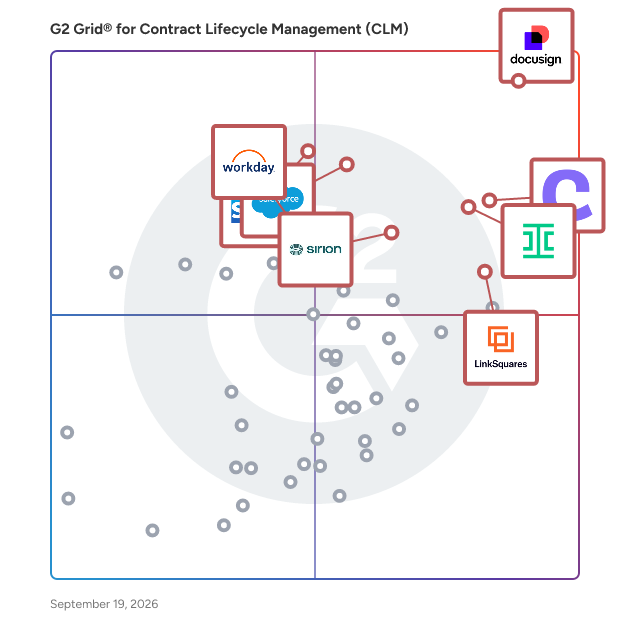
# Best Contract Lifecycle Management (CLM) Software - Page 9

  *By [Julie Jung](https://research.g2.com/insights/author/julie-jung)*

   Contract lifecycle management (CLM) software is used to streamline the entire contract lifecycle process, from pre-signature to post-signature. CLM software can simplify the process of managing contracts across key lifecycle stages such as contract creation, negotiation, execution, approval, and renewal.

CLM software tracks milestones, deadlines, and obligations outlined in the contract, sending automated reminders and notifications to relevant parties. While traditionally utilized by legal teams, CLM software is widely used by other teams within an organization, such as sales, procurement, and finance. By automating contract workflows, these tools help manage high volumes of routine agreements more efficiently.

Unlike [contract management software](https://www.g2.com/categories/contract-management), CLM software helps users manage actions post-signature (or post-execution), including obligation tracking, performance and compliance management, and dispute resolutions. These tools provide a centralized platform for storing all obligation terms and communications. This assists businesses in mitigating risks, ensuring all internal and external parties understand and deliver on their contractual obligations. Having a centralized repository and access for collaboration, shared automated workflows, and visibility to contract performance analytics helps improve compliance and overall efficiency for managing contracts.

CLM software commonly integrates with [customer relationship management (CRM) software](https://www.g2.com/categories/crm), [proposal software](https://www.g2.com/categories/proposal), [accounting software](https://www.g2.com/categories/accounting), and [e-signature software](https://www.g2.com/categories/e-signature).

To qualify for inclusion in the Contract Lifecycle Management (CLM) category, a product must:

- Provide all the features of a contract management solution
- Manage the entire contract lifecycle from start to finish
- Track and monitor the contract creation and delivery process
- Allow users to estimate the efficiency of the contract lifecycle and find ways to improve it
- Provide regular reporting to internal and relevant external parties about the contracts and performance with respect to obligations
- Comply with industry requirements, government regulations, audits, and response to lawsuits


## Category Overview

**Total Products under this Category:** 141


## Trust & Credibility Stats

**Why You Can Trust G2's Software Rankings:**

- 30 Analysts and Data Experts
- 9,000+ Authentic Reviews
- 141+ Products
- Unbiased Rankings

G2's software rankings are built on verified user reviews, rigorous moderation, and a consistent research methodology maintained by a team of analysts and data experts. Each product is measured using the same transparent criteria, with no paid placement or vendor influence. While reviews reflect real user experiences, which can be subjective, they offer valuable insight into how software performs in the hands of professionals. Together, these inputs power the G2 Score, a standardized way to compare tools within every category.


## Best Contract Lifecycle Management (CLM) Software At A Glance

- **Leader:** [Docusign CLM](https://www.g2.com/products/docusign-clm/reviews)
- **Highest Performer:** [Legistify](https://www.g2.com/products/legistify-legistify/reviews)
- **Easiest to Use:** [LinkSquares](https://www.g2.com/products/linksquares/reviews)
- **Top Trending:** [Inhubber](https://www.g2.com/products/inhubber/reviews)
- **Best Free Software:** [SpotDraft](https://www.g2.com/products/spotdraft/reviews)


## Parent Category

[Sales Tools](https://www.g2.com/categories/sales-tools)


## Related Categories

- [Contract Management Software](https://www.g2.com/categories/contract-management)
- [E-Signature Software](https://www.g2.com/categories/e-signature)
- [Contract Analytics Software](https://www.g2.com/categories/contract-analytics)


---

## Buyer Guide

### What You Should Know About Contract Lifecycle Management (CLM) Software

### What is Contract Lifecycle Management (CLM) Software?

Contract lifecycle management (CLM) software assists businesses in every stage of the contract lifecycle by streamlining the process from creation to post-signature activities, including obligation tracking, contract resolution, and contract compliance management. These tools assist organizations in ensuring that internal and external stakeholders are knowledgeable and uphold their contractual obligations by storing all contract data in a centralized repository, providing a medium to collaborate and communicate.

CLM tools differ from traditional [contract management software](https://www.g2.com/categories/contract-management). CLM solutions allow users to manage activities after contract execution, including performance and contract compliance, obligation tracking, and dispute resolutions. CLM products provide features to notify parties of upcoming contract milestones to help streamline the contract renewal process and inform appropriate parties of contract performance.

Various departments in an organization are users of CLM solutions, as contracts are inherent to many business operations. CLM tools typically integrate with various software, including [CRM software](https://www.g2.com/categories/crm), [e-signature software](https://www.g2.com/categories/e-signature), [accounting software](https://www.g2.com/categories/accounting), [proposal software](https://www.g2.com/categories/proposal), and [CPQ software](https://www.g2.com/categories/cpq).&amp;nbsp;

### What are the Common Features of Contract Lifecycle Management (CLM) Software?

The following are some core features of CLM software:

**Contract creation and templates:** Contracts are naturally nuanced and require standardized language and specific clauses. CLM tools allow organizations to create contracts and templates to streamline the creation process and ensure uniformity throughout the documents. This feature enables non-legal professionals to create basic contracts with confidence, ensuring that the required language is provided and correct.&amp;nbsp;&amp;nbsp;

**Contract editing:** A key feature of CLM solutions is contract redlining, or the ability to edit contracts and compare multiple versions. Contract editing can be done internally and externally and is vital in contract management as it provides an audit trail that highlights the changes between contract iterations.

**Contract database:** This feature helps store contracts in a central repository with native search capabilities. Organizations can increase efficiency by digitally searching through contracts rather than manually.&amp;nbsp;

**Notifications and reminders:** CLM tools offer features to schedule reminders for users and notify them of upcoming contract milestones, such as contract renewal or expiry. This assists users in meeting contractual deadlines and ensures contracts are completed on time. Additionally, this feature ensures that businesses know and take the necessary action to renew contracts or communicate proposed changes or amendments to future contract iterations.&amp;nbsp;

**Integrations or APIs:** Another core feature of CLM solutions is its ability to integrate with key business systems, such as [CRM software](https://www.g2.com/categories/crm) to associate contracts with customer accounts and [CPQ software](https://www.g2.com/categories/cpq) to pull calculated quote information into the contract.&amp;nbsp;

**Advance contract analytics:** CLM tools leverage analytics to optimize contract management with this feature. This provides businesses insight into the contract creation and delivery process and assists in identifying bottlenecks and ways to improve the efficiency of the process.&amp;nbsp;

**Report and dashboards:** CLM solutions leverage contract data to provide standard and ad hoc reports of contract statuses and timelines, with the ability to monitor live overviews of contract activities.&amp;nbsp;

**Contract approvals:** Streamline processes for contract approvals to integrate workflows across departments logically with this software solution. This increases the efficiency of each stage of the CLM process, easily coordinating with appropriate stakeholders and ensuring standards are met.

### What are the Benefits of Contract Lifecycle Management (CLM) Software?

CLM software offers various benefits to organizations, including:

**Increased collaboration:** CLM solutions provide a digital medium for users to collaborate, revise, and review contracts with internal and external stakeholders. This expedites the entire contract process, particularly the internal review and contract negotiation stage.&amp;nbsp;

**Enhanced automation:** A key benefit of CLM tools is the ability to streamline workflows for each stage of the contract management process to minimize manual tasks and ensure appropriate procedures are followed. Automation can be used to notify users and track key contract data, such as expiration or renewal dates and streamline contract workflows to minimize contract cycle time.

**Audit trail:** Due to the sensitive nature of contracts and the financial and legal risk associated with contracts, organizations need to have an audit trail of all contract activities to ensure contract compliance. CLM tools provide an audit trail to easily track all edits or revisions made to a contract and keep accurate accounting compliance records.&amp;nbsp;

**Performance tracking:** An essential benefit of CLM software solutions is easily assessing contract performance regarding obligations and compliance. These tools provide stakeholders with a centralized dashboard to efficiently track how a contract performs to ensure maximum value is received and avoid potential revenue leakage.

**Increased self service:** The ability to provide contract templates is a significant benefit to non-legal professionals. It allows them to create agreements or contracts with confidence and avoid the bottleneck of legal professionals drafting the initial contract. This lets legal teams focus on higher priority items and allows other non-legal groups to perform the necessary work to begin the contract process.&amp;nbsp;

### Who Uses Contract Lifecycle Management (CLM) Software?

Contracts are an essential aspect of business operations, and as such, the stakeholders who utilize CLM tools are broad and can vary based on unique business needs and processes. Below are a few examples of business groups that likely regularly use CLM solutions.&amp;nbsp;

**Legal teams:** CLM software enables legal professionals to streamline the contract management process by creating templates for non-legal colleagues, providing a contract repository, tracking obligations, and ensuring compliance. These tools also provide legal teams reminders and notifications of contract renewals and expirations, which is vital as most legal teams are responsible for managing a plethora of contracts simultaneously.&amp;nbsp;

**Sales teams:** CLM tools enable sales teams to share contracts securely, collaborate with internal and external parties, and get contracts signed. CLM tools assist sales teams in streamlining the process of signing contracts and mitigating risks associated with inaccurate information as information is typically integrated from CRM, CPQ, or e-signature solutions. In addition to mitigating risk, this can expedite the contract signing process and help establish good relationships with customers.&amp;nbsp;

**HR teams:** HR professionals can leverage CLM solutions to quickly replicate contracts or agreements using the pre-created contract templates, streamlining hiring processes.

**Finance teams:** CLM software helps finance teams to track contract obligations and performance, identify lost revenue, and find cost-saving opportunities. CLM solutions also notify finance teams of upcoming contract expirations and renewals to ensure that teams do not miss renewals or potential revenue opportunities.&amp;nbsp;

### Which Contract Lifecycle Management Software is the Best for Tech Companies?

- [Ironclad](https://www.g2.com/products/ironclad/reviews): A cloud-based CLM platform offering customizable workflows, AI-assisted contract analysis, and seamless integrations with tools like Salesforce and Google Drive. ​
- [LinkSquares](https://www.g2.com/products/linksquares/reviews): Provides AI-powered contract analysis and lifecycle management, enabling tech companies to gain insights into contract terms, obligations, and risks. ​
- [DocuSign CLM](https://www.g2.com/products/docusign-clm/reviews): Extends beyond e-signatures to offer end-to-end contract management, including automated workflows and compliance tracking, integrating with over 900 services.
- [Juro](https://www.g2.com/products/juro/reviews): An all-in-one contract automation platform designed for in-house legal teams. Combines contract creation, negotiation, and e-signing in a browser-native, collaborative interface — perfect for startups and SaaS companies.
- [Ironclad](https://www.g2.com/products/ironclad/reviews): Built for legal teams at fast-growing tech companies, Ironclad offers modern, customizable workflows, seamless integrations (like Salesforce and Slack), and strong AI contract analytics.

### What&#39;s the Leading CLM Solution for Remote Teams?

- [ContractPodAi](https://www.g2.com/products/contractpodai/reviews): A cloud-native platform designed for legal and procurement teams, offering contract authoring, approval routing, and document automation—ideal for remote collaboration at scale.
- [Gatekeeper](https://www.g2.com/products/gatekeeper/reviews): A vendor and contract lifecycle management platform that offers automation, AI data extraction, and a secure solution for managing contracts and vendors, making it suitable for remote collaboration.​
- [Evisort](https://www.g2.com/products/evisort/reviews): Provides AI-powered contract analytics, real-time collaboration, and cloud accessibility, enabling legal and procurement teams to manage contracts efficiently from anywhere.

### Software Related to Contract Lifecycle Management (CLM) Software

Related solutions that can be used together with CLM software include:

[E-signature software](https://www.g2.com/categories/e-signature) **:** E-signature, also known as electronic signature software, allows users to securely collect signatures on digital documents, eliminating the need for physical copies and allowing users to sign in real time. E-signature solutions and CLM tools commonly integrate to expedite the signing process while ensuring security and compliance with industry standards and regulations.&amp;nbsp;

[CRM software](https://www.g2.com/categories/crm) **:** CLM software typically integrates with CRM software to increase visibility across multiple business units in a company. This integration also allows sales teams to associate contracts with a particular account in a central database to understand the contractual aspect of a client relationship fully.

[CPQ software](https://www.g2.com/categories/cpq) **:** CPQ, or configure, price, quote software, commonly integrates with CLM tools to pull in quote and pricing data. The integration between these software reduces the risk of manual error and ensures that pricing information is consistent with company policies.

[Proposal software](https://www.g2.com/categories/proposal) **:** Proposal software assists in generating request for proposals (RFPs) for sales operations. These tools typically integrate with CRM and CPQ software to automate data retrieval. Proposal software often integrates with CLM products as the proposal is finalized and moves to the next stage of the contract process.

[Contract analytics software](https://www.g2.com/categories/contract-analytics) **:** Contract analytics software often integrates with CLM solutions to retrieve and analyze contract data. Contract analytics tools use artificial intelligence (AI) or machine learning (ML) to eliminate duplicates and extract key contract data such as keywords, payment terms, or obligations.

### Challenges with Contract Lifecycle Management (CLM) Software

CLM products can come with its own set of challenges. A few of them are listed below.&amp;nbsp;

**Security:** Contracts are extremely sensitive as they may contain financial information, personally identifiable information (PII), or other contract data that are a key target during data breaches. Ensuring security is of utmost importance when leveraging a CLM tool, and businesses should be aware of industry standards in terms of security, implementation, and operations. As most CLM tools are cloud based, companies may not be able to control and secure the cloud environment independently. Additionally, as contracts are frequently collaborated on throughout multiple business units, ensuring that they are worked on in a secure environment is essential.&amp;nbsp;

**Compliance requirements:** As CLM solutions manage each stage of the contract process, it is pivotal that businesses understand the various standards and regulations that they must adhere to, which may be dependent on industry and location.

**Complex integrations:** CLM tools often integrate with various systems, leading to cumbersome integrations. Businesses selecting CLM tools should ensure that the chosen tool can integrate into their existing IT infrastructure and understand the detailed processes for ensuring its compatibility and workflows. Companies should also be aware of the required workflows for their CLM software as it may conflict with existing business processes and require internal adjustments.&amp;nbsp;

**Accessibility and adoption:** A challenge that some organizations face when leveraging a CLM tool is adequate accessibility. CLMs manage the entire contract process, from presignature to post-contract execution. Thus, it is crucial to ensure that all relevant business units access the system and have appropriate controls. For CLM products to be most effective, they need to be widely adopted across the organization, as without user adoption, the system cannot perform to its full capabilities.&amp;nbsp;

### How to Buy Contract Lifecycle Management (CLM) Software

#### Requirements Gathering (RFI/RFP) for Contract Lifecycle Management (CLM) Software

Requirements gathering for CLM tools is critical to ensure that the business is leveraging a product that meets its needs. To do so, companies must evaluate the software based on their critical needs, as provided below.&amp;nbsp;

#### Compare Contract Lifecycle Management (CLM) Products

**Create a long list**

Long lists are created by eliminating software solutions that do not provide critical functionality. To make a long list for a CLM product, a buyer should assess the essential functions and analyze which products provide the necessary functionality. CLM software provides functions throughout the entire contract lifecycle ranging from contract creation and templatization to reporting and analytics. A typical long list should not contain more than 10 products unless there are many similar options. In this case, buyers should consider a product’s ability to integrate with existing software, scalability, customization, mobile accessibility, and any relevant industry regulations or standards to eliminate products.&amp;nbsp;

**Create a short list**

From the long list of CLM vendors, it is helpful to narrow down the list and develop a shorter list of contenders, preferably no more than three to five. With this in hand, businesses can produce a matrix to compare the various offerings&#39; features, compatibility, and pricing.&amp;nbsp;

**Conduct demos**

To ensure the comparison is thoroughgoing, the user should try a demo or free trial for each software solution on the shortlist with the same use cases and criteria. This will allow the business to evaluate like for like and see how each product stacks up against the competition.&amp;nbsp;

#### Selection of Contract Lifecycle Management Software

**Choose a selection team**

CLM software impacts a variety of business units within an organization, highlighting the importance of selecting a critical selection team. It is vital to consider input and qualification criteria from each business unit member that will leverage the software, as needs and use cases can vary. The selection committee for a CLM tool may consist of a member from each department intended to leverage the software, such as a legal representative, HR employee, sales leader, and IT professional to ensure software compatibility. The selection committee will be responsible for assessing each use case of the software and ensuring compliance with organizational and industry standards.&amp;nbsp;

**Negotiation**

When negotiating a software contract, it is critical first to ensure that the software will meet industry regulations and standards and provide a secure medium to manage the entire contract lifecycle. This is imperative as the cost of CLM tools can vary tremendously. The price depends on the size of the business, the amount of storage needed, and the number of licenses, among other factors. Additionally, since CLM products extend across multiple business units, buyers should also determine if they need assistance implementing or integrating with other business support systems. Lastly, businesses should consider the contract duration that is most appropriate for their needs to negotiate longer-term contracts better.&amp;nbsp;

**Final decision**

Buyers should make the final decision based on all the information gathered previously. Businesses should rank their needs in order of importance and select the tool that meets their most critical needs first, then assess which software best fits their business needs.


---
## Frequently Asked Questions

### How do CLM solutions handle contract renewal and expiration notifications?

CLM solutions typically offer automated contract renewal and expiration notifications to help users manage deadlines effectively. For instance, products like Icertis, Agiloft, and DocuSign provide customizable alerts and reminders, ensuring that stakeholders are informed well in advance of key dates. Users frequently highlight the importance of these features, noting that they enhance compliance and reduce the risk of missed renewals. Additionally, many solutions integrate with calendar applications to streamline notification processes, further supporting proactive contract management.


### How do CLM systems ensure data security and privacy compliance?

CLM systems ensure data security and privacy compliance through features such as encryption, access controls, and audit trails. For instance, products like DocuSign CLM and Icertis provide robust security measures, including role-based access and compliance with regulations like GDPR and HIPAA. Users frequently highlight the importance of these features, noting that they enhance trust and mitigate risks associated with sensitive contract data. Additionally, many systems offer customizable security settings to align with specific organizational policies, further reinforcing compliance efforts.


### How does pricing typically vary among CLM software options?

Pricing for Contract Lifecycle Management (CLM) software varies significantly based on features and vendor positioning. For instance, products like DocuSign CLM and Icertis typically range from $15 to $50 per user per month, while more comprehensive solutions like Agiloft and ContractWorks can exceed $100 per user per month. Additionally, some vendors offer tiered pricing based on the number of users or features, with entry-level plans starting around $10 per user per month. Overall, organizations should evaluate their specific needs against the pricing structures of different vendors.


### How does user experience differ across various CLM platforms?

User experience across various CLM platforms varies significantly. For instance, DocuSign CLM scores high in user satisfaction with a rating of 4.5, praised for its intuitive interface and ease of use. Conversely, Agiloft, while also rated 4.5, is noted for its extensive customization options, which can lead to a steeper learning curve. Icertis, rated 4.4, is recognized for its robust analytics features but has received feedback regarding its complex navigation. Overall, user experience is influenced by factors such as interface design, customization capabilities, and feature accessibility.


### How long does it usually take to implement a CLM solution?

The implementation time for a Contract Lifecycle Management (CLM) solution typically ranges from 3 to 6 months, depending on factors such as the complexity of the organization, the specific software chosen, and the level of customization required. For instance, products like DocuSign CLM and Icertis often report implementation times on the shorter end, while more complex solutions like Agiloft may take longer due to extensive feature sets and integration needs.


### How scalable are CLM solutions for growing businesses?

CLM solutions are generally scalable for growing businesses, with many users highlighting the ability to manage increasing contract volumes efficiently. Products like DocuSign CLM and Agiloft are noted for their flexibility and integration capabilities, allowing businesses to adapt as they expand. Users report that features such as automated workflows and customizable templates significantly enhance scalability. Additionally, solutions like Icertis and ContractWorks are praised for their user-friendly interfaces, which facilitate onboarding and usage across larger teams, ensuring that growth does not hinder contract management processes.


### What are common use cases for Contract Lifecycle Management software?

Common use cases for Contract Lifecycle Management software include automating contract creation, streamlining approval workflows, managing contract renewals, and ensuring compliance with legal and regulatory requirements. Users frequently highlight the importance of tracking contract performance and leveraging analytics for better decision-making. Additionally, integration with other business systems, such as CRM and ERP, is often cited as a critical feature that enhances operational efficiency and collaboration across departments.


### What are the key features to look for in a CLM solution?

Key features to look for in a Contract Lifecycle Management (CLM) solution include automated contract creation, robust collaboration tools, compliance tracking, and advanced analytics capabilities. Users frequently highlight the importance of integration with existing systems, user-friendly interfaces, and customizable workflows. Additionally, effective search functionality and secure storage options are critical for managing contracts efficiently. Solutions like DocuSign CLM, Icertis, and Agiloft are noted for excelling in these areas, providing comprehensive support for the entire contract lifecycle.


### What are the most important compliance features in CLM software?

Key compliance features in Contract Lifecycle Management software include automated compliance tracking, audit trails, and regulatory reporting capabilities. Users highlight the importance of integration with existing compliance frameworks and the ability to manage contract obligations effectively. Additionally, features like customizable compliance workflows and alerts for regulatory changes are frequently mentioned as critical for maintaining compliance. Products such as Icertis Contract Management, Agiloft, and DocuSign CLM are noted for their strong compliance functionalities, with user ratings reflecting satisfaction in these areas.


### What integrations should I consider for my CLM system?

When considering integrations for your Contract Lifecycle Management (CLM) system, prioritize those with strong connections to CRM, ERP, and document management systems. Notable products in this category, such as DocuSign CLM, Icertis, and Agiloft, frequently highlight integrations with Salesforce, Microsoft Dynamics, and Google Drive, enhancing workflow efficiency and data synchronization. Additionally, look for compatibility with e-signature solutions and collaboration tools to streamline contract processes and improve team collaboration.


### What kind of customer support is typically offered with CLM solutions?

Customer support for Contract Lifecycle Management (CLM) solutions typically includes options such as live chat, email support, and phone support, with many vendors offering dedicated account managers. User reviews indicate that platforms like DocuSign CLM and Agiloft are praised for their responsive customer service, while others like Icertis and Concord highlight comprehensive onboarding assistance. Additionally, self-service resources such as knowledge bases and community forums are commonly available, enhancing user experience and support accessibility.


### What metrics should I track to measure CLM effectiveness?

To measure the effectiveness of Contract Lifecycle Management (CLM), track metrics such as contract cycle time, which reflects the speed of contract processing, and user satisfaction ratings, which indicate overall usability. Additionally, monitor compliance rates to assess adherence to contract terms and the percentage of contracts renewed on time, which can highlight efficiency in contract management. Other important metrics include the number of contracts processed per user and the reduction in legal disputes, both of which can demonstrate the impact of CLM solutions on operational efficiency.


