Learn More About Electronic Data Interchange (EDI) Software
What is Electronic Data Interchange (EDI) Software?
Electronic data interchange (EDI) software was created to lessen the procedural demand around industry trading processes such as shipping and mass product purchasing, purchase order (PO) generation, etc. Initially, invoices, POs, supply chain shipping information, and the like were manually generated and was time consuming to share between trading partners.
EDI software is a simple and secure solution that significantly shortens the time taken in the purchasing process, as well as reduce the costs associated with manual entry using automation. It facilitates the exchange of such business documents in an electronic real-time format between trading partners and across a variety of platforms and programs. It allows automation for generating electronic documents like POs, invoices, advance ship notices (ASN), and inventory levels.
Presently, EDI has expanded beyond trade. Documents and data exchanged using EDI can still be trade transactions, but now they also can involve health care data (e.g., patient electronic health records), transportation information (e.g., mass shipping data), construction workflows, and more.
When selecting EDI software, it is critical to understand the format of the information that is being sent, and the format the target receiver can accept. For example, UN/EDIFACT is an international standard format and predominantly used within the U.K., but transmissions in the U.S. typically follow the ANSI ASC X12 standard. If the sender and receptor data EDI formats do not match, the information will not be received.
EDI software also integrates well with other software solutions. Many EDI buyers are looking to integrate with a warehouse management system (WMS), an enterprise resource planning (ERP) system, SAP services, or other data processing systems.
What Does EDI Stand For?
EDI stands for electronic data interchange. However, electronic file transfer is only one of many things that this software can do. It also offers features that can help businesses by lowering costs and improving speed, accuracy, and business efficiency.
EDI is used to electronically transfer business documents such as POs, supply chain invoices, shipping bills, and communicate with one another. A specified format which is known as EDI standards is set by both parties to facilitate the transmission of information. Traders use EDI to exchange financial information in electronic form.
What Types of Electronic Data Interchange (EDI) Software Exist?
On-premises vs. cloud-based EDI software
A cloud-based solution will make important data readily available to any permitted users with an internet connection, enabling remote business partners to access data regardless of their location. Conversely, an on-premises solution will be accessible from one location or server but tends to allow more overall control and security. Some EDIs offer both cloud and on-premises options, allowing the buyer to choose their deployment preference. However, some EDIs only exist as either a cloud-based or on-premises system. An important determining factor would be to verify whether existing software easily integrates with an on-premise or cloud-based solution.
Additionally, it is helpful to consider the preferences of business partners and clients. How do they prefer to access files and media? Some corporations prefer data that can be accessed through real-time, web-based services. This question also requires an organization to consider their security preferences. Although cloud solutions do have defensive security features, some companies might prefer controlled access to files, which on-premises solutions readily offer.
Integration capabilities
EDI software is able to integrate quickly with other tools, such as those that help manage back-end processes. After integration, processes that were once manual become automated tasks, allowing companies to shift their focus toward other important efforts. Potential buyers should consider their integration requirements and ensure the product they choose will work well with the processes they already have in place.
What are the Common Features of Electronic Data Interchange (EDI) Software?
To maximize the strategic value and return on investment (ROI) of an EDI software investment, buyers should opt for solutions that enable robust business document transfer automation, minimize manual intervention, and can smoothly and seamlessly scale as the needs grow. The following are some core features within EDI software:
-
Data exchange: Data exchange capabilities of EDI software enable electronic document transfer between businesses and trading partners.
-
Data mapping: EDI software can translate the data back and forth, converting internal data format into the EDI standard format.
-
Workflow management: The workflow scheduler feature enables end-to-end automation of key EDI processes without any user intervention.
-
Exception handling: EDI solutions detect the errors and instantly notifies and alerts the transmission issue.
-
Communication protocols: The software supports encrypted file transfer protocols like VAN, AS2, FTP/sFTP, and HTTPS.
-
Real-time reporting: Real-time reporting features within an EDI software provides a real-time customizable dashboard that allows users to track, monitor, and manage transactions.
-
EDI standards: This software provides built-in support for agreed-upon EDI standards to send and receive business documents.
-
Transfer methods: This software allows the company to exchange data directly, through a value-added network (VAN), or sometimes both. VAN is a hosted data-sharing service.
-
Secure exchange: EDI software facilitates the safe exchange of data between endpoints since EDI transmission data should stay secure in the sharing network.
-
Integration: The software easily integrates with different systems or software to create a smoother workflow experience.
-
Data tracking: Data tracking feature aggregates and generates details surrounding data transmissions. Solutions will typically offer dashboards or reporting features to evaluate transactions. EDI software allows users to use this data to plan projects, map documents, and optimize transfers.
-
EDI testing: The software creates a test environment for EDI transactions to verify them and ensure they adhere to industry compliance requirements.
What are the Benefits of Electronic Data Interchange (EDI) Software?
EDI solutions are highly efficient in business process automation, is entirely paperless, and require little to no human intervention. Deploying an EDI system not only saves time and money, but it also enables close collaboration between trading partners and helps build customer satisfaction and loyalty.
-
Time savings: EDI changes transmission time from days to minutes so users can get more done, quicker. Additionally, improved accuracy of EDIs let teams spend less time making corrections to invoices and other pieces of data.
-
Cost savings: Order processing can be costly. By cutting the costs associated with sending physical documentation, EDI software reduces the spending related to generating and distributing data.
-
Efficiency and accuracy: EDI software improves the accuracy of data transmissions. Between slimmed-down processes and increased accuracy, teams will have more time for other tasks. In addition, EDI increases transparency in B2B interactions, offering greater insight into entire transactions for auditing purposes.
-
Improved timelines: EDI solutions reduce the time taken in manually sending and receiving documents in real time. It also reduces the time taken to manually create invoices and process POs.
Who Uses Electronic Data Interchange (EDI) Software?
Any team that deals with B2B data interactions daily would potentially benefit from an EDI software. Since EDI solutions improve business data transmissions with efficiency, cost, and time savings, any teams or companies doing regular B2B data transmission would also benefit. Health care is a prime example as critical patient data can be transmitted accurately in minutes instead of hours or days.
Purchase and invoice teams: EDI software also automates transactions that occur between organizations on a frequent basis, such as exchanging POs, invoices, and supply chain shipping notices. Purchase and invoice generation teams utilize EDI to automate supply chain processes and exchange business documents.
EDI helps many organizations that produce, ship, purchase, and sell goods or provide care, from retailers and manufacturers to logistics firms, airlines, healthcare providers, insurers, and more.
Supply chain companies (retail, manufacturing, and automotive industries): EDI streamlines the process of transferring business documents and is hence an essential part of manufacturing processes. Automating data exchange across supply chains ensures time-critical data delivery and real-time tracking. EDI software allows shorter order processing and delivery times which in turn helps in reducing inventory.
Companies in the financial sector: These businesses manage a lot of confidential data and complicated transactions. EDI helps financial firms reduce manual paper processes in payables and receivables. It also prevents errors by process automation in document transfers and generations.
Retail industry: EDI in the retail industry allows companies to cut costs without compromising on customer service. It helps reduce the time taken in manual transactions and increases efficiency through the supply chain.
Healthcare organizations: EDI software enables exchanging patient health information and processing health insurance documents.
What’s the best EDI software for small businesses?
For small businesses aiming to streamline order processing, ensure compliance, and integrate with trading partners efficiently, leading SMB EDI software options include:
-
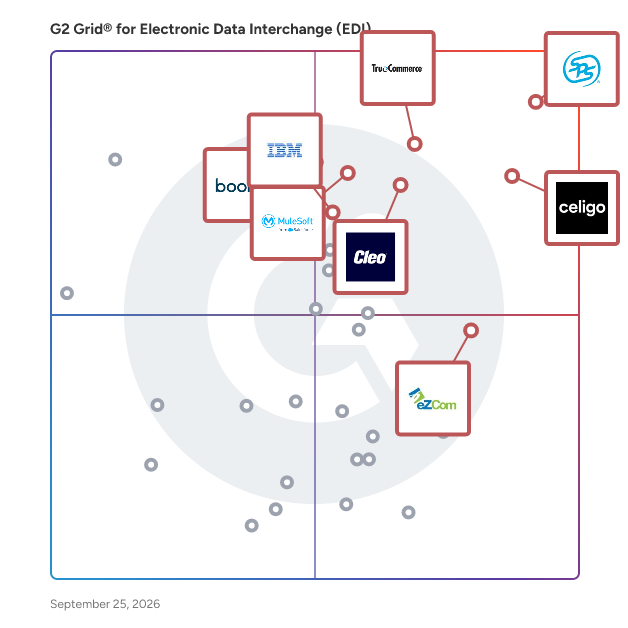
SPS Commerce Fulfillment EDI offers a comprehensive solution with full-service support, providing access to a vast network of pre-mapped connections. It's designed to help vendors meet retailer requirements, including EDI compliance and batch processing, making it a strong choice for small businesses seeking scalability and ease of use.
-
TrueCommerce EDI provides seamless integration across the supply chain, simplifying the process of transmitting invoices, orders, and other documents. Its user-friendly interface and robust customer support suit small businesses looking to automate their EDI processes.
-
eZCom Software EDI is recognized for its user-friendly interface and robust customer support. It streamlines order processing and ensures compliance with trading partners. Its intuitive design makes it accessible for businesses seeking efficient EDI solutions.
What’s the best value EDI software for manufacturing?
For manufacturing companies seeking cost-effective EDI solutions that streamline supply chain operations and integrate seamlessly with existing systems, leading options include:
-
TrueCommerce EDI offers comprehensive integration across the supply chain, facilitating seamless connections with ERP systems and leading eCommerce platforms like Shopify and Magento. Its user-friendly interface and robust customer support suit manufacturers aiming to automate their EDI processes.
-
Cleo Integration Cloud provides a cloud-based platform that unifies EDI and API integrations, offering end-to-end visibility across B2B transactions. Its customizable interface simplifies partner onboarding and enhances exception management, catering to the complex needs of manufacturing operations.
-
MuleSoft Anypoint Platform enables manufacturers to integrate EDI with other applications and data sources through robust API-led connectivity. Its real-time reporting features and scalability support complex manufacturing ecosystems requiring agile data exchange.
Software Related to Electronic Data Interchange (EDI) Software
Related solutions that can be used together with EDI software include:
Blockchain software: As blockchain software becomes more prevalent, there’s significant discussion about how blockchain might augment EDI or even make EDI obsolete. Blockchain’s natural transparency can improve accountability and accuracy in EDI transmissions, and its reliability can further improve EDI accuracy and dependability.
Challenges with Electronic data interchange (EDI) Software
On-premises EDI solutions are becoming a challenge for companies. Here are some of the most common issues enterprises face from their EDI technologies deployed on premises.
Increased costs: EDI is an expensive investment, but maintaining outdated and legacy EDI solutions can further magnify costs. When an enterprise owns EDI software and hardware, it also needs to invest in manpower to manage and maintain the on-premises software. Additionally, when something crashes, the hours and costs for maintenance also add up quickly.
Scaling: Homegrown on-premises EDI software is not capable of scaling up to support data needs as the business grows. This becomes challenging for businesses in the long run as they plan to grow operations. EDI standards also vary from industry to industry, supporting each of the standardized data format to enable EDI transactions is difficult with on-premises EDI systems.
Lack of automation: EDI based on the cloud can integrate with other business systems and applications to automate processes. Traditional EDI solutions are quite rigid and can only perform specific EDI tasks because they cannot integrate with an ERP or CRM for end-to-end processing. Using on-premises EDI solutions become time consuming, inefficient, and unscalable.
How to Buy Electronic Data Interchange (EDI) Software
Requirements Gathering (RFI/RFP) for Electronic Data Interchange (EDI) Software
If a company is just starting out and looking to purchase the first EDI software, or maybe an organization needs to update a legacy system--wherever a business is in its buying process, g2.com can help select the best EDI software for the business.
The particular business pain points might be related to all of the manual processes involved in ordering and distribution and business document exchange in large volumes on day to day basis between trading partners.
If the company has a lot of data transfers daily, the need is to look for a solution that can grow with the organization. Users should think about the pain points and jot them down; these should be used to help create a checklist of criteria. Additionally, the buyer must determine the number of employees who will need to use this software, as this drives the number of licenses they are likely to buy.
Taking a holistic overview of the business and identifying pain points can help the team springboard into creating a checklist of criteria. Buyers should identify the features they want in an EDI solution and have an idea of what the organization needs in terms of deployment, industry, and cybersecurity. Buyers must create a checklist of requirements that can be easily referred to when evaluating different EDI solutions.
Compare Electronic Data Interchange (EDI) Software Products
Create a long list
From meeting the business functionality needs to implementation, vendor evaluations are an essential part of the software buying process. For ease of comparison after all demos are complete, it helps to prepare a consistent list of questions regarding specific needs and concerns to ask each vendor.
Create a short list
From the long list of vendors, it is helpful to narrow down the list of vendors and come up with a shorter list of contenders, preferably no more than three to five. With this list in hand, businesses can produce a matrix to compare the features and pricing of the various solutions.
Conduct demos
To ensure the comparison is thorough, the user should demo each solution on the short list with the same use case and datasets. This will allow the business to evaluate like for like and see how each vendor stacks up against the competition.
Selection of Electronic Data Interchange (EDI) Software
Choose a selection team
Before getting started, it's crucial to create a winning team that will work together throughout the entire process, from identifying pain points to implementation. The software selection team should consist of members of the organization who have the right interest, skills, and time to participate in this process.
Negotiation
Many companies are willing to negotiate pricing that is listed on their website. It is imperative to open up a conversation regarding pricing and licensing. For example, the vendor may be willing to give a discount for multi-year contracts or for recommending the product to others.
Final decision
After this stage, and before going all in, it is recommended to roll out a test run or pilot program to test adoption with a small sample size of users. If the tool is well used and well received, the buyer can be confident that the selection was correct. If not, it might be time to go back to the drawing board.
What Does Electronic Data Interchange (EDI) Software Cost?
An EDI solution can be deployed by organizations in one of two ways: on premises or in the cloud.
In addition to transaction volume, costs are always a consideration. As cloud-based EDI is a subscription model, the company only pays for what it uses. As the volume increasesthe cost does too. In contrast, on-premises EDI requires an upfront expenditure for hardware. It is a good practice to map the current and future requirements and it’s impact on the budget. Organizations that require control over their data opt for an on-premises EDI solution. EDI software may be a big investment, but in terms of improved efficiencies, increased productivity, and accelerated growth potential, the return on investment (ROI) is worth it.
Some of the key factors to measure the ROI of an EDI software include determining the cost of and time taken in manual data entry in POs and invoices, error detection percentage in manual data entry, and the number of data transmission requests per day.
Implementation of Electronic Data Interchange (EDI) Software
How is Electronic Data Interchange (EDI) Software Implemented?
Deployment options include on-premises or on the cloud. In an on-premises deployment, the software is loaded on servers at a company’s location. One advantage to on-premises deployment of EDI is the ability for in-house management. However, this option does require a skilled IT team with the bandwidth to manage updates and monitoring.
In contrast, a cloud EDI deployment is hosted and managed at an off-site third-party location. The company has access to their EDI data through their office computers.
Who is Responsible for Electronic Data Interchange (EDI) Software Implementation?
Some key people involved in the implementation of an EDI software includes:
EDI coordinator: These are IT professionals with extensive experience in delivering EDI solutions. The coordinator can be an in-house team member or an external consultant, depending on the EDI requirements and experience of the organizations.
Executive committee: This committee consists of a group of department heads of the business units which are going to be affected by the EDI deployment. This committee is typically led by the EDI coordinator.
Dedicated EDI team: This is a team formed to primarily focus on the actual implementation of the EDI system.
What Does the Implementation Process Look Like for Electronic Data Interchange (EDI) Software?
EDI implementation can be complicated at both technical and organizational levels, so following a systematic and structured approach to the implementation process can be helpful. Some of the processes in EDI implementation are listed as follows:
Requirements analysis: The implementation process starts with addressing key questions such as what business processes (orders, invoices) should the software support, data or information that needs to be exchanged, whether data exchange should be a one-way or a two-way process, etc.
Building organization structure: For EDI implementation, it is important to make strategic decisions with regard to equipping the project team with the necessary resources and expertise required in driving the implementation within the organization.
Selection of the ideal EDI solution (in-house or EDI service provider): To ensure automated data processing, companies need special EDI software that supports the message standards and interface requirements. Businesses must conduct research around the solutions available in the market and weigh the pros and cons of an EDI outsourcing solution.
Information compilation: A variety of information is required for implementation and rollout such as EDI translation, EDI formats or EDI standards, transliteration (EBCDIC, ASCII, UTF), EDI data file transfer, or managed communication, etc.
System and data integration: The necessary infrastructure must be set up (in-house model) or the communication connection to the EDI provider (outsourcing model) needs to be established according to the company’s operational model. Then, the interfaces to the internal ERP system must be supplied or adapted.
EDI testing: Once the EDI system has been implemented or all of the requirements have been fulfilled by the EDI provider, pilot project testing is conducted with the buyer.
Electronic Data Interchange (EDI) Software Trends
Shift from on-premises to cloud EDI software
With the cloud growing in popularity, EDI vendors are working hard to make sure organizations have the flexibility they need to meet their business requirements. This includes the ability to work in multiple environments, from on premises to the cloud. Purchasing hardware, setting it up, maintaining it, and buying software licenses is an expensive expenditure for organizations. Paying for a monthly cloud EDI service may be easier to initiate and scale, which is why many companies are moving towards adopting cloud EDI solutions.