Best Data Science and Machine Learning Platforms

How Many Data Science and Machine Learning Platforms Products Does G2 Track?

Total Products under this Category: 1,686

Category Stats (Sep 2026)

  • Average Rating: 4.46/5 The average rating of products in this category, based on all submitted ratings
  • Top Trending Product: Anyscale (+4.14%) - Among all products in this category, Anyscale recorded the largest rating increase compared to last month

Last updated: September 01, 2026

How Does G2 Rank Data Science and Machine Learning Platforms Products?

Why You Can Trust G2's Software Rankings:

  • 30 Analysts and Data Experts
  • 14,400+ Authentic Reviews
  • 1,686+ Products
  • Unbiased Rankings

G2's software rankings are built on verified user reviews, rigorous moderation, and a consistent research methodology maintained by a team of analysts and data experts. Each product is measured using the same transparent criteria, with no paid placement or vendor influence. While reviews reflect real user experiences, which can be subjective, they offer valuable insight into how software performs in the hands of professionals. Together, these inputs power the G2 Score, a standardized way to compare tools within every category.

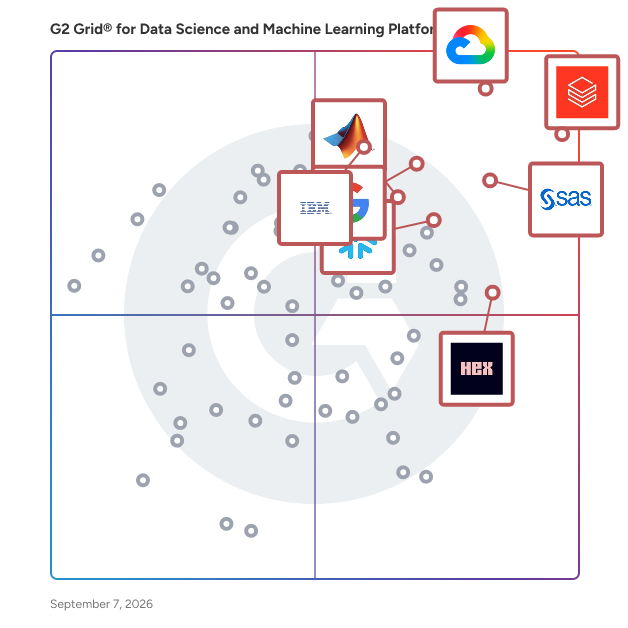
G2 Grid® for Data Science and Machine Learning Platforms

G2 Grid® for Data Science and Machine Learning Platforms plotting products by satisfaction and market presence

Highlighted products: Databricks, Gemini Enterprise Agent Platform, SAS Viya, Google Cloud AutoML, IBM watsonx.data, Snowflake, MATLAB, and Hex.

Underlying data: [Grid® JSON](https://www.g2.com/categories/data-science-and-machine-learning-platforms/grids.json?focus%5B%5D=databricks&focus%5B%5D=gemini-enterprise-agent-platform&focus%5B%5D=sas-sas-viya&focus%5B%5D=google-cloud-automl&focus%5B%5D=ibm-watsonx-data&focus%5B%5D=snowflake&focus%5B%5D=matlab&focus%5B%5D=hex-tech-hex)

Databricks

Databricks is the Data and AI company. More than 20,000 organizations worldwide — including adidas, AT&T, Bayer, Block, Mastercard, Rivian, Unilever, and 70% of the Fortune 500 — rely on the Databricks Data + AI Platform to build and scale data and AI apps, analytics, and agents. Headquartered in San Francisco with 30+ offices around the globe, Databricks offers a unified platform that includes Genie, Lakebase, Agent Bricks, Lakeflow, Lakehouse, and Unity Catalog. Founded in 2013 by the original creators of Apache Spark™, Delta Lake, MLflow and Unity Catalog, Databricks is built on an open lakehouse architecture that brings data, analytics and AI together. The platform is used by data engineers, data scientists, analysts, developers, machine learning teams, AI teams and business users to collaborate across the full data and AI lifecycle. Key Databricks capabilities include: - Data engineering: Build, automate and manage reliable batch, streaming and real-time data pipelines. - Analytics and business intelligence: Run SQL analytics, create dashboards and enable business teams to explore data. - Data governance: Discover, secure and manage data and AI assets across teams, clouds and workloads. - Machine learning and AI: Develop models, build generative AI applications and create production-grade AI agents. - Data applications: Build and deploy data-driven applications using governed enterprise data. Available across AWS, Azure and Google Cloud, Databricks helps organizations work across clouds, reduce data silos and simplify collaboration across teams and tools. Customers use Databricks for use cases such as customer personalization, fraud detection, predictive maintenance, real-time analytics, cybersecurity, healthcare research, financial risk management, supply chain optimization and AI-powered decision-making. Databricks is used across industries including financial services, healthcare and life sciences, retail, manufacturing, energy and the public sector. Organizations use the platform to modernize data infrastructure, accelerate AI adoption and turn enterprise data into business value.

Average Rating: 4.6/5.0

Total Reviews: 1,331

How Do G2 Users Rate Databricks?

  • Application: 8.7/10 (Category avg: 8.5/10)
  • Managed Service: 8.5/10 (Category avg: 8.3/10)
  • Natural Language Understanding: 8.4/10 (Category avg: 8.3/10)
  • Ease of Admin: 8.4/10 (Category avg: 8.6/10)

Who Is the Company Behind Databricks?

  • Seller: Databricks Inc.
  • Company Website:
  • Year Founded: 2013
  • HQ Location: San Francisco, CA
  • Twitter: @databricks
    92,269 Twitter followers
  • LinkedIn® Page: www.linkedin.com
    14,336 employees on LinkedIn®

Who Uses This Product?

  • Who Uses This: Data Engineer, Data Analyst
  • Top Industries: Information Technology and Services, Financial Services
  • Company Size: 48% Large, 38% Medium

What Do G2 Reviewers Say About Databricks?

AI-generated summary from verified user reviews

Pros
  • Users enjoy the ease of use and extensive features of Databricks, streamlining data warehousing and machine learning tasks.
  • Users value the seamless integrations with AWS services that enhance efficiency and support diverse business needs.
  • Users appreciate the ease of use of Databricks, enhancing their experience with its intuitive interface and efficient features.
  • Users value the seamless collaboration provided by Databricks, enhancing teamwork on data projects and insights sharing.
  • Users value the effective data management features of Databricks, simplifying their workflows and enhancing decision-making.
Cons
  • Users face a steep learning curve with Databricks, as its complexity can be confusing for newcomers.
  • Users note that the cost of Databricks can be quite high, particularly for large data projects and limited free options.
  • Users express frustration over missing features in Databricks, limiting its effectiveness for complex deployments and custom setups.
  • Users find the steep learning curve of Databricks challenging, particularly for those unfamiliar with big data tools.
  • Users face unintuitive UI issues that lead to random errors and complicate the experience for non-technical users.

What Are Recent G2 Reviews of Databricks?

What Are G2 Users Discussing About Databricks?

Gemini Enterprise Agent Platform

Google Cloud's comprehensive platform for developers to build, scale, govern and optimize agents and models. It's a single destination for technical teams to build agents that can transform enterprise applications and workflows into powerful agentic systems.

Average Rating: 4.3/5.0

Total Reviews: 727

How Do G2 Users Rate Gemini Enterprise Agent Platform?

  • Application: 8.3/10 (Category avg: 8.5/10)
  • Managed Service: 8.3/10 (Category avg: 8.3/10)
  • Natural Language Understanding: 8.5/10 (Category avg: 8.3/10)
  • Ease of Admin: 8.0/10 (Category avg: 8.6/10)

Who Is the Company Behind Gemini Enterprise Agent Platform?

  • Seller: Google
  • Year Founded: 1998
  • HQ Location: Mountain View, CA
  • Twitter: @google
    31,899,995 Twitter followers
  • LinkedIn® Page: www.linkedin.com
    301,144 employees on LinkedIn®
  • Ownership: NASDAQ:GOOG

Who Uses This Product?

  • Who Uses This: Software Engineer, Data Scientist
  • Top Industries: Computer Software, Information Technology and Services
  • Company Size: 42% Small, 29% Large

What Do G2 Reviewers Say About Gemini Enterprise Agent Platform?

AI-generated summary from verified user reviews

Pros
  • Users appreciate the ease of use of the Gemini Enterprise Agent Platform, highlighting its beginner-friendly interface and intuitive design.
  • Users appreciate the multimodal capabilities of Gemini, enhancing productivity by understanding text, images, code, and documents together.
  • Users value the multimodal capabilities of Gemini, enhancing productivity in software development and automation projects.
  • Users value the multimodal capabilities of Gemini, enhancing productivity in software development and automation projects.
  • Users value the integrated platform of Gemini, enhancing productivity by combining various functionalities in a unified system.
Cons
  • Users find the platform expensive, especially when considering resource usage and challenging documentation.
  • Users find the complex pricing structure of Gemini Enterprise Agent Platform confusing and difficult to navigate.
  • Users find the learning curve steep with Gemini Enterprise Agent Platform, due to its numerous complex components and configurations.
  • Users find the complex pricing structure of Gemini Enterprise Agent challenging and suggest simplifying it for clarity.
  • Users find the difficult learning curve of Gemini Enterprise Agent Platform overwhelming, especially with advanced features and integrations.

What Are Recent G2 Reviews of Gemini Enterprise Agent Platform?

What Are G2 Users Discussing About Gemini Enterprise Agent Platform?

SAS Viya

SAS Viya is a cloud-native data and AI platform that enables teams to build, deploy and scale explainable AI that drives trusted, confident decisions. It unites the entire data and AI life cycle and empowers teams to innovate quickly while balancing speed, automation and governance by design. Viya unifies data management, advanced analytics and decisioning in a single platform, so organizations can move from experimentation to production with confidence, delivering measurable business impact that is secure, explainable and scalable across any environment. Key capabilities required to deliver trusted decisions include: • End-to-end clarity across the data and AI life cycle, with built-in lineage, auditability and continuous monitoring to support defensible decisions. • Governance by design, enabling consistent oversight across data, models and decisions to reduce risk and accelerate adoption. • Explainable AI at scale, so insights and outcomes can be understood, validated and trusted by business and regulators alike. • Operationalized analytics, ensuring value continues beyond deployment through monitoring, retraining and life cycle management. • Flexible, cloud-native deployment, allowing organizations to start anywhere and scale everywhere while maintaining control.

Average Rating: 4.3/5.0

Total Reviews: 775

How Do G2 Users Rate SAS Viya?

  • Application: 7.8/10 (Category avg: 8.5/10)
  • Managed Service: 7.9/10 (Category avg: 8.3/10)
  • Natural Language Understanding: 7.8/10 (Category avg: 8.3/10)
  • Ease of Admin: 7.6/10 (Category avg: 8.6/10)

Who Is the Company Behind SAS Viya?

  • Seller: SAS Institute Inc.
  • Company Website:
  • Year Founded: 1976
  • HQ Location: Cary, NC
  • Twitter: @SASsoftware
    60,863 Twitter followers
  • LinkedIn® Page: www.linkedin.com
    15,122 employees on LinkedIn®

Who Uses This Product?

  • Who Uses This: Student, Biostatistician
  • Top Industries: Pharmaceuticals, Banking
  • Company Size: 33% Small, 33% Large

What Do G2 Reviewers Say About SAS Viya?

AI-generated summary from verified user reviews

Pros
  • Users value the ease of use in SAS Viya, enhancing data visualization and decision-making for businesses.
  • Users appreciate the advanced analytical capabilities of SAS Viya, making data analysis and decision-making more efficient.
  • Users value the sophisticated analytical capabilities of SAS Viya, enhancing decision-making and insights from diverse data sources.
  • Users value the end-to-end data lifecycle tooling in SAS Viya, enhancing insights and strategic decision-making capabilities.
  • Users value the powerful data visualization capabilities of SAS Viya, enhancing insights and decision-making in their organizations.
Cons
  • Users find SAS Viya difficult for non-technical users to navigate, impacting ease of access to reports and dashboards.
  • Users find the visualization complexity of SAS Viya challenging, especially for those without technical expertise.
  • Users find the learning curve challenging, especially for non-technical individuals navigating reports and dashboards.
  • Users find the difficult learning curve for SAS Viya challenging, especially for non-technical users attempting to access features.
  • Users find the expensive pricing of SAS Viya a potential barrier, complicating their decision-making process.

What Are Recent G2 Reviews of SAS Viya?

What Are G2 Users Discussing About SAS Viya?

Google Cloud AutoML

Google Cloud AutoML is a suite of machine learning products designed to enable developers with limited expertise to train high-quality custom models tailored to their specific business needs. By leveraging Google's advanced transfer learning and neural architecture search technologies, AutoML simplifies the process of building, deploying, and scaling machine learning models, making AI more accessible to a broader audience. Key Features and Functionality: - Automated Model Training: AutoML automates the selection of model architecture and hyperparameter tuning, reducing the need for manual intervention and specialized knowledge. - User-Friendly Interface: The platform offers an intuitive graphical interface that allows users to upload data, train models, and manage deployments with ease. - Versatile Model Types: AutoML supports various data types and tasks through specialized services: - AutoML Vision: For image classification and object detection. - AutoML Natural Language: For text classification, sentiment analysis, and entity recognition. - AutoML Translation: For creating custom translation models between language pairs. - AutoML Video Intelligence: For video classification and object tracking. - AutoML Tables: For structured data tasks like regression and classification. - Seamless Integration: AutoML integrates with other Google Cloud services, facilitating efficient data management, model deployment, and scalability. Primary Value and Problem Solving: Google Cloud AutoML democratizes machine learning by enabling users without deep technical expertise to develop and deploy custom models. This accessibility allows businesses to harness the power of AI to solve complex problems, such as improving customer experiences through personalized recommendations, automating content moderation, enhancing language translation services, and gaining insights from large datasets. By reducing the barriers to entry, AutoML empowers organizations to innovate and stay competitive in their respective industries.

Average Rating: 4.3/5.0

Total Reviews: 48

How Do G2 Users Rate Google Cloud AutoML?

  • Natural Language Understanding: 9.5/10 (Category avg: 8.3/10)
  • Ease of Admin: 8.4/10 (Category avg: 8.6/10)

Who Is the Company Behind Google Cloud AutoML?

  • Seller: Google
  • Year Founded: 1998
  • HQ Location: Mountain View, CA
  • Twitter: @google
    31,899,995 Twitter followers
  • LinkedIn® Page: www.linkedin.com
    301,144 employees on LinkedIn®
  • Ownership: NASDAQ:GOOG

Who Uses This Product?

  • Top Industries: Information Technology and Services
  • Company Size: 43% Small, 39% Medium

What Do G2 Reviewers Say About Google Cloud AutoML?

AI-generated summary from verified user reviews

Pros
  • Users appreciate the seamless AI integration of Google Cloud AutoML, enhancing productivity without needing deep ML knowledge.
  • Users appreciate the ease of use of Google Cloud AutoML, enabling quick training of models without deep expertise.
  • Users appreciate the easy integrations of Google Cloud AutoML, enhancing their machine learning experience effortlessly.
  • Users appreciate the seamless integration of Google Cloud AutoML, enhancing usability and collaboration with other Google services.
  • Users appreciate the intuitive interface of Google Cloud AutoML, making machine learning accessible without deep expertise.
Cons
  • Users find the cost prohibitive for smaller projects or students, making it less accessible for them.
  • The pricing can be expensive for small projects or students, limiting accessibility and usage for some users.

What Are Recent G2 Reviews of Google Cloud AutoML?

What Are G2 Users Discussing About Google Cloud AutoML?

FAQs About Data Science and Machine Learning Platforms

Generated using AI

Last updated: April 27, 2026

Leading machine learning services for enterprise

Based on G2 reviews, enterprise teams often favor platforms that unify data preparation, model training, deployment, governance, and monitoring in one environment.

  • Vertex AI — unified ML lifecycle and deployment.
  • Databricks — lakehouse workflows with collaborative notebooks.
  • SAS Viya — large-scale analytics with governance.
  • IBM watsonx.ai — governed AI development for enterprises.

Top-rated software for data analysis in SaaS industry

Based on G2 reviews, buyers in software environments often prioritize platforms that shorten analysis cycles, support collaboration, and reduce tool switching.

  • Hex — SQL, Python, and dashboarding together.
  • Vertex AI — end-to-end ML workflows in one place.
  • Databricks — scalable analytics and ML collaboration.
  • Deepnote — collaborative notebooks for team analysis.

Which platform offers the best machine learning solutions

Based on G2 reviews, the strongest options depend on whether your team values unified workflows, low-code model building, notebook collaboration, or governance.

  • Vertex AI — managed training, deployment, and monitoring.
  • Databricks — engineering, analytics, and ML together.
  • SAS Viya — advanced analytics with strong controls.
  • Anaconda Platform — reproducible environments and package management.

What are data science and machine learning platforms used for

According to verified users, data science and machine learning platforms are used to centralize the work of preparing data, building models, testing ideas, deploying models, and sharing results. Reviews repeatedly mention workflow simplification as a major benefit: teams can reduce tool switching, automate repetitive preparation tasks, and move from experimentation to production with less manual setup. Buyers also use these platforms for dashboards, forecasting, predictive modeling, model monitoring, collaboration across technical and non-technical teams, and connecting data from warehouses, cloud systems, spreadsheets, or operational tools. Common buyer concerns in the reviews include learning curve, documentation quality, cost visibility, and performance on very large workloads.

How do teams use data science and machine learning platforms for collaboration

According to verified users, collaboration is one of the most practical reasons teams adopt these platforms. Reviews describe analysts, data scientists, and engineers working in shared notebooks, common environments, and governed workspaces so they can move from raw data to analysis, visualizations, and deployed models without passing files back and forth. Teams also mention easier sharing of dashboards, published apps, reusable workflows, and reproducible environments. In several reviews, this reduces friction between technical and non-technical stakeholders because results can be reviewed, discussed, and reused in one place. The strongest collaboration themes in the recent reviews are shared notebooks, consistent environments, versioned workflows, and easier handoffs into production.

IBM watsonx.data

IBM® watsonx.data® helps you access, integrate and understand all your data —structured and unstructured—across any environment. It optimizes workloads for price and performance while enforcing consistent governance across sources, formats and teams. Watch the demo to learn how watsonx.data empowers you to build gen AI apps and powerful AI agents. Free Trial available: https://ibm.biz/Watsonx-data_Trial

Average Rating: 4.4/5.0

Total Reviews: 170

G2 Deal: Save 30% on your first monthly or annual subscription. Offer ends 15 April 2026.

Get 30% off your new monthly or annual watsonx.data Enterprise subscription. Optimize data workloads at a fraction of the cost. Offer ends 15 April 2026.

Price: ~~61.81~~ → 88.30

View this exclusive G2 deal

How Do G2 Users Rate IBM watsonx.data?

  • Application: 5.8/10 (Category avg: 8.5/10)
  • Managed Service: 7.2/10 (Category avg: 8.3/10)
  • Natural Language Understanding: 8.0/10 (Category avg: 8.3/10)
  • Ease of Admin: 8.0/10 (Category avg: 8.6/10)

Who Is the Company Behind IBM watsonx.data?

  • Seller: IBM
  • Company Website:
  • Year Founded: 1911
  • HQ Location: Armonk, New York, United States
  • Twitter: @IBMSecurity
    74,660 Twitter followers
  • LinkedIn® Page: www.linkedin.com
    344,328 employees on LinkedIn®

Who Uses This Product?

  • Who Uses This: Software Engineer, Software Developer
  • Top Industries: Computer Software, Information Technology and Services
  • Company Size: 34% Small, 31% Large

What Do G2 Reviewers Say About IBM watsonx.data?

AI-generated summary from verified user reviews

Pros
  • Users appreciate the ease of use of IBM watsonx.data, finding it reliable and efficient for data management.
  • Users value the seamless data integration and user-friendly interface of IBM watsonx.data for efficient analytics.
  • Users appreciate the organized and efficient data management of IBM watsonx.data, simplifying analytics and enhancing team collaboration.
  • Users value the seamless data source integration of IBM watsonx.data, enhancing efficiency and flexibility in their workflows.
  • Users appreciate the flexible analytics capabilities of IBM watsonx.data, enabling faster insights from diverse data sources.
Cons
  • Users find the steep learning curve of IBM watsonx.data challenging, hindering easy adoption for newcomers.
  • Users find the complexity of setting up IBM watsonx.data a barrier, especially for newcomers and small teams.
  • Users find the pricing steep for IBM watsonx.data, especially for smaller businesses with limited resources.
  • Users find the difficult setup process time-consuming, with a steep learning curve and extensive documentation review required.
  • Users find performance tuning difficult with IBM watsonx.data, especially for beginners and teams with limited IT resources.

What Are Recent G2 Reviews of IBM watsonx.data?

Snowflake

Snowflake makes enterprise AI easy, efficient and trusted. Thousands of companies around the globe, including hundreds of the world’s largest, use Snowflake’s AI Data Cloud to share data, build applications, and power their business with AI. The era of enterprise AI is here. Learn more at snowflake.com (NYSE: SNOW).

Average Rating: 4.6/5.0

Total Reviews: 713

How Do G2 Users Rate Snowflake?

  • Application: 9.2/10 (Category avg: 8.5/10)
  • Managed Service: 9.0/10 (Category avg: 8.3/10)
  • Natural Language Understanding: 8.6/10 (Category avg: 8.3/10)
  • Ease of Admin: 8.7/10 (Category avg: 8.6/10)

Who Is the Company Behind Snowflake?

  • Seller: Snowflake, Inc.
  • Company Website:
  • Year Founded: 2012
  • HQ Location: 135 Constitution Drive, Menlo Park CA
  • Twitter: @SnowflakeDB
    278 Twitter followers
  • LinkedIn® Page: www.linkedin.com
    12,574 employees on LinkedIn®

Who Uses This Product?

  • Who Uses This: Data Engineer, Data Analyst
  • Top Industries: Information Technology and Services, Computer Software
  • Company Size: 45% Medium, 42% Large

What Do G2 Reviewers Say About Snowflake?

AI-generated summary from verified user reviews

Pros
  • Users appreciate the ease of use of Snowflake, which simplifies data sharing and enhances productivity across teams.
  • Users value the reliable features and user-friendly interface of Snowflake, enhancing data management and analytics efficiency.
  • Users value the seamless scalability of Snowflake, enabling efficient handling of large datasets and workload changes without performance loss.
  • Users value the fast and efficient data processing capabilities of Snowflake, enhancing their analysis experience significantly.
Cons
  • Users highlight the high costs of Snowflake, making it less accessible for smaller businesses with limited budgets.
  • Users find feature limitations in Snowflake, such as lack of code blocks and restricted permissions, frustrating.
  • Users often struggle with high costs due to unoptimized queries and inadequate cost control measures in Snowflake.
  • Users find the cost structure challenging, requiring time to optimize for efficient use of Snowflake.
  • Users find Snowflake's limited features in dynamic scripts and monitoring hinder flexibility and usability.

What Are Recent G2 Reviews of Snowflake?

What Are G2 Users Discussing About Snowflake?

MATLAB

MATLAB is a high-level programming and numeric computing environment widely utilized by engineers and scientists for data analysis, algorithm development, and system modeling. It offers a desktop environment optimized for iterative analysis and design processes, coupled with a programming language that directly expresses matrix and array mathematics. The Live Editor feature enables users to create scripts that integrate code, output, and formatted text within an executable notebook. Key Features and Functionality: - Data Analysis: Tools for exploring, modeling, and analyzing data. - Graphics: Functions for visualizing and exploring data through various plots and charts. - Programming: Capabilities to create scripts, functions, and classes for customized workflows. - App Building: Facilities to develop desktop and web applications. - External Language Interfaces: Integration with languages such as Python, C/C++, Fortran, and Java. - Hardware Connectivity: Support for connecting MATLAB to various hardware platforms. - Parallel Computing: Ability to perform large-scale computations and parallelize simulations using multicore desktops, GPUs, clusters, and cloud resources. - Deployment: Options to share MATLAB programs and deploy them to enterprise applications, embedded devices, and cloud environments. Primary Value and User Solutions: MATLAB streamlines complex mathematical computations and data analysis tasks, enabling users to develop algorithms and models efficiently. Its comprehensive toolboxes and interactive apps facilitate rapid prototyping and iterative design, reducing development time. The platform's scalability allows for seamless transition from research to production, supporting deployment on various systems without extensive code modifications. By integrating with multiple programming languages and hardware platforms, MATLAB provides a versatile environment that addresses the diverse needs of engineers and scientists across industries.

Average Rating: 4.5/5.0

Total Reviews: 753

How Do G2 Users Rate MATLAB?

  • Application: 8.6/10 (Category avg: 8.5/10)
  • Managed Service: 8.3/10 (Category avg: 8.3/10)
  • Natural Language Understanding: 8.5/10 (Category avg: 8.3/10)
  • Ease of Admin: 8.4/10 (Category avg: 8.6/10)

Who Is the Company Behind MATLAB?

  • Seller: MathWorks
  • Year Founded: 1984
  • HQ Location: Natick, MA
  • Twitter: @MATLAB
    105,142 Twitter followers
  • LinkedIn® Page: www.linkedin.com
    7,985 employees on LinkedIn®

Who Uses This Product?

  • Who Uses This: Student, Graduate Research Assistant
  • Top Industries: Higher Education, Research
  • Company Size: 42% Large, 31% Small

What Do G2 Reviewers Say About MATLAB?

AI-generated summary from verified user reviews

Pros
  • Users appreciate the user-friendly interface of MATLAB, making data visualization and manipulation easy and efficient.
  • Users appreciate the powerful visualization tools of MATLAB, enhancing real-time data plotting and image processing capabilities.
  • Users appreciate the powerful and user-friendly data visualization features of MATLAB for real-time plotting.
  • Users appreciate the variety of tools in MATLAB, enhancing capabilities in numerical analysis, image processing, and simulations.
  • Users appreciate the ease of simulations with MATLAB, especially with its seamless integration of Simulink for diverse applications.
Cons
  • Users find MATLAB to be expensive, making it difficult for individuals and small companies to afford.
  • Users often experience slow performance with MATLAB, especially on less powerful machines or with large datasets.
  • Users find MATLAB's high system requirements frustrating, often leading to slower performance on less powerful machines.
  • Users find the expensive licensing of MATLAB a significant barrier, particularly for individuals and small companies.
  • Users frequently encounter lagging performance with MATLAB, especially during large simulations and with multiple scripts open.

What Are Recent G2 Reviews of MATLAB?

What Are G2 Users Discussing About MATLAB?

Hex

Hex is the world’s favorite AI Analytics platform. With Hex, anyone can explore data using natural language, with or without code, all on trusted context, in one AI-powered platform. Get started now > https://app.hex.tech/signup?source=g2 Get a demo > https://hex.tech/request-a-demo/?source=g2

Average Rating: 4.5/5.0

Total Reviews: 402

How Do G2 Users Rate Hex?

  • Application: 6.9/10 (Category avg: 8.5/10)
  • Managed Service: 6.8/10 (Category avg: 8.3/10)
  • Natural Language Understanding: 5.1/10 (Category avg: 8.3/10)
  • Ease of Admin: 9.0/10 (Category avg: 8.6/10)

Who Is the Company Behind Hex?

  • Seller: Hex Tech
  • Company Website:
  • Year Founded: 2019
  • HQ Location: San Francisco, US
  • Twitter: @_hex_tech
    6,982 Twitter followers
  • LinkedIn® Page: www.linkedin.com
    280 employees on LinkedIn®

Who Uses This Product?

  • Who Uses This: Data Analyst, Data Scientist
  • Top Industries: Computer Software, Information Technology and Services
  • Company Size: 53% Medium, 22% Small

What Do G2 Reviewers Say About Hex?

AI-generated summary from verified user reviews

Pros
  • Users find Hex to be user-friendly, highlighting its seamless integrations and fast implementation as major advantages.
  • Users love the seamless integration of SQL with Python, enhancing their analytical capabilities in Hex effortlessly.
  • Users appreciate the seamless data management capabilities of Hex, enabling effortless integration and collaboration.
  • Users value the effortless integration of SQL and Python in Hex, enhancing data analysis and visualization capabilities.
  • Users appreciate the seamless data analysis and reporting capabilities of Hex, enhancing collaboration and interactivity.
Cons
  • Users criticize the limited features of Hex, noting insufficient capabilities compared to standard BI tools like Tableau.
  • Users find the missing features in Hex frustrating, desiring better data visualization and result management capabilities.
  • Users find Hex lacking features, especially in dashboarding and advanced functionalities that impact usability and efficiency.
  • Users experience slow performance with Hex, especially within virtual machines and due to limited computational capacity.
  • Users often face data management issues with kernel failures and GPU integration, complicating their experience with Hex.

What Are Recent G2 Reviews of Hex?

What Are G2 Users Discussing About Hex?

Dataiku

Dataiku is the Platform for AI Success: the AI orchestration layer where enterprises build, deploy, and govern analytics, models, and agents at scale. It sits on top of the data platforms, clouds, and AI services you already use, working across all of them without locking you into any one. Dataiku expands who can build production AI, putting the right tools in the hands of data scientists and domain experts alike, from fraud analysts to demand planners. It orchestrates machine learning, rules, LLMs, and agents as one governed system, built on more than a decade of running production AI. Governance is part of the build rather than something bolted on afterward, so teams ship faster while keeping performance, cost, and risk under control. The result: AI that moves from experimentation to trusted, measurable execution now, not in 18 months.

Average Rating: 4.4/5.0

Total Reviews: 218

How Do G2 Users Rate Dataiku?

  • Application: 8.3/10 (Category avg: 8.5/10)
  • Managed Service: 8.2/10 (Category avg: 8.3/10)
  • Natural Language Understanding: 7.8/10 (Category avg: 8.3/10)
  • Ease of Admin: 8.0/10 (Category avg: 8.6/10)

Who Is the Company Behind Dataiku?

  • Seller: Dataiku
  • Company Website:
  • Year Founded: 2013
  • HQ Location: New York, NY
  • Twitter: @dataiku
    22,917 Twitter followers
  • LinkedIn® Page: www.linkedin.com
    1,605 employees on LinkedIn®

Who Uses This Product?

  • Who Uses This: Data Scientist, Data Analyst
  • Top Industries: Financial Services, Pharmaceuticals
  • Company Size: 59% Large, 23% Medium

What Do G2 Reviewers Say About Dataiku?

AI-generated summary from verified user reviews

Pros
  • Users find Dataiku easy to use, simplifying ML development and helping detect opportunities and risks effortlessly.
  • Users appreciate how Dataiku simplifies ML development, enabling quick training, evaluation, and understanding of data easily.
  • Users value the ease of use in Dataiku, enabling collaboration and simplifying complex data processes for all skill levels.
  • Users appreciate the easy integrations of Dataiku, facilitating collaboration across diverse analytics tools and skill sets.
  • Users commend the productivity improvement brought by Dataiku’s visual recipes and robust tools for analytics projects.
Cons
  • Users find the learning curve steep, making it challenging for beginners to fully utilize Dataiku's advanced features.
  • Users find the steep learning curve challenging, especially for beginners navigating Dataiku's advanced features.
  • Users face slow performance with Dataiku when managing large datasets, impacting efficiency and productivity.
  • Users find the difficult learning curve challenging for beginners, impacting their ability to maximize the platform's potential.
  • Users find the pricing high for small companies and students, impacting accessibility for basic projects.

What Are Recent G2 Reviews of Dataiku?

What Are G2 Users Discussing About Dataiku?

IBM watsonx.ai

Watsonx.ai is part of the IBM watsonx platform that brings together new generative AI capabilities, powered by foundation models and traditional machine learning into a powerful studio spanning the AI lifecycle. With watsonx.ai, you can build, train, validate, tune and deploy generative AI, foundation models and machine learning capabilities with ease and build AI applications in a fraction of the time with a fraction of the data.

Average Rating: 4.4/5.0

Total Reviews: 142

How Do G2 Users Rate IBM watsonx.ai?

  • Application: 8.8/10 (Category avg: 8.5/10)
  • Managed Service: 8.5/10 (Category avg: 8.3/10)
  • Natural Language Understanding: 8.6/10 (Category avg: 8.3/10)
  • Ease of Admin: 8.5/10 (Category avg: 8.6/10)

Who Is the Company Behind IBM watsonx.ai?

  • Seller: IBM
  • Company Website:
  • Year Founded: 1911
  • HQ Location: Armonk, New York, United States
  • Twitter: @IBMSecurity
    74,660 Twitter followers
  • LinkedIn® Page: www.linkedin.com
    344,328 employees on LinkedIn®

Who Uses This Product?

  • Who Uses This: Consultant
  • Top Industries: Information Technology and Services, Computer Software
  • Company Size: 41% Small, 32% Large

What Do G2 Reviewers Say About IBM watsonx.ai?

AI-generated summary from verified user reviews

Pros
  • Users praise the ease of use of IBM watsonx.ai, facilitating straightforward integration and model development.
  • Users value the wide range of model types in IBM watsonx.ai, enhancing flexibility and efficiency in development.
  • Users appreciate the user-friendly AI studio of IBM watsonx.ai, enabling efficient chatbot creation with minimal coding.
  • Users appreciate the user-friendly platform that simplifies building and deploying AI models efficiently and effectively.
  • Users appreciate the enterprise-grade AI of IBM watsonx.ai, which integrates seamlessly for practical, reliable business solutions.
Cons
  • Users find the difficult learning curve challenging, indicating the need for clearer documentation and better onboarding support.
  • Users find the complexity of IBM watsonx.ai challenging, especially for beginners and small teams seeking easier solutions.
  • Users find the steep learning curve of IBM watsonx.ai challenging, making it less approachable for non-technical teams.
  • Users express concerns about the high costs of IBM watsonx.ai, finding it challenging and not budget-friendly for small teams.
  • Users find the complex setup of IBM watsonx.ai challenging, especially for newcomers and small teams seeking ease of use.

What Are Recent G2 Reviews of IBM watsonx.ai?

Deepnote

Deepnote is a data workspace where agents and humans work together. It's designed to simplify data exploration, accelerate analysis, and quickly deliver actionable insights for you and your team. Unlike outdated tools such as Jupyter, Deepnote is built with the next decade in mind. Deepnote gives anyone working with data superpowers. It unifies your data workflow through an integrated semantic layer, preparing your data for advanced AI applications. You can also leverage our AI data copilot to chat with your data, create charts, write code, or turn your AI notebooks into fully-fledged data dashboards or apps. Combine data, SQL or Python code, and visualizations side-by-side on a flexible canvas - enhanced with cutting-edge AI reasoning models. 🤖 Analyze with AI • Generate code and visualizations by describing your goal. • Auto-write, run, and debug code with AI. • Move faster with context-aware AI suggestions. 🔗 Unify • Connect to 60+ data sources like BigQuery, Snowflake, and PostgreSQL. • Combine Python and SQL in one notebook. • Build reusable ETL, analytics, and metric modules. • Create a semantic layer with shared definitions and trusted metrics. ⚖️ Scale • Instantly boost compute power, more included than Colab. • Schedule jobs and get notified with fresh results. • Organize work in projects and folders for team clarity. • Manage workflows via REST API. 🚀 Launch • Turn notebooks into dashboards or data apps, natively or with Streamlit. • Let users explore data with interactive inputs. • Share secure, live apps in one click.

Average Rating: 4.5/5.0

Total Reviews: 382

How Do G2 Users Rate Deepnote?

  • Application: 8.0/10 (Category avg: 8.5/10)
  • Managed Service: 7.9/10 (Category avg: 8.3/10)
  • Natural Language Understanding: 7.2/10 (Category avg: 8.3/10)
  • Ease of Admin: 8.8/10 (Category avg: 8.6/10)

Who Is the Company Behind Deepnote?

  • Seller: Deepnote
  • Company Website:
  • Year Founded: 2019
  • HQ Location: San Francisco , US
  • Twitter: @DeepnoteHQ
    5,239 Twitter followers
  • LinkedIn® Page: www.linkedin.com
    21 employees on LinkedIn®

Who Uses This Product?

  • Who Uses This: Student, Data Analyst
  • Top Industries: Computer Software, Higher Education
  • Company Size: 67% Small, 25% Medium

What Do G2 Reviewers Say About Deepnote?

AI-generated summary from verified user reviews

Pros
  • Users find Deepnote's ease of use enhances collaboration and simplifies data analysis with its intuitive interface.
  • Users value the seamless collaboration capabilities of Deepnote, enhancing teamwork and efficiency in data projects.
  • Users value the real-time collaboration capabilities of Deepnote, enhancing teamwork and efficiency in analytics processes.
  • Users value the easy integrations in Deepnote, enabling faster development and seamless data management across platforms.
  • Users find data management effortless with Deepnote, benefiting from easy integrations and seamless analysis capabilities.
Cons
  • Users notice slow performance when handling large datasets, affecting analysis speed and user experience.
  • Users find the limited features of Deepnote restricts their ability to fully utilize its potential.
  • Users experience data management issues with slow performance and an unintuitive file management system, affecting usability.
  • Users experience lagging performance with Deepnote, particularly when processing large datasets, affecting efficiency during critical tasks.
  • Users face slow loading times in Deepnote, particularly with larger projects, which can hinder productivity and frustrate experiences.

What Are Recent G2 Reviews of Deepnote?

What Are G2 Users Discussing About Deepnote?

Anaconda Core

Anaconda is built to advance AI with open source at scale, giving builders and organizations the confidence to increase productivity, and save time, spend and risk associated with open source. 95% of the Fortune 500 including Panasonic, AmTrust, Booz Allen Hamilton and over 50 million users rely on the value The Anaconda Platform delivers through a centralized approach to sourcing, securing, building, and deploying AI. With 21 billion downloads and growing, Anaconda has established itself as the gold standard for Python, data science, and AI and the enterprise-ready solution of choice for AI innovation. Anaconda is available across hybrid AI environments and cloud platforms such as AWS, Microsoft Azure, Databricks, Snowflake and more with backing from world-class investors including Insight Partners. Learn more at https://www.anaconda.com.

Average Rating: 4.5/5.0

Total Reviews: 234

How Do G2 Users Rate Anaconda Core?

  • Application: 8.9/10 (Category avg: 8.5/10)
  • Managed Service: 8.6/10 (Category avg: 8.3/10)
  • Natural Language Understanding: 8.5/10 (Category avg: 8.3/10)
  • Ease of Admin: 8.7/10 (Category avg: 8.6/10)

Who Is the Company Behind Anaconda Core?

  • Seller: Anaconda, Inc.
  • Year Founded: 2012
  • HQ Location: Austin, Texas
  • Twitter: @anacondainc
    83,629 Twitter followers
  • LinkedIn® Page: www.linkedin.com
    580 employees on LinkedIn®

Who Uses This Product?

  • Who Uses This: Software Engineer, Student
  • Top Industries: Information Technology and Services, Computer Software
  • Company Size: 38% Small, 25% Large

What Do G2 Reviewers Say About Anaconda Core?

AI-generated summary from verified user reviews

Pros
  • Users value the ease of use of Anaconda Core, making package management and installation simple across platforms.
  • Users find the setup ease of Anaconda Core remarkable, making project initiation and package management simple and efficient.
  • Users value the efficiency of Anaconda Core, enhancing productivity and simplifying the workflow for data science projects.
  • Users appreciate the intuitive design of Anaconda Core, facilitating efficient project management and easy navigation.
  • Users enjoy the coding ease provided by Anaconda Core, simplifying package management and enhancing productivity in data science.
Cons
  • Users face data management issues with Anaconda Core, including large installations and challenges with backup and integration.
  • Users experience slow performance with Anaconda Core, particularly during installation and on older hardware, affecting usability.
  • Users find the limited features of Anaconda Core insufficient, impacting their ability to fully utilize the platform.
  • Users find the limited features of Anaconda Core hinder their experience and reduce functionality compared to competitors.
  • Users report a limited storage concern, finding the Anaconda Core installation size cumbersome for their devices.

What Are Recent G2 Reviews of Anaconda Core?

What Are G2 Users Discussing About Anaconda Core?

Alteryx

Alteryx, through it's Alteryx One platform, helps enterprises transform complex, disconnected data into a clean, AI-ready state. Whether you’re creating financial forecasts, analyzing supplier performance, segmenting customer data, analyzing employee retention, or building competitive AI applications from your proprietary data, Alteryx One makes it easy to cleanse, blend, and analyze data to unlock the unique insights that drive impactful decisions. AI-Guided Analytics Alteryx automates and simplifies every stage of data preparation and analysis, from validation and enrichment to predictive analytics and automated insights. Incorporate generative AI directly into your workflows to streamline complex data tasks and generate insights faster. Unmatched flexibility, whether you prefer code-free workflows, natural language commands, or low-code options, Alteryx adapts to your needs. Trusted. Secure. Enterprise-Ready. Alteryx is trusted by over half of the Global 2000 and 19 of the top 20 global banks. With built-in automation, governance, and security, your workflows can scale and maintain compliance while delivering consistent results. And it doesn’t matter if your systems are on-premises, hybrid, or in the cloud; Alteryx fits effortlessly into your infrastructure. Easy to Use. Deeply Connected. What truly sets Alteryx apart is our focus on efficiency and ease of use for analysts and our active community of 700,000 Alteryx users to support you at every step of your journey. With seamless integration to data everywhere including platforms like Databricks, Snowflake, AWS, Google, SAP, and Salesforce, our platform helps unify siloed data and accelerate getting to insights. Visit Alteryx.com for more information, and to start your free trial.

Average Rating: 4.6/5.0

Total Reviews: 863

How Do G2 Users Rate Alteryx?

  • Application: 8.7/10 (Category avg: 8.5/10)
  • Managed Service: 7.9/10 (Category avg: 8.3/10)
  • Natural Language Understanding: 7.9/10 (Category avg: 8.3/10)
  • Ease of Admin: 8.3/10 (Category avg: 8.6/10)

Who Is the Company Behind Alteryx?

  • Seller: Alteryx
  • Company Website:
  • Year Founded: 1997
  • HQ Location: Irvine, CA
  • Twitter: @alteryx
    26,149 Twitter followers
  • LinkedIn® Page: www.linkedin.com
    2,312 employees on LinkedIn®

Who Uses This Product?

  • Who Uses This: Data Analyst, Analyst
  • Top Industries: Financial Services, Accounting
  • Company Size: 63% Large, 21% Medium

What Do G2 Reviewers Say About Alteryx?

AI-generated summary from verified user reviews

Pros
  • Users appreciate the ease of use in Alteryx, finding it simple to automate tasks with drag and drop functionality.
  • Users value the automation capabilities of Alteryx, streamlining data processes and enhancing analytical efficiency.
  • Users find Alteryx to be very intuitive, making it easy for non-technical users to learn and utilize.
  • Users find that Alteryx's interface makes learning technology easy for everyone, even those without a tech background.
  • Users value Alteryx for its efficiency in managing data, streamlining workflows, and enhancing overall productivity.
Cons
  • Users highlight the expensive pricing of Alteryx, making it difficult for small teams or startups to afford licenses.
  • Users face a steep learning curve with Alteryx, requiring time to master its complex features.
  • Users find that Alteryx suffers from missing features, such as lack of direct database access and limited reporting tools.
  • Users find the learning difficulty of Alteryx steep, especially for those unfamiliar with RegEx and SQL.
  • Users experience slow performance with Alteryx, particularly when handling large workflows and during data wrangling tasks.

What Are Recent G2 Reviews of Alteryx?

Posit Team

Posit is a Public Benefit Corporation building open-source software and an enterprise data science platform. We created the RStudio IDE, Shiny, Positron, and Quarto — tools used by millions of data scientists, machine learning engineers, and researchers worldwide, including teams at 25% of the Fortune Global 100. Our commercial products help organizations put those tools into production: Posit Workbench provides centralized development environments supporting Positron, RStudio, VS Code, and Jupyter; Posit Connect handles publishing and deployment for Shiny, AI applications, Streamlit, Dash, FastAPI, Flask, Bokeh, and more; and Posit Package Manager provides security-compliant package management for R and Python.

Average Rating: 4.5/5.0

Total Reviews: 568

How Do G2 Users Rate Posit Team?

  • Application: 8.4/10 (Category avg: 8.5/10)
  • Managed Service: 8.3/10 (Category avg: 8.3/10)
  • Natural Language Understanding: 8.6/10 (Category avg: 8.3/10)
  • Ease of Admin: 8.3/10 (Category avg: 8.6/10)

Who Is the Company Behind Posit Team?

  • Seller: Posit
  • Year Founded: 2009
  • HQ Location: Boston, US
  • Twitter: @posit_pbc
    120,874 Twitter followers
  • LinkedIn® Page: www.linkedin.com
    441 employees on LinkedIn®

Who Uses This Product?

  • Who Uses This: Research Assistant, Graduate Research Assistant
  • Top Industries: Higher Education, Information Technology and Services
  • Company Size: 49% Large, 26% Medium

What Do G2 Reviewers Say About Posit Team?

AI-generated summary from verified user reviews

Pros
  • Users appreciate the ease of use of Posit Team, simplifying data analysis workflows and enhancing productivity.
  • Users praise Posit for its reliable performance and seamless integrations, enhancing productivity and simplifying workflows.
  • Users value Posit's commitment to open source software, enhancing productivity and integration with R programming.
  • Users appreciate the responsive and reliable customer support of Posit Team, enhancing their overall experience and productivity.
  • Users appreciate the easy integrations of Posit Team, enhancing their workflows with seamless compatibility with multiple tools.
Cons
  • Users experience slow performance with large datasets, which disrupts workflow and demands higher system requirements.
  • Users face a steep learning curve with Posit Team, making initial usage and advanced features challenging.
  • Users report performance issues with Posit Team, particularly during use with larger datasets and frequent crashes.
  • Users report a steep learning curve with Posit Team, making initial setup and advanced features challenging for newcomers.
  • Users face lagging performance with Posit Team, especially when handling large datasets, impacting overall productivity.

What Are Recent G2 Reviews of Posit Team?

What Are G2 Users Discussing About Posit Team?

Deep Learning VM Image

Deep Learning VM Images are pre-configured virtual machine images optimized for data science and machine learning tasks. These images come with essential machine learning frameworks and tools pre-installed, enabling users to deploy and scale machine learning models efficiently on Google Cloud's infrastructure. Key Features and Functionality: - Pre-installed Frameworks: Support for TensorFlow Enterprise, TensorFlow, PyTorch, and generic high-performance computing, catering to various machine learning needs. - Operating System Options: Based on Debian 11 and Ubuntu 22.04, providing flexibility and compatibility with different environments. - Comprehensive Python Environment: Includes Python 3.10 with a suite of libraries such as NumPy, SciPy, Matplotlib, Pandas, NLTK, Pillow, scikit-image, OpenCV, and scikit-learn, facilitating a robust development experience. - JupyterLab Integration: Offers JupyterLab notebook environments for rapid prototyping and interactive development. - GPU Acceleration: Equipped with the latest NVIDIA drivers and packages, including CUDA 11.x and 12.x, CuDNN, and NCCL, to leverage GPU capabilities for accelerated computation. Primary Value and User Solutions: Deep Learning VM Images streamline the setup process for machine learning projects by providing ready-to-use environments with pre-installed frameworks and tools. This reduces the time and effort required for configuration, allowing data scientists and machine learning practitioners to focus on model development and experimentation. The integration with Google Cloud's scalable infrastructure ensures that users can efficiently manage and scale their machine learning workloads, whether they require CPU or GPU resources. Regular updates and community support further enhance the reliability and performance of these VM images, making them a valuable resource for accelerating machine learning initiatives.

Average Rating: 4.4/5.0

Total Reviews: 63

How Do G2 Users Rate Deep Learning VM Image?

  • Application: 8.8/10 (Category avg: 8.5/10)
  • Managed Service: 8.4/10 (Category avg: 8.3/10)
  • Natural Language Understanding: 8.6/10 (Category avg: 8.3/10)
  • Ease of Admin: 8.8/10 (Category avg: 8.6/10)

Who Is the Company Behind Deep Learning VM Image?

  • Seller: Google
  • Year Founded: 1998
  • HQ Location: Mountain View, CA
  • Twitter: @google
    31,899,995 Twitter followers
  • LinkedIn® Page: www.linkedin.com
    301,144 employees on LinkedIn®
  • Ownership: NASDAQ:GOOG

Who Uses This Product?

  • Top Industries: Computer Software, Information Technology and Services
  • Company Size: 48% Small, 34% Medium

What Do G2 Reviewers Say About Deep Learning VM Image?

AI-generated summary from verified user reviews

Pros
  • Users value the pre-installed ML frameworks and tools of Deep Learning VM Image, enhancing efficiency in projects.
  • Users find the ease of use of Deep Learning VM Image beneficial, enabling focus on development without manual setup.
  • Users value the easy integrations with cloud services, which streamline deployment and enhance productivity seamlessly.
  • Users benefit from the fast processing capabilities of Deep Learning VM Image, enhancing efficiency in deep learning projects.
  • Users benefit from the exceptional speed of Deep Learning VM Image, significantly accelerating data processing and workflow efficiency.
Cons
  • Users note the high cost of Deep Learning VM Image compared to general-purpose options, impacting budget considerations.
  • Users highlight the high costs associated with Deep Learning VM Image, particularly for GPU/TPU usage and continuous operations.
  • Users face high computational costs and latency issues with Deep Learning VM Image, impacting overall performance and expenses.
  • Users find the difficult learning curve challenging, especially for beginners navigating the complex features of Deep Learning VM Image.
  • Users report a steep learning curve for Google Deep Learning VM, making it challenging for newcomers to adapt.

What Are Recent G2 Reviews of Deep Learning VM Image?

Bijou Barry
BB
Researched and written by Bijou Barry
Updated April 22, 2026

Learn More About Data Science and Machine Learning Platforms

What are data science and machine learning (DSML) platforms?

The amount of data being produced within companies is increasing rapidly. Businesses are realizing its importance and are leveraging this accumulated data to gain a competitive advantage. Companies are turning their data into insights to drive business decisions and improve product offerings. With data science, of which artificial intelligence (AI) is a part, users can mine vast amounts of data. Whether structured or unstructured, it uncovers patterns and makes data-driven predictions.

One crucial aspect of data science is the development of machine learning models. Users leverage data science and machine learning engineering platforms that facilitate the entire process, from data integration to model management. With this single platform, data scientists, engineers, developers, and other business stakeholders collaborate to ensure that the data is appropriately managed and mined for meaning.

Types of DSML platforms

Not all data science and machine learning software platforms are designed equal. These tools allow developers and data scientists to build, train, and deploy machine learning models. However, they differ in terms of the data types supported and the method and manner of deployment. 

Cloud data science and machine learning platforms

With the ability to store data in remote servers and easily access it, businesses can focus less on building infrastructure and more on their data, both in terms of how to derive insight from it and to ensure its quality. Cloud-based DSML platforms afford them the ability to both train and deploy the models in the cloud. This also helps when these models are being built into various applications, as it provides easier access to change and tweak the models that have been deployed.

On-premises data science and machine learning platforms

Cloud is not always the answer, as it is not always a viable solution. Not all data experts have the luxury of working in the cloud for several reasons, including data security and issues related to latency. In cases like health care, strict regulations, such as HIPAA, require data to be secure. Therefore, on-premises DSML solutions can be vital for some professionals, such as those in the healthcare industry and government sector, where privacy compliance is stringent and sometimes necessary.

Edge platforms

Some DSML tools and software allow for spinning up algorithms on the edge, consisting of a mesh network of data centers that process and store data locally before being sent to a centralized storage center or cloud. Edge computing optimizes cloud computing systems to avoid disruptions or slowing in the sending and receiving of data. 

What are the common features of data science and machine learning solutions?

The following are some core features within data science and machine learning platforms that can help users prepare data and train, manage, and deploy models.

Data preparation: Data ingestion features allow users to integrate and ingest data from various internal or external sources, such as enterprise applications, databases, or Internet of Things (IoT) devices.

Dirty data (i.e., incomplete, inaccurate, or incoherent data) is a nonstarter for building machine learning models. Bad AI training begets bad models, which in turn begets bad predictions that may be useful at best and detrimental at worst. Therefore, data preparation capabilities allow for data cleansing and data augmentation (in which related datasets are brought to bear on company data) to ensure that the data journey gets off to a good start.

Model training: Feature engineering transforms raw data into features that better represent the underlying problem to the predictive models. It is a key step in building a model and improves model accuracy on unseen data.

Building a model requires training it by feeding it data. Training a model is the process of determining the proper values for all the weights and the bias from the inputted data. Two key methods used for this purpose are supervised learning and unsupervised learning. The former is a method in which the input is labeled, whereas the latter deals with unlabeled data.

Model management: The process does not end once the model is released. Businesses must monitor and manage their models to ensure that they remain accurate and updated. Model comparison allows users to quickly compare models to a baseline or to a previous result to determine the quality of the model built. Many of these platforms also have tools for tracking metrics, such as accuracy and loss.

Model deployment: The deployment of machine learning models is the process of making them available in production environments, where they provide predictions to other software systems. Methods of deployment include REST APIs, GUI for on-demand analysis, and more.

What are the benefits of using DSML engineering platforms?

Through the use of data science and machine learning platforms, data scientists can gain visibility into the entire data journey, from ingestion to inference. This helps them better understand what is and isn’t working and provides them with the tools necessary to fix problems if and when they arise. With these tools, experts prepare and enrich their data, leverage machine learning libraries, and deploy their algorithms into production.

Share data insights: Users can share data, models, dashboards, or other related information with collaboration-based tools to foster and facilitate teamwork.

Simplify and scale data science: Many platforms are opening up these tools to a broader audience with easy-to-use features and drag-and-drop capabilities. In addition, pre-trained models and out-of-the-box pipelines tailored to specific tasks help streamline the process. These platforms easily help scale up experiments across many nodes to perform distributed training on large datasets.

Experimentation: Before a model is pushed to production, data scientists spend a significant amount of time working with the data and experimenting to find an optimal solution. Data science and machine learning vendors facilitate this experimentation through data visualization, data augmentation, and data preparation tools. Different types of layers and optimizers for deep learning, which are algorithms or methods used to change the attributes of neural networks, such as weights and learning rate, to reduce losses, are also used in experimentation.

Who uses data science and machine learning products?

Data scientists are in high demand, but skilled professionals are in shortage. The skillset is varied and vast (for example, there is a need to understand various algorithms, advanced mathematics, programming skills, and more). Therefore, such professionals are difficult to come by and command high compensation. To tackle this issue, platforms increasingly include features that make it easier to develop AI solutions, such as drag-and-drop capabilities and prebuilt algorithms.

In addition, for data science projects to initiate, it is key that the broader business buys into them. The more robust platforms provide resources that help nontechnical users understand the models, the data involved, and the aspects of the business that have been impacted.

Data engineers: With robust data integration capabilities, data engineers tasked with the design, integration, and management of data use these platforms to collaborate with data scientists and other stakeholders within the organization.

Citizen data scientists: With the rise of more user-friendly features, citizen data scientists, who are not professionally trained but have developed data skills, are increasingly turning to data science and machine learning platforms to bring AI into their organizations.

Professional data scientists: Expert data scientists use these solutions to scale data science operations across the lifecycle, simplifying the process of experimentation to deployment and speeding up data exploration and preparation, as well as model development and training.

Business stakeholders: Business stakeholders use these tools to gain clarity into the machine learning models and better understand how they tie in with the broader business and its operations.

What are the alternatives to data science and machine learning platforms?

Alternatives to data science and machine learning solutions can replace this type of software, either partially or completely:

AI & machine learning operationalization software: Depending on the use case, businesses might consider AI and machine learning operationalization software. This software does not provide a platform for the full end-to-end development of machine learning models but can provide more robust features around operationalizing these algorithms. This includes monitoring the health, performance, and accuracy of models.

Machine learning software: Data science and machine learning platforms are great for the full-scale development of models, whether that be for computer vision, natural language processing (NLP), and more. However, in some cases, businesses may want a solution that is more readily available off the shelf, which they can use in a plug-and-play fashion. In such a case, they can consider machine learning software, which will involve less setup time and development costs.

There are many different types of machine learning algorithms that perform a variety of tasks and functions. These algorithms may consist of more specific ones, such as association rule learning, Bayesian networks, clustering, decision tree learning, genetic algorithms, learning classifier systems, and support vector machines, among others. This helps organizations look for point solutions.

Challenges with DSML platforms

Software solutions can come with their own set of challenges. 

Data requirements: A great deal of data is required for most AI algorithms to learn what is needed. Users need to train machine learning algorithms using techniques such as reinforcement learning, supervised learning, and unsupervised learning to build a truly intelligent application.

Skill shortage: There is also a shortage of people who understand how to build these algorithms and train them to perform the necessary actions. The common user cannot simply fire up AI software and have it solve all their problems.

Algorithmic bias: Although the technology is efficient, it is not always effective and is marred by various types of biases in the training data, such as race or gender biases. For example, since many facial recognition algorithms are trained on datasets with primarily white male faces, others are more likely to be falsely identified by the systems.

Which companies should buy DSML engineering platforms?

The implementation of AI can have a positive impact on businesses across a host of different industries. Here are a handful of examples:

Financial services: AI is widely used in financial services, with banks using it for everything from developing credit score algorithms to analyzing earnings documents to spot trends. With data science and machine learning software solutions, data science teams can build models with company data and deploy them to internal and external applications.

Healthcare: Within healthcare, businesses can use these platforms to better understand patient populations, such as predicting in-patient visits and developing systems that can match people with relevant clinical trials. In addition, as the process of drug discovery is particularly costly and takes a significant amount of time, healthcare organizations are using data science to speed up the process, using data from past trials, research papers, and more.

Retail: In retail, especially e-commerce, personalization rules supreme. The top retailers are leveraging these platforms to provide customers with highly personalized experiences based on factors such as previous behavior and location. With machine learning in place, these businesses can display highly relevant material and catch the attention of potential customers. 

How to choose the best data science and machine learning (DSML) platform

Requirements gathering (RFI/RFP) for DSML platforms

If a company is just starting out and looking to purchase its first data science and machine learning platform, or wherever a business is in its buying process, g2.com can help select the best option.

The first step in the buying process must involve a careful look at one’s company data. As a fundamental part of the data science journey involves data engineering (i.e., data collection and analysis), businesses must ensure that their data quality is high and the platform in question can adequately handle their data, both in terms of format as well as volume. If the company has amassed a lot of data, it needs to look for a solution that can grow with the organization. Users should think about the pain points and jot them down; these should be used to help create a checklist of criteria. Additionally, the buyer must determine the number of employees who will need to use this software, as this drives the number of licenses they are likely to buy.

Taking a holistic overview of the business and identifying pain points can help the team springboard into creating a checklist of criteria. The checklist serves as a detailed guide that includes both necessary and nice-to-have features, including budget, features, number of users, integrations, security requirements, cloud or on-premises solutions, and more.

Depending on the deployment scope, producing an RFI, a one-page list with a few bullet points describing what is needed from a data science platform might be helpful.

Compare DSML products

Create a long list

From meeting the business functionality needs to implementation, vendor evaluations are an essential part of the software buying process. For ease of comparison, after all demos are complete, it helps to prepare a consistent list of questions regarding specific needs and concerns to ask each vendor.

Create a short list

From the long list of vendors, it is helpful to narrow down the list of vendors and come up with a shorter list of contenders, preferably no more than three to five. With this list in hand, businesses can produce a matrix to compare the features and pricing of the various solutions.

Conduct demos

To ensure a thorough comparison, the user should demo each solution on the short list using the same use case and datasets. This will allow the business to evaluate like-for-like and see how each vendor compares against the competition.

Selection of DSML platforms

Choose a selection team

Before getting started, it's crucial to create a winning team that will work together throughout the entire process, from identifying pain points to implementation. The software selection team should consist of members of the organization who have the right interests, skills, and time to participate in this process. A good starting point is to aim for three to five people who fill roles such as the main decision maker, project manager, process owner, system owner, or staffing subject matter expert, as well as a technical lead, IT administrator, or security administrator. In smaller companies, the vendor selection team may be smaller, with fewer participants, multitasking, and taking on more responsibilities.

Negotiation

Just because something is written on a company’s pricing page does not mean it is fixed (although some companies will not budge). It is imperative to open up a conversation regarding pricing and licensing. For example, the vendor may be willing to give a discount for multi-year contracts or to recommend the product to others.

Final decision

After this stage, and before going all in, it is recommended to roll out a test run or pilot program to test adoption with a small sample size of users. If the tool is well used and well received, the buyer can be confident that the selection was correct. If not, it might be time to go back to the drawing board.

Cost of data science and machine learning platforms

As mentioned above, data science and machine learning platforms are available as both on-premises and cloud solutions. Pricing between the two might differ, with the former often requiring more upfront infrastructure costs. 

As with any software, these platforms are frequently available in different tiers, with the more entry-level solutions costing less than the enterprise-scale ones. The former will frequently not have as many features and may have usage caps. DSML vendors may have tiered pricing, in which the price is tailored to the users’ company size, the number of users, or both. This pricing strategy may come with some degree of support, which might be unlimited or capped at a certain number of hours per billing cycle.

Once set up, they do not often require significant maintenance costs, especially if deployed in the cloud. As these platforms often come with many additional features, businesses looking to maximize the value of their software can contract third-party consultants to help them derive insights from their data and get the most out of the software.

Return on Investment (ROI)

Businesses decide to deploy data science and machine learning platforms with the goal of deriving some degree of ROI. As they are looking to recoup the losses that they spent on the software, it is critical to understand the costs associated with it. As mentioned above, these platforms typically are billed per user, which is sometimes tiered depending on the company size. More users will typically translate into more licenses, which means more money.

Users must consider how much is spent and compare that to what is gained, both in terms of efficiency as well as revenue. Therefore, businesses can compare processes between pre- and post-deployment of the software to better understand how processes have been improved and how much time has been saved. They can even produce a case study (either for internal or external purposes) to demonstrate the gains they have seen from their use of the platform.

Implementation of data science and machine learning platforms

How are DSML software tools implemented?

Implementation differs drastically depending on the complexity and scale of the data. In organizations with vast amounts of data in disparate sources (e.g., applications, databases, etc.), it is often wise to utilize an external party, whether that be an implementation specialist from the vendor or a third-party consultancy. With vast experience under their belts, they can help businesses understand how to connect and consolidate their data sources and how to use the software efficiently and effectively.

Who is responsible for DSML platform implementation?

It may require many people or teams to properly deploy a data science platform, including data engineers, data scientists, and software engineers. This is because, as mentioned, data can cut across teams and functions. As a result, one person or even one team rarely has a full understanding of all of a company’s data assets. With a cross-functional team in place, a business can begin to piece together its data and begin the journey of data science, starting with proper data preparation and management.

What is the implementation process for data science and machine learning products?

In terms of implementation, it is typical for the platform to be deployed in a limited fashion and subsequently rolled out in a broader fashion. For example, a retail brand might decide to A/B test its use of a personalization algorithm for a limited number of visitors to its site to understand better how it is performing. If the deployment is successful, the data science team can present their findings to their leadership team (which might be the CTO, depending on the structure of the business).

If the deployment is unsuccessful, the team can return to the drawing board to determine what went wrong. This will involve examining the training data and algorithms used. If they try again, yet nothing seems to be successful (i.e., the outcome is faulty or there is no improvement in predictions), the business might need to go back to basics and review their data.

When should you implement DSML tools?

As previously mentioned, data engineering, which involves preparing and gathering data, is a fundamental feature of data science projects. Therefore, businesses must make getting their data in order their top priority, ensuring that there are no duplicate records or misaligned fields. Although this sounds basic, it is anything but. Faulty data as an input will result in faulty data as an output.