Best DMARC Providers

How Many DMARC Software Products Does G2 Track?

Total Products under this Category: 62

Category Stats (Sep 2026)

  • Average Rating: 4.75/5 The average rating of products in this category, based on all submitted ratings
  • Top Trending Product: DMARCguard (+0.29%) - Among all products in this category, DMARCguard recorded the largest rating increase compared to last month

Last updated: September 26, 2026

How Does G2 Rank DMARC Software Products?

Why You Can Trust G2's Software Rankings:

  • 30 Analysts and Data Experts
  • 4,800+ Authentic Reviews
  • 62+ Products
  • Unbiased Rankings

G2's software rankings are built on verified user reviews, rigorous moderation, and a consistent research methodology maintained by a team of analysts and data experts. Each product is measured using the same transparent criteria, with no paid placement or vendor influence. While reviews reflect real user experiences, which can be subjective, they offer valuable insight into how software performs in the hands of professionals. Together, these inputs power the G2 Score, a standardized way to compare tools within every category.

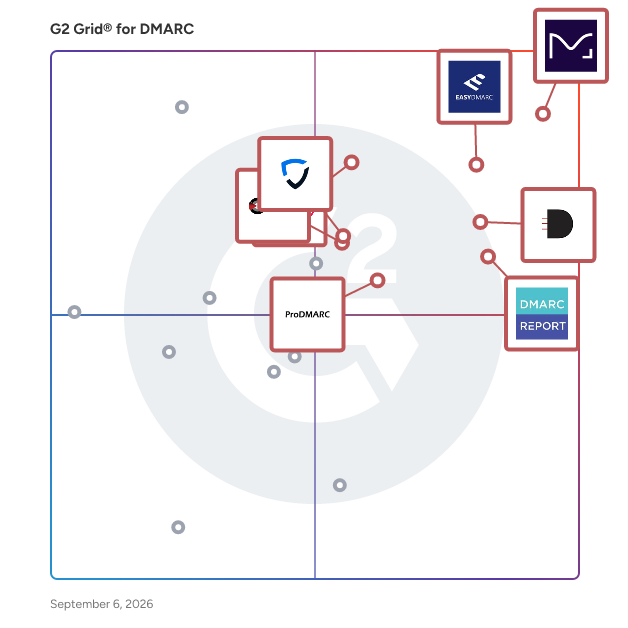
G2 Grid® for DMARC Software

G2 Grid® for DMARC Software plotting products by satisfaction and market presence

Highlighted products: Valimail, EasyDMARC, PowerDMARC, DMARC Report, Red Sift OnDMARC, Sendmarc, CTM360, and ProDMARC.

Underlying data: [Grid® JSON](https://www.g2.com/categories/dmarc/grids.json?focus%5B%5D=valimail&focus%5B%5D=easydmarc&focus%5B%5D=powerdmarc&focus%5B%5D=dmarc-report&focus%5B%5D=red-sift-red-sift-ondmarc&focus%5B%5D=sendmarc&focus%5B%5D=ctm360-ctm360&focus%5B%5D=prodmarc)

Valimail

Valimail: The Leader in Email Authentication & Brand Protection Valimail is the trusted leader in automated email authentication, helping organizations achieve and maintain DMARC enforcement up to 4x faster with a unique blend of speed, simplicity, and automation. By eliminating manual processes, Valimail ensures that your brand stays protected against phishing, spoofing, and email fraud while improving email deliverability and brand trust. Valimail offers three solutions: 1) Valimail Monitor provides organizations with global visibility into all senders using their domains, removing the complexity of interpreting raw DMARC reports. Key Features & Benefits: -See Who’s Sending on Your Behalf – Instantly identify all senders using your domain and authorize the right ones. -Check Google & Yahoo Readiness – Get a real-time check to ensure your domain meets Google & Yahoo’s latest DMARC, DKIM, and SPF requirements. -Preview BIMI for Your Brand – Upload your logo and see how it would appear in inboxes on mobile and desktop. >> First step towards DMARC enforcement – Identify and authorize all senders before making changes that impact email flow. 2) Valimail Enforce is the only FedRAMP-certified platform and the vetted DMARC partner for Microsoft 365, offering fully automated DMARC, SPF, and DKIM configuration to eliminate errors and simplify implementation. Key Features & Benefits: -Automated DMARC, DKIM, and SPF Configuration – Reduce the risk of misconfiguration and achieve enforcement faster. -Expert DMARC Support & Advisory Services – Get direct access to technical support for tailored guidance and rapid issue resolution. -Powerful Analytics & Reporting – Gain actionable insights into email performance, phishing attempts, and domain spoofing. >> Stop phishing attacks, prevent brand impersonation, and ensure only legitimate emails reach inboxes. 3) Valimail Amplify helps brands stand out in crowded inboxes by enabling BIMI (Brand Indicators for Message Identification) and displaying your verified brand logo directly in emails. Key Features & Benefits: -Enhanced Brand Visibility & Competitive Edge – Your logo appears directly in inboxes, making your emails instantly recognizable. -Boost Engagement & Trust – Recipients trust and engage more with branded emails, improving open rates and conversions. -Seamless BIMI Implementation – The only fully automated BIMI solution, offering single-click logo configuration and automated VMC/CMC management. -Effortless Brand Asset Management – Easily assign, update, or swap logos across domains. >> For companies at DMARC enforcement, Amplify accelerates BIMI adoption—ensuring your logo appears in inboxes faster. For more information visit www.valimail.com.

Average Rating: 4.5/5.0

Total Reviews: 666

How Do G2 Users Rate Valimail?

  • Ease of Use: 8.9/10 (Category avg: 9.4/10)
  • DMARC Alignment: 9.3/10 (Category avg: 9.6/10)
  • Threat Identifications: 8.5/10 (Category avg: 9.3/10)
  • Analytics: 8.6/10 (Category avg: 9.4/10)

Who Is the Company Behind Valimail?

  • Seller: Valimail
  • Company Website:
  • Year Founded: 2015
  • HQ Location: Denver, CO
  • Twitter: @ValiMail
    1,110 Twitter followers
  • LinkedIn® Page: linkedin.com
    101 employees on LinkedIn®

Who Uses This Product?

  • Who Uses This: IT Manager, Owner
  • Top Industries: Information Technology and Services, Computer Software
  • Company Size: 46% Small, 33% Medium

What Do G2 Reviewers Say About Valimail?

AI-generated summary from verified user reviews

Pros
  • Users appreciate the ease of use of Valimail, benefiting from its intuitive dashboard and automated tools.
  • Users value Valimail's automated DMARC enforcement, enhancing email security and simplifying the management process significantly.
  • Users praise the easy setup of Valimail, appreciating the straightforward process and helpful customer support during implementation.
  • Users appreciate the easy setup of Valimail, enabling quick configuration and effective DMARC management.
  • Users praise the brilliant reporting features of Valimail, enhancing security and simplifying domain management.
Cons
  • Users find Valimail expensive, especially small businesses struggling with additional costs for necessary features and subscriptions.
  • Users find Valimail's reporting limited and lacking in detail, reducing its effectiveness for audits and reviews.
  • Users find the complexity of Valimail's setup and learning curve challenging, especially for non-technical users.
  • Users find a lack of detail in Valimail's reporting and tier access, complicating their overall experience.
  • Users express concerns about the lack of advanced features, such as MTA-STS management and DKIM key management.

What Are Recent G2 Reviews of Valimail?

What Are G2 Users Discussing About Valimail?

EasyDMARC

EasyDMARC is a one-stop platform for securing your email domain infrastructure and boosting email deliverability for your peace of mind. Trusted by 83,000 businesses globally, our time-saving solutions simplify and automate your DMARC journey, helping you minimize the risk of cyberattacks while ensuring your emails reach the right inboxes. Our intuitive platform protects your data and brand reputation by automating DMARC setup and management, preventing domain spoofing, and optimizing email authentication processes with tools like the Smart Alerting System, DMARC Wizard, and EasySPF. Gain in-depth visibility into your email ecosystem, monitor traffic, analyze authentication results, and safeguard your domain's reputation without compromising data privacy. With a user-friendly interface and no requirement for technical expertise, EasyDMARC empowers businesses of all sizes to manage email authentication effortlessly.

Average Rating: 4.7/5.0

Total Reviews: 284

How Do G2 Users Rate EasyDMARC?

  • Ease of Use: 9.3/10 (Category avg: 9.4/10)
  • DMARC Alignment: 9.5/10 (Category avg: 9.6/10)
  • Threat Identifications: 9.0/10 (Category avg: 9.3/10)
  • Analytics: 9.4/10 (Category avg: 9.4/10)

Who Is the Company Behind EasyDMARC?

  • Seller: EasyDMARC
  • Company Website:
  • Year Founded: 2018
  • HQ Location: Dover, US
  • Twitter: @easydmarc
    972 Twitter followers
  • LinkedIn® Page: www.linkedin.com
    121 employees on LinkedIn®

Who Uses This Product?

  • Who Uses This: Owner, CEO
  • Top Industries: Information Technology and Services, Computer & Network Security
  • Company Size: 41% Small, 25% Medium

What Do G2 Reviewers Say About EasyDMARC?

AI-generated summary from verified user reviews

Pros
  • Users love the ease of use of EasyDMARC, finding it simple to configure and highly effective for reporting.
  • Users praise the quick and excellent customer support provided by EasyDMARC, enhancing their overall experience.
  • Users appreciate the ease of DMARC management with EasyDMARC, significantly simplifying their email security processes.
  • Users highly value the intuitive dashboard insights of EasyDMARC, which simplify monitoring and enhance security management.
  • Users find the easy setup of EasyDMARC exceptionally user-friendly, enhancing their overall experience with the product.
Cons
  • Users express frustration with the limited functionality of EasyDMARC, making domain management and billing challenging.
  • Users feel that the product is expensive, with limited value for larger organizations and high pricing model pressures.
  • Users report DMARC issues related to basic reporting, unresolved bugs, and confusion over CNAME record usage.
  • Users find the complexity of setup for new domains and subdomains to be challenging and often confusing.
  • Users struggle with DNS problems, losing control and facing confusion in subdomain setups and manual changes.

What Are Recent G2 Reviews of EasyDMARC?

What Are G2 Users Discussing About EasyDMARC?

PowerDMARC

PowerDMARC is an email authentication platform that helps organizations protect their domain name, brand, and emails against spoofing, impersonation, ransomware, and other forms of unauthorized use. Trusted by over 1,000 organizations, including Fortune 100 companies and government agencies across 100 countries, PowerDMARC provides a unified platform for deploying, monitoring, and managing critical email authentication protocols: DMARC, SPF, DKIM, BIMI, MTA-STS, and TLS-RPT. The platform transforms complex technical protocols into actionable insights, enabling security teams to protect their email channels without requiring deep DNS expertise. PowerDMARC helps organizations: -Achieve DMARC enforcement faster – Guided implementation tools, one-click DNS publishing, and simplified aggregate/forensic reporting help security teams move from monitoring to full email protection (p=reject) without blocking legitimate mail or disrupting business operations. -Gain complete email channel visibility – AI-powered Threat Intelligence analyzes millions of data points to identify unauthorized senders, spoofing attempts, lookalike domains, and email deliverability issues in real-time through human-readable reports. -Simplify complex authentication management – One centralized dashboard consolidates SPF record optimization (with automatic flattening to stay under the 10-lookup limit), DKIM key management, and DMARC policy configuration – eliminating manual DNS troubleshooting. -Meet compliance and security standards – SOC 2 Type 2, ISO 27001 certified, and GDPR compliant infrastructure ensures enterprise-grade security for regulated industries including finance, healthcare, and government sectors. -Scale across multiple domains and clients – MSP/MSSP-ready architecture with full multi-tenancy support and white-label capabilities enables partners to onboard, manage, and monitor thousands of client domains from a single interface with custom branding. PowerDMARC serves a global network of 500+ channel partners and supports organizations ranging from small businesses implementing their first DMARC policy to large enterprises managing complex multi-domain email ecosystems across multiple business units. The platform integrates seamlessly with major email service providers and security tools, delivering continuous monitoring and instant alerts when authentication failures or potential threats are detected. With dedicated onboarding support and extensive documentation, teams can deploy email authentication protocols quickly and confidently. Whether you're protecting a single domain from impersonation attacks or an MSP managing email security for hundreds of clients, PowerDMARC provides the tools to authenticate legitimate email, block malicious senders, improve email deliverability, and build trust with every message sent from your domain. For more information head to www.powerdmarc.com

Average Rating: 4.9/5.0

Total Reviews: 266

How Do G2 Users Rate PowerDMARC?

  • Ease of Use: 9.4/10 (Category avg: 9.4/10)
  • DMARC Alignment: 9.7/10 (Category avg: 9.6/10)
  • Threat Identifications: 9.3/10 (Category avg: 9.3/10)
  • Analytics: 9.5/10 (Category avg: 9.4/10)

Who Is the Company Behind PowerDMARC?

  • Seller: PowerDMARC
  • Company Website:
  • Year Founded: 2020
  • HQ Location: Middletown, Delaware
  • Twitter: @powerdmarc
    190 Twitter followers
  • LinkedIn® Page: www.linkedin.com
    38 employees on LinkedIn®

Who Uses This Product?

  • Who Uses This: Owner, CEO
  • Top Industries: Information Technology and Services, Computer & Network Security
  • Company Size: 65% Small, 24% Medium

What Do G2 Reviewers Say About PowerDMARC?

AI-generated summary from verified user reviews

Pros
  • Users commend the exceptional customer support of PowerDMARC, ensuring smooth implementation and assistance throughout the process.
  • Users appreciate the ease of use of PowerDMARC, thanks to its intuitive interface and excellent support.
  • Users value the intuitive DMARC management of PowerDMARC, simplifying email security monitoring across multiple domains.
  • Users value the intuitive and user-friendly interface of PowerDMARC, enhancing accessibility and management for all users.
  • Users commend the easy setup process of PowerDMARC, facilitated by efficient support and intuitive tools.
Cons
  • Users find the initial setup complex, especially those unfamiliar with email authentication, complicating their experience.
  • Users experience slow performance with PowerDMARC, resulting in noticeable delays between actions and variable website response times.
  • Users note the high cost of PowerDMARC, which can be a barrier for some businesses and clients.
  • Users express frustration with poor customer support, particularly due to the lack of local assistance and response delays.
  • Users find PowerDMARC's services costly for SMBs and MSPs, making it challenging to onboard all clients easily.

What Are Recent G2 Reviews of PowerDMARC?

What Are G2 Users Discussing About PowerDMARC?

DMARC Report

Block malware and phishing attacks. A DMARC reporting solution for MSPs, service providers, and businesses who need to monitor and manage a large number of domains for DMARC compliance. Secure and monitor multiple domains with enterprise-grade DMARC management. DMARC Report is a comprehensive email authentication and reporting platform built to give organizations full visibility and control over how their domains are used in email. As phishing, spoofing, and business email compromise attacks continue to rise, simply publishing a DMARC record is no longer enough. DMARC Report helps teams actively monitor DMARC performance, identify unauthorized senders, and confidently move toward enforcement without risking legitimate email delivery. Designed for MSPs, IT service providers, security teams, and growing enterprises, DMARC Report makes it easy to manage DMARC across dozens or even hundreds of domains from a single dashboard. The platform automatically collects, parses, and visualizes DMARC aggregate and forensic reports, transforming complex XML data into clear, actionable insights. Users can instantly see which senders are authentic, which are misaligned, and which may pose a security threat. DMARC Report goes beyond basic reporting by helping organizations understand SPF and DKIM alignment issues that impact both deliverability and security. Detailed source analysis, timeline views, and policy readiness indicators allow teams to troubleshoot authentication problems quickly and prioritize remediation. Real-time alerts notify users of sudden spikes in suspicious activity, helping prevent attacks before they escalate into costly incidents. Built with scale and compliance in mind, DMARC Report supports multi-domain management, role-based access, and team collaboration. MSPs and agencies can easily segment customer domains, provide reporting access, and demonstrate measurable security improvements to clients. For enterprises, the platform simplifies governance by centralizing DMARC oversight while maintaining strict data controls. Privacy and data protection are core to the platform’s design. DMARC Report follows a privacy-first approach to DMARC data handling, making it suitable for organizations operating under strict regulatory and compliance requirements. Unlike tools that prioritize volume over clarity, DMARC Report focuses on accuracy, transparency, and usability—ensuring teams can act on insights without needing deep DMARC expertise. Getting started is fast and straightforward. With guided onboarding and clear recommendations, users can progress from monitoring to quarantine or reject policies with confidence. Flexible pricing tiers accommodate everything from small domain portfolios to high-volume, enterprise-scale environments, with options for annual savings and custom plans. By combining enterprise-grade security, intuitive reporting, and scalable domain management, DMARC Report empowers organizations to protect their brand, improve email deliverability, and reduce the risk of phishing and impersonation attacks. Whether you manage email for a single business or hundreds of clients, DMARC Report provides the visibility and control needed to make DMARC work—at scale and with confidence.

Average Rating: 4.8/5.0

Total Reviews: 470

G2 Deal: Get 33% off any Yearly plan

Use coupon code - g2deal - and get 33% off any yearly plan.

View this exclusive G2 deal

How Do G2 Users Rate DMARC Report?

  • Ease of Use: 9.0/10 (Category avg: 9.4/10)
  • DMARC Alignment: 9.7/10 (Category avg: 9.6/10)
  • Threat Identifications: 9.1/10 (Category avg: 9.3/10)
  • Analytics: 9.2/10 (Category avg: 9.4/10)

Who Is the Company Behind DMARC Report?

  • Seller: DuoCircle LLC
  • Company Website:
  • Year Founded: 2014
  • HQ Location: San Diego, CA
  • Twitter: @duocirclellc
    130 Twitter followers
  • LinkedIn® Page: www.linkedin.com
    13 employees on LinkedIn®

Who Uses This Product?

  • Who Uses This: CEO, Owner
  • Top Industries: Marketing and Advertising, Information Technology and Services
  • Company Size: 88% Small, 4% Medium

What Do G2 Reviewers Say About DMARC Report?

AI-generated summary from verified user reviews

Pros
  • Users value the easy setup and comprehensive reporting of DMARC Report, enhancing their DMARC management experience.
  • Users value the easy setup process of DMARC Report, enhancing efficiency and ensuring seamless client onboarding.
  • Users appreciate the ease of use of DMARC Report, simplifying setup and streamlining their workflow effectively.
  • Users appreciate the easy domain verification offered by DMARC Report, enhancing email deliverability and management efficiency.
  • Users praise the user-friendly dashboard of DMARC Report, simplifying email security management with clear insights and efficiency.
Cons
  • Users find the interface design clunky, which adds unnecessary complexity to navigating and analyzing data effectively.
  • Users find the complexity of DMARC Report challenging, particularly for those less familiar with DMARC concepts.
  • Users find the outdated interface somewhat challenging, yet manageable for accessing necessary data.
  • Users find the documentation lacking, making troubleshooting and complex integrations unnecessarily difficult and time-consuming.
  • Users find the poor navigation of DMARC Report challenging, making data analysis and usability less effective.

What Are Recent G2 Reviews of DMARC Report?

What Are G2 Users Discussing About DMARC Report?

Red Sift OnDMARC

Red Sift OnDMARC is a DMARC management and email authentication platform that helps organizations stop unauthorized use of their email domains and reach full DMARC enforcement. Over 1,200 organizations across healthcare, finance, retail, and government use OnDMARC, including Domino's, Capgemini, ZoomInfo, Athletic Greens, and Wise. DMARC (Domain-based Message Authentication, Reporting & Conformance) is an email security standard that prevents attackers from spoofing a domain. Getting to p=reject, the enforcement level where domain spoofing is actually blocked, typically takes security teams months without dedicated tooling. OnDMARC cuts that to 6-8 weeks through guided configuration, automated DNS record management, and real-time visibility into authentication status across sending services. Reports give security and deliverability teams a clear picture of which services are sending on behalf of their domains, what's passing authentication, and what needs to be fixed. OnDMARC covers the full range of email authentication protocols: DMARC, DKIM, SPF, MTA-STS, and BIMI. Record updates are automated, removing the need for manual DNS edits and reducing the chance of misconfiguration. Key capabilities - Fast path to enforcement. Guided configuration and automated record updates help security teams reach p=reject in 6-8 weeks. - Investigate. An audit tool for inspecting sending sources, identifying misconfigurations, and tracing authentication failures back to their source. - Protocol automation. Ongoing management of DMARC, DKIM, SPF, MTA-STS, and BIMI without manual DNS intervention. - BIMI and VMC provisioning. Supports Brand Indicators for Message Identification setup and Verified Mark Certificate provisioning for inbox logo display. - DNS Guardian. Monitors DNS records for misconfigurations such as dangling CNAMEs that can expose domains to takeover and SubdoMailing-style attacks. - Red Sift Radar. An AI-assisted analysis layer that surfaces contextual recommendations, helping teams identify and fix email misconfigurations faster. OnDMARC is used by security teams, IT administrators, and email deliverability professionals across organizations of all sizes, including enterprises and regulated industries where email authentication compliance is part of broader security requirements.

Average Rating: 4.8/5.0

Total Reviews: 107

How Do G2 Users Rate Red Sift OnDMARC?

  • Ease of Use: 9.4/10 (Category avg: 9.4/10)
  • DMARC Alignment: 9.6/10 (Category avg: 9.6/10)
  • Threat Identifications: 8.6/10 (Category avg: 9.3/10)
  • Analytics: 9.1/10 (Category avg: 9.4/10)

Who Is the Company Behind Red Sift OnDMARC?

  • Seller: Red Sift
  • Company Website:
  • Year Founded: 2015
  • HQ Location: London, England, United Kingdom
  • Twitter: @redsift
    1,267 Twitter followers
  • LinkedIn® Page: www.linkedin.com
    97 employees on LinkedIn®

Who Uses This Product?

  • Top Industries: Financial Services, Retail
  • Company Size: 55% Medium, 28% Large

What Do G2 Reviewers Say About Red Sift OnDMARC?

AI-generated summary from verified user reviews

Pros
  • Users praise the fantastic customer support of Red Sift OnDMARC, making implementation and configuration seamless and efficient.
  • Users commend the ease of use of Red Sift OnDMARC, highlighting its simplicity and efficiency for busy professionals.
  • Users commend the extremely easy setup of Red Sift OnDMARC, enabling a smooth transition and efficient management.
  • Users value the ease of setup with Red Sift OnDMARC, allowing for seamless implementation and efficient management.
  • Users value the ease of implementation of Red Sift OnDMARC, finding it intuitive and user-friendly.
Cons
  • Users find the complexity of the platform overwhelming initially, but support helps ease the learning curve.
  • Users find the dashboard overwhelming, requiring time to learn and adapt to its complexity and frequent changes.
  • Users note the insufficient data in reports, limiting the ability to fully trace email sources effectively.
  • Users face challenges with DNS problems as manual updates are needed, risking communication lapses and oversight.
  • Users find the poor navigation of Red Sift OnDMARC challenging, especially when using the portal and support pages.

What Are Recent G2 Reviews of Red Sift OnDMARC?

What Are G2 Users Discussing About Red Sift OnDMARC?

Sendmarc

Sendmarc is a DMARC implementation and management platform designed to help organizations authenticate their email domains and gain full visibility of their email-sending ecosystem. The platform consolidates and analyzes data from multiple email service providers, enabling teams to assess configuration issues, monitor authentication activity, and identify unauthorized senders. Our implementation process supports organizations in safely moving toward a DMARC enforcement policy, reducing email impersonation and spoofing risks while ensuring that legitimate email continues to flow as expected. The platform is built to minimize configuration errors and provide clear, actionable reporting so teams can make informed decisions. Sendmarc focuses exclusively on DMARC, SPF, DKIM, and related email authentication standards. Customers work with engineers experienced in these protocols, and many organizations reach full domain protection within a 90-day period. This approach helps organizations strengthen their email security posture, meet industry compliance requirements, improve visibility, and support more reliable email delivery.

Average Rating: 4.9/5.0

Total Reviews: 51

How Do G2 Users Rate Sendmarc?

  • Ease of Use: 9.5/10 (Category avg: 9.4/10)
  • DMARC Alignment: 10.0/10 (Category avg: 9.6/10)
  • Threat Identifications: 9.7/10 (Category avg: 9.3/10)
  • Analytics: 9.7/10 (Category avg: 9.4/10)

Who Is the Company Behind Sendmarc?

  • Seller: Sendmarc
  • Company Website:
  • Year Founded: 2018
  • HQ Location: Wilmington, US
  • Twitter: @sendmarc
    70 Twitter followers
  • LinkedIn® Page: www.linkedin.com
    92 employees on LinkedIn®

Who Uses This Product?

  • Top Industries: Information Technology and Services, Computer & Network Security
  • Company Size: 44% Small, 35% Medium

What Do G2 Reviewers Say About Sendmarc?

AI-generated summary from verified user reviews

Pros
  • Users find implementation incredibly easy with Sendmarc, praising its clear guidance and helpful support throughout the process.
  • Users value the excellent customer support from Sendmarc, appreciating the guidance and knowledge during onboarding and implementation.
  • Users appreciate the ease of use of Sendmarc, noting its simple onboarding and clear documentation for domain security.
  • Users value the clear and comprehensive guidance from Sendmarc, enhancing their understanding of domain security improvements.
  • Users value the user-friendly interface of Sendmarc, making domain security management simple and effective.
Cons
  • Users desire more inadequate reporting features and export options, indicating a need for improvement in data management.
  • Users desire more built-in reporting and export options for data, currently limited in Sendmarc.
  • Users desire more limited reporting and export options for data within Sendmarc, but can request enhancements.

What Are Recent G2 Reviews of Sendmarc?

CTM360

CTM360 is a consolidated external security platform that integrates External Attack Surface Management, Digital Risk Protection, Cyber Threat Intelligence, Brand Protection & Anti-phishing, Surface, Deep, & Dark Web Monitoring, Security Ratings, Third-party risk Management, and fully managed unlimited Takedowns. As a pioneer and innovator in preemptive security, CTM360 operates as an external CTEM technology platform outside an organization’s perimeter. Seamless and turn-key, CTM360 requires no configurations, installations or inputs from the end-user, with all data pre-populated and specific to your organization. All aspects are managed by CTM360.

Average Rating: 4.6/5.0

Total Reviews: 173

How Do G2 Users Rate CTM360?

  • Ease of Use: 9.2/10 (Category avg: 9.4/10)
  • DMARC Alignment: 9.3/10 (Category avg: 9.6/10)
  • Threat Identifications: 8.8/10 (Category avg: 9.3/10)
  • Analytics: 9.0/10 (Category avg: 9.4/10)

Who Is the Company Behind CTM360?

  • Seller: CTM360
  • Company Website:
  • Year Founded: 2014
  • HQ Location: Manama, BH
  • Twitter: @teamCTM360
    999 Twitter followers
  • LinkedIn® Page: www.linkedin.com
    136 employees on LinkedIn®

Who Uses This Product?

  • Top Industries: Banking, Financial Services
  • Company Size: 37% Large, 37% Medium

What Do G2 Reviewers Say About CTM360?

AI-generated summary from verified user reviews

Pros
  • Users commend the top-notch customer support of CTM360, highlighting responsive and knowledgeable assistance at every level.
  • Users commend the ease of use of CTM360, appreciating its straightforward setup and user-friendly interface.
  • Users admire the comprehensive platform of CTM360, which effectively enhances proactive cybersecurity and incident response.
  • Users commend the effective monitoring capabilities of CTM360, aiding quick identification of risks and enhancing security posture.
  • Users praise the high detection efficiency of CTM360, appreciating its accuracy and proactive risk management capabilities.
Cons
  • Users note the limited features of CTM360, particularly on the Android app compared to the web portal.
  • Users are frustrated by the integration issues with existing security infrastructures, seeking better compatibility and usability.
  • Users note a lack of features in CTM360, particularly compared to the web portal and community edition limitations.
  • Users face a lack of integration with existing security systems, limiting automated data feeds and user experience.
  • Users find the lack of integrations with existing security tools limits automated daily security feeds and functionality.

What Are Recent G2 Reviews of CTM360?

ProDMARC

ProDMARC offers end-to-end support, from planning and configuration to monitoring and fine-tuning. The platform’s experts ensure a smooth and efficient DMARC deployment tailored to each organization’s unique needs. ProDMARC's project management covers everything: initial planning, technical setup, and ongoing analysis of results, so you can confidently move from monitoring mode to enforcement. Key Features & Benefits of ProDMARC: 1. Seamless SPF, DKIM, and DMARC Setup: User-friendly tools for implementing and optimizing email authentication. 2. Full Visibility of Outbound Email Sources: Easily distinguish between legitimate senders, authorized third parties, and potential threats like spammers or fraudsters. 3. Insightful Analytics: Track trends and volumes of outgoing emails, including phishing attempts, to stay ahead of threats. 4. Reliable Email Delivery Assurance: Ensure outgoing emails meet SPF, DKIM, and DMARC standards, minimizing the risk of false positives. 5. Guidance for DMARC Transition: Actionable insights to help you move confidently from DMARC monitoring to full enforcement. 6. Detailed Forensic Data: Access sample forensic reports for attempted phishing attacks, offering critical details for better threat management. ProDMARC is the choice for companies serious about email security, providing the tools and insights needed to safeguard their digital communication.

Average Rating: 4.9/5.0

Total Reviews: 57

How Do G2 Users Rate ProDMARC?

  • Ease of Use: 9.5/10 (Category avg: 9.4/10)
  • DMARC Alignment: 9.4/10 (Category avg: 9.6/10)
  • Threat Identifications: 9.7/10 (Category avg: 9.3/10)
  • Analytics: 9.5/10 (Category avg: 9.4/10)

Who Is the Company Behind ProDMARC?

  • Seller: PROGIST
  • Year Founded: 2017
  • HQ Location: Mumbai, Maharashtra
  • LinkedIn® Page: www.linkedin.com
    64 employees on LinkedIn®

Who Uses This Product?

  • Top Industries: Banking, Financial Services
  • Company Size: 60% Large, 28% Medium

What Do G2 Reviewers Say About ProDMARC?

AI-generated summary from verified user reviews

Pros
  • Users value the fast and helpful customer support from ProDMARC, enhancing their overall experience and satisfaction.
  • Users value the user-friendly DMARC management of ProDMARC, enhancing email security with clear insights and support.
  • Users value the easy email security provided by ProDMARC, ensuring enhanced deliverability and brand protection effortlessly.
  • Users value the user-friendly interface of ProDMARC, appreciating its intuitive design and responsive customer support.
  • Users value the easy monitoring and management of email authentication provided by ProDMARC, enhancing security and efficiency.
Cons
  • Users find the initial setup complex for beginners, though documentation and support help mitigate difficulties.
  • Users find the initial setup complex for ProDMARC, which may hinder the onboarding experience for beginners.
  • Users find the limited functionality of ProDMARC restrictive, especially for complex email-sending environments and policy customization.
  • Users note that while ProDMARC's pricing is acceptable, there is room for improvement in costly services.
  • Users feel that ProDMARC offers limited policy customization compared to manual DMARC setups, which can be frustrating.

What Are Recent G2 Reviews of ProDMARC?

Mimecast DMARC Analyzer

Safeguard your organization's data with Mimecast, combining continuous backup, advanced archiving, and resilient recovery solutions to ensure data protection, compliance, and peace of mind.

Average Rating: 4.2/5.0

Total Reviews: 15

How Do G2 Users Rate Mimecast DMARC Analyzer?

  • Ease of Use: 9.0/10 (Category avg: 9.4/10)
  • DMARC Alignment: 9.0/10 (Category avg: 9.6/10)
  • Threat Identifications: 9.2/10 (Category avg: 9.3/10)
  • Analytics: 8.8/10 (Category avg: 9.4/10)

Who Is the Company Behind Mimecast DMARC Analyzer?

  • Seller: Mimecast
  • Year Founded: 2003
  • HQ Location: London
  • Twitter: @Mimecast
    18,007 Twitter followers
  • LinkedIn® Page: www.linkedin.com
    2,388 employees on LinkedIn®
  • Ownership: NASDAQ: MIME

Who Uses This Product?

  • Company Size: 40% Small, 40% Large

What Do G2 Reviewers Say About Mimecast DMARC Analyzer?

AI-generated summary from verified user reviews

Pros
  • Users praise the excellent customer support of Mimecast DMARC Analyzer for guiding them seamlessly through implementation.
  • Users value the friendly support from Mimecast, making implementation straightforward and enhancing the overall experience.
  • Users find the implementation process easy with great support, making setup straightforward and efficient.
  • Users value the comprehensive reporting feature of Mimecast DMARC Analyzer, making data presentation easy and effective.
  • Users commend the excellent troubleshooting support from Mimecast, making implementation straightforward and stress-free.

What Are Recent G2 Reviews of Mimecast DMARC Analyzer?

Palisade DMARC

Palisade is a DMARC and email-authentication platform built around an AI agent that does the work, not just the reporting. Most DMARC tools hand your team a task list. Palisade's agent reads your aggregate reports, opens a prioritized ticket for every sender, SPF, DKIM and DMARC issue with the fix already drafted, and — with Hosted DNS — deploys the approved fix for you. The agent investigates every sender, drafts every fix, and proposes each policy step — you approve before anything ships. Work on your domains from the AI you already use. Palisade is MCP-ready: connect Claude, ChatGPT, Copilot, or any MCP-compatible assistant and work on your domains from the AI you already use — check records, review tickets, and plan the path to enforcement. Reach p=reject without blocking real mail. Palisade moves domains through p=none to quarantine to reject in stages, classifying each sender as Pending, Confirmed or Discarded on 14 days of pass/fail evidence. Most platforms park you at p=none indefinitely; Palisade is built to get you to enforcement safely. See your whole sending estate. Every ESP, CRM and automation tool sending as your domain, which ones fail SPF or DKIM, and what to do about it, before campaigns land in spam. Google and Microsoft bulk-sender requirements covered. Built for MSPs and agencies too. Multi-tenant dashboard, white-label assessments that open sales conversations, ConnectWise, Autotask and HaloPSA sync, per-client-domain pricing that improves with portfolio size, and a free NFR license for your own domain. Transparent, flat pricing. Plans are priced by monthly email volume, from $19/month, with every organization domain included, unlimited users, and API access on every plan including Free. Start free on your first domain forever, or take a 15-day full-product trial. No credit card required for either. Plus 21 free email-security tools: DMARC, SPF, DKIM, BIMI and MTA-STS checkers, record generators, a header analyzer, and reputation and blocklist checks, all usable without an account.

Average Rating: 5.0/5.0

Total Reviews: 47

How Do G2 Users Rate Palisade DMARC?

  • Ease of Use: 9.1/10 (Category avg: 9.4/10)
  • DMARC Alignment: 8.7/10 (Category avg: 9.6/10)
  • Threat Identifications: 8.8/10 (Category avg: 9.3/10)
  • Analytics: 9.1/10 (Category avg: 9.4/10)

Who Is the Company Behind Palisade DMARC?

  • Seller: Palisade
  • Year Founded: 2023
  • HQ Location: Montreal, Canada
  • Twitter: @Palisade_email
    677 Twitter followers
  • LinkedIn® Page: www.linkedin.com
    8 employees on LinkedIn®

Who Uses This Product?

  • Top Industries: Computer Software, Information Technology and Services
  • Company Size: 55% Medium, 45% Small

What Are Recent G2 Reviews of Palisade DMARC?

ZeroBounce

ZeroBounce is an award-winning email verification and deliverability platform helping 400,000+ customers improve their email ROI and inbox placement. Its premier deliverability services include: 99% accurate email validation - Remove outdated and risky email addresses to lower email bounce rates and maintain a positive sender reputation. Email Finder - Find new, valid business email addresses and scale your B2B outreach DMARC Monitor - Secure your emails and prevent phishing scams with unlimited email monitoring, security alerts, and automated reporting Email Deliverability Tools - Improve inbox visibility with customized toolkits. Includes email server testing, inbox placement testing, Email Finder, and DMARC Monitoring Activity Data & Email Scoring - Find your most active email subscribers with Activity Data. Additionally, Email Scoring service provides more in-depth insights about your email list to help you achieve email success. ZeroBounce has validated 25+ billion emails and serves companies of all sizes, from solo business owners to Amazon, Disney, Netflix, and Sephora. The platform ensures military-grade security and is GDPR, SOC 2 Type II, ISO-27001-certified, and fully HIPAA compliant.

Average Rating: 4.7/5.0

Total Reviews: 1,357

How Do G2 Users Rate ZeroBounce?

  • Ease of Use: 9.5/10 (Category avg: 9.4/10)
  • DMARC Alignment: 9.3/10 (Category avg: 9.6/10)
  • Threat Identifications: 9.0/10 (Category avg: 9.3/10)
  • Analytics: 9.0/10 (Category avg: 9.4/10)

Who Is the Company Behind ZeroBounce?

  • Seller: ZeroBounce
  • Company Website:
  • Year Founded: 2015
  • HQ Location: Santa Barbara, California
  • Twitter: @zerobounce1
    657 Twitter followers
  • LinkedIn® Page: www.linkedin.com
    109 employees on LinkedIn®

Who Uses This Product?

  • Who Uses This: Marketing Manager, CEO
  • Top Industries: Marketing and Advertising, Information Technology and Services
  • Company Size: 29% Small, 11% Medium

What Do G2 Reviewers Say About ZeroBounce?

AI-generated summary from verified user reviews

Pros
  • Users value the high accuracy of ZeroBounce's reports, which enhances lead quality and generation performance.
  • Users appreciate the ease of use of ZeroBounce, enjoying quick and accurate email validation for campaigns.
  • Users value the high accuracy of email validation, ensuring reliable contact lists while enhancing domain protection.
  • Users value the effective email validation of ZeroBounce, enhancing domain protection by filtering invalid emails.
  • Users appreciate the quick and accurate deliverability improvement of ZeroBounce, boosting lead quality and campaign performance.
Cons
  • Users find ZeroBounce's pricing to be on the higher side, making it less accessible for large email lists.
  • Users report inaccuracy in email validation, noting occasional misclassification of valid addresses and greylisting delays.
  • Users experience verification issues with ZeroBounce, leading to inconsistencies in email safety and reliability.
  • Users find the costly services of ZeroBounce can be high for large volumes, limiting accessibility and flexibility.
  • Users find the credit limitations on ZeroBounce frustrating, especially when verifying large lists quickly depletes available credits.

What Are Recent G2 Reviews of ZeroBounce?

What Are G2 Users Discussing About ZeroBounce?

Suped

Suped is a powerful yet user-friendly DMARC monitoring platform designed to demystify email authentication and secure your domain. We provide a complete solution that empowers you to take full control of your email ecosystem, protect your brand reputation, and ensure your legitimate emails always reach the inbox. Gain Unprecedented Visibility into Your Email Channels Suped transforms complex DMARC data into actionable insights. Our platform processes both aggregate (RUA) and forensic (RUF) reports, presenting them through an intuitive dashboard with clear visualizations. Instantly see your DMARC policy effectiveness, track SPF and DKIM alignment across all your email sources, and monitor your overall domain health, including reputation status and blocklist mentions. With a clear view of your compliance score and weekly trends, you'll always know where you stand. Proactive Threat Detection and Real-Time Alerts Go beyond passive monitoring with proactive threat detection. Suped provides real-time alerts the moment an unauthorized source attempts to send email using your domain. These instant notifications allow you to identify and shut down spoofing and phishing attacks as they happen, protecting your brand, your customers, and your partners from malicious actors. From Monitoring to Enforcement with Expert Guidance Implementing DMARC shouldn't be a leap of faith. Suped offers expert, step-by-step policy guidance to help you safely transition your DMARC policy from monitoring (p=none) to full enforcement (p=quarantine or p=reject). Our recommendations are designed to help you gradually strengthen your security posture without risking the deliverability of your legitimate emails. We guide you through the process of authenticating valid sources and achieving full compliance, making domain protection accessible to everyone. Whether you're an IT administrator, a security professional, or a business owner, Suped provides the tools and clarity you need to secure your domain, build trust with your recipients, and stop email fraud in its tracks.

Average Rating: 5.0/5.0

Total Reviews: 57

How Do G2 Users Rate Suped?

  • Ease of Use: 9.7/10 (Category avg: 9.4/10)
  • DMARC Alignment: 9.9/10 (Category avg: 9.6/10)
  • Threat Identifications: 9.9/10 (Category avg: 9.3/10)
  • Analytics: 8.0/10 (Category avg: 9.4/10)

Who Is the Company Behind Suped?

  • Seller: Suped
  • Year Founded: 2025
  • HQ Location: Sydney, AU
  • LinkedIn® Page: www.linkedin.com
    2 employees on LinkedIn®

Who Uses This Product?

  • Who Uses This: Owner
  • Top Industries: Consumer Services, Information Technology and Services
  • Company Size: 84% Small, 30% Medium

What Do G2 Reviewers Say About Suped?

AI-generated summary from verified user reviews

Pros
  • Users highlight the ease of use of Suped, appreciating its intuitive design and prompt support for beginners.
  • Users value the clean and intuitive dashboard of Suped, enhancing navigation and quick insights for decision-making.
  • Users praise the exceptional detection accuracy of Suped, noting its clear reporting and insightful analytics for informed decisions.
  • Users appreciate the supportive customer service of Suped, enhancing their experience with prompt and helpful assistance.
  • Users love Suped's user-friendly interface, which simplifies complex tasks and enhances overall usability and understanding.
Cons
  • Users note the limited customization in Suped's reporting features, making navigation and mobile use occasionally challenging.
  • Users face a steep learning curve with Suped's advanced features, requiring time to fully understand and utilize them.
  • Users find the reporting features inadequate, wishing for more customization and advanced tracking options for better insights.
  • Users find Suped's limited functionality in advanced customization hampers their overall experience and navigation ease.
  • Users find difficult navigation in Suped, with mobile use and deep reporting often feeling cumbersome despite its effectiveness.

What Are Recent G2 Reviews of Suped?

GoDMARC

GoDMARC is a cloud-based analytical tool which empowers enterprises to easily deploy DMARC. It's designed specifically for the fulfilment of the requirements including Authentication of emails, Robust reporting, diminish false positives, stops phishing delivery successfully, Diminish complexity, and more. Our dedicated DMARC customer support services are available via Email, Chat and Phone, with direct access to a range of industry certified and professionally qualified support engineers with extensive technical knowledge.

Average Rating: 4.9/5.0

Total Reviews: 12

How Do G2 Users Rate GoDMARC?

  • Ease of Use: 9.7/10 (Category avg: 9.4/10)
  • DMARC Alignment: 10.0/10 (Category avg: 9.6/10)
  • Threat Identifications: 9.3/10 (Category avg: 9.3/10)
  • Analytics: 9.7/10 (Category avg: 9.4/10)

Who Is the Company Behind GoDMARC?

  • Seller: GoDMARC
  • Year Founded: 2018
  • HQ Location: New Delhi, Delhi
  • Twitter: @GODMARC4
    33 Twitter followers
  • LinkedIn® Page: www.linkedin.com
    1 employees on LinkedIn®

Who Uses This Product?

  • Company Size: 62% Small, 31% Large

What Are Recent G2 Reviews of GoDMARC?

What Are G2 Users Discussing About GoDMARC?

AutoSPF

We help fix a very specific technical email issue, we flatten SPF records that exceed the 10-lookup threshold. AutoSPF automatically maintains updated SPF records for businesses. Our solution compresses the number of DNS lookups in SPF records, which will improve the delivery rate of emails, allow for DMARC alignment and help with compliance.

Average Rating: 5.0/5.0

Total Reviews: 20

How Do G2 Users Rate AutoSPF?

  • Ease of Use: 9.7/10 (Category avg: 9.4/10)
  • DMARC Alignment: 9.4/10 (Category avg: 9.6/10)
  • Threat Identifications: 8.3/10 (Category avg: 9.3/10)
  • Analytics: 9.2/10 (Category avg: 9.4/10)

Who Is the Company Behind AutoSPF?

  • Seller: DuoCircle LLC
  • Year Founded: 2014
  • HQ Location: San Diego, CA
  • Twitter: @duocirclellc
    130 Twitter followers
  • LinkedIn® Page: www.linkedin.com
    13 employees on LinkedIn®

Who Uses This Product?

  • Company Size: 38% Medium, 33% Large

What Are Recent G2 Reviews of AutoSPF?

What Are G2 Users Discussing About AutoSPF?

MXToolbox

MxToolbox Delivery Center gives organizations Comprehensive Email Reputation Protection: the visibility and tools needed to monitor and manage email reputation, adopt and maintain DMARC, comply with bulk sender rules, and consistently get email to the inbox. Built on more than 20 years of email delivery expertise, the platform is trusted by 42,000+ domains, checks against 100+ blacklists, supports 500+ DMARC-compliant inbox providers, and processes 114 million+ DMARC digests annually across senders in 120+ countries. Delivery Center organizes protection around five layers of the email stack: Transport (TLS and MTA-STS encryption in transit), Blacklist Reputation (real-time monitoring across 100+ blacklists), DMARC Compliance (aggregate and forensic report analysis), DMARC Reject Policies (a guided, staged rollout from monitoring to full enforcement), and proprietary blocklist and inbox-placement algorithms that show exactly where campaigns land at major providers. Together these layers give a single, continuously monitored view of everything that affects whether email reaches the inbox. For Email Marketers Campaigns depend on inbox placement, not just delivery. Delivery Center lets marketers test campaigns before they send, showing whether a message will land in the inbox, spam, or junk folder at Google, Outlook.com, and Yahoo!, along with a DMARC compliance check and a comparison against bulk sender best practices for links, images, and content. BIMI support displays a verified brand logo directly in the inbox, with continuous monitoring to catch any configuration drift once BIMI is live. Because Google, Yahoo!, and Microsoft now enforce formal bulk sender requirements, Delivery Center tracks the three pillars marketers are held to — spam complaint rates, DMARC authentication, and one-click unsubscribe — so compliance gaps surface before they trigger blocked campaigns. Adaptive Blacklist Monitoring automatically detects every sending source behind a domain, including ESPs, CRMs, and marketing automation platforms, and checks all of them continuously so a listing on any one sender doesn't go unnoticed. Feedback loop integrations and Google Postmaster data reveal how recipients are actually responding, and DMARC-based domain protection flags unauthorized senders attempting to spoof the brand before fraud and phishing erode the reputation a marketing program depends on. For DMARC-Aware Teams Moving from a DMARC monitoring policy to full enforcement is the goal, but doing it too early can block legitimate mail. Delivery Center processes the dense XML aggregate reports (RUA) inbox providers send and turns them into a clear view of which senders are passing, which are failing, and why — tracking overall DMARC compliance alongside SPF and DKIM pass rates broken out by sender. Automatic sender discovery identifies known platforms (Google Workspace, Microsoft 365, Marketo, Salesforce, HubSpot, Mailchimp, and hundreds more) directly from DMARC report data, flags unauthorized senders using the domain, and distinguishes misconfigured legitimate senders from active bad actors. SPF alignment analysis catches the common stumbling block of senders that pass SPF but fail alignment, plus SPF Flattening to resolve lookup-limit failures; DKIM alignment tracking works at the sender and selector level, since DKIM signatures survive forwarding and are often the stronger path to compliance. When it's time to tighten policy, Delivery Center shows precisely which senders would be blocked today and guides the staged move through p=none to p=quarantine to p=reject, monitoring the impact after each step. DMARC forensic reports (RUF) add per-message detail — sending IP, envelope domain, and failure reason — for troubleshooting specific authentication failures. Reaching p=reject also unlocks BIMI eligibility. For IT Email Administrators Email problems rarely announce themselves before a user complains. Mailflow Monitoring gives continuous round-trip visibility into inbound and outbound mail paths, including hop-by-hop latency, with instant alerts when performance falls outside defined thresholds. DNS record management brings SPF, DKIM, DMARC, MX, BIMI, MTA-STS, and TLS-RPT records into a single view with expert recommendations, so ongoing changes — a new SaaS sender, a DKIM key rotation, an SPF record creeping toward its lookup limit — don't quietly break delivery. Continuous configuration checks validate SPF syntax and include chains, DKIM selector health, DMARC policy impact, and BIMI record and certificate requirements, with change detection that alerts on unexpected modifications to any existing record. When a user reports an issue, Delivery Center consolidates mailflow status, blacklist status, and authentication results into one place, so administrators can move from report to root cause by checking mailflow, then blacklist listings, then SPF/DKIM/DMARC alignment, and finally applying the recommended fix — in minutes rather than hours. Granular, configurable alerting covers blacklist listings, mailflow latency and availability, DMARC compliance drops and new unauthorized senders, configuration changes, spam rate trends, and broader system health across MX records, sending IPs, and mail infrastructure, including geolocation visibility to catch unexpected sending locations.

Average Rating: 4.1/5.0

Total Reviews: 29

How Do G2 Users Rate MXToolbox?

  • Ease of Use: 9.2/10 (Category avg: 9.4/10)
  • DMARC Alignment: 9.8/10 (Category avg: 9.6/10)
  • Threat Identifications: 8.5/10 (Category avg: 9.3/10)
  • Analytics: 9.0/10 (Category avg: 9.4/10)

Who Is the Company Behind MXToolbox?

  • Seller: MXToolbox.com
  • Year Founded: 2003
  • HQ Location: Austin, TX
  • Twitter: @MXToolBox
    1,941 Twitter followers
  • LinkedIn® Page: www.linkedin.com
    14 employees on LinkedIn®

Who Uses This Product?

  • Top Industries: Information Technology and Services
  • Company Size: 52% Small, 34% Medium

What Do G2 Reviewers Say About MXToolbox?

AI-generated summary from verified user reviews

Pros
  • Users value the comprehensive data analysis features of MXToolbox, enhancing network security and operational insights.
  • Users find MXToolbox's DMARC management essential for effective network security and comprehensive analysis integration.
  • Users value the evergreen toolset of MXToolbox, benefiting from its extensive network security functionalities.
  • Users value the accuracy of MXToolbox in providing comprehensive details and diagnosing email delivery issues.
  • Users find the Deliverability Improvement feature of MXToolbox essential for enhancing domain reputation and mail diagnostics.
Cons
  • Users feel the service can be overly expensive, requiring a costly pay version for in-depth features and insights.
  • Users find the email wording misleading, causing unnecessary alarm when there are no blacklisted IPs.
  • Users find the email alerts alarming due to confusing messages about blacklisting status, causing unnecessary stress.

What Are Recent G2 Reviews of MXToolbox?

What Are G2 Users Discussing About MXToolbox?

Brandon Summers-Miller
BS
Researched and written by Brandon Summers-Miller
Updated November 26, 2024

Learn More About DMARC Software

What is DMARC? 

Domain-based message authentication, reporting, and conformance, or DMARC, is an email protocol that combats email spoofing and enhances security. It accomplishes this with a two-pronged approach: verification and notification.

DMARC’s verification functionality authenticates emails that originate from the domain. This is achieved by comparing each email's "From" address with authorized senders in the domain’s records. Any email with a sender not on this list raises a flag, potentially indicating spoofing attempts. Spoofing refers to hackers impersonating legitimate senders.

DMARC's notification functionality generates reports highlighting security issues and messages deviating from established protocols. Organizations use these reports to identify potential domain spoofing and uncover other authentication lapses that lead to data breaches or security threats.

Consistent maintenance, updates, and performance monitoring of DMARC ensure all incoming emails originate from trusted sources, ultimately enhancing an organization's overall cybersecurity posture. 

By deploying comprehensive authentication protocols like DMARC, organizations fortify their online presence against cyberattacks. This approach also simplifies compliance with data protection regulations like the General Data Protection Regulation (GDPR) and the California Consumer Privacy Act (CCPA). 

DMARC vs. SPF vs. DKIM

DMARC, SPF, and DKIM are all important protocols working together to safeguard email security. However, they serve a distinct function.

  • DMARC focuses on oversight. It instructs receiving mail servers about how to handle emails that fail authentication checks performed by SPF and DKIM. DMARC policies can dictate whether to quarantine, reject, or deliver such emails. Additionally, DMARC reports provide valuable insights into email authentication effectiveness.
  • SPF verifies the email sender's legitimacy. It allows domain owners to publish an SPF record in their DNS that specifies the authorized email servers that are permitted to send emails on their behalf. Receiving mail servers can then check the SPF record to verify if the sender's IP address is authorized.
  • DKIM employs digital signatures for email authentication. Domain owners publish a public key in their DNS record. DKIM-enabled email servers sign outgoing emails with a private key corresponding to the public key. Receiving mail servers then confirm the signature using the public key, ensuring the email originated from a legitimate source and hasn't been compromised in transit.

SPF and DKIM work together to authenticate emails, while DMARC oversees the authentication process and reports for further analysis. Implementing all three protocols creates a strong defense against email spoofing and phishing attacks.

Types of DMARC policies

Organizations can implement DMARC policies that dictate how receiving mail servers handle emails that fail authentication checks (those not aligned with your SPF and DKIM settings). Here are the three primary DMARC policies; each is expressed as a “p=” function representing “policy equals.” 

  • p=none (monitoring): This policy instructs receiving servers to perform authentication checks but doesn't take any action (quarantine or reject) for failing messages. However, it makes sure reports are sent back to you. This is a good starting point for gathering data and identifying potential issues.
  • p=quarantine (review):  Emails failing DKIM and SPF checks are quarantined, allowing you to review them before delivery. This gives you an extra layer of security and minimizes the risk of accidentally blocking legitimate messages.
  • p=reject (strict enforcement): The most secure option, this policy instructs receiving servers to automatically reject emails failing authentication. 

While organizations and domain owners can configure DMARC for their domains on their own, DMARC services ease the process. 

What are DMARC solutions? 

DMARC solutions enhance email security by enforcing authentication protocols like DomainKeys Identified Mail (DKIM) and Sender Policy Framework (SPF). They help organizations set and enforce DMARC policies, quarantine or block emails failing SPF and DKIM checks, and provide real-time insights through simplified reports. 

What are the common features of DMARC software?

DMARC software comes with a variety of features designed to enhance email security and prevent domain misuse. Here's a detailed breakdown of its key features:

  • Email authentication: Verifies outgoing emails by checking DKIM, SPF, and DMARC alignment to ensure they originate from authorized domains, preventing spoofing and phishing.
  • DMARC policy management: Enables users to configure, enforce, and update DMARC policies, allowing organizations to quarantine or reject unauthorized emails to protect against domain misuse.
  • Threat detection and prevention: Identifies and blocks suspicious email attempts, such as phishing or spoofing, before they reach recipients, ensuring email security.
  • Comprehensive reporting: Converts complex XML-based DMARC reports into easy-to-read dashboards, providing insights into email traffic, authentication results, and domain activity.
  • Real-time monitoring: Offers live tracking of email authentication results, allowing IT teams to identify potential issues and adjust DMARC settings promptly.
  • Integration with other security tools: Works seamlessly with secure email gateways, SIEM, email security software, and other tools to provide a comprehensive approach to email and domain security.
  • Alerts and notifications: Sends real-time alerts to inform users of potential threats, unauthorized email attempts, or misconfigurations, enabling quick response.

Benefits of DMARC solutions 

Best DMARC analyzers provide deep insights into email traffic and enhance overall email security by proactively detecting threats and improving deliverability. Here's a list of some key advantages:

  • Deeper visibility into email traffic: DMARC analyzer software supplies data in clear visualizations, such as charts and graphs, that offer a comprehensive understanding of your email traffic patterns. Knowing this, you can identify suspicious activity, track authentication rates, and monitor the effectiveness of your DMARC policies.
  • Improved threat detection: DMARC analysis tools highlight anomalies and potential security risks within your email traffic. This helps sniff out phishing attempts, unauthorized email senders, and other damaging activities before they cause harm.
  • Enhanced email deliverability: By implementing DMARC and addressing authentication issues, you ensure legitimate emails from your domain aren’t flagged as spam. This improves email delivery and sees to it that your recipients receive messages without delay.
  • Reduced risk of spoofing: DMARC helps prevent attackers from impersonating your domain name in phishing attacks. This protects your brand reputation and safeguards your customers from falling victim to fraudulent emails.
  • Refined compliance reporting: Regulations often require DMARC compliance. DMARC software generates tailored, simplifying the audit process and saving resources.
  • Integration with security systems: Many DMARC tools integrate with existing email security systems, resulting in better analysis, faster threat response times, and a more holistic approach to security.
  • Automated monitoring and alerting: DMARC monitoring tools give you either real-time or scheduled reports and send alerts for authentication failures or suspicious activity, allowing you to stay informed and take swift action when needed.

Who uses DMARC services?

DMARC software benefits a wide range of organizations and individuals. Here are some of the primary user groups.

  • Businesses: Small businesses and large organizations use DMARC to protect their domain reputation, prevent phishing attacks, and improve email deliverability.
  • Government agencies: Government institutions heavily rely on secure email communication. DMARC safeguards sensitive information and strengthens public trust.
  • Educational institutions: Schools and universities use DMARC to protect students, faculty, and staff from email-based scams and verify critical communications reach intended recipients.
  • Healthcare institutions: DMARC is often implemented in healthcare institutions to bolster email security, expand patient trust, and potentially support the Health Insurance Portability and Accountability Act (HIPAA) compliance efforts.
  • Non-profit organizations: DMARC helps non-profits combat fraudulent fundraising attempts and safeguard donor information.
  • Email service providers (ESPs): ESPs utilize DMARC to authenticate emails sent through their platforms.
  • Security-conscious people: Individuals concerned about email security can employ DMARC on their personal domains to prevent unauthorized use and impersonation.

DMARC software pricing

DMARC software pricing varies depending on the features offered, the number of email domains you need to manage, and the vendor you choose. DMARC might be included for free as part of a broader security suite you already use. Otherwise, standalone DMARC software is available, with pricing that scales based on your needs. It's important to compare pricing models and features from different vendors before making a decision.

Here's a look at some common pricing structures.

  • Per-domain pricing: This is a popular model wherein you pay a set fee for every domain you want to monitor with DMARC. Prices typically are billed monthly per domain and can increase based on features and support options.
  • Tiered pricing: Some vendors offer tiered pricing plans with different feature sets and domain limits. This lets you choose a plan that best suits your needs and budget. Basic plans might start for free or little cost, while more comprehensive plans with advanced features can be expensive.
  • User-based pricing: This model charges based on the number of users who need access to the DMARC software. This benefits larger organizations with multiple users who require access to reports and functionalities.

Here are some additional factors that can influence DMARC software pricing:

  • Compliance requirements: Some vendors offer features specifically tailored to meet compliance requirements, which might come at an additional cost.
  • Data storage: The amount of data storage for DMARC reports affects pricing.
  • Support options: The level of support offered (e.g., phone support, dedicated account manager) also influences the price.

Challenges with DMARC software

  • Initial setup complexity: Implementing DMARC involves technical steps like creating and publishing DMARC records in your DNS. This can overwhelm organizations without a dedicated IT team.
  • Managing multiple domains: Organizations with numerous domains need to take care of DMARC configurations for each domain, increasing complexity and the potential for mistakes. 
  • DMARC syntax or content errors: DMARC errors like typos, formatting issues, or incorrect characters disrupt reporting. Some mistakes (like a misplaced semicolon) might be easy to miss.
  • Alignment issues: DMARC relies on SPF and DKIM for authentication. Inconsistencies among these protocols and DMARC policies lead to authentication failures and complicate troubleshooting. This can impact email deliverability, especially during the initial rollout, as the software gradually aligns with existing DKIM and SPF settings.
  • Resource allocation: Monitoring DMARC reports, identifying issues, and adjusting policies require ongoing effort. This might necessitate allocating additional resources or training existing staff.
  • Limited visibility into internal email: DMARC primarily focuses on inbound emails. Organizations might need to employ additional security measures to address threats originating from within their network.

Which companies should buy DMARC software?

Any organization that values email security and deals with sensitive data must consider investing in DMARC software. Here's a breakdown:

  • Organizations handling personally identifiable information (PII): Companies that collect and manage personal data like names, addresses, or social security numbers that are prime targets for phishing attacks should use DMARC software. 
  • Financial institutions: Financial institutions that deal with sensitive financial data are highly susceptible to email-based fraud. DMARC strengthens its email security posture, protecting customer information and fostering trust.
  • Healthcare providers: Healthcare organizations handle sensitive patient data, forensic reports, and other information that cybercriminals target. DMARC implementation prevents phishing attacks that compromise patient privacy and disrupt critical healthcare operations.
  • Educational institutions: Schools and universities manage student and faculty data. DMARC protects this sensitive information and gets legitimate communications where they need to go.
  • Organizations with phishing-prone employees: Companies whose employees are more likely to fall victim to phishing scams, like those with remote workforces or high staff turnover, will significantly benefit from DMARC. 

How to choose the best DMARC service provider? 

Selecting the best DMARC software involves carefully considering your business needs and the capabilities offered by various DMARC vendors. Here's a roadmap to guide you through this critical decision:

Identify business needs and goals

Start by evaluating your current email security setup. Determine whether SPF and DKIM are already implemented, and identify challenges that DMARC can address.

 Clearly define your primary implementation goals while considering your IT team's technical expertise. If expertise is limited, look for solutions that are user-friendly and simplify both implementation and ongoing management.

  • Assess SPF and DKIM effectiveness and identify gaps in your email security.
  • Define specific DMARC goals, such as improving deliverability or preventing spoofing.
  • Prioritize ease of use if your team has limited experience with DMARC protocols.

Evaluate DMARC software features and specifications

Look for DMARC software that offers a balance of core and advanced features. While core features ensure basic functionality, advanced options enhance security and scalability.

  • Core features: DMARC record creation, policy configuration, monitoring, API integration, and report generation.
  • Advanced features: Automated enforcement actions, threat detection, integration with existing security systems, and scalability.
  • Reporting and visualization: Choose software with intuitive dashboards and comprehensive reports to simplify data analysis.

Your deployment choice depends on your organization’s infrastructure and security requirements. Compare the options and pricing models to find the best fit.

  • Deployment: Decide between cloud-based or on-premise solutions based on your security needs.
  • Pricing model: Consider factors like free trials, subscription options, or money-back guarantees.
  • Scalability: Ensure the software can accommodate your current email volume and future growth.

Review vendor vision, roadmap, and support

The right vendor is key to successful DMARC implementation. So, look for a reliable vendor should have a strong track record, good customer reviews, and a commitment to product development. Research the following: 

  • Vendor reputation: Research customer feedback, industry standing, and case studies.
  • Product roadmap: Ensure the vendor’s development plans align with your evolving needs.
  • Support options: Confirm the availability of support  phone, email, chat) to address any issues promptly.

Final decision

After evaluating your needs and comparing vendors, create a shortlist of DMARC software options. Test demos or trials to gain hands-on experience before making your final choice.

The ideal DMARC software should balance functionality, affordability, vendor reliability, and ease of use, helping your organization achieve effective email security and compliance.

How to implement DMARC software

DMARC software offers complete email authentication, but successful implementation requires laying a foundation with existing protocols like SPF and DKIM. Here's a breakdown of the key steps involved:

  • Set up SPF and DKIM: Publish an SPF record in your DNS to specify authorized email servers, allowing recipient servers to verify the sender's legitimacy. Following this, publish a public key in your DNS; outgoing emails are digitally signed with a private key. Recipient servers use the public key to verify that emails are legitimate and unaltered.
  • Align identifiers consistently: Ensure your email systems are correctly configured to align with SPF and DKIM identifiers to avoid authentication failures and deliverability issues.
  • Initial monitoring with "none" policy: Publish a DMARC record in your DNS with a "p=none" policy to start monitoring without enforcing actions on failing emails. Use this phase to gather reports for analysis.
  • Analyze DMARC reports: Review insights on authentication rates, sources of failing emails, and misconfigurations. Adjust SPF/DKIM settings or collaborate with senders to improve authentication.
  • Gradual enforcement: Move from "none" to "quarantine" to review suspicious emails before delivery, and eventually to "reject" to block unauthorized emails once you’re confident in your configurations.

Remember, implementing DMARC is an iterative process. Begin with monitoring, adjust settings, and gradually enforce stricter policies as authentication success improves. Use DMARC software to guide and optimize this process.