Best Machine Learning Software

Shalaka Joshi
SJ
Researched and written by Shalaka Joshi

Machine learning software leverages algorithms that learn and adapt from data to automate complex decision-making and generate predictions, improving speed and accuracy of outputs over time as the application ingests more training data, with applications spanning process automation, customer service, security risk identification, and contextual collaboration.

Core Capabilities of Machine Learning Software

To qualify for inclusion in the Machine Learning category, a product must:

  • Offer an algorithm that learns and adapts based on data
  • Consume data inputs from a variety of data pools
  • Ingest data from structured, unstructured, or streaming sources including local files, cloud storage, databases, or APIs
  • Be the source of intelligent learning capabilities for applications
  • Provide an output that solves a specific issue based on the learned data

Common Use Cases for Machine Learning Software

Machine learning platforms are used across industries to power intelligent automation and predictive capabilities. Common use cases include:

  • Automating complex decisions in financial services, healthcare, and agriculture
  • Powering the backend AI that end users interact with in customer-facing applications
  • Building and training models for security risk identification and fraud detection

How Machine Learning Software Differs from Other Tools

End users of machine learning-powered applications do not interact with the algorithm directly, machine learning powers the backend AI layer that users engage with. Machine learning platforms differ from machine learning operationalization (MLOps) platforms by focusing on model development and training rather than deployment monitoring and lifecycle management.

Insights from G2 Reviews on Machine Learning Software

According to G2 review data, users highlight flexible data ingestion and model accuracy improvements over time as the most valued capabilities. Data science teams frequently cite ease of integration with existing data infrastructure and the breadth of supported algorithms as key decision factors.

Show More
Show Less

Featured Machine Learning Software At A Glance

Leader:
Highest Performer:
Easiest to Use:
Top Trending:
Show LessShow More
Highest Performer:
Easiest to Use:
Top Trending:

G2 takes pride in showing unbiased reviews on user satisfaction in our ratings and reports. We do not allow paid placements in any of our ratings, rankings, or reports. Learn about our scoring methodologies.

No filters applied
377 Listings in Machine Learning Available
(652)4.3 out of 5
5th Easiest To Use in Machine Learning software
View top Consulting Services for Vertex AI
Entry Level Price:Pay As You Go
G2 Advertising
Sponsored
G2 Advertising
Get 2x conversion than Google Ads with G2 Advertising!
G2 Advertising places your product in premium positions on high-traffic pages and on targeted competitor pages to reach buyers at key comparison moments.
(54)4.6 out of 5
1st Easiest To Use in Machine Learning software
View top Consulting Services for Azure OpenAI Service
(32)4.5 out of 5
7th Easiest To Use in Machine Learning software
View top Consulting Services for Google Cloud TPU
(50)4.6 out of 5
9th Easiest To Use in Machine Learning software
View top Consulting Services for machine-learning in Python
(189)4.4 out of 5
11th Easiest To Use in Machine Learning software
View top Consulting Services for Dataiku
Entry Level Price:Free
(21)4.3 out of 5
8th Easiest To Use in Machine Learning software

Learn More About Machine Learning Software

Machine learning software buying insights at a glance

Machine learning software helps organizations transform large volumes of raw data into meaningful predictions and insights. As companies collect increasing amounts of operational, customer, and behavioral data, traditional analytics tools often fall short in identifying deeper patterns or forecasting future outcomes. By using algorithms that learn from historical data, top machine learning tools enable businesses to uncover trends, anticipate risks, and automate complex decision-making processes, without manual intervention.

When evaluating the best machine learning software, buyers typically look for platforms that make it easier to move from experimentation to production. These tools allow data scientists and engineers to train models on large datasets, deploy them into real-world applications, and monitor their performance over time. The best machine learning platforms also simplify collaboration across teams, enabling analysts, developers, and operations leaders to work from a single environment.

Across industries, organizations use machine learning software to solve a wide range of business challenges. Some of the most common use cases include predictive analytics for demand forecasting, churn prediction, and revenue planning; fraud detection and anomaly detection in financial and cybersecurity workflows; recommendation engines for e-commerce platforms and streaming services; natural language processing for chatbots and automated support tools; image recognition and document classification for operational automation

Pricing for machine learning platforms varies significantly depending on the level of compute power, data processing, and automation features required. Many cloud-based solutions operate on consumption-based pricing tied to compute usage and storage, while enterprise platforms may offer subscription-based licensing alongside infrastructure costs.

Top 5 FAQs from software buyers:

  • How does machine learning differ from artificial intelligence (AI) and deep learning?
  • How does the machine learning software integrate with my existing data and infrastructure?
  • How is the machine learning model’s accuracy calculated and validated?
  • What post-deployment support is included for machine learning maintenance and monitoring?

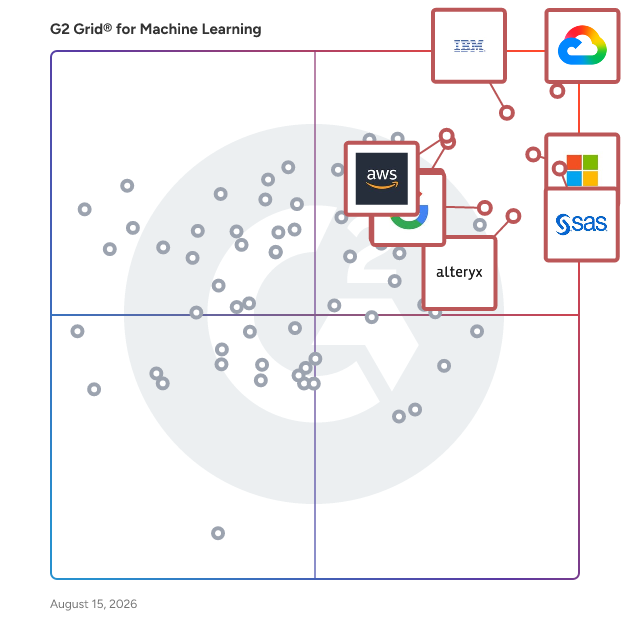
G2’s top-rated machine learning software, based on verified user reviews, includes Vertex AI, IBM watsonx.ai, SAS Viya, Google Cloud TPU, and AIToolbox. (Source 2)

What are the top-reviewed machine learning software on G2?

Vertex AI

  • Reviews: 328
  • Satisfaction: 98
  • Market Presence: 98
  • G2 Score: 98

IBM watsonx.ai

  • Reviews: 47
  • Satisfaction: 85
  • Market Presence: 89
  • G2 Score: 87

SAS Viya

  • Reviews: 90
  • Satisfaction: 83
  • Market Presence: 75
  • G2 Score: 79

Google Cloud TPU

  • Reviews: 18
  • Satisfaction: 78
  • Market Presence: 66
  • G2 Score: 72

AIToolbox

  • Reviews: 15
  • Satisfaction: 80
  • Market Presence: 64
  • G2 Score: 72

Satisfaction reflects user-reported ratings across factors such as ease of use, feature fit, and quality of support. (Source 2)

Market Presence scores combine review volume, third-party signals, and overall market visibility. (Source 2)

G2 Score is a weighted composite of Satisfaction and Market Presence. (Source 2)

Learn how G2 scores products. (Source 1)

What I Often See in Machine Learning Software?

Feedback Pros: What Users Consistently Appreciate

  • Unified platform covering training, deployment, and monitoring workflows
  • “I use Vertex AI for building, training, and deploying machine learning models, and I love how it solves the problem of managing complex ML workflows. It reduces the effort required to build, train, and deploy models by centralizing everything, making automation easier and scaling faster. This means I can focus more on building better models instead of worrying about infrastructure. What I like most is how it combines training, deployment, and monitoring in one place. The integration with Google Cloud services works really well, scaling is smooth, and managed pipelines save a lot of time. Overall, it makes ML development more efficient and reliable.” - Jeni J, Vertex AI Review
  • Strong cloud integrations supporting scalable model training and pipelines
  • “What I like most about SAS Viya is its cloud-native architecture and strong performance. It enables faster data processing through in-memory analytics, supports Python, R, and SQL alongside SAS, and offers convenient access via a web-based interface. Overall, these capabilities make analytics more scalable, collaborative, and flexible than in traditional SAS environments.” - Sachin M, SAS Viya Review
  • User-friendly interfaces simplifying experimentation with machine learning models
  • “I find IBM watsonx.ai impressive because it's not just a model playground; it’s built for real enterprise use. I love that it solves practical, real-world business problems by making AI easier to build, manage, and trust. The platform supports everything from data prep and model training to tuning and development. It effectively blends capabilities from traditional machine learning workflows with generative AI tools into a single platform, helping enterprises operationalize AI faster. I also appreciate how easy the initial setup is.” - Marilyn B, IBM watsonx.ai Review

Cons: Where Many Platforms Fall Short

  • Steep learning curve when configuring machine learning environments
  • “One area that could be improved is the learning curve for new users, especially when configuring services in Google Cloud. Pricing and documentation could also be clearer for beginners.” - Syed Shariq A, Vertex AI Review
  • Unpredictable pricing tied to compute-heavy model training workloads
  • “One potential downside of SAS Viya is that it can have a steep learning curve, especially for users who are new to SAS or enterprise analytics platforms. The cost of licensing and implementation can also be high compared with some open-source alternatives, which may limit accessibility for smaller organizations. Additionally, while Viya supports multiple programming languages, some advanced customization can still feel more seamless within the SAS ecosystem, which may reduce flexibility for teams that primarily work in open-source environments.” - John M, SAS Viya Review
  • Debugging pipelines and monitoring distributed model performance remains difficult
  • “One downside of Google Cloud TPU is that it’s more specialized than GPUs, so it tends to work best with TensorFlow and a limited set of supported frameworks. This can reduce flexibility if your team relies on multiple machine learning frameworks across different projects. Debugging and monitoring TPU workloads can also be more complicated than with traditional GPU setups, which may add friction during development and troubleshooting. In addition, costs can add up quickly for long-running training jobs if resources aren’t optimized and managed carefully.” -  Mahmoud H, Google Cloud TPU Review

My Expert Takeaway on Machine Learning Software in 2026

88% of G2 reviewers mentioned they are likely to recommend their machine learning software. The top-rated tools also earned high marks for ease of use (avg. 88%) and ease of setup (avg. 86%), especially among SMBs and mid-market teams looking to use these machine learning tools to scale predictive models more efficiently. 

High-performing organizations treat machine learning platforms as part of a broader data ecosystem rather than standalone tools. High-performing teams, especially in industries such as fintech, ecommerce, and SaaS, often integrate machine learning directly into their analytics pipelines, data warehouses, and production applications. This allows predictions to run continuously in the background of operational systems.

G2 reviewers frequently emphasize that even the best machine learning software requires thoughtful implementation. Companies that see the strongest results typically invest in data engineering, MLOps practices, and cross-team collaboration between data scientists and software engineers. When those pieces come together, the best machine learning platforms can dramatically accelerate experimentation and turn predictive insights into everyday business decisions.

Machine Learning Software FAQs

What is the most cost-efficient machine learning platform?

Cost efficiency depends on workload size and pricing structure. Vertex AI primarily uses usage-based pricing tied to compute and predictions, while IBM watsonx.ai offers both pay-as-you-go and subscription tiers. SAS Viya is typically sold through enterprise subscriptions depending on deployment needs.

What is the most secure machine learning platform for sensitive data?

Platforms such as IBM watsonx.ai and SAS Viya emphasize governance, access controls, and compliance features. Vertex AI and Google Cloud TPU also rely on built-in cloud security frameworks.

What is the top ML platform for enterprise AI development?

Enterprise teams often use platforms like Vertex AI, AI Toolbox, and IBM watsonx.ai because they combine model development, deployment, and governance in one environment.

What ML software offers the easiest model deployment process?

Platforms such as Vertex AI and SAS Viya provide managed pipelines and deployment tools that simplify moving models from experimentation to production.

What platform is best for real-time ML predictions?

Real-time prediction workloads often use platforms like Vertex AI for scalable endpoints and Google Cloud TPU for high-performance inference.

Which machine learning platform offers the best predictive analytics tools?

Platforms such as SAS Viya, Vertex AI, and IBM watsonx.ai provide strong predictive analytics capabilities, including model training, evaluation, and monitoring tools.

Sources

G2 Scoring Methodologies

G2 Winter Reports

Researched by Shalaka Joshi

Last Updated on March 17, 2026