Best Active Learning Software

How Many Active Learning Tools Products Does G2 Track?

Total Products under this Category: 168

Category Stats (Oct 2026)

  • Average Rating: 4.64/5 (↑0.07 vs Sep 2026) The average rating of products in this category, based on all submitted ratings

Last updated: October 05, 2026

How Does G2 Rank Active Learning Tools Products?

Why You Can Trust G2's Software Rankings:

  • 30 Analysts and Data Experts
  • 900+ Authentic Reviews
  • 168+ Products
  • Unbiased Rankings

G2's software rankings are built on verified user reviews, rigorous moderation, and a consistent research methodology maintained by a team of analysts and data experts. Each product is measured using the same transparent criteria, with no paid placement or vendor influence. While reviews reflect real user experiences, which can be subjective, they offer valuable insight into how software performs in the hands of professionals. Together, these inputs power the G2 Score, a standardized way to compare tools within every category.

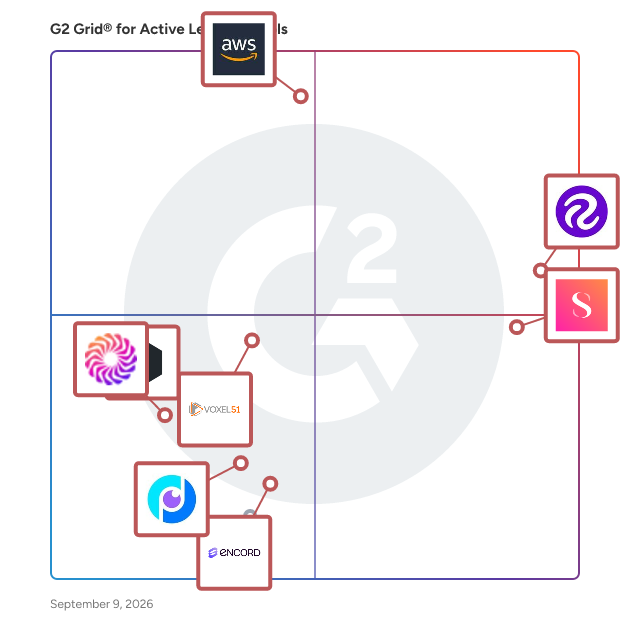
G2 Grid® for Active Learning Tools

G2 Grid® for Active Learning Tools plotting products by satisfaction and market presence

Highlighted products: Roboflow, Amazon Augmented AI, SuperAnnotate, Voxel51, Labelbox, Encord, Deepchecks, and Galileo.

Underlying data: [Grid® JSON](https://www.g2.com/categories/active-learning-tools/grids.json?focus%5B%5D=roboflow&focus%5B%5D=amazon-augmented-ai&focus%5B%5D=superannotate&focus%5B%5D=voxel51&focus%5B%5D=labelbox&focus%5B%5D=encord&focus%5B%5D=deepchecks&focus%5B%5D=galileo-galileo)

Roboflow

Roboflow has everything you need to build and deploy computer vision applications. Over 1,000,000 users from businesses of every size — from startups to public companies — use the company's end-to-end platform for image and video collection, organization, annotation, preprocessing, model training, and deployment. Roboflow provides tools for each step in the computer vision deployment lifecycle and integrates with your existing solutions so you can tailor your pipeline to meet your needs.

Average Rating: 4.7/5.0

Total Reviews: 160

Who Is the Company Behind Roboflow?

  • Seller: Roboflow
  • Year Founded: 2019
  • HQ Location: Remote, US
  • Twitter: @roboflow
    13,577 Twitter followers
  • LinkedIn® Page: www.linkedin.com
    144 employees on LinkedIn®

Who Uses This Product?

  • Who Uses This: Founder, Researcher
  • Top Industries: Computer Software, Research
  • Company Size: 78% Small, 14% Medium

What Do G2 Reviewers Say About Roboflow?

AI-generated summary from verified user reviews

Pros
  • Users appreciate the ease of use of Roboflow, enabling efficient model training and collaboration with a user-friendly interface.
  • Users highlight Roboflow's efficiency in dataset management, streamlining tasks and significantly saving time and reducing errors.
  • Users value the annotation efficiency of Roboflow, enjoying time savings and reduced errors in dataset management.
  • Users love how Roboflow's data labeling simplifies collaboration, annotation, and export processes, saving time and reducing errors.
  • Users appreciate the powerful and versatile features of Roboflow, making it ideal for academic and large-scale projects.
Cons
  • Users find the cost prohibitive for advanced features, especially students needing budget-friendly options.
  • Users note the limited features of Roboflow, as some advanced options require higher-tier plans and constraints exist.
  • Users experience limited functionality in Roboflow, particularly with advanced features and flexibility for complex tasks.
  • Users find annotation issues with Roboflow, especially in auto-labeling and polygon marking for complex images.
  • Users find inefficient labeling processes cumbersome, especially in team environments with a lack of automation and shortcuts.

What Are Recent G2 Reviews of Roboflow?

Amazon Augmented AI

Amazon Augmented AI (Amazon A2I) is a fully managed service that simplifies the integration of human reviews into machine learning (ML) workflows, ensuring high accuracy in ML predictions. By providing pre-built workflows and customizable options, Amazon A2I enables developers to incorporate human judgment into their ML applications without the need to build and manage complex human review systems. Key Features and Functionality: - Pre-Built Workflows: Amazon A2I offers ready-to-use workflows for common ML use cases, such as content moderation with Amazon Rekognition and text extraction with Amazon Textract. - Customizable Workflows: Developers can create custom workflows tailored to their specific needs, integrating human reviews into any ML application, including those built with Amazon SageMaker. - Flexible Workforce Options: Users can choose from a variety of human reviewers, including their own private workforce, a workforce of over 500,000 independent contractors via Amazon Mechanical Turk, or pre-screened vendors experienced in human review tasks. - Confidence Thresholds and Sampling: Amazon A2I allows setting confidence thresholds to route low-confidence predictions for human review or implementing random sampling to audit predictions, ensuring a balance between accuracy and cost-effectiveness. Primary Value and Problem Solved: Amazon A2I addresses the challenge of ensuring high accuracy in ML predictions by seamlessly incorporating human judgment into automated workflows. This integration is particularly valuable in scenarios where ML models may struggle with low-confidence predictions or require human oversight for sensitive data. By reducing the complexity and cost associated with building human review systems, Amazon A2I enables organizations to deploy ML solutions more confidently and efficiently, ensuring that critical decisions are informed by both machine intelligence and human expertise.

Average Rating: 4.5/5.0

Total Reviews: 66

Who Is the Company Behind Amazon Augmented AI?

  • Seller: Amazon Web Services (AWS)
  • Year Founded: 2006
  • HQ Location: Seattle, WA
  • Twitter: @awscloud
    2,232,483 Twitter followers
  • LinkedIn® Page: www.linkedin.com
    148,266 employees on LinkedIn®
  • Ownership: NASDAQ: AMZN

Who Uses This Product?

  • Top Industries: Information Technology and Services, Computer Software
  • Company Size: 40% Small, 33% Medium

What Are Recent G2 Reviews of Amazon Augmented AI?

SuperAnnotate

SuperAnnotate bridges the gap between cutting-edge AI innovation and the high-quality human data that powers it - helping advanced AI teams build more intelligent models. With a global network of thousands of rigorously vetted experts, ethical and scalable managed operations, precise talent matching, and purpose‑built technology, SuperAnnotate delivers full project visibility and unmatched data quality. SuperAnnotate powers complex annotation, evaluation, and reinforcement learning workflows to build, evaluate and align frontier AI. Trusted by innovators like Databricks, IBM and ServiceNow - and backed by NVIDIA, Dell Technologies Capital, Databricks Ventures, Cox Enterprises, and Lionel Messi’s Play Time VC - SuperAnnotate enables the world’s top AI teams to build responsible and state‑of‑the‑art models with human data.

Average Rating: 4.8/5.0

Total Reviews: 356

Who Is the Company Behind SuperAnnotate?

  • Seller: SuperAnnotate
  • Company Website:
  • Year Founded: 2018
  • HQ Location: San Francisco, CA
  • Twitter: @superannotate
    720 Twitter followers
  • LinkedIn® Page: www.linkedin.com
    413 employees on LinkedIn®

Who Uses This Product?

  • Who Uses This: Student, Data Trainer
  • Top Industries: Information Technology and Services, Computer Software
  • Company Size: 57% Small, 23% Medium

What Do G2 Reviewers Say About SuperAnnotate?

AI-generated summary from verified user reviews

Pros
  • Users enjoy the intuitive interface of SuperAnnotate, which simplifies large-scale annotation projects and boosts collaboration.
  • Users enjoy the user-friendly interface of SuperAnnotate, facilitating efficient and accurate annotations with powerful tools.
  • Users praise the annotation efficiency of SuperAnnotate, appreciating its time-saving features and user-friendly interface.
  • Users highlight the efficiency of SuperAnnotate, enabling quick, high-quality annotations with user-friendly tools and collaboration features.
  • Users value the high-quality annotations provided by SuperAnnotate, enhancing efficiency and ensuring consistency across projects.
Cons
  • Users have noted performance issues with SuperAnnotate, including slow loading times for large projects and technical glitches.
  • Users often face slow performance, experiencing lag and hanging when cropping images and labeling tasks on SuperAnnotate.
  • Users find the difficult learning curve challenging, particularly with advanced features and large datasets requiring time to master.
  • Users find the complexity for new users of SuperAnnotate challenging, especially with advanced tools and features.
  • Users find the lack of guidance challenging, making the learning curve steep for new users of SuperAnnotate.

What Are Recent G2 Reviews of SuperAnnotate?

What Are G2 Users Discussing About SuperAnnotate?

AI can help you find the answers. G2 helps you trust them.

Connect G2 to Claude or ChatGPT for answers grounded in G2's trusted reviews, comparisons, and pricing from real user insights.

How it works

Voxel51

Voxel51 is an end-to-end multimodal data platform for physical AI. It brings ML engineers, data teams, and annotators into a unified environment to explore unstructured data, curate datasets, manage and review annotations, evaluate models, and investigate failure modes across images, video, 3D, and time-series data. Built on open-source FiftyOne with 5M+ downloads, Voxel51 adds the collaboration, scale, and security capabilities that teams with AI in production need. Organizations ranging from startups to global enterprises use Voxel51, including Porsche, Ford, Sony, Hyundai, Bonsai Robotics, and Berkshire Grey. Researchers at Google, Microsoft, and NVIDIA also use Voxel51 to build state-of-the-art physical AI datasets. Voxel51 gives teams deep visibility into their data before, during, and after model training: • Search & visualize: Play back synchronized sensor streams and use hybrid search across modalities. • Curate: Get best-in-class embeddings to identify data quality issues, outliers, and coverage gaps. • Annotate: Manage annotation workflows and speed up labeling with automated QA and VLM-assisted labeling. • Evaluate: Analyze model performance and trace failure modes back to the underlying data Voxel51 Agent makes this process more seamless by automating the repetitive data work between decisions, giving engineers more room to focus on what the model needs next. Bring your own agent with Voxel51 MCP and connect to over 100 providers or your own self-hosted model. The platform integrates with existing labeling tools, MLOps systems, and data infrastructure, helping teams spend less time building custom tooling and more time improving their models. Customers report up to a 30% increase in model accuracy, more than five months of development time saved, and 50× faster data curation.

Average Rating: 4.5/5.0

Total Reviews: 24

Who Is the Company Behind Voxel51?

  • Seller: Voxel51
  • Company Website:
  • Year Founded: 2018
  • HQ Location: Ann Arbor, US
  • Twitter: @Voxel51
    1,624 Twitter followers
  • LinkedIn® Page: www.linkedin.com
    56 employees on LinkedIn®

Who Uses This Product?

  • Top Industries: Computer Software
  • Company Size: 67% Small, 25% Medium

What Are Recent G2 Reviews of Voxel51?

FAQs About Active Learning Tools

Generated using AI

Last updated: June 3, 2026

What vendor risks should teams evaluate when shortlisting Active Learning Tools platforms for enterprise rollout

According to verified users, teams should look closely at scalability, workflow fit, and operational overhead before committing to an enterprise rollout. Reviews frequently mention tradeoffs around large dataset performance, export speed, infrastructure management, and the ease of moving data into downstream pipelines. Buyers also call out the importance of review workflows, version control, collaboration features, and support responsiveness when multiple teams are involved. Integration flexibility matters too, especially for teams exporting to different frameworks or deploying models across cloud and edge environments. Another recurring risk is adoption friction: some tools are praised for intuitive interfaces, while others require deeper technical setup or self-hosting expertise that can slow broader rollout.

Top-rated Active Learning Tools for annotating and labeling large datasets very efficiently

Based on G2 reviews, these products are most often praised for efficient large-scale annotation workflows.

  • Roboflow — fast annotation, export, and versioning.
  • FiftyOne — dataset curation, search, and error analysis.
  • SuperAnnotate — organized labeling, review, and collaboration.

What are the best Active Learning Tools for organizing computer vision datasets

Based on G2 reviews, these products stand out for organizing, reviewing, and refining computer vision datasets.

  • Roboflow — dataset splits, formats, and version control.
  • FiftyOne — visual auditing and similarity search.
  • SuperAnnotate — project organization with quality review.

What features are most important in active learning software

According to verified users, the most important features in active learning software center on making data work faster, cleaner, and easier to manage. Commonly praised capabilities include annotation tools, AI-assisted labeling, review and quality control workflows, dataset versioning, preprocessing and augmentation, and flexible export options for different model frameworks. Reviewers also value collaboration features that let teams assign work, inspect labels, and maintain consistency across projects. For more advanced use cases, users highlight model evaluation, visual debugging, similarity or embedding-based search, and support for moving from raw data to training and deployment with less manual handoff. Ease of use remains a recurring priority, especially for mixed-skill teams.

How do teams use Active Learning Tools for computer vision workflows

G2 reviewers mention that teams use Active Learning Tools to manage the full computer vision data cycle more efficiently. Common workflows include uploading raw images or video frames, annotating them with boxes, polygons, or segmentation tools, reviewing labels for consistency, and exporting datasets into formats that fit training pipelines. Many reviews also describe using these tools to version datasets, run preprocessing or augmentation, inspect model outputs, and identify labeling errors before retraining. In practice, teams rely on them to reduce manual effort, coordinate work across contributors, and speed the path from dataset preparation to experimentation, deployment, and ongoing model improvement across research and production environments.

Labelbox

Labelbox is the leading data-centric AI platform for building intelligent applications. Teams looking to capitalize on the latest advances in generative AI and LLMs use the Labelbox platform to inject these systems with the right degree of human supervision and automation. Whether they are building AI products with custom or foundation models, or using AI to automate data tasks or find business insights, Labelbox enables teams to do so effectively and quickly. The platform is used by Fortune 500 enterprises such as Walmart, P&G, Genentech, and Adobe, and hundreds of leading AI teams. Labelbox is backed by leading investors including SoftBank, Andreessen Horowitz, B Capital, Gradient Ventures (Google's AI-focused fund), and Databricks Ventures.

Average Rating: 4.5/5.0

Total Reviews: 48

Who Is the Company Behind Labelbox?

  • Seller: Labelbox
  • Year Founded: 2018
  • HQ Location: San Francisco, California
  • Twitter: @labelbox
    3,489 Twitter followers
  • LinkedIn® Page: www.linkedin.com
    482 employees on LinkedIn®

Who Uses This Product?

  • Top Industries: Computer Software, Information Technology and Services
  • Company Size: 46% Small, 38% Medium

What Do G2 Reviewers Say About Labelbox?

AI-generated summary from verified user reviews

Pros
  • Users find Labelbox extremely easy to use, simplifying project management and enhancing productivity for data training.
  • Users appreciate the easy and efficient data labeling process of Labelbox, enhancing workflow and model accuracy.
  • Users value the efficiency of Labelbox, appreciating its smooth setup and seamless project management capabilities.
  • Users appreciate the AI capabilities of Labelbox, simplifying data labeling and enhancing model accuracy effortlessly.
  • Users find easy integrations in Labelbox beneficial, enabling a seamless setup and user-friendly experience for all.
Cons
  • Users express frustration over the lack of features, citing limited task claims and minimal customization options.
  • Users report slow performance when handling large datasets, impacting efficiency and user experience significantly.
  • Users find Labelbox to have a difficult learning curve due to its complexity and slower processing with large data sets.
  • Users find the high cost daunting, especially small scale users who may struggle with affordability despite great features.
  • Users experience slow processing with Labelbox, leading to long waits for project initiation and completion.

What Are Recent G2 Reviews of Labelbox?

What Are G2 Users Discussing About Labelbox?

Encord

Encord is the universal data layer for AI. The platform helps AI teams train and run their models with the right data - managing, curating, annotating, and aligning data across the full AI lifecycle. Encord works with over 300 leading AI teams, including Woven by Toyota, Zipline, AXA, and Flock Safety. Confidentially build production AI with rich multimodal data. Encord is SOC 2, AICPA SOC, HIPAA, and GDPR compliant.

Average Rating: 4.8/5.0

Total Reviews: 65

Who Is the Company Behind Encord?

  • Seller: Encord
  • Year Founded: 2020
  • HQ Location: San Francisco, US
  • Twitter: @encord_team
    1,014 Twitter followers
  • LinkedIn® Page: www.linkedin.com
    220 employees on LinkedIn®

Who Uses This Product?

  • Top Industries: Computer Software, Hospital & Health Care
  • Company Size: 51% Small, 40% Medium

What Do G2 Reviewers Say About Encord?

AI-generated summary from verified user reviews

Pros
  • Users praise Encord for its responsive customer support, ensuring quick solutions and seamless collaboration during projects.
  • Users commend Encord for its annotation efficiency, appreciating the smooth workflow and intuitive interface that enhances productivity.
  • Users value the intuitive interface and powerful AI features of Encord, enhancing their data annotation efficiency significantly.
  • Users value the efficiency of Encord, experiencing smooth workflows and quick data integration that accelerates their processes.
  • Users value the intuitive interface and comprehensive features of Encord, enhancing efficiency in data curation and annotation.
Cons
  • Users find that custom workflows can be challenging, but support from the team helps mitigate the difficulties.
  • Users find it challenging to keep up with frequent updates from Encord, despite support from their customer success team.
  • Users find it challenging to keep up with best practices due to frequent feature updates from Encord.

What Are Recent G2 Reviews of Encord?

Deepchecks

Release high-quality LLM apps quickly without compromising on testing. Never be held back by the complex and subjective nature of LLM interactions.

Average Rating: 4.4/5.0

Total Reviews: 22

Who Is the Company Behind Deepchecks?

Who Uses This Product?

  • Company Size: 55% Small, 36% Medium

What Do G2 Reviewers Say About Deepchecks?

AI-generated summary from verified user reviews

Pros
  • Users value the strong security and compliance with data privacy standards offered by Deepchecks, ensuring safe deployment.
  • Users value the intuitive interface for diverse users of Deepchecks, enhancing productivity across technical and non-technical roles.
  • Users value the excellent customer support of Deepchecks, appreciating assistance for both technical and non-technical users.
  • Users value the helpful and professional customer support that enhances their experience with Deepchecks.
  • Users find Deepchecks incredibly user-friendly, making it suitable for both technical and non-technical team members.

What Are Recent G2 Reviews of Deepchecks?

Galileo

Galileo's Agentic Evaluations is a comprehensive solution designed to empower developers in building reliable AI agents powered by large language models (LLMs). This platform provides the necessary tools and insights to optimize agent performance, ensuring they are ready for real-world deployment. Key Features and Functionality: - Complete Visibility into Agent Workflows: Developers gain a clear view of multi-step agent completions, from input to final action, with comprehensive tracing and visualizations that help quickly identify inefficiencies and errors. - Agent-Specific Metrics: The platform offers proprietary, research-backed metrics to evaluate agents at multiple levels, including: - LLM Planner: Assesses tool selection quality and instruction accuracy. - Tool Calls: Evaluates errors in individual tool executions. - Overall Session Success: Measures task completion and successful agent interactions. - Granular Cost and Latency Tracking: Optimize cost-effectiveness with aggregate tracking for cost, latency, and errors across sessions and processes. - Seamless Integrations: Supports popular AI frameworks like LangGraph and CrewAI, facilitating easy integration into existing workflows. - Proactive Insights: Provides alerts and dashboards to identify systemic issues and uncover actionable insights for continuous improvement, such as failed tool calls or misalignment between final actions and initial instructions. Primary Value and Problem Solved: Agentic Evaluations addresses the challenges developers face in building and evaluating AI agents, such as non-deterministic paths, increased failure points, and cost management. By offering an end-to-end framework with system-level and step-by-step evaluations, it enables the development of reliable, resilient, and high-performing AI agents. This ensures that agents are not only functional but also efficient and trustworthy, ready to handle complex, multi-step workflows in real-world applications.

Average Rating: 4.4/5.0

Total Reviews: 18

Who Is the Company Behind Galileo?

  • Seller: Galileo
  • Year Founded: 2021
  • HQ Location: San Francisco, US
  • LinkedIn® Page: www.linkedin.com
    123 employees on LinkedIn®

Who Uses This Product?

  • Company Size: 61% Medium, 33% Small

What Are Recent G2 Reviews of Galileo?

Aquarium

The Platform For ML Data Curation - Aquarium's embedding technology surfaces the biggest problems in your model performance and finds the right data to solve them.

Average Rating: 4.6/5.0

Total Reviews: 14

Who Is the Company Behind Aquarium?

Who Uses This Product?

  • Company Size: 57% Small, 29% Medium

What Are Recent G2 Reviews of Aquarium?

Dataloop

Dataloop is a cutting-edge AI Development Platform that's transforming the way organizations build AI applications. Our platform is meticulously crafted to cater to developers at the heart of the AI development process, making it simpler and more intuitive to work with data and AI models. Our comprehensive solution spans the full AI development lifecycle, offering tools and functionalities that streamline data management, annotation, model selection, and deployment. Dataloop's platform is built with a focus on collaboration, allowing developers, data scientists, and engineers to work together seamlessly, breaking down traditional silos and fostering innovation. Key features include an intuitive drag-and-drop interface for constructing data pipelines, a vast library of pre-built AI elements and models, and robust data curation and annotation capabilities. These features are designed to empower developers to rapidly prototype, iterate, and deploy AI solutions, keeping pace with the fast-evolving demands of the market. Dataloop is committed to advancing AI development by providing a developer-centric platform that addresses the complexities and challenges of AI and data management. Our vision is to democratize AI development, enabling every organization to harness the power of AI and drive forward their innovative solutions.

Average Rating: 4.4/5.0

Total Reviews: 87

Who Is the Company Behind Dataloop?

  • Seller: Dataloop
  • Year Founded: 2017
  • HQ Location: Herzliya, IL
  • LinkedIn® Page: www.linkedin.com
    45 employees on LinkedIn®

Who Uses This Product?

  • Top Industries: Computer Software, Information Technology and Services
  • Company Size: 39% Medium, 33% Small

What Do G2 Reviewers Say About Dataloop?

AI-generated summary from verified user reviews

Pros
  • Users find Dataloop's ease of use impressive, highlighting intuitive navigation and seamless integration into workflows.
  • Users value the annotation efficiency of Dataloop, appreciating its easy-to-use and intuitive interface.
  • Users appreciate the easy annotation capabilities of Dataloop, complimented by its simplistic and user-friendly interface.
  • Users appreciate the simple and easy-to-navigate user interface of Dataloop, enhancing their overall experience.
  • Users appreciate the easy integrations offered by Dataloop, enhancing their existing workflows effortlessly.
Cons
  • Users find the UI complexity of Dataloop confusing after recent changes, impacting their overall experience.
  • Users find the confusing syntax in Dataloop's UI changes impact their overall experience negatively.
  • Users find the difficult navigation after UI changes to be confusing and disruptive to their experience.
  • Users feel there is a lack of communication from the community, impacting support and user engagement.
  • Users suggest a lack of guidance in Dataloop, particularly for first-time users needing a demo section.

What Are Recent G2 Reviews of Dataloop?

What Are G2 Users Discussing About Dataloop?

Cleanlab

Cleanlab solves the biggest challenge in AI agents: reliability. Our platform equips your team with the tools to make agents production-ready, detecting low-quality outputs, identifying root causes, improving response quality, and applying guardrails to ensure safe, accurate, and compliant performance at scale.

Average Rating: 4.2/5.0

Total Reviews: 13

Who Is the Company Behind Cleanlab?

Who Uses This Product?

  • Company Size: 38% Medium, 38% Small

What Do G2 Reviewers Say About Cleanlab?

AI-generated summary from verified user reviews

Pros
  • Users enjoy the easy integrations of Cleanlab, effortlessly incorporating it into their existing data processing workflows.
  • Users value the accurate error detection in Cleanlab, significantly reducing their manual review time.
  • Users benefit from Cleanlab's clear and example-driven documentation, enabling efficient use by all types of users.
  • Users appreciate the ease of use of Cleanlab, enjoying quick setup and seamless integration for data refinement.
  • Users note that Cleanlab provides significant time savings, allowing for quicker dataset management and analysis.
Cons
  • Users find the difficult setup of Cleanlab challenging initially, but valuable once they become familiar with it.
  • Users find Cleanlab expensive, making it difficult for small startups to afford its implementation.
  • Users experience slow performance when handling large datasets, indicating a need for improvement in efficiency.
  • Users find the initial setup complex, making it challenging for experimentation, especially with large datasets.
  • Users often face dependency issues with Cleanlab, relying heavily on model predictions that can complicate their workflow.

What Are Recent G2 Reviews of Cleanlab?

Lightly

Lightly helps machine learning teams to build better models through better data. It allows companies to select the right data for model training by using active learning. Intelligently select the best samples for model training through advanced filtering and active-learning algorithms. Balance your class distributions, remove redundancies and dataset bias. Label only the best data for model training until you reach your target accuracy. Analyze the quality and diversity of your datasets. Better understand your data with Lightly's holistic views from the big picture down to the smallest nuances of your data. Uncover class distributions, dataset gaps, and representation biases before labeling to save time and money. Monitor your model performance in production. Spot outliers and failure cases. Select out-of-distribution data directly on the edge or cloud. Send data back for retraining and updating the model. Manage your dataset. Track different versions, and once your dataset is ready, simply share with labeling with the click of a button. That's Lightly: The end-to-end active learning solution.

Average Rating: 4.4/5.0

Total Reviews: 14

Who Is the Company Behind Lightly?

  • Seller: Lightly
  • Year Founded: 2019
  • HQ Location: Zurich, CH
  • LinkedIn® Page: www.linkedin.com
    38 employees on LinkedIn®

Who Uses This Product?

  • Company Size: 57% Medium, 29% Small

What Do G2 Reviewers Say About Lightly?

AI-generated summary from verified user reviews

Pros
  • Users find AI modeling capabilities invaluable for enhancing data labeling and improving AI training efficiency.
  • Users praise the performance speed of Lightly, ensuring quick data processing and efficient AI model training.
  • Users find that Lightly provides high-quality data selection, which enhances AI learning efficiency and effectiveness.
  • Users value the learning enhancement provided by Lightly, as it improves AI performance through quality data selection.
  • Users love the time-saving aspects of Lightly, with quick responses that enhance efficiency and reduce costs.
Cons
  • Users report a learning difficulty with Lightly, particularly for newcomers struggling to select quality data.
  • Users find the limited customization of Lightly frustrating, as it impacts adaptability and accuracy in responses.

What Are Recent G2 Reviews of Lightly?

Ango Hub

For organizations driving advancements in traditional AI and generative AI, iMerit delivers comprehensive, software-delivered solutions that encompass high-quality data annotation, enrichment, and model fine-tuning across multimodal datasets, including text, images, audio, video, and sensor data. By combining state-of-the-art technology with human expertise, iMerit empowers businesses to develop precise AI models, from traditional supervised learning systems to cutting-edge generative AI applications. Unlike generic service providers, iMerit specializes in secure, scalable, and domain-specific solutions, enabling innovation and performance in the most demanding AI and machine learning initiatives. For developers of traditional AI applications iMerit provides best in class data annotation tooling, workflow automation and a highly skilled workforce within a single end-to-end solution. The unique combination of technology, talent and techniques produces the highest quality data in the industry for machine learning. For developers of Generative AI applications iMerit provides the tools, automation and domain experts for accurate model evaluation and fine turning. The solution combines the technology and human-in-the-loop domain experts for all forms of supervised reinforcement learning. Services include corpus creation, data augmentation, RLHF, RAG fine tuning, chain of thought reasoning and red-teaming for greater model precision. Visit www.imerit.net to learn more.

Average Rating: 4.8/5.0

Total Reviews: 11

Who Is the Company Behind Ango Hub?

  • Seller: iMerit Technology
  • Year Founded: 2012
  • HQ Location: San Jose, California, United States
  • Twitter: @iMeritDigital
    1,654 Twitter followers
  • LinkedIn® Page: www.linkedin.com
    6,415 employees on LinkedIn®

Who Uses This Product?

  • Company Size: 50% Small, 25% Large

What Do G2 Reviewers Say About Ango Hub?

AI-generated summary from verified user reviews

Pros
  • Users value the AI integration capabilities of Ango Hub, enhancing their projects with synchronized, high-quality labeled data.
  • Users value the annotation efficiency of Ango Hub, enabling streamlined and synchronized labeling for complex AI/ML projects.
  • Users value the customization features of Ango Hub, facilitating tailored solutions for complex AI/ML annotation projects.
  • Users value the high-quality labeled data provided by Ango Hub, enhancing accuracy in their AI/ML projects.
  • Users appreciate Ango Hub's ability to manage high-quality labeled data effectively for complex AI/ML projects.
Cons
  • Users find the complexity of the platform may necessitate dedicated training to navigate effectively.
  • The steep learning curve of Ango Hub necessitates dedicated training for users to effectively navigate the platform.

What Are Recent G2 Reviews of Ango Hub?

What Are G2 Users Discussing About Ango Hub?

Amazy.uk

Amazy.uk is an innovative platform designed to streamline the lesson planning process for modern educators. It enables teachers to create and share interactive, engaging lesson plans efficiently, significantly reducing preparation time. With a suite of 16 versatile tools, including options for text, multimedia integration, and interactive exercises, educators can craft lessons tailored to diverse learning needs. The platform also offers an AI assistant to generate templates, lesson examples, and interactive activities, further enhancing the teaching experience. Automated marking and comprehensive progress tracking allow teachers to monitor student performance effortlessly. Additionally, Amazy.uk provides access to a vast library of ready-to-use materials and fosters a collaborative community where educators can share resources and best practices. By simplifying lesson creation and management, Amazy.uk empowers teachers to focus more on delivering quality education and less on administrative tasks. Key Features and Functionality: - Interactive Lesson Creation: Utilize 16 powerful tools to design engaging lessons incorporating text, multimedia, and interactive exercises. - AI-Assisted Content Generation: Leverage AI to create templates, lesson examples, and interactive activities, saving time and enhancing lesson quality. - Automated Marking and Progress Tracking: Automatically grade student submissions and monitor their progress with detailed analytics. - Extensive Content Library: Access thousands of ready-made lesson plans and activities contributed by educators worldwide. - Self-Paced Learning: Create lessons that students can complete independently, accommodating diverse learning paces and styles. - Collaborative Workspace: Share resources, build private content libraries, and collaborate with other educators within the platform. Primary Value and Solutions Provided: Amazy.uk addresses the common challenges educators face in lesson planning and student engagement by offering a comprehensive, user-friendly platform that simplifies content creation and management. By automating routine tasks like grading and providing tools for interactive lesson design, it reduces preparation time and enhances the quality of education delivered. The platform's collaborative features and extensive resource library support continuous professional development and foster a community of practice among educators. Ultimately, Amazy.uk empowers teachers to focus more on teaching and less on administrative burdens, leading to improved learning outcomes for students.

Average Rating: 4.5/5.0

Total Reviews: 1

Who Is the Company Behind Amazy.uk?

  • Seller: Amazy.uk
  • Year Founded: 2020
  • HQ Location: London, GB
  • LinkedIn® Page: www.linkedin.com
    12 employees on LinkedIn®

Who Uses This Product?

  • Company Size: 100% Small

What Are Recent G2 Reviews of Amazy.uk?

Bijou Barry
BB
Researched and written by Bijou Barry
Updated April 9, 2026

Learn More About Active Learning Tools

What is active learning software?

Active learning tools are advanced ML tools that train on labeled data and continuously refine their models to predict labels for unlabeled data points. Active learners are commonly used in computer vision tasks like image recognition, segmentation, and object detection. When the model faces uncertainty, such as with ambiguous data or edge cases, it uses the “human-in-the-loop” technique to involve human annotators in correcting errors, refining predictions, and enhancing overall accuracy.

Active learning software determines a data point’s class based on Euclidean distance or its position on the classification boundary, generating a confidence score. If the score is low for the predicted label, the model queries a human, making it a semi-supervised process where the model learns while actively engaging the user.

Businesses using these tools can reduce data labeling costs, improve dataset quality, and optimize budgets. Active learning tools work in compliance with ML software, MLOps platforms, artificial intelligence (AI) software, and data science platforms to build accurate models and achieve positive outcomes.

How do active learning tools work in machine learning?

Below is the complete process of how active learning tools use background knowledge to identify unlabeled test data and enhance its accuracy with retraining. 

  • Starting small: The process begins by training the ML model on the provided labeled dataset, which is essentially 10% of the total training dataset. It also provides a solid foundation for the ML tool’s initial training.
  • Model training: Using the available data, the active learning system trains one or multiple ML models (committee of models), which will work on the rest of the 90% unlabeled dataset.
  • Query strategy: A query strategy selects the most informative unlabeled data. The points that the algorithm is most uncertain about are mined and kept aside for human intervention. 
  • Human-in-the-loop: The accuracy and precision of active learning tools stem from human involvement in data labeling. The ML model identifies data points to query based on their informativeness, and human intervention occurs only when the model is most uncertain about a decision. This approach prevents incorrect class predictions. 
  • Retraining: Once the newly trained dataset is added, the model retrains, predicting uncertain data points and integrating these learnings into its main algorithm. This continuous cycle of querying, labeling, and retraining improves the model's accuracy, speed, and resource efficiency.

What are the common features of active learning tools?

Active learning tools efficiently handle large data volumes, using real-time user feedback to boost performance. Let’s explore the features offered by some best active learning solutions. 

  • Automated query strategies: These tools use query strategies like uncertainty sampling, random sampling, and margin sampling to identify the most informative data points for human review. It helps ML models accurately assign labels to challenging data points.
  • Integration with existing ML frameworks: Active learning tools are compatible with key ML frameworks like PyTorch, Python Keras, TensorFlow, and Scikit-Learn, allowing developers to code efficiently and save time. 
  • Scalability: An active learning-powered ML model processes large datasets of various types. These tools adapt to all user inputs, integrating learnings into their core training dataset for retraining and performance enhancement.
  • Faster model training: Retraining on new data points allows the ML model to excel in live testing environments, minimizing error risks and passing quality assurance during production unit testing. This accelerates ML workflows. 
  • Data labeling: Active learning tools manage, track, and label large volumes of unlabeled datasets without requiring separate database management tools. They store prepared unlabeled training data for future classification and query labeling.
  • Performance metrics and analytics: Built-in performance metrics and analytics dashboards highlight the impact of labeled data on model efficiency, helping to reduce errors and risks.
  • Customizable querying: Active learning supports flexible, customizable query strategies tailored to various use cases, enhancing accuracy.
  • Collaboration and interactivity: These tools thoroughly review training data and repurpose elements to aid in classifying unlabeled datasets while continuously collaborating with users for process refinement. 
  • Data annotation: Active learning tools simplify data annotation through an integrated query system, eliminating the need for application programming interface (API) calls to external systems. Also, multiple data variants like ordinal, nominal, continuous, or discrete can be annotated if the machine doesn’t predict its label accurately.

Types of active learning tools

Active learning tools can be classified based on their data labeling approach, as well as the uncertainty measure (informative instance) and confidence score generated by the model. 

Depending on the dataset's difficulty level, businesses can utilize two types of active learning tools.

Query synthesis

This approach is ideal for labeling challenging data points that the ML model rates with an unusually high confidence score. Query synthesis identifies data points that misalign with the overall data distribution.

  • Generative AI software: These tools train algorithms on unlabeled data pools by creating clusters of informative data points based on real-world distributions. They use a generator-discriminator structure, where the generator produces random samples and the discriminator evaluates their authenticity. Generative adversarial networks (GANs) or variational autoencoders (VAEs) may be employed to generate query instances. 
  • Simulated environments:  These tools generate synthetic data points based on their distance from the classification boundary, utilizing active learning in simulated environments. The best example is Tesla's autopilot autopilot, which focuses on real-world object detection and recognition.

Sampling methods

Sampling methods select the most informative data points from new incoming unlabeled data streams and determine clustering. Key types include:

  • Uncertainty sampling: Clusters incoming unlabeled data based on a preset threshold or informative score, indicating the ML model's uncertainty in predicting these points' classes.
  • Least confidence sampling: Targets data points with the lowest confidence scores, indicating high uncertainty. Data clusters with the least confidence scores are sent for human classification.
  • Policy-based active learning (PAL): Enables stream-based selective sampling in a reinforcement context. The data points pass through a reward-penalty algorithm and are dynamically classified based on their key characteristics.
  • Margin sampling: Margin sampling active learning tools prioritize data points near the classification boundary. Competing classes are classified based on their entropy measures and average distance from the boundary.
  • Entropy-based sampling: Only clusters the unlabeled data points that have competing hypotheses and are highly uncertain about labeling, thus pointing out the model’s difficulty in assigning a class.
  • Random sampling: The algorithm randomly samples incoming unlabeled points and clusters them into different groups. Then, the confidence intervals for these models are evaluated, and they are classified as the nearest label.
  • Query by committee (QBC): An ensemble of ML models that collectively agree or disagree. If consensus indicates difficulty in predicting a label, data points are gathered and passed to the human in the loop for human labeling.
  • Diversity sampling tools: Focuses on selecting heterogeneous data variables that are not labeled in the training set. These diverse samples are judged based on their uncertainty score, informative measure, and confidence interval.
  • Expected model change: The ML model only queries data points expected to significantly impact accuracy and precision, optimizing model performance through retraining.

What are the benefits of active learning tools?

Active learning solutions are resource-efficient for companies that relied heavily on data labeling software and annotators. Let’s look at some of the major benefits.

  • Cost-effectiveness: Active learning software trains on small labeled datasets, using previous learnings to predict data classes, significantly reducing the need for costly data labeling.
  • Faster model performance: By focusing on the most informative samples, these tools improve prediction accuracy and retrain models on new data, boosting performance on real-world test data.
  • Faster time to market: Active learning accelerates the machine development lifecycle, enabling faster assembly and deployment of models through collaborative data handling and targeted training.
  • Optimized resource utilization: Increased collaboration and rigorous training make these tools more efficient than unsupervised ML algorithms, saving valuable time for data scientists and easing the work of data annotators.
  • Improved model generalization: By using metrics like confidence scores and tensor values, these models rapidly self-learn, enhancing efficiency on unseen data and delivering more reliable, generalized models.
  • Better for self-assist technology: These tools excel in tasks such as object detection for autonomous vehicles, robotic vacuums, and voice recognition systems.

Challenges of active learning tools 

Even the best active learning solutions come with their own set of challenges. Some common challenges are mentioned below. 

  • Data growth: Managing ever-growing datasets requires additional investments in data management solutions or network infrastructure, which can be costly.
  • Data security and compliance: Ensuring compliance with general data protection regulation (GDPR) and other legal standards is crucial when handling data. These tools need additional data security and privacy features to ensure data protection at all times.
  • Data preservation: Maintaining data quality as it evolves can be tough, demanding investments into data archiving and data backup software for preservation.
  • Data storage and retrieval cost: Storing and retrieving data, especially high-resolution images, videos, and text datasets, can be costly. These solutions must efficiently compress and index data to balance handling and processing for model training.
  • Data accessibility: Limited access to data, whether on-premises, in the cloud, or in hybrid environments—can hinder processing.
  • Format compatibility: Accommodating all data formats often requires data conversion or parsing to prevent diverse formats from affecting ML model performance.

Active learning vs. reinforcement learning

Active learning and reinforcement learning are distinct machine learning algorithms that have their own unique approaches to data prediction.

Active learning is a semi-supervised machine learning technique where a small labeled dataset is paired with a larger unlabeled one for model training. These tools infer from labeled data and generate confidence scores for new data points, using factors like heuristics, probability distribution, and distance from classification boundaries. If the model is uncertain about a label, it queries a human annotator. Active learning is widely used in image synthesis, computer vision, and object detection.

In contrast, reinforcement learning is neither supervised nor unsupervised. It trains an agent by observing its actions in various scenarios, using a reward and penalty system to encourage positive behavior and discourage mistakes. Errors trigger a feedback loop, where a human guides the agent to align with new values. This iterative process fosters decision-making, trial and error, and dynamic data prediction. Reinforcement learning is primarily applied in gaming, robotics, and automation.

Active learning tools use cases

Active learning tools have a wide set of practical applications across industries. Let’s explore some use cases for key AI assistive tasks.

  • Computer vision: Companies that work with short datasets and high computational costs use these collaborative tools to detect, localize, and classify external objects with less time, resources, and production effort of ML teams.
  • Object detection: These tools reduce the manpower needed to feed large image sets for object detection process. This is especially useful when the model needs to declare the class of every external component and label them without any error.
  • Image classification: These tools are pivotal in static or dynamic image classification by iteratively refining the ML model. They are also used for medical imaging and simplifying and identifying diseases and their pathology.
  • Image restoration: These tools can repair chipped or scrubbed images by analyzing the image style and template and matching it with unlabeled data. These tools are widely used for photo editing, satellite imagery, digital archiving, and photo editing.
  • Natural language processing: These tools can be used for sentiment analysis and sequential modeling. By training on fewer data samples, they can actively learn the word vector representation and use the data to analyze newer text sequences.
  • Voice recognition solutions: These tools can also be used for voice assistive technology like Amazon Echo, Google Home or Microsoft Cortana. It can be programmed with an initial prompt-answer dataset and can learn from externally dictated commands. 

Active learning software pricing

Active learning tools offer various pricing models, with costs typically influenced by factors like features, number of users, deployment scale, and the level of support and training needed. Common pricing models include:

  • Subscription-based: This is the most common model, where users pay a recurring fee for ongoing access to the tool.
  • Pay-as-you-go: In this model, users are charged based on their actual usage, often measured by the number of data points processed or labels created.
  • One-time payment: This model requires a single upfront payment for a perpetual license, granting indefinite access to the software.

On average prices can range from a few hundred dollars per month for basic licenses to thousands or even tens of thousands for enterprise-level solutions with extensive support and customization.

Most tools offer flexible pricing plans to accommodate different budgets and needs, and most vendors provide trial versions or demos for users to test features before making a commitment.

Which companies should buy active learning tools?

Any industry or company with a development team can employ an active learning tool. Below are some major companies that can benefit from purchasing one. 

  • Financial institutions handle complex data for tasks like credit control, risk analysis, account management, and loan approvals. Active learning tools reduce data complexity, speed up data labeling, and provide timely predictions for these critical tasks.
  • Healthcare organizations manage diverse data, including medical records, patient information, and lab results, for activities like drug research and distribution. Active learning solutions store, manage, and retrieve this data intelligently, ensuring smooth operations.
  • Legal firms benefit from active learning by categorizing and labeling legal documents, which optimizes document review, legal research, decision-making, and drafting, allowing for faster, more accurate case analysis.
  • Government agencies use active learning tools to design policies, regulatory frameworks, election initiatives, and welfare programs. These tools analyze past policy outcomes to inform new guidelines.
  • Educational institutions utilise active learning to create e-learning curriculums, organize webinars, and provide instant feedback, enhancing learning environments and simplifying administrative tasks.
  • Retail and manufacturing companies apply active learning to label supply chain data, forecast demand, and improve quality control. This enables optimized warehousing, reduced waste, and enhanced customer satisfaction.

How to choose the best active learning tools

Selecting the right active learning tool for your project requires careful consideration of several factors mentioned below. Be sure to involve your data and machine learning teams to make an informed, efficient decision.

1. Define goals and requirements: These tools are beneficial only if there's a clear understanding of business data and data scientists' needs. Identify the specific use case (e.g., image classification, NLP, or anomaly detection) and ensure the tool aligns with your data types and task complexity.

2. Identify key features:

  • Model compatibility: Ensure the tool integrates well with your existing ML frameworks.
  • Sampling strategies: Look for common methods like uncertainty sampling, query-by-committee, and disagreement-based sampling.
  • Scalability: The tool must handle large datasets and growing complexity without compromising performance.
  • Ease of use: Consider how quickly your team can become proficient in using the software.
  • Support and documentation: Check for thorough tutorials, forums, and responsive support to assist your team.

3. Consider cost and licensing: Review pricing models and trial options. Consider the balance between cost, features, and scalability, while staying within your budget.

4. Test and compare: Use demos to test features, benchmark performance on your datasets, and read user reviews for additional insights.

5. Run a pilot: After selecting a provider, take a customized demo to experience the software hands-on. This helps ensure a smooth decision-making process.

6. Post-implementation checks: Subscribe to the best plan for your company, and post-implementation, run quality control tests using your data. Ensure the platform maintains scalability, efficiency, and role-based access. Long-term, assess overall performance and ROI to track business growth.

Who uses active learning tools?

Below are a few types of professionals who may use active learning software.

  • IT administrators use active learning tools to optimize data infrastructure for secure and efficient model training and deployment. By analyzing user patterns, they can detect and respond to security threats more effectively.
  • Data scientists apply active learning to improve model accuracy and development speed by focusing on uncertain data points, reducing labeling costs, and refining the most informative data for training.
  • Active learning helps data analysts automate data exploration, focusing on flagged data points that are critical for decision-making. This approach speeds up analysis, enhances accuracy, and reduces the need for manual sorting.

Key teams benefiting from active learning:

  • Machine learning teams oversee the entire ML model cycle and develop forecasting strategies. Active learning tools enhance data quality and scalability, improving forecasting outcomes. They also explore new techniques, benchmark algorithms, and integrate active learning into existing pipelines.
  • Data operations teams ensure data quality and monitor model performance to prevent degradation. They use active learning to extract insights from customer feedback and collaborate across departments to improve retention and drive product enhancements.