
Introducing G2.ai, the future of software buying.Try now

Product Strategy

by Kelly Fiorini
Product strategy is a plan that guides a product’s direction and goals throughout its lifecycle. Learn about its types, benefits, and basic components.

What is product strategy?

Product strategy is a big-picture plan outlining a product’s direction and goals throughout its lifecycle. Also called a product development strategy, it defines what the product is, who it’s for, and how to develop and promote it.

A strong product strategy ensures the product meets the end user’s needs, while it fosters alignment among product managers, developers, and marketers. It provides a vision and a sense of direction to guide decision-making from product development to lifecycle management. 

Many product teams use strategy and innovation roadmapping tools to assist them in planning and organizing. These tools prioritize tasks, show users the relationship between ideas, and facilitate collaboration among team members.

Types of product strategy

Companies often take a specific angle or approach with their product strategy. From design to marketing, they position the product to fill an identified gap in the market. Four common types of product strategy are:

  • Differentiation strategy. Organizations that choose this product strategy make their product unique in some way, like focusing on an unusual feature. Then, they emphasize this feature or quality in their marketing.
  • Quality strategy. With this approach, organizations design a product that stands out due to its quality. While the product may be similar to others on the market, it offers high-end materials or components. Companies following a quality-oriented product strategy promote the product as luxurious or prestigious.
  • Focus or niche strategy. This is when organizations with a large customer base design a product for a niche market and market it specifically to that group.
  • Cost strategy. With this strategy, companies determine how to use resources in a cost-effective way. Then, they use the product’s cost to make it stand out from competitors’ and attract potential buyers. 

Basic elements of a product strategy

Companies that develop an intentional product strategy reduce the risk that a new product flops.
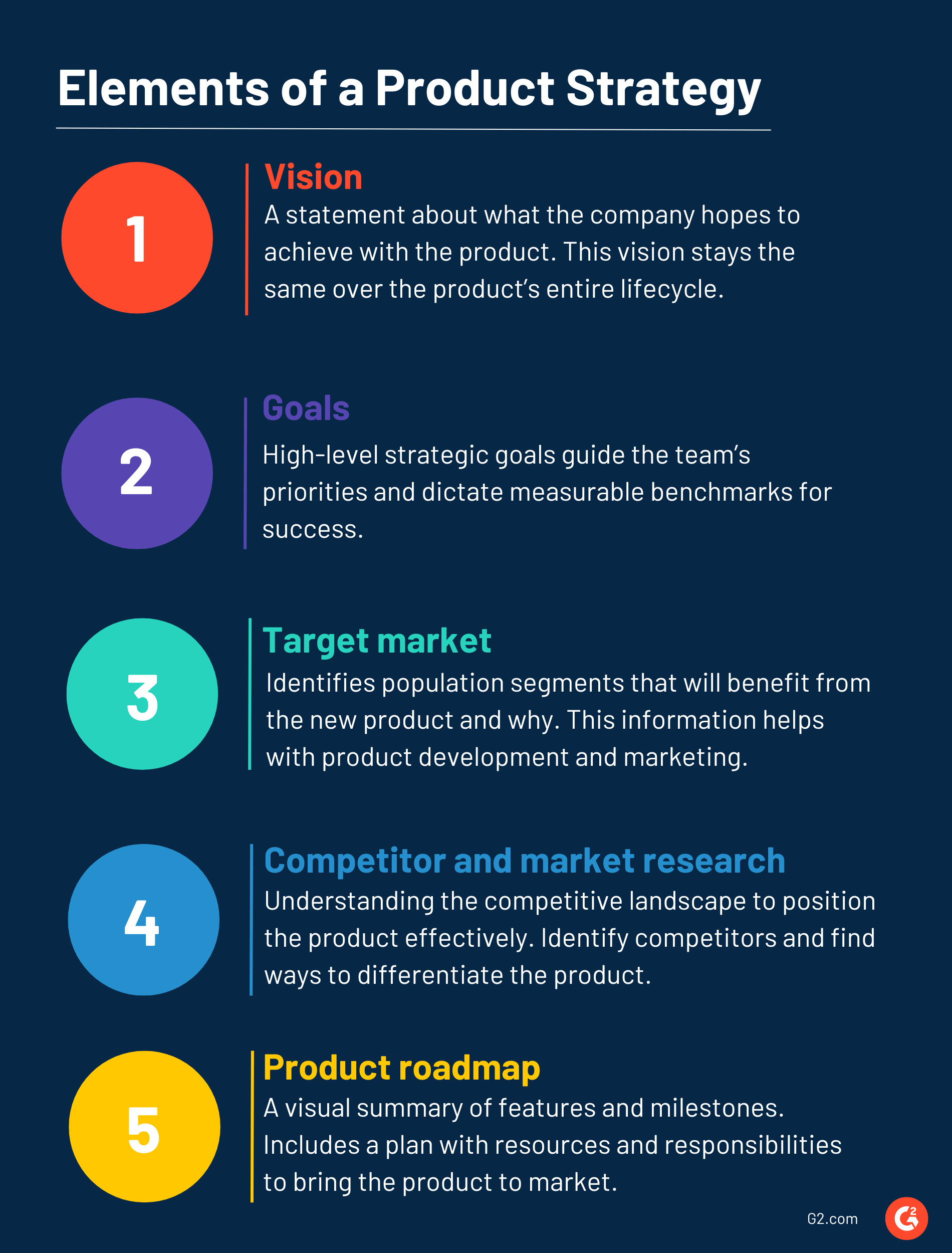
basic elements of product strategy

Some of the elements companies put in their product strategy are:

  • The vision, just as a company crafts a vision statement outlining what it stands for and the impact they want to make, a product strategy details an aspirational statement about what the organization hopes to achieve with the product. This vision stays the same over the product’s entire lifecycle.
  • Goals arise from the product’s vision. These high-level strategic goals guide the team’s priorities and dictate measurable benchmarks for success, like gaining 1,000 monthly active users in a set timeframe.
  • The target market is the part of product strategy concerned with identifying which segments of the population will benefit from the new product and why. Understanding the target audience helps with product development and marketing.
  • Competitor and market research aims to position the product effectively by understanding the competitive landscape. This means identifying and evaluating competitors to look for opportunities to differentiate the product.
  • A product roadmap should be a main feature of any product strategy. As a visual summary of product features and delivery milestones, this roadmap also includes an execution plan with the resources and responsibilities needed to bring the product to market. Unlike the product vision, the product roadmap evolves over time as the company gains a better understanding of its users and the market.

Benefits of product strategy

A well-defined product strategy helps companies achieve long-term success. Making a product strategy before launch can: 

  • Create team alignment. A product strategy provides clarity and purpose for all team members working on the project, guiding their decision-making and encouraging collaboration. For example, members of the development and marketing teams gain a shared understanding of the goals, target market, and timelines.
  • Gain a competitive edge. Businesses use product strategy to stand out from competitors. With a thorough understanding of the product’s audience and the competitive landscape, the team can identify a unique value proposition so the product wins customers and builds brand loyalty.
  • Optimize resources. Companies make better decisions about allocating and perfecting their budgets, labor, and time. Team members know which initiatives pair with which strategic goals and can work to promote features and maximize revenue.

Product strategy best practices

Creating a product strategy requires time and input from various stakeholders, but it increases the chances of a successful product launch. When developing a product strategy, companies should:

  • Take a customer-centric approach. Conduct surveys to explore customers’ wants and needs, and run concept tests to gather feedback on early product iterations. By keeping customers top of mind, companies create products that meet their clients’ needs, resulting in more product success and revenue.
  • Create strong goals. A product strategy’s goals influence every step of a product roadmap. Companies must ensure that their goals are SMART: specific, measurable, achievable, relevant, and time-bound. 
  • Take an iterative approach. Instead of relying on a static product roadmap, companies should stay agile, adapting and refining their strategy based on customer feedback, market shifts, and evolving user needs. Creating and testing prototypes, and iterating the roadmap and product as needed will ensure the product stays relevant and effective.

Learn more about how your product management team can build a better product.

Kelly Fiorini
KF

Kelly Fiorini

Kelly Fiorini is a freelance writer for G2. After ten years as a teacher, Kelly now creates content for mostly B2B SaaS clients. In her free time, she’s usually reading, spilling coffee, walking her dogs, and trying to keep her plants alive. Kelly received her Bachelor of Arts in English from the University of Notre Dame and her Master of Arts in Teaching from the University of Louisville.

Product Strategy Software

This list shows the top software that mention product strategy most on G2.

Aha! is the world's #1 product development software. We help more than 1 million product builders go from discovery to delivery and bring their strategy to life. Our suite of tools includes Aha! Roadmaps, Aha! Discovery, Aha! Ideas, Aha! Whiteboards, Aha! Knowledge, and Aha! Develop. Product teams rely on our expertise, guided templates, and training programs via Aha! Academy to be their best. We are proud to be a very different type of high-growth SaaS company. The business is self-funded, profitable, and 100% remote. We are recognized as one of the best fully remote companies to work for, champion the Bootstrap Movement, and have given over $1M to people in need through Aha! Cares. Learn more at www.aha.io.

Miro is an Innovation Workspace built to accelerate product development from insight to execution. Designed for teams operating in fast-moving, cross-functional environments, Miro brings together research, planning, prototyping, and strategy into one visual, collaborative space. Miro supports every phase of the product development lifecycle — from early discovery and journey mapping to sprint planning, design reviews, and scaled Agile workshops. And with AI features like clustering, summarization, and Sidekicks embedded directly into the canvas, teams can synthesize feedback, generate product briefs, and align on roadmaps in a fraction of the time. Two-way Jira integration and customizable Agile templates make it easy to manage end-to-end workflows, while supporting rituals like sprint planning, daily standups, and retrospectives. Whether you’re mapping product strategy or testing early prototypes, Miro helps teams collapse planning steps and drive innovation faster — all within a secure, flexible workspace.

Craft.io is an agile product management tool designed to provide users with a clear understanding of what their product is and where it is going.

ProdPad provides product management software that helps product teams collect ideas, identify priorities, and build flexible product roadmaps.

Capture problems, feedback and user research, organize feature ideas, plan releases, share beautiful interactive roadmaps.

airfocus helps you manage and communicate your product strategy, prioritize your work, build roadmaps, and connect feedback to solve the right problems.

Pendo is on a mission to elevate the world's experiences with software. Organizations around the world use Pendo to accelerate and deepen software product adoption.

Clozd provides world-class services and technology for win-loss analysis. We help B2B solution providers uncover the real reasons why they win and lose, so they can start winning more.

Mural is on a mission to help every go-to-market team achieve alignment. With the right tools to collaborate, ideate, and execute customer-centered strategies, organizations can break down the silos that slow success down and get results, faster. Mural offers an intuitive and interactive collaboration space with purpose-built templates, enterprise-grade security, and industry-leading methodologies for the customer-obsessed. GTM teams can come together on an infinite canvas that is flexible and visual to brainstorm ideas, plan project timelines, and execute together quickly. Mural’s Facilitation Superpowers lead to increased engagement from teams, customers, and GTM partners, which transforms every meeting into a co-creation session. Mapping and storyboarding features speed up buy-in and decision making by demonstrating an understanding of customers’ needs and how to meet them. Mural AI can summarize key takeaways from interactions, or suggest new ideas to strategize how to get to ‘yes.’ Out-of-the-box and custom templates make it easy to share best practices to level up every teammate to be customer-obsessed.

Amplitude is an analytics solution built for modern product teams.

UiPath enables business users with no coding skills to design and run robotic process automation

Automation Anywhere Enterprise is an RPA platform architected for the digital enterprise.

ProductPlan is an easy way to plan, visualize, and share product information management. Quickly plan and share beautiful roadmaps, Prioritize the best features, Visualize your strategy for more impact, and Create better company alignment and focus.

Fibery is a product discovery and development platform. Analyze user feedback, identify top insights, track development, and close the feedback loop.

UserTesting is an AI-enhanced human insight platform that helps organizations collect fast, actionable feedback from real users—empowering teams to validate decisions, co-innovate at scale, and deliver better products, services, and customer experiences. Trusted by leading enterprises to reduce risk, accelerate innovation, and exceed customer expectations.

Drive revenue and accelerate growth with results-oriented training delivered by Silicon Valley’s top Product Managers. Choose from Individual, Standard, or Custom Team Training to cover everything your Product teams need to know. Upon completion, your team members will receive one of our three certificates– PMC™, PLC™, or PEC™– attesting to your organization’s commitment to employee development.

The CARTO platform empowers everyone, from business analysts to data scientists, to turn location data into business outcomes.

Mixpanel helps businesses deeply understand user behavior and drive intelligent action with the leading user analytics solution.

Segment is a customer data platform that helps every team access clean and reliable customer data to make real-time decisions, accelerate growth, and personalize experiences. Today, over 20,000 companies across 70+ countries use Segment, from fast-growing businesses like Instacart, Peloton, and Bonobos to some of the world’s largest organizations like Levi’s, Intuit, and FOX. With Segment, companies can connect and activate reliable first-party data across 300+ marketing, analytics, and data warehousing tools.

Generate fully customized QR Codes, with color & shape, logo and keep track of how many people scan your QR Codes. Our QR code platform offers complete analytics and landing pages to increase conversions to your business.