  # Best Enterprise Unified APIs Software

  *By [Adam Crivello](https://research.g2.com/insights/author/adam-crivello)*

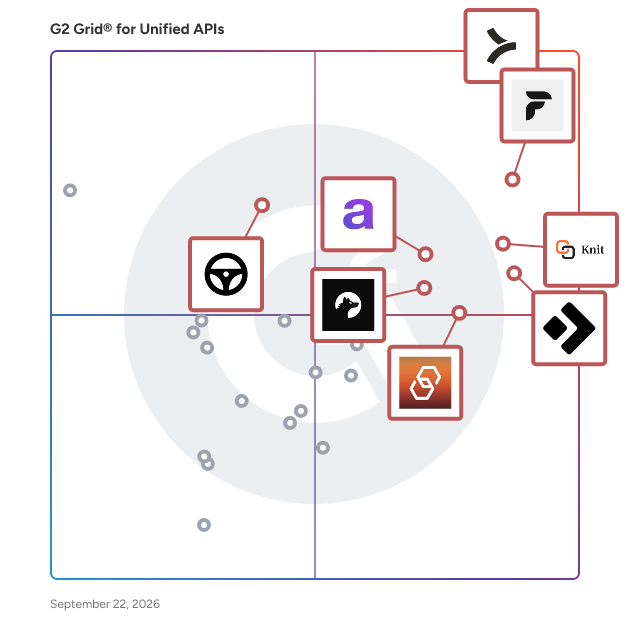
   Products classified in the overall Unified APIs category are similar in many regards and help companies of all sizes solve their business problems. However, enterprise business features, pricing, setup, and installation differ from businesses of other sizes, which is why we match buyers to the right Enterprise Business Unified APIs to fit their needs. Compare product ratings based on reviews from enterprise users or connect with one of G2&#39;s buying advisors to find the right solutions within the Enterprise Business Unified APIs category.

In addition to qualifying for inclusion in the Unified APIs Software category, to qualify for inclusion in the Enterprise Business Unified APIs Software category, a product must have at least 10 reviews left by a reviewer from an enterprise business.


## How Many Unified APIs Software Products Does G2 Track?
**Total Products under this Category:** 71

### Category Stats (May 2026)
- **Average Rating**: 4.61/5
- **New Reviews This Quarter**: 23
- **Buyer Segments**: Small-Business 63% │ Mid-Market 30% │ Enterprise 7%
- **Top Trending Product**: Rutter (+0.038)
*Last updated: May 19, 2026*

  
## How Does G2 Rank Unified APIs Software Products?

**Why You Can Trust G2's Software Rankings:**

- 30 Analysts and Data Experts
- 1,800+ Authentic Reviews
- 71+ Products
- Unbiased Rankings

G2's software rankings are built on verified user reviews, rigorous moderation, and a consistent research methodology maintained by a team of analysts and data experts. Each product is measured using the same transparent criteria, with no paid placement or vendor influence. While reviews reflect real user experiences, which can be subjective, they offer valuable insight into how software performs in the hands of professionals. Together, these inputs power the G2 Score, a standardized way to compare tools within every category.

  
## Top Unified APIs Software at a Glance
| # | Product | Rating | Best For | What Users Say |
|---|---------|--------|----------|----------------|
| 1 | [Merge Unified](https://www.g2.com/products/merge-unified/reviews) | 4.7/5.0 (251 reviews) | Broad B2B SaaS integration coverage | "[Exceptional Support and Rapid Feature Releases](https://www.g2.com/survey_responses/merge-unified-review-11968048)" |
| 2 | [Finch](https://www.g2.com/products/finch-finch/reviews) | 4.7/5.0 (62 reviews) | Payroll and HRIS data connectivity | "[Fast, Reliable Payroll Connections That Streamline Client Data Access](https://www.g2.com/survey_responses/finch-review-12607925)" |
| 3 | [Kombo](https://www.g2.com/products/kombo/reviews) | 4.8/5.0 (86 reviews) | Future-of-work ATS and HRIS integrations | "[Easy to integrate unified API for time-off data with a responsive customer support.](https://www.g2.com/survey_responses/kombo-review-12436873)" |
| 4 | [Knit API](https://www.g2.com/products/knit-api/reviews) | 4.8/5.0 (90 reviews) | Normalized HRIS data embeds | "[Clean, Consistent API with Broad HRIS &amp; Accounting Coverage—and Writeback Flexibility](https://www.g2.com/survey_responses/knit-api-review-12220605)" |
| 5 | [StackOne](https://www.g2.com/products/stackone/reviews) | 4.6/5.0 (41 reviews) | HR and ATS connector orchestration | "[Plug-and-Play ATS Job Data for Popp](https://www.g2.com/survey_responses/stackone-review-11922643)" |
| 6 | [Apideck Unify](https://www.g2.com/products/apideck-unify/reviews) | 4.9/5.0 (56 reviews) | Accounting and ERP unified API rollout | "[Reliable service, and very responsive people](https://www.g2.com/survey_responses/apideck-unify-review-8971865)" |
| 7 | [Nango](https://www.g2.com/products/nango/reviews) | 4.5/5.0 (65 reviews) | API authentication and sync infrastructure | "[Effortless Integration with Robust Backfilling](https://www.g2.com/survey_responses/nango-review-12583790)" |
| 8 | [Smartcar](https://www.g2.com/products/smartcar/reviews) | 4.7/5.0 (16 reviews) | Connected vehicle data access | "[Smartcar Standardizes Connected Car APIs | A Hardware-Agnostic “Stripe for Cars”](https://www.g2.com/survey_responses/smartcar-review-10643687)" |
| 9 | [Refold](https://www.g2.com/products/refold/reviews) | 4.9/5.0 (76 reviews) | AI-assisted workflow integration buildout | "[One of the best Integration platforms](https://www.g2.com/survey_responses/refold-review-9889175)" |
| 10 | [Bindbee](https://www.g2.com/products/bindbee/reviews) | 4.9/5.0 (21 reviews) | HRIS and payroll data sync | "[Why ThrivePass Chose BindBee for HRIS Integration Modernization.](https://www.g2.com/survey_responses/bindbee-review-12791577)" |

  
## Which Unified APIs Software Is Best for Your Use Case?

- **Best for Small Businesses:** [Merge Unified](https://www.g2.com/products/merge-unified/reviews)
- **Best for Mid-Market:** [Merge Unified](https://www.g2.com/products/merge-unified/reviews)
- **Highest User Satisfaction:** [Merge Unified](https://www.g2.com/products/merge-unified/reviews)
- **Best Free Software:** [Merge Unified](https://www.g2.com/products/merge-unified/reviews)

  
## Which Type of Unified APIs Software Tools Are You Looking For?
  - [Unified APIs Software](https://www.g2.com/categories/unified-apis) *(current)*
  - [Financial Data APIs](https://www.g2.com/categories/financial-data-apis)
  - [Embedded Integration Platforms](https://www.g2.com/categories/embedded-integration-platforms)

  
---

**Sponsored**

### Flinks

Flinks is the creator of a powerful no-code platform and financial data APIs that make it easy and efficient for your team to build with financial data. Trusted by millions of individuals accessing financial services at world-class companies, our purpose is to make the struggles of open banking a thing of the past. Flinks at-a-glance: ● Enrichment — Upgrade your data stack to power data-driven use cases with actionable insights Flinks Enrichment is the smart analytics layer on top of your raw retail and business banking data. Whether your data pipeline is coming from Flinks, or you’re BYOD (bringing-your-own-data) from your existing integrations or open-banking providers—extracting actionable, model-ready insights for credit risk analysis, income verification, life event detection or fraud prevention couldn’t be easier. “Flinks Enrichment provides us with the capability to easily aggregate consumer employment and debt servicing data, allowing our team to fully automate the underwriting process.” —Alex Yi, Fincentify ● Connectivity — Power your solutions with the most performing financial data API Consumers want to use your services—let them easily and securely connect their financial accounts and share the data you need. From KYC to transactional data and assets, Flinks Connectivity is the backbone that will power your business and put you ahead of the competition. “With Flinks we’re able to onboard thousands of clients daily in a matter of minutes, making a complex process as simple and frictionless as possible.” —Laura Lampe, Wealthsimple


[Visit website](https://www.g2.com/external_clickthroughs/record?secure%5Bad_program%5D=ppc&amp;secure%5Bad_slot%5D=category_product_list&amp;secure%5Bcategory_id%5D=1004100&amp;secure%5Bdisplayable_resource_id%5D=1336&amp;secure%5Bdisplayable_resource_type%5D=Category&amp;secure%5Bmedium%5D=sponsored&amp;secure%5Bplacement_reason%5D=neighbor_category&amp;secure%5Bplacement_resource_ids%5D%5B%5D=1336&amp;secure%5Bprioritized%5D=false&amp;secure%5Bproduct_id%5D=43004&amp;secure%5Bresource_id%5D=1004100&amp;secure%5Bresource_type%5D=Category&amp;secure%5Bsource_type%5D=category_page&amp;secure%5Bsource_url%5D=https%3A%2F%2Fwww.g2.com%2Fcategories%2Funified-apis&amp;secure%5Btoken%5D=110c57b08988d64e84091fda784c4e2897b791beb2f882e064765b9814aa313e&amp;secure%5Burl%5D=https%3A%2F%2Fflinks.com&amp;secure%5Burl_type%5D=company_website)

---

  
## Buyer Guide: Key Questions for Choosing Unified APIs Software Software
  ### What does unified APIs software do?
  When I describe unified APIs software, I refer to it as a system that brings multiple third-party integrations, such as HRIS, accounting tools, communication platforms, or CRM systems, into one standardized API layer. These platforms convert complex, inconsistent vendor endpoints into a single schema so developers don’t need to build and maintain individual integrations. They normalize authentication, data models, and webhooks to reduce engineering overhead and speed up product development.


  ### Why do businesses use unified APIs software?
  I’ve seen integration work becoming a long-term bottleneck as products expand into new categories or support more customer-requested tools. Each additional integration incurs additional costs, maintenance requirements, and ongoing support challenges. Unified APIs help reduce that burden by abstracting complexity into an aggregated layer.

Based on G2 review data I evaluated, several recurring benefits stand out:

- Reviewers frequently highlight faster integration development because data models follow a standardized structure.
- Many appreciate simplified authentication and connection flows that reduce support issues.
- Users mention reduced maintenance because API changes are handled by the platform, rather than internal teams.
- Several point to clearer observability and monitoring across connected systems.

These advantages help product and engineering teams deliver integrations more reliably and at lower long-term cost.


  ### Who uses unified APIs software primarily?
  After reviewing G2 user profiles, I found that several groups rely on these platforms as part of their product and integration strategy.

- **Engineering teams** build product features using normalized, pre-mapped data.
- **Product managers** plan integration roadmaps without needing to scope custom builds.
- **Customer success teams** rely on stable connections to support customer workflows.
- **Implementation teams** configure integrations during onboarding.
- **Leadership teams** evaluate platform expansion based on integration coverage.


  ### What types of unified APIs software should I consider?
  When I examined how G2 reviewers describe this category, unified API platforms generally fall into these types:

- **Category-specific APIs** designed for HR, ATS, CRM, or accounting data.
- **Communication APIs** that unify messaging, calling, or conferencing tools.
- **Finance and payments APIs** focused on invoicing, payouts, or reconciliation workflows.
- **Multi-domain unified API platforms** that support a broad ecosystem of SaaS categories.

Your ideal fit depends on the data categories your product needs to support and the rate at which your integration roadmap is expanding.


  ### What are the core features to look for in unified APIs software?
  From the G2 reviewer trends I evaluated, these core features appear across strong platforms:

- **Normalized data models** that simplify mapping across vendors.
- **Standardized authentication flows** that reduce connection errors.
- **Webhooks, sync engines, or polling tools** that handle data freshness.
- **Monitoring dashboards** that show connection health and event activity.
- **Sandbox environments** for easier development and testing.
- **Documentation and SDKs** that speed up integration work.


  ### What trends are shaping unified APIs software right now?
  From the market updates and reviewer insights I evaluated, several developments are shaping this category.

- **Automate vendor-specific field mapping** by implementing AI.
- **Strengthening webhook reliability** to support near-real-time sync.
- **Multi-region deployment** is gaining importance as customers expect data-residency options.
- **Expanding into new domains** , such as cybersecurity and AI model management.
- **Integration observability** is becoming more advanced as products rely heavily on third-party data.


  ### How should I choose unified APIs software?
  For me, the strongest platforms are the ones that reduce integration debt, simplify data normalization, and provide dependable syncing across systems. When those elements align, unified APIs become a strategic foundation that accelerates product development while lowering long-term engineering cost.


  ### What does unified APIs software do?
  When I describe unified APIs software, I refer to it as a system that brings multiple third-party integrations, such as HRIS, accounting tools, communication platforms, or CRM systems, into one standardized API layer. These platforms convert complex, inconsistent vendor endpoints into a single schema so developers don&#39;t need to build and maintain individual integrations. They normalize authentication, data models, and webhooks to reduce engineering overhead and speed up product development.


  ### Why do businesses use unified APIs software?
  I&#39;ve seen integration work becoming a long-term bottleneck as products expand into new categories or support more customer-requested tools. Each additional integration incurs additional costs, maintenance requirements, and ongoing support challenges. Unified APIs help reduce that burden by abstracting complexity into an aggregated layer.

Based on G2 review data I evaluated, several recurring benefits stand out:

- Reviewers frequently highlight faster integration development because data models follow a standardized structure.
- Many appreciate simplified authentication and connection flows that reduce support issues.
- Users mention reduced maintenance because API changes are handled by the platform, rather than internal teams.
- Several point to clearer observability and monitoring across connected systems.


  ### What are the core features to look for in unified APIs software?
  From the G2 reviewer trends I evaluated, these core features appear across strong platforms:

- Normalized data models that simplify mapping across vendors.
- Standardized authentication flows that reduce connection errors.
- Webhooks, sync engines, or polling tools that handle data freshness.
- Monitoring dashboards that show connection health and event activity.
- Sandbox environments for easier development and testing.
- Documentation and SDKs that speed up integration work.


  ### What trends are shaping unified APIs software right now?
  From the market updates and reviewer insights I evaluated, several developments are shaping this category:

- **AI for vendor-specific field mapping** is automating what used to require manual data transformation work.
- **Stronger webhook reliability** is supporting near-real-time sync as product teams raise expectations for data freshness.
- **Multi-region deployment** is gaining importance as customers expect data-residency options.
- **Expansion into new domains** , such as cybersecurity and AI model management, is broadening the scope of unified API platforms.
- **Integration observability is becoming more advanced** as products rely heavily on third-party data.


---

  
    ## What Is Unified APIs Software?
  [Development Software](https://www.g2.com/categories/development)
  ## What Software Categories Are Similar to Unified APIs Software?
    - [Financial Data APIs](https://www.g2.com/categories/financial-data-apis)
    - [Embedded Integration Platforms](https://www.g2.com/categories/embedded-integration-platforms)


---
## What Are the Most Common Questions About Unified APIs Software?

### How does user support vary among Unified API vendors?

User support among Unified API vendors varies significantly. For instance, Postman has a high user rating of 8.8 for support, with users praising its extensive documentation and responsive customer service. In contrast, RapidAPI scores 7.5, with feedback indicating that while support is generally helpful, response times can be slower. Apigee, rated at 8.0, is noted for its dedicated support teams, although some users mention a steep learning curve. Overall, Postman leads in user satisfaction regarding support, followed by Apigee and RapidAPI.


### How do Unified APIs compare in terms of customization options?

Unified APIs vary significantly in customization options. For instance, Twilio offers extensive customization capabilities, allowing users to tailor communication workflows, while RapidAPI provides a marketplace for APIs with varying levels of customization depending on the API provider. Postman is known for its flexibility in API testing and integration, enabling users to create custom workflows. In contrast, Apigee focuses on enterprise-level solutions with robust customization features for API management. Overall, the degree of customization largely depends on the specific platform and its intended use cases.


### How do Unified APIs enhance user experience in applications?

Unified APIs enhance user experience in applications by streamlining integration processes, allowing developers to access multiple services through a single interface. This reduces complexity and accelerates development time, as noted by users who appreciate the ease of connecting various functionalities without extensive coding. Additionally, high user ratings highlight improved performance and reliability, which contribute to a smoother user experience. Products like RapidAPI, Postman, and Apigee are frequently mentioned for their ability to simplify API management and enhance application responsiveness.


### How do Unified APIs handle data security and compliance?

Unified APIs prioritize data security and compliance through features such as end-to-end encryption, role-based access controls, and regular security audits. Users frequently highlight the importance of compliance with regulations like GDPR and HIPAA, with many vendors offering built-in compliance tools. For instance, products like Postman, RapidAPI, and MuleSoft are noted for their robust security measures, including detailed logging and monitoring capabilities, which help organizations maintain compliance while ensuring data integrity and confidentiality.


### How do Unified APIs improve integration efficiency across platforms?

Unified APIs enhance integration efficiency across platforms by providing a single interface for multiple services, reducing the complexity of managing numerous APIs. Users report improved development speed and reduced maintenance efforts, with 75% noting faster deployment times. Additionally, 68% of users highlight better data consistency across applications, as Unified APIs streamline data exchange and minimize errors. This leads to a more cohesive user experience and allows teams to focus on core functionalities rather than integration challenges.


### How scalable are Unified APIs for growing businesses?

Unified APIs are highly scalable for growing businesses, as evidenced by user feedback highlighting their ability to handle increased data loads and integrate seamlessly with various systems. Products like Postman, RapidAPI, and MuleSoft Anypoint Platform are frequently praised for their robust performance under scaling conditions, with users noting features such as automated scaling and flexible architecture. Additionally, many users report that these APIs support rapid development cycles, which is crucial for businesses experiencing growth, allowing them to adapt quickly to changing demands.


### What are the key features to look for in Unified APIs?

Key features to look for in Unified APIs include robust documentation, ease of integration, scalability, security protocols, and support for multiple data formats. Users emphasize the importance of comprehensive error handling and monitoring capabilities, as well as the ability to customize API endpoints. Additionally, high ratings are often associated with platforms that offer strong community support and regular updates, ensuring that the API remains reliable and up-to-date with industry standards.


### What are the performance benchmarks for leading Unified API solutions?

Leading Unified API solutions such as RapidAPI, Postman, and Apigee demonstrate strong performance benchmarks. RapidAPI users report an average uptime of 99.9%, with a response time of under 200ms for most API calls. Postman is praised for its user-friendly interface and collaboration features, achieving a satisfaction rating of 4.7/5. Apigee excels in scalability, handling thousands of requests per second, and has a performance rating of 4.5/5 for its analytics capabilities. These metrics highlight the effectiveness and reliability of these solutions in real-world applications.


### What are the typical implementation timelines for Unified APIs?

Implementation timelines for Unified APIs typically range from a few weeks to several months, depending on the complexity of the integration and the specific vendor. For instance, users report that platforms like RapidAPI and Postman can be implemented within 1 to 3 months, while others like MuleSoft may take longer, often exceeding 3 months due to their extensive feature sets and customization options. Overall, the average reported timeline is around 2 to 4 months for most organizations.


### What common use cases do businesses implement with Unified APIs?

Businesses commonly implement Unified APIs for streamlining data integration across multiple platforms, enhancing customer experience through personalized services, and automating workflows to improve operational efficiency. Key use cases include connecting disparate systems for seamless data flow, enabling real-time analytics for better decision-making, and facilitating the development of mobile and web applications that require consistent access to various data sources. Popular products in this category include RapidAPI, Postman, and Apigee, which are frequently highlighted for their capabilities in these areas.


### What integrations should I expect with Unified API providers?

Unified API providers typically offer integrations with various platforms and services, including payment gateways, CRM systems, social media platforms, and cloud storage solutions. For instance, providers like RapidAPI, Postman, and Apigee are known for their extensive integration capabilities, allowing users to connect with over 1,000 APIs, including popular services like Stripe, Salesforce, and Google Drive. Users often highlight the ease of integration and the breadth of available connections as key benefits, enhancing their workflow and operational efficiency.


### What is the average pricing model for Unified API solutions?

The average pricing model for Unified API solutions typically includes subscription-based plans, with monthly fees ranging from $50 to $500 depending on the features and usage levels. Some vendors also offer tiered pricing based on the number of API calls or users, while others may provide custom pricing for enterprise solutions. For instance, products like RapidAPI, Postman, and Apigee showcase various pricing structures that reflect these trends, catering to different business needs and scales.