Best AI Orchestration Software

How Many AI Orchestration Software Products Does G2 Track?

Total Products under this Category: 974

Category Stats (Oct 2026)

  • Average Rating: 4.61/5 (↑0.01 vs Sep 2026) The average rating of products in this category, based on all submitted ratings
  • Top Trending Product: Crewai (+2.21%) - Among all products in this category, Crewai recorded the largest rating increase compared to last month

Last updated: October 26, 2026

How Does G2 Rank AI Orchestration Software Products?

Why You Can Trust G2's Software Rankings:

  • 30 Analysts and Data Experts
  • 24,800+ Authentic Reviews
  • 974+ Products
  • Unbiased Rankings

G2's software rankings are built on verified user reviews, rigorous moderation, and a consistent research methodology maintained by a team of analysts and data experts. Each product is measured using the same transparent criteria, with no paid placement or vendor influence. While reviews reflect real user experiences, which can be subjective, they offer valuable insight into how software performs in the hands of professionals. Together, these inputs power the G2 Score, a standardized way to compare tools within every category.

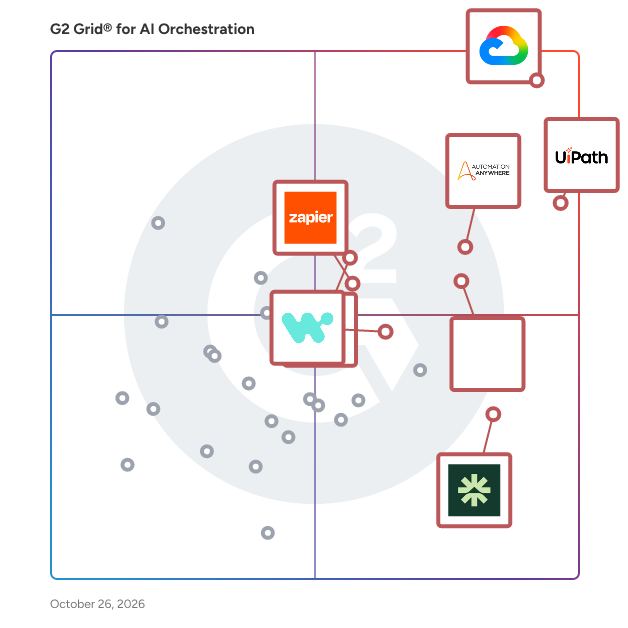
G2 Grid® for AI Orchestration Software

G2 Grid® for AI Orchestration Software plotting products by satisfaction and market presence

Highlighted products: Gemini platform, UiPath Agentic Automation, Automation Anywhere Agentic Process Automation, Langchain, MuleSoft Anypoint Platform, Zapier, Willow AI Governance Control Plane, and Workato.

Underlying data: [Grid® JSON](https://www.g2.com/categories/ai-orchestration/grids.json?focus%5B%5D=gemini-platform&focus%5B%5D=uipath-agentic-automation&focus%5B%5D=automation-anywhere-agentic-process-automation&focus%5B%5D=langchain&focus%5B%5D=mulesoft-anypoint-platform&focus%5B%5D=zapier&focus%5B%5D=willow-ai&focus%5B%5D=workato)

Gemini platform

Google Cloud's comprehensive platform for developers to build, scale, govern and optimize agents and models. It's a single destination for technical teams to build agents that can transform enterprise applications and workflows into powerful agentic systems.

Average Rating: 4.3/5.0

Total Reviews: 724

Who Is the Company Behind Gemini platform?

  • Seller: Google
  • Year Founded: 1998
  • HQ Location: Mountain View, CA
  • Twitter: @google
    31,899,995 Twitter followers
  • LinkedIn® Page: www.linkedin.com
    301,144 employees on LinkedIn®
  • Ownership: NASDAQ:GOOG

Who Uses This Product?

  • Who Uses This: Software Engineer, Data Scientist
  • Top Industries: Computer Software, Information Technology and Services
  • Company Size: 42% Small, 29% Large

What Do G2 Reviewers Say About Gemini platform?

AI-generated summary from verified user reviews

Pros
  • Users appreciate the ease of use of the Gemini Enterprise Agent Platform, highlighting its beginner-friendly interface and intuitive design.
  • Users appreciate the multimodal capabilities of Gemini, enhancing productivity by understanding text, images, code, and documents together.
  • Users value the multimodal capabilities of Gemini, enhancing productivity in software development and automation projects.
  • Users value the multimodal capabilities of Gemini, enhancing productivity in software development and automation projects.
  • Users value the integrated platform of Gemini, enhancing productivity by combining various functionalities in a unified system.
Cons
  • Users find the platform expensive, especially when considering resource usage and challenging documentation.
  • Users find the complex pricing structure of Gemini Enterprise Agent Platform confusing and difficult to navigate.
  • Users find the learning curve steep with Gemini Enterprise Agent Platform, due to its numerous complex components and configurations.
  • Users find the complex pricing structure of Gemini Enterprise Agent challenging and suggest simplifying it for clarity.
  • Users find the difficult learning curve of Gemini Enterprise Agent Platform overwhelming, especially with advanced features and integrations.

What Are Recent G2 Reviews of Gemini platform?

What Are G2 Users Discussing About Gemini platform?

UiPath Agentic Automation

UiPath (NYSE: PATH) is a global leader in agentic automation, empowering enterprises to harness the full potential of AI agents to autonomously execute and optimize complex business processes. The UiPath Platform™ uniquely combines controlled agency, developer flexibility, and seamless integration to help organizations scale agentic automation safely and confidently. Committed to security, governance, and interoperability, UiPath supports enterprises as they transition into a future where automation delivers on the full potential of AI to transform industries. For more information, visit www.uipath.com. Agentic testing is an AI-powered approach to software quality assurance that leverages autonomous agents to generate, execute, and evolve tests across the entire testing lifecycle. By partnering intelligent agents with human testers, agentic testing dramatically increases test coverage, accelerates release cycles, improves system resilience, and enables continuous testing at enterprise scale. It empowers teams to shift from manual, reactive testing to proactive, scalable quality engineering—driving faster innovation with higher confidence.

Average Rating: 4.6/5.0

Total Reviews: 6,270

Who Is the Company Behind UiPath Agentic Automation?

  • Seller: UiPath
  • Company Website:
  • Year Founded: 2005
  • HQ Location: New York
  • Twitter: @UiPath
    108,104 Twitter followers
  • LinkedIn® Page: www.linkedin.com
    5,142 employees on LinkedIn®

Who Uses This Product?

  • Who Uses This: RPA Developer, Software Engineer
  • Top Industries: Information Technology and Services, Computer Software
  • Company Size: 51% Large, 28% Medium

What Do G2 Reviewers Say About UiPath Agentic Automation?

AI-generated summary from verified user reviews

Pros
  • Users appreciate the advanced AI capabilities of UiPath Agentic Automation, enhancing adaptability and seamless workflow integration.
  • Users appreciate the ease of use of UiPath Agentic Automation, making it simple for developers to integrate and automate tasks.
  • Users value the seamless integration of AI with automation in UiPath Agentic Automation for handling complex tasks.
  • Users commend the automation ease of UiPath Agentic Automation, benefiting from its advanced AI capabilities and orchestration.
  • Users value the efficiency of UiPath Agentic Automation, enjoying streamlined automation solutions that save time and effort.
Cons
  • Users find the product expensive, with high licensing costs compared to other RPA tools, impacting overall value.
  • Users find the learning curve challenging, especially with agent training and required programming knowledge for non-tech individuals.
  • Users find the complexity of UiPath Agentic Automation overwhelming, especially when navigating advanced features and setups.
  • Users feel that the pricing issues of UiPath Agentic Automation are too high, affecting repurchase decisions.
  • Users find the licensing issues confusing, making initial setup and advanced feature access challenging for newcomers.

What Are Recent G2 Reviews of UiPath Agentic Automation?

What Are G2 Users Discussing About UiPath Agentic Automation?

Automation Anywhere Agentic Process Automation

Automation Anywhere Agentic Process Automation (APA) is an enterprise platform that orchestrates AI agents, RPA bots, APIs, documents, and human expertise as a single governed system of work. APA transforms what is possible with automation — orchestrating every instrument of work across every system, with execution grounded in process expertise, and end-to-end process governance across every agent, every step, and every decision. It turns individual capabilities into compounded business transformation. With the APA platform, you can optimize what already runs your business and expand into what has never been feasible before. What's inside the platform Process Reasoning Engine (PRE) — the decision layer. Goal-driven AI agents plan, act, adapt, and self-correct in real time as conditions change. Mozart Orchestrator — a unified composer that manages decisions, dependencies, context, and exceptions across agents, automations, documents, and APIs. AI Agent Studio — a low-code workspace for building AI agents on foundational models from Amazon Bedrock, Google Vertex AI, Azure OpenAI, OpenAI, and others. Automator AI — generative AI–powered automation development across any application, cloud or on-premises. Document Automation — processes unstructured documents at over 95% accuracy, and 5x faster with Cloud Extraction Service for large-scale extraction. Process Discovery — surfaces bottlenecks and identifies what to automate next. Automation Co-Pilot — triggers multi-step agentic workflows in natural language, inside the applications teams already use. Governance built in, not bolted on Every agent, action, and decision runs inside enterprise controls: fine-grained role-based access control (RBAC), AES-256 encryption at rest, TLS in transit, native audit logs with SIEM integration, and human-in-the-loop oversight. Automation Anywhere maintains SOC 1 Type 2, SOC 2 Type 2, ISO 27001, ISO 22301, and HITRUST certifications, and supports GDPR compliance. Proven in production 1,500+ live APA deployments, 400M+ automations run per year, and 1.8M+ unique AI agent executions across 26 global regions. Bancolombia — 1,300% ROI in the first year and a 50% increase in customer service efficiency JBS — $1M and 125,000 hours saved in IT Granite Telecom — $635,000 in monthly savings and 15,000 hours saved per month Ricoh — 500 days of operational time saved per month SoftBank Corp. — 85% reduction in recruitment hours Who it's for Enterprise operations, IT, finance, HR, customer service, and shared services teams in banking, insurance, healthcare, life sciences, manufacturing, telecommunications, and the public sector — wherever complex, cross-system work has to run reliably and be governed. Learn more at https://www.automationanywhere.com.

Average Rating: 4.5/5.0

Total Reviews: 4,164

Who Is the Company Behind Automation Anywhere Agentic Process Automation?

  • Seller: Automation Anywhere
  • Company Website:
  • Year Founded: 2003
  • HQ Location: San Jose, CA
  • Twitter: @AutomationAnywh
    55,050 Twitter followers
  • LinkedIn® Page: www.linkedin.com
    2,327 employees on LinkedIn®

Who Uses This Product?

  • Who Uses This: RPA Developer, Software Engineer
  • Top Industries: Information Technology and Services, Computer Software
  • Company Size: 58% Large, 23% Medium

What Do G2 Reviewers Say About Automation Anywhere Agentic Process Automation?

AI-generated summary from verified user reviews

Pros
  • Users praise the ease of use in Automation Anywhere Agentic Process Automation for simplifying RPA bot creation and management.
  • Users value the ease of automating repetitive tasks with Automation Anywhere, enhancing productivity and efficiency effortlessly.
  • Users appreciate the efficiency of Automation Anywhere, highlighting its ease of use and significant impact on productivity.
  • Users value the automation ease of Automation Anywhere, enabling non-coders to effortlessly build bots and streamline tasks.
  • Users appreciate the intuitive interface of Automation Anywhere, making automation easy and enhancing overall efficiency.
Cons
  • Users find Automation Anywhere's pricing model to be expensive and complex, which can be challenging for small teams.
  • Users find the steep learning curve challenging, especially for beginners navigating advanced features and debugging workflows.
  • Users find the missing features of Automation Anywhere Agentic Process Automation frustrating, limiting their workflow capabilities.
  • Users experience software bugs causing issues like errors in automation and problems with browser extensions.
  • Users often face bot issues including complex debugging and integration challenges, affecting overall usability and performance.

What Are Recent G2 Reviews of Automation Anywhere Agentic Process Automation?

What Are G2 Users Discussing About Automation Anywhere Agentic Process Automation?

AI can help you find the answers. G2 helps you trust them.

Connect G2 to Claude or ChatGPT for answers grounded in G2's trusted reviews, comparisons, and pricing from real user insights.

How it works

Langchain

LangChain is an open-source framework designed to simplify the development of applications powered by large language models (LLMs). By providing a suite of tools and abstractions, LangChain enables developers to build context-aware, reasoning applications such as chatbots, question-answering systems, and content generators. Its modular architecture allows for seamless integration with various LLMs, including those from OpenAI, Anthropic, and Cohere, facilitating the creation of sophisticated AI-driven solutions. Key Features and Functionality: - Modular Components: LangChain offers isolated modules for model input/output, prompt templates, and retrieval mechanisms, allowing developers to customize and extend functionalities as needed. - Agent Framework: The framework supports the creation of agents that can make decisions and perform tasks based on user inputs, enhancing the interactivity and utility of applications. - Memory Management: LangChain provides both short-term and long-term memory capabilities, enabling applications to maintain context over extended interactions. - Extensive Integrations: With over 1,000 integrations, LangChain allows developers to connect with various models, tools, and databases without the need to rewrite application code, ensuring flexibility and future-proofing. - Durable Runtime: Built on LangGraph’s durable runtime, LangChain ensures agents have built-in persistence, rewind capabilities, checkpointing, and support for human-in-the-loop interactions. Primary Value and Problem Solving: LangChain addresses the challenges developers face when integrating LLMs into applications by offering a structured and efficient approach to building AI-driven solutions. It streamlines the development process, reduces the complexity associated with managing interactions between various components, and provides the flexibility to adapt to evolving AI technologies. By leveraging LangChain, developers can rapidly deploy reliable and scalable AI applications that are capable of understanding and responding to complex user inputs, thereby enhancing user experiences and operational efficiency.

Average Rating: 4.5/5.0

Total Reviews: 147

Who Is the Company Behind Langchain?

Who Uses This Product?

  • Who Uses This: Student, Software Developer
  • Top Industries: Computer Software, Information Technology and Services
  • Company Size: 58% Small, 25% Medium

What Do G2 Reviewers Say About Langchain?

AI-generated summary from verified user reviews

Pros
  • Users commend the ease of use of Langchain, facilitating seamless integration and development of AI applications.
  • Users value the easy integrations of Langchain, facilitating seamless connections between LLMs, data, and APIs.
  • Users value the ease of use and powerful integrations of Langchain, making it accessible for various applications.
  • Users appreciate the seamless integrations of LangChain, enhancing the efficiency of AI app development and scaling.
  • Users value the customization capabilities of Langchain, enabling tailored, efficient development for complex AI applications.
Cons
  • Users find LangChain's complexity issues frustrating, as heavy abstractions hinder debugging and complicate deployment.
  • Users find Langchain's steep learning curve daunting, with complexity in integration and frequent API changes complicating usage.
  • Users often find poor documentation of LangChain to be overwhelming, making it challenging to navigate and maintain projects.
  • Users face a steep learning curve and frequent breaking changes that complicate their experience with Langchain.
  • Users criticize the software instability of Langchain, particularly due to frequent breaking changes and documentation delays.

What Are Recent G2 Reviews of Langchain?

MuleSoft Anypoint Platform

MuleSoft Anypoint Platform is the industry-leading integration and governance solution designed to connect any application, API, and AI agent across hybrid and multi-cloud environments. For nearly two decades, we have served as the integration backbone for the world’s most complex enterprises. Today, we are extending to the AI era. We allow organizations to move beyond AI sprawl into a unified architecture where legacy systems, modern APIs, and autonomous agents interact securely on a single, trusted foundation. Key capabilities and components include: Hybrid integration and connectivity, utilizing a library of hundreds of pre-built connectors and support for new AI protocols like MCP and A2A to provide AI agents with the tools they need to access and act within legacy ERPs, CRMs, and on-premise databases. MuleSoft Agent Fabric: Unified API and agent governance, applying the same rigorous security policies, cost controls, and traffic enforcement to AI models and agents that organizations already trust for their global API ecosystems through a single, federated control plane. Fabric also includes agent visibility and registry, offering a single source of truth to discover and observe any cross-ecosystem agent, ensuring complete transparency and the elimination of shadow AI. MuleSoft Vibes: Natural language design and management, providing a revamped experience where teams can use native natural language prompts to scaffold integrations, manage lifecycles, and stay ahead of technical sprawl using the AI tools they already prefer. Trusted runtime and compliance, delivering a fully managed, hybrid, or on-prem foundation that has been proven at scale for years, ensuring that every interaction is backed by enterprise-grade monitoring and human-in-the-loop security. Overall, MuleSoft Anypoint Platform is the enterprise platform for organizations seeking to bring visibility, trust, and orchestration to their APIs and AI agents.

Average Rating: 4.4/5.0

Total Reviews: 763

Who Is the Company Behind MuleSoft Anypoint Platform?

  • Seller: Salesforce
  • Company Website:
  • Year Founded: 1999
  • HQ Location: San Francisco, CA
  • Twitter: @salesforce
    579,511 Twitter followers
  • LinkedIn® Page: www.linkedin.com
    89,711 employees on LinkedIn®

Who Uses This Product?

  • Who Uses This: Software Engineer, Senior Software Engineer
  • Top Industries: Information Technology and Services, Computer Software
  • Company Size: 54% Large, 31% Medium

What Do G2 Reviewers Say About MuleSoft Anypoint Platform?

AI-generated summary from verified user reviews

Pros
  • Users appreciate the ease of use of MuleSoft Anypoint Platform, finding it ideal for their data loading needs.
  • Users value the integration capabilities of MuleSoft Anypoint Platform, enabling seamless connections across various systems and APIs.
  • Users value the easy integrations of MuleSoft Anypoint Platform, simplifying the connection of various systems seamlessly.
  • Users value the immense integration capabilities of MuleSoft Anypoint Platform, enhancing efficiency with diverse systems and tools.
  • Users appreciate the clean UI and comprehensive features of MuleSoft Anypoint Platform for efficient API management.
Cons
  • Users find the learning curve steep for MuleSoft Anypoint Platform, especially for those transitioning from other tools.
  • Users express concern over the high cost of MuleSoft Anypoint Platform, making it less accessible for smaller projects.
  • Users find learning difficulty with MuleSoft Anypoint Platform, requiring advanced skills and complicating transitions from familiar tools.
  • Users experience a steep learning curve with MuleSoft Anypoint, often requiring extensive training and adjustment time.
  • Users find the API limitations of MuleSoft Anypoint Platform restrictive, desiring increased capacity for better scalability.

What Are Recent G2 Reviews of MuleSoft Anypoint Platform?

What Are G2 Users Discussing About MuleSoft Anypoint Platform?

Willow AI Governance Control Plane

The AI Basecamp for the enterprise. Willow is the Agentic Access Platform for the enterprise, the AI Basecamp where every AI agent checks in before it touches a single system. Most companies are stitching together a gateway, a shadow AI scanner, a DLP bolt-on, and a manual approval process. Seven tools pretending to be one. Willow is the platform. One control plane for every AI agent, tool, MCP, skill, and plugin in the enterprise, covering identity, runtime guardrails, shadow AI detection, and audit, from the same place. What Willow does: - Secure gateway between any AI agent, Claude, ChatGPT, Cursor, Copilot, custom agents, and your internal systems: Jira, GitHub, Salesforce, Snowflake, Slack, and 1,000+ more. - Governs the action inside each tool, not just the connection. Least privilege enforced at runtime, not detected after the fact. - Detects shadow AI the moment it appears, through a browser extension and endpoint agent, before an unmanaged MCP or skill becomes an incident. - Self-serve employee portal so every department, not just engineering, connects approved tools without IT tickets. - Full audit trail tied to a real human identity, streamed to your SIEM in real time. Deploys SaaS, dedicated cloud, or fully on-prem inside your VPC. SOC 2 Type II, ISO, GDPR compliant. Why teams pick Willow over a point solution: Gateways route traffic. Scanners give you visibility with no way to act on it. DLP bolts on after the mistake already happened. Willow governs the action, detects what's unmanaged, and lets the whole org self-serve, on one control plane. Visibility - Control - Governance - Enforcement Live in production at Wix (~5,000 weekly active users, ~600 governed tools and MCPs, 1M+ governed tool calls per week), Innovid, Papaya Global, Riskified, Freetrade, Agora, Lansweeper and more. Built for CISOs, VPs of Engineering, platform leads, and CTOs rolling out AI at scale.

Average Rating: 4.9/5.0

Total Reviews: 94

Who Is the Company Behind Willow AI Governance Control Plane?

  • Seller: Willow
  • Company Website:
  • Year Founded: 2025
  • HQ Location: New York
  • Twitter: @withwillowai
    28 Twitter followers
  • LinkedIn® Page: www.linkedin.com
    15 employees on LinkedIn®

Who Uses This Product?

  • Who Uses This: Software Engineer, Product Manager
  • Top Industries: Computer Software, Financial Services
  • Company Size: 70% Medium, 26% Large

What Are Recent G2 Reviews of Willow AI Governance Control Plane?

Zapier

Zapier is the #1 workflow automation platform for businesses that want to grow faster by maximizing the efficiency of their teams, tools, and processes without relying on development teams. With our new visual editor, free Filter and Formatter tasks for more control, and reduced task-based pricing, you're going love automating with Zapier. It's free to sign up — no credit card required — and creating your first workflow, what we call a "Zap," is just a few clicks away. Since 2011, over 2 million business have turned to Zapier for their automation needs, including: lead management, sales pipeline, marketing campaigns, customer support, data management, project management, and tickets and incidents.

Average Rating: 4.5/5.0

Total Reviews: 2,065

Who Is the Company Behind Zapier?

  • Seller: Zapier
  • Company Website:
  • Year Founded: 2011
  • HQ Location: San Francisco, CA
  • Twitter: @zapier
    95,859 Twitter followers
  • LinkedIn® Page: www.linkedin.com
    1,521 employees on LinkedIn®

Who Uses This Product?

  • Who Uses This: Owner, CEO
  • Top Industries: Marketing and Advertising, Information Technology and Services
  • Company Size: 70% Small, 24% Medium

What Do G2 Reviewers Say About Zapier?

AI-generated summary from verified user reviews

Pros
  • Users find Zapier's ease of use remarkable, simplifying automation and app integrations without the need for technical skills.
  • Users value Zapier's seamless automation, effectively connecting apps and streamlining workflows for increased efficiency.
  • Users value the extensive integrations Zapier offers, streamlining tasks across their essential tools effortlessly.
  • Users love the easy integrations of Zapier, allowing seamless connections between tools for efficient automation.
  • Users value the wide range of integrations in Zapier, enhancing task automation across various platforms effortlessly.
Cons
  • Users find the cost of Zapier to be high, especially for accessing advanced features and integrations.
  • Users find the complexity of setup and feature navigation challenging, complicating their ability to test effectively.
  • Users find pricing issues with Zapier, as premium features come at a much higher cost than expected for small projects.
  • Users find the learning curve overwhelming due to the extensive integrations, making it challenging to build efficient zaps.
  • Users express frustration with Zapier's limited features, making it challenging for smaller teams and specific use cases.

What Are Recent G2 Reviews of Zapier?

What Are G2 Users Discussing About Zapier?

Workato

Workato is the #1-rated iPaaS and the leader in Enterprise MCP — the platform enterprises trust to unify integration, automation, and AI in one secure, cloud-native runtime. Trusted by over 12,000 customers including half the Fortune 500, Workato connects every system, process, and data source with 14,000+ pre-built connectors. What sets Workato apart: Enterprise MCP turns proven business processes into governed, agent-ready skills that any AI agent — Claude, ChatGPT, Cursor, or custom-built — can execute safely and predictably. No rip-and-replace required. Whether modernizing legacy integrations or deploying agentic AI at scale, Workato delivers the orchestration, governance, and trust needed in the enterprise.

Average Rating: 4.7/5.0

Total Reviews: 827

Who Is the Company Behind Workato?

  • Seller: Workato
  • Company Website:
  • Year Founded: 2013
  • HQ Location: Mountain View, California
  • Twitter: @Workato
    3,641 Twitter followers
  • LinkedIn® Page: www.linkedin.com
    1,466 employees on LinkedIn®

Who Uses This Product?

  • Who Uses This: Software Engineer, Senior Software Engineer
  • Top Industries: Computer Software, Information Technology and Services
  • Company Size: 41% Medium, 34% Large

What Do G2 Reviewers Say About Workato?

AI-generated summary from verified user reviews

Pros
  • Users appreciate the ease of use of Workato, enabling quick automation without needing technical expertise.
  • Users love the easy integrations with Workato, allowing quick automation of tools like Salesforce and Slack.
  • Users love how Workato's easy integrations simplify automation, saving them hours and making processes seamless.
  • Users value the user-friendly and low-code interface of Workato, making business process automation seamless and efficient.
  • Users appreciate the ease of automation with Workato, enabling seamless integrations and saving significant time on repetitive tasks.
Cons
  • Users often find the complexity of Workato overwhelming, particularly regarding pricing and onboarding, leading to confusion.
  • Users find the learning curve steep, with complexity and confusion hindering smooth onboarding and workflow management.
  • Users are frustrated by data limitations in Workato, impacting email sends, job reporting, and large file transfers.
  • Users find the missing features in Workato's connector library limit their integration capabilities with lesser-known applications.
  • Users find the steep learning curve of Workato daunting, especially during onboarding and initial usage.

What Are Recent G2 Reviews of Workato?

What Are G2 Users Discussing About Workato?

aixplain

aixplain is the operating system for AI agents that organizations own and can account for. People use agents in their everyday work, the agents and workflows they create become assets the organization builds on, and everything runs on any model and any server: aixplain cloud, your own servers, air-gapped, or on a desktop. Every agent answers to a named owner, and inspector agents check every run. Omni: the AI agent you delegate work to, and use to create new agents. Koder: builds software and AI services in your codebase, on Desktop or in the CLI, and deploys your agents as secure APIs. aixplain Desktop: Omni and Koder on Mac, Windows and Linux. aixplain OS: the runtime and control plane underneath. Built for organizations that need control over where their AI runs, including in Arabic. Offices in San Jose, Riyadh and Aachen. Recognized in the CB Insights AI 100, 2025.

Average Rating: 4.3/5.0

Total Reviews: 97

Who Is the Company Behind aixplain?

  • Seller: aiXplain
  • Year Founded: 2020
  • HQ Location: San Jose, US
  • LinkedIn® Page: www.linkedin.com
    50 employees on LinkedIn®

Who Uses This Product?

  • Top Industries: Computer Software, Information Technology and Services
  • Company Size: 60% Small, 28% Medium

What Are Recent G2 Reviews of aixplain?

Frontier

Frontier is a new enterprise AI platform from OpenAI for building, deploying, and managing autonomous AI agents across a company’s tech stack. It’s basically a centralized place to run “AI coworkers” that can interact with real systems and workloads, not just chat.

Average Rating: 4.3/5.0

Total Reviews: 63

Who Is the Company Behind Frontier?

  • Seller: OpenAI
  • Year Founded: 2015
  • HQ Location: San Francisco, CA
  • Twitter: @OpenAI
    4,941,980 Twitter followers
  • LinkedIn® Page: www.linkedin.com
    10,438 employees on LinkedIn®

Who Uses This Product?

  • Top Industries: Accounting, Consumer Services
  • Company Size: 63% Small, 22% Medium

What Are Recent G2 Reviews of Frontier?

Airia

Airia is the enterprise AI platform built for organizations that need to discover, secure, govern, and optimize AI at scale. As agentic AI expands across the enterprise, most organizations are running far more AI than they realize, with limited visibility into what those agents are doing, what data they can access, and whether they meet regulatory requirements. Airia gives enterprises a single platform to surface every agent, model, and MCP server across their environment, enforce runtime controls and safety guardrails, generate audit-ready compliance evidence for the EU AI Act, NIST AI RMF, ISO 42001, and more, and manage model performance, token usage, and AI spend. The result is an enterprise that can move fast with AI while maintaining the oversight, accountability, and control that regulated industries demand. Recognized by Gartner in the Magic Quadrant for AI Governance. Trusted by over 500 enterprises worldwide. Learn more at airia.com.

Average Rating: 4.6/5.0

Total Reviews: 36

Who Is the Company Behind Airia?

  • Seller: Airia
  • Year Founded: 2023
  • HQ Location: Atlanta, US
  • LinkedIn® Page: www.linkedin.com
    161 employees on LinkedIn®

Who Uses This Product?

  • Top Industries: Information Technology and Services
  • Company Size: 49% Medium, 38% Small

What Do G2 Reviewers Say About Airia?

AI-generated summary from verified user reviews

Pros
  • Users appreciate the ease of use of Airia, enabling quick deployment and a seamless experience for their teams.
  • Users highlight the exceptional customer support of Airia, noting responsiveness and a genuine investment in user success.
  • Users appreciate the easy setup of Airia, allowing quick implementation and flexible agent creation with excellent support.
  • Users appreciate the integrated chat feature of Airia, making it easy to deploy AI solutions effortlessly.
  • Users benefit from the high deployment efficiency of Airia, simplifying AI integration across businesses with strong support.
Cons
  • Users experience access limitations due to fewer integrations and lacking robust security roles compared to competitors.
  • Users often face call quality issues that can disrupt communication, though support is responsive and helpful.
  • Users report occasional dependency issues with API calls failing, though support and documentation improvements are helpful.
  • Users often face a steep learning curve with Airia, making it difficult to navigate industry-specific features.
  • Users note the limited features of Airia, particularly regarding fewer integrations compared to competitors and lacking RBAC functionality.

What Are Recent G2 Reviews of Airia?

Astro by Astronomer

For data teams looking to increase the availability of trusted data, Astronomer provides Astro, the modern data orchestration platform, powered by Airflow. Astro enables data engineers, data scientists, and data analysts to build, run, and observe pipelines-as-code. Astronomer is the driving force behind Apache Airflow™, the de facto standard for expressing data flows as code. Airflow is downloaded more than 31 million times each month and is used by hundreds of thousands of teams around the world.

Average Rating: 4.5/5.0

Total Reviews: 135

Who Is the Company Behind Astro by Astronomer?

  • Seller: Astronomer
  • Company Website:
  • Year Founded: 2018
  • HQ Location: New York, US
  • Twitter: @astronomerio
    19,697 Twitter followers
  • LinkedIn® Page: www.linkedin.com
    4,483 employees on LinkedIn®

Who Uses This Product?

  • Who Uses This: Data Engineer, Senior Data Engineer
  • Top Industries: Information Technology and Services, Financial Services
  • Company Size: 47% Medium, 38% Large

What Do G2 Reviewers Say About Astro by Astronomer?

AI-generated summary from verified user reviews

Pros
  • Users appreciate the ease of use of Astro, finding it intuitive and effective for managing complex workflows.
  • Users appreciate the efficiency improvements of Astro, simplifying workflows and reducing the need for dedicated DevOps resources.
  • Users appreciate the intuitive user interface of Astro, facilitating easy monitoring and management of complex workflows.
  • Users appreciate the automation capabilities of Astro by Astronomer, streamlining workflows and enhancing data orchestration.
  • Users value the deployment ease of Astro by Astronomer, enhancing productivity with simple, reliable, and efficient setups.
Cons
  • Users highlight that Astro by Astronomer can be quite expensive, posing challenges for smaller teams and budget constraints.
  • Users note a steep learning curve with Astro, requiring significant time for adaptation and training.
  • Users find the steep learning curve of Astro challenging, requiring extra time for new team members to adapt.
  • Users note a steep learning curve with Astro, making adaptation challenging for new team members.
  • Users note the feature limitations of Astro, citing high costs and lack of flexibility compared to self-hosting.

What Are Recent G2 Reviews of Astro by Astronomer?

What Are G2 Users Discussing About Astro by Astronomer?

Apache Airflow

Apache Airflow is an open-source platform designed for authoring, scheduling, and monitoring complex workflows. Developed in Python, it enables users to define workflows as code, facilitating dynamic pipeline generation and seamless integration with various technologies. Airflow's modular architecture and message queue system allow it to scale efficiently, managing workflows from single machines to large-scale distributed systems. Its user-friendly web interface provides comprehensive monitoring and management capabilities, offering clear insights into task statuses and execution logs. Key Features: - Pure Python: Workflows are defined using standard Python code, allowing for dynamic pipeline generation and easy integration with existing Python libraries. - User-Friendly Web Interface: A robust web application enables users to monitor, schedule, and manage workflows without the need for command-line interfaces. - Extensibility: Users can define custom operators and extend libraries to fit their specific environment, enhancing the platform's flexibility. - Scalability: Airflow's modular architecture and use of message queues allow it to orchestrate an arbitrary number of workers, making it ready to scale as needed. - Robust Integrations: The platform offers numerous plug-and-play operators for executing tasks across various cloud platforms and third-party services, facilitating easy integration with existing infrastructure. Primary Value and Problem Solving: Apache Airflow addresses the challenges of managing complex data workflows by providing a scalable and dynamic platform for workflow orchestration. By defining workflows as code, it ensures reproducibility, version control, and collaboration among teams. The platform's extensibility and robust integrations allow organizations to adapt it to their specific needs, reducing operational overhead and improving efficiency in data processing tasks. Its user-friendly interface and monitoring capabilities enhance transparency and control over workflows, leading to improved data quality and reliability.

Average Rating: 4.4/5.0

Total Reviews: 128

Who Is the Company Behind Apache Airflow?

Who Uses This Product?

  • Who Uses This: Data Engineer
  • Top Industries: Information Technology and Services, Computer Software
  • Company Size: 45% Medium, 31% Large

What Do G2 Reviewers Say About Apache Airflow?

AI-generated summary from verified user reviews

Pros
  • Users appreciate the ease of use of Apache Airflow, facilitating seamless workflow design, scheduling, and monitoring.
  • Users appreciate the intuitive web UI of Apache Airflow, which facilitates easy monitoring and debugging of workflows.
  • Users appreciate the flexibility of Apache Airflow, enabling customizable workflows and seamless integration with various services.
  • Users appreciate the automation capabilities of Apache Airflow, enabling efficient scheduling and management of workflow jobs.
  • Users appreciate the easy integrations of Apache Airflow, which enhance its versatility for managing complex workflows.
Cons
  • Users find the difficult setup of Apache Airflow challenging, particularly for newcomers and complex configurations.
  • Users face a challenging learning curve with Airflow, finding it complicated to master operators and scheduling.
  • Users find Apache Airflow has a steep learning curve, complicating initial setup and configuration for beginners.
  • Users face a learning difficulty with Apache Airflow, finding the interface and debugging overly complicated.
  • Users find the user interface outdated, hindering the efficiency and experience of using Apache Airflow.

What Are Recent G2 Reviews of Apache Airflow?

What Are G2 Users Discussing About Apache Airflow?

IBM watsonx Orchestrate

IBM® watsonx Orchestrate® puts AI to work for automating complex workflows and processes at scale, without changing your existing systems and tools. IBM watsonx Orchestrate helps you build, deploy and manage powerful AI assistants and agents, enabling seamless collaboration between them, to create one unified user experience. It can easily integrate with your existing business systems by connecting to multiple proprietary and third-party AI models or automation tools from 100+ enterprise apps. This allows the solution to adapt to your business needs instead of forcing you to adapt to generative AI. It is built on top of watsonx, which is a generative AI solution that allows the user to access multiple foundation models while emphasizing on enterprise-grade security, governance, and compliance. The outcome? Less manual work. Faster decisions. Increased AI productivity. A more efficient business— at scale. IBM watsonx Orchestrate offers the following: - Multi-agent orchestration - Easily deploy, manage, and govern a heterogenous network of AI assistants and agents, across their lifecycle. Enable smooth collaboration amongst multiple AI assistants and agents, whether they are built in-house or from third-party vendors, for a unified user experience. Work across hybrid cloud environments while integrating with complex tech stacks, wherever they reside. Empower employees with self-service access to AI assistants and agents so that they can focus more on what matters most to them. - Low-code agent builder and pre-built agents – Quickly build and deploy custom-built or pre-built AI agents using a range of low-code to pro-code tools, designed for everyday business users as well as professional developers. Easily leverage a software development kit (SDK) that includes tools, documentation, and code samples for faster turnaround times. Accelerate your agentic automation journey with pre-built agents built for specific business domains like human resources, sales, procurement, customer service and more. - Complex business workflow and process automation optimization - Streamline essential processes and reduce manual workflows to get faster ROIs by integrating with current systems or multiple third-party models. Simplify access to several tools and leverage ready-made integrations with 100+ leading enterprise apps including those from Microsoft, Salesforce, SAP, ServiceNow, Workday and more. Key Highlights: 1. Several tools and ready-to-use integrations designed for connecting with 100+ leading enterprise apps, for faster time to value. 2. A set of pre-built agents for specific business domains (like human resources, procurement, sales and more), as well as custom agent building capabilities including a range of low-code to pro-code authoring tools, for adapting to enterprise specific needs. 3. Multi-agent orchestration to enable hassle-free collaboration between several AI assistants, agents, and applications for a unified user experience.

Average Rating: 4.4/5.0

Total Reviews: 367

G2 Deal: Save 30% on your first annual subscription. Offer ends 15 April 2026.

Save 30% on a new watsonx Orchestrate Standard annual plan. Time to take AI from pilot to production. Offer ends 15 April 2026.

Price: ~~4452~~ → 6360

View this exclusive G2 deal

Who Is the Company Behind IBM watsonx Orchestrate?

  • Seller: IBM
  • Company Website:
  • Year Founded: 1911
  • HQ Location: Armonk, New York, United States
  • Twitter: @IBMSecurity
    74,660 Twitter followers
  • LinkedIn® Page: www.linkedin.com
    344,328 employees on LinkedIn®

Who Uses This Product?

  • Who Uses This: Software Engineer, Senior Software Engineer
  • Top Industries: Information Technology and Services, Computer Software
  • Company Size: 42% Large, 38% Small

What Do G2 Reviewers Say About IBM watsonx Orchestrate?

AI-generated summary from verified user reviews

Pros
  • Users value the ease of use of IBM Watsonx Orchestrate for building and deploying intelligent agents effortlessly.
  • Users value the easy integrations of IBM Watsonx Orchestrate, enhancing automation and simplifying marketing workflows effectively.
  • Users value the low to no code interface that makes automating tasks with IBM watsonx Orchestrate easy and efficient.
  • Users value the seamless AI integration of IBM watsonx Orchestrate, enhancing efficiency and user experience across platforms.
  • Users appreciate the seamless integrations of IBM Watsonx Orchestrate, enabling smooth workflows across various marketing platforms.
Cons
  • Users find the learning curve steep and mention limited educational resources for mastering IBM watsonx Orchestrate.
  • Users find the complexity in the learning curve to be challenging, especially when integrating with enterprise systems.
  • Users find the integration issues cumbersome, often requiring extra workflows for a seamless experience.
  • Users note the missing features in IBM watsonx Orchestrate, which hinder usability and complicate development processes.
  • Users find IBM watsonx Orchestrate to be expensive, making it less accessible for smaller firms and integrations challenging.

What Are Recent G2 Reviews of IBM watsonx Orchestrate?

What Are G2 Users Discussing About IBM watsonx Orchestrate?

Kore.AI

Kore.ai, a global leader in enterprise AI, helps organizations transform customer experience and workplace productivity through governed, secure AI built to scale. The AI-native Kore.ai Agent Platform and prebuilt agentic solutions let enterprises design, deploy, and govern multi-agent systems across customer service, workplace productivity, and industry use cases. Its Agent Blueprint Language (ABL) helps teams build and orchestrate agents, while Arch AI and Kore.ai's dual-brain architecture keep agents accurate and auditable at scale. Built on an open, model-agnostic foundation, the platform lets enterprises choose their AI models, cloud, and enterprise systems — no lock-in required. Trusted by more than 500 Global 2000 organizations, Kore.ai holds a deep AI patent portfolio and is recognized as a leader by Gartner, Forrester and others. Headquartered in Silicon Valley, Kore.ai serves customers worldwide through a global network of offices and partners. Learn more at www.kore.ai.

Average Rating: 4.6/5.0

Total Reviews: 402

Who Is the Company Behind Kore.AI?

  • Seller: Kore.ai
  • Company Website:
  • Year Founded: 2013
  • HQ Location: Orlando, FL
  • Twitter: @koredotai
    5,659 Twitter followers
  • LinkedIn® Page: www.linkedin.com
    1,226 employees on LinkedIn®

Who Uses This Product?

  • Who Uses This: Software Engineer, Associate
  • Top Industries: Information Technology and Services, Computer Software
  • Company Size: 41% Large, 30% Small

What Do G2 Reviewers Say About Kore.AI?

AI-generated summary from verified user reviews

Pros
  • Users enjoy the ease of use in Kore.ai, appreciating effortless configuration and beginner-friendly chatbot development.
  • Users appreciate the user-friendly interface and extensive features of Kore.AI, making development and integration seamless.
  • Users appreciate the simplicity and user-friendliness of Kore.AI for effortless chatbot development and integration.
  • Users value the effortless integration capabilities of Kore.AI, enhancing their experience with seamless third-party connections.
  • Users value the easy integrations of Kore.AI, enhancing their experience with seamless connectivity to third-party APIs.
Cons
  • Users find the learning curve steep with Kore.AI due to outdated documentation and complicated transitions between versions.
  • Users find usage limitations challenging due to inconsistent variable naming conventions and IVR channel development constraints.
  • Users experience noticeable slow performance with Kore.AI, particularly in resolving issues and saving configurations.
  • Users often face slow loading times, leading to frustrating experiences and unpredictable bot behavior in Kore.AI.
  • Users experience significant software bugs on Kore.AI, leading to crashes and hindering app development efforts.

What Are Recent G2 Reviews of Kore.AI?

Bijou Barry
BB
Researched and written by Bijou Barry
Updated April 9, 2026

Learn More About AI Orchestration Software

AI Orchestration software buying insights at a glance

AI orchestration software is the control layer that lets several AI models, agents, and tools work as one governed system. It routes tasks between them, watches how each step performs, and pauses for human approval when a decision needs it. Engineering and operations teams adopt it once scripts and one-off integrations start breaking under production load. It overlaps with workflow management software, which only sequences simple tasks, and sits next to LLMOps software and AI agent builders software in most AI stacks.

Pilots are turning into production agents, and that shift is what puts orchestration on buyers' shortlists. Teams want agents that can operate within CRMs, ERPs, and data pipelines without anyone losing track of what ran, who approved it, and how much it cost. Developer-first frameworks such as LangChain compete in the same category as managed enterprise suites, so the right choice often depends on who builds and maintains the workflows.

G2 review data indicate high satisfaction across the category. Reviewers rated the category 4.62 stars on average: 91% would recommend it, ease of use and support scored 89% each, and ease of setup 87%. Setup is the lowest among those, which aligns with reviewer comments about complex integrations and steep learning curves.

Reviews show buyers pulling in two directions. They want agents that act on live systems, and they want tracing, permissions, and approvals in place before those agents run unattended. The products with the strongest reviews pair multi-agent coordination with monitoring and governance that engineers and business users can both work with.

Common use cases and how businesses benefit

  • Multi-agent workflows: Several models and agents hand work to each other inside a single business process.
  • Governance and access control: Permissions, audit trails, and approval steps apply to every agent action.
  • Workflow monitoring: Teams see failures, latency, and resource use across every orchestrated component.
  • System integration: Agents reach ERPs, CRMs, data pipelines, and internal tools through governed connectors.
  • Scheduled reporting and monitoring: Recurring data pulls, alerts, and intelligence reports run without manual handoffs.

Cost usually follows seats or developers, workflow or agent-action volume, connectors, and governance features. Open-source options are free to run, with spend shifting to hosting and model usage. Entry plans cap workflows, while enterprise tiers add governance, dedicated support, and private-cloud or on-premise deployment. Review summaries for several leading products name price as a common pain point.

Top 5 FAQs from software buyers:

  • How well do AI orchestration platforms integrate with existing data pipelines, CRMs, and enterprise systems?
  • What governance, access control, and human-approval features should teams expect from AI orchestration platforms?
  • How scalable is multi-agent orchestration across many workflows, models, and teams?
  • What monitoring and debugging support helps teams trace failures in scheduled agent workflows?
  • How much engineering effort do deployment and ongoing maintenance of orchestrated workflows require?

The five highest G2 Scores among the best AI orchestration software are UiPath Agentic Automation, Zapier, MuleSoft Anypoint Platform, IBM watsonx Orchestrate, and Langchain.

What are the top-reviewed AI orchestration software on G2?

UiPath Agentic Automation

  • Number of Reviews: 215
  • Satisfaction: 100
  • Market Presence: 94
  • G2 Score: 97

Zapier

  • Number of Reviews: 66
  • Satisfaction: 69
  • Market Presence: 72
  • G2 Score: 71

MuleSoft Anypoint Platform

  • Number of Reviews: 107
  • Satisfaction: 64
  • Market Presence: 76
  • G2 Score: 70

IBM watsonx Orchestrate

  • Number of Reviews: 39
  • Satisfaction: 25
  • Market Presence: 92
  • G2 Score: 58

Langchain

  • Number of Reviews: 41
  • Satisfaction: 59
  • Market Presence: 53
  • G2 Score: 56

Satisfaction reflects user-reported ratings across factors such as ease of use, feature fit, and support quality. (Source 2)

Market Presence scores are calculated from review volume, third-party signals, and overall market visibility. (Source 2)

G2 Score is a weighted composite of Satisfaction and Market Presence. (Source 2)

Learn how G2 scores products. (Source 1)

What I Often See in AI Orchestration Software

Reviewers like flexible integrations, one-place visibility, and builders non-engineers can use. They complain about learning curves, cost, and tracing errors in complex workflows.

Feedback Pros: What Users Consistently Appreciate

  • Model-agnostic design that makes swapping models and data sources easy

"Langchain's greatest strength is how dramatically it speeds up AI application development through its flexible, model-agnostic framework. What I like best is its rich ecosystem of pre-built integrations, which makes connecting LLMs to vector database and external data sources for RAG workflows virtually effortless." - Langchain Review, Mahwish Qamar

  • Centralized visibility of every automation from a single pane

"I really like that Orchestrator lets us see all of our automation from a single pane. The Insights feature is great because it shows the business exactly how our automations impact the bottom line. Coding agents make development go so much faster." - UiPath Agentic Automation Review, Brett Booz

  • No-code builders and AI copilots that help non-coders automate

"I really like the built-in CoPilot AI because it helps me build fairly advanced workflows and troubleshoot issues, especially with aspects I'm not confident in, like Python code. My Zaps started out basic, but now they are more advanced, and having AI assistance is invaluable since I'm not a coder." - Zapier Review, Keely Miller

Cons: Where Many Platforms Fall Short

  • Steep learning curve from many abstractions and fast-changing frameworks

"It feels too bloated and complicated for simple tasks. They hide basic things under too many layers, so when something breaks, debugging is painful. Plus, the library changes so fast that old code breaks constantly, and finding clear, up-to-date documentation can be a real headache." - Langchain Review, Shobha Dhadse

  • High licensing costs that strain smaller teams and budgets

"While MuleSoft Anypoint Platform is a powerful option for API-led integration, it comes with a few notable challenges. Licensing and infrastructure costs can be high, which can be especially difficult for smaller organizations. There’s also a steep learning curve for new developers, since it requires familiarity with Mule flows, DataWeave, and core API management concepts." - MuleSoft Anypoint Platform Review, Malabika Das

  • Troubleshooting failures is difficult once workflows grow complex

"When workflows become more complex, troubleshooting errors can be difficult, especially if you’re not very technical. While the platform is powerful, the pricing and occasional debugging challenges can be frustrating for smaller teams or individual users." - Zapier Review, Emmanuel C. Joseph

My Expert Takeaway on AI Orchestration Software in 2026

My analysis of G2 review data from the past year shows AI orchestration pays off when teams move past one-off automations to a governed layer that coordinates agents across systems. G2 reviewers rate the category 4.62 stars and give it a 91% likelihood of recommending to across many product reviews. When choosing an AI orchestration platform, I would weigh that satisfaction against how a tool handles what reviews most often flag: setup effort, governance, and cost as usage scales.

Where G2 reviewers see the most value, they combine AI decision-making with automation, so agents reason through emails and documents, not just follow scripts, and connect many systems from a single platform. Several add that once a workflow is built, it runs reliably with little oversight. That tells me the payoff comes when orchestration replaces a stack of point tools, not when it automates a single task, so I would scope the first use case as an end-to-end workflow spanning a few systems.

Financial services, information technology, and computer software lead the reviews, with banking and accounting close behind. The weight of regulated, finance-heavy industries tells me that governance and auditability drive adoption as much as time saved does. In those settings, I would treat access controls, approvals, and an audit trail on every agent action as requirements, not extras.

The friction is upfront, before go-live. On Ease of Setup, the category scores 87%, a notch below its 89% for support quality and everyday use, and G2 reviewers tie that gap to heavy configuration, a long ramp for new builders, and failures that are hard to pin down once several agents have interacted. Several add that these workflows need steady governance as they scale. So the platforms are easier to run than to stand up and debug, and I would judge a finalist by how fast a first governed workflow reaches production and how clearly its logs explain a failure.

If I were advising a team evaluating the best AI orchestration software, I would focus on three things early on: how quickly a real end-to-end workflow reaches production, how access controls and approvals apply to every agent action, and how clearly the platform traces a failure to its cause. Average payback runs 10 months, so I would treat it as a medium-term investment and prove one workflow before expanding. The AI orchestration platforms that do well on those three become infrastructure the whole team builds on.

AI Orchestration Software FAQs

What are the best AI orchestration platforms for engineering teams?

Engineering teams usually want deep integration and control over the logic, and software and IT roles make up a large share of the review base. G2 reviewers point to the highest-scoring platforms here:

  • UiPath Agentic Automation: Highest G2 Score; G2 reviewers run governed enterprise agents on it.
  • MuleSoft Anypoint Platform: Highest likelihood-to-recommend among the leaders, with API-led integration.
  • IBM watsonx Orchestrate: G2 reviewers use its multi-agent orchestration with pre-built business agents.
  • LangChain: G2 reviewers value the open-source framework's control and wide integrations.
  • Apache Airflow: G2 review summaries highlight code-defined workflows with scheduling and monitoring.

Which AI orchestration platforms can non-engineers learn and build with quickly?

For non-engineers, G2 reviewers point to visual builders and short setup times, and go-live is G2's closest measure of that. The quickest to start include:

  • Zapier: Fastest go-live at 0.7 months; G2 reviewers praise its no-code builder and AI copilot.
  • Kore.AI: Average go-live of 1.1 months; G2 reviewers call setup beginner-friendly.
  • Airia: Average go-live of 1.1 months, with strong Ease of Setup, per G2 data.

Which AI orchestration platforms run scheduled workflows reliably without constant engineering oversight?

Unattended runs depend on scheduling, monitoring, and alerts that surface failures fast, and G2 reviewers flag hard-to-trace errors as workflows grow, so this is worth testing. Options include:

Which AI orchestration platforms help automate competitive intelligence and recurring reports?

Recurring reports are a good first workflow because they are repeatable and measurable, and G2 reviewers say these tools save time on repetitive work. Payback is G2's closest measure of that. Options include:

  • UiPath Agentic Automation: Pays back in 7 months on average, among the fastest of the leaders.
  • Zapier: G2 reviewers automate cross-app reports; pays back in 3 months on average.
  • Astro by Astronomer: Managed Airflow for report pipelines that run on a schedule, per profile.

Can AI orchestration platforms track brand citations across ChatGPT, Perplexity, and other LLMs?

Orchestration platforms connect, schedule, and route data, but tracking brand citations across ChatGPT, Perplexity, and other LLMs is the job of dedicated AI search visibility optimization tools. A common setup uses an orchestration platform to run the visibility tool on a schedule, summarize the results, and send the report or alert to the right people. Buyers can look for pre-built connectors and agents to speed up that setup.

What is the difference between AI orchestration and agentic AI?

AI orchestration and agentic AI differ on three parameters: scope, autonomy, and unit of work. Agentic AI centers on AI agent software, where a single agent plans and acts toward one goal on its own, so its scope is a single task and its autonomy is high; AI orchestration spans many agents, models, and data workflows, so its scope is the whole process and its emphasis is control, through sequencing, access controls, and human approvals. In short, agentic AI is the building block, and orchestration is the governed layer that monitors those agents and connects them to business systems.
Sources

  1. G2 Scoring Methodologies
  2. G2 Market Presence Score Overview

Researched By: Bijou Barry

Last updated on October 23, 2026