Learn More About Large Language Model Operationalization (LLMOps) Software
LLMOps buying insights at a glance
LLMOps software manages large language models after they leave the notebook: it deploys them into business applications, tracks their health and accuracy, and enforces security, access, and compliance rules. Instead of treating each model launch as a one-off project, teams get prompt versioning, performance monitoring, cost tracking, and guardrails within a single operating layer. It goes beyond general MLOps software by handling LLM-specific problems such as prompt optimization, hallucination monitoring, and model-specific guardrails.
Generative AI has moved from pilots to production, and every new application adds models, prompts, endpoints, and token bills that someone has to track. Data scientists, ML engineers, and AI operations teams use these tools to keep chatbots, content generation, and internal knowledge assistants reliable, to catch model drift and output errors early, and to keep spend predictable. Because model behavior shifts with every prompt edit and model update, the operating layer needs versioning, rollback, and monitoring.
G2 reviewers rate LLMOps 4.43 out of 5 on average. Likelihood to recommend is 91%, ease of use is 91%, and ease of setup is 90%, while quality of support and requirements fit are both at 89%.
Buyers balance breadth against ease. Cloud-native platforms bring deep governance and multi-model access; lightweight gateways and frameworks start in minutes, and reviewers report steeper learning curves and larger bills as scope grows. The category serves startups and large platform teams with very different needs, so the right fit depends on team size and existing infrastructure.
Common use cases and how businesses benefit
-
Production monitoring: Teams track accuracy, latency, and failures across live LLM applications.
-
Prompt and model versioning: Prompt changes and model swaps are tested, released, and rolled back safely.
-
Cost and token governance: Spend is tracked and attributed to applications and teams.
-
Compliance and access control: Logging, permissions, and data controls support regulated use.
-
Multi-model deployment: One layer routes traffic across providers and models.
Cost for LLMOps platforms follows token or request volume, compute for hosted inference, seat or workspace counts, and add-ons such as observability, guardrails, and evaluation. Many products offer usage-based or free tiers for experiments, while enterprise plans add governance, support, and private deployment. Reviewers flag complex pricing and rising bills at scale, so cost attribution matters early.
Top 5 FAQs from software buyers:
- Can the platform roll back a prompt or model change in minutes, without a redeploy?
- How does it monitor accuracy and cost per application, and can it alert on degradation?
- Does it integrate natively with the cloud providers and models the team already uses?
- What compliance logging, access control, and data residency options does it offer?
- How steep is onboarding for a small team without dedicated ML infrastructure?
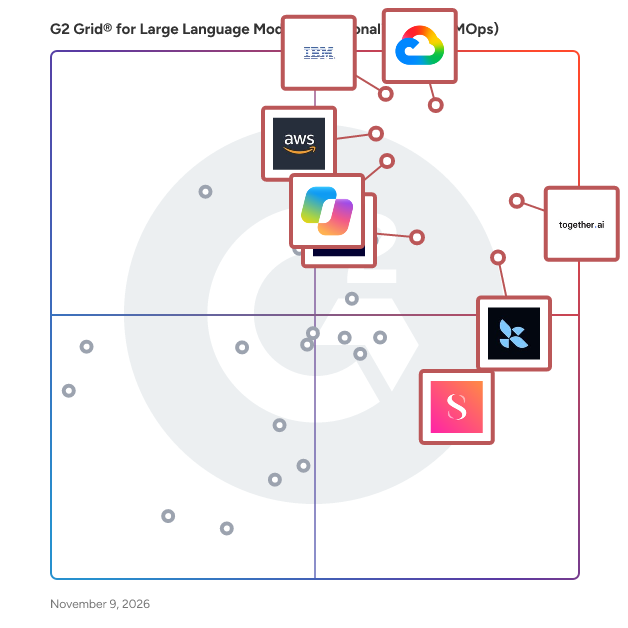
On G2, the best LLMOps software by G2 Score includes Gemini Enterprise Agent Platform, IBM watsonx.ai, AWS Bedrock, LangChain, and OpenRouter.
What are the top-reviewed Large Language Model Operationalization (LLMOps) Software on G2?
Gemini Enterprise Agent Platform
- Number of Reviews: 105
- Satisfaction: 86
- Market Presence: 97
- G2 Score: 92
IBM watsonx.ai
- Number of Reviews: 49
- Satisfaction: 82
- Market Presence: 96
- G2 Score: 89
AWS Bedrock
- Number of Reviews: 31
- Satisfaction: 70
- Market Presence: 88
- G2 Score: 79
Langchain
- Number of Reviews: 26
- Satisfaction: 76
- Market Presence: 54
- G2 Score: 65
OpenRouter
- Number of Reviews: 16
- Satisfaction: 61
- Market Presence: 54
- G2 Score: 57
Satisfaction reflects user-reported ratings across factors such as ease of use, feature fit, and support quality. (Source 2)
Market Presence scores are calculated from review volume, third-party signals, and overall market visibility. (Source 2)
G2 Score is a weighted composite of Satisfaction and Market Presence. (Source 2)
Learn how G2 scores products. (Source 1)
What I Often See in Large Language Model Operationalization (LLMOps) Software
Reviewers praise one API that reaches many models, rollbacks that need no redeploy, and onboarding that gets teams running quickly. They push back on rate limits and provider outages, on learning curves and shifting versions, and on pricing that climbs with usage.
Feedback Pros: What Users Consistently Appreciate
- Single API access to many models without vendor lock-in
"Multi-model flexibility: Access leading AI models from Anthropic, Meta, Mistral, and Amazon through a single unified API, without vendor lock-in. Zero infrastructure management: A fully serverless architecture supports scaling, fine-tuning, and deployment without having to provision or manage the underlying GPUs." - AWS Bedrock Review, Fady Nabil
- Governance and security stay inside a team's existing cloud controls
"The biggest benefit is flexibility with governance. You can compare models for cost, latency, and quality while still staying within AWS tooling for security, IAM, monitoring, and deployment. That is especially useful when you want to move fast on AI use cases but still keep control over how things are deployed and governed." - AWS Bedrock Review, Athira Gopi
- Simple onboarding with clear dashboards for usage and pricing
"I also appreciate the pricing flexibility, smooth UX experience, and meaningful dashboards. The onboarding process is simple, easy, and fast, not requiring much information, which enhances its ease of use. Overall, OpenRouter simplifies multi-model AI development by reducing integration work and optimizing time and cost." - OpenRouter Review, Jayanth Chukka
Cons: Where Many Platforms Fall Short
- Rate limits and provider outages that make response times uneven
"Because OpenRouter relies on underlying model providers, latency spikes or outages on the provider's end can occasionally affect response times. When popular open-source endpoints become congested, fallback routing helps, but it can still lead to inconsistent response times compared to direct provider integrations." - OpenRouter Review, Sanjay Shankar
- Steep learning curve and fast-changing versions that complicate debugging
"One downside of LangChain is that the learning curve can be steep when working with complex chains, agents, and integration. Debugging workflows sometimes takes extra time, especially when multiple components are connected. Frequent updates and changes between versions can also require code adjustments." - Langchain Review, Shashank Sharma
- Configuration effort and usage-based pricing that climbs with volume
"Writing the YAML syntax to map complex routing paths and custom plugin logic required a lot of trial and error. Additionally, enterprise tier pricing scales sharply with API call volume, forcing us to strictly monitor monthly throughput to prevent unexpected cost spikes." - Kong Konnect Review, Vikash Kumar
My Expert Takeaway on Large Language Model Operationalization (LLMOps) Software in 2026
Across LLMOps reviews over the past year, I keep seeing the category do two different jobs: giving applications governed access to many models through one interface, and running agents that plan and carry out multi-step work on their own. G2 reviewers rate it 4.43 stars with a 91% recommend rate, so the appetite is real, yet the experience splits sharply by which of those two jobs a team is buying for.
On the agent side, what separates the teams that get value is restraint. Reviewers who let agents run fully autonomously describe infinite loops, errors that snowball once an early step is wrong, and token or credit budgets drained with nothing to show for it. The teams that do well cap steps and spend, keep a human checkpoint on anything that acts, and still review the output. I read autonomy here as a setting to tune carefully, not a default to trust.
The reviewers skew toward software and IT, but the recent wave runs wider than ML specialists: owners of small businesses automating market research, content, and spreadsheet work, as well as security teams wary of sending internal data to external model APIs. That spread tells me two things: that the tools are reaching non-experts who need clear prompts and guardrails, and that, for the regulated end, where data is processed, there is a gate that comes before any feature comparison.
Cost is the thread running through the complaints, in two shapes. On model-access platforms, reviewers describe bills that span input and output tokens, storage, and add-on services, with idle resources quietly charging while nothing runs; on agent platforms, loops and retries burn tokens for results that never arrive. Either way, the teams that stay in control instrument spend early, with cost tags, token budgets, and alerts set before the bills surprise them.
The first thing I would settle when choosing the best LLMOps software is which job it is buying for: governed model access or agent orchestration, since the leaders differ on that split. From there, I would pilot one real workload with the guardrails the reviews keep asking for: step and loop limits, a token budget, a human checkpoint, and a clear answer on where data is processed. The LLMOps platforms that make those controls easy, rather than optional add-ons, are the ones that hold up in production.
Large Language Model Operationalization (LLMOps) Software FAQs
What are the best LLMOps platforms for teams running multiple models with version control and cost tracking?
The best choice depends on the team's engineering depth and where its models run, since the highest-ranked products are also the most demanding to set up. These are the top scorers on G2, from full enterprise platforms to lighter frameworks and gateways:
-
Gemini Enterprise Agent Platform: Highest G2 Score; governs and optimizes agents and models, per its profile.
-
IBM watsonx.ai: Governed studio for building, tuning, and deploying generative AI, per its profile.
-
AWS Bedrock: G2 reviewers praise a single serverless API to many models, with no GPU management.
-
LangChain: G2 reviewers use the open-source framework and LangGraph for stateful agents.
-
OpenRouter: G2 reviewers access many models with one key, along with usage dashboards.
Which LLMOps tools let teams roll back a prompt or model within minutes when accuracy drops?
Fast rollback depends on keeping prompt and model changes separate from code releases, so a change can be switched off without a redeploy. On G2:
-
LangChain: LangGraph adds persistence, rewind, and checkpointing for agents, per its profile.
-
LaunchDarkly: G2 reviewers describe rolling back as a toggle rather than a redeploy.
-
Arize AX: Offline evaluations test changes before release and flag regressions, per its profile.
Which LLMOps platforms monitor accuracy in production and alert teams when a model degrades?
Monitoring means tracing each request, scoring output quality, and alerting when results drift. Buyers should check what an alert looks like on a real failure before relying on one. Top options on G2:
-
Gemini Enterprise Agent Platform: Unified model deployment and monitoring on Google Cloud, per its profile.
-
Kong Konnect: Centralized analytics and observability for AI and API traffic, per its profile.
-
LaunchDarkly: G2 reviewers monitor live agent performance and act without a redeploy.
-
Arize AX: G2 reviewers trace prompts and tool calls, then score quality with an LLM judge.
Which LLMOps platforms track token costs per application or team and keep spend under control?
G2 reviewers report that usage-based pricing climbs with volume, so attributing token usage and routing requests matter early on. These products offer both:
-
Gemini Enterprise Agent Platform: Governs and optimizes agents and models in one place, per its profile.
-
AWS Bedrock: Prompt routing and model distillation lower cost per request, per its profile.
-
OpenRouter: G2 reviewers track per-token usage and spend on built-in dashboards.
-
Kong Konnect: Semantic caching and token-based rate limiting at the gateway, per its profile.
Which LLMOps platforms fit enterprise cloud, multi-model, and compliance requirements?
Enterprise buyers usually need native cloud integration, access to several models, compliance logging, and a choice of where data is processed. It is worth asking every vendor for its data-residency terms in writing:
-
IBM watsonx.ai: Governed studio covering foundation models and traditional machine learning, per its profile.
-
AWS Bedrock: Guardrails and multi-model access inside the AWS ecosystem, per its profile.
-
Kong Konnect: Deploys across cloud, on-premises, and hybrid with governed access, per its profile.
-
Arize AX: Profile lists SOC 2 Type II, ISO 27001, HIPAA, and GDPR.
What are the key differences between MLOps, LLMOps, and AgentOps?
MLOps covers the lifecycle of traditional machine learning models, while LLMOps adds prompt management, hallucination monitoring, and guardrails for language models. AgentOps extends the same discipline to autonomous agents by tracing multi-step behavior and tool calls. Teams running agents on top of language models usually need all three layers to work together.