Learn More About Generative AI Infrastructure Software
Generative AI Infrastructure software buying insights at a glance
Generative AI Infrastructure software provides the technical foundation teams need to build, deploy, and scale generative AI models, especially large language models (LLMs). In real production environments. Instead of stitching together separate tools for compute, orchestration, model serving, monitoring, and governance, these platforms centralize the core “infrastructure layer” that makes generative AI reliable at scale
As more companies move from experimentation to customer-facing AI features, and as performance and cost pressures increase, Generative AI Infrastructure has become essential for engineering, ML, and platform teams that need predictable inference, controlled spend, and operational guardrails without slowing innovation.
Based on G2 reviews, buyers most often adopt generative AI infrastructure to shorten time-to-production and address scaling challenges, including GPU resource management, deployment reliability, latency control, and performance monitoring. The strongest review patterns consistently point to a few recurring wins: faster deployment and iteration cycles, smoother scaling under real traffic, and improved visibility into model health and usage. Many teams also emphasize that the infrastructure tools they keep long-term are the ones that make it easier to enforce controls (cost, governance, reliability) without introducing friction for developers and ML teams.
Pricing typically follows a usage-driven model tied to infrastructure intensity, often based on compute consumption (GPU hours), inference volume, model hosting, storage, observability features, and enterprise governance controls. Some vendors bundle platform access into tiered subscriptions and layer usage costs on top, while others shift to contracted enterprise pricing once the workload grows and requirements such as SLAs, compliance, private networking, or dedicated support become mandatory.
Top 5 FAQs from software buyers:
- How do generative AI infrastructure platforms manage inference speed and latency?
- What’s the best infrastructure stack for deploying LLMs in production?
- How do these tools control and forecast GPU costs at scale?
- What monitoring and governance features exist for production model operations?
- How do teams choose between managed infrastructure vs. self-hosted frameworks?
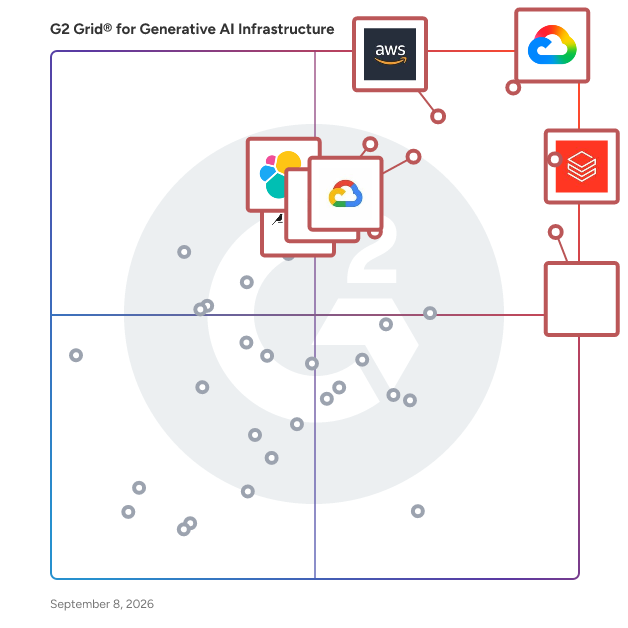
G2’s top-rated Generative AI Infrastructure software, based on verified reviews, includes Vertex AI, Google Cloud AI Infrastructure, AWS Bedrock, IBM watsonx.ai , and Langchain. (Source 2)
What are the top-reviewed Generative AI Infrastructure software on G2?
Vertex AI
- Reviews: 184
- Satisfaction: 100
- Market Presence: 99
- G2 Score: 99
Google Cloud AI Infrastructure
- Reviews: 36
- Satisfaction: 71
- Market Presence: 75
- G2 Score: 73
AWS Bedrock
- Reviews: 37
- Satisfaction: 63
- Market Presence: 82
- G2 Score: 72
IBM watsonx.ai
- Reviews: 19
- Satisfaction: 57
- Market Presence: 73
- G2 Score: 65
Langchain
- Reviews: 31
- Satisfaction: 75
- Market Presence: 49
- G2 Score: 62
Satisfaction reflects user-reported ratings, including ease of use, support, and feature fit. (Source 2)
Market Presence scores combine review and external signals that indicate market momentum and footprint. (Source 2)
G2 Score is a weighted composite of Satisfaction and Market Presence. (Source 2)
Learn how G2 scores products. (Source 1)
What I Often See in Generative AI Infrastructure Software
Feedback Pros: What Users Consistently Appreciate
- Unified ml workflow with seamless bigquery and gcs Integration
-
“What I like most about Vertex AI is how it unifies the entire machine learning workflow, from data preparation and training to deployment and monitoring. We’ve used it to streamline our ML pipeline, and the integration with BigQuery and Google Cloud Storage makes data handling incredibly efficient. The UI is intuitive, and it’s easy to move between no-code experimentation and full-scale custom model development.”- Andre P. Vertex AI Review
- All-in-one model training, deployment, and monitoring with automation
-
“What I like the most is how easy it is to manage the full machine learning workflow in one place. From training to deployment, everything is well integrated with other Google Cloud tools. The interface is simple, and automation features save a lot of time when handling multiple models.”- Joao S. Vertex AI Review
- Scales easily for GPU/TPU workloads with enterprise reliability
-
“Google Cloud gives powerful tools and machines (like TPUs) to build and run AI faster. It is easy to scale up or down and works well with Google’s other products. It keeps data safe and offers good performance worldwide. Good for mission critical & enterprise workloads. Users generally find Google’s docs, guides, forums, etc., to be thorough, which helps especially for smaller or less urgent issues.”- Neha J. Google Cloud AI Infrastructure Review
Cons: Where Many Platforms Fall Short
- Advanced setup and MLOps concepts can feel overwhelming at first
-
“The learning curve can be steep at the beginning, especially for those new to Google Cloud’s way of organizing resources. Pricing transparency could also improve; costs can ramp up quickly if you don’t set up quotas or monitoring. Some features, like advanced pipeline orchestration or custom training jobs, feel a bit overwhelming without strong documentation or prior ML Ops experience.”- Rodrigo M. Vertex AI Review
- Costs rise quickly without quotas, monitoring, and pricing clarity
-
“Bedrock pricing model needs improvement. Few of the models are projected under AWS marketplace pricing. Bedrock is not available in all regions and has to rely on the US region for the same.”- Saransundar N. AWS Bedrock Review
- Requires GenAI knowledge; not ideal for absolute beginners
-
“I'm not sure about it. I think it 'might' be that it is not for absolute beginners. You need to know what Generative AI models are and how they function to be able to get any benefit out of this.”- Divya K. IBM watsonx.ai Review
Generative AI Infrastructure software FAQs
What is Generative AI Infrastructure software?
Generative AI infrastructure software provides the systems required to build and run generative models in production, covering compute management (often GPUs), model deployment and serving, orchestration, monitoring, and governance. The goal is to make generative AI reliable, scalable, and cost-controlled, so teams can ship AI features without operational instability.
What is the best Generative AI Infrastructure software?
-
Vertex AI – Industry-leading AI platform for building, deploying, and scaling generative models, with top user satisfaction and advanced integration across Google Cloud.
-
Google Cloud AI Infrastructure – Robust cloud-based AI infrastructure offering scalable resources and flexible tools for diverse machine learning and generative AI workloads.
-
AWS Bedrock – Amazon’s generative AI service with modular deployment across AWS, supporting multiple foundation models and seamless integration with AWS tools.
-
IBM watsonx.ai – Enterprise AI platform delivering machine learning and generative AI capabilities, with strong governance and support for regulated environments.
-
Langchain – Developer framework for building AI-powered applications with language models, enabling rapid prototyping, orchestration, and customization of generative workflows.
How do teams control GPU costs with generative AI infrastructure?
Teams control GPU costs by tracking utilization, limiting inefficient workloads, scheduling batch jobs intelligently, and enforcing usage governance across projects. Strong infrastructure platforms provide visibility into consumption drivers (GPU hours, inference volume, peak usage) and include tools for quotas, rate limits, and cost forecasting to prevent runaway spend.
What monitoring features matter most for Generative AI Infrastructure?
The most valuable monitoring features include latency tracking, throughput, error rates, cost per request, and system-level GPU utilization. Many teams also look for AI-specific monitoring such as drift detection, prompt/response evaluation, version tracking, and the ability to correlate model changes with performance shifts in production.
How should buyers choose Generative AI Infrastructure tools?
Buyers should start with production requirements: which models will be served, expected traffic volume, latency goals, and governance needs. From there, evaluate deployment simplicity, observability depth, scaling reliability, security controls, and cost transparency. The best choice is usually the platform that supports both experimentation and production operations without forcing teams to rebuild workflows later.