Best AI SDK Software

How Many AI SDK Software Products Does G2 Track?

Total Products under this Category: 39

Category Stats (Sep 2026)

  • Average Rating: 4.45/5 (↑0.04 vs Aug 2026) The average rating of products in this category, based on all submitted ratings
  • Top Trending Product: AssemblyAI (+4.32%) - Among all products in this category, AssemblyAI recorded the largest rating increase compared to last month

Last updated: September 14, 2026

How Does G2 Rank AI SDK Software Products?

Why You Can Trust G2's Software Rankings:

  • 30 Analysts and Data Experts
  • 3,600+ Authentic Reviews
  • 39+ Products
  • Unbiased Rankings

G2's software rankings are built on verified user reviews, rigorous moderation, and a consistent research methodology maintained by a team of analysts and data experts. Each product is measured using the same transparent criteria, with no paid placement or vendor influence. While reviews reflect real user experiences, which can be subjective, they offer valuable insight into how software performs in the hands of professionals. Together, these inputs power the G2 Score, a standardized way to compare tools within every category.

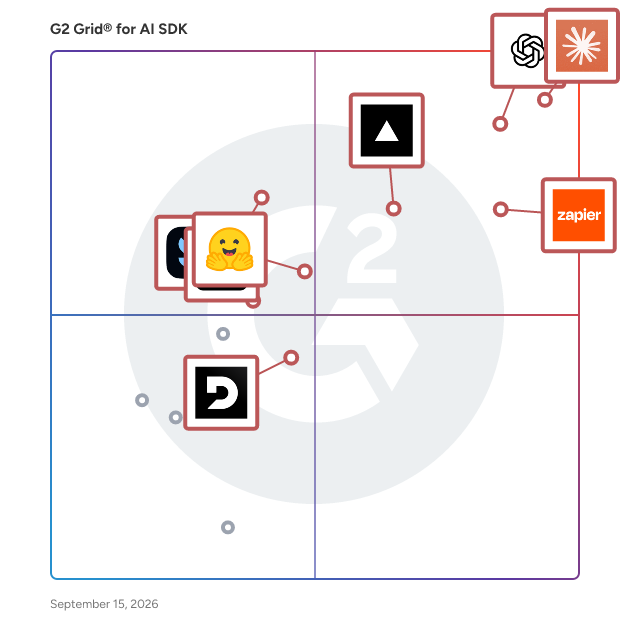
G2 Grid® for AI SDK Software

G2 Grid® for  AI SDK Software plotting products by satisfaction and market presence

Highlighted products: Anthropic SDK, OpenAI SDK, Zapier, Vercel AI SDK, Google Vertex AI SDK, Hugging Face smolagents, LangGraph, and Deepgram.

Underlying data: [Grid® JSON](https://www.g2.com/categories/ai-sdk/grids.json?focus%5B%5D=anthropic-sdk&focus%5B%5D=openai-sdk&focus%5B%5D=zapier&focus%5B%5D=vercel-ai-sdk&focus%5B%5D=google-vertex-ai-sdk&focus%5B%5D=hugging-face-smolagents&focus%5B%5D=langgraph&focus%5B%5D=deepgram)

Anthropic SDK

The Anthropic SDK is a comprehensive suite of tools designed to facilitate the development of custom AI agents using the Claude language models. It offers developers a robust framework to build production-ready agents across various domains, including coding, business, and customer support. Key Features and Functionality: - Optimized Claude Integration: Ensures efficient interaction with Claude models through automatic prompt caching and performance enhancements. - Rich Tool Ecosystem: Provides a diverse set of tools for file operations, code execution, web search, and extensibility via the Model Context Protocol (MCP). - Advanced Permissions: Offers fine-grained control over agent capabilities, allowing developers to specify and restrict functionalities as needed. - Production Essentials: Includes built-in error handling, session management, and monitoring to support reliable deployment in production environments. - Multi-Language Support: Available in multiple programming languages, including Python, TypeScript, Java, Go, Ruby, C#, and PHP, catering to a wide range of development needs. Primary Value and User Solutions: The Anthropic SDK empowers developers to create sophisticated AI agents tailored to specific tasks, such as: - Coding Agents: Develop agents capable of diagnosing and resolving production issues, conducting security audits, and performing code reviews to enforce best practices. - Business Agents: Build assistants for legal contract reviews, financial analysis, customer support, and content creation, enhancing efficiency and accuracy in these domains. By providing a structured and efficient development environment, the Anthropic SDK addresses the complexities of AI agent creation, enabling users to deploy intelligent solutions that streamline workflows and improve decision-making processes.

Average Rating: 4.6/5.0

Total Reviews: 132

Who Is the Company Behind Anthropic SDK?

  • Seller: Anthropic
  • HQ Location: San Francisco, California
  • Twitter: @AnthropicAI
    1,440,248 Twitter followers
  • LinkedIn® Page: www.linkedin.com
    5,886 employees on LinkedIn®

Who Uses This Product?

  • Who Uses This: Software Engineer
  • Top Industries: Computer Software, Information Technology and Services
  • Company Size: 47% Small, 36% Medium

What Are Recent G2 Reviews of Anthropic SDK?

OpenAI SDK

The OpenAI Agents SDK is a comprehensive framework designed to facilitate the development, deployment, and optimization of AI agents. It offers a robust and lightweight orchestration system that enables developers to create sophisticated agents capable of performing complex, multi-step tasks across various domains. Key Features and Functionality: - Visual and Code-First Development: The SDK provides both a visual canvas through the Agent Builder and a code-first environment, allowing developers to choose their preferred method for building agents. - Built-in Observability: It includes tools for monitoring and optimizing agent performance, ensuring reliability and efficiency in real-world applications. - Integration with OpenAI Models: The SDK seamlessly integrates with OpenAI's advanced models, such as GPT-5, enabling agents to leverage state-of-the-art AI capabilities. - Support for Multimodal Inputs: Agents can process and generate text, images, and other data types, facilitating versatile applications. - Deployment Tools: The SDK offers resources like ChatKit for creating customizable, front-end agentic experiences, streamlining the deployment process. Primary Value and Problem Solving: The OpenAI Agents SDK addresses the challenge of building and managing complex AI agents by providing a unified platform that simplifies development and deployment. It empowers developers to create agents that can autonomously handle intricate tasks, reducing the time and effort required for manual coding and integration. By leveraging this SDK, users can accelerate the creation of AI-driven solutions, enhance operational efficiency, and deliver more intelligent and responsive applications to their end-users.

Average Rating: 4.4/5.0

Total Reviews: 107

Who Is the Company Behind OpenAI SDK?

  • Seller: OpenAI
  • Year Founded: 2015
  • HQ Location: San Francisco, CA
  • Twitter: @OpenAI
    4,941,980 Twitter followers
  • LinkedIn® Page: www.linkedin.com
    10,438 employees on LinkedIn®

Who Uses This Product?

  • Top Industries: Information Technology and Services, Computer Software
  • Company Size: 55% Small, 33% Medium

What Are Recent G2 Reviews of OpenAI SDK?

Zapier

Zapier is the #1 workflow automation platform for businesses that want to grow faster by maximizing the efficiency of their teams, tools, and processes without relying on development teams. With our new visual editor, free Filter and Formatter tasks for more control, and reduced task-based pricing, you're going love automating with Zapier. It's free to sign up — no credit card required — and creating your first workflow, what we call a "Zap," is just a few clicks away. Since 2011, over 2 million business have turned to Zapier for their automation needs, including: lead management, sales pipeline, marketing campaigns, customer support, data management, project management, and tickets and incidents.

Average Rating: 4.5/5.0

Total Reviews: 2,064

Who Is the Company Behind Zapier?

  • Seller: Zapier
  • Company Website:
  • Year Founded: 2011
  • HQ Location: San Francisco, CA
  • Twitter: @zapier
    95,859 Twitter followers
  • LinkedIn® Page: www.linkedin.com
    1,521 employees on LinkedIn®

Who Uses This Product?

  • Who Uses This: Owner, CEO
  • Top Industries: Marketing and Advertising, Information Technology and Services
  • Company Size: 70% Small, 24% Medium

What Do G2 Reviewers Say About Zapier?

AI-generated summary from verified user reviews

Pros
  • Users find Zapier's ease of use remarkable, simplifying automation and app integrations without the need for technical skills.
  • Users value Zapier's seamless automation, effectively connecting apps and streamlining workflows for increased efficiency.
  • Users value the extensive integrations Zapier offers, streamlining tasks across their essential tools effortlessly.
  • Users love the easy integrations of Zapier, allowing seamless connections between tools for efficient automation.
  • Users enjoy time-saving automation with Zapier, seamlessly connecting apps and streamlining repetitive tasks efficiently.
Cons
  • Users find the cost of Zapier to be high, especially for accessing advanced features and integrations.
  • Users find the complexity of setup and feature navigation challenging, complicating their ability to test effectively.
  • Users find pricing issues with Zapier, as premium features come at a much higher cost than expected for small projects.
  • Users find the learning curve overwhelming due to the extensive integrations, making it challenging to build efficient zaps.
  • Users express frustration with Zapier's limited features, making it challenging for smaller teams and specific use cases.

What Are Recent G2 Reviews of Zapier?

What Are G2 Users Discussing About Zapier?

Vercel AI SDK

The Vercel AI SDK is a free, open-source TypeScript toolkit designed to streamline the development of AI-powered applications and agents. Created by the team behind Next.js, it offers a unified API that allows developers to integrate various AI models seamlessly into their projects. The SDK is compatible with popular UI frameworks such as React, Svelte, Vue, Angular, and runtimes like Node.js, making it a versatile choice for building dynamic, AI-driven user interfaces. Key Features and Functionality: - Unified Provider API: Easily switch between AI providers like OpenAI, Anthropic, and Google by modifying a single line of code, facilitating flexibility and scalability in AI integration. - Framework-Agnostic Support: Build applications using a variety of frameworks, including React, Next.js, Vue, Nuxt, SvelteKit, and more, ensuring broad compatibility and ease of use. - Streaming AI Responses: Enhance user experience by delivering AI-generated responses instantly through efficient streaming capabilities, reducing latency and improving interactivity. - Generative UI Components: Create dynamic, AI-powered user interfaces that captivate users, leveraging the SDK's tools to build engaging and responsive applications. - Comprehensive Documentation and Community Support: Access extensive resources, including a cookbook, tools registry, and an active community, to assist in development and troubleshooting. Primary Value and Problem Solved: The Vercel AI SDK simplifies the integration of AI functionalities into web applications, addressing common challenges such as managing streaming responses, handling tool calls, and dealing with provider-specific APIs. By abstracting these complexities, the SDK enables developers to focus on building features rather than infrastructure, significantly reducing development time and effort. Its compatibility with multiple frameworks and AI providers ensures that developers can create versatile and scalable AI-powered applications with ease.

Average Rating: 4.4/5.0

Total Reviews: 96

Who Is the Company Behind Vercel AI SDK?

  • Seller: Vercel
  • Year Founded: 2015
  • HQ Location: San Francisco, California, United States
  • Twitter: @vercel
    432,041 Twitter followers
  • LinkedIn® Page: www.linkedin.com
    1,013 employees on LinkedIn®

Who Uses This Product?

  • Who Uses This: Software Engineer, Student
  • Top Industries: Computer Software, Information Technology and Services
  • Company Size: 67% Small, 22% Medium

What Do G2 Reviewers Say About Vercel AI SDK?

AI-generated summary from verified user reviews

Pros
  • Users appreciate the ease of use and integration of Vercel AI SDK, streamlining AI application development significantly.
  • Users appreciate the ease of use of Vercel AI SDK, simplifying AI application deployment with excellent documentation.
  • Users value the easy API integration of Vercel AI SDK, streamlining development for AI-powered features and applications.
  • Users highlight the easy setup of Vercel AI SDK, enabling quick integration and a smooth development experience.
  • Users value the automation capabilities of Vercel AI SDK, significantly speeding up development and enhancing efficiency.
Cons
  • Users find the insufficient documentation challenging, hindering their ability to quickly adopt the Vercel AI SDK effectively.
  • Users find the limited features of Vercel AI SDK restrictive for complex AI-driven applications and desire more support.
  • Users find that the SDK's complex implementation can limit flexibility for non-Vercel deployments and advanced use cases.
  • Users find complexity issues in debugging due to vague error messages and insufficient documentation for integration.
  • Users struggle with integration issues due to insufficient documentation and unclear error messages during API interactions.

What Are Recent G2 Reviews of Vercel AI SDK?

Google Vertex AI SDK

The Google Vertex AI SDK is a comprehensive suite of tools designed to facilitate the development, deployment, and management of machine learning (ML) models on Google Cloud's Vertex AI platform. It offers a unified environment that streamlines the entire ML lifecycle, enabling data scientists and developers to efficiently build, train, and scale ML models and generative AI applications. Key Features and Functionality: - Unified Platform: Integrates tools for data preparation, model training, evaluation, deployment, and monitoring within a single API and user interface, simplifying the ML workflow. - Model Training Options: Supports both AutoML for code-free model training and custom training for full control over ML frameworks and hyperparameter tuning. - Model Garden: Provides access to a curated catalog of over 200 enterprise-ready models, including Google's foundation models like Gemini, Imagen, and Veo, as well as third-party and open-source models. - MLOps Tools: Includes Vertex AI Pipelines for workflow orchestration, Feature Store for managing ML features, Model Registry for versioning models, and Model Monitoring for detecting training-serving skew and inference drift. - Agent Builder and Agent Engine: Offers tools for building, deploying, and governing AI agents, supporting development with the Agent Development Kit (ADK) and providing infrastructure for deploying and scaling agents. Primary Value and User Solutions: The Vertex AI SDK addresses the complexities of ML model development by offering a cohesive and scalable platform that reduces the need for extensive code, thereby accelerating the transition from experimentation to production. By consolidating various ML tools and services, it enhances collaboration among data scientists and developers, improves operational efficiency, and facilitates the deployment of robust AI solutions. This comprehensive approach empowers organizations to harness the full potential of machine learning and artificial intelligence in their applications.

Average Rating: 4.5/5.0

Total Reviews: 27

Who Is the Company Behind Google Vertex AI SDK?

  • Seller: Google
  • Year Founded: 1998
  • HQ Location: Mountain View, CA
  • Twitter: @google
    31,899,995 Twitter followers
  • LinkedIn® Page: www.linkedin.com
    301,144 employees on LinkedIn®
  • Ownership: NASDAQ:GOOG

Who Uses This Product?

  • Top Industries: Computer Software, Information Technology and Services
  • Company Size: 57% Small, 25% Large

What Are Recent G2 Reviews of Google Vertex AI SDK?

Hugging Face smolagents

Smolagents is an open-source Python library developed by Hugging Face, designed to simplify the creation and execution of AI agents with minimal code. With a core logic comprising approximately 1,000 lines, smolagents emphasizes simplicity and efficiency, enabling developers to build powerful agents swiftly. The library is model-agnostic, allowing integration with various large language models (LLMs), including those from Hugging Face, OpenAI, Anthropic, and others via LiteLLM integration. It also supports multiple modalities, handling text, vision, video, and audio inputs, thereby broadening its application scope. Secure execution is ensured through sandboxed environments like E2B, Blaxel, Modal, and Docker. Additionally, smolagents offers deep integration with the Hugging Face Hub, facilitating seamless sharing and loading of agents and tools, and includes command-line utilities for quick agent deployment without extensive boilerplate code. Key Features: - Minimalist and Efficient Design: A compact codebase (~1,000 lines) with minimal abstractions enables quick agent development and easy understanding. - Code Agents for Direct Execution: Agents generate and run Python code snippets directly, reducing steps and LLM calls by approximately 30%, improving performance and handling complex logic. - Secure Sandboxed Execution: Supports running code in isolated environments like E2B to ensure safe and controlled execution of agent actions. - Wide LLM Compatibility: Compatible with any large language model, including Hugging Face Hub models, OpenAI, Anthropic, and others via LiteLLM integration. - Deep Hugging Face Hub Integration: Enables sharing and loading of tools and agents from the Hub, promoting community collaboration and ecosystem growth. - Support for Traditional Tool-Calling Agents: In addition to code agents, supports agents that generate actions as JSON or text blobs for flexible use cases. Primary Value and Problem Solved: Smolagents addresses the complexity and time-consuming nature of developing AI agents by providing a streamlined, efficient framework that requires minimal code. Its model-agnostic and modality-agnostic design ensures flexibility, allowing developers to integrate various LLMs and handle diverse input types. The secure execution environments mitigate risks associated with running agent-generated code, making it suitable for sensitive applications. By facilitating easy sharing and collaboration through the Hugging Face Hub, smolagents fosters a community-driven approach to AI agent development, accelerating innovation and deployment.

Average Rating: 4.4/5.0

Total Reviews: 48

Who Is the Company Behind Hugging Face smolagents?

  • Seller: Hugging Face
  • Year Founded: 2016
  • HQ Location: United States
  • Twitter: @huggingface
    708,886 Twitter followers
  • LinkedIn® Page: www.linkedin.com
    984 employees on LinkedIn®

Who Uses This Product?

  • Top Industries: Computer Software, Information Technology and Services
  • Company Size: 60% Small, 27% Medium

What Are Recent G2 Reviews of Hugging Face smolagents?

LangGraph

LangGraph is a low-level orchestration framework and runtime designed for building, managing, and deploying long-running, stateful agents. It provides developers with the tools to create agents capable of handling complex tasks reliably. LangGraph focuses on agent orchestration, offering capabilities such as durable execution, streaming, and human-in-the-loop interactions. It integrates seamlessly with LangChain components but can also function independently, allowing for flexible and customizable agent development. Key Features and Functionality: - Durable Execution: Ensures agents can persist through failures and operate over extended periods, resuming from their last state without data loss. - Human-in-the-Loop: Facilitates human oversight by allowing inspection and modification of agent states at any point during execution. - Comprehensive Memory: Supports both short-term working memory for ongoing reasoning and long-term memory across sessions, enabling stateful interactions. - Debugging with LangSmith: Provides deep visibility into agent behavior through visualization tools that trace execution paths, capture state transitions, and offer detailed runtime metrics. - Production-Ready Deployment: Offers scalable infrastructure designed to handle the unique challenges of deploying sophisticated, stateful, long-running workflows. Primary Value and User Solutions: LangGraph addresses the challenges developers face when creating complex, stateful agents by offering a robust framework that ensures reliability and control. By providing durable execution, it allows agents to maintain functionality over time, even in the face of failures. The human-in-the-loop feature ensures that developers can intervene and guide agent behavior as needed, enhancing trust and accuracy. Comprehensive memory support enables agents to maintain context, leading to more coherent and personalized interactions. Integration with LangSmith enhances debugging and monitoring capabilities, allowing for efficient development and maintenance. Overall, LangGraph empowers developers to build and deploy sophisticated agent systems with confidence, streamlining the development process and improving the performance of AI-driven applications.

Average Rating: 4.4/5.0

Total Reviews: 35

Who Is the Company Behind LangGraph?

Who Uses This Product?

  • Top Industries: Computer Software, Information Technology and Services
  • Company Size: 53% Small, 28% Large

What Are Recent G2 Reviews of LangGraph?

Deepgram

Enterprise Voice AI platform designed for developers building voice-first products using speech-to-text, text-to-speech, or speech-to-speech APIs. Over 200,000 developers build with Deepgram's voice-native foundational models, accessed via APIs or self-managed software. Start building with $200 in free credits! Beyond that, developers can: 🔊 Process live-streaming or pre-recorded audio with superior accuracy 🗣️ Convert text into natural-sounding AI voices for enterprise use cases with text-to-speech ⚡️ Easily build voice agents with our unified Voice Agent API 🌎 Accurately transcribe audio in over 36+ languages ⚙️ Train custom models for unique use cases 🔑 Access deep NLU with a unified API 💻 Build in any programming language with our SDKs ✅ Deploy on-prem or on DG’s managed cloud 📈 Get scalable GPU infra for training and inference

Average Rating: 4.6/5.0

Total Reviews: 477

Who Is the Company Behind Deepgram?

  • Seller: Deepgram
  • Company Website:
  • Year Founded: 2015
  • HQ Location: San Francisco, California
  • Twitter: @DeepgramAI
    10,837 Twitter followers
  • LinkedIn® Page: www.linkedin.com
    371 employees on LinkedIn®

Who Uses This Product?

  • Who Uses This: Software Engineer, CEO
  • Top Industries: Computer Software, Information Technology and Services
  • Company Size: 80% Small, 19% Medium

What Do G2 Reviewers Say About Deepgram?

AI-generated summary from verified user reviews

Pros
  • Users praise the high accuracy of Deepgram, benefiting from fast and reliable speech-to-text transcriptions.
  • Users praise Deepgram for its fast and reliable transcriptions, making transcription tasks significantly easier and quicker.
  • Users appreciate the ease of use of Deepgram, thanks to its simple API and efficient transcription services.
  • Users commend Deepgram for its excellent transcription accuracy and user-friendly integration, enhancing their audio processing experience.
  • Users commend Deepgram for its fast and accurate real-time transcription, enhancing analysis and live applications effortlessly.
Cons
  • Users are frustrated by the limited language support which hinders the platform's versatility and usability.
  • Users find the pricing issues concerning, especially for large projects and tight budgets, making it less accessible.
  • Users find the pricing high, making it challenging for startups and students with limited budgets.
  • Users experience inaccuracy issues with Deepgram, including missed words and limited language support that hinder transcription quality.
  • Users note the limited language support of Deepgram, though enhancements are in progress to address this issue.

What Are Recent G2 Reviews of Deepgram?

What Are G2 Users Discussing About Deepgram?

GitHub Copilot

GitHub Copilot helps more than 1 million developers and over 20,000 businesses push what’s possible in software development. Based on powerful LLMs, including OpenAI’s GPT models, this AI pair programmer helps developers write code faster and with less work by drawing context from comments and code to suggest individual lines and whole functions instantly. All languages are supported, however the more common a language, the better represented it will be in the training data and the more robust suggestions will be.

Average Rating: 4.4/5.0

Total Reviews: 386

Who Is the Company Behind GitHub Copilot?

  • Seller: GitHub
  • Year Founded: 2008
  • HQ Location: San Francisco, CA
  • Twitter: @github
    2,673,925 Twitter followers
  • LinkedIn® Page: www.linkedin.com
    6,653 employees on LinkedIn®

Who Uses This Product?

  • Who Uses This: Software Engineer, Senior Software Engineer
  • Top Industries: Computer Software, Information Technology and Services
  • Company Size: 37% Small, 32% Medium

What Do G2 Reviewers Say About GitHub Copilot?

AI-generated summary from verified user reviews

Pros
  • Users find GitHub Copilot's ease of use enhances their coding workflow, boosting productivity without interruptions.
  • Users value the seamless coding assistance of GitHub Copilot, enhancing productivity and confidence in their programming tasks.
  • Users appreciate the productivity improvement from GitHub Copilot, enhancing development speed and code consistency throughout projects.
  • Users find GitHub Copilot's effective problem-solving capabilities invaluable, providing timely coding suggestions and solutions directly.
  • Users appreciate the efficiency of GitHub Copilot, enhancing coding with intelligent suggestions and error reduction.
Cons
  • Users find the poor coding accuracy of GitHub Copilot can lead to ineffective and lazy coding practices.
  • Users find poor suggestions from GitHub Copilot frustrating, as they often require careful review and aren't always suitable.
  • Users find the subscription cost expensive, making it a barrier for students and new developers.
  • Users note the inaccuracy of GitHub Copilot, often leading to complications and potential bugs in their code.
  • Users find that GitHub Copilot has context understanding issues, leading to confusion and inaccurate code suggestions.

What Are Recent G2 Reviews of GitHub Copilot?

LlamaIndex

LlamaIndex is a data framework for your LLM applications

Average Rating: 4.4/5.0

Total Reviews: 37

Who Is the Company Behind LlamaIndex?

  • Seller: LlamaIndex
  • HQ Location: San Francisco, California, United States
  • LinkedIn® Page: www.linkedin.com
    112 employees on LinkedIn®

Who Uses This Product?

  • Top Industries: Computer Software, Information Technology and Services
  • Company Size: 50% Small, 45% Medium

What Are Recent G2 Reviews of LlamaIndex?

AssemblyAI

AssemblyAI transcribes and understands audio using state-of-the-art AI models, revolutionizing speech-to-text and natural language processing.

Average Rating: 4.4/5.0

Total Reviews: 36

Who Is the Company Behind AssemblyAI?

  • Seller: AssemblyAI
  • Year Founded: 2017
  • HQ Location: San Francisco, California
  • Twitter: @AssemblyAI
    45,724 Twitter followers
  • LinkedIn® Page: www.linkedin.com
    109 employees on LinkedIn®

Who Uses This Product?

  • Top Industries: Information Technology and Services, Computer Software
  • Company Size: 36% Large, 33% Small

What Are Recent G2 Reviews of AssemblyAI?

Lyzr.ai

Lyzr is an enterprise AI agent platform that helps organizations design, deploy, and operate autonomous and semi-autonomous agents across business functions such as customer service, sales, human resources, finance, and IT. The platform brings together an agent framework, a low-code studio, and a central control plane, so teams can move AI initiatives from pilot to full production with consistency and oversight. Organizations use it to build task-specific agents for secure knowledge assistance, retrieval-augmented search, and multi-step workflow automation, improving how work gets done while keeping data protected. Lyzr is built for enterprises that want to adopt AI without replacing the systems they already run. Its model-agnostic architecture lets teams work with their preferred language models and switch between them as needs change, with no re-architecting required. The same flexibility extends to deployment: agents can run in a private cloud, a single-tenant setup, or fully on-premise, so organizations keep control of their data and operations. Governance, observability, and auditability are part of the platform itself, which is what makes Lyzr suitable for compliance-sensitive teams and production-grade reliability. At the core of the platform is an agent framework paired with Architect and Agent Studio, which together support single-task and multi-agent workflows through code, low-code, or no-code. A central registry gives teams monitoring, access control, versioning, and traceable execution logs across every agent, regardless of who built it or on which framework. Connectors, SDKs, and APIs link agents to existing tools such as CRMs, ERPs, ITSM systems, data lakes, and messaging platforms, so agents operate inside current processes rather than replacing them. The result is a faster path from prototype to production, supported by reusable components and ready-made integrations. Built-in governance keeps regulated teams audit-ready, while simulation, evaluation workflows, and version and rollback controls reduce operational risk before and after agents go live. Because integration effort stays low and models and pipelines remain interchangeable, organizations can orchestrate the systems they already have and evolve over time without being locked into a single vendor. Typical use cases include secure knowledge assistants and retrieval-augmented search for employees and customers, customer support agents that handle classification, drafting, and resolution, and sales agents that support account research, outreach sequencing, and meeting scheduling. Lyzr also powers back-office automation across HR, finance, and IT service management, making it a practical choice for cross-team, multi-step processes that need coordination across several tools and data sources.

Average Rating: 4.4/5.0

Total Reviews: 46

Who Is the Company Behind Lyzr.ai?

  • Seller: Lyzr
  • Company Website:
  • Year Founded: 2023
  • HQ Location: New York, USA
  • LinkedIn® Page: www.linkedin.com
    227 employees on LinkedIn®

Who Uses This Product?

  • Top Industries: Computer Software, Information Technology and Services
  • Company Size: 72% Small, 17% Medium

What Do G2 Reviewers Say About Lyzr.ai?

AI-generated summary from verified user reviews

Pros
  • Users appreciate the ease of use of Lyzr.ai, enabling quick setup and seamless engagement for anyone.
  • Users appreciate the setup ease of Lyzr.ai, allowing quick creation and testing of AI agents without complexity.
  • Users value the deployment ease of Lyzr.ai, enabling fast and simple AI agent development without coding expertise.
  • Users appreciate the efficiency of Lyzr.ai, enabling rapid development and deployment of AI workflows with minimal effort.
  • Users appreciate the intuitive and customizable interface of Lyzr.ai, enabling quick and effective AI agent creation.
Cons
  • Users find the poor documentation of Lyzr.ai challenging, often having to troubleshoot issues independently.
  • Users express concern over the lack of integration, limiting flexibility and ease of use in Lyzr.ai.
  • Users find the steep learning curve of Lyzr.ai challenging, complicating the promised low-code accessibility and experimentation.
  • Users feel there is limited customization in Lyzr.ai, hindering the ability to tailor the platform to specific needs.
  • Users feel the lack of ready-made templates limits their efficiency and highlights the need for more features.

What Are Recent G2 Reviews of Lyzr.ai?

Crewai

CrewAI is a robust Python framework designed to facilitate the creation and orchestration of autonomous AI agents capable of collaborative problem-solving. By enabling developers to define specialized roles, assign tasks, and equip agents with specific tools, CrewAI streamlines the development of complex, multi-agent workflows. Its architecture supports both high-level simplicity and precise low-level control, making it suitable for a wide range of applications—from simple automations to intricate enterprise solutions. Key Features and Functionality: - Role-Based Agents: Define agents with specific roles, expertise, and objectives, such as researchers, analysts, or writers. - Flexible Tool Integration: Equip agents with custom tools and APIs to interact with external services and data sources. - Intelligent Collaboration: Facilitate inter-agent communication and task delegation to achieve complex objectives efficiently. - Structured Workflows: Implement sequential or parallel task execution with dynamic management of dependencies. - CrewAI Flows: Provide granular, event-driven control over workflows, enabling precise task orchestration and integration with Crews. Primary Value and User Solutions: CrewAI addresses the challenge of building and managing collaborative AI systems by offering a framework that balances autonomy with control. It empowers developers to create AI teams where each agent has specialized roles, tools, and goals, optimizing for both autonomy and collaborative intelligence. This approach enhances efficiency, scalability, and adaptability in AI-driven projects, making it an ideal solution for enterprises seeking to automate complex tasks and workflows.

Average Rating: 4.2/5.0

Total Reviews: 20

Who Is the Company Behind Crewai?

Who Uses This Product?

  • Top Industries: Computer Software, Information Technology and Services
  • Company Size: 73% Small, 23% Medium

What Are Recent G2 Reviews of Crewai?

StackOne

StackOne is the infrastructure for AI agents to take actions on enterprise apps. StackOne is the infrastructure layer that lets enterprise IT extend employees' AI from conversation to action across any enterprise app, turning AI rollouts into real returns. It offers 400+ enterprise app integrations and 25k+ actions out of the box — accessible via MCP, A2A, SDKs, and APIs — plus developer tools to customize or build any others. StackOne's execution engine trims the context agents process, so they act more accurately using fewer tokens. Governance, observability, and compliance keep every action safe and auditable.

Average Rating: 4.7/5.0

Total Reviews: 47

Who Is the Company Behind StackOne?

  • Seller: StackOne
  • Company Website:
  • Year Founded: 2023
  • HQ Location: London, GB
  • LinkedIn® Page: www.linkedin.com
    55 employees on LinkedIn®

Who Uses This Product?

  • Top Industries: Human Resources, E-Learning
  • Company Size: 63% Small, 31% Medium

What Do G2 Reviewers Say About StackOne?

AI-generated summary from verified user reviews

Pros
  • Users highlight the responsive and helpful customer support from StackOne, enhancing their overall experience with the product.
  • Users value the easy integrations with StackOne, appreciating the smooth process and excellent support throughout.
  • Users highlight the excellent integration capabilities of StackOne, simplifying ATS integration and enhancing efficiency.
  • Users highlight the ease of use of StackOne, appreciating its intuitive interface and supportive documentation.
  • Users value the excellent technical documentation of StackOne, making integration seamless and support readily available.
Cons
  • Users express concern over insufficient information, often needing to search for solutions themselves rather than receiving proactive support.
  • Users note the limited integrations available, although the team is working to improve this aspect over time.
  • Users notice a lack of filtering options in StackOne, impacting efficiency when working with different HRIS backends.
  • Users report software bugs that occasionally disrupt functionality, especially after updates and during integration with various HRIS backends.
  • Users experience occasional API limitations with StackOne, leading to frustrations from breakages and delays in the SDK.

What Are Recent G2 Reviews of StackOne?

Mio

AI co-worker that lives in Slack, connects to more than 3,000 of your tools, and gets work done across them

Average Rating: 5.0/5.0

Total Reviews: 2

Who Is the Company Behind Mio?

  • Seller: Mio
  • Year Founded: 2025
  • HQ Location: N/A
  • LinkedIn® Page: www.linkedin.com
    5 employees on LinkedIn®

Who Uses This Product?

  • Company Size: 100% Small

What Are Recent G2 Reviews of Mio?

Bijou Barry
BB
Researched and written by Bijou Barry
Updated June 24, 2026