Best Small Language Models (SLMs)

How Many Small Language Models (SLMs) Products Does G2 Track?

Total Products under this Category: 11

Category Stats (Sep 2026)

  • Average Rating: 4.31/5 (↑0.07 vs Aug 2026) The average rating of products in this category, based on all submitted ratings
  • Top Trending Product: Gemma 3 4B (+1.7%) - Among all products in this category, Gemma 3 4B recorded the largest rating increase compared to last month

Last updated: September 26, 2026

How Does G2 Rank Small Language Models (SLMs) Products?

Why You Can Trust G2's Software Rankings:

  • 30 Analysts and Data Experts
  • 200+ Authentic Reviews
  • 11+ Products
  • Unbiased Rankings

G2's software rankings are built on verified user reviews, rigorous moderation, and a consistent research methodology maintained by a team of analysts and data experts. Each product is measured using the same transparent criteria, with no paid placement or vendor influence. While reviews reflect real user experiences, which can be subjective, they offer valuable insight into how software performs in the hands of professionals. Together, these inputs power the G2 Score, a standardized way to compare tools within every category.

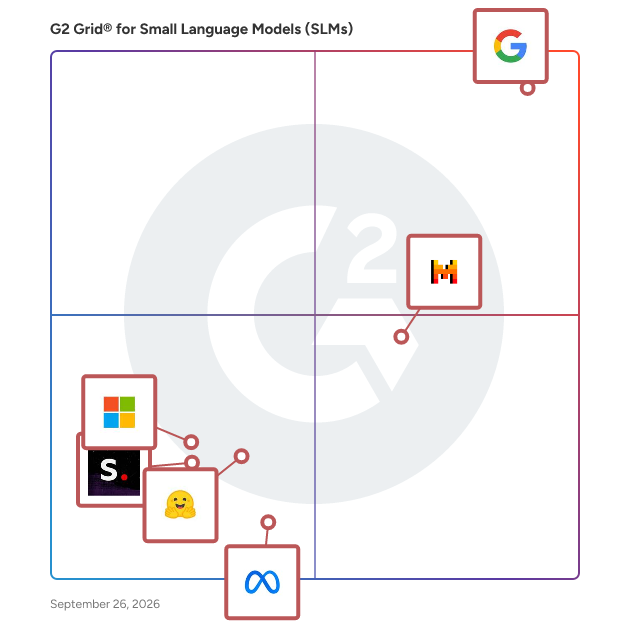
G2 Grid® for Small Language Models (SLMs)

G2 Grid® for  Small Language Models (SLMs)  plotting products by satisfaction and market presence

Highlighted products: Gemma 3 4B, Mistral 7B, bloom 1b1, Phi 4 mini, Llama 3.2 3b, and StableLM.

Underlying data: [Grid® JSON](https://www.g2.com/categories/small-language-models-slms/grids.json?focus%5B%5D=gemma-3-4b&focus%5B%5D=mistral-7b&focus%5B%5D=bloom-1b1&focus%5B%5D=phi-4-mini&focus%5B%5D=llama-3-2-3b&focus%5B%5D=stablelm)

Gemma 3 4B

Gemma 3 270M is a compact, text-only model within the Gemma family of generative AI models, designed to perform a variety of text generation tasks such as question answering, summarization, and reasoning. With 270 million parameters, it offers a balance between performance and efficiency, making it suitable for applications with limited computational resources. Key Features and Functionality: - Text Generation: Capable of generating coherent and contextually relevant text for tasks like summarization and question answering. - Function Calling: Supports function calling, enabling the creation of natural language interfaces for programming functions. - Wide Language Support: Trained to support over 140 languages, facilitating multilingual applications. - Efficient Deployment: Its relatively small size allows for deployment on devices with limited computational power. Primary Value and User Solutions: Gemma 3 270M provides developers with a versatile and efficient AI model for text-based applications. Its support for function calling allows for the development of natural language interfaces, enhancing user interaction with software systems. The model's wide language support enables the creation of applications that cater to a global audience. Additionally, its compact size ensures that it can be deployed on devices with limited resources, making advanced AI capabilities accessible in various environments.

Average Rating: 4.2/5.0

Total Reviews: 110

Who Is the Company Behind Gemma 3 4B?

  • Seller: Google
  • Year Founded: 1998
  • HQ Location: Mountain View, CA
  • Twitter: @google
    31,899,995 Twitter followers
  • LinkedIn® Page: www.linkedin.com
    301,144 employees on LinkedIn®
  • Ownership: NASDAQ:GOOG

Who Uses This Product?

  • Top Industries: Computer Software, Information Technology and Services
  • Company Size: 64% Small, 19% Medium

What Are Recent G2 Reviews of Gemma 3 4B?

Mistral 7B

Mistral-7B-v0.1 is a small, yet powerful model adaptable to many use-cases. Mistral 7B is better than Llama 2 13B on all benchmarks, has natural coding abilities, and 8k sequence length. It’s released under Apache 2.0 licence, and we made it easy to deploy on any cloud.

Average Rating: 4.2/5.0

Total Reviews: 64

Who Is the Company Behind Mistral 7B?

  • Seller: Mistral
  • Year Founded: 2023
  • HQ Location: Paris, Île-de-France, France
  • Twitter: @MistralAI
    195,825 Twitter followers
  • LinkedIn® Page: www.linkedin.com
    1,540 employees on LinkedIn®

Who Uses This Product?

  • Top Industries: Computer Software, Information Technology and Services
  • Company Size: 64% Small, 23% Medium

What Do G2 Reviewers Say About Mistral 7B?

AI-generated summary from verified user reviews

Pros
  • Users appreciate the efficiency of Mistral 7B, benefiting from its fast performance and low resource requirements.
  • Users praise the performance improvement of Mistral 7B, noting its speed and affordability compared to GPT-3.5.
  • Users highlight the fast responses of Mistral 7B, making it ideal for chatbots and callbots.
  • Users value the time-saving features of Mistral 7B, enhancing efficiency in real-time applications and deployment.
  • Users praise the good accuracy of Mistral 7B, noting its quick response to input text.
Cons
  • Users find the inaccurate responses of Mistral 7B limit its effectiveness for general use compared to GPT.
  • Users find that Mistral 7B has a poor understanding in complex reasoning, leading to unsatisfactory responses in conversations.
  • Users find the complexity of Mistral 7B challenging, impacting ease of use and understanding of its capabilities.
  • Users find Mistral 7B's lack of creativity disappointing, describing its text as too generic and overly wordy.
  • Users note that Mistral 7B has limited functionality in complex reasoning and nuanced conversation compared to larger models.

What Are Recent G2 Reviews of Mistral 7B?

bloom 1b1

BLOOM-1b1 is a multilingual language model developed by the BigScience Workshop, designed to generate human-like text across 48 languages. As a transformer-based model, it utilizes a decoder-only architecture with 24 layers and 16 attention heads, totaling approximately 1.06 billion parameters. This configuration enables BLOOM-1b1 to perform a wide range of natural language processing tasks, including text generation, translation, and summarization. Key Features and Functionality: - Multilingual Capability: Supports text generation in 48 languages, facilitating diverse linguistic applications. - Transformer Architecture: Employs a decoder-only structure with 24 layers and 16 attention heads, enhancing its ability to understand and generate complex text. - Extensive Training Data: Trained on a vast and diverse dataset, ensuring robustness and adaptability across various contexts. - Open Access: Released under the BigScience RAIL License 1.0, promoting transparency and collaboration within the AI community. Primary Value and User Solutions: BLOOM-1b1 addresses the need for a versatile and accessible language model capable of handling multiple languages and tasks. Its open-access nature allows researchers, developers, and organizations to integrate advanced language processing capabilities into their applications without the constraints of proprietary models. By supporting a wide array of languages, BLOOM-1b1 enables more inclusive and effective communication tools, bridging linguistic gaps and fostering global connectivity.

Average Rating: 4.3/5.0

Total Reviews: 16

Who Is the Company Behind bloom 1b1?

  • Seller: Hugging Face
  • Year Founded: 2016
  • HQ Location: United States
  • Twitter: @huggingface
    708,886 Twitter followers
  • LinkedIn® Page: www.linkedin.com
    984 employees on LinkedIn®

Who Uses This Product?

  • Company Size: 50% Small, 25% Medium

What Are Recent G2 Reviews of bloom 1b1?

Phi 4 mini

The Phi-3 Mini-4K-Instruct is a lightweight, state-of-the-art language model developed by Microsoft, featuring 3.8 billion parameters. It is part of the Phi-3 model family and is designed to support a context length of 4,000 tokens. Trained on a combination of synthetic data and filtered publicly available websites, the model emphasizes high-quality, reasoning-dense content. Post-training enhancements, including supervised fine-tuning and direct preference optimization, have been applied to improve instruction adherence and safety measures. The Phi-3 Mini-4K-Instruct demonstrates robust performance across benchmarks assessing common sense, language understanding, mathematics, coding, long-context comprehension, and logical reasoning, positioning it as a leading model among those with fewer than 13 billion parameters. Key Features and Functionality: - Compact Architecture: With 3.8 billion parameters, the model offers a balance between performance and resource efficiency. - Extended Context Length: Supports processing of up to 4,000 tokens, enabling handling of longer inputs effectively. - High-Quality Training Data: Utilizes a curated dataset combining synthetic data and filtered web content, focusing on high-quality and reasoning-intensive information. - Enhanced Instruction Following: Post-training processes, including supervised fine-tuning and direct preference optimization, improve the model's ability to follow instructions accurately. - Versatile Performance: Excels in various tasks such as common sense reasoning, language understanding, mathematical problem-solving, coding, and logical reasoning. Primary Value and User Solutions: The Phi-3 Mini-4K-Instruct addresses the need for a powerful yet efficient language model suitable for environments with limited memory and computational resources. Its compact size and extended context capabilities make it ideal for applications requiring low latency and strong reasoning abilities. By delivering state-of-the-art performance in a resource-efficient package, it enables developers and researchers to integrate advanced language understanding and generation features into their applications without the overhead associated with larger models.

Average Rating: 4.3/5.0

Total Reviews: 14

Who Is the Company Behind Phi 4 mini?

  • Seller: Hugging Face
  • Year Founded: 2016
  • HQ Location: United States
  • Twitter: @huggingface
    708,886 Twitter followers
  • LinkedIn® Page: www.linkedin.com
    984 employees on LinkedIn®

Who Uses This Product?

  • Top Industries: Computer Software
  • Company Size: 63% Small, 31% Medium

What Are Recent G2 Reviews of Phi 4 mini?

FAQs About Small Language Models (SLMs)

Generated using AI

Last updated: June 3, 2026

Common use cases for small language models in business applications to support growing teams

According to verified users, small language models are most often used for lightweight text generation, coding help, prompt testing, summarization, chatbot development, and rapid prototyping. Reviews also describe teams using them to process large documents, retrieve context for question-answering workflows, and support content automation. A recurring theme is that these models help growing teams experiment quickly without relying as heavily on paid APIs or closed systems. Reviewers also value local deployment for more control over data handling, lower infrastructure costs, and easier iteration when testing new internal AI features.

Data privacy and security considerations when deploying small language models before committing to software a

According to verified users, privacy and security concerns usually center on where the model runs, how much control teams keep over data, and whether the system has enough safeguards for production use. Multiple reviews highlight local deployment as a major advantage because it reduces dependence on external services and gives teams more control over sensitive information. At the same time, some reviewers mention weaker guardrails, rough documentation, and limited official support, which can make secure deployment and troubleshooting harder. Buyers should pay close attention to setup requirements, governance needs, and how much internal expertise is available before rolling out a model more broadly.

Evaluating small language model performance for domain-specific tasks for organizations comparing vendors on features

According to verified users, performance evaluation usually comes down to speed, context handling, accuracy, ease of setup, and how well the model fits a specific workflow. Reviews frequently praise fast response times, lightweight operation, and the ability to run on modest hardware, which matters for teams building internal tools or experimenting quickly. For domain-specific tasks, reviewers also watch how well models handle long documents, maintain context in extended interactions, and support fine-tuning or customization. Common tradeoffs mentioned in reviews include weaker reasoning on complex tasks, less polished outputs, and more hands-on work to reach production quality.

What defines small language models

Small language models are typically described as lightweight, efficient AI models built for practical text tasks without the heavier infrastructure often associated with larger systems. In recent reviews, users consistently define them by their ability to run locally or on less powerful hardware, support faster experimentation, and offer more flexibility for customization. They are often chosen for prompt testing, chatbot development, coding assistance, summarization, and document-based workflows. Reviews also show that buyers associate this category with lower dependence on external APIs, more control over deployment, and tradeoffs such as less reliable long-context reasoning or more tuning work for advanced use cases.

How does small language models integrate with LangChain

G2 reviewers mention integration as a practical buying factor, especially for teams building simple internal workflows. In the recent review set, LangChain is specifically mentioned as working well with local model usage for prompt testing and lightweight orchestration. More broadly, reviewers value compatibility with Python, machine learning frameworks, and vector database style retrieval workflows because these help connect models to document processing, chatbot development, and rapid prototyping. The main takeaway is that integrations matter less as a standalone checklist item and more as an enabler for building usable workflows quickly, especially when teams want flexibility, local control, and lower-cost experimentation.

Llama 3.2 3b

Llama 3.2 3B Instruct is a 3-billion parameter multilingual large language model developed by Meta, designed to excel in conversational AI applications. It leverages an optimized transformer architecture and has been fine-tuned using supervised learning and reinforcement learning with human feedback to enhance its performance in generating contextually relevant and coherent responses. Key Features and Functionality: - Multilingual Proficiency: Supports multiple languages, enabling seamless interactions across diverse linguistic contexts. - Optimized Transformer Architecture: Utilizes an advanced transformer design to improve efficiency and response quality. - Fine-Tuned Training: Employs supervised fine-tuning and reinforcement learning with human feedback to enhance conversational abilities. - Versatile Applications: Suitable for tasks such as agentic retrieval, summarization, assistant-like chat applications, knowledge retrieval, and query or prompt rewriting. Primary Value and User Solutions: Llama 3.2 3B Instruct addresses the need for a robust and efficient language model capable of handling complex conversational tasks across multiple languages. Its optimized architecture and fine-tuned training process ensure high-quality, contextually appropriate responses, making it an invaluable tool for developers and organizations seeking to implement advanced AI-driven communication solutions.

Average Rating: 4.3/5.0

Total Reviews: 23

Who Is the Company Behind Llama 3.2 3b?

Who Uses This Product?

  • Top Industries: Computer Software, Information Technology and Services
  • Company Size: 52% Small, 35% Medium

What Are Recent G2 Reviews of Llama 3.2 3b?

StableLM

StableLM is a suite of open-source large language models (LLMs) developed by Stability AI, designed to deliver high-performance natural language processing capabilities. These models are trained on extensive datasets to support a wide range of applications, including text generation, language understanding, and conversational AI. By offering accessible and efficient language models, StableLM aims to empower developers and researchers to build innovative AI-driven solutions. Key Features and Functionality: - Open-Source Accessibility: StableLM models are freely available, allowing for broad usage and community-driven enhancements. - Scalability: The models are designed to scale across various applications, from small-scale projects to enterprise-level deployments. - Versatility: StableLM supports diverse natural language processing tasks, including text generation, summarization, and question-answering. - Performance Optimization: The models are optimized for efficiency, ensuring high performance across different hardware configurations. Primary Value and User Solutions: StableLM addresses the need for accessible, high-quality language models in the AI community. By providing open-source LLMs, it enables developers and researchers to integrate advanced language understanding and generation capabilities into their applications without the constraints of proprietary systems. This fosters innovation and accelerates the development of AI solutions across various industries.

Average Rating: 4.7/5.0

Total Reviews: 20

Who Is the Company Behind StableLM?

  • Seller: Stability AI
  • HQ Location: London
  • Twitter: @StabilityAI
    256,849 Twitter followers
  • LinkedIn® Page: www.linkedin.com
    189 employees on LinkedIn®

Who Uses This Product?

  • Company Size: 50% Small, 30% Large

What Do G2 Reviewers Say About StableLM?

AI-generated summary from verified user reviews

Pros
  • Users commend the ease of use of StableLM, allowing for efficient processing and straightforward debugging.
  • Users value the high efficiency of StableLM, noting its quick responses and reliable performance in tasks.
  • Users value the efficient and reliable performance of StableLM, enhancing ease of use and consistency.
  • Users find StableLM highly efficient and reliable, streamlining language building and ensuring data accuracy for specific needs.
  • Users value the high accuracy of StableLM for precise data exchange and effective language building.
Cons
  • Users report technical issues with StableLM, including instability, lag, and limited customer support leading to frustration.
  • Users express concerns about data security risks and potential vulnerabilities to cybersecurity attacks while using StableLM.
  • Users note the high resource consumption of StableLM, making it challenging for small organizations to deploy effectively.
  • Users report low accuracy with StableLM, especially on complex tasks and in the presence of noisy data.
  • Users experience slow performance with StableLM, especially on complex tasks and when dealing with noisy data.

What Are Recent G2 Reviews of StableLM?

granite 4 tiny

Granite-4.0-Tiny-Preview is a 7-billion-parameter fine-grained hybrid mixture-of-experts (MoE) instruction-following model developed by IBM's Granite Team. Fine-tuned from the Granite-4.0-Tiny-Base-Preview, it utilizes a combination of open-source instruction datasets and internally generated synthetic data to address long-context problems. The model employs techniques such as supervised fine-tuning and reinforcement learning-based alignment to enhance its performance in structured chat formats. Key Features and Functionality: - Multilingual Support: Handles tasks in English, German, Spanish, French, Japanese, Portuguese, Arabic, Czech, Italian, Korean, Dutch, and Chinese. - Versatile Capabilities: Excels in summarization, text classification, extraction, question-answering, retrieval-augmented generation (RAG), code-related tasks, function-calling, multilingual dialogues, and long-context tasks like document summarization and question-answering. - Advanced Training Techniques: Incorporates supervised fine-tuning and reinforcement learning for improved instruction adherence and tool-calling capabilities. Primary Value and User Solutions: Granite-4.0-Tiny-Preview is designed to handle general instruction-following tasks and can be integrated into AI assistants across various domains, including business applications. Its multilingual support and advanced capabilities make it a valuable tool for developers seeking to build sophisticated AI solutions.

Average Rating: 4.1/5.0

Total Reviews: 4

Who Is the Company Behind granite 4 tiny?

  • Seller: IBM
  • Year Founded: 1911
  • HQ Location: Armonk, New York, United States
  • Twitter: @IBMSecurity
    74,660 Twitter followers
  • LinkedIn® Page: www.linkedin.com
    344,328 employees on LinkedIn®
  • Ownership: SWX:IBM

Who Uses This Product?

  • Company Size: 50% Medium, 50% Small

What Are Recent G2 Reviews of granite 4 tiny?

NVIDIA Nemotron Nano 9b

NVIDIA Nemotron-Nano-9B-v2 is a compact, open-source language model designed to deliver high-performance reasoning and agentic capabilities. Utilizing a hybrid Mamba-Transformer architecture, it efficiently processes long-context sequences up to 128,000 tokens, making it suitable for complex tasks requiring extensive context understanding. The model supports multiple languages, including English, German, French, Italian, Spanish, and Japanese, and excels in instruction following and code generation tasks. Key Features and Functionality: - Hybrid Architecture: Combines Mamba-2 state-space layers with Transformer attention layers, enhancing throughput and accuracy in reasoning tasks. - Efficient Long-Context Processing: Capable of handling sequences up to 128,000 tokens on a single NVIDIA A10G GPU, facilitating scalable long-context reasoning. - Multilingual Support: Trained on data spanning 15 languages and 43 programming languages, enabling broad multilingual and coding fluency. - Toggleable Reasoning Feature: Allows users to control the model's reasoning process using simple commands like "/think" or "/no_think," balancing accuracy and response speed. - Reasoning Budget Control: Introduces a "thinking budget" mechanism, enabling developers to set the number of tokens used during the reasoning process, optimizing for latency or cost. Primary Value and User Solutions: NVIDIA Nemotron-Nano-9B-v2 addresses the need for efficient, high-performance language models capable of handling extensive context and complex reasoning tasks. Its hybrid architecture and advanced features provide developers and researchers with a versatile tool for building AI applications that require deep understanding and rapid processing of large-scale textual data. The model's open-source nature and permissive licensing facilitate widespread adoption and customization, empowering users to deploy sophisticated AI solutions across various domains.

Average Rating: 3.8/5.0

Total Reviews: 6

Who Is the Company Behind NVIDIA Nemotron Nano 9b?

  • Seller: NVIDIA
  • Year Founded: 1993
  • HQ Location: Santa Clara, CA
  • Twitter: @nvidia
    2,582,827 Twitter followers
  • LinkedIn® Page: www.linkedin.com
    51,762 employees on LinkedIn®
  • Ownership: NVDA

Who Uses This Product?

  • Company Size: 50% Medium, 50% Small

What Are Recent G2 Reviews of NVIDIA Nemotron Nano 9b?

MPT-7B

MPT-7B is a decoder-style transformer pretrained from scratch on 1T tokens of English text and code. This model was trained by MosaicML. MPT-7B is part of the family of MosaicPretrainedTransformer (MPT) models, which use a modified transformer architecture optimized for efficient training and inference. These architectural changes include performance-optimized layer implementations and the elimination of context length limits by replacing positional embeddings with Attention with Linear Biases (ALiBi). Thanks to these modifications, MPT models can be trained with high throughput efficiency and stable convergence. MPT models can also be served efficiently with both standard HuggingFace pipelines and NVIDIA's FasterTransformer.

Who Is the Company Behind MPT-7B?

  • Seller: MosaicML
  • Year Founded: 2021
  • HQ Location: San Francisco, US
  • LinkedIn® Page: www.linkedin.com
    13,148 employees on LinkedIn®

Who Uses This Product?

  • Company Size: 100% Small

What Are Recent G2 Reviews of MPT-7B?

step-1 8k

Step-1 8k is a large-scale language model developed by StepFun, designed to understand and generate natural language text across various domains. With a context length of 8,000 tokens, it can process substantial input and output, making it suitable for tasks such as content creation, multilingual communication, question answering, and logical reasoning. Additionally, Step-1 8k exhibits strong mathematical and coding capabilities, supporting applications in scientific computation and software development. Key Features and Functionality: - Extensive Context Processing: Handles up to 8,000 tokens, allowing for comprehensive understanding and generation of lengthy texts. - Versatile Language Tasks: Excels in content generation, translation, summarization, and conversational AI. - Mathematical and Coding Proficiency: Capable of performing complex calculations and generating code snippets, aiding in scientific and programming tasks. - High Cost-Performance Ratio: Offers a balance between performance and cost, making it accessible for various applications. Primary Value and User Solutions: Step-1 8k enhances productivity by automating and streamlining language-related tasks. Its ability to process extensive context ensures coherent and contextually relevant outputs, benefiting professionals in content creation, software development, and data analysis. By integrating Step-1 8k, users can achieve efficient and accurate results in their respective fields.

Who Is the Company Behind step-1 8k?

Sutra

Multilingual Mixture-of-Experts model supporting 50+ languages with better MMLU performance and reduced hallucinations using online knowledge.

Who Is the Company Behind Sutra?

  • Seller: Two AI
  • Year Founded: 2021
  • HQ Location: Silicon Valley, US
  • LinkedIn® Page: www.linkedin.com
    49 employees on LinkedIn®
Jeffrey Lin
JL
Researched and written by Jeffrey Lin
Updated April 9, 2026