Best Process ERP Software

How Many Process ERP Software Products Does G2 Track?

Total Products under this Category: 109

Category Stats (Oct 2026)

  • Average Rating: 4.02/5 (↑0.02 vs Sep 2026) The average rating of products in this category, based on all submitted ratings

Last updated: October 05, 2026

How Does G2 Rank Process ERP Software Products?

Why You Can Trust G2's Software Rankings:

  • 30 Analysts and Data Experts
  • 4,000+ Authentic Reviews
  • 109+ Products
  • Unbiased Rankings

G2's software rankings are built on verified user reviews, rigorous moderation, and a consistent research methodology maintained by a team of analysts and data experts. Each product is measured using the same transparent criteria, with no paid placement or vendor influence. While reviews reflect real user experiences, which can be subjective, they offer valuable insight into how software performs in the hands of professionals. Together, these inputs power the G2 Score, a standardized way to compare tools within every category.

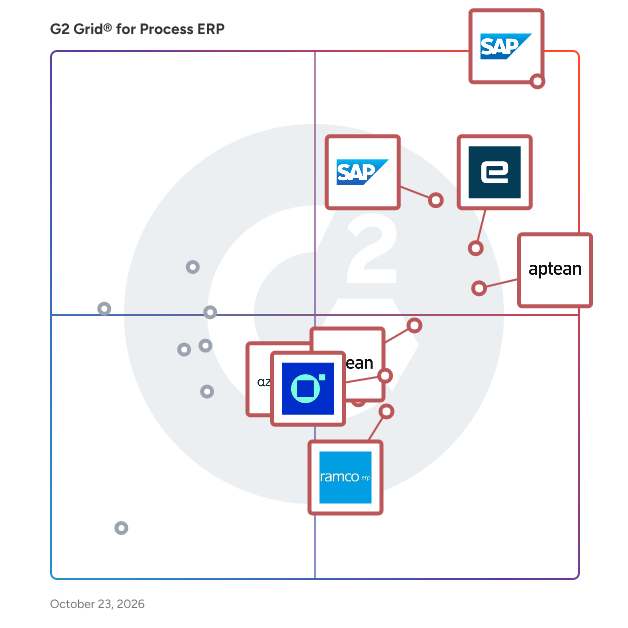
G2 Grid® for Process ERP Software

G2 Grid® for Process ERP Software plotting products by satisfaction and market presence

Highlighted products: SAP Cloud ERP (SAP S/4HANA Cloud), SAP ECC, Kinetic, Aptean Food & Beverage ERP, Aptean Process Manufacturing ERP Ross Edition, Syspro, Ramco ERP, and Azentio ERP.

Underlying data: [Grid® JSON](https://www.g2.com/categories/process-erp/grids.json?focus%5B%5D=sap-cloud-erp-sap-s-4hana-cloud&focus%5B%5D=sap-ecc&focus%5B%5D=epicor-kinetic&focus%5B%5D=aptean-food-beverage-erp&focus%5B%5D=aptean-process-manufacturing-erp-ross-edition&focus%5B%5D=syspro&focus%5B%5D=ramco-erp&focus%5B%5D=azentio-erp)

SAP Cloud ERP (SAP S/4HANA Cloud)

SAP Cloud ERP (S/4HANA Cloud) is a modular, cloud-based enterprise resource planning (ERP) solution that brings embedded AI into core business processes to help organizations of any size improve productivity, efficiency, and scalability. It supports critical business functions including finance, supply chain, human resources, and sales, while providing industry best-practice processes, predictable subscription-based costs, and the flexibility to add capabilities, users, and functionality as business needs evolve. With proven implementation tools and preconfigured processes, SAP Cloud ERP enables organizations to go live quickly and confidently while supporting ongoing growth and innovation. For midsize organizations who want to adopt SAP Cloud ERP the primary offering is SAP GROW, which combines SAP Cloud ERP with preconfigured best practices, implementation services, and adoption resources to help businesses achieve rapid, scalable cloud ERP deployment. For even quicker deployment, there’s SAP GROW Fast, a prepackaged offering delivered by SAP partners.

Average Rating: 4.4/5.0

Total Reviews: 962

How Do G2 Users Rate SAP Cloud ERP (SAP S/4HANA Cloud)?

  • Cash Management: 9.0/10 (Category avg: 7.6/10)
  • Quality of Support: 8.7/10 (Category avg: 7.7/10)
  • AP Automation: 8.9/10 (Category avg: 7.5/10)
  • AR Automation: 9.0/10 (Category avg: 7.8/10)

Who Is the Company Behind SAP Cloud ERP (SAP S/4HANA Cloud)?

  • Seller: SAP
  • Company Website:
  • Year Founded: 1972
  • HQ Location: Walldorf
  • Twitter: @SAP
    297,052 Twitter followers
  • LinkedIn® Page: www.linkedin.com
    149,349 employees on LinkedIn®

Who Uses This Product?

  • Who Uses This: Consultant, Senior Consultant
  • Top Industries: Information Technology and Services, Accounting
  • Company Size: 47% Large, 36% Medium

What Do G2 Reviewers Say About SAP Cloud ERP (SAP S/4HANA Cloud)?

AI-generated summary from verified user reviews

Pros
  • Users appreciate the ease of use of SAP Cloud ERP, making it effective and time-saving for daily tasks.
  • Users appreciate the cloud-based architecture of SAP S/4HANA Cloud for its scalability and reduced IT overhead.
  • Users value the real-time processing and industry-specific functionalities of SAP S/4HANA Cloud for enhanced financial management.
  • Users appreciate the real-time efficiency of SAP S/4HANA Cloud, with instant access to reports and accurate data.
  • Users value the real-time data capabilities of SAP S/4HANA Cloud, enhancing decision-making with instant access to analytics.
Cons
  • Users find the complexity and restrictions of SAP Cloud ERP challenging, leading to costly implementations and training needs.
  • Users find the learning curve steep for SAP Cloud ERP, making initial understanding and training challenging.
  • Users find the learning difficulty significant, as the complex system necessitates extensive training for new users.
  • Users find the complex setup of SAP Cloud ERP challenging, often requiring extensive training and expert assistance.
  • Users find the limited customization of SAP Cloud ERP restrictive, hindering adaptation to unique business processes.

What Are Recent G2 Reviews of SAP Cloud ERP (SAP S/4HANA Cloud)?

What Are G2 Users Discussing About SAP Cloud ERP (SAP S/4HANA Cloud)?

SAP ECC

Leverage world-class ERP software. Sharpen your competitive edge and drive growth with enterprise resource planning from SAP. With more than 40 years of experience and nearly 50,000 customers, our market-leading enterprise resource planning (ERP) software is a proven, trusted foundation built to support the world۪s largest organizations as well as small and midsize companies in 25 different industries. Leverage role-based access to critical data, applications, and analytical tools and streamline your processes across procurement, manufacturing, service, sales, finance, and HR.

Average Rating: 4.2/5.0

Total Reviews: 867

How Do G2 Users Rate SAP ECC?

  • Cash Management: 8.4/10 (Category avg: 7.6/10)
  • Quality of Support: 7.9/10 (Category avg: 7.7/10)
  • AP Automation: 8.2/10 (Category avg: 7.5/10)
  • AR Automation: 8.4/10 (Category avg: 7.8/10)

Who Is the Company Behind SAP ECC?

  • Seller: SAP
  • Year Founded: 1972
  • HQ Location: Walldorf
  • Twitter: @SAP
    297,052 Twitter followers
  • LinkedIn® Page: www.linkedin.com
    149,349 employees on LinkedIn®
  • Ownership: NYSE:SAP

Who Uses This Product?

  • Who Uses This: Consultant, Assistant Manager
  • Top Industries: Information Technology and Services, Accounting
  • Company Size: 64% Large, 29% Medium

What Do G2 Reviewers Say About SAP ECC?

AI-generated summary from verified user reviews

Pros
  • Users value the seamless departmental integration of SAP ECC, enhancing operations and simplifying data management across functions.
  • Users find SAP ECC to be easy to use, thanks to its intuitive transaction code interface and detailed data entry.
  • Users value the seamless integration of SAP ECC, which enhances collaboration and streamlines various business functions effectively.
  • Users value the seamless integration across departments in SAP ECC, enhancing operational efficiency and data flow.
  • Users appreciate the strong integration features of SAP ECC, ensuring smooth data flow across departments for streamlined operations.
Cons
  • Users find the time-consuming implementation process of SAP ECC a significant burden, affecting overall efficiency and usability.
  • Users find the complex setup of SAP ECC frustrating, requiring extensive time and resources for effective implementation.
  • Users criticize the steep learning curve of SAP ECC, citing its complex interface and cumbersome processes as major drawbacks.
  • Users find SAP ECC not user-friendly, citing its steep learning curve and outdated interface as major drawbacks.
  • Users find SAP ECC user-unfriendly due to its complex interface, requiring extensive training and skilled resources.

What Are Recent G2 Reviews of SAP ECC?

What Are G2 Users Discussing About SAP ECC?

Kinetic

Epicor Kinetic is a cloud-first enterprise resource planning (ERP) system specifically designed for manufacturing organizations. This comprehensive solution integrates essential business functions such as finance, supply chain management, production planning, quality control, service, and analytics into a unified platform. By consolidating these core operations, Kinetic enables teams to effectively manage data and processes across various departments, enhancing overall operational efficiency. Targeted primarily at discrete, make-to-order, engineer-to-order, and mixed-mode manufacturers, Kinetic addresses the unique challenges faced by these industries. It is particularly beneficial for organizations that require seamless coordination of operations from the initial stages of estimating and purchasing through to production, shipment, and financial reporting. The platform is equipped with manufacturing and planning tools that facilitate production management, scheduling, materials requirements, and shop floor coordination, ensuring that all aspects of the manufacturing process are streamlined and transparent. Kinetic’s capabilities extend to supply chain, inventory, and warehouse management, which support purchasing, supplier collaboration, and order fulfillment. Additionally, the financial management and analytics features allow users to track costs, margins, and operational performance in a single environment, providing valuable insights into business results. The inclusion of workflow automation, embedded AI capabilities, and extensibility tools further enhances the user experience by reducing manual tasks and supporting role-based processes, making it easier for teams to focus on strategic initiatives. The Kinetic platform is designed for a diverse range of users, including operations leaders, plant managers, supply chain teams, production planners, finance teams, IT stakeholders, and other business users who require shared visibility into manufacturing and commercial processes. Common use cases encompass production scheduling, inventory and materials management, quality tracking, product configuration, project-based manufacturing, and multi-site coordination. Organizations looking for an ERP solution that supports global operations or offers browser-based access often consider Kinetic as a viable option. Epicor Kinetic is utilized across various sectors, including industrial machinery, fabricated metals, electronics and high-tech, automotive, aerospace and defense, medical devices, and plastics. With its AI-driven capabilities, Kinetic not only supports day-to-day ERP activities but also assists in decision-making and workflow management, positioning manufacturers for future-ready business and digital transformation. This singular ERP solution is designed to adapt to the evolving needs of manufacturers, ensuring they remain competitive in a rapidly changing landscape.

Average Rating: 3.9/5.0

Total Reviews: 722

How Do G2 Users Rate Kinetic?

  • Cash Management: 7.6/10 (Category avg: 7.6/10)
  • Quality of Support: 6.2/10 (Category avg: 7.7/10)
  • AP Automation: 6.7/10 (Category avg: 7.5/10)
  • AR Automation: 7.3/10 (Category avg: 7.8/10)

Who Is the Company Behind Kinetic?

  • Seller: Epicor
  • Company Website:
  • Year Founded: 1972
  • HQ Location: Austin, TX
  • Twitter: @Epicor
    9,286 Twitter followers
  • LinkedIn® Page: www.linkedin.com
    6,161 employees on LinkedIn®

Who Uses This Product?

  • Who Uses This: Controller, IT Manager
  • Top Industries: Manufacturing, Machinery
  • Company Size: 79% Medium, 15% Small

What Do G2 Reviewers Say About Kinetic?

AI-generated summary from verified user reviews

Pros
  • Users find Kinetic easy to navigate, appreciating seamless query running and dashboard creation for better visibility.
  • Users appreciate the flexible personalization options of Kinetic, enhancing efficiency and decision-making through accessible information.
  • Users value the high customization and flexibility of Kinetic, enabling tailored solutions for unique business processes.
  • Users appreciate the easy customizability of Kinetic, adapting it seamlessly to their unique business needs.
  • Users appreciate the customization flexibility of Kinetic, enabling easy adjustments to fit their specific business needs.
Cons
  • Users find the learning curve steep, struggling with complex reporting tools and inadequate documentation for effective usage.
  • Users struggle with user-friendliness, noting cumbersome navigation, insufficient logging, and tedious setup processes in Kinetic.
  • Users find the learning difficulty of Kinetic challenging due to convoluted navigation and time-consuming dashboard adjustments.
  • Users find the missing features in Kinetic's finance part inadequate for complying with specific country requirements.
  • Users find the navigation difficult with clunky panels and inefficient dashboard views, leading to a challenging experience.

What Are Recent G2 Reviews of Kinetic?

What Are G2 Users Discussing About Kinetic?

AI can help you find the answers. G2 helps you trust them.

Connect G2 to Claude or ChatGPT for answers grounded in G2's trusted reviews, comparisons, and pricing from real user insights.

How it works

Aptean Food & Beverage ERP

Aptean Food & Beverage ERP is an award-winning enterprise resource planning (ERP) solution purpose-built to address the unique challenges of the food and beverage industry. Aptean Food & Beverage ERP runs on Microsoft Dynamics 365 Business Central—one of the world's most widely adopted and fastest-growing ERP platforms—so the interface feels familiar and easy to use from day one. On top of that Microsoft foundation, Aptean has built industry-specific functionality you won't find in a generic ERP. Aptean Food & Beverage ERP is the current evolution of many trusted legacy systems used across the industry. If you've used or heard of bcFood, Foodware 365, Foodware BC, Foodware Enterprise, JustFood, Linkfresh 365 Business Central, Linkfresh 365 Enterprise, DIN, SI Food, Produce Pro ERP, Drink-IT, Unity, UnityF8, Affinitus ChefServe, and FreshWare you're in the right place. These solutions have been unified under the Aptean umbrella to bring a modern, more powerful experience backed by ongoing support and innovation. Who is Aptean Food & Beverage ERP for? Aptean Food & Beverage ERP is built for food and beverage producers, manufacturers, and distributors who need an ERP tailored to their industry’s demands. Key benefits include: • End-to-End Traceability: Track ingredients at every stage for seamless backward and forward traceability, ensuring quick and efficient recall management. • Integrated Food Safety Management: Maintain regulatory compliance and peace of mind with tools for tracking allergens, nutritional information, and standards like SQF, BRC, and HACCP. • Advanced Warehouse Management: Optimize operations with features like expiration date tracking, allergen segregation, and First Expired, First Out (FEFO) protocols to reduce waste and improve accuracy. • Trade Management: Simplify complex pricing with hierarchical and measurement-based strategies tailored to industry needs. • Scalable Configurations: Flexible to adapt to businesses of all sizes, from small producers to large-scale manufacturers. Beyond the core ERP, Aptean's AppCentral platform connects the system to Enterprise Asset Management, Business Intelligence, Electronic Data Interchange (EDI), Transportation Management, and Product Lifecycle Management. Aptean Intelligence layers AI on top, with GenAI Query, predictive risk detection, and AI agents that catch expiring inventory, flag vendor issues, and keep cash flow moving. Unlike generic ERP systems, Aptean Food & Beverage ERP is purpose-built from the ground up for the industry, often requiring minimal to no customization out of the box. Backed by 30+ years of industry-specific development, Aptean is trusted by more than 1,500 food and beverage companies worldwide. Frost & Sullivan named Aptean its 2026 Technology Innovation Leader, citing the platform’s AI capabilities, faster implementation, and stronger ROI compared with competing solutions. Contact us today for a free, no-obligation consultation or demo!

Average Rating: 4.0/5.0

Total Reviews: 46

How Do G2 Users Rate Aptean Food & Beverage ERP?

  • Cash Management: 5.8/10 (Category avg: 7.6/10)
  • Quality of Support: 8.1/10 (Category avg: 7.7/10)
  • AP Automation: 7.5/10 (Category avg: 7.5/10)
  • AR Automation: 6.7/10 (Category avg: 7.8/10)

Who Is the Company Behind Aptean Food & Beverage ERP?

  • Seller: Aptean
  • Company Website:
  • Year Founded: 2012
  • HQ Location: Alpharetta, Georgia
  • Twitter: @Aptean
    1,620 Twitter followers
  • LinkedIn® Page: www.linkedin.com
    3,789 employees on LinkedIn®

Who Uses This Product?

  • Top Industries: Food & Beverages, Food Production
  • Company Size: 65% Medium, 23% Small

What Are Recent G2 Reviews of Aptean Food & Beverage ERP?

What Are G2 Users Discussing About Aptean Food & Beverage ERP?

Aptean Process Manufacturing ERP Ross Edition

Aptean Process Manufacturing ERP Ross Edition is a powerful solution tailored for formula and recipe-based manufacturers in industries like food, beverage, chemicals, and pharmaceuticals. Built to streamline operations and ensure compliance, Ross ERP provides advanced capabilities such as lot traceability, regulatory compliance, and real-time production insights. By integrating inventory control, quality management, supply chain planning, and financial oversight into a single platform, Ross ERP helps process manufacturers automate key functions, monitor production data, and adapt to changing demands. With its cloud-enabled environment and modular design, this ERP system scales with your business, delivering cost-effective and efficient tools to meet your evolving needs. Key Features -Inventory and Warehouse Management: Gain real-time visibility into inventory and track projected balances based on supply and demand, ensuring accurate inventory control. -Product Costing and Inventory Valuation: Simulate “what if” scenarios and manage costs with flexible valuation options, including standard, weighted, average, and lot actual costs. -Action Center: Monitor key performance indicators (KPIs) with drill-down graphs and automated error alerts to quickly identify and address critical issues. -Quality Management: Stay compliant and retrieve quality information easily during mock recalls or audits with robust quality management tools. -Data Collection: Automate materials tracking, speed up receiving and shipping, and gain instant shop floor visibility with real-time data collection. -Supply Chain Planning: Optimize capacity, materials, and labor with practical production plans that align inventory and supply to maximize customer satisfaction and minimize costs. -Sales and Pricing Management: Prevent revenue leakage by managing pricing, promotions, rebates, discounts, and customer billbacks efficiently. Financial Management: Centralize financial data for transparent reporting, integrated planning, budgeting, forecasting, and regulatory compliance. -Mobile Production Management: Access real-time factory data on a mobile device to increase efficiency, reduce errors, and eliminate paperwork. Sales Portal: Enable secure online ordering and manage web-based content through a dedicated sales portal. Why Choose Aptean Process Manufacturing ERP Ross Edition? Purpose-Built for Process Manufacturers: Designed for formula and recipe-based industries like food, beverage, chemicals, and pharmaceuticals. Streamlined Operations: Automate essential processes, reduce manual tasks, and enhance efficiency across production, inventory, and supply chain management. End-to-End Visibility: Gain real-time insights into production, inventory, and financial data to make informed decisions. Scalable and Flexible: Implement only the features you need today and expand as your business grows, thanks to a modular, fully integrated design. Regulatory Compliance Made Easy: Ensure quality and compliance with tools for traceability, quality management, and reporting. Cloud-Enabled Efficiency: Operate with confidence using a secure, cloud-enabled system that ensures access to data anytime, anywhere. Who Is This For? Aptean Process Manufacturing ERP Ross Edition is ideal for mid-sized to large process manufacturers in industries like food, beverage, chemicals, and pharmaceuticals. It’s perfect for companies that prioritize quality, compliance, and operational efficiency while managing complex supply chains and recipe-based production processes. With modular applications and seamless integration, the ERP adapts to your unique needs. Whether you’re focused on advanced quality, supply chain planning, or real-time analytics, Aptean Process Manufacturing ERP grows alongside your business while maintaining a single source of truth. Aptean Process Manufacturing ERP Ross Edition simplifies operations, ensures compliance, and enhances efficiency for formula and recipe-based manufacturers. By providing tools for automation, real-time insights, and scalable functionality, Ross ERP helps your business thrive in today’s competitive markets. See for yourself – reach out today to book a free no-obligation demo.

Average Rating: 4.2/5.0

Total Reviews: 30

How Do G2 Users Rate Aptean Process Manufacturing ERP Ross Edition?

  • Cash Management: 8.9/10 (Category avg: 7.6/10)
  • Quality of Support: 8.5/10 (Category avg: 7.7/10)
  • AP Automation: 8.3/10 (Category avg: 7.5/10)
  • AR Automation: 9.2/10 (Category avg: 7.8/10)

Who Is the Company Behind Aptean Process Manufacturing ERP Ross Edition?

  • Seller: Aptean
  • Year Founded: 2012
  • HQ Location: Alpharetta, Georgia
  • Twitter: @Aptean
    1,620 Twitter followers
  • LinkedIn® Page: www.linkedin.com
    3,789 employees on LinkedIn®
  • Phone: +1-770-351-9600

Who Uses This Product?

  • Top Industries: Food Production, Food & Beverages
  • Company Size: 81% Medium, 16% Small

What Do G2 Reviewers Say About Aptean Process Manufacturing ERP Ross Edition?

AI-generated summary from verified user reviews

Pros
  • Users value the great customer support from Aptean, enhancing their experience with the ERP system Ross.
  • Users value the excellent customer support from Aptean, fostering a sense of community and guidance throughout their journey.
  • Users value the accurate data provided by Aptean ROSS ERP, enhancing visibility and efficiency in process manufacturing.
  • Users commend the business suitability of Aptean ROSS ERP, noting its tailored design for process manufacturing and compliance.
  • Users value the efficient data management in Aptean ERP, improving access to real-time production data and organization.
Cons
  • Users find the user unfriendliness of Aptean Process Manufacturing ERP Ross Edition challenging, requiring extensive training for better navigation.
  • Users report a significant learning curve for senior employees, making engagement and adoption of the ERP system challenging.
  • Users find that learning difficulty hampers adoption, especially among senior employees not familiar with new technology.
  • Users find the interface non-intuitive, often requiring excessive navigation that complicates their experience without proper training.
  • Users find the interface unintuitive, often needing training to navigate its confusing features effectively.

What Are Recent G2 Reviews of Aptean Process Manufacturing ERP Ross Edition?

What Are G2 Users Discussing About Aptean Process Manufacturing ERP Ross Edition?

Syspro

Syspro is manufacturing ERP and distribution management software built for mid-sized manufacturers and distributors. The platform gives companies in discrete manufacturing, process manufacturing, and wholesale distribution full control over production operations, inventory management, and supply chain visibility. Syspro helps you: Achieve operational excellence: get real-time visibility from the shop floor to the warehouse to delivery. Syspro provides manufacturing operations management (MOM) and supply chain orchestration as the backbone for efficient operations across the value chain. Drive profitability: digitize and automate order-to-cash and procure-to-pay processes. Accelerate collections, control working capital, and find efficiencies through automation and process optimization. Ensure compliance and traceability: protect margins and reputation with built-in lot-level genealogy, quality management systems (QMS), and end-to-end traceability by design. Meet regulatory requirements including FDA, ISO, and ESG reporting standards. Apply industrial-grade AI: use machine learning for demand forecasting, predictive analytics, anomaly detection, and quality monitoring, so production planning and inventory decisions are backed by data. Syspro works with businesses ranging from family-owned operations to established global manufacturers, across industries including food and beverage, automotive parts, electronics assembly, pharmaceuticals, and industrial equipment. The platform handles the operational complexity of modern manufacturing and distribution, so teams can focus on running the business.

Average Rating: 4.1/5.0

Total Reviews: 245

How Do G2 Users Rate Syspro?

  • Cash Management: 8.4/10 (Category avg: 7.6/10)
  • Quality of Support: 7.9/10 (Category avg: 7.7/10)
  • AP Automation: 7.7/10 (Category avg: 7.5/10)
  • AR Automation: 7.7/10 (Category avg: 7.8/10)

Who Is the Company Behind Syspro?

  • Seller: Syspro
  • Company Website:
  • Year Founded: 1978
  • HQ Location: The Old Vicarage, Market Street, DE74 2Jb, Castle Donington, GB
  • LinkedIn® Page: www.linkedin.com
    648 employees on LinkedIn®

Who Uses This Product?

  • Who Uses This: IT Manager, Controller
  • Top Industries: Manufacturing, Electrical/Electronic Manufacturing
  • Company Size: 71% Medium, 24% Small

What Do G2 Reviewers Say About Syspro?

AI-generated summary from verified user reviews

Pros
  • Users commend the ease of use of Syspro, highlighting its helpful prompts and intuitive tracking features.
  • Users value the user-friendly functionality of Syspro, making job tracking and sales order management seamless.
  • Users commend Syspro for its business suitability in manufacturing, appreciating its continuous evolution and comprehensive solutions.
  • Users praise the helpful customer support of Syspro, making it easy to navigate and customize processes.
  • Users value the ease of customization in Syspro, enhancing workflows and improving key performance indicators effortlessly.
Cons
  • Users find inefficient processes in Syspro that slow down operations, necessitating workarounds and additional customization.
  • Users frequently experience data integrity issues and inefficiencies in Syspro's management, affecting overall functionality.
  • Users experience inefficiency with Syspro, particularly during report runs and bank reconciliations, leading to delays.
  • Users face payment issues with Syspro, including inefficiencies, UI problems, and difficulties with data integrity.
  • Users experience poor customer support from Syspro, with slow responsiveness and inexperienced staff hindering assistance.

What Are Recent G2 Reviews of Syspro?

What Are G2 Users Discussing About Syspro?

Ramco ERP

Ramco offers post-modern and cognitive ERP software on cloud transforming organizations to digital enterprises. Ramco ERP is a comprehensive cloud ERP solution catering to the needs of fast growing enterprises embarked on digital transformation. Ramco's cognitive and post-modern ERP software help optimize complex business processes and enables organizations to thrive digitally. Ramco ERP offers • Unified solution - Power of One • Flexible workflow based approach • In Memory based real-time optimization engine • Cognitive & self-learning solution • Powerful Analytics Ramco ERP is scalable and can be deployed on cloud or on-premise. It supports integration with most of the existing business applications. Ramco ERP is ideal for any organization who want to optimize their operations, embark on Digital transformation and thrive digitally. Ramco ERP caters to both medium and large scale enterprises. For more details, visit http://bit.ly/2cpg2hg. Ramco is a fast growing cloud enterprise software player across ERP, Logistics, Asset Management, HCM & Global Payroll, Time & Attendance and Aviation MRO. Trusted by 1000+ customers worldwide and 150,000+ end users, Ramco Systems focuses on Innovation and Culture to differentiate itself in the marketplace.

Average Rating: 4.1/5.0

Total Reviews: 28

How Do G2 Users Rate Ramco ERP?

  • Cash Management: 7.9/10 (Category avg: 7.6/10)
  • Quality of Support: 8.1/10 (Category avg: 7.7/10)
  • AP Automation: 7.6/10 (Category avg: 7.5/10)
  • AR Automation: 7.9/10 (Category avg: 7.8/10)

Who Is the Company Behind Ramco ERP?

  • Seller: Ramco Systems
  • Year Founded: 1997
  • HQ Location: Chennai, Tamil Nadu
  • Twitter: @RamcoSystems
    7,770 Twitter followers
  • LinkedIn® Page: www.linkedin.com
    3,949 employees on LinkedIn®
  • Ownership: NSE: RAMCOSYS

Who Uses This Product?

  • Company Size: 52% Medium, 42% Large

What Do G2 Reviewers Say About Ramco ERP?

AI-generated summary from verified user reviews

Pros
  • Users value the user-friendly accessibility of Ramco ERP, ensuring secure data management with ease.
  • Users value the user-friendly interface of Ramco ERP, ensuring that data remains secure and easily accessible.
  • Users value the secure data storage of Ramco ERP, appreciating its user-friendly interface for managing information.
  • Users find Ramco ERP to be user-friendly, effectively ensuring data security while simplifying processes.
  • Users value the user-friendly interface and strong security of Ramco ERP, ensuring data protection and ease of use.
Cons
  • Users find the difficult customization of Ramco ERP time-consuming, which affects efficiency and slows down processes.
  • Users find that the slow loading times of Ramco ERP hinder their productivity and efficiency during use.
  • Users find the slow performance of Ramco ERP frustrating, as it leads to time-consuming loading issues.
  • Users find the slow loading times of Ramco ERP to be time-consuming and a hindrance to productivity.
  • Users find the time-consuming loading of Ramco ERP frustrating, impacting efficiency during operations.

What Are Recent G2 Reviews of Ramco ERP?

What Are G2 Users Discussing About Ramco ERP?

Azentio ERP

Azentio ERP cloud unifies diverse business operations, enabling organizations to focus on strategic growth and innovation. It delivers measurable impact through streamlined processes, enhanced collaboration, and data-driven insights that empower leaders to make informed decisions. Designed to adapt to dynamic business needs, it fosters resilience and scalability. Azentio ERP cloud is the backbone of transformation, helping businesses achieve sustained success in competitive markets.

Average Rating: 4.4/5.0

Total Reviews: 17

How Do G2 Users Rate Azentio ERP?

  • Cash Management: 10.0/10 (Category avg: 7.6/10)
  • Quality of Support: 8.6/10 (Category avg: 7.7/10)
  • AP Automation: 8.3/10 (Category avg: 7.5/10)
  • AR Automation: 8.3/10 (Category avg: 7.8/10)

Who Is the Company Behind Azentio ERP?

  • Seller: Azentio
  • Year Founded: 2020
  • HQ Location: Singapore
  • LinkedIn® Page: www.linkedin.com
    1,909 employees on LinkedIn®
  • Ownership: Private
  • Phone: +65 68 081 600

Who Uses This Product?

  • Top Industries: Information Technology and Services
  • Company Size: 44% Medium, 39% Large

What Do G2 Reviewers Say About Azentio ERP?

AI-generated summary from verified user reviews

Pros
  • Users love the comprehensive features of Azentio ERP, enabling easy payroll processing and employee management.
  • Users find Azentio ERP to be easy to use, allowing quick payroll processing and effortless employee management.
  • Users value the seamless integrations of Azentio ERP, making processes like payroll and employee management easy.
  • Users love the easy payroll processing of Azentio ERP, simplifying tasks like payslip generation and employee management.
  • Users find the easy setup of Azentio ERP user-friendly, allowing quick payroll processing and seamless integration.
Cons
  • Users report experiencing poor customer support, making it difficult to resolve issues like duplicate entries during data uploads.
  • Users experience software bugs such as duplicate entries during large data uploads and difficulty reaching support.
  • Users experience upload issues with duplicate entries for large data uploads and difficulty contacting support.

What Are Recent G2 Reviews of Azentio ERP?

What Are G2 Users Discussing About Azentio ERP?

Microsoft Dynamics 365 Supply Chain Management

Microsoft Dynamics AX is the complete ERP solution for enterprises that provides a purpose-built foundation across five industries (manufacturing, distribution, retail, services, and public sector), along with comprehensive, core ERP functionality for financial, human resources and operations management. It empowers your people to anticipate and embrace change so your business can thrive. All of this is packaged in a single global solution giving you rapid time to value.

Average Rating: 3.7/5.0

Total Reviews: 98

How Do G2 Users Rate Microsoft Dynamics 365 Supply Chain Management?

  • Cash Management: 8.3/10 (Category avg: 7.6/10)
  • Quality of Support: 7.5/10 (Category avg: 7.7/10)
  • AP Automation: 8.3/10 (Category avg: 7.5/10)
  • AR Automation: 8.3/10 (Category avg: 7.8/10)

Who Is the Company Behind Microsoft Dynamics 365 Supply Chain Management?

  • Seller: Microsoft
  • Year Founded: 1975
  • HQ Location: Redmond, Washington
  • Twitter: @microsoft
    13,091,739 Twitter followers
  • LinkedIn® Page: www.linkedin.com
    232,750 employees on LinkedIn®
  • Ownership: MSFT

Who Uses This Product?

  • Top Industries: Information Technology and Services, Computer Software
  • Company Size: 47% Medium, 33% Large

What Do G2 Reviewers Say About Microsoft Dynamics 365 Supply Chain Management?

AI-generated summary from verified user reviews

Pros
  • Users value the accurate data provided by Dynamics 365, enhancing decision-making and reducing product unavailability.
  • Users value the customizability of Microsoft Dynamics 365 SCM, enhancing visibility and enabling data-driven decisions across the supply chain.
  • Users value the live insights provided by Microsoft Dynamics 365 SCM, enhancing decision-making across the entire supply chain.
  • Users value the live insights across the entire supply chain, enhancing decision-making and reducing product unavailability.
  • Users value the live insights in Microsoft Dynamics 365 Supply Chain Management for enhanced visibility and decision-making.
Cons
  • Users find Microsoft Dynamics 365 Supply Chain Management to be expensive, particularly challenging for smaller or new businesses.
  • Users find that lack of features can hinder smaller businesses' ability to manage costs effectively during onboarding.
  • Users find the lack of features burdensome, especially when balancing costs as smaller businesses or global operations.
  • Users find that missing features limit functionality, particularly affecting cost management for smaller or complex organizations.
  • Users find that specialized support costs can be prohibitive for small businesses, limiting feature accessibility.

What Are Recent G2 Reviews of Microsoft Dynamics 365 Supply Chain Management?

What Are G2 Users Discussing About Microsoft Dynamics 365 Supply Chain Management?

Sage X3

Sage X3 is an AI-powered ERP software suite that includes integrated functionality for financial management, sales, customer service, distribution, inventory, manufacturing, and business intelligence. It is web-based, browser-agnostic, and responsive across mobile devices. Sage X3 offers flexible deployment options, including on-premises, Sage-managed SaaS in the AWS cloud, or partner-provisioned cloud environments. The software is highly configurable to company requirements, user roles, and preferences. Built-in features such as visual processes, automated workflows and alerts, document management, and collaboration tools are designed to streamline operations and enhance productivity. With native support for multi-company, multi-site, multi-language, multi-currency, and multi-legislation environments, Sage X3 is built to support global organizations. Its extensible architecture allows for customizable add-ons and seamless integration with third-party systems, including CRM, WMS, and e-commerce platforms. Embedded Sage AI and Sage Copilot deliver real-time insights, intelligent automation, and conversational interaction across key business functions.

Average Rating: 3.8/5.0

Total Reviews: 51

How Do G2 Users Rate Sage X3?

  • Cash Management: 9.2/10 (Category avg: 7.6/10)
  • Quality of Support: 7.0/10 (Category avg: 7.7/10)
  • AP Automation: 10.0/10 (Category avg: 7.5/10)
  • AR Automation: 10.0/10 (Category avg: 7.8/10)

Who Is the Company Behind Sage X3?

  • Seller: Sage Software
  • Company Website:
  • Year Founded: 1981
  • HQ Location: Newcastle
  • LinkedIn® Page: www.linkedin.com
    15,833 employees on LinkedIn®
  • Ownership: SGE.L

Who Uses This Product?

  • Top Industries: Manufacturing, Information Technology and Services
  • Company Size: 70% Medium, 21% Small

What Do G2 Reviewers Say About Sage X3?

AI-generated summary from verified user reviews

Pros
  • Users value the ease of use and simple interface of Sage X3, making training and implementation effortless.
  • Users value the customizability of Sage X3, allowing tailored solutions to meet diverse business needs efficiently.
  • Users value the customization options in Sage X3, enabling tailored adaptations to meet diverse business needs.
  • Users find the integration ease of Sage X3 excellent, enabling smooth connections with various business tools and systems.
  • Users appreciate the seamless integration features of Sage X3, enhancing flexibility and data analysis for optimized processes.
Cons
  • Users experience significant difficulties with data management, particularly due to the cumbersome intercompany journal posting process.
  • Users find the interface design poor and outdated, complicating tasks that should be simple and efficient.
  • Users find Sage X3 to be time-consuming for basic tasks, complicating operations and hindering productivity.
  • Users find the complex processes of Sage X3, especially intercompany journal postings, to be quite frustrating.
  • Users find the complexity of workflows and maintenance in Sage X3 to be a significant challenge for daily operations.

What Are Recent G2 Reviews of Sage X3?

What Are G2 Users Discussing About Sage X3?

Infor CloudSuites (M3)

Infor M3 is a powerful cloud ERP software solution that uses the latest technologies to provide an exceptional user experience and powerful analytics in a multi-company, multi-country, and multi-site ERP cloud solution platform. Infor M3 and related industry-specific CloudSuite solutions come with industry-leading functionality for the chemical, distribution, equipment, fashion, food and beverage, and industrial manufacturing industries. Infor M3 can help medium to large national and global organizations quickly move into the digital age, respond faster to change, reduce excess inventory, and cut costs. In addition, it helps you manage your network of people, technology, activities, information, and resources efficiently and economically. Flexible deployment options and implementation accelerators offer a low total cost of ownership and short time to value.

Average Rating: 3.8/5.0

Total Reviews: 123

How Do G2 Users Rate Infor CloudSuites (M3)?

  • Cash Management: 7.8/10 (Category avg: 7.6/10)
  • Quality of Support: 7.6/10 (Category avg: 7.7/10)
  • AP Automation: 8.3/10 (Category avg: 7.5/10)
  • AR Automation: 8.3/10 (Category avg: 7.8/10)

Who Is the Company Behind Infor CloudSuites (M3)?

  • Seller: Infor
  • Year Founded: 2002
  • HQ Location: New York
  • Twitter: @Infor
    18,472 Twitter followers
  • LinkedIn® Page: www.linkedin.com
    22,165 employees on LinkedIn®
  • Phone: 800-260-2640

Who Uses This Product?

  • Top Industries: Apparel & Fashion, Food & Beverages
  • Company Size: 49% Medium, 45% Large

What Do G2 Reviewers Say About Infor CloudSuites (M3)?

AI-generated summary from verified user reviews

Pros
  • Users value the accurate data tracking in Infor CloudSuite M3, enabling thorough end-to-end visibility.
  • Users appreciate the end-to-end data tracking in Infor CloudSuite M3, enabling clear insights and visibility.
  • Users value the easy access to end-to-end data tracking, enhancing their operational visibility.
  • Users value the end-to-end tracking capability of Infor CloudSuite M3, allowing for comprehensive data visibility.
  • Users value the end-to-end data tracking capability of Infor CloudSuite M3, ensuring a clear overview of operations.
Cons
  • Users find difficult learning curve for Infor CloudSuite M3, making it challenging to fully utilize the software.
  • Users find Infor CloudSuite M3 difficult to use, which hampers their overall experience with the software.
  • Users find the learning difficulty of Infor CloudSuite M3 a barrier to effectively utilizing the software.
  • Users find the understanding difficulty of Infor CloudSuite M3 to be a significant barrier in usability.
  • Users find the user unfriendliness of Infor CloudSuite M3 makes it challenging to navigate and utilize effectively.

What Are Recent G2 Reviews of Infor CloudSuites (M3)?

What Are G2 Users Discussing About Infor CloudSuites (M3)?

IFS Cloud ERP

IFS Cloud is a fully composable AI-powered platform designed to provide businesses with the flexibility and adaptability necessary to meet their specific requirements and navigate ongoing business evolution. This comprehensive solution encompasses a wide range of functionalities, including Enterprise Resource Planning (ERP), Enterprise Asset Management (EAM), Supply Chain Management (SCM), Information Technology Service Management (ITSM), Asset Investment Planning (AIP), and Field Service Management (FSM). By integrating advanced technologies such as artificial intelligence, machine learning, and real-time data analytics, IFS Cloud empowers organizations to make informed strategic decisions and excel at their critical operational moments. Targeted primarily at businesses that manufacture goods, maintain complex assets, and manage service-oriented operations, IFS Cloud addresses the unique challenges faced by these industries. The platform is particularly beneficial for organizations looking to enhance productivity, efficiency, and sustainability through the transformative power of Industrial AI™. By leveraging real-time insights and predictive analytics, users can optimize their operations, streamline processes, and improve service delivery, ultimately leading to better customer satisfaction and business outcomes. Key features of IFS Cloud include its modular architecture, which allows organizations to customize their solutions based on specific needs and growth trajectories. This composable nature ensures that businesses can adapt their systems as they evolve, integrating new functionalities without the need for extensive overhauls. Furthermore, the platform’s AI capabilities enable predictive maintenance and intelligent resource allocation, which can significantly reduce downtime and operational costs. The seamless integration of various management functions into a single platform also facilitates better collaboration across departments, enhancing overall organizational efficiency. The platform’s commitment to customer-centricity is rooted in IFS's history, which began in 1983 when the founders prioritized customer needs above all else. This foundational value continues to drive IFS as it has grown into a global leader with a workforce of over 7,000 employees across 80 countries. Recognized for its agility and trustworthiness, IFS is often recommended as a top supplier in its sector, reflecting its dedication to delivering value and supporting strategic transformations for its clients. Through IFS Cloud, businesses can harness the full potential of their operations, ensuring they remain competitive in an ever-evolving market landscape.

Average Rating: 3.9/5.0

Total Reviews: 167

How Do G2 Users Rate IFS Cloud ERP?

  • Cash Management: 8.1/10 (Category avg: 7.6/10)
  • Quality of Support: 6.2/10 (Category avg: 7.7/10)
  • AP Automation: 7.8/10 (Category avg: 7.5/10)
  • AR Automation: 7.9/10 (Category avg: 7.8/10)

Who Is the Company Behind IFS Cloud ERP?

  • Seller: IFS
  • Company Website:
  • Year Founded: 1983
  • HQ Location: Linkoping , Sweden
  • Twitter: @ifs
    18,002 Twitter followers
  • LinkedIn® Page: www.linkedin.com
    9,233 employees on LinkedIn®

Who Uses This Product?

  • Top Industries: Automotive, Manufacturing
  • Company Size: 64% Medium, 29% Large

What Do G2 Reviewers Say About IFS Cloud ERP?

AI-generated summary from verified user reviews

Pros
  • Users appreciate the ease of use of IFS Cloud, finding it adaptable and straightforward for business needs.
  • Users appreciate the full functionality of IFS Cloud, benefiting from its intuitive design and logical processes.
  • Users appreciate the flexibility of IFS Cloud, enabling easy configuration and comprehensive coverage of all operations.
  • Users find IFS Cloud to be user-friendly, enabling effortless design and management of business operations.
  • Users appreciate the easy access of IFS Cloud, making navigation and management of operations seamless and efficient.
Cons
  • Users find improvement needed in IFS Cloud's usability and support, impacting understanding and overall experience.
  • Users experience poor customer support with IFS Cloud, often facing delayed resolutions and inadequate assistance.
  • Users find the complex setup of IFS Cloud challenging, requiring extensive time, expertise, and detailed budgeting.
  • Users find IFS Cloud lacking in missing features, leading to frustration with its functionality and customer support.
  • Users experience poor support with IFS Cloud, facing delays in resolution and challenges in usability despite abundant documentation.

What Are Recent G2 Reviews of IFS Cloud ERP?

What Are G2 Users Discussing About IFS Cloud ERP?

Priority ERP

Priority is a leading provider of scalable, flexible, and open cloud-based business management solutions for organizations of all sizes, from global enterprises to small and growing businesses. Recognized by leading industry analysts for continuous product innovation, Priority delivers real-time access to business data, processes, and insights from any desktop or mobile device. At the core of the platform lies a comprehensive system that unifies financials, CRM and sales, supply chain management, manufacturing, distribution, customer service, project management, warehouse management (WMS), human resources, and more within a single, integrated environment. Built on a modern, API-first architecture, Priority enables organizations to connect systems, automate workflows, and adapt processes without heavy reliance on development resources. A key advancement in recent versions is Priority aiERP, which embeds artificial intelligence directly into everyday business processes. Rather than operating as a separate layer, AI is built into the system to support how teams actually work. This includes: -aiERP Companion: a natural language interface that allows users to query data, generate reports, and create business rules using plain language -aiERP Advisor: real-time insights and recommendations based on live operational and financial data -AI Agents: task-specific agents that automate routine activities across departments, including: --Accounting (journal entries, VAT reporting, payment analysis) --Sales (customer creation, quotes, order processing, analytics) --Supply chain (purchase orders, vendor setup, inventory movements) --HR and payroll (employee onboarding, payroll processing) These capabilities are designed with a human-in-the-loop approach, ensuring users maintain control, validate outputs, and guide decision-making. Priority also supports advanced operational capabilities such as: -Native Warehouse Management (WMS) with real-time inventory control -Advanced Delivery Planning (ADP) for route optimization and logistics efficiency -Proof of Delivery (POD) mobile applications for end-to-end supply chain visibility -Built-in Business Process Management (BPM) for workflow automation -No-code tools including a Mobile App Generator and Portal Generator for rapid application development The platform supports multiple deployment models, including public cloud (hosted on AWS), hybrid, and on-premise environments, allowing organizations to scale and evolve without disruptive system replacements. With continuous upgrades and no forced end-of-life cycles, Priority enables long-term system stability while continuously introducing new capabilities. Priority’s cloud ERP has been recognized globally by analysts such as IDC (which named Priority a Major Player in AI-enabled ERP for midsize businesses) and Gartner, where it has been featured in the Magic Quadrant for several years. Today, more than 75,000 companies across 40 countries rely on Priority to manage their operations, gain visibility into their business, and adapt to changing market conditions.

Average Rating: 4.4/5.0

Total Reviews: 43

How Do G2 Users Rate Priority ERP?

  • Cash Management: 7.5/10 (Category avg: 7.6/10)
  • Quality of Support: 7.9/10 (Category avg: 7.7/10)
  • AP Automation: 8.3/10 (Category avg: 7.5/10)
  • AR Automation: 5.0/10 (Category avg: 7.8/10)

Who Is the Company Behind Priority ERP?

  • Seller: Priority Software
  • Company Website:
  • Year Founded: 1986
  • HQ Location: Rosh HaAyin, Israel
  • Twitter: @PrioritySw
    497 Twitter followers
  • LinkedIn® Page: www.linkedin.com
    475 employees on LinkedIn®

Who Uses This Product?

  • Top Industries: Information Technology and Services
  • Company Size: 66% Medium, 32% Small

What Do G2 Reviewers Say About Priority ERP?

AI-generated summary from verified user reviews

Pros
  • Users value the effective financial management capabilities of Priority ERP, finding it beneficial for business operations.
  • Users find the inventory management of Priority ERP highly efficient, streamlining stock control and financial oversight.
Cons
  • Users report integration issues with Priority ERP, particularly regarding support and limited SSO options like SAML.
  • Users are frustrated with the poor customer support and lack of stable integrations in Priority ERP.
  • Users express concerns about poor support and limited integrations, impacting their overall experience with Priority ERP.

What Are Recent G2 Reviews of Priority ERP?

What Are G2 Users Discussing About Priority ERP?

Plex Smart Manufacturing Platform

Plex, by Rockwell Automation is a leader in cloud-delivered smart manufacturing solutions, empowering the world's manufacturers to make awesome products. The Plex Smart Manufacturing Platform includes solutions for manufacturing execution (MES), ERP, quality, supply chain planning and management, asset performance management, production monitoring, process automation and analytics to connect people, systems, machines and supply chains, enabling them to lead with precision, efficiency and agility. Our platform gives manufacturers the ability to connect, automate, track, and analyze every aspect of their business to drive transformation.

Average Rating: 4.0/5.0

Total Reviews: 74

How Do G2 Users Rate Plex Smart Manufacturing Platform?

  • Cash Management: 8.9/10 (Category avg: 7.6/10)
  • Quality of Support: 7.1/10 (Category avg: 7.7/10)
  • AP Automation: 9.0/10 (Category avg: 7.5/10)
  • AR Automation: 9.0/10 (Category avg: 7.8/10)

Who Is the Company Behind Plex Smart Manufacturing Platform?

  • Seller: Rockwell Automation
  • Year Founded: 1903
  • HQ Location: Milwaukee, WI
  • Twitter: @ROKAutomation
    44,405 Twitter followers
  • LinkedIn® Page: www.linkedin.com
    22,901 employees on LinkedIn®
  • Ownership: NYSE:ROK

Who Uses This Product?

  • Top Industries: Automotive, Food & Beverages
  • Company Size: 65% Medium, 23% Large

What Are Recent G2 Reviews of Plex Smart Manufacturing Platform?

What Are G2 Users Discussing About Plex Smart Manufacturing Platform?

Infor CloudSuites (LN)

Manufacturers concerned about profitability and performance turn to Infor LN to efficiently manage end to end processes, from production scheduling to supply chain planning. With industry-functionality built-in, Infor LN provides discrete manufacturers with Smart Manufacturing and Industry 4.0 capabilities to keep pace with change and unfolding challenges and opportunities. Infor LN is available on-premise or in the cloud as CloudSuite Aerospace & Defense, CloudSuite Automotive, CloudSuite Engineering & Construction, CloudSuite High Tech and CloudSuite Industrial Enterprise.

Average Rating: 4.0/5.0

Total Reviews: 84

How Do G2 Users Rate Infor CloudSuites (LN)?

  • Cash Management: 8.3/10 (Category avg: 7.6/10)
  • Quality of Support: 7.1/10 (Category avg: 7.7/10)
  • AP Automation: 8.8/10 (Category avg: 7.5/10)
  • AR Automation: 8.8/10 (Category avg: 7.8/10)

Who Is the Company Behind Infor CloudSuites (LN)?

  • Seller: Infor
  • Year Founded: 2002
  • HQ Location: New York
  • Twitter: @Infor
    18,472 Twitter followers
  • LinkedIn® Page: www.linkedin.com
    22,165 employees on LinkedIn®
  • Phone: 800-260-2640

Who Uses This Product?

  • Top Industries: Automotive, Electrical/Electronic Manufacturing
  • Company Size: 46% Medium, 43% Large

What Do G2 Reviewers Say About Infor CloudSuites (LN)?

AI-generated summary from verified user reviews

Pros
  • Users appreciate the automated data processing of Infor CloudSuite LN, simplifying their everyday tasks significantly.
  • Users appreciate the ready-made workflows in Infor CloudSuite LN, simplifying industry-specific processes.
  • Users appreciate the automated problem-solving capabilities of Infor CloudSuite LN, enhancing efficiency in daily tasks.
  • Users value the process efficiency of Infor CloudSuite LN, seamlessly supporting their everyday tasks.
Cons
  • Users report frequent bug issues in Infor CloudSuite LN, hindering functionality and usability in manufacturing processes.
  • Users struggle with the complex features due to hidden options and a lack of user guidance, complicating their workflow.
  • Users struggle with poor error handling, facing hidden options and lack of guidance, complicating their interactions with the software.
  • Users notice the lack of manufacturing-specific features in Infor CloudSuite LN, alongside a legacy feel and bugs.
  • Users report functionality issues in Infor CloudSuite LN, noting missing features and bugs affecting user experience.

What Are Recent G2 Reviews of Infor CloudSuites (LN)?

What Are G2 Users Discussing About Infor CloudSuites (LN)?

Nathan Calabrese
NC
Researched and written by Nathan Calabrese
Updated October 3, 2024

Learn More About Process ERP Software

What is Process ERP Software?

Process enterprise resource planning (ERP) software is a manufacturing ERP solution that automates and streamlines process manufacturing operations, optimizes resource allocation, improves productivity, ensures quality control, and achieves operational excellence. It provides a centralized platform for managing and integrating various processes and functions within the manufacturing organization, which leads to improved efficiency, cost reduction, and better decision-making.

This type of manufacturing ERP system caters to the specific needs of process manufacturers, which combine ingredients to make finished products in batches that cannot be easily separated once they are produced (as opposed to discrete units). The business processes of a process manufacturer are unique since the production process typically involves mixing and blending ingredients through chemical reactions, heating, or cooling.

What Types of Process ERP Software Exist?

Depending on how the software is delivered and deployed, there are several types of process ERP solutions:

Delivery options

Standalone process ERP solutions focus exclusively on this type of manufacturing and cannot be used for other types of production, such as discrete and engineer-to-order (ETO). A more extensive solution, such as mixed-mode ERP software, combines two or more manufacturing types (process, discrete, and ETO).

Deployment options

While cloud-based or software as a service (SaaS) is now the norm, some solutions are still delivered on-premises. A hybrid model combines the two options and lets buyers choose between them.

What are the Common Features of Process ERP Software?

The following are the key features within process ERP tools that can help users with the automation of manufacturing operations:

Production planning and scheduling management: The software helps process manufacturers plan and schedule production activities based on demand forecasting, resource availability, and capacity constraints. It creates and optimizes production schedules to minimize lead times, maximize resource utilization, reduce waste, and meet customer demands efficiently. As opposed to discrete production, which uses bills of materials (BOM), process manufacturing requires recipes and formulas to define how to combine ingredients to make the finished products. 

Supply chain management: Process ERP software streamlines supply chain operations by integrating suppliers, distributors, and other partners into manufacturing. It facilitates efficient procurement, order management, and logistics management. As a result, manufacturers can track the movement of raw materials, manage supplier relationships, optimize transportation, and ensure timely delivery of products.

Financial management: This software provides modules to manage financial processes, such as accounts payable, accounts receivable, general ledger, and financial reporting. It integrates financial data with other operational functions, such as production, allowing businesses to monitor profitability, costs and expenses, manage budgets, and generate accurate financial statements.

Sales and customer relationship management (CRM): ERP systems rarely provide the most advanced sales and CRM features in the market, and process ERP is no exception. It is, therefore, essential to integrate these solutions to find and keep customers, define and manage product pricing, and market to different market segments and personas.

Reporting and analytics: The software generates reports and analyses on various aspects of manufacturing operations, providing valuable insights into performance, efficiency, and profitability. It allows businesses to monitor metrics and key performance indicators (KPIs), identify trends, and make data-driven decisions to optimize operations and improve overall performance.

What are the Benefits of Process ERP Software?

Process ERP provides business processes and functionality that bring manufacturers the following benefits:

Focus on process manufacturing: Process ERP was explicitly designed for manufacturing businesses from industries that process ingredients and raw materials. This makes it the ideal solution for production in niche segments of the manufacturing industry, such as food and beverage, chemicals, and pharmaceuticals.

Integrated system: Like other ERP solutions, process ERP is an integrated solution for manufacturing companies, which provides a single data repository for all operations. This single source of truth improves productivity and business performance by ensuring everyone in the company can access the most up-to-date information.

Cost reduction: By optimizing processes and improving resource utilization, process ERP software helps reduce costs. It minimizes waste, streamlines inventory management, optimizes production schedules, and improves supply chain management. These cost-saving measures can have a significant impact on the overall profitability of the manufacturing operations.

Improved efficiency: ERP software integrates and streamlines various processes within the manufacturing workflow, improving efficiency. It enables better coordination and communication between different departments, such as production, inventory, purchasing, and sales, leading to reduced lead times, optimized resource allocation, and increased productivity.

Enhanced visibility and control: Process ERP software provides real-time visibility into the entire manufacturing process, from raw material procurement to finished product delivery. This visibility allows management to monitor operations, track progress, identify bottlenecks, and make informed decisions. It also facilitates better real-time inventory management, demand planning, and forecasting.

Who Uses Process ERP Software?

All employees of a process manufacturing company can benefit from using this type of software, the most important being:

Production managers: The team responsible for automating process manufacturing processes benefits most from using this software. Production managers use process manufacturing to define, implement, and monitor production plans and optimize resource allocation, such as raw materials, employees, and equipment.

Quality control professionals: Quality is critical for process manufacturing since production errors may compromise a batch of finished products. To avoid this, quality control professionals use process ERP for traceability and to ensure that the finished product is within the standards and safety requirements required by customers or imposed by governments. 

Logistics: Since ingredients used in process manufacturing can have a limited shelf life or be hazardous, buying, moving, and storing them is critical. The finished products can be perishable and may require special transportation, such as refrigerated trucks, which makes shipping more complicated than in other industries.

What are the Alternatives to Process ERP Software?

Alternatives to process ERP can replace this type of software, either wholly or partially:

ERP systems: ERP systems may include features for process manufacturing, but these are only sometimes advanced enough to help process manufacturers manage their entire business. 

Mixed mode ERP software: As the name suggests, this type of software combines two or more manufacturing types. Process manufacturing is usually mixed with discrete for companies that need both. 

Software Related to Process ERP Software

Related solutions that can be used together with process ERP software include:

Quality management systems (QMS): While all process ERP solutions provide functionality for quality management, integration with separate QMS solutions may be required, especially for highly regulated industries such as chemicals or pharmaceuticals.

Product lifecycle management (PLM) software: Product development is critical for process manufacturing, and process ERP solutions usually cover only part of the product lifecycle. Through integration with PLM software, companies can develop products, manufacture and improve them, and monitor their quality and profitability.

Manufacturing execution system (MES): While process ERP solutions include features for shop floor planning, integration with MES may be required for advanced functions such as workstations and equipment monitoring for production.

Supply chain management software: Most process ERP systems provide basic supply chain features, but integration is often needed with other logistics software such as warehouse management and demand planning.

Asset management software: The assets used in process ERP can significantly impact the quality of the products manufactured and the safety of the personnel, which is why this type of software integrates with asset management solutions to ensure proper and optimal use of industrial equipment.

Business intelligence software: Process ERP usually includes advanced reporting and dashboards, but integration with business intelligence solutions may be required to gather insights on optimizing production and resource utilization.

HR software: Some process ERP solutions offer workforce management and HR modules, but it is most common to integrate with HR software for better human resource allocation and optimization.

E-commerce software: While process manufacturers usually sell their products through distributors, more and more companies are using e-commerce software for direct-to-consumer sales.

Challenges with Process ERP Software

Process ERP solutions can come with their own set of challenges. 

Vertical focus: Due to the vertical emphasis, this type of software isn't a good option for the business needs of manufacturers in other industries, such as industrial equipment, fashion, apparel, or electronics.

Cost: While most process ERP solutions are now cloud-based, they may still be expensive, especially for small and mid-size companies. This is due to these systems' complexity, making them difficult to implement and maintain.

Which Companies Should Buy Process ERP Software?

The following companies can benefit from process ERP software:

Manufacturers: Process manufacturing companies are the primary beneficiaries of this type of software since other ERP solutions don't have the functionality needed for their specific needs.

Production outsourcing providers: When manufacturers outsource production operations, their partners must use process ERP to manage production cycles, inventory, and logistics. These companies still need access to ERP software to monitor outsourced operations and track manufacturing costs.

How to Buy Process ERP Software

Requirements Gathering (RFI/RFP) for Process ERP Software

Requests for information (RFIs) and requests for proposals (RFPs) for process ERP can include thousands of criteria, and buyers need to make sure that they prioritize what matters most of them. It is, therefore, critical to include criteria for process manufacturing and the buyer's industry. For example, toxic chemicals require special storage conditions, and food ingredients have expiration dates that companies must consider when planning production.

Compare Process ERP Software Products

Create a long list

A long list can be created by including ERP solutions that include process manufacturing functionality or those that focus exclusively on this type of production. Discrete ERP software should not be considered since critical features for process manufacturing, like batch production, are not supported.

Create a short list

To further differentiate between products in the long list, buyers can look for software specifically designed for their industry. For instance, a pharmaceutical company may not benefit from using process ERP solutions focusing on food and beverage, even though the functionality may be similar. 

Conduct demos

To better understand how process ERP systems may help them, buyers need to see detailed demos of the solutions from the short list. In addition, vendors must show business processes for various departments like production, logistics, or accounting. An example would be the ability to run manufacturing resource planning (MRP) calculations to determine what resources and equipment are needed to manufacture a specific product in different quantities and variations.

Selection of Process ERP Software

Choose a selection team

Selecting an ERP platform for process manufacturing is a complex project, so it is critical to involve subject matter experts from each department, from production and logistics to sales and accounting. 

Negotiation

To successfully negotiate during the process ERP software selection, buyers need to have as much information as possible about the products, the vendors selling them, and their partners. 

While the cost of the software is essential, the features are critical, as well as customer references and feedback on the pros and cons of the software.

Final decision

The final decision should take into consideration all the factors mentioned above: functionality, price, customer feedback, as well as the services provided by the vendor, such as implementation, support, and customization.