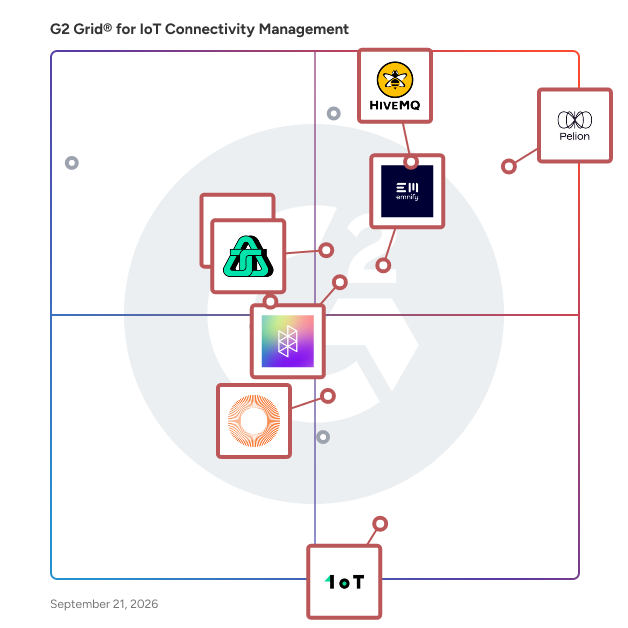
  # Best IoT Connectivity Management Software for Small Business

  *By [Bijou Barry](https://research.g2.com/insights/author/bijou-barry)*

   Products classified in the overall IoT Connectivity Management category are similar in many regards and help companies of all sizes solve their business problems. However, small business features, pricing, setup, and installation differ from businesses of other sizes, which is why we match buyers to the right Small Business IoT Connectivity Management to fit their needs. Compare product ratings based on reviews from enterprise users or connect with one of G2&#39;s buying advisors to find the right solutions within the Small Business IoT Connectivity Management category.

In addition to qualifying for inclusion in the IoT Connectivity Management Software category, to qualify for inclusion in the Small Business IoT Connectivity Management Software category, a product must have at least 10 reviews left by a reviewer from a small business.


  ## How Many IoT Connectivity Management Software Products Does G2 Track?
**Total Products under this Category:** 54

  
## How Does G2 Rank IoT Connectivity Management Software Products?

**Why You Can Trust G2's Software Rankings:**

- 30 Analysts and Data Experts
- 800+ Authentic Reviews
- 54+ Products
- Unbiased Rankings

G2's software rankings are built on verified user reviews, rigorous moderation, and a consistent research methodology maintained by a team of analysts and data experts. Each product is measured using the same transparent criteria, with no paid placement or vendor influence. While reviews reflect real user experiences, which can be subjective, they offer valuable insight into how software performs in the hands of professionals. Together, these inputs power the G2 Score, a standardized way to compare tools within every category.


---

**Sponsored**

### Onomondo

Onomondo is an IoT connectivity platform that turns telecom complexity into clarity. Our cloud native core unifies 600+ carrier networks, delivering M2M connectivity with NB-IoT, LTE-M, and traditional cellular technologies across 180+ countries through one API and platform. Our global IoT SIMs connect devices in logistics, automotive, energy, and beyond, with use cases from EV chargers to asset tracking. With real-time diagnostics and simple data routing, teams can identify issues in minutes and launch at scale. From the first prototype to a global fleet, Onomondo keeps infrastructure invisible so innovators can focus on building. IoT SIMs Efficiently deploy one SIM, APN, and SKU. Save time and effort on configuring and inventory management. Coverage Create coverage maps exactly where you need them. With non-steered SIMs, connect devices to over 650+ networks in 180+ countries. Platform Control and monitor your entire IoT fleet with our powerful platform, featuring real-time insights. Insights Quickly fix issues and keep devices online. Access the data you need to solve problems with our powerful network insight tools.


[Visit website](https://www.g2.com/external_clickthroughs/record?secure%5Bad_program%5D=ppc&amp;secure%5Bad_slot%5D=category_product_list&amp;secure%5Bcategory_id%5D=2310&amp;secure%5Bdisplayable_resource_id%5D=2310&amp;secure%5Bdisplayable_resource_type%5D=Category&amp;secure%5Bmedium%5D=sponsored&amp;secure%5Bplacement_reason%5D=page_category&amp;secure%5Bplacement_resource_ids%5D%5B%5D=2310&amp;secure%5Bprioritized%5D=false&amp;secure%5Bproduct_id%5D=139341&amp;secure%5Bresource_id%5D=2310&amp;secure%5Bresource_type%5D=Category&amp;secure%5Bsource_type%5D=category_page&amp;secure%5Bsource_url%5D=https%3A%2F%2Fwww.g2.com%2Fcategories%2Fiot-connectivity-management%2Fsmall-business&amp;secure%5Btoken%5D=01251a5074c4a655c07d98cc1198998b357ace6b64022b1da1d69b20217a0779&amp;secure%5Burl%5D=https%3A%2F%2Fwww.onomondo.com%2F&amp;secure%5Burl_type%5D=company_website)

---

  ## What Are the Top-Rated IoT Connectivity Management Software Products in 2026?
### 1. [Pelion IoT Connectivity](https://www.g2.com/products/pelion-iot-connectivity/reviews)
  Pelion: Global IoT Connectivity Made Effortless What is Pelion? Pelion helps customers rapidly deploy, connect, secure and manage IoT Connectivity for operations of any scale or use case. With Pelion’s market leading eSIM eUICC technology you can experience flexible and seamless multi carrier access with one SIM spanning 600+ networks in over 150 countries. Pelion offers you the best network access and the best data rates, across the most reliable mobile networks globally. Providing greater visibility and control of every single eSIM connection across your estate with our scalable and simple-to-use management platform. By combining the best in connectivity, software and services Pelion empowers ambitious businesses in energy, e-mobility, manufacturing, transportation, retail and healthcare to deploy faster, reduce costs, mitigate risk and simplify operations.


  **Average Rating:** 4.3/5.0
  **Total Reviews:** 145
**How Do G2 Users Rate Pelion IoT Connectivity?**

- **Quality of Support:** 8.5/10 (Category avg: 9.3/10)
- **Account Alerts:** 8.0/10 (Category avg: 8.6/10)
- **Cost Analytics:** 8.0/10 (Category avg: 8.7/10)
- **Available Bandwidth:** 8.3/10 (Category avg: 8.9/10)

**Who Is the Company Behind Pelion IoT Connectivity?**

- **Seller:** [Pelion](https://www.g2.com/sellers/pelion)
- **Company Website:** https://pelion.com/
- **Year Founded:** 2002
- **HQ Location:** Glasgow, Scotland, United Kingdom
- **Twitter:** @PelionIoT (184 Twitter followers)
- **LinkedIn® Page:** https://www.linkedin.com/company/pelioniot/ (126 employees on LinkedIn®)

**Who Uses This Product?**
  - **Top Industries:** Information Technology and Services, Transportation/Trucking/Railroad
  - **Company Size:** 43% Small-Business, 28% Mid-Market


#### What Are Pelion IoT Connectivity's Pros and Cons?

**Pros:**

- Ease of Use (51 reviews)
- Customer Support (50 reviews)
- Network Connectivity (47 reviews)
- IoT Connectivity (40 reviews)
- Easy Setup (34 reviews)

**Cons:**

- SIM Issues (36 reviews)
- Poor Support (23 reviews)
- Technical Issues (21 reviews)
- SIM Management Issues (20 reviews)
- Technical Difficulties (19 reviews)

### 2. [emnify](https://www.g2.com/products/emnify/reviews)
  emnify is a global connectivity platform built for IoT By operating our own cloud-native mobile core and connectivity management platform, we give you full control to manage and secure connectivity for your devices anywhere in the world.


  **Average Rating:** 4.9/5.0
  **Total Reviews:** 88
**How Do G2 Users Rate emnify?**

- **Quality of Support:** 9.8/10 (Category avg: 9.3/10)
- **Account Alerts:** 9.1/10 (Category avg: 8.6/10)
- **Cost Analytics:** 9.4/10 (Category avg: 8.7/10)
- **Available Bandwidth:** 9.4/10 (Category avg: 8.9/10)

**Who Is the Company Behind emnify?**

- **Seller:** [emnify](https://www.g2.com/sellers/emnify)
- **Company Website:** https://www.emnify.com
- **Year Founded:** 2014
- **HQ Location:** Berlin
- **Twitter:** @EMnify (825 Twitter followers)
- **LinkedIn® Page:** https://www.linkedin.com/company/emnify/ (182 employees on LinkedIn®)

**Who Uses This Product?**
  - **Who Uses This:** CEO, CTO
  - **Top Industries:** Automotive, Farming
  - **Company Size:** 71% Small-Business, 20% Mid-Market


### 3. [Hologram](https://www.g2.com/products/hologram/reviews)
  Own your IoT deployment with Hologram&#39;s cellular SIM cards and easy-to-use monitoring dashboard. Our seamless, global coverage, multi-carrier network and support specialists are here to help you connect and manage your IoT devices. Our flexible pricing plans are designed to get you off the ground. Focus on scaling your fleet and managing your devices without any additional carrier negotiations, integrations, or hardware swaps. Test drive Hologram with a pilot IoT SIM and get connected in under a week.


  **Average Rating:** 4.5/5.0
  **Total Reviews:** 62
**How Do G2 Users Rate Hologram?**

- **Quality of Support:** 8.0/10 (Category avg: 9.3/10)
- **Account Alerts:** 8.2/10 (Category avg: 8.6/10)
- **Cost Analytics:** 8.0/10 (Category avg: 8.7/10)
- **Available Bandwidth:** 8.9/10 (Category avg: 8.9/10)

**Who Is the Company Behind Hologram?**

- **Seller:** [Hologram](https://www.g2.com/sellers/hologram)
- **Company Website:** https://hologram.io
- **Year Founded:** 2013
- **HQ Location:** Chicago, US
- **Twitter:** @Hologram_io (26 Twitter followers)
- **LinkedIn® Page:** https://www.linkedin.com/company/3293837/ (71 employees on LinkedIn®)

**Who Uses This Product?**
  - **Who Uses This:** CEO
  - **Top Industries:** Farming, Transportation/Trucking/Railroad
  - **Company Size:** 70% Small-Business, 29% Mid-Market


#### What Are Hologram's Pros and Cons?

**Pros:**

- API Integration (1 reviews)
- Custom Dashboards (1 reviews)
- Customer Support (1 reviews)
- Documentation Quality (1 reviews)
- Efficient Solutions (1 reviews)

**Cons:**

- Limited Customization (1 reviews)
- Limited Features (1 reviews)

### 4. [Telnyx IoT](https://www.g2.com/products/telnyx-iot/reviews)
  Telnyx IoT provides secure, global connectivity solutions for IoT devices, simplifying the challenge of bringing smart devices online from anywhere. Leveraging the power of a secure virtual private mobile and IP network in the cloud, Telnyx IoT offers flexible data coverage across 180+ countries through a single SIM, catering to a diverse range of IoT applications. Telnyx IoT SIM cards are eUICC enabled and available in various forms including triple-size plastic SIM cards, eSIM chips (embedded MFF2), and over-the-air eSIMs. A single Telnyx SIM connects devices to over 650 networks (4G LTE, 3G, 2G, and LTE-M) worldwide, including all major carriers in the United States. Intelligent network switching allows automatic and seamless failover to the best carrier, ensuring maximum uptime for connected devices.The service offers pay-as-you-go pricing, starting at $0.0125 per MB, and includes options for private LTE networks and public static IP addresses. For managing IoT deployments, Telnyx provides a portal and APIs for easy control and monitoring of SIM fleets, including activation and deactivation, setting data limits, network priorities, and more. For more information, visit https://telnyx.com/products/iot-sim-card .


  **Average Rating:** 4.6/5.0
  **Total Reviews:** 69
**How Do G2 Users Rate Telnyx IoT?**

- **Quality of Support:** 8.8/10 (Category avg: 9.3/10)
- **Account Alerts:** 8.8/10 (Category avg: 8.6/10)
- **Cost Analytics:** 8.3/10 (Category avg: 8.7/10)
- **Available Bandwidth:** 8.6/10 (Category avg: 8.9/10)

**Who Is the Company Behind Telnyx IoT?**

- **Seller:** [Telnyx](https://www.g2.com/sellers/telnyx)
- **Year Founded:** 2009
- **HQ Location:** 600 Congress Avenue 14th Floor Austin, TX 78701
- **Twitter:** @telnyx (4,352 Twitter followers)
- **LinkedIn® Page:** https://www.linkedin.com/company/3349412/ (367 employees on LinkedIn®)

**Who Uses This Product?**
  - **Top Industries:** Information Technology and Services, Telecommunications
  - **Company Size:** 84% Small-Business, 14% Mid-Market


#### What Are Telnyx IoT's Pros and Cons?

**Pros:**

- Customer Support (4 reviews)
- Ease of Use (4 reviews)
- Affordable Pricing (2 reviews)
- Easy Setup (2 reviews)
- IoT Connectivity (2 reviews)

**Cons:**

- SIM Issues (2 reviews)
- SIM Management Issues (2 reviews)
- Expensive (1 reviews)
- High Pricing (1 reviews)
- Learning Curve (1 reviews)

### 5. [HiveMQ](https://www.g2.com/products/hivemq/reviews)
  HiveMQ is the Industrial Data Platform helping enterprises move from connected devices to intelligent operations. Built on the MQTT standard and a distributed edge-to-cloud architecture, HiveMQ connects and governs industrial data in real time, enabling organizations to act with intelligence. With proven reliability, scalability, and interoperability, HiveMQ provides the foundation industrial companies need to operationalize AI, powering the next generation of intelligent industry. Global leaders including Audi, BMW, Eli Lilly, Liberty Global, Mercedes-Benz, and Siemens trust HiveMQ to run their most mission-critical operations.


  **Average Rating:** 4.5/5.0
  **Total Reviews:** 84
**How Do G2 Users Rate HiveMQ?**

- **Quality of Support:** 9.0/10 (Category avg: 9.3/10)
- **Account Alerts:** 9.3/10 (Category avg: 8.6/10)
- **Cost Analytics:** 9.3/10 (Category avg: 8.7/10)
- **Available Bandwidth:** 8.7/10 (Category avg: 8.9/10)

**Who Is the Company Behind HiveMQ?**

- **Seller:** [HiveMQ](https://www.g2.com/sellers/hivemq)
- **Company Website:** https://www.hivemq.com/
- **Year Founded:** 2012
- **HQ Location:** Landshut, Bayern
- **Twitter:** @HiveMQ (2,848 Twitter followers)
- **LinkedIn® Page:** https://www.linkedin.com/company/2949784 (170 employees on LinkedIn®)

**Who Uses This Product?**
  - **Top Industries:** Computer Software, Information Technology and Services
  - **Company Size:** 45% Mid-Market, 38% Small-Business


#### What Are HiveMQ's Pros and Cons?

**Pros:**

- Reliability (20 reviews)
- Features (18 reviews)
- Monitoring (14 reviews)
- Efficiency Improvement (11 reviews)
- Customer Support (10 reviews)

**Cons:**

- Expensive (17 reviews)
- Difficult Learning (9 reviews)
- Usability Issues (9 reviews)
- Technical Issues (7 reviews)
- UX Improvement (4 reviews)

### 6. [Eseye](https://www.g2.com/products/eseye/reviews)
  As a world leader in IoT connectivity solutions, Eseye helps customers to realise lasting value from global IoT projects. We bring the deep device expertise needed to integrate, manage and optimise IoT connectivity for estates of any scale or complexity. Then seamlessly connect these devices across 190 countries and more than 800 networks. All with near-100% uptime. We see IoT differently. We always start with the device – getting this right is the key to success. Together, we define what good looks like, then build a custom roadmap to deliver IoT right first time. We help customers to navigate every step, from idea to implementation and beyond. This is future-proofed IoT, built on decades of end-to-end delivery for the likes of Amazon, Shell and Costa Coffee. Nobody does IoT better.


  **Average Rating:** 4.4/5.0
  **Total Reviews:** 27
**How Do G2 Users Rate Eseye?**

- **Quality of Support:** 9.3/10 (Category avg: 9.3/10)
- **Account Alerts:** 8.1/10 (Category avg: 8.6/10)
- **Cost Analytics:** 7.5/10 (Category avg: 8.7/10)
- **Available Bandwidth:** 7.9/10 (Category avg: 8.9/10)

**Who Is the Company Behind Eseye?**

- **Seller:** [Eseye](https://www.g2.com/sellers/eseye)
- **Year Founded:** 2007
- **HQ Location:** Guildford, GB
- **Twitter:** @eseyeM2M (2,444 Twitter followers)
- **LinkedIn® Page:** https://www.linkedin.com/company/eseye/ (116 employees on LinkedIn®)

**Who Uses This Product?**
  - **Company Size:** 59% Small-Business, 22% Enterprise


### 7. [Onomondo](https://www.g2.com/products/onomondo/reviews)
  Onomondo is an IoT connectivity platform that turns telecom complexity into clarity. Our cloud native core unifies 600+ carrier networks, delivering M2M connectivity with NB-IoT, LTE-M, and traditional cellular technologies across 180+ countries through one API and platform. Our global IoT SIMs connect devices in logistics, automotive, energy, and beyond, with use cases from EV chargers to asset tracking. With real-time diagnostics and simple data routing, teams can identify issues in minutes and launch at scale. From the first prototype to a global fleet, Onomondo keeps infrastructure invisible so innovators can focus on building. IoT SIMs Efficiently deploy one SIM, APN, and SKU. Save time and effort on configuring and inventory management. Coverage Create coverage maps exactly where you need them. With non-steered SIMs, connect devices to over 650+ networks in 180+ countries. Platform Control and monitor your entire IoT fleet with our powerful platform, featuring real-time insights. Insights Quickly fix issues and keep devices online. Access the data you need to solve problems with our powerful network insight tools.


  **Average Rating:** 4.8/5.0
  **Total Reviews:** 20
**How Do G2 Users Rate Onomondo?**

- **Quality of Support:** 9.6/10 (Category avg: 9.3/10)
- **Account Alerts:** 8.1/10 (Category avg: 8.6/10)
- **Cost Analytics:** 8.1/10 (Category avg: 8.7/10)
- **Available Bandwidth:** 8.8/10 (Category avg: 8.9/10)

**Who Is the Company Behind Onomondo?**

- **Seller:** [Onomondo](https://www.g2.com/sellers/onomondo)
- **Year Founded:** 2012
- **HQ Location:** Copenhagen, DK
- **Twitter:** @onomondo (307 Twitter followers)
- **LinkedIn® Page:** https://www.linkedin.com/company/onomondo (111 employees on LinkedIn®)

**Who Uses This Product?**
  - **Top Industries:** Information Technology and Services
  - **Company Size:** 80% Small-Business, 20% Mid-Market


#### What Are Onomondo's Pros and Cons?

**Pros:**

- Ease of Use (4 reviews)
- API Integration (2 reviews)
- Easy Integrations (2 reviews)
- Features (2 reviews)
- Simple (2 reviews)

**Cons:**

- Limited Features (2 reviews)
- Expensive (1 reviews)
- SIM Issues (1 reviews)
- Technical Issues (1 reviews)

### 8. [Datablaze Voyager](https://www.g2.com/products/datablaze-voyager/reviews)
  Voyager by Datablaze is a highly scalable solution for SMB and large enterprises looking to manage their IoT deployments. The platform&#39;s real-time IoT data dashboard offers powerful capabilities such as data connection determination, user identification, and real-time wireless connectivity usage tracking across multiple carriers. Additionally, Voyager allows for the management of IoT hardware in the field, scheduling of alerts and notifications, location-based mapping and reporting, and sensor monitoring. With its consolidated invoice calculation, and multi-tenant billing capabilities, Voyager streamlines the billing process for global wireless deployments, all from a single user interface. For more information visit datablaze.com.


  **Average Rating:** 4.8/5.0
  **Total Reviews:** 17
**How Do G2 Users Rate Datablaze Voyager?**

- **Quality of Support:** 10.0/10 (Category avg: 9.3/10)
- **Account Alerts:** 10.0/10 (Category avg: 8.6/10)
- **Cost Analytics:** 9.7/10 (Category avg: 8.7/10)
- **Available Bandwidth:** 10.0/10 (Category avg: 8.9/10)

**Who Is the Company Behind Datablaze Voyager?**

- **Seller:** [Datablaze](https://www.g2.com/sellers/datablaze)
- **Year Founded:** 2002
- **HQ Location:** Eagle, US
- **Twitter:** @datablazeIoT (44 Twitter followers)
- **LinkedIn® Page:** https://www.linkedin.com/company/2464854 (22 employees on LinkedIn®)

**Who Uses This Product?**
  - **Company Size:** 71% Small-Business, 24% Mid-Market


### 9. [1oT](https://www.g2.com/products/1ot/reviews)
  1oT is your one-stop shop for global IoT connectivity. We combine everything that&#39;s needed to run a global IoT company - 1 SIM card for your global IoT deployments, 1 platform to manage SIM cards and connectivity, and 1 invoice for all the SIMs, wherever they are. 1oT Terminal is a self-service platform for managing global IoT deployments from one interface. Its base features offer full control over your SIMs, and customizable premium features help you save money and simplify fleet management. Our SIMs are used in 2.5 million IoT devices in 173 countries. Go global with a single connectivity partner - 1oT.


  **Average Rating:** 4.7/5.0
  **Total Reviews:** 22
**How Do G2 Users Rate 1oT?**

- **Quality of Support:** 9.9/10 (Category avg: 9.3/10)
- **Account Alerts:** 7.8/10 (Category avg: 8.6/10)
- **Cost Analytics:** 8.5/10 (Category avg: 8.7/10)
- **Available Bandwidth:** 9.2/10 (Category avg: 8.9/10)

**Who Is the Company Behind 1oT?**

- **Seller:** [1oT](https://www.g2.com/sellers/1ot)
- **Year Founded:** 2016
- **HQ Location:** Tallinn, EE
- **Twitter:** @1ot_mobi (306 Twitter followers)
- **LinkedIn® Page:** https://www.linkedin.com/company/10687229 (37 employees on LinkedIn®)

**Who Uses This Product?**
  - **Company Size:** 74% Small-Business, 17% Mid-Market


#### What Are 1oT's Pros and Cons?

**Pros:**

- Customer Support (1 reviews)
- Easy Integrations (1 reviews)
- Efficient Solutions (1 reviews)
- IoT Connectivity (1 reviews)
- Network Connectivity (1 reviews)

**Cons:**

- SIM Issues (1 reviews)
- Technical Difficulties (1 reviews)


    ## What Is IoT Connectivity Management Software?
  [IoT Management Platforms](https://www.g2.com/categories/iot-management)
  ## What Software Categories Are Similar to IoT Connectivity Management Software?
    - [IoT Platforms](https://www.g2.com/categories/iot-platforms)
    - [IoT Device Management Platforms](https://www.g2.com/categories/iot-device-management-platforms)
    - [Industrial IoT Software](https://www.g2.com/categories/industrial-iot)

  
---

## How Do You Choose the Right IoT Connectivity Management Software?

### What You Should Know About IoT Connectivity Management Software

### What is IoT Connectivity Management Software?

For an internet of things (IoT) project to work as planned, smart devices require internet connectivity and data plans, just as our computers and phones do. These unique connections will entail data limits, subscription lengths, and various associated costs. They will also require close monitoring to ensure connections remain strong and data is transferred without delay or interruption. IoT connectivity management software provides IT teams with real-time insights into these network connections and data plans, allowing for convenient updates and modifications wherever necessary.

IoT connectivity management is closely related to [IoT device management software](https://www.g2.com/categories/iot-device-management), which offers a comprehensive view of the devices in an IoT ecosystem and real-time information about their overall health and status. These solutions also assist with over-the-air (OTA) firmware updates and patches as well as analytics such as performance and resource usage. IoT connectivity management addresses the connectivity services that are enabling these devices to exchange real-time data, which may involve any number of different subscribers and service providers. The platforms in this category may provide features for lifecycle management of subscriber identity modules (SIMs), including activation and plan renewals. A number of solutions provide some overlap between IoT connectivity management and IoT device management, allowing users to manage IoT devices and connections from a single, unified source. In other cases, these functions are handled with standalone solutions.

Key Benefits of IoT Connectivity Management Software

- Track the entirety of subscribers and data subscription plans across a fleet of connected devices
- Monitor data usage and remaining limits of device to help adjust processes, device activity, or plans as needed
- Activate, renew, modify, or cancel IoT data subscriptions conveniently for individual devices or groups of devices
- Diagnose wireless connectivity issues involving IoT hardware proactively to minimize downtime and optimize performance wherever possible

### Why Use IoT Connectivity Management Software?

Businesses and consumers alike are increasingly realizing the benefits of connected devices each day. A business can oversee a deployment of a small number of IoT devices or thousands of devices across the world. Whatever the details may be, the assigned network operators in charge of these applications will need to ensure that each device and its containing IoT hardware is properly connected to a network (e.g., 5G, NB-IoT, LTE-M), and is transmitting data at the desired level. This may entail one or more subscription plans for wireless connectivity, along with continuous monitoring of costs, available resources, and plan details. The connectivity solutions in this category provide a centralized view of this information as well as the ability to modify data subscriptions and SIM card activations. By leveraging this technology, teams can ensure that IoT projects remain online and functioning in the intended ways, while keeping costs and data consumption at a manageable level across the enterprise.

Some companies may launch an IoT deployment but allow distributed teams, external businesses, or individual users to manage certain pools of devices based on proximity or specific use cases. In these situations, the network or platform administrator can use connectivity management tools to maintain control over the connectivity lifecycle, including subscription management and real-time reporting on device data consumption. The solutions in this category may also assist with managing costs associated with data contracts, including plan activations and renewals as well as data overages or limit adjustments. If there are any efforts to monetize the IoT applications with customer subscription models, businesses may be able to utilize these platforms to deploy subscription models and launch end-user billing functionalities. These efforts can generate new revenue streams for the business, while the project continues to optimize and modernize operations in various other ways.

### Who Uses IoT Connectivity Management Software?

Depending on the size and scope of a company’s IoT initiative, it may involve any number of specialists across the enterprise as well as third-party assistance during the design, implementation, or ongoing maintenance of the project. Still, there may be different users of this technology depending on the company or the circumstances of the project. IT departments or dedicated IoT experts may be the likely users of IoT connectivity management tools, helping to manage these advanced devices, their data subscription plans, and the consumption of data across these fleets. Roles like IoT engineer, IoT platform architect, and IoT project manager are becoming increasingly common as enterprise companies allocate greater resources to building and managing smart devices and device applications. Working with an [IoT consulting services provider](https://www.g2.com/categories/iot-consulting-services) can help teams determine the necessary steps in launching the business’ IoT project, achieving and maintaining connectivity across the fleet, and assigning the associated responsibilities to those best suited for the job. Consultants can also help recommend the right software and hardware solutions as well as the network and cloud services providers who can help power the project.

### IoT Connectivity Management Software Features

The solutions in this emerging category offer unique sets of capabilities that assist with activating, monitoring, and modifying the network connections of IoT devices. In some cases, IoT connectivity management platforms may be packaged with IoT data service plans or SIM card packages from mobile network operators. In other cases, these tools are offered as standalone solutions but may provide integrations with different network providers, types of networks, and SIM cards. The following are some common features associated with the diverse offerings in this category:

**SIM management —** SIM cards, much like those in mobile devices, are what allow embedded smart devices in an IoT project to communicate with the network and with each other. Remote devices in an IoT architecture will often contain both smart sensors and SIM cards to enable the full range of functionality and connectivity required of advanced IoT apps. IoT connectivity management tools may offer assistance with managing the complete lifecycle of SIMs, from initial activation to their eventual retirement, while some tools assist with certain aspects of these business processes. Users may be able to view a real-time dashboard of all the SIM cards being utilized in an IoT fleet, along with identifying information and activation status.

In addition to general management of SIMs, some products offer security features to help protect this hardware from unwanted access or modifications. With certain tools, users can lock SIMs on specific devices to prevent unauthorized usage and even encrypt communication between embedded devices and corresponding IoT applications. Using these solutions in tandem with [IoT security software](https://www.g2.com/categories/iot-security) can help businesses secure IoT projects from the many threats they might be vulnerable to, including data theft, malware, and rogue control of devices. It’s important to consider the security implications of bringing physical devices to the cloud when planning an IoT initiative.

**Subscription lifecycle management —** Along with general tracking and management of SIMs, IoT connectivity management tools may provide assistance with monitoring and managing service plans across both internal and customer-facing scenarios. Just as internet or mobile connectivity requires network subscriptions with a qualified provider, so do many implementations of smart technology and embedded device architectures. The solutions in this category may provide capabilities to assist with the subscriber lifecycle, including plan renewals, cancellations, and upgrades. These features may offer visibility into the terms of each subscription (e.g., data limits, contract terms) as well as assistance with adjusting plans directly on the platform. Some products also include features for deploying customer subscription models related to connected devices, both in B2B and B2C scenarios, along with tools for deactivating and restricting subscribers as needed.

**Consumption and cost monitoring —** When initiating an IoT connectivity scenario, businesses will establish certain data limits and associated costs for each device based on their expected tasks as part of the fleet and the budgets for the project. After these plans are activated, teams will need to keep a steady eye on device activity to ensure data consumption and its associated costs remain in line with projections and contract limits. If a device or set of devices is consuming more data than expected, it may require these subscription plans to be adjusted or device workflows to be reconsidered in order to reduce data usage and costs. The solutions in this category may offer features to help monitor these metrics, so teams can proactively address issues or make necessary changes before they cause issues. A number of tools allow users to configure alerts or notifications related to device usage, such as when data consumption approaches the defined limits of a subscription plan. Additionally, some tools provide diagnostics into SIMs and overall connectivity to help identify and fix issues in a timely fashion. If data usage or costs exceed the plan limits or allocated budgets, users can modify connectivity plans directly on these platforms. If the problems are more related to device distributions or workflows, teams will need to consider changes to their IoT infrastructure in addition to connectivity settings and service plans.

### Software and Services Related to IoT Connectivity Management Software

Any enterprise effort related to IoT devices and device connectivity will entail a significant investment of time and resources, from embedding the physical assets to designing the backend applications that will drive their intelligent functionality. The IoT industry is accelerating at an unprecedented rate to greet the demand surrounding IoT strategies. There are a wide variety of software and services that might go into a company’s own IoT projects, in addition to the physical hardware itself. The following are some common solutions businesses may consider when researching the connectivity solutions in this category.

[**IoT device management software**](https://www.g2.com/categories/iot-device-management) **—** Once an intelligent device is connected to the IoT network, the physical asset itself will require monitoring and maintenance, in addition to the data plans being used across these systems. IoT device management software provides a centralized view of connected device fleets, including location details and active status as part of the IoT infrastructure. Using these solutions, business teams are enabled to maintain real-time visibility over any and all devices being put to use in an IoT project, along with helpful metrics such as battery life and maintenance recommendations. A number of IoT device management tools allow for OTA updates to distributed assets, such as security patches of firmware updates. In some cases, users also leverage these tools to gain remote access to specific devices and execute device tasks when the need arises. Certain solutions include features of both IoT device management and IoT connectivity management, whereas others provide standalone capabilities and integrate with other tools to share data and perform the complete range of IoT-related tasks.

[**IoT platforms**](https://www.g2.com/categories/iot-platforms) **—** Embedding and connecting devices is only part of the battle when it comes to an IoT project. To uncover the benefits of these intelligent systems, such as inter-device communication and automated data generation, businesses need to design backend applications that lay out these workflows and instruct smart objects to trigger events or sync with other devices in the network. IoT platforms are a convenient way for teams to achieve these outcomes and build basic IoT applications that can power a fleet to work as intended. IoT platforms are designed for a mass user base and allow applications to be created with little or no coding experience. If businesses require more complex outcomes with an IoT application or want to create advanced features for an existing application, they can consider [IoT development tools](https://www.g2.com/categories/iot-development-tools) that offer integrated development environments (IDEs) in a number of modern programming languages. In the event that teams want to outsource the design or seek improvement of an IoT application, they may enlist the help of third-party [IoT developers](https://www.g2.com/categories/internet-of-things-iot-developers).

[**IoT analytics software**](https://www.g2.com/categories/iot-analytics) **—** One of the primary benefits of smart technology is the potential for unparalleled insights that can be generated by connected objects, from asset performance and health to business process and workforce analytics. IoT analytics software is designed to gather data from these distributed assets and draw actionable findings from these massive sets of unstructured data. In addition to this, users of this technology can perform advanced queries to find relevant information for timely data analytics. IoT analytics tools can be integrated with other data tools being used by the company, such as [database software](https://www.g2.com/categories/database-software) and [business intelligence software](https://www.g2.com/categories/business-intelligence), to securely store IoT data on the cloud and allow it to be shared and accessed as needed.

[**Managed IoT services**](https://www.g2.com/categories/managed-iot-services) **—** In a similar vein to IoT developers, managed IoT services providers help offload one or more tasks involved in a connected systems architecture. Working with external specialists can help businesses across industries to accelerate their IoT goals and maintain an operational fleet of smart devices without the need for a dedicated internal team. The services offered by these agencies might include fleet or network monitoring, device maintenance, and IoT analytics. These specialists may also be able to assist with connectivity management tasks, such as data limit monitoring and subscriber tracking. Businesses might also consider [IoT implementation services](https://www.g2.com/categories/iot-implementation-services) for help with the initial deploying and troubleshooting of these projects. Certain providers may offer comprehensive packages that assist with the complete lifecycle of an enterprise IoT initiative.

### IoT Connectivity Management FAQs

### Most Popular FAQs

#### Which IoT Connectivity Management software has the best reviews?

Based on overall reviewer sentiment around reliability, usability, and operational value, these platforms stand out most consistently in the category:

- [Pelion IoT Connectivity](https://www.g2.com/products/pelion-iot-connectivity/reviews) - A strong choice for teams that need broad carrier reach, centralized SIM control, and dependable fleet connectivity across regions.
- [HiveMQ](https://www.g2.com/products/hivemq/reviews) - Best for teams that care most about reliable, large-scale MQTT connectivity and real-time message flow across connected devices.
- [Aeris IoT Connectivity Management](https://www.g2.com/products/aeris-iot-connectivity-management/reviews) - A good fit for organizations that want centralized SIM visibility, stable connectivity, and workflow automation through APIs.
- [floLIVE](https://www.g2.com/products/flolive/reviews) - Worth considering for companies that need global deployment flexibility, multi-IMSI support, and strong partner responsiveness.

#### Who offers the best connectivity management IoT?

The strongest IoT connectivity vendors in this category tend to combine global network reach with practical day-to-day management capabilities and operational reliability. These providers stand out most clearly:

- [Pelion IoT Connectivity](https://www.g2.com/products/pelion-iot-connectivity/reviews) - Best for companies that want one platform to manage distributed SIM fleets and roaming-heavy deployments.
- [Aeris IoT Connectivity Management](https://www.g2.com/products/aeris-iot-connectivity-management/reviews) - A smart fit for teams that want visibility into usage, troubleshooting, and API-driven internal workflows.
- [floLIVE](https://www.g2.com/products/flolive/reviews)&amp;nbsp; - A strong option for global IoT rollouts that need local pricing logic and flexible multi-network coverage.
- [Console Connect](https://www.g2.com/products/console-connect/reviews) - Useful for organizations that care about global connectivity, reach, and service coordination across locations.

#### What’s the best IoT connectivity management platform for a mid size software company that needs global eSIM support?

Mid-sized software companies evaluating global eSIM support typically need a balance of international coverage, operational flexibility, and manageable platform complexity. These options are especially well-suited to that use case:

- [Pelion IoT Connectivity](https://www.g2.com/products/pelion-iot-connectivity/reviews)- Best for teams that need broad international coverage and proven support for managing connected fleets across networks.
- [floLIVE](https://www.g2.com/products/flolive/reviews) - A strong fit for companies that want multi-IMSI flexibility, local breakout options, and global deployment support.
- [Aeris IoT Connectivity Management](https://www.g2.com/products/aeris-iot-connectivity-management/reviews)&amp;nbsp; - A good option for mid-sized teams that want centralized visibility and API-based automation without losing operational control.
- [Onomondo](https://www.g2.com/products/onomondo/reviews) - Worth a look for teams that want simple SIM management, clean APIs, and a lighter-weight operational experience.

#### Which vendor has the most reliable IoT connectivity management software for tracking thousands of devices?

For large-scale device tracking, the most reliable platforms are typically those that combine uptime, scalability, and strong operational visibility. These vendors stand out in that regard:

- [HiveMQ](https://www.g2.com/products/hivemq/reviews) - Best for organizations that need highly reliable MQTT infrastructure and real-time telemetry flow at scale.
- [Pelion IoT Connectivity](https://www.g2.com/products/pelion-iot-connectivity/reviews) - A dependable choice for teams managing large device fleets across multiple operators and geographies.
- [Hologram](https://www.g2.com/products/hologram/reviews) - A good fit for businesses that want stable IoT SIM connectivity with an approachable management layer.
- [Eseye](https://www.g2.com/products/eseye/reviews) - Worth considering for teams that need enterprise-grade cellular IoT coverage and resilient fleet connectivity.

#### Which industry uses IoT the most?

Manufacturing remains the industry most closely associated with large-scale IoT adoption, largely because connected operations, predictive maintenance, and plant-level monitoring deliver clear and measurable operational returns. In the context of connectivity management, you also see strong relevance across software, telecommunications, transportation, and electronics-related industries, where always-on device visibility and cross-region connectivity are mission-critical.

### Small Business FAQs

#### What is the most affordable IoT Connectivity Management for SMBs?

For SMBs, affordability usually means more than low entry pricing. The best-value platforms are those that keep deployment simple, reduce management overhead, and deliver the core capabilities smaller teams actually need. These options stand out most clearly for that balance:

- [Telnyx IoT](https://www.g2.com/products/telnyx-iot/reviews) - A strong fit for SMBs that want flexible IoT connectivity with simple deployment and value-oriented pricing.
- [Onomondo](https://www.g2.com/products/onomondo/reviews) - Best for small teams that want an intuitive SIM management experience and clean API access.
- [Hologram](https://www.g2.com/products/hologram/reviews) - A practical choice for SMBs that need reliable connectivity and a management layer that stays approachable as they grow.

#### What is the best IoT Connectivity Management for startups?

Startups typically need an IoT connectivity platform that can be implemented quickly, managed by a lean team, and scaled without adding operational complexity too early. These platforms are particularly well-suited for that environment:

- [Hologram](https://www.g2.com/products/hologram/reviews) - Best for startups that want a straightforward setup, solid support, and quick time to value.
- [Onomondo](https://www.g2.com/products/onomondo/reviews) - A strong option for startup teams that want a modern API-led way to manage SIM fleets.
- [Telnyx IoT](https://www.g2.com/products/telnyx-iot/reviews)&amp;nbsp; - A good fit for startups that care about ease of use, fast provisioning, and flexible deployment.
- [floLIVE](https://www.g2.com/products/flolive/reviews)- Worth considering when a startup needs global ambition from day one rather than a local-first rollout.

#### Which IoT Connectivity Management is the most user-friendly for startups?

For startups, usability matters most when the product can be deployed quickly, administered without specialized telecom expertise, and understood by a small team without extensive training. These platforms are the strongest fits for that standard:

- [Hologram](https://www.g2.com/products/hologram/reviews)- Best for startups that want an accessible interface and dependable support without much ramp time.
- [Onomondo](https://www.g2.com/products/onomondo/reviews)&amp;nbsp; - A strong fit for teams that want simple SIM controls and API-driven workflows that feel lightweight.
- [Telnyx IoT](https://www.g2.com/products/telnyx-iot/reviews) - A good choice for startups that want easy setup and a clean operational experience.
- [Aeris IoT Connectivity Management](https://www.g2.com/products/aeris-iot-connectivity-management/reviews)&amp;nbsp; - Worth a look for teams that want a user-friendly dashboard with room to grow into more advanced management.

#### Why do startups outgrow manual SIM and carrier management faster than they expect?

Startups usually outgrow manual connectivity processes as soon as devices begin to spread across different regions, carriers, and customer environments. At that stage, the problem shifts from basic connectivity to operational coordination. Visibility, usage control, troubleshooting speed, and workflow automation become much more important once exceptions start piling up and the team can no longer manage the program through ad hoc processes.

#### When should a small business move from a basic carrier setup to a dedicated IoT connectivity platform?

A small business should start considering a dedicated IoT connectivity platform when device volume, roaming requirements, or customer service expectations begin creating operational strain. At that point, the value of a specialized platform comes from centralized usage monitoring, easier troubleshooting, stronger network redundancy, and fewer manual handoffs between internal teams and support partners.

### Enterprise FAQs

#### What is the best-rated IoT Connectivity Management for tech enterprises?

Enterprise buyers in technology tend to prioritize scale, governance, and international deployment readiness over simplicity alone. Based on those needs, these platforms stand out as the strongest enterprise-oriented options in the category:

- [Pelion IoT Connectivity](https://www.g2.com/products/pelion-iot-connectivity/reviews)- A strong enterprise option for global SIM orchestration, roaming-heavy fleets, and multi-operator deployments.
- [HiveMQ](https://www.g2.com/products/hivemq/reviews) - Best for tech enterprises that need resilient MQTT infrastructure and reliable message delivery at very high volume.
- [Console Connect](https://www.g2.com/products/console-connect/reviews) - A good fit for enterprises that care about worldwide network reach and coordinated support across regions.
- [Aeris IoT Connectivity Management](https://www.g2.com/products/aeris-iot-connectivity-management/reviews)&amp;nbsp; - Worth considering for enterprises that want centralized visibility with internal-system integration through APIs.

#### What is the most reliable IoT Connectivity Management tool for enterprises?

Enterprise buyers usually define reliability in terms of stable connectivity, global resilience, responsive support, and consistent performance as deployments scale. These platforms earn the strongest recognition on that front:

- [HiveMQ](https://www.g2.com/products/hivemq/reviews)&amp;nbsp; - Best for enterprises that need dependable device messaging and clustering under heavy load.
- [Pelion IoT Connectivity](https://www.g2.com/products/pelion-iot-connectivity/reviews) - A strong choice for enterprises that need consistent connectivity across countries and operator relationships.
- [floLIVE](https://www.g2.com/products/flolive/reviews) - A smart fit for enterprises that need network redundancy and flexible global connectivity design.
- [Console Connect](https://www.g2.com/products/console-connect/reviews)&amp;nbsp; - Useful for enterprises managing geographically distributed network and connectivity requirements.

#### What is the best-reviewed IoT Connectivity Management for enterprise app integration?

For enterprises, app integration matters most when connectivity data needs to feed internal operations, monitoring systems, and product infrastructure. These platforms stand out for that type of integration-oriented use case:

- [Aeris IoT Connectivity Management](https://www.g2.com/products/aeris-iot-connectivity-management/reviews)&amp;nbsp; - Best for enterprises that want API-based workflow automation tied directly to internal operations.
- [HiveMQ](https://www.g2.com/products/hivemq/reviews) - A strong option for teams integrating IoT message streams into cloud, data, and application stacks.
- [Onomondo](https://www.g2.com/products/onomondo/reviews) - A good fit for enterprises that want simple API-led SIM management and integration flexibility.
- [Hologram](https://www.g2.com/products/hologram/reviews) - Worth considering for enterprises that value API access and custom dashboard possibilities.

#### How do enterprises keep global IoT deployments manageable across regions and operators?

The most effective enterprise strategy is to centralize SIM lifecycle management, maintain carrier flexibility, monitor usage continuously, and build escalation processes that don’t depend on local workarounds. Once an organization is operating across multiple countries and operators, the most successful approach is typically the one that combines network redundancy, fleet visibility, and clear operational ownership within a single management framework.

#### Why do enterprises need eSIM orchestration and network redundancy in IoT?

Enterprises generally need eSIM orchestration and network redundancy because both functions serve as core operational safeguards rather than optional enhancements. eSIM orchestration gives teams the flexibility to adapt carrier strategy over time, while redundancy reduces the risk that a single-network dependency could disrupt business-critical operations as fleets expand across international markets and more complex deployment environments.

**Last updated on April 24, 2026**


