Best IoT Development Tools

Bijou Barry
BB
Researched and written by Bijou Barry

IoT development tools are software development solutions specifically targeted to developers building IoT applications. These tools may include integrated development environments (IDEs), command line interface (CLIs), software development kits (SDKs), libraries and frameworks of code, or APIs that are tailored to IoT developers. IoT developers can use these tools when building web, mobile, and device applications. IoT development tools may be used on top of IoT platforms when building IoT applications, or in conjunction with IoT device management software.

To qualify for inclusion in the IoT Development Tools category, a product must:

Provide assistance to developers when specifically building IoT applications
Be used separately or on top of an IoT platform
Show More
Show Less

Best IoT Development Tools At A Glance

Highest Performer:
Easiest to Use:
Top Trending:
Best Free Software:
Show LessShow More
Top Trending:
Best Free Software:

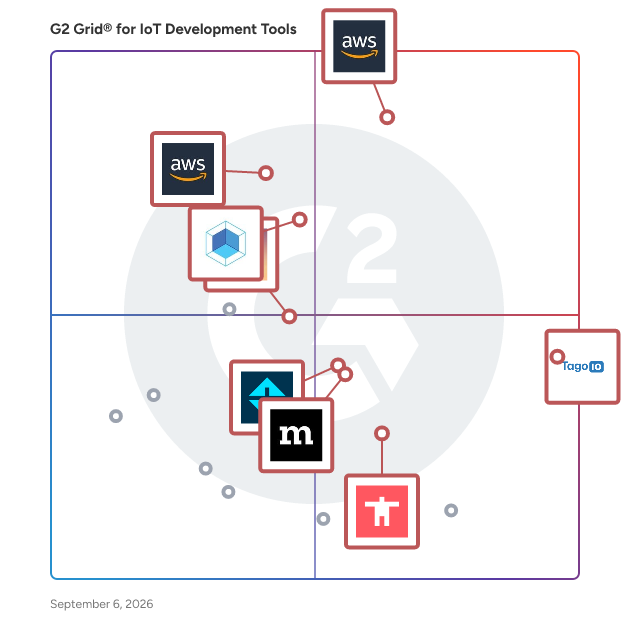
G2 takes pride in showing unbiased reviews on user satisfaction in our ratings and reports. We do not allow paid placements in any of our ratings, rankings, or reports. Learn about our scoring methodologies.

No filters applied
61 Listings in IoT Development Tools Available
(54)4.9 out of 5
1st Easiest To Use in IoT Development Tools software
Entry Level Price:Free
(107)4.3 out of 5
6th Easiest To Use in IoT Development Tools software
View top Consulting Services for AWS IoT
G2 Advertising
Sponsored
G2 Advertising
Get 2x conversion than Google Ads with G2 Advertising!
G2 Advertising places your product in premium positions on high-traffic pages and on targeted competitor pages to reach buyers at key comparison moments.
(66)4.4 out of 5
3rd Easiest To Use in IoT Development Tools software
Entry Level Price:Free
(195)4.5 out of 5
4th Easiest To Use in IoT Development Tools software
Entry Level Price:Contact Us
(28)4.6 out of 5
2nd Easiest To Use in IoT Development Tools software
Entry Level Price:Free

Learn More About IoT Development Tools

What are IoT Development Tools?

Internet of things (IoT) development tools are software development solutions that help developers build IoT applications. IoT developers can use these tools when building web, mobile, and device applications.

IoT development tools may be used on top of IoT platforms when building IoT applications or in conjunction with IoT device management tools. As IoT devices become more commonplace in business strategies, the benefits are quickly emerging across the board. This includes business analytics and insights, improved efficiency, and creating a greater customer experience. 

What Does IoT Stand For?

IoT stands for the internet of things. IoT, in broad terms, connects and shares data across billions of devices and physical objects over the internet. There are a wide variety of use cases and capabilities for IoT applications, devices, and solutions that will be further discussed below. 

What are the Common Features of IoT Development Tools?

The following are some core features within IoT development tools: 

Ease of use: IoT development systems often require more technical knowledge than no-code alternatives, but that does not mean they need to be difficult to use. IoT development tools can be simplified by adding features such as syntax highlighting, shortcuts, and completion aid automation. 

Integrations or APIs: An API is a software intermediary that allows two applications to communicate with each other. IoT development tools will often come prebuilt with libraries of APIs, or protocols that help simplify certain development outcomes. Using these APIs, users can streamline the process of connecting and deploying devices, saving time and energy from manual coding.

Help guides: As with many development tools and open-source tools, IoT development solutions will regularly provide documentation and help guides to assist with using the products to their fullest potential. These developer documents may provide information about product features, user commands, and general instructions for users. In some cases, documentation may provide detailed instruction for getting started, configuring different types of hardware, and troubleshooting, along with information about supported hardware and basic knowledge related to IoT technology and development. An integrated development environment (IDE) is a specific type of IoT software development for building applications that combines common developer tools into a single graphical user interface (GUI). Developers using the tools in this category will spend a significant amount of time writing and editing lines of code.

What are the Benefits of IoT Development Tools?

A few benefits of IoT development tools are listed below:

Programming: Programming enables developers to design IoT solutions using popular IoT programming languages such as Python, Node.js, and Java. IoT development systems provide the means for programming IoT applications. This gives users a blank canvas in which developers can design the ideal IoT ecosystem for their respective business scenarios. 

Expanded use cases: IoT development tools help expand existing IoT applications with unique functionalities and an increased range of connected devices. This includes building applications and improving integration with other IoT devices. 

Application development: IoT app development helps provide APIs, documentation guides, and open-source code in some cases to support developers and a wide variety of application development scenarios. 

Who Uses IoT Development Tools?

While some organizations are still developing their IoT capabilities, many forward-thinking organizations have created IoT-specific job positions. Some of the most common IoT focused titles include:

IoT developers: These individuals oversee the creation of devices or sensors, including programming software that allows devices to both connect with other systems and function properly on their own. Other responsibilities for IoT developers may include designing, coding, and testing features of products meant to connect to other devices.

IoT engineers: IoT engineers develop innovative services that help users receive, control, and manage information. They are also in charge of developing and managing a vast array of IoT devices, platforms, software, hardware, and systems through a combination of data, technology, and research.

IoT solutions architects: IoT solutions architects are involved in developing practical uses and applications of IoT technology. They typically work with engineers and salespeople to facilitate process development.

Challenges with IoT Development Tools

IoT development tools can come with their own set of challenges.

Security: IoT technology includes numerous connected devices. This connectivity makes IoT devices and IoT applications common targets for hackers. Individuals who utilize IoT applications should be educated on how to avoid falling for potential cybersecurity threats. 

IoT gateways: IoT gateways are key to the connectivity of IoT devices. Different devices can have different connectivity protocols: Bluetooth, Wi-Fi, serial ports, Zigbee, and have various energy profiles. Gateways are located between the connected devices, IoT sensors, and the cloud, so the entire IoT ecosystem depends on them.

Operating systems: Before starting IoT application development, several technical factors should be considered. First of all, the team has to evaluate the IoT devices they will work with. IoT devices generally have limited memory capacity. This means the developers have to choose the corresponding operating system. It should fit both the capabilities of the device and the requirements for its functionality.

Which Companies Should Buy IoT Development Tools?

For IoT development tools to be effective, organizations should have a base level of IoT infrastructure and applications already in existence at the organization. 

Companies with IoT infrastructure: Companies who already have made the upfront investment in IoT technology can quickly unlock the full potential of IoT development tools. They can even take advantage of more advanced IoT development solutions, such as IDEs or command-line interfaces. 

Companies with less IoT infrastructure: Companies with less IoT infrastructure should consider investing in technology such as IoT platforms or IoT device management to provide a foundation for the development tools. If not, they should consider less complex, no-code alternatives to IoT development tools. 

How to Buy IoT Development Tools

Requirements Gathering (RFI/RFP) for IoT Development Tools

As an emerging technology, IoT is a new area for many organizations. Before investing in IoT development tools, organizations should make the upfront investment to be prepared and ready to implement IoT applications. This includes potentially hiring developers and other key IoT-focused positions, as well as investing in any additional devices needed to support IoT development. 

Prioritization of requirements can aid the selection team in deciding what tool would best fit their company’s needs. Since IoT is an emerging technology, the development tools may change and develop over time. 

Compare IoT Development Tools Products

Create a long list

Before choosing an IoT software development solution, organizations should consider the use cases for their organization, as well as how they would like to access and deploy the tools. The size of the organization, as well as the scope of the organization, are all key factors to consider as well. Many IoT software development tools are open-source tools. Deployment preference should also be considered. Many IoT software development tools offer cloud platforms and cloud services options, such as PaaS. Companies should also consider the development platform involved, such as iOS, Android, or Raspberry Pi. 

Create a short list

As IoT continues to develop as a technology, companies considering acquiring IoT technology should be adaptable to future needs and developments. Scalability, customization, and personalization should all be considered when selecting a vendor from a short list. Many IoT software development tools are complex, and therefore companies should ensure that the product is user friendly for their IoT team. The software development process can be simplified potentially through real-time updates, courtesy of automation, artificial intelligence, and machine learning. 

Conduct demos

Before investing in an IoT software development tool, organizations must take the time to meet with vendors to test out the software development tool. In particular, organizations should ensure that the IoT software development tool involved is compatible with other products and upcoming projects. 

Selection of IoT Development Tools

Choose a selection team

Unlike IoT platforms, which have low code or no code, IoT software development systems are fairly complex and require an individual to have a background in the space. The selection team should therefore consist of IoT specialists, such as IoT developers, IoT engineers, and IoT solution architects. If an organization lacks these specialist roles, general software and application developers should be involved. 

Negotiation

Upon entering the negotiation stage, organizations should have a clear sense of the potential use cases they are hoping to solve with the IoT software development tool they are purchasing. They should have a short list of vendors who fit these use cases and can scale and grow in case additional business needs emerge. Pricing for IoT development tools will vary depending on the exact tool purchased, as well as the scale of IoT development projects. When purchasing these tools, it’s important to factor in any additional costs needed to acquire compatible IoT systems and resources. 

Final decision

If an organization has IoT specialists, the purchasing decision should be led and organized by them. These specialists would be the most informed members of the team and have the background knowledge to understand if the IoT software development tool is compatible with other IoT systems within the organization.