Learn More About AI Code Generation Software
AI code generation software encompasses tools that utilize artificial intelligence (AI) and machine learning (ML) to create and write code based on a user's prompt. This code is written based on the best practices for that particular coding language and a natural language description of the expected code.
In short, instead of manually typing out each line of code, the user gives the AI code generation tool a description of what they want the code to do. The software then uses ML and AI to write the code automatically based on user input.
Most tools are generalized, but some AI code generation tools are created for specific use cases, like game or web development. Developers use AI code generation software to reduce the time and effort spent on repetitive coding tasks. By incorporating these tools into their workflow, developers at all skill levels can improve code consistency and increase productivity. Plus, code generation tools can write code faster and in real time than a human programmer. They’re also more efficient because they can learn any technology or framework represented in their training dataset.
Additionally, this type of software makes coding more accessible to everyone, regardless of skill level or knowledge of programming languages. AI code generation platforms for non-engineers can help turn natural-language requirements into prototypes, although production applications still need technical review. Based on G2 reviews, buyers evaluate AI code generation software by comparing ease of use, development speed, code suggestions, and the effort required to review and correct generated output.
What are the common features of AI code generation software?
The following are some features of AI code generation software that companies can use to write lines of code on their behalf.
Note that specific features may vary between different products.
-
Automatic code generation: This allows the software to generate code snippets automatically, based on various parameters and details, which can reduce repetitive coding tasks and increase developer productivity.
-
Machine learning capabilities: Machine learning algorithms are used to improve code suggestions and generate more sophisticated and high-quality code snippets based on the context given by the user.
-
Natural language processing (NLP) integration: This feature allows the software to understand and process human language to generate code based on verbal or written descriptions.
-
Support for multiple programming languages: This enables the software to support various programming languages, such as Python, Javascript, Ruby, HTML, and PHP, making it versatile for different development scenarios.
-
Advanced debugging tools: AI-powered code generators often come with advanced debugging tools, which provide detailed insights into the performance of the generated programs. The code editor can also quickly detect errors and vulnerabilities in source code to help programmers identify potential problems before they become significant issues.
-
Code suggestions and autocompletion: This feature offers code completion suggestions to enhance existing code to help developers write more efficiently and learn syntax and functions of languages quickly.
What are the benefits of AI code generation software?
Whether you’re an experienced developer or a user new to the world of writing code, using AI code generation software has numerous benefits.
-
Faster development: These AI tools can drastically reduce the time and effort needed to write code, complete projects, and work on other repetitive tasks. Since AI coding tools speed up the process of writing code, this also means faster project turnovers.
-
Less task switching: AI code generators reduce the jumping back and forth between writing lines of code and free developers of the smaller tasks on their plate.
-
Boosts productivity: AI code generators streamline the development process for users, as developers can work faster and more efficiently. This saves time, resources, and money, and projects are completed sooner.
-
Frees up developers to work on larger, more complex projects: Since these coding assistants make the most of algorithms that can write code quickly and accurately, the developer is not required to do as much. This reduces the need for smaller, more minute tasks dedicated to writing code and allows developers to focus on more complex projects.
AI code generation software pricing
AI code generation software is typically broken into three different pricing models.
-
Subscription model: Users pay a recurring fee to access all features at regular intervals, such as monthly or annually.
-
Freemium model: Offers a free basic version of the software with limited features and functionality. Users can upgrade to a paid version to access additional features when needed.
-
Pay-per-use model: This model allows users to pay for the software based on their usage, data storage, time spent using the tool, seats, or consumption.
Like most software, the price will vary depending on factors such as the complexity of the program and the features it offers. Basic tools can range from free to a few hundred dollars. More robust enterprise-level tools could be upwards of thousands of dollars. Some tools may also have recurring monthly fees and updates to the software with a price attached.
Before investing in an AI code generation tool, companies need to list their specific needs and the features on their must-have list for more clarity.
Challenges with AI code generation software
Despite the several benefits users can experience from AI code generation software, there are some challenges to remember, too. Security flaws and dependency vulnerabilities can appear in AI-generated code, so teams should scan third-party packages, check versions against known vulnerability databases, and review generated code before merging it.
-
Code quality: One of the main challenges of using AI-generated code editors is the code's quality. Since coding AI assistants use regenerative AI technology and predict how code is written based on specific training material, they may produce low-quality and non-functional source code. It also may not comprehend what it’s writing, leading to more errors or broken code.
-
Maintenance: All code needs to be maintained, but code written using an AI code generation tool may be more complex than necessary, making it harder to maintain over time. This overly complex code can lead to unnecessary abstractions, excessive layers of code, or overly intricate logic, making debugging and collaboration challenging.
-
Less control: Some users worry that relying too heavily on AI assistants could diminish their coding skills and expertise. Additionally, there’s the potential loss of control over the development process, as users may have less input into the written code.
-
Learning curve for developers/organizations: As with using any new software for the first time, there’s a learning curve for both developers and the organization. However, the curve may be steep and take time to master before achieving maximum productivity.
Which companies should buy AI code generation software?
Any company with a development team could benefit from AI code generation tools, but there are specific types of companies that should consider buying this type of software to add to their tech stack.
-
Financial institutions: Banks and financial institutions can utilize AI code generation to automate regulatory compliance, enhance security measures, and develop custom financial processes for risk analysis and fraud detection.
-
Healthcare organizations: Healthcare companies can use AI code generation to develop predictive models, automate medical imaging analysis, and optimize patient care processes.
-
Legal firms: A legal organization can use AI code generation to assist in document automation, legal research and analytics, and compliance monitoring.
-
Government agencies: Government organizations can use these tools to automate administrative tasks, enhance cybersecurity efforts, and develop predictive models for resource allocation and policy planning.
-
Educational companies: Educational institutions and schools can use AI code generation to develop personalized learning platforms, automate administrative tasks like grading and scheduling, and analyze student performance data for insights into how effective the current curriculum is.
-
Retail companies: Retailers can use this software to optimize pricing strategies, automate customer segmentation for targeted marketing campaigns, and develop recommendations for personalized shopping experiences.
-
Agencies: Marketing and software development agencies can use top AI code generation tools to build client websites, develop custom applications, automate repetitive coding tasks, and deliver projects faster without expanding their development teams.
Finance and healthcare organizations comparing the best AI code generators for secure, compliant development should check data handling, access controls, and code-review requirements before adoption. Agencies comparing top AI code generation tools can use Cursor to work across client codebases, GitHub Copilot to assist developers in their existing editors, and Replit to prototype applications for clients.
How to choose the best AI code generation tools?
The following explains the step-by-step process buyers can use to find suitable AI code-generation tools for their business.
1. Identify business needs and priorities
Before choosing an AI code generation tool, businesses should identify their top priorities in a tool and what exactly they’ll be using it for. Clear goals and requirements can make the selection process easier and more efficient. Companies should consider factors like how quickly they need to generate results, how much automation will be required, and what level of accuracy is needed.
2. Choose the necessary technology and features
Next, companies should narrow down the features and functionalities they need most. Some essential technology and features a company may be looking for are:
-
Auto completion of code: This provides suggestions and completes code snippets based on context.
-
Code refactoring: With this feature, the tool can restructure existing code to improve performance and readability.
-
Syntax checking: This feature identifies errors and potential bugs in the code.
- Code analysis: AI code generation tools must identify bottlenecks, security vulnerabilities, and areas for optimization.
-
Machine learning assistants: These enable AI-powered assistants to help developers write code, suggest improvements, or answer coding-related queries.
-
Cross-platform support: This is required for multiple programming languages and development environments so that users can work across different platforms seamlessly.
Once companies short-list services based on their requirements and must-have functionalities, it’s easier to determine which options best suit their needs.
3. Review vendor vision, roadmap, viability, and support
In this stage, a buyer should start vetting the selected AI code generation software vendors and conduct demos to determine if a product meets their requirements. For the best outcome, a buyer should share detailed requirements in advance so a vendor knows what features and functionalities to showcase during the demo.
Below are some questions buyers should ask vendors during the demo.
- How does the software handle different programming languages and frameworks?
- What level of customization and flexibility does the software offer for generating code to fit specific project requirements?
- How does your software ensure code quality and compliance with coding standards?
- What support and training options do you provide for users adopting your software?
- What security measures are in place to protect sensitive code and data processed by your software?
- Can the tool integrate with existing development tools and workflows, such as IDEs and version control systems?
- What level of technical support is available, and how responsive is your support team to customer inquiries and issues?
4. Evaluate the deployment and purchasing model
Once a buyer has received answers and is ready to move on to the next stage, they will likely loop in key stakeholders within the organization and at least one employee from each department who will be using the software. For example, with AI code generation, it’s best that the buyer loops in the developers who will be using the software to ensure it covers everything they need for maximum productivity.
5. Put it all together
A buyer makes the final decision after getting buy-in from everyone on the selection committee, including end users. This buy-in is essential for getting everyone on the same page regarding implementation, onboarding, and various use cases.
AI code generation software trends
Some recent trends that were seen in the field of AI code generation software are:
-
Companies integrating and adopting AI code generation tools for the first time: AI code generation tools are making the most of recent developments in AI and ML for significant improvements regarding their features and functionality. Many companies are learning how to integrate these tools with their current tech stack for the first time. This trend stems from the demand for efficient code, the want to save money, and companies looking for a competitive advantage.
-
AI will aid rather than replace developers: It’s important that developers see AI and AI code generation tools as an aid they can use to speed up the process of writing code, which gives them the opportunity and time to work on other tasks rather than being a replacement. AI can automate repetitive tasks, provide insights, and enhance productivity. Whereas developers and real users will always lean on critical thinking, creativity, and problem-solving skills that AI currently cannot replicate.
AI Code Generation Software FAQs
Most Popular FAQs
Which AI code generation tools have the best reviews?
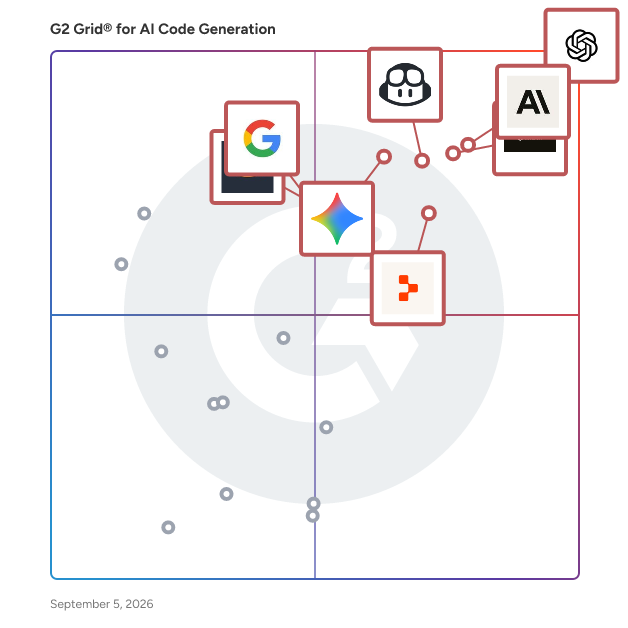
Cursor, GitHub Copilot, Claude, and Replit stand out among AI code generation tools for their different approaches to software development. Cursor and GitHub Copilot are geared toward developers working in existing codebases, while Claude supports complex coding problems and Replit focuses on building applications from ideas.
-
Cursor: An AI-powered code editor recognized for its agentic workflows, project-wide context, and ability to implement changes across multiple files.
-
GitHub Copilot: Offers inline code completion, coding agents, and pull request assistance within familiar IDEs and GitHub workflows.
-
Claude: Helps developers reason through technical problems, generate implementations, and work through complex debugging tasks with detailed explanations.
-
Replit: Combines AI-assisted application building with a browser-based development environment, allowing users to generate, test, and deploy software without extensive local setup.
How do different AI code generation tools compare for enterprise software teams?
Enterprise software teams should compare AI code generators based on how they work with existing repositories, development environments, and deployment infrastructure. GitHub Copilot fits established GitHub workflows, Cursor offers a more agent-driven coding environment, and Amazon Q Developer focuses on AWS development.
-
GitHub Copilot: Fits organizations using GitHub for source control, where AI-generated changes can move through existing pull requests, automated tests, and code review processes.
-
Cursor: Gives engineers an AI-first editor for exploring large repositories, coordinating changes across related files, and reviewing proposed modifications before accepting them.
-
Amazon Q Developer: Supports AWS-based engineering teams with code generation, cloud API guidance, infrastructure troubleshooting, and application modernization tasks.
What are the highest-rated AI code generation tools for development teams seeking to accelerate delivery without sacrificing code quality?
Development teams comparing highly rated AI code generation tools should assess Cursor, GitHub Copilot, and Claude for repository-wide edits, everyday code completion, and complex debugging.
-
Cursor: Lets developers describe a feature, generate an initial implementation, and refine it through follow-up instructions, with visibility into changes across the project.
-
GitHub Copilot: Reduces time spent on boilerplate, repetitive functions, and test scaffolding, leaving developers more time to validate business logic and review completed changes.
-
Claude: Helps engineers work through implementation alternatives, investigate difficult bugs, and examine edge cases before finalizing code.
Which AI code generation platforms avoid security flaws and dependency vulnerabilities in generated code?
Amazon Q Developer, GitHub Copilot, and Gemini Code Assist are worth evaluating for security-conscious development teams, although no AI coding assistant eliminates vulnerabilities automatically. The important distinction is whether generated code can be checked for insecure patterns, risky dependencies, and violations of established development policies before deployment.
-
Amazon Q Developer: Includes security scanning and remediation assistance for supported languages, making it relevant to teams reviewing vulnerabilities in AWS application code.
-
GitHub Copilot: Works within GitHub-based development processes, where generated contributions can be evaluated using CodeQL, Dependabot, and repository-specific security policies.
-
Gemini Code Assist: Provides code explanations and debugging assistance to help engineers inspect generated implementations, particularly in Google Cloud development environments.
What is the best AI generation software?
For code generation, GitHub Copilot and Cursor are strong choices for professional developers, while Replit and Claude address different needs in application creation and technical problem-solving. The best option depends on whether you're extending an existing codebase, creating an application, or working through a difficult programming task.
-
GitHub Copilot: Suits developers who prefer AI code completion and agent assistance inside the editors and repository workflows they already use.
-
Cursor: Offers a dedicated AI coding environment for developers who want to delegate multi-step implementation tasks while retaining control over file changes.
-
Replit: Allows users to describe an application, generate its initial structure, and preview a working version directly in the browser.
-
Claude: Works well for developers who want detailed reasoning about algorithms, architecture decisions, unfamiliar code, or complex debugging problems.
Small Business FAQs
What are the most affordable AI code generation tools for small businesses?
For small businesses comparing AI code generation tools, affordability depends on more than subscription prices. GitHub Copilot provides an entry point for everyday coding assistance and Replit combines development and hosting in one environment, although deployment and AI usage can affect the total cost.
-
GitHub Copilot: Provides an accessible option for small engineering teams looking to reduce repetitive coding effort without changing their existing development environment.
-
Replit: Removes much of the initial environment setup by combining application creation, testing, and hosting, although teams should account for usage credits and deployment charges.
What are the best AI code generation tools for startups?
Replit and Cursor address different stages of startup development, from building an initial product to maintaining a growing application. Replit is particularly relevant for getting a prototype running, while Cursor give technical founders more control over ongoing software development.
-
Replit: Helps founders turn product requirements into working applications through conversational instructions, with built-in previews for testing features during early development.
-
Cursor: Fits startups with developers maintaining their own repositories, especially when feature requests require coordinated frontend and backend changes.
Which AI code generation tools are the most user-friendly for startups?
Replit, Cursor, and Junie offer approachable coding workflows for startups with different levels of technical experience. Replit reduces environment configuration, Cursor lets developers describe changes conversationally, and Junie brings agent-assisted coding into the JetBrains IDEs some teams already know.
-
Replit: Lets founders describe an app, see a working preview, and request revisions from the same interface without configuring a local development environment.
-
Cursor: Allows developers to explain the functionality they want in natural language and inspect the resulting file changes, reducing the need to write every implementation manually.
-
Junie: Works within JetBrains development environments and uses existing project context to help developers complete coding tasks without learning an entirely new editor.
Which AI code generation tools are best for small teams building web applications?
Cursor, Replit, and Emergent offer distinct approaches to web application development. Cursor is better aligned with editing existing projects, Replit combines coding with browser-based testing, and Emergent focuses on generating applications from natural-language requirements.
-
Cursor: Helps web developers modify React components, adjust application logic, and trace related code across files when implementing new functionality.
-
Replit: Lets teams build and preview web applications in one workspace, reducing the effort involved in configuring development environments and deployment infrastructure.
-
Emergent: Uses AI agents to generate application structure, interfaces, and backend functionality from written requirements, making it useful for small teams prototyping web products.
How can small businesses use AI code generation tools without dedicated developers?
Small businesses can use AI code generators to create basic internal dashboards, automate spreadsheet workflows, build simple websites, and prototype customer-facing tools. Natural-language development platforms such as Replit and Emergent make these tasks accessible without requiring every user to write code, while ChatGPT can help explain scripts or troubleshoot errors.
A practical starting point is a contained project, such as an internal reporting dashboard or a form that organizes incoming customer requests. The business can describe its requirements, generate an initial application, and test the output against real scenarios. Applications that handle payments, customer data, authentication, or sensitive business information should receive technical security and reliability checks before going live.
Enterprise FAQs
What are the best-rated AI code generation tools for technology enterprises?
GitHub Copilot, Cursor, and Amazon Q Developer are relevant options for technology enterprises managing substantial codebases and established engineering processes. Their differences become clearer when considering where development happens: inside GitHub-connected workflows, an AI-first editor, or an AWS environment.
-
GitHub Copilot: Supports enterprise engineering teams working across repositories and IDEs, with organization-level administration and AI assistance integrated into established development practices.
-
Cursor: Gives developers project-aware agents for refactoring, debugging, and implementing related changes across large applications, while allowing them to inspect generated modifications.
-
Amazon Q Developer: Serves organizations developing on AWS, particularly where engineers need assistance with cloud SDKs, infrastructure configurations, and application modernization.
What are the most reliable AI code generation tools for enterprises?
For enterprises, reliability means an AI coding assistant can contribute consistently to day-to-day engineering without disrupting established development processes. GitHub Copilot is suited to standardized IDE and repository workflows, Claude helps with deeper technical reasoning, and Gemini Code Assist offers coding support within supported enterprise development environments.
-
GitHub Copilot: Keeps AI assistance close to the code developers already maintain, with organization controls and support for established testing and pull request practices.
-
Claude: Helps engineers examine implementation logic, troubleshoot difficult errors, and explore alternative solutions when straightforward code completion isn't sufficient.
-
Gemini Code Assist: Provides IDE-based coding support and project context, with enterprise-oriented administration capabilities relevant to organizations standardizing developer tooling.
Which AI code generation tools are best for enterprise app integration?
GitHub Copilot, Amazon Q Developer, and Gemini Code Assist fit different enterprise integration environments. GitHub Copilot aligns with source control and IDE workflows, Amazon Q Developer supports AWS development, and Gemini Code Assist is relevant to teams building applications on Google Cloud.
-
GitHub Copilot: Integrates with GitHub and supported IDEs, letting developers use AI assistance while working within existing repository, pull request, and code review processes.
-
Amazon Q Developer: Helps engineers work with AWS services, APIs, and infrastructure-as-code configurations when developing or maintaining cloud applications.
-
Gemini Code Assist: Connects coding assistance with supported editors and Google Cloud development workflows, including guidance for cloud services and application code.
Which AI code generation tools are best for maintaining large enterprise codebases?
Large enterprise codebases require more than generating individual functions. Developers often need to understand undocumented dependencies, trace how components interact, and update related files without introducing regressions. Cursor, Unblocked, and GitHub Copilot address different parts of that maintenance process.
-
Cursor: Helps developers navigate project structure, identify relevant files, and coordinate changes across related components during refactoring or feature updates.
-
Unblocked: Connects repository information with engineering knowledge from sources such as Jira, Slack, and documentation, helping developers understand why existing systems work the way they do.
-
GitHub Copilot: Assists with explaining unfamiliar code, generating tests, and updating legacy functions within existing repository workflows.
How can enterprises use AI code generation without compromising code security?
Enterprises can reduce AI-generated code risks by controlling which repositories and data coding assistants can access, scanning generated dependencies, and requiring the same testing and approval process used for human-written code. Security policies should also address prompt data retention, secret exposure, third-party packages, and whether coding agents can execute commands or modify files without approval.
Researched and written by Adam Crivello
Reviewed and edited by Supanna Das
Updated on: October 12, 2026