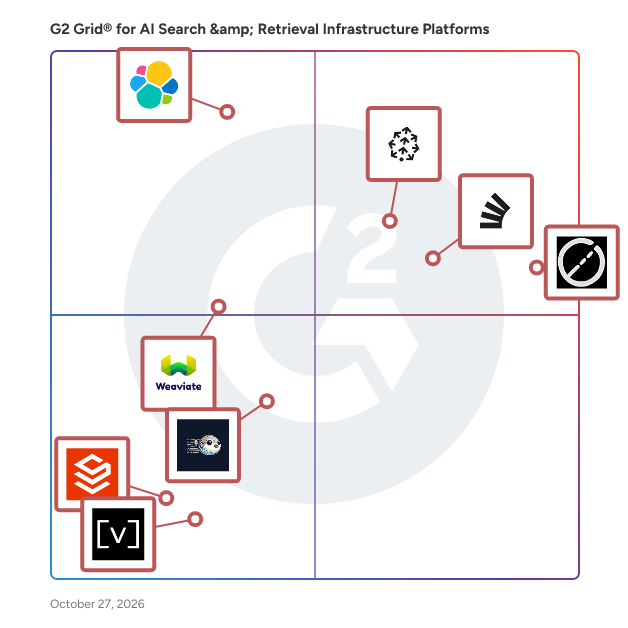
AI search & retrieval infrastructure platforms provide the core systems businesses use to power intelligent search and retrieval across their data and applications, enabling AI systems to find and return the most relevant information.
Core Capabilities of AI Search & Retrieval Infrastructure Platforms
To qualify for inclusion in the AI Search & Retrieval Infrastructure category, a product must:
- Support vector-based and hybrid (keyword + semantic) search
- Ingest, index, and update structured and unstructured data
- Store, manage, or integrate with embedding systems used for semantic retrieval
- Rank search results based on relevance, including hybrid relevance scoring
- Filter and refine search results using metadata
- Allow configuration of ranking logic, such as field weighting, boosting, reranking, or hybrid weighting adjustments
- Support API-based retrieval workflows for LLM-powered applications, including retrieval-augmented generation (RAG)
- Provide APIs and SDKs for integration into applications and workflows
- Support incremental or near-real-time indexing updates
- Enable deployment via at least one of the following: managed cloud, self-hosted, or hybrid
Common use cases for AI Search & Retrieval Infrastructure Platforms
These platforms are typically used in organizations building AI-powered products, internal knowledge search tools, or customer-facing discovery experiences where fast and accurate information access is critical.
AI search & retrieval infrastructure platforms support business strategies focused on scaling AI capabilities, improving AI response quality, and enabling more reliable AI applications by strengthening how information is indexed, retrieved, ranked, and delivered.
The platform is primarily used by software engineers, machine learning (ML) engineers, and platform teams within product, data, and engineering functions. It addresses business problems such as searching large, unstructured datasets, reducing AI hallucinations, improving relevance and accuracy, and supporting retrieval-augmented generation (RAG) workflows.
Common attributes for these platforms include vector and hybrid search, data ingestion and indexing, relevance ranking, embeddings management, and APIs or SDKs for integration. These attributes allow the platform to retrieve information based on meaning as well as keywords, keep data organized and up to date, and return the most relevant results. Embeddings management supports semantic understanding, while APIs or SDKs make it easier to integrate search capabilities into applications and AI workflows.
How AI Search & Retrieval Infrastructure Platforms Differs from Other Tools
In contrast to answer engine optimization (AEO) tools which optimize content for discoverability by AI systems, or site search software, which enables users to search within a specific website or application, AI search & retrieval infrastructure platforms operate at the architectural layer to support AI-driven information retrieval across data sources.
Insights from G2 on AI Search & Retrieval Infrastructure Platforms
Based on category trends on G2, hybrid vector and keyword search, flexible ranking controls, and APIs for RAG workflows stand out as key capabilities. Software and ML engineers choose these platforms to improve answer relevance and reduce hallucinations in AI applications.