
Mahima Chavan
Mahima Chavan is an SEO Intern at G2, where she helps buyers confidently navigate and evaluate software using content. She specializes in AEO strategy and research in AI-driven discovery, with work spanning category guides and buyer-focused content designed to perform on both search engines and AI answer tools.
TL;DR: What is machine learning?
- What is it? Machine learning is a branch of artificial intelligence in which systems learn patterns from data and apply them to cases they have not seen.
- How does machine learning work? Examples are collected and prepared, a model is trained on them by adjusting the weight it places on each piece of information, tested on data held back from training, and then run on live cases and monitored.
- How does it relate to AI and deep learning? The three are nested. Deep learning sits inside machine learning, which sits inside artificial intelligence.
- What are the types of machine learning? Supervised, unsupervised, reinforcement, and semi-supervised learning, separated by what the system learns from.
- What is machine learning used for? Across the recent 900+ G2 reviews, the most common use cases are building predictive models, analysis and reporting, and building assistants and content.
- What buyers want most? Not a task at all, but one platform rather than several, and rented compute rather than owned.
- Who uses machine learning? Technology companies, most of all, though small businesses account for 40% of reviewers.
- Its strengths and limits? It handles problems too complex to write rules for and works at a scale people cannot, but it can only learn what its data contains, rarely explains itself, and loses accuracy as conditions change.
Machine learning decides which emails reach your inbox, what your phone suggests as you finish a sentence, and what a warehouse stocks before a cold week. Most of it is invisible, and most of it arrived within the last decade.
The concept gets explained everywhere, usually with the same short list of consumer examples. What gets explained far less often is the other half of it: what machine learning looks like as software an organization buys, staffs, and runs. To get at that, I read through what buyers of machine learning software say they use it for.
What does machine learning mean?
Machine learning is a branch of artificial intelligence in which a system learns patterns from data and uses them to make predictions or decisions. The goal is generalization: performing well on new data it has never seen, not just on the examples it was trained on.
Take a system that flags suspicious credit card transactions. Written conventionally, it applies limits that somebody chose: flag anything above a set amount, or any purchase made abroad. Built with machine learning, it is instead shown millions of transactions already marked fraudulent or legitimate, and works out the warning signs itself, including ones nobody would have thought to write down. When criminals change tactics, the first system needs an analyst to notice and a developer to edit the code. The second needs recent transactions.
The same method stretches to problems as different as ranking search results, reading handwriting, and forecasting demand, because each one comes down to finding structure in past examples and extending it forward. It also means every machine learning system carries an expiry risk: it keeps working only for as long as the examples it learned from still resemble the present.
Companies do this work with machine learning software, which provides tools for preparing data, training models, and running them in production. It is a fast-growing category.
The number of machine learning products carrying enough customer reviews to be scored on G2's Grid Report rose from 17 in Summer 2021 to 62 in Summer 2026, more than tripling in five years.
Want to learn more about Machine Learning Software? Explore Machine Learning products.
How does machine learning work?
Machine learning works by finding patterns in past data and applying them to new data, in four stages: collecting and preparing examples, training a model on them, testing it on data it has not seen, and then running it against real cases.
The core of it is inference from examples, which is easiest to see in numbers. Given this sequence:
- 3 to 9
- 4 to 16
- 5 to 25
Most people can say what pairs with 6, and answer 36. Nobody was told the rule was squaring. It was inferred from three examples. That inference, done across millions of examples and thousands of variables, is what a machine learning model does.
To follow the four stages through a real case, take a finance team that wants to know which invoices are going to be paid late.
Stage 1: Collect and prepare the data
A model learns from examples, so the first job is assembling examples that reflect the conditions it will actually face, then cleaning them. Data that is duplicated, incomplete, or unrepresentative produces an unreliable model, however good the algorithm. This stage usually takes the longest.
For the finance team, it costs little because the examples already exist. Every invoice from the past three years is known to have been paid on time or late, and each carries the details that might explain why: the customer, the amount, the payment terms, and the number of reminders sent.
Stage 2: Train the model
Training is where the model gets built. An algorithm runs over the examples repeatedly, adjusting the weight it places on each piece of information to reduce the gap between its output and the known answer. Those weights are the model's parameters, and training is the search for good values for them.
Here, the algorithm starts with a guess at how much each invoice detail counts, applies it to invoices whose outcome is already known, measures how often it was wrong, and nudges each weight in whichever direction reduces the error. Payment history might turn out to matter several times more than invoice size. Settings chosen before training begins, such as how many passes to run, are called hyperparameters, and a person picks those.
Stage 3: Test it on unseen data
A model that performs well on the data it was trained on has not necessarily learned anything. Testing means evaluating it against examples held back from training, which is what catches overfitting, where a model has memorized its training set and fails on anything new.
So the team holds back a slice of invoices the model never saw and checks its predictions against what actually happened. Strong results on the invoices it trained on and weak results on these mean it memorized rather than learned.
Stage 4: Run it and keep watching
Deployment puts the model where the decisions are made, and monitoring keeps it honest. Accuracy decays as real-world conditions drift away from the training data, so this stage never entirely finishes.
New invoices are scored as they are issued, and the ones flagged as likely late go to someone for early follow-up. Accuracy is rechecked as the months pass, because customers' circumstances change and so do payment terms.
A brief history of machine learning
Machine learning is older than most people assume. The idea dates to the 1940s, the term to 1959, and the methods behind today's systems to the 1980s. What changed recently is not the theory but the amount of data and computing power available to run it.
- Pre-1920s: Thomas Bayes, Andrey Markov, Adrien-Marie Legendre, and others lay the mathematical groundwork that foundational machine learning techniques still rest on.
- 1943: Walter Pitts and Warren McCulloch present the first mathematical model of neural networks.
- 1949: Donald Hebb publishes The Organization of Behavior, exploring how behavior relates to brain activity and neural networks.
- 1950: Alan Turing asks whether machines have the capability to learn.
- 1951: Marvin Minsky and Dean Edmonds build the first artificial neural network.
- 1956: The Dartmouth Workshop, organized by John McCarthy, Marvin Minsky, Nathaniel Rochester, and Claude Shannon, coined the term artificial intelligence. It is often called the birthplace of the field.
- 1959: Arthur Samuel coined the term machine learning while building a checkers program that improved with play, which is why he is considered the father of the field.
- 1965: Alexey Ivakhnenko and Valentin Lapa develop the first multi-layer perceptron. Ivakhnenko is often regarded as the father of deep learning.
- 1967: The nearest neighbor algorithm is conceived.
- 1979: Kunihiko Fukushima publishes his work on the neocognitron, a hierarchical multilayered network for detecting patterns, which later inspires convolutional neural networks.
- 1985: Terrence Sejnowski invents NETtalk, a program that learns to pronounce English words roughly the way infants do.
- 1995: Tin Kam Ho introduces random decision forests.
- 1997: IBM's Deep Blue beats world chess champion Garry Kasparov, a landmark for artificial intelligence, though it searched moves rather than learning from them.
- 2000: Neural networks researcher Igor Aizenberg first uses the term deep learning.
- 2009: Fei-Fei Li launches ImageNet, a large image database that becomes the standard benchmark for visual object recognition.
- 2011: Google's X Lab develops Google Brain. The same year, IBM Watson beats human competitors on the trivia show Jeopardy.
- 2012: A deep neural network wins the ImageNet competition by a wide margin, moving deep learning from a niche approach to the mainstream one.
- 2014: Ian Goodfellow and colleagues develop the generative adversarial network. Facebook releases DeepFace, a facial recognition system reaching 97.25% accuracy, and Google introduces its large-scale machine learning system, Sibyl.
- 2015: AlphaGo becomes the first AI to beat a professional player at Go.
- 2017: The transformer architecture is published, and becomes the design underneath nearly every large language model that follows.
- 2020: OpenAI announces GPT-3, a language model able to generate human-like text.
- 2021: DeepMind releases AlphaFold 2 and its database, covering more than 360,000 protein structure predictions, including all known human proteins. OpenAI reveals DALL-E, which generates images from written descriptions.
- 2022: ChatGPT launches on 30 November and reaches 100 million users within two months, the fastest adoption of any consumer application to that point.
- 2023: GPT-4 arrives, and open-weight models are released publicly, putting capable systems in the hands of anyone able to run them.
- 2024: OpenAI releases GPT-4o in May, handling text, images, and audio in a single model rather than stitching separate ones together, and responding to speech in roughly the time a person would. In September the same year, it previewed O1, the first model trained to work through a problem in steps before answering rather than replying immediately.
- 2025: DeepSeek releases R1, the first widely available open-weight model to match that step-by-step reasoning, at a fraction of the cost. Reasoning stops being something only a handful of companies can offer.
- 2026: Attention turns to agents, systems that carry out multi-step tasks over extended periods rather than returning a single response. This is the current direction of the field rather than a settled milestone.
The 83 years between the first model of a neural network and the agents of 2026 are the point. Most of the ideas arrived long before the data and computing power that made them work.
Looking for a platform to build and run models on? Explore the best data science and ML platforms on G2.
How are AI, machine learning, and deep learning related?
The three are nested, not competing.
- Artificial intelligence is the goal of machines doing work that would otherwise need human intelligence.
- Machine learning is the method that reaches it by learning from examples.
- Deep learning is machine learning built on many-layered neural networks. Every deep learning system is machine learning, and every machine learning system is artificial intelligence, but not the reverse.
What is the difference between AI and machine learning?
Artificial intelligence is broader than machine learning because it covers several fields, not one. Machine learning is the field that has come to dominate, which is why the two names get treated as if they were the same thing. Every machine learning system is artificial intelligence, but not everything called artificial intelligence is machine learning.
| Parameter | Artificial intelligence | Machine learning |
|---|---|---|
| Definition | The goal of getting machines to do work that would otherwise need human intelligence | A method for reaching that goal, in which systems learn a task from examples |
| What sits inside it | Robotics, computer vision, natural language processing, expert systems, and machine learning | Supervised, unsupervised, and reinforcement learning |
| What it is judged on | Whether the task got done | Whether the predictions are accurate |
| Example | A self-driving car completing a journey safely | The stop-sign recognizer inside that car |
The self-driving car is the clearest way to hold the two apart. They describe different levels of the same system rather than rival technologies. The car is the artificial intelligence, and it succeeds or fails based on whether you arrive. The stop-sign recognizer inside it is machine learning, and it succeeds or fails based on whether it reads the sign correctly. A car can be excellent at one and poor at the other.
What is the difference between machine learning and generative AI?
Generative AI is machine learning that creates new content rather than judging existing content. A model is trained on very large collections of text, images, audio, or code until it has absorbed the patterns running through them, then produces fresh material that follows those patterns. It sits inside deep learning, which sits inside machine learning.
| Parameters | Machine learning | Generative AI |
|---|---|---|
| What it produces | A number, a category, or a ranking | New text, images, audio, video, or code |
| A typical request | Which of these customers will cancel? | Draft a summary of this contract |
| What it learns from | Examples paired with known answers | Very large collections of existing text, images, or code |
| Common methods | Regression, decision trees, clustering, classifiers | Large language models and other transformer networks |
| Whether the same input gives the same answer | Yes, once the model is trained | Not always, since output can vary between runs |
| How do you judge it | Whether the prediction turned out to be right | Whether the output is accurate and usable |
| What it costs to run | Usually cheap once trained | Priced per request, and can be significant at volume |
A model that forecasts next month's demand and a model that drafts an email are both examples of machine learning. Only the second is generative. They also fail differently. A wrong forecast shows up when the month ends. Text that is wrong can still read well, which makes it easier to miss.
Generative AI is also the newest arrival in this category and is already a substantial part of it. Building assistants, chatbots, and content was the fourth most common thing buyers described in the reviews analyzed here.
What is the difference between machine learning and deep learning?
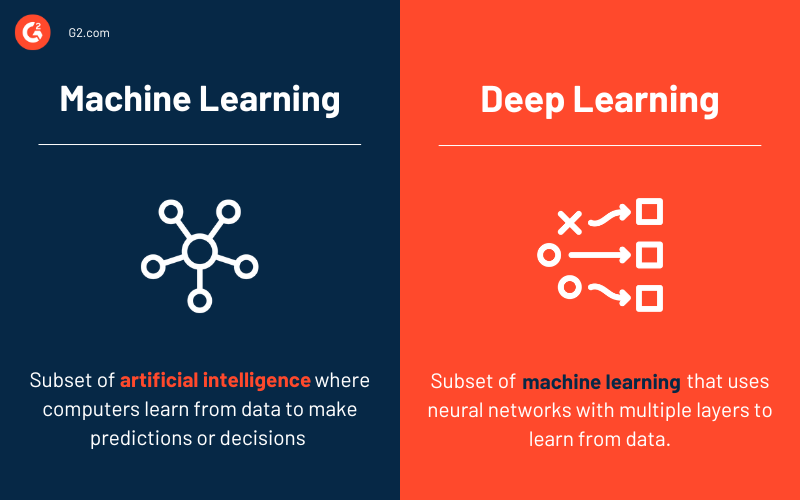
Both learn from examples. The difference is who picks what the model should pay attention to: in machine learning a person does, and in deep learning the model works it out itself.
| Parameters | Machine learning | Deep learning |
|---|---|---|
| Definition | Systems that learn a task from examples | Machine learning built on artificial neural networks stacked many layers deep |
| What a person supplies | Examples with known answers, plus the attributes worth weighing | Examples with known answers |
| What the model works out | How those attributes combine to produce an answer | Both which attributes matter and how they combine |
| Data it needs | Can work with modest datasets | Large volumes |
| Hardware it runs on | A standard processor is often enough | Usually specialized processors such as GPUs |
| How readable the result is | Often traceable to the attributes that drove the outcome | Often opaque, and an active area of research |
| What it suits | Forecasting, scoring, and classification on structured data | Images, audio, and language |
That difference in what a person supplies drives everything else. To predict house prices with conventional machine learning, someone specifies square footage, bedroom count, and zip code, and the model works out how to weigh them. Give the same problem to deep learning and it will find its own attributes, which is also how image recognition systems read handwriting nobody has described to them.
Working attributes out, rather than being told them, takes far more examples and much more computing power. That is why deep learning became practical only once both got cheap, and why, for modest, well-understood data, conventional machine learning usually remains the better choice.
What are the types of machine learning?
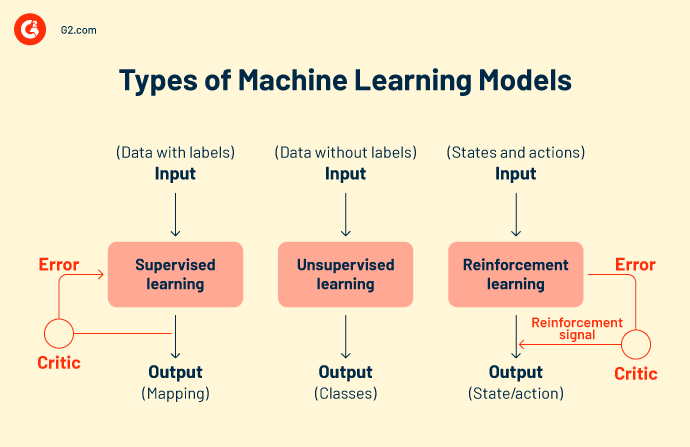
There are four types of machine learning, separated by what the system learns from. Supervised learning uses labeled data, unsupervised learning uses unlabeled data, reinforcement learning uses the rewards and penalties its own actions earn, and semi-supervised learning mixes a little labeled data with a lot of unlabeled data.
1. Supervised learning
Supervised learning trains on data where the right answer is already attached. Each example pairs an input with the output it should produce, and the system learns the mapping between the two. The quality of those labels sets the ceiling on what the model can do.
It divides into two jobs.
- Classification assigns a category, such as whether a subscriber will cancel, or which of twelve queues a support ticket belongs in. The common algorithms are logistic regression, decision trees, random forest, k-nearest neighbors, naive Bayes, and support vector machines.
- Regression predicts a number, such as what a house will sell for given past sales on the street, or how many units a store will need next month. The common algorithms are linear regression, random forest, and gradient boosting.
This is the most widely used type, largely because labeled data is the kind organizations already have. Any record of what happened, from deals closed to invoices paid late, is a labeled dataset waiting to be used.
2. Semi-supervised learning
Semi-supervised learning mixes a small amount of labeled data with a large amount of unlabeled data, and it exists mainly because labeling is expensive.
Medical imaging is the standard case. Paying a radiologist to label every scan in a set of hundreds of thousands is out of reach; paying for a few thousand, then letting the system use those to make sense of the rest, is not. Teams label what they can afford and let the model work with the remainder.
3. Unsupervised learning
Unsupervised learning works on data with no answers attached. The system is handed raw records and finds structure in them, which makes it an option when the categories are not known in advance.
Four jobs fall under it.
- Clustering groups records that resemble one another, such as customers with similar buying patterns. K-means and hierarchical clustering are the usual algorithms.
- Association finds things that occur together, such as items that keep appearing in the same order. Apriori is the best known algorithm for this.
- Anomaly detection picks out records unlike the rest, such as a machine whose vibration readings drift away from every other machine on the line, or login activity matching no established pattern.
- Dimensionality reduction compresses many variables into a few without losing much information, which is how a dataset hundreds of columns wide becomes something a person can plot and read. Principal component analysis and singular value decomposition both do this.
Because there is no correct answer to check against, the output needs interpreting. A model can show you that a cluster exists; deciding whether it means anything is still a human job.
4. Reinforcement learning
Reinforcement learning has no prepared dataset at all. The system acts, receives a reward or a penalty, and adjusts to earn more rewards over time, learning a strategy through repetition rather than from worked examples.
The dinosaur game that appears in Google Chrome when the internet drops works this way for a person. You do not read a rulebook. You play, fail, adjust, and after enough attempts, you clear the cactus every time.
It suits problems that are a sequence of decisions rather than a single prediction: robotics, game-playing systems, and control problems such as routing a delivery fleet or managing power draw in a data center. Q-learning and policy gradient methods are the standard approaches, and deep reinforcement learning pairs them with neural networks to handle more complicated environments.
What are some examples of machine learning?
Most people use machine learning dozens of times a day without noticing. Each of the examples below is one of the types described above, applied to a specific job, and they are grouped by type.
| Type | Example | What the model is doing |
|---|---|---|
| Supervised | Spam filtering | Sorting mail into junk and not junk |
| Supervised | Product and content recommendations | Ranking items by how likely you are to want them |
| Supervised | Fraud alerts from a bank | Flagging transactions unlike your usual pattern |
| Unsupervised | Customer segmentation | Grouping customers who behave alike, with no labels given |
| Unsupervised | Frequently bought together suggestions | Spotting items that tend to be purchased in the same order |
| Unsupervised | Themes in customer feedback | Surfacing the topics running through thousands of comments, without being told what to look for |
| Reinforcement | Game-playing and robotics | Learning by trying, failing, and being rewarded |
| Deep learning | Face unlock on a phone | Matching a live image against a stored pattern |
| Deep learning | Reading a handwritten address | Identifying characters from examples alone |
| Deep learning | Speech transcription | Mapping sound patterns to words |
| Generative | Chat assistants and writing tools | Producing new text in response to a prompt |
What links these is not the task but the shape of the data behind it. Sorting mail and ranking products feel like unrelated jobs, yet both learn from examples with known answers, which is what makes both supervised. The type follows from the data available, not from the industry or the application.
What is machine learning used for?
Machine learning is used to predict, classify, and generate: anticipating what a customer will do next, sorting documents and images, scoring risk, and producing text. Reviews left by verified users of machine learning software show how widely that spreads in practice.
Every G2 reviewer is asked what problem their software solves, which makes the answers a first-hand account of what these tools get bought to do. The analysis of the 900+ reviews left in the Machine Learning Software category over the last 24 months shows the tasks named most often.
| Task | What buyers describe doing | Industries the reviews came from | Share of reviews |
|---|---|---|---|
| Building predictive models | Building classification, detection, and time series models on low-code tools, often chosen because there is no data science team |
|
11% |
| Analysis, statistics, and reporting | Finding patterns in large datasets, combining several sources into executive dashboards and recurring reports |
|
10% |
| Building assistants, chatbots, and content | Summarizing documents, drafting content and support replies, running chatbots, and searching over a company's own material |
|
8% |
| Preparing data | Cleaning and combining fragmented sources into repeatable workflows, replacing Excel and manual consolidation that took hours |
|
7% |
| Recommendations and personalization | Serving recommendations in near real time without building an engine, judged on click-through and engagement. This is the intent behind searches for machine learning platforms supporting real-time inference for live recommendation engine systems. |
|
6% |
| Scoring churn, risk, and fraud | Predicting which customers will leave, scoring leads and accounts for routing, estimating lifetime value, flagging fraud |
|
3% |
Something else stood out while I was reading. Two answers came up more often than any single task, and both describe how buyers run machine learning rather than what they run it on. Replacing several separate tools with one platform accounts as a common theme for 14% of reviews, and running models on someone else's hardware rather than buying the machines accounts for 13%.
Who uses machine learning software?
Machine learning software is used most by technology companies, and increasingly by small businesses, who account for 40% of all reviewers.
By company size
Small businesses are the largest customer segment served, and their share has grown while the enterprise share has fallen.
| Customer segment | Summer 2021 | Summer 2026 |
|---|---|---|
| Small business | 36% | 40% |
| Mid-market | 30% | 32% |
| Enterprise | 34% | 27% |
Enterprises made up a third of reviewers in this category five years ago and just over a quarter today, while the small business share rose over the same period.
By industry
The technology industry is the largest single buyer of machine learning software. Computer software and IT services companies file 29% of reviews between them.
| Industry | Share of reviews |
|---|---|
| Information technology and services | 16% |
| Computer software | 13% |
| Financial services | 4% |
| Banking | 3% |
| Higher education | 3% |
| Accounting | 3% |
| Marketing and advertising | 3% |
| Pharmaceuticals | 2% |
Shares are of all 900+ reviews, of which 16% did not name an industry.
The median low-code ML reviewer is no longer a data scientist. Read G2's analysis of low-code ML platforms in 2026.
How to build a machine learning model
Building a model runs in five steps, and the first usually takes the longest.
- Collect and prepare the training data. The examples a model learns from work rather like a textbook of worked problems: the more the better, provided they are right. They have to reflect the conditions the model will actually meet, carry the attributes you want it to learn, and contain no duplicates.
- Choose an algorithm. An algorithm is the procedure run over data to produce a model, and which one suits depends on the problem, how much data there is, and whether it is labeled. Labeled data points to decision trees, linear regression, logistic regression, support vector machines, or random forest. Unlabeled data points to k-means clustering, Apriori, singular value decomposition, or neural networks. If the goal is to predict something, that means supervised learning; if it is to find structure, unsupervised.
- Train it. The algorithm runs over the data repeatedly, adjusting its internal weights and biases each pass by comparing output against the expected result, until accuracy stops improving. What comes out is the model.
- Validate against held-back data. This catches overfitting, where a model has tuned itself so tightly to its training set that it fails on anything new. There is no universal accuracy threshold. Where 99 of every 100 cases are negative, a model scoring 99% may have learned nothing. What matters is whether it beats a simple baseline, such as always predicting the most common outcome.
- Test and deploy. Run it at larger scale, then put it where the decisions are made and keep watching, because accuracy drifts as conditions change. Doing that well is a discipline of its own, MLOps, covering the deployment, monitoring, and retraining pipeline that keeps a model working after launch. Running and maintaining many models in production at once is what MLOps platforms are built for, and Databricks, Dataiku, and SAS Viya are among the highest-rated in that category on G2. A spam filter gets better every time someone marks a message as junk.
Much of this is now automated. AutoML platforms take the algorithm selection and training steps and run them for you, testing multiple algorithms against your data and tuning them without anyone specifying which to try. It is why buyers of machine learning software so often describe choosing a tool precisely because they had no data science team to hire, and why the person building the model is increasingly an analyst rather than a specialist.
The top-rated machine learning tools on G2
The most trusted machine learning by data science leaders based on user reviews, by Summer 2026 Grid placement:
| Product | G2 rating | Best for |
|---|---|---|
| Gemini Enterprise Agent Platform | 4.3/5 | Enterprise deployment |
| IBM watsonx.ai | 4.4/5 | Large-scale enterprise AI adoption |
| SAS Viya | 4.3/5 | In-memory AI and analytics |
| Azure OpenAI Service | 4.6/5 | OpenAI models inside the Microsoft ecosystem |
| Dataiku | 4.4/5 | Large enterprises with mixed-skill teams |
See the full ranking of the best machine learning tools.
What are the advantages of machine learning?
Machine learning handles problems too complex to write rules for, surfaces patterns people would not think to test, and works at a scale and speed people cannot match. It also improves as more examples arrive, and adapts to changed conditions by retraining rather than being rebuilt.
- Problems too subtle to specify become solvable. Writing rules that separate a handwritten five from a six across every style of handwriting is beyond practical reach, and so is describing in advance what makes an email fraudulent. A model learns those distinctions from examples instead.
- Unexpected patterns surface on their own. Because the model weighs every attribute it is given, it finds combinations a person would never have thought to check. Actionable insights is one of four capabilities G2 rates for this category, and it carries a 90% category average.
- Scale stops being a limit. A fraud model reviews every transaction as it happens. A team of analysts reviews a sample, after the fact.
- More examples make the model better. Performance is tied to the data available, so a model that sees more cases generally improves without anyone rewriting it. Training data, as a feature, carries a category average of 90%.
- Changed conditions call for retraining, not rewriting. When the world moves, the fix is newer data rather than a developer reworking the logic, which is a faster loop than conventional software allows.
Buyers largely agree that the software delivers. Across the 62 products rated on G2's Summer 2026 Grid Report, 90% of reviewers say their machine learning software meets their requirements.
What are the limitations of machine learning?
Machine learning is limited by its data, its opacity, its shelf life, and its inability to tell correlation from cause. A model can only learn what its examples contain, including whatever bias they carry. It cannot usually explain how it reached a conclusion, and its accuracy fades as the conditions it learned from change.
- A model can only learn what its data contains. The quality and coverage of the examples sets the ceiling on everything downstream. G2 reviewers describe this directly, pointing to how much data they need and how hard it is to get into usable shape, which is also why data preparation appears on the list of what buyers use the software for.
- Bias is inherited, not introduced. A model learns the patterns it is shown, including the ones nobody intended. A system trained on past hiring decisions will reproduce whatever preferences those decisions contained, consistently and at speed, while appearing to be neutral.
- A model cannot usually explain itself. It produces an answer, not an argument. With simple methods you can trace which attributes drove a result, but the more capable the model, the harder that becomes, and it is a real obstacle wherever a decision has to be justified to a regulator, a customer, or a court. G2 reviewers describe systems as a black box and say they cannot see how a conclusion was reached.
- Accuracy decays over time. A model is a snapshot of the conditions it learned from, so when those conditions move, accuracy falls quietly rather than failing loudly. G2 reviewers report predictions slipping as months pass. This is why monitoring a live model matters as much as training it.
- Correlation is not causation. A model can learn that two things move together without any sense of which drives which, so a relationship that holds throughout training can disappear the moment something upstream changes.
None of this makes machine learning unreliable. It makes it a tool with conditions attached: it works where there is enough good data, where patterns persist, and where being roughly right at scale is worth more than being explainable in every case.
Frequently asked questions about machine learning
Got more questions? Here are the answers.
Q1. How much data does machine learning need?
There is no fixed threshold. Conventional machine learning can work with hundreds or thousands of examples, because a person selects the relevant attributes in advance. Deep learning needs far more, since it derives those attributes itself. Quality matters more than volume either way: a smaller dataset that reflects real conditions beats a larger one that does not.
Q2. Can you use machine learning without a data science team?
Yes, and it is one of the most common reasons buyers give for the tool they chose. Low-code and no-code platforms let people build and test models through a visual interface rather than by writing code, and reviewers describe picking exactly those because hiring data scientists was never on the table. You still need data worth learning from, and someone to judge whether the output makes sense. Alteryx, Altair AI Studio, and Dataiku are among G2's machine learning platforms with AutoML features building models without deep ML expertise.
Q3. What is AutoML and how does it differ from traditional machine learning?
AutoML automates the steps that used to require a specialist. It tests multiple algorithms against your data, tunes them, and selects the best performer, instead of waiting for someone to decide which to try. Traditional machine learning leaves those judgments to a person, which is why it assumed a data science team in the first place. The shift shows up in G2's buyer data: building predictive models on low-code tools was the most common task buyers described across the 900+ reviews analyzed, and reviewers in that group repeatedly say they bought precisely because they had no data science team to hire.
Q4. Do you have to build a machine learning model from scratch?
Usually not. Pre-trained models cover common jobs such as recommendations, forecasting, language, and image recognition; you supply your own data rather than designing the model. Amazon SageMaker, Azure Machine Learning, and IBM watsonx.ai provide pre-trained models for demand forecasting and recommendations, and all three sit in G2's low-code machine learning platforms category. Building from scratch earns its cost only when the problem is particular to your business and nothing pre-trained fits.
Q5. Do you need a different tool for each stage of machine learning?
No, and buyers increasingly do not want one. Replacing several separate tools with a single platform was the most common thing reviewers said their software solved, ahead of any individual task. Databricks, Dataiku, and SAS Viya each appear in both G2's MLOps platforms and low-code machine learning platforms categories, enabling complete end-to-end workflows from raw data to production inference in one place.
Q6. Why does a machine learning model get less accurate over time?
Because the world it learned from keeps moving. A model is a snapshot of its training conditions, so when customer behavior, prices, or fraud tactics change, the patterns it learned stop matching what it sees. This is called drift, and it is quiet rather than dramatic: the model keeps returning confident answers that are gradually less right. G2 reviewers describe predictions slipping as months pass. The platforms that catch data drift before it degrades model accuracy in production, such as Aporia and Arize AX, sit in G2's MLOps platforms category.
Q7. How do machine learning platforms detect and handle model drift?
Through three linked mechanisms. Monitoring compares live predictions against the distribution the model trained on and reports when the two diverge. Drift alerts raise that divergence with the team rather than waiting for someone to notice. Retraining triggers then start a fresh run, on a schedule or once a threshold is crossed. Aporia, Arize AX, and Weights & Biases simplify model monitoring and automated retraining workflows and sit in G2's MLOps platforms category.
Q8. What is explainability in machine learning, and which platforms support it?
Explainability is the ability to show why a model produced a particular output. Decision trees and linear models can be traced back to the attributes that drove a result. Deep learning generally cannot, which is why reviewers call these systems a black box. It matters wherever a decision must be justified to a regulator, a customer, or a court. Buyers evaluating machine learning with explainability features showing why a prediction was made tend to look at the MLOps platforms category, where model observability products such as Arize AX and Aporia sit.
Q9. How can machine learning reduce operating costs?
Mostly by removing manual work rather than people. Reviewers describe automating repetitive tasks such as drafting content, summarizing documents, and preparing data, cutting work that took hours down to minutes. Machine learning systems that handle very large million-row datasets without extreme costs, such as Databricks and SAS Viya, make that scale affordable. Set against that, running models at volume has its own cost, and generative tools are priced per request.
What machine learning means for buyers
Machine learning stopped being a specialist concern some time ago, and the clearest evidence in G2's data is the shape of the category rather than any single figure. The number of products carrying enough reviews to be scored has more than tripled in five years, and the ones arriving now are built for buyers who never intended to hire a data science team.
What those buyers describe doing with the software is mostly ordinary work. Preparing data. Building a model that predicts a number. Putting a dashboard in front of someone who has to decide something on Monday. The two answers they gave most often were not tasks at all but preferences about how to run it, one platform rather than several, and someone else's hardware rather than their own. Those are the concerns of people who have stopped treating a technology as novel and started treating it as infrastructure.
Which is a useful way to approach it? The question worth asking is not whether machine learning is impressive, but whether your problem has enough good data behind it, and whether the patterns in that data will still hold next year.
Machine learning underpins a growing share of the software people use daily. To see how quickly that share is growing, read the latest machine learning statistics.
This was originally written in 2024 by Amal Joby and has been updated with new information in 2026.