Introducing G2.ai, the future of software buying.Try now

Data Integrity

by Sagar Joshi
Data integrity deals with measures to preserve or safeguard the coherence of any data. Learn more about its importance, types, and best practices.

What is data integrity?

Data integrity is the overall accuracy, completeness, and consistency of data in its lifecycle. It’s a critical aspect of designing, using, and implementing any system that stores or processes data.

Data health has become a pressing issue in this era of big data, where more information is processed and stored than ever before. As a result, taking steps to protect the integrity of the gathered data is non-negotiable. Data quality tools help a lot of businesses maintain the accuracy and consistency of data. 

The first step in ensuring data security is comprehending the fundamentals of data integrity and how it functions. It’s impossible to overstate the significance of data integrity in preventing data loss or a data leak. 

To keep one's data safe from malicious external forces, users must first ensure that internal users handle data appropriately. Users can prevent sensitive data from ever being misclassified or stored incorrectly by implementing the appropriate data validation and error checking.

Types of data integrity

Two main types of data integrity guarantee data consistency, accuracy, and completeness in relational and hierarchical databases.

  • Physical integrity protects data's accuracy and completeness during storage and retrieval. Physical integrity is endangered when calamities occur. Human error and storage erosion can also be why data processing managers, system programmers, applications programmers, and internal auditors cannot obtain accurate data.
  • Logical integrity protects the integrity of the data in a relational database. Physical integrity shields data from human error and hackers, but logical integrity does so differently based on the following types.
     
    • Entity integrity ensures data isn't listed duplicated and that no field in a table is null. They are the distinctive values that identify individual pieces of data. 
    • Referential integrity describes procedures that guarantee uniform data storage and use. Rules about using foreign keys are incorporated into the database's structure to ensure that only appropriate changes, additions, or deletions occur. Rules may include restrictions that prevent duplicate data entry, provide accurate data entry, and forbid irrelevant data entry.
    • Domain integrity guarantees the precision of each data entry in a domain. A domain in this context refers to the range of acceptable values a column may contain. It may have restrictions and other controls restricting the format, nature, and volume of entered data.
    • User-defined integrity refers to the guidelines and limitations users develop to meet their specific requirements. 

Best practices to guarantee data integrity

Since the risk to data integrity has grown to be so harmful to businesses and information systems, several strategic measures have been developed to reduce the risks. However, since it would be impossible to eliminate all risks simultaneously, users need to combine several different tactics and tools.

  • Ensure high-quality, complete, and accurate data: The pursuit of data integrity starts during the collection phase’s design. Ask if the information gathered using this method is correct. Is there a guarantee that no data will be lost if collected this way? Is the information from a dependable source? After creating the collection strategy, evaluate whether it performs as intended. If not, make necessary changes to its design and begin collecting again. Starting with uncorrupted data is much simpler than correcting inaccurate data later.
  • Check for errors: One of the simplest ways to lose data integrity is through human error, but users can control this situation. In addition to double-checking the work, asking others to review it, and exercising caution, a few other tricks can aid in error detection. Users can keep track of every distinct point in a dataset by doing something as straightforward as shading every other row.
  • Be alert to cybersecurity threats: When an employee clicks a link in an email or text message containing malware, the malware activates and begins to steal or damage the data. Hackers have numerous methods for accessing data, so being aware of them can help protect integrity.
  • Explain the significance of data integrity: Inform others about the need to safeguard data accuracy, completeness, and quality and how to combat potential threats if many employees handle data. 
  • Create data backups: Data backups are essential. Based on needs, this can happen overnight or more frequently, and it’s possible to automate this procedure fully. When two copies of the data are kept, and they both start similarly, the likelihood that users will ever lose or compromise their data significantly decreases.
  • Learn data science: Developing data science skills benefits an organization and not only for its data integrity knowledge. A user can also use it to positively affect the business. It also provides the flexibility to manage one's career much more efficiently.

Importance of data integrity

Data integrity is crucial for the sake of maintaining any business. The data's accuracy enables individuals to keep an unaltered and complete database with a continuous data flow. Massive amounts of data moving throughout businesses is undoubtedly fantastic, but it won't be useful if the data is of poor quality.

Data integrity guarantees the quality of the product or service. It ensures the security and privacy of clients – for example, medical patients and social media users.

Data integrity gives users more confidence to use online tools and applications, which promotes the growth of businesses in the digital economy. The end-to-end protection of data transmission over a medium is possible. Stored procedures make it simple to have total control over data access.

Data integrity vs. data quality

Data security and data integrity are related concepts essential to one another's accomplishment. Data integrity requires data security, which protects data from unauthorized access or corruption.
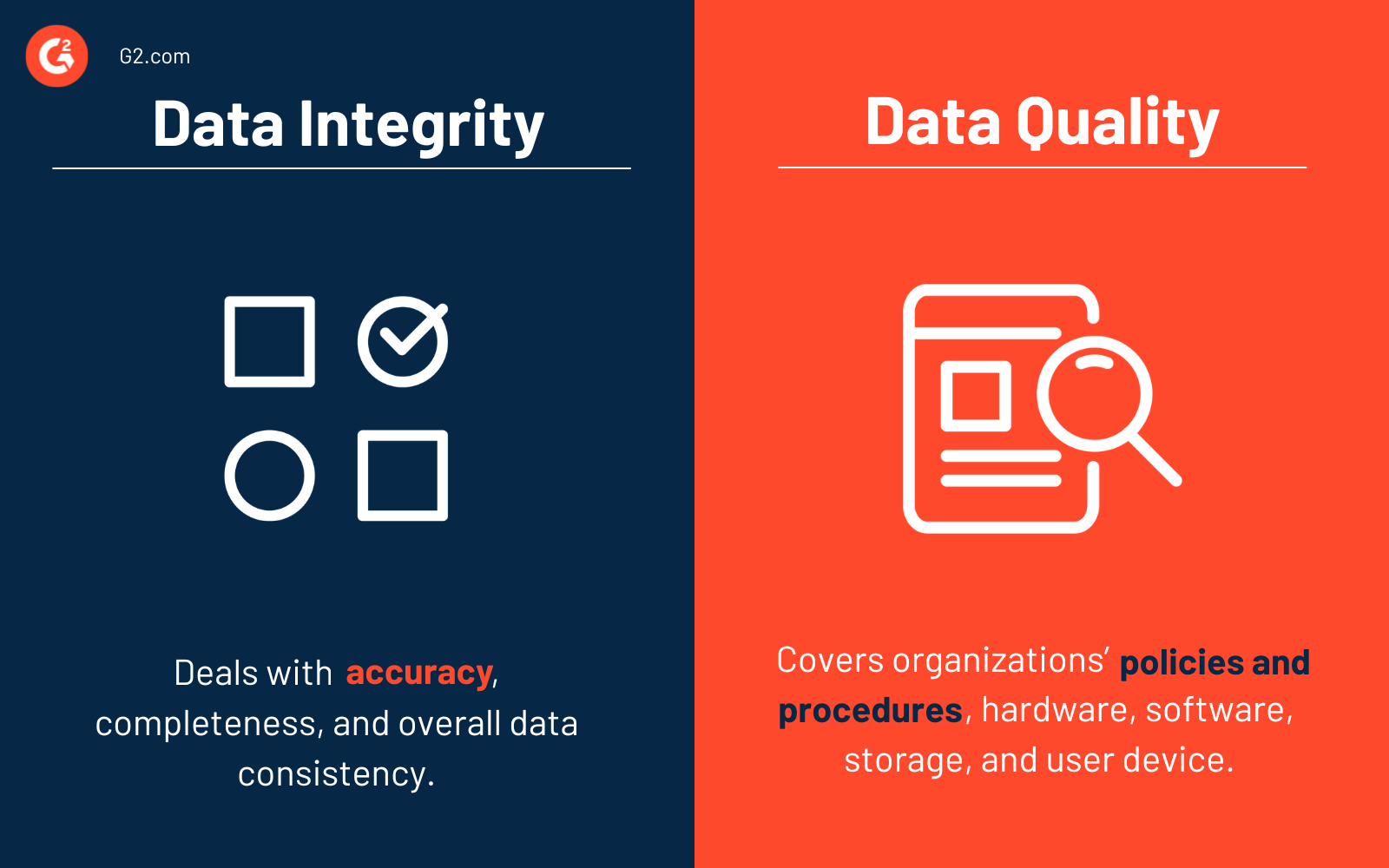
Data Integrity vs. Data Quality

Data integrity deals with accuracy, completeness, and overall data consistency. In terms of security and legal compliance, such as GDPR compliance, data integrity also refers to data security. A set of procedures, guidelines, and standards put in place during the design stage are responsible for keeping it up to date. No matter how long it is kept or how frequently it is accessed, information stored in a database will remain accurate, complete, and trustworthy if the integrity of the data is secure.

The process of preserving digital information throughout its entire lifecycle to guard it against corruption, theft, or unauthorized access is known as data security. It covers everything, including organizations’ policies and procedures, hardware, software, storage, and user devices. Tools and technologies used in data security make it easier to see how a company uses its data.

Through techniques like data masking, encryption, and redaction of sensitive information, companies protect their data against cyber threats. Additionally, the process aids businesses in simplifying auditing procedures and adhering to data protection laws that are becoming stricter.

Learn more about encryption to maintain data integrity throughout its lifecycle effectively.

Sagar Joshi
SJ

Sagar Joshi

Sagar Joshi is a former content marketing specialist at G2 in India. He is an engineer with a keen interest in data analytics and cybersecurity. He writes about topics related to them. You can find him reading books, learning a new language, or playing pool in his free time.

Data Integrity Software

This list shows the top software that mention data integrity most on G2.

Sell faster, smarter, and more efficiently with AI + Data + CRM. Boost productivity and grow in a whole new way with Sales Cloud.

Find your next customer with ZoomInfo Sales, the biggest, most accurate, and most frequently refreshed database of contact and company insights, intelligence, and purchasing intent data, all in one, modern go-to-market platform.

DemandTools is a data quality toolset for Salesforce CRM. De-deduplication, normalization, standardization, comparison, import, export, mass delete, and more.

Smartsheet is a modern work management platform that helps teams manage projects, automate processes, and scale workflows all in one central platform.

SQL Server 2017 brings the power of SQL Server to Windows, Linux and Docker containers for the first time ever, enabling developers to build intelligent applications using their preferred language and environment. Experience industry-leading performance, rest assured with innovative security features, transform your business with AI built-in, and deliver insights wherever your users are with mobile BI.

The platform was built to help you get better at recruiting. Find better talent, conduct more meaningful interviews and get the data you need to improve your process and make the right decisions, faster.

With SharePoint you can manage versions, apply retention schedules, declare records, and place legal holds, whether you're dealing with traditional content, Web content.

Leading Engagement Platform that empowers marketers to build brand value, grow revenue, and prove impact.

Vena’s corporate performance management software combines native Microsoft® Excel® with the sophisticated workflow, audit capabilities, business rules and central database of an enterprise-class solution.

MySQL is the world's most popular open-source database, renowned for its reliability, performance, and ease of use. It serves as the backbone for many high-profile web applications, including those of Facebook, Twitter, and YouTube. MySQL offers a comprehensive suite of features that cater to the needs of modern web, mobile, embedded, and cloud applications. Key Features and Functionality: - Transactional Data Dictionary: Implemented as a set of SQL tables stored in a single InnoDB tablespace, enhancing data management efficiency. - Common Table Expressions (CTEs): Also known as WITH queries, CTEs simplify complex queries and improve readability. - Window Functions: These functions reduce code complexity and boost developer productivity by allowing calculations across sets of table rows related to the current row. - Invisible Indexes: Facilitate better management of software upgrades and database changes for applications that require continuous operation. - Descending Indexes: Eliminate the need for sorting results, leading to performance improvements. - JSON Support: Includes the JSON_TABLE() function, which accepts JSON data and returns it as a relational table, enhancing flexibility in data handling. - Document Store: Allows the development of both SQL and NoSQL document applications using a single database, providing versatility in application design. - SQL Roles: Simplify permission management by granting and denying permissions to groups of users, thereby reducing the security workload. - OpenSSL Integration: Utilizes OpenSSL as the default TLS/SSL library, ensuring secure data transmission. - Default to utf8mb4 Character Set: Supports richer mobile applications and international character sets, accommodating a global user base. - Geographic Information System (GIS) Enhancements: Supports geography and Spatial Reference Systems (SRS), enabling advanced spatial data analysis. - InnoDB Cluster: Provides improved high availability through integrated solutions. - InnoDB ClusterSet: Offers cross-region disaster recovery capabilities, ensuring data resilience. - Replication: Provides flexible topologies for scale-out and high availability, enhancing system robustness. - Reliability: Requires minimal intervention to achieve continuous uptime, ensuring consistent performance. - Partitioning: Improves performance and management of very large database environments by dividing tables into smaller, more manageable pieces. - ACID Transactions: Ensures reliable and secure business-critical applications by supporting Atomicity, Consistency, Isolation, and Durability. - Stored Procedures and Triggers: Enhance developer productivity and enforce complex business rules at the database level. - Views: Ensure sensitive information is not compromised by providing controlled access to data. - Ease of Use: Offers a "3 minutes from download to development" installation and configuration process, facilitating quick deployment. - Low Administration: Requires very little database maintenance, reducing operational overhead. Primary Value and User Solutions: MySQL delivers a robust, scalable, and secure database solution that addresses the needs of developers and enterprises alike. Its comprehensive feature set supports the development of high-performance applications across various platforms, including web, mobile, embedded, and cloud environments. By offering advanced functionalities such as ACID compliance, high availability, and flexible replication, MySQL ensures data integrity and reliability. Its ease of use and low administrative requirements enable organizations to reduce operational costs and accelerate time-to-market for their applications. Furthermore, MySQL's support for modern development practices, including JSON and NoSQL capabilities, allows developers to build versatile and future-proof applications.

PostgreSQL is a powerful, open-source object-relational database system renowned for its reliability, extensibility, and adherence to SQL standards. Originating from the POSTGRES project at the University of California at Berkeley in 1986, it has evolved over nearly four decades into a robust platform capable of handling complex data workloads across various operating systems. PostgreSQL's architecture emphasizes data integrity and scalability, making it a preferred choice for developers and organizations worldwide. Key Features and Functionality: - Comprehensive Data Types: Supports a wide range of data types, including primitives (Integer, Numeric, String, Boolean), structured (Date/Time, Array, Range), document (JSON/JSONB, XML), and geometric types. - Advanced Data Integrity: Ensures data accuracy through features like UNIQUE constraints, primary and foreign keys, exclusion constraints, and various locking mechanisms. - High Performance and Concurrency: Utilizes advanced indexing methods (B-tree, GiST, GIN, BRIN), a sophisticated query planner, multi-version concurrency control (MVCC), parallel query execution, and table partitioning to optimize performance. - Reliability and Disaster Recovery: Offers write-ahead logging (WAL), various replication methods (asynchronous, synchronous, logical), point-in-time recovery (PITR), and active standbys to ensure data durability and availability. - Robust Security Measures: Provides multiple authentication methods (GSSAPI, SSPI, LDAP, SCRAM-SHA-256, Certificate, OAuth 2.0), a comprehensive access-control system, and supports multi-factor authentication. - Extensibility: Allows the creation of custom data types, functions, and operators. Supports procedural languages like PL/pgSQL, Perl, Python, and Tcl, with additional languages available through extensions. Primary Value and User Solutions: PostgreSQL addresses the needs of developers and organizations by offering a highly extensible and standards-compliant database system that ensures data integrity, scalability, and robust performance. Its open-source nature allows for continuous innovation and adaptability, enabling users to tailor the database to their specific requirements. Whether managing small applications or large-scale enterprise systems, PostgreSQL provides a reliable foundation for storing and processing data efficiently.

Marketing automation software to help you attract the right audience, convert more visitors into customers, and run complete inbound marketing campaigns at scale — all on one powerful, easy-to-use CRM platform.

The smarter iPaaS integration platform for connecting your apps and synchronizing data

Anchored by Dun & Bradstreet’s powerful D-U-N-S® Numbering System, D&B Hoovers (formerly Avention) uses sophisticated analytics to deliver a sales acceleration solution packed with insight.

The STARLIMS Quality Manufacturing Informatics Platform simplifies complex processes, easily integrates with other tools and systems, and extends data collection beyond the lab with one system, and one partner. Underpinned by our comprehensive technology platform and flexible infrastructure offerings, you have everything you need for a fast launch without compromising on security or functionality. Seamlessly integrate your LIMS with SDMS, LES, ELN, Advanced Analytics, and mobile solutions to meet your Quality Manufacturing needs in and outside the lab.

Sales Hub is a modern sales software that helps teams build pipeline, accelerate deal velocity, and create stronger customer connections. Powered by HubSpot’s Smart CRM, it combines AI, automation, and insights in one easy-to-use platform, so reps can sell smarter and scale without added complexity.

Oracle Database is a comprehensive, multi-model database management system developed by Oracle Corporation. It is designed to handle various data types and workloads, including online transaction processing (OLTP), data warehousing, and mixed database operations. With its robust architecture, Oracle Database supports deployment across on-premises environments, cloud platforms, and hybrid configurations, offering flexibility and scalability to meet diverse business needs. Key Features and Functionality: - Multi-Model Support: Oracle Database accommodates various data models, including relational, document, graph, and key-value, enabling developers to work with diverse data types within a single platform. - Advanced Analytics: The database integrates advanced analytics capabilities, such as in-database machine learning and AI Vector Search, allowing users to perform complex analyses directly within the database environment. - High Availability and Scalability: Designed for mission-critical applications, Oracle Database offers features like data replication, backup, server clustering, and automatic storage management to ensure high availability and seamless scalability. - Security: With comprehensive security measures, including encryption, SQL Firewall, and data masking, Oracle Database safeguards sensitive information and maintains data integrity. - Multicloud Deployment: Oracle Database supports deployment across various cloud platforms, including Oracle Cloud Infrastructure, AWS, Microsoft Azure, and Google Cloud, providing flexibility and compliance with data residency requirements. Primary Value and Solutions Provided: Oracle Database addresses the complex data management needs of modern enterprises by offering a unified platform that supports multiple data models and workloads. Its integration of AI and machine learning capabilities enables organizations to derive actionable insights directly from their data, enhancing decision-making processes. The database's high availability and scalability ensure that businesses can maintain continuous operations and adapt to growing data demands. Additionally, its robust security features protect against data breaches and ensure compliance with regulatory standards. By supporting multicloud deployments, Oracle Database provides the flexibility to operate in various cloud environments, facilitating seamless integration and innovation across different platforms.

LabWare LIMS has been the most technically advanced Laboratory Information Management System since its introduction to the market, and it continues to hold that position today. LabWare delivers a comprehensive and scalable laboratory informatics solution that not only meets the diverse needs of different industries but also enables users to drive innovation, improve decision-making, and achieve operational excellence.

SAP ECC software is a proven foundation for the world's largest organizations. Streamline procurement, manufacturing, service, sales, finance, and HR processes.

Designed for organizations that prioritize diverse workforces and cultures of trust and belonging, UKG Pro® puts people at the center of your strategy. From HR and complex payroll to talent and industry-focused workforce management (WFM),our comprehensive human capital management solution (HCM) anticipates people’s needs beyond just work. We partner with you every step of the way to drive better business outcomes and create great workplaces for all.