# Best E-Commerce Platforms with B2C Capabilities

  *By [Subhransu Sahu](https://research.g2.com/insights/author/subhransu-sahu)*

   This page was last updated on June 9th, 2025

An e-commerce platform is a comprehensive software that allows companies to manage all operations related to online sales of products or services. E-commerce platforms create a centralized, digital hub for product and customer data, allowing e-commerce businesses to manage product information, personalize store content and layout, and process online transactions and payments. While most e-commerce platforms are designed for B2C sales, some vendors provide versions for B2B. Traditional e-commerce platforms focus on managing sales of physical products, but more and more solutions are providing features for digital products that are sold as a subscription model. This type of software can be used by all employees of an online commerce company but is most beneficial for sales, product management, and marketing.

The [best e-commerce platforms](https://learn.g2.com/best-ecommerce-platforms) unify, scale, and maintain core business processes like the front-facing selling of products and services and the back-end functions of managing inventory and shipping. This type of software should not be confused with [shopping cart software](https://www.g2.com/categories/shopping-cart), which can only be used to create and manage online stores. E-commerce platforms generally integrate with [inventory management software](https://www.g2.com/categories/inventory-management) and [drop shipping software](https://www.g2.com/categories/drop-shipping). B2B e-commerce platforms integrate with [CRM software](https://www.g2.com/categories/crm), [ERP systems](https://www.g2.com/categories/erp-systems), and [supply chain &amp; logistics software](https://www.g2.com/categories/supply-chain-logistics)

To qualify for inclusion in the E-commerce Platforms category, a product must:

- Help companies run their e-commerce business on a single, unified platform
- Manage e-commerce products and services, as well as product information
- Deliver standard options to create online stores that can be customized
- Include functionality for personalization to improve the customer experience
- Provide features for or integrate with drop shipping and inventory management software
- Track and manage customers, their order history, and online behavior
- Allow companies to choose between multiple payment options and gateways
- Support the headless commerce architecture and provide native mobile apps
- Offer security, or encryption of data and information, or both and comply with regulations
- Include features for e-commerce data management, integration, and search


## Category Overview

**Total Products under this Category:** 537


## Trust & Credibility Stats

**Why You Can Trust G2's Software Rankings:**

- 30 Analysts and Data Experts
- 23,500+ Authentic Reviews
- 537+ Products
- Unbiased Rankings

G2's software rankings are built on verified user reviews, rigorous moderation, and a consistent research methodology maintained by a team of analysts and data experts. Each product is measured using the same transparent criteria, with no paid placement or vendor influence. While reviews reflect real user experiences, which can be subjective, they offer valuable insight into how software performs in the hands of professionals. Together, these inputs power the G2 Score, a standardized way to compare tools within every category.


---

**Sponsored**

### SAP Commerce Cloud

The SAP Commerce solutions delivers feature rich digital commerce capabilities built on a modern cloud native platform that will enable businesses to innovate quickly and deliver the perfect fit digital commerce solution for your business. SAP Commerce has the broadest and varying customer base with over 3500 customers, representing 20 industries across 100 countries. Customers trust our solution for its ability to scale and perform, customers has transacted over 570B+ dollars of gross merchandising value representing over 120M+ orders on our ecommerce platform.


[Visit company website](https://www.g2.com/external_clickthroughs/record?secure%5Bad_program%5D=paid_promo&amp;secure%5Bad_slot%5D=category_product_list&amp;secure%5Bcategory_id%5D=34&amp;secure%5Bmedium%5D=sponsored&amp;secure%5Bprioritized%5D=false&amp;secure%5Bproduct_id%5D=785&amp;secure%5Bresource_id%5D=34&amp;secure%5Bresource_type%5D=Category&amp;secure%5Bsource_type%5D=category_page&amp;secure%5Bsource_url%5D=https%3A%2F%2Fwww.g2.com%2Fcategories%2Fe-commerce-platforms%2Ff%2Fproduct-configuration&amp;secure%5Btoken%5D=87db0e463df74dfe3cb167eed16aa27818176f36f8ede4d4c47516d8966e3b3e&amp;secure%5Burl%5D=https%3A%2F%2Fwww.sap.com%2Findia%2Fproducts%2Fcrm%2Fcommerce-cloud.html&amp;secure%5Burl_type%5D=paid_promos)

---

## Top-Rated Products (Ranked by G2 Score)
  ### 1. [Shopio](https://www.g2.com/products/shopio/reviews)
  Create your online store today! No risk. No credit card required.


  **Average Rating:** 4.3/5.0
  **Total Reviews:** 15

**User Satisfaction Scores:**

- **Has the product been a good partner in doing business?:** 8.3/10 (Category avg: 8.8/10)
- **Extensibility:** 8.3/10 (Category avg: 8.4/10)
- **Customization:** 6.1/10 (Category avg: 8.4/10)
- **Data Orchestration:** 7.2/10 (Category avg: 8.3/10)


**Seller Details:**

- **Seller:** [Shopio ECommerce Software Solution, Inc.](https://www.g2.com/sellers/shopio-ecommerce-software-solution-inc)
- **HQ Location:** San Francisco, CA
- **Twitter:** @shopiocom (6,814 Twitter followers)
- **LinkedIn® Page:** https://www.linkedin.com/company/shopio (1 employees on LinkedIn®)
- **Phone:** 1-415-800-4137

**Reviewer Demographics:**
  - **Company Size:** 53% Small-Business, 27% Mid-Market


  ### 2. [ASKNET SOLUTIONS](https://www.g2.com/products/asknet-solutions/reviews)
  Provides global and fully customizable on-demand solutions as well as comprehensive full services for world-class eCommerce, to manage transactions for B2C and B2B publishers of digital media. asknet provides you with all the tools needed to go to market in 190+ markets (tax, payments, fraud prevention, security, etc.), while focusing on customer success excellence to grow your revenue and conversion rates with personalized branded checkouts for your customers adapted to different geographical locations, as well as other support services such as UX/UI. Asknet customers value the vast availability of different features, and the customization and flexibility of the customer success team. More info: www.asknet-ecommerce.com


  **Average Rating:** 4.1/5.0
  **Total Reviews:** 11

**User Satisfaction Scores:**

- **Has the product been a good partner in doing business?:** 8.3/10 (Category avg: 8.8/10)
- **Extensibility:** 7.9/10 (Category avg: 8.4/10)
- **Customization:** 8.1/10 (Category avg: 8.4/10)
- **Data Orchestration:** 8.9/10 (Category avg: 8.3/10)


**Seller Details:**

- **Seller:** [ASKNET AG](https://www.g2.com/sellers/asknet-ag)
- **Year Founded:** 1995
- **HQ Location:** Karlsruhe, Germany
- **LinkedIn® Page:** https://www.linkedin.com/company/36911 (25 employees on LinkedIn®)

**Reviewer Demographics:**
  - **Company Size:** 64% Mid-Market, 18% Small-Business


  ### 3. [Workarea](https://www.g2.com/products/workarea/reviews)
  Workarea is the only digital commerce platform built on a modern tech stack uniting commerce, content and insights in one application. Workarea is the SaaS platform of choice for growing mid to enterprise-level online retailers and merchants such as Sanrio/Hello Kitty, Do it Best Corp., The Bouqs, Woodcraft, Costume SuperCenter, Lime Crime, Reformation, and many others.


  **Average Rating:** 4.5/5.0
  **Total Reviews:** 11

**User Satisfaction Scores:**

- **Has the product been a good partner in doing business?:** 9.3/10 (Category avg: 8.8/10)
- **Extensibility:** 8.9/10 (Category avg: 8.4/10)
- **Customization:** 8.9/10 (Category avg: 8.4/10)
- **Data Orchestration:** 9.4/10 (Category avg: 8.3/10)


**Seller Details:**

- **Seller:** [WebLinc](https://www.g2.com/sellers/weblinc)
- **Year Founded:** 2015
- **HQ Location:** Philadelphia, PA
- **Twitter:** @workarea (2 Twitter followers)
- **LinkedIn® Page:** https://www.linkedin.com/company/No-Linkedin-Presence-Added-Intentionally-By-DataOps (1 employees on LinkedIn®)

**Reviewer Demographics:**
  - **Company Size:** 64% Small-Business, 36% Mid-Market


#### Pros & Cons

**Pros:**

- Customizability (1 reviews)
- Customization Options (1 reviews)
- Ease of Use (1 reviews)


  ### 4. [EKM](https://www.g2.com/products/ekm/reviews)
  EKM is the UK&#39;s most popular ecommerce platform, it&#39;s everything you need to create a successful online shop. Your online shop continuously improves thanks to our unique Evolution Mode. With UK support and your own dedicated Account Manager to get you setup, EKM is the quickest and easiest way to sell your products online.


  **Average Rating:** 4.2/5.0
  **Total Reviews:** 9

**User Satisfaction Scores:**

- **Extensibility:** 6.7/10 (Category avg: 8.4/10)
- **Customization:** 7.9/10 (Category avg: 8.4/10)
- **Data Orchestration:** 8.3/10 (Category avg: 8.3/10)


**Seller Details:**

- **Seller:** [Ekm.Com](https://www.g2.com/sellers/ekm-com)
- **Year Founded:** 2002
- **HQ Location:** Preston, GB
- **LinkedIn® Page:** https://www.linkedin.com/company/ekm.com (143 employees on LinkedIn®)

**Reviewer Demographics:**
  - **Company Size:** 56% Mid-Market, 22% Small-Business


#### Pros & Cons

**Pros:**

- E-commerce Services (1 reviews)
- Reliability (1 reviews)

**Cons:**

- Data Management (1 reviews)
- Missing Features (1 reviews)

  ### 5. [ROC Commerce](https://www.g2.com/products/roc-commerce/reviews)
  ROC Commerce is the complete omni-channel commerce solution for your business. Whether B2C or B2B, business success with ROC Commerce is built upon experience with your future in focus. ROC Commerce provides the functionality and flexibility you’ve been looking for in today’s best ecommerce solution. We offer the market’s smartest AI and machine-learning search, right out of the box. Would you like to customize shipping offers? Offer item-level discounts? We do that. You will be capable of running multiple sales and promotions with ease. By combining the best ecommerce strategies into a modern platform, ROC Commerce is ready to exceeds your expectations while maintaining constant focus on speed, flexibility and affordability.


  **Average Rating:** 4.2/5.0
  **Total Reviews:** 9

**User Satisfaction Scores:**

- **Has the product been a good partner in doing business?:** 7.8/10 (Category avg: 8.8/10)
- **Extensibility:** 7.5/10 (Category avg: 8.4/10)
- **Customization:** 6.7/10 (Category avg: 8.4/10)
- **Data Orchestration:** 8.3/10 (Category avg: 8.3/10)


**Seller Details:**

- **Seller:** [Real Omni Channel Commerce](https://www.g2.com/sellers/real-omni-channel-commerce)
- **Year Founded:** 2010
- **HQ Location:** Des Plaines, Illinois
- **Twitter:** @_roccommerce (23 Twitter followers)
- **LinkedIn® Page:** https://www.linkedin.com/company/10520797 (1 employees on LinkedIn®)

**Reviewer Demographics:**
  - **Company Size:** 36% Mid-Market, 36% Small-Business


  ### 6. [corecommerce](https://www.g2.com/products/corecommerce/reviews)
  eCommerce platforms for store creation, hosting and payments. Choose from a variety of responsive templates, or have us build your custom store or just add us as your shopping cart linked to your existing website. Our customizable hosted payments page products can also work as a standalone, secure product for collecting payments from your clients.


  **Average Rating:** 3.9/5.0
  **Total Reviews:** 8

**User Satisfaction Scores:**

- **Has the product been a good partner in doing business?:** 9.4/10 (Category avg: 8.8/10)
- **Extensibility:** 5.8/10 (Category avg: 8.4/10)
- **Customization:** 5.8/10 (Category avg: 8.4/10)
- **Data Orchestration:** 5.0/10 (Category avg: 8.3/10)


**Seller Details:**

- **Seller:** [corecommerce](https://www.g2.com/sellers/corecommerce)
- **Year Founded:** 2001
- **HQ Location:** Nashville-Davidson, Tennessee
- **Twitter:** @CoreCommerce (3,252 Twitter followers)
- **LinkedIn® Page:** https://www.linkedin.com/company/corecommerce/ (11 employees on LinkedIn®)

**Reviewer Demographics:**
  - **Company Size:** 63% Mid-Market, 38% Enterprise


#### Pros & Cons

**Pros:**

- Customer Support (1 reviews)
- Ease of Use (1 reviews)
- Easy Integration (1 reviews)
- E-commerce Services (1 reviews)
- Quick Setup (1 reviews)

**Cons:**

- Poor Customer Support (2 reviews)
- Accounting Issues (1 reviews)
- Limitations (1 reviews)

  ### 7. [Acenda](https://www.g2.com/products/acenda/reviews)
  Acenda is a cloud eCommerce platform that enables manufacturers, distributors, and vertical retailers to build a webstore, connect products to multiple sales channels, control and sync inventory, manage and fulfill orders, access detailed reporting, run experimentation -- and ultimately increase conversions.


  **Average Rating:** 4.4/5.0
  **Total Reviews:** 7

**User Satisfaction Scores:**

- **Has the product been a good partner in doing business?:** 10.0/10 (Category avg: 8.8/10)
- **Extensibility:** 10.0/10 (Category avg: 8.4/10)
- **Customization:** 10.0/10 (Category avg: 8.4/10)
- **Data Orchestration:** 10.0/10 (Category avg: 8.3/10)


**Seller Details:**

- **Seller:** [Acenda.com](https://www.g2.com/sellers/acenda-com)
- **Year Founded:** 2013
- **HQ Location:** San Diego, US
- **Twitter:** @Acenda_Official (28 Twitter followers)
- **LinkedIn® Page:** https://www.linkedin.com/company/3599281 (25 employees on LinkedIn®)

**Reviewer Demographics:**
  - **Company Size:** 71% Small-Business, 29% Mid-Market


#### Pros & Cons

**Pros:**

- Customer Service (1 reviews)
- Customer Support (1 reviews)
- Ease of Use (1 reviews)
- Quick Setup (1 reviews)
- Reliability (1 reviews)

**Cons:**

- Expensive (1 reviews)

  ### 8. [Kentro](https://www.g2.com/products/kentro/reviews)
  Kentro: The Next-Generation ERP &amp; 3PL for E-Commerce In an era where eCommerce operations demand agility and efficiency, Kentro emerges as the modern alternative to traditional ERP systems like NetSuite or SAP. As a cloud-based, multi-channel ERP and in house 3PL solution, Kentro is designed specifically for the eCommerce landscape, offering a suite of features that streamline operations, fulfillment, and logistics at a fraction of the cost and complexity. Why Choose Kentro? - Modern ERP &amp; 3PL Solution: Built for the E-Commerce age, Kentro offers advanced capabilities for both inventory management and order fulfillment, outperforming old-school systems. - Cost-Effective: Experience the power of a high-end ERP system like NetSuite or SAP, with the added benefit of 3PL services, at a more accessible price point. - User-Friendly Interface: Navigate through your e-commerce operations with an interface that’s both easy to use and highly effective. - Real-Time Operation: Stay ahead with real-time inventory management, order fulfillment, and supply chain insights integrated with 3PL for seamless logistics. Key Features: - Built-in B2B Online Store: Seamless management of both customer and business sales. - Real-Time Inventory Management: Always know your stock levels and manage them efficiently with integrated 3PL. - Order Fulfillment &amp; Routing: Smooth, automated order processing with integrated shipping and fulfillment. - 3PL Services: Streamlined fulfillment for DTC and B2B with same-day shipping and efficient warehouse management. - Drop-Ship Automations: Simplify your drop-shipping process. - Supply Chain Management: Gain complete control over your supply chain. - Product Catalog Management: Easily manage and update your product listings. - Multi-Channel Listing: Integrate and synchronize your sales across various platforms. - Workflow Automation: Customizable rules engine to automate your daily tasks. - Accounting Automation: Keep your financial data synchronized and updated. - Vendor/Supplier Dashboard: Dedicated portals for your business partners. - Communication Automation: Automated email and SMS notifications and alerts. - Refund Management: Streamline your refund processes. - Custom API Integration: Open Channel and Store APIs for bespoke integrations. Your E-Commerce Operations, Redefined Kentro is more than an ERP; it’s a strategic partner in your e-commerce journey, now with fully integrated 3PL services. With direct integrations to over 100 external tools and 5000+ zaps, Kentro bridges the gap between disparate processes, turning complex operations into streamlined workflows. Ready to transform your e-commerce operations? Discover the Kentro difference today!


  **Average Rating:** 4.8/5.0
  **Total Reviews:** 17

**User Satisfaction Scores:**

- **Has the product been a good partner in doing business?:** 10.0/10 (Category avg: 8.8/10)


**Seller Details:**

- **Seller:** [Kentro](https://www.g2.com/sellers/kentro)
- **Year Founded:** 2021
- **HQ Location:** Sao Paulo, SP
- **LinkedIn® Page:** https://www.linkedin.com/company/kentro-sistemas/ (36 employees on LinkedIn®)

**Reviewer Demographics:**
  - **Top Industries:** Consumer Goods, Health, Wellness and Fitness
  - **Company Size:** 76% Mid-Market, 24% Small-Business


#### Pros & Cons

**Pros:**

- Customer Support (3 reviews)
- Ease of Use (3 reviews)
- Affordable (2 reviews)
- Automation (2 reviews)
- Cost Efficiency (2 reviews)

**Cons:**

- Feature Limitations (1 reviews)
- Implementation Issues (1 reviews)
- Incomplete Development (1 reviews)
- Limited Features (1 reviews)
- Limited Integration (1 reviews)

  ### 9. [oorjit](https://www.g2.com/products/oorjit/reviews)
  Oorjit pioneers in providing a complete customer and merchant engagement solution. A highly flexible and scale-able platform that can adapts &amp; evolve based on your market needs. Engage the right audience using any of the multiple solutions from a single platform powered by Oorjit. Each solution delivers a unique type of customer-merchant engagement so select the one that best suits your need. WHY OORJIT? \&gt;\&gt;Dynamic catalog management and inventory synchronization features \&gt;\&gt;Marketing tools enabling personalized promotions and offers \&gt;\&gt;Loyalty program with referral rewards and point redemption \&gt;\&gt;Powerful Content Management System \&gt;\&gt;Marketplace integration to sell on Amazon and eBay \&gt;\&gt;Integrated affiliate and sales person modules \&gt;\&gt;Supports multi-vendor and multi-store business models \&gt;\&gt;Internationalization and Localization Capabilities \&gt;\&gt;Built in analytic to measure customer behavior and sales


  **Average Rating:** 4.2/5.0
  **Total Reviews:** 7

**User Satisfaction Scores:**

- **Has the product been a good partner in doing business?:** 8.9/10 (Category avg: 8.8/10)


**Seller Details:**

- **Seller:** [ISPG Technologies I Pvt Ltd](https://www.g2.com/sellers/ispg-technologies-i-pvt-ltd)
- **Year Founded:** 2005
- **HQ Location:** Dubai, Dubai, United Arab Emirates
- **Twitter:** @oorjitplatform (308 Twitter followers)
- **LinkedIn® Page:** https://www.linkedin.com/company/744862/ (312 employees on LinkedIn®)

**Reviewer Demographics:**
  - **Company Size:** 57% Small-Business, 29% Mid-Market


#### Pros & Cons

**Pros:**

- Ease of Use (1 reviews)
- Easy Integration (1 reviews)
- E-commerce Services (1 reviews)
- Flexibility (1 reviews)
- Navigation Ease (1 reviews)

**Cons:**

- Confusion (1 reviews)

  ### 10. [IZBERG](https://www.g2.com/products/izberg/reviews)
  Briefly, IZBERG provides the most advanced Marketplace platform on the market, allowing mid-size and large companies to increase their revenues, lower their costs, and offer an outstanding shopping experience to their customers.


  **Average Rating:** 4.3/5.0
  **Total Reviews:** 6

**User Satisfaction Scores:**

- **Extensibility:** 8.3/10 (Category avg: 8.4/10)
- **Customization:** 8.3/10 (Category avg: 8.4/10)
- **Data Orchestration:** 7.9/10 (Category avg: 8.3/10)


**Seller Details:**

- **Seller:** [IZBERG](https://www.g2.com/sellers/izberg)
- **Year Founded:** 2014
- **HQ Location:** Levallois-Perret, FR
- **Twitter:** @IZBERG_MP (1,672 Twitter followers)
- **LinkedIn® Page:** https://www.linkedin.com/company/2525286 (14 employees on LinkedIn®)

**Reviewer Demographics:**
  - **Company Size:** 67% Mid-Market, 33% Small-Business


#### Pros & Cons

**Pros:**

- Asset Management (2 reviews)
- Business Growth (2 reviews)
- E-commerce Services (2 reviews)
- Features (1 reviews)
- Online Sales (1 reviews)

**Cons:**

- Data Inaccuracy (1 reviews)
- Data Management (1 reviews)
- Inefficient Workflow (1 reviews)
- Integration Challenges (1 reviews)
- Integration Issues (1 reviews)

  ### 11. [SmarterCommerce](https://www.g2.com/products/smartercommerce/reviews)
  SmarterCommerce was developed and introduced to the JD Edwards marketplace as a unified commerce solution providing world-class capabilities in the areas of Payment Processing, B2C and B2B Ecommerce, Mobile Commerce, Retail Point-of-Sale (POS) and Call Center solutions together with unparalleled integration with JD Edwards. All our solutions have been certified as Oracle Validated Integrations and comply with the latest Payment Card Industry (PCI) Payment Application Data Security Standards (PA-DSS). In addition to rapid deployment of SmarterCommerce, our implementation services can be delivered on a fixed fee basis to dramatically reduce project risks and ensure a predictable cost and ROI.


  **Average Rating:** 3.9/5.0
  **Total Reviews:** 6

**User Satisfaction Scores:**

- **Has the product been a good partner in doing business?:** 8.3/10 (Category avg: 8.8/10)
- **Extensibility:** 9.2/10 (Category avg: 8.4/10)
- **Customization:** 8.3/10 (Category avg: 8.4/10)
- **Data Orchestration:** 7.5/10 (Category avg: 8.3/10)


**Seller Details:**

- **Seller:** [Smarter Commerce](https://www.g2.com/sellers/smarter-commerce)
- **Year Founded:** 1993
- **HQ Location:** Miami, US
- **Twitter:** @PremierGroupIT (37 Twitter followers)
- **LinkedIn® Page:** https://www.linkedin.com/company/smartercommerce/ (59 employees on LinkedIn®)

**Reviewer Demographics:**
  - **Company Size:** 67% Mid-Market, 33% Small-Business


  ### 12. [Swell](https://www.g2.com/products/swell-2019-12-28/reviews)
  Swell is the most powerful headless ecommerce platform for enterprises, agencies and startups. Powerful performance combined with unlimited design possibilities, a sleek dashboard and a modern developer workflow make Swell a perfect choice for the modern online business. Modern online storefronts can be created with any web, mobile or VR/AR technology. Build D2C, B2B, marketplaces, subscriptions, pre-orders, enterprise or any custom online experiences without having to code from scratch. A truly API-first approach and headless architecture enables small to medium businesses and middle-market enterprises alike to sell creatively and grow rapidly through a robust and customizable solution.


  **Average Rating:** 4.2/5.0
  **Total Reviews:** 8

**User Satisfaction Scores:**

- **Has the product been a good partner in doing business?:** 10.0/10 (Category avg: 8.8/10)
- **Extensibility:** 10.0/10 (Category avg: 8.4/10)
- **Customization:** 10.0/10 (Category avg: 8.4/10)
- **Data Orchestration:** 10.0/10 (Category avg: 8.3/10)


**Seller Details:**

- **Seller:** [Swell](https://www.g2.com/sellers/swell)
- **HQ Location:** Denver, US
- **Twitter:** @swelldotcom (8,771 Twitter followers)
- **LinkedIn® Page:** https://www.linkedin.com/company/swellcommerce/ (18 employees on LinkedIn®)

**Reviewer Demographics:**
  - **Company Size:** 50% Small-Business, 38% Mid-Market


#### Pros & Cons

**Pros:**

- Ease of Use (3 reviews)
- Analytics (1 reviews)
- Analytics Tracking (1 reviews)
- Customizability (1 reviews)
- Customization Options (1 reviews)

**Cons:**

- Confusion (2 reviews)
- Learning Curve (2 reviews)
- Limited Customization (2 reviews)
- Connectivity Issues (1 reviews)
- Difficult Modifications (1 reviews)

  ### 13. [Odoo eCommerce](https://www.g2.com/products/odoo-odoo-ecommerce/reviews)
  Modern open source online store.Awesome product pages. Mobile friendly. Easy


  **Average Rating:** 4.3/5.0
  **Total Reviews:** 4

**User Satisfaction Scores:**

- **Has the product been a good partner in doing business?:** 7.9/10 (Category avg: 8.8/10)
- **Data Orchestration:** 6.7/10 (Category avg: 8.3/10)


**Seller Details:**

- **Seller:** [Odoo](https://www.g2.com/sellers/odoo)
- **Year Founded:** 2005
- **HQ Location:** Brussels, Belgium
- **Twitter:** @Odoo (55,191 Twitter followers)
- **LinkedIn® Page:** https://www.linkedin.com/company/633558/ (7,994 employees on LinkedIn®)

**Reviewer Demographics:**
  - **Company Size:** 100% Small-Business


#### Pros & Cons

**Pros:**

- Inventory Management (1 reviews)

**Cons:**

- Poor Customer Support (1 reviews)

  ### 14. [Singularity](https://www.g2.com/products/singularity/reviews)
  Singularity solves the challenges of managing content, products, inventory, pricing, customers, sales teams &amp; multichannel orders with proven, comprehensive solutions for your unique business.


  **Average Rating:** 4.6/5.0
  **Total Reviews:** 4

**User Satisfaction Scores:**

- **Extensibility:** 10.0/10 (Category avg: 8.4/10)
- **Customization:** 10.0/10 (Category avg: 8.4/10)
- **Data Orchestration:** 10.0/10 (Category avg: 8.3/10)


**Seller Details:**

- **Seller:** [Singularity](https://www.g2.com/sellers/singularity)
- **Year Founded:** 2001
- **HQ Location:** Denver, US
- **Twitter:** @S1Commerce (73 Twitter followers)
- **LinkedIn® Page:** https://www.linkedin.com/company/6632265 (3 employees on LinkedIn®)

**Reviewer Demographics:**
  - **Company Size:** 60% Mid-Market, 40% Small-Business


  ### 15. [UniformMarket by Sellerscommerce](https://www.g2.com/products/uniformmarket-by-sellerscommerce/reviews)
  UniformMarket is the #1 ecommerce platform for the uniforms industry. With over 90+ years of experience in the uniform industry, no one is better equipped to understand the needs of uniform providers. Since 2005, over 1200+ retailers, manufacturers, and distributors have used our ecommerce software to sell uniforms worth over $2B to millions of shoppers across North America, United Kingdom, Australia and New Zealand. Our offerings: RETAIL COMMERCE Powerful, responsive online stores for uniform, footwear and gear retailers. Our Content Management System is easy to use with countless options, features and widgets to enable retailers to customize and manage their ecommerce sites themselves. With Group Stores, retailer B2B groups such as corporate and government accounts can purchase using the popular “store within a store” function that allows custom pricing, embellishment and embroidery options for each account. UNIFORM PROGRAM MANAGEMENT Dedicated company stores to manage employee purchasing programs. Set up employee groups to manage purchasing agents, supervisors and employees. Use product groups to organize what shoppers see after login. Run payment groups to make allowances, quotas and credit card rules in a snap. Our experience helping to launch thousands of online stores to manage uniform programs coupled with over 500+ configuration options makes us the experts in crafting solutions for everyone from the largest national corporations to local single location. WHOLESALE COMMERCE A modern B2B ecommerce platform for uniform manufacturers to manage all their online commerce through a single administrative portal. Manage specific wholesale customer groups like retailers and dealers without the need to log in to multiple platforms.


  **Average Rating:** 4.4/5.0
  **Total Reviews:** 4

**User Satisfaction Scores:**

- **Has the product been a good partner in doing business?:** 9.2/10 (Category avg: 8.8/10)


**Seller Details:**

- **Seller:** [SellersCommerce](https://www.g2.com/sellers/sellerscommerce)
- **Year Founded:** 2013
- **HQ Location:** Rosemont, US
- **Twitter:** @sellerscommerce (352 Twitter followers)
- **LinkedIn® Page:** https://www.linkedin.com/company/sellers-commerce/ (87 employees on LinkedIn®)

**Reviewer Demographics:**
  - **Company Size:** 80% Small-Business, 20% Mid-Market


  ### 16. [Zielcommerce](https://www.g2.com/products/zielcommerce/reviews)
  Zielcommerce is a readymade enterprise-grade eCommerce software solution. That allows you to build and launch your own eCommerce store. Within no time, you can 100% customize your eCommerce store with its powerful features. Enriched with high technology stack, Zielcommerce is adaptable, lightweight, flexible, and highly scalable. You can build both a single vendor and multi vendor eCommerce marketplace on any platform without any hassle. Thus, it can be used for startup companies to large enterprises. Zielcommerce hosts its eCommerce platform from cloud-based or on-premise servers. Its loosely coupled features permit both &quot;workload increase or workload decrease&quot; by &quot;provisioning and deprovisioning&quot; resources in an autonomic manner. Its robust features that attract more international customers include multiple payment gateways, multiple currencies, multilingual, and advanced security. This feature-rich Zielcommerce offers affordable plans for their customers to choose and sell their products online. You can promote your store on the go by integrating any number of APIs to your eCommerce store and boost your sales. With the eCommerce store, you will also get a readymade mobile application that is synchronized to the store for mobile shoppers.


  **Average Rating:** 4.2/5.0
  **Total Reviews:** 5

**User Satisfaction Scores:**

- **Has the product been a good partner in doing business?:** 8.8/10 (Category avg: 8.8/10)
- **Extensibility:** 8.3/10 (Category avg: 8.4/10)
- **Customization:** 8.3/10 (Category avg: 8.4/10)
- **Data Orchestration:** 7.8/10 (Category avg: 8.3/10)


**Seller Details:**

- **Seller:** [ZielCommerce](https://www.g2.com/sellers/zielcommerce)
- **HQ Location:** N/A
- **LinkedIn® Page:** https://www.linkedin.com/company/zielcommercecom/

**Reviewer Demographics:**
  - **Company Size:** 60% Mid-Market, 40% Small-Business


  ### 17. [Dimensions](https://www.g2.com/products/dimensions/reviews)
  “Build it and they will come.” Dimensions Standard is one of the packages that satisfy this saying. It helps to build and enticing the business to the next level and attracts more target audience and traffic which in return gives great outcome and success. If you want growth in your business, you have to aggressively take some extra efforts and beat out the competitors in the market to attract customers and traffic. We have design one of such product which satisfies the need of mid-scale businesses is Dimension Standard is one of the trending activity over the internet. It improves the brand image of the website or the organization. Dimension Standard is fast, provides better customer service. It makes the business process efficient and simplifies business processes. It reduces paperwork as everything is online. Warebuy has understood the importance and developed Dimensions Standard. Why choose our product Dimensions Standard? The uniqueness of this product are the following parameters: • E-commerce store builder Apart from this, we also provide 24/7 support to our client as we believe not only selling products but also to stand with our client when needed in terms of product functionality and features. This product is ideal for mid-scale growing businesses. This product is ready to purchase which adds the following list of advantages: • Improves efficiency and user experience • Increase the productivity of the business • Less employee training is required • Fewer relationship to manage • Less overall costing


  **Average Rating:** 3.3/5.0
  **Total Reviews:** 3


**Seller Details:**

- **Seller:** [Futurism Technologies](https://www.g2.com/sellers/futurism-technologies)
- **HQ Location:** Piscataway, New Jersey 
- **Twitter:** @FuturismTechno (346 Twitter followers)
- **LinkedIn® Page:** https://www.linkedin.com/company/No-Linkedin-Presence-Added-Intentionally-By-DataOps (1 employees on LinkedIn®)
- **Ownership:** Futurism Technologies
- **Phone:** +1 (732) 790-2938

**Reviewer Demographics:**
  - **Company Size:** 100% Enterprise


  ### 18. [GrandNode](https://www.g2.com/products/grandnode/reviews)
  Cross platform, open source e-commerce solution based on ASP.NET Core 3.0 and NoSQL database - MongoDB. Since GrandNode was moved to ASP.NET Core 3.0 you are able to run it on any system - Linux, Windows, Mac. Scalable e-commerce solution which can be adapted in any company independently from company size or industry. Highly functional open source e-commerce. Improved with Marketing Automations features. Customer reminders, actions, mailing campaigns. Increase sales with implemented auctions and reservation system. All important features available in the ready to use package on GitHub.


  **Average Rating:** 4.7/5.0
  **Total Reviews:** 3

**User Satisfaction Scores:**

- **Has the product been a good partner in doing business?:** 8.3/10 (Category avg: 8.8/10)
- **Extensibility:** 8.3/10 (Category avg: 8.4/10)
- **Customization:** 8.3/10 (Category avg: 8.4/10)
- **Data Orchestration:** 9.2/10 (Category avg: 8.3/10)


**Seller Details:**

- **Seller:** [GrandNode](https://www.g2.com/sellers/grandnode)
- **Year Founded:** 2015
- **HQ Location:** Kraków, PL
- **Twitter:** @grandnode (81 Twitter followers)
- **LinkedIn® Page:** https://www.linkedin.com/company/grandnode.com (1 employees on LinkedIn®)

**Reviewer Demographics:**
  - **Company Size:** 50% Small-Business, 25% Mid-Market


  ### 19. [BazarBit](https://www.g2.com/products/bazarbit/reviews)
  BazarBit is e-commerce website builder and online store builder provides and custom ecommerce software solutions.


  **Average Rating:** 5.0/5.0
  **Total Reviews:** 2


**Seller Details:**

- **Seller:** [Pure Technologies](https://www.g2.com/sellers/pure-technologies)
- **Year Founded:** 2018
- **HQ Location:** N/A
- **Twitter:** @bazar_bit (206 Twitter followers)
- **LinkedIn® Page:** https://www.linkedin.com/company/bazarbit/ (2 employees on LinkedIn®)

**Reviewer Demographics:**
  - **Company Size:** 100% Small-Business


  ### 20. [KommerceServer eCommerce Suite](https://www.g2.com/products/kommerceserver-ecommerce-suite/reviews)
  The KommerceServer eCommerce Suite is mobile ready and contains robust eCommerce web Storefront and web Portal solutions that are designed to be integrated with your enterprise application. It also includes an advanced framework for building and maintaining eCommerce applications.


  **Average Rating:** 4.5/5.0
  **Total Reviews:** 2

**User Satisfaction Scores:**

- **Has the product been a good partner in doing business?:** 10.0/10 (Category avg: 8.8/10)
- **Extensibility:** 9.2/10 (Category avg: 8.4/10)
- **Customization:** 10.0/10 (Category avg: 8.4/10)
- **Data Orchestration:** 10.0/10 (Category avg: 8.3/10)


**Seller Details:**

- **Seller:** [Kore Technologies](https://www.g2.com/sellers/kore-technologies)
- **Year Founded:** 1999
- **HQ Location:** San Diego, US
- **Twitter:** @KoreTech (168 Twitter followers)
- **LinkedIn® Page:** https://www.linkedin.com/company/kore-technologies (22 employees on LinkedIn®)

**Reviewer Demographics:**
  - **Company Size:** 100% Mid-Market


#### Pros & Cons

**Pros:**

- Easy Integration (1 reviews)
- E-commerce Services (1 reviews)

**Cons:**

- Integration Issues (1 reviews)
- Limited Customization (1 reviews)
- Missing Features (1 reviews)

  ### 21. [Oxatis](https://www.g2.com/products/oxatis/reviews)
  Oxatis (www.actinic.co.uk) provides award-winning SaaS e-Commerce solutions for small and medium sized businesses, combining ease of use, flexibility and affordability. Subscriptions includ all features, upgrades and free UK online technical support. A range of design and SEO services are also available to build and manage a successful online shop.


  **Average Rating:** 2.3/5.0
  **Total Reviews:** 2

**User Satisfaction Scores:**

- **Has the product been a good partner in doing business?:** 5.0/10 (Category avg: 8.8/10)
- **Extensibility:** 0.0/10 (Category avg: 8.4/10)
- **Customization:** 8.3/10 (Category avg: 8.4/10)
- **Data Orchestration:** 8.3/10 (Category avg: 8.3/10)


**Seller Details:**

- **Seller:** [Oxatis Software Ltd](https://www.g2.com/sellers/oxatis-software-ltd)
- **HQ Location:** N/A
- **Twitter:** @OxatisUk (639 Twitter followers)
- **LinkedIn® Page:** https://www.linkedin.com/company/oxatis-uk/ (2 employees on LinkedIn®)

**Reviewer Demographics:**
  - **Company Size:** 100% Small-Business


  ### 22. [Papertrell](https://www.g2.com/products/papertrell/reviews)
  Papertrell is a leading eCommerce platform for selling digital products to anyone, anywhere, instantly. With Papertrell you can sell eBooks, audio-books, comics, music, videos and online courses to a global audience. Whether it’s one-time purchases or recurring subscriptions, simply upload and start selling instantly. Instead of relying on file downloads, give your customers a rich user experience with Papertrell&#39;s digital library with built-in readers and media players. Papertrell also provides you with an advanced dashboard to manage your online sales. You can setup your own branded storefront or simply connect your existing eCommerce store to start selling digital products. Some of the world&#39;s leading brands like Hachette, Mayo Clinic, Michel Thomas and Amar Chitra Katha trust Papertrell to power their global digital product sales. Visit https://www.papertrell.com for a free trial


  **Average Rating:** 4.8/5.0
  **Total Reviews:** 2

**User Satisfaction Scores:**

- **Extensibility:** 8.3/10 (Category avg: 8.4/10)
- **Customization:** 8.3/10 (Category avg: 8.4/10)
- **Data Orchestration:** 8.3/10 (Category avg: 8.3/10)


**Seller Details:**

- **Seller:** [Papertrell](https://www.g2.com/sellers/papertrell)
- **Year Founded:** 2011
- **HQ Location:** Bangalore, IN
- **LinkedIn® Page:** https://www.linkedin.com/company/papertrell (5 employees on LinkedIn®)

**Reviewer Demographics:**
  - **Company Size:** 100% Small-Business


  ### 23. [Tray](https://www.g2.com/products/https-www-tray-com-br-tray/reviews)
  Saas e-commerce platform. one of brazilian leaders.


  **Average Rating:** 3.8/5.0
  **Total Reviews:** 2

**User Satisfaction Scores:**

- **Has the product been a good partner in doing business?:** 9.2/10 (Category avg: 8.8/10)
- **Extensibility:** 8.3/10 (Category avg: 8.4/10)
- **Customization:** 7.5/10 (Category avg: 8.4/10)
- **Data Orchestration:** 8.3/10 (Category avg: 8.3/10)


**Seller Details:**

- **Seller:** [tray store](https://www.g2.com/sellers/tray-store)
- **Year Founded:** 2002
- **HQ Location:** Marília, BR
- **LinkedIn® Page:** https://www.linkedin.com/company/tray (433 employees on LinkedIn®)

**Reviewer Demographics:**
  - **Company Size:** 100% Small-Business


  ### 24. [Advansys](https://www.g2.com/products/advansys/reviews)
  Advansys build professional high conversion eCommerce solutions, websites and bespoke multi-channel eCommerce websites.


  **Average Rating:** 4.0/5.0
  **Total Reviews:** 1


**Seller Details:**

- **Seller:** [Advansys](https://www.g2.com/sellers/advansys)
- **Year Founded:** 2000
- **HQ Location:** Wokingham, GB
- **LinkedIn® Page:** https://www.linkedin.com/company/advansys-limited (27 employees on LinkedIn®)

**Reviewer Demographics:**
  - **Company Size:** 100% Mid-Market, 100% Small-Business


#### Pros & Cons

**Pros:**

- Ease of Use (1 reviews)
- Feature Diversity (1 reviews)


  ### 25. [CloudShoppy](https://www.g2.com/products/cloudshoppy/reviews)
  CloudShoppy is an affordable eCommerce platform for small and medium size businesses to start their online shop with just few clicks.


  **Average Rating:** 4.5/5.0
  **Total Reviews:** 1

**User Satisfaction Scores:**

- **Extensibility:** 8.3/10 (Category avg: 8.4/10)
- **Customization:** 8.3/10 (Category avg: 8.4/10)
- **Data Orchestration:** 8.3/10 (Category avg: 8.3/10)


**Seller Details:**

- **Seller:** [OSoft Labs](https://www.g2.com/sellers/osoft-labs)
- **HQ Location:** Hyderabad, IN
- **Twitter:** @OSoftLabs (6 Twitter followers)
- **LinkedIn® Page:** https://www.linkedin.com/company/cloudshoppy (2 employees on LinkedIn®)

**Reviewer Demographics:**
  - **Company Size:** 100% Small-Business


## Parent Category

[E-Commerce Software](https://www.g2.com/categories/e-commerce)


## Related Categories

- [Subscription Management Software](https://www.g2.com/categories/subscription-management)
- [Shopping Cart Software](https://www.g2.com/categories/shopping-cart)
- [Omnichannel Commerce Software](https://www.g2.com/categories/omnichannel-commerce)


---

## Buyer Guide

### What You Should Know About eCommerce Platforms

### What are E-commerce Platforms?

E-commerce platforms are end-to-end solutions that cover most aspects of an online business. While there are hundreds (maybe thousands) of products that provide features for online sales, not all of them are e-commerce platforms. The basic e-commerce tools are usually known as shopping cart software and their functions are limited to creating the online store, adding products, and embedding the shopping cart on a website.

#### What Types of E-commerce Platforms Exist?

**B2C e-commerce platforms**

[Business-to-consumer (B2C) e-commerce platform](https://www.g2.com/categories/e-commerce-platforms/f/b2c) is the most common and focuses exclusively on selling to consumers. B2C e-commerce is open to anyone who wants to purchase online. There may be geographical limitations regarding shipping or currencies, but theoretically, any consumer with a valid credit card can use this type of software to buy online.

**B2B e-commerce platforms**

[Business-to-business (B2B) e-commerce platform](https://www.g2.com/categories/e-commerce-platforms/f/b2b) allows companies to sell online to other companies.&amp;nbsp;

**B2C vs. B2B e-commerce platforms**

There are a few essential differences between B2C and B2B e-commerce:

- Invoicing is used for B2B while for B2C, consumers only need receipts or payment confirmation
- Account-specific pricing ensures business customers can benefit from special pricing when purchasing online
- Catalogs can be customized for corporate customers
- [Product configuration](https://www.g2.com/categories/e-commerce-platforms/f/product-configuration) and quotes are used for custom products or to personalize standard items for each corporate customer
- Multistore management allows businesses to consolidate purchases from various physical and online stores
- Integration with contract management, finance, ERP, or retail management systems is essential for B2B

Besides physical products, companies can also use online stores to sell services and software. While traditional e-commerce software can, in theory, be used to sell both products and services, it is preferable to use a platform dedicated to services. These service-based platforms provide features such as:

- Subscription plans to define what service or software is being offered on a regular basis
- Subscription billing to invoice and track payments for the products and services delivered using a subscription model
- Subscription analytics to monitor the efficiency of plans, packages, or promotions

### What are the Common Features of E-commerce Platforms?

##### **E-commerce platforms features for merchandising and marketing**

[**E-commerce personalization**](https://www.g2.com/categories/e-commerce-platforms/f/recommendations-personalization) **:** Personalization features help companies customize their online content and messaging to better target users and influence their purchasing behavior. It can be used to provide recommendations and to deliver messages at critical stages of the buying process. For instance, when users try to close a webpage, they will get a popup window that is meant to convince them to stay on the page.

**E-merchandising:** This combines product marketing and merchandising to provide potential buyers with information and purchase flows that make it easier for them to buy online. E-merchandising can also improve the buyer experience, which translates into consumer loyalty.

**Product catalog (or catalog management):** This feature helps display products by category in a way that’s easier to navigate than scrolling or searching through lists of hundreds or thousands of products. Most basic e-commerce tools do not provide this type of functionality because it is not critical for small companies. Medium and large businesses that sell a high number of products and services can significantly benefit from using catalog management software by creating custom catalogs for various consumer segments and sometimes even for individual B2B customers.

##### **E-commerce platforms features for order processing**

**Shopping cart:** The most basic feature but also the most critical, shopping carts are the interface between the company and its customers. The first thing that customers will use to buy online is a shopping cart, and they usually do not care how it works and what’s needed to keep it safe. The essential characteristic of shopping cart software is ease of use. Buyers want the ability to perform transactions fast, so the user interface of a shopping cart needs to be extremely easy to use.

**Product management:** Product management is essential for companies using e-commerce platforms since they usually sell many types of products. A complex offering of products and services means that a lot of product data needs to be managed and maintained to ensure that the online store accurately represents what the company sells. Product information is also important to track sales and revenues by product, a mix of items, packages, or product types.

**Check out:** This functionality is critical to finalize the online transaction and place an order. If consumers and customers are having a hard time during check out, they may abandon the purchase and not try again.

**Online payments:** This feature ensures that the buyer pays for the products and services purchased and the company receives the payment. The accuracy of payments is vital to avoid adjustments and payment gateways should provide sales tax functionality for multiple countries and regions.

##### **Additional features of e-commerce platforms**

The following features are not usually included in a typical e-commerce platform but can be very beneficial to companies that need advanced functionality:

- Standard themes and online store personalization allow companies to customize their online sales portals
- Payment gateway or out-of-the-box integrations with payment providers eliminate the need for companies to need to work with [third-party providers](https://www.g2.com/categories/e-commerce-platforms/f/3rd-party-store-integration) for payments
- Fraud protection may include SSL certificates and other security measures to protect the company and its customers
- [Multichannel sales](https://www.g2.com/categories/e-commerce-platforms/f/multi-channel-fulfillment) allow companies to sell on other channels than their websites, such as social media or email
- Global, multicountry, multilanguage, and multicurrency features are critical for companies that sell products in different countries
- Product information management (PIM) allows companies to manage and keep all the details about their products up to date, such as description, price, and characteristics (size, color, weight)
- Marketing functionality such as A/B testing and [SEO](https://www.g2.com/categories/e-commerce-platforms/f/seo) help companies promote their online stores so that consumers can find their products or services
- Web [content management](https://www.g2.com/categories/e-commerce-platforms/f/content-management) helps companies convince potential consumers to buy their products and services
- Shipping is an essential feature for online sales and e-commerce platforms allow users to choose how and when the products will be shipped
- [Customer service](https://www.g2.com/categories/e-commerce-platforms/f/customer-service) is critical for aftersales to address issues, avoid returns, and keep customers happy

Many e-commerce platforms will also offer the following features:

- [Product search and filtering capabilities](https://www.g2.com/categories/e-commerce-platforms/f/product-search-and-filtering)
- [Reporting/analytics capabilities](https://www.g2.com/categories/e-commerce-platforms/f/reporting-analytics)
- [Omnichannel capabilities](https://www.g2.com/categories/e-commerce-platforms/f/omnichannel)
- [Storefront design capabilities](https://www.g2.com/categories/e-commerce-platforms/f/storefront-design-tools)
- [Product visualization capabilities](https://www.g2.com/categories/e-commerce-platforms/f/product-visualization)
- [Order management capabilities](https://www.g2.com/categories/e-commerce-platforms/f/order-management)
- [Multi-site management capabilities](https://www.g2.com/categories/e-commerce-platforms/f/multi-site-management)
- [Test-to-product migration capabilities](https://www.g2.com/categories/e-commerce-platforms/f/test-to-product-migration)
- [Shopping cart abandonment capabilities](https://www.g2.com/categories/e-commerce-platforms/f/shopping-cart-abandonment)
- [Product review capabilities](https://www.g2.com/categories/e-commerce-platforms/f/product-reviews)

Platform functionality refers to the technical characteristics of the software.&amp;nbsp;

- E-commerce platforms need to integrate with other software such as [inventory management](https://www.g2.com/categories/e-commerce-platforms/f/inventory-management) or shipping, which can be done using APIs. APIs can be customized by users to integrate with most cloud solutions, making it easier to transfer product data or sales information between solutions.&amp;nbsp;
- The customization and personalization of the software make it easier to use and increases adoption. Configuring screens and dashboards eliminates unnecessary clutter and helps users quickly access information.&amp;nbsp;
- Access rights and user roles define who does what in the system and which features employees can use to do their jobs effectively. It is also important to manage access for external users, such as suppliers or drop shipping partners, who should only use particular modules of the e-commerce platform.
- Security features protect against unauthorized access to private data such as the consumers’ personal details or credit card information. User access should also be limited to business data. For example, a user in charge of shipping should have access to orders and inventory but should not access payment information.

![](https://lh6.googleusercontent.com/Hg2rmxs3urd2n5UyTGHM8aoOKji2ISOcdupg0wP3FFTbuRnpZb_1ZbT-Lg4qCkLMHkVSUrsREKqP9h1Uh-K8Cz3bIRqGoIWl5yaSHo_k4c3yp80I4atrDMIrzO1p9rv5Iuxekiuj)

**Overview of the most common features of e-commerce platforms** &amp;nbsp;

### What are the Benefits of E-commerce Platforms?

The main objectives that e-commerce platforms can help companies achieve are to:

**Manage online stores:** Online stores and all related data such as product details and availability, pricing and discounts, customer addresses, and payment information.

**Attract buyers:** Attract buyers and convince them to purchase the products and services sold by the company.

**Address post-purchase issues:** Including [returns](https://www.g2.com/categories/e-commerce-platforms/f/returns-refunds), shipping or payment errors, and discrepancies between what consumers expected and what they received

**Track online sales:** Track sales by volume and value, as well as missed opportunities such as abandoned carts

**Compliance:** Comply with regulations for data security and avoid data breaches and cyberattacks or online fraud

Another significant benefit of using e-commerce software is that it generates a lot of data that is used by other systems such as CRM software, accounting software, ERP systems, and supply chain and logistics suites. For instance, detailed information on sales and returns can be used to determine the profitability of the company, how to improve inventory levels, or which customers are the most profitable and which ones are not generating significant revenue.

Using all this information, companies can adjust their strategy to adapt to changing customer preferences and focus on markets and segments that are more likely to generate important revenues and sustainable profits.

Traditionally, businesses sell products and services to two separate categories of customers: businesses and consumers. These two types of customers can be covered by companies that sell to both, usually known as business-to-many (B2M).

A recent approach to attract more customers involves partnerships between businesses to expand their market presence, or business-to-business-to-consumer (B2B2C). By using this approach, companies can promote each other and cross-sell products and services to reach new market segments.

### Who Uses E-commerce Platforms?

In theory, any company that sells online can use e-commerce platforms. In practice, the cost of this type of software can be prohibitive for small businesses. For this reason, these companies usually choose free or limited versions of e-commerce platforms. There are also hundreds of shopping cart tools that can provide sufficient functionality for small companies. Finally, online marketplaces allow these companies to sell their products without investing in e-commerce software.&amp;nbsp;

E-commerce platforms are most beneficial to medium and large companies who sell their products or services in multiple countries or markets and have complex operations. Since e-commerce platforms provide the most extensive features in the market, this type of software can be used by various employees, customers, and partners.

##### **Employees**

Employees from many departments can benefit from using e-commerce platforms, the most important being:

**Product management:** who make sure that the product information is accurate and up to date and that only active products are available for purchasing online

**Marketing:** who need to ensure that the products and services sold online are represented and promoted in a manner that protects the brand image and differentiates the company from its competitors

**Sales:** who define and implement strategies to improve revenues and monitor the performance of the products and services sold by the company

**Customer service:** who deal with complaints and other interactions with customers that may impact the purchasing process

##### **Additional user personas**

**Partners:** Partners may sell their products and services on the e-commerce platform of a company or their online stores. Partners can also use online marketplace platforms, so they need to synchronize data between these platforms and e-commerce platforms.

**Suppliers:** They usually provide products and services to other companies and do not sell them directly to consumers. Suppliers need access to e-commerce platforms to provide product information and inventory availability.

**Distributors:** Distributors buy products from other companies and sell them online. They may sell these products in their online store or online marketplaces. Retailers combine in-store and online sales to target multiple segments of customers or consumers. For this purpose, they need to integrate e-commerce with point of sale (POS) or retail management software.

**Customers and consumers:** Consumers use e-commerce platforms to look for products and services and to make purchases and payments. The ideal software should provide the easiest and most engaging way to facilitate purchasing.

### What are the Alternatives to E-commerce Platforms?

Alternatives to e-commerce platforms can replace this type of software, either partially or completely:

[**Shopping cart software**](https://www.g2.com/categories/shopping-cart) **:** This is a lightweight version of e-commerce platforms, with limited functionality that focuses mostly on creating and managing online stores. This option is most beneficial to small businesses that sell a limited range of products.

[**Marketplace software**](https://www.g2.com/categories/marketplace) **:** This is beneficial for companies that allow partners to sell on their website. This type of software allows each partner to create a separate online store and manage sales independently from the others.&amp;nbsp;

[**Omnichannel commerce software**](https://www.g2.com/categories/omnichannel-commerce) **:** This helps businesses sell their products on multiple channels—online and in store. There are also several online channels such as websites, social media, and mobile devices.

#### Software Related to E-commerce Platforms

Related solutions that can be used together with e-commerce platforms include:

[**Inventory control software**](https://www.g2.com/categories/inventory-control) **:** This allows companies to manage the availability of the products they sell online. This type of software can also be used to identify the products’ quantities required to fulfill demand, for inventory valuation, and inventory transfers between warehouses and locations. All these features are vital to ensure that companies ship the right products for each consumer and customer.

[**Accounting and finance software**](https://www.g2.com/categories/accounting-finance) **:** These tools manage all financial aspects of the sales transactions performed on the e-commerce platform. While consumers do not require invoices and other documents related to a purchase, the high volume of sales data needs to be consolidated and allocated to the appropriate general ledger accounts. For B2B, the volume of transactions isn’t very high, but invoicing is more complicated. Corporate customers may need custom invoices, shipping manifests, and warranty documents. Also, large companies have multiple business units that can purchase online individually or at the corporate level. Payment can also be made by numerous business entities from multiple bank accounts or credit cards.

[**Product information management (PIM) software**](https://www.g2.com/categories/product-information-management-pim) **:** This is a standalone, more sophisticated version of the product management functionality described above. While most e-commerce platforms provide features for product information management, PIM is used by companies selling tens of thousands of products or variations and combinations of items.

[**Payment gateways**](https://www.g2.com/categories/payment-gateways) **:** This is usually delivered pre-integrated as part of an e-commerce platform. This type of software can also be used separately by companies who do not want to limit their options to the integrations provided by e-commerce vendors. While most providers of e-commerce platforms offer integration with the most popular payment gateways, other options may be preferable, especially for markets that aren&#39;t well served by the main players.

![](https://lh3.googleusercontent.com/tomkD28zhqtI3UHb3G0eDMvizjCkmSQlETwPhevSQKJ9NnbC3WdwK8MOh59AW1Egmnvi0kZvm0SYVVqHOmCPh9uwL4R6uEZx3TBNO_pSufNcY7PUTNu1EJtu9kdjkldYyGrE1OeS)

**Overview of G2’s categories for e-commerce**

### Challenges with E-commerce Platforms&amp;nbsp;

The lack of integration between e-commerce software and other solutions can be a critical issue that can cause the desynchronization of data between online stores and the back office. This, in turn, may lead to lost sales and unhappy consumers.

Another challenge is the ability to transfer product information from e-commerce platforms to other platforms or online marketplaces. Companies using these platforms also need to export sales data and analyze it in accounting or ERP solutions. While there are hundreds of tools to export and import data to and from such platforms, not all e-commerce platforms offer robust features for this purpose.

### Which Companies Should Buy E-commerce Platforms?

While any company that sells products or services online can benefit from using e-commerce platforms, this type of software is most beneficial for the following types of businesses:

**Retailers:** They are embracing e-commerce as an increasing number of consumers prefer to buy online. At the same time, retail companies will continue to sell in store, which means that they need to track sales on all channels.&amp;nbsp;

**Manufacturers:** Manufacturing companies use e-commerce for B2B sales but require advanced functionality such as product configuration and quote management. Invoicing is also important for B2B sales, as companies require fiscal documents for each transaction.&amp;nbsp;

**Software companies:** These companies use [subscription management software](https://www.g2.com/categories/subscription-management), an alternative to e-commerce. This type of software manages software packages, pricing, sales and renewals, and revenue management. Some e-commerce vendors provide some of these features as part of their solutions, but that is the exception rather than the rule.

### How to Buy E-commerce Platforms

Selecting the best e-commerce platform for the specific needs of a company can be complicated.&amp;nbsp;

#### Requirements Gathering (RFI/RFP) for E-commerce Platforms

Requirements gathering helps companies understand what their users need to be productive at work. For e-commerce, requirements can vary significantly depending on the types of products and services the companies are selling.

There are two main types of products: tangible (physical products) and [intangible](https://www.g2.com/categories/e-commerce-platforms/f/intangible-products) (virtual goods such as digital content and software). Additionally, some companies may sell age-restricted products or services, such as alcohol or online gambling.

Requirements also vary based on how companies are selling their products and services. This refers to buyer personas (B2B vs. B2C), geographical reach (local or global markets), and channels (online, in store, or through distribution partners)

Prioritization of requirements helps the selection team focus on what matters most for their company. Requirements should cover the present and future needs of the company. The former refers to all features that are needed to keep the company up and running, such as the ability to create online stores, manage product information, and provide a seamless buying experience. The latter depends on the strategy of the company. For instance, expanding into new markets requires features for [internationalization](https://www.g2.com/categories/e-commerce-platforms/f/internationalization) such as multilanguage stores and the ability to process payments in different currencies.&amp;nbsp;

#### Compare E-commerce Platforms Products

**Create a long list**

Long lists are created by eliminating the options that do not provide critical functionality. For instance, buyers looking for B2B e-commerce should not consider software that focuses exclusively on B2C. A typical long list should not include more than 10 products unless there are many options that are very similar. In this case, additional details like the geographical presence of the company or its reputation can be used to eliminate vendors.

**Product comparison**

Buyers have multiple options to compare e-commerce platforms, such as research reports and buyer’s guides, decision support systems, as well as [technology review platforms](https://www.g2.com/categories/technology-review-platforms). These resources provide different perspectives on the benefits and challenges of e-commerce platforms.&amp;nbsp;

RFI distribution is the process of gathering detailed information on software capabilities from vendors. RFIs are usually sent out to the vendor that made it to the long list and can contain hundreds or thousands of criteria.&amp;nbsp;

**What to ask vendors of e-commerce platforms?**

Requirements are essential, but there are other details about a vendor that can be dealbreakers, such as:

**References:** Customer references to allow buyers to get in touch with existing e-commerce users. Open discussions may reveal feedback that users aren’t always comfortable sharing publicly. Software reviews and case studies are also useful.

**Partner network:** The partner network of the vendor can provide valuable support to global companies. Suppose the vendor doesn’t have an office in Europe, for instance. In that case, a partner can help its customers comply with regulations such as GDPR, which protects the privacy of internet users in the European Union.

**Customer support:** Support options vary from one vendor to another, from 24/7 availability to only on business days, local or global, and customized support packages. Basic support is usually included in the license cost, but additional services can be quite expensive. Around-the-clock support covers multiple time zones, so customers don’t have to wait for hours to get help. E-commerce companies can lose money even when their system is unavailable for only a few minutes.

**Create a short list**

Short lists are created by reviewing the RFI information received from vendors. It is possible that some vendors decline to participate and don’t respond to RFIs. These vendors are usually eliminated from the selection process.

**Conduct demos**

Demos are a great opportunity for buyers to see how e-commerce platforms work. Only the shortlisted vendors are invited to demonstrate their solutions. Demos should be performed live, using the system, not through slide decks and screenshots. All vendors should follow a predetermined scenario that simulates the business processes of the buyer. A common scenario for e-commerce is to add a new product in the system, integrate with inventory management to track its availability, then add it to the online store and go through the purchasing steps that buyers would follow.

#### Selection of&amp;nbsp;E-commerce Platforms

**Choose a selection team**

To choose a selection team, decision makers need to involve subject matter experts from all teams that will use the system. For e-commerce, this includes product management, sales and marketing, and inventory. The accounting team should also be involved to evaluate the integration of the e-commerce platform with financial software.&amp;nbsp;

The selection team needs to analyze all the data gathered from vendors, customer references, software reviews, or reports and research. This task can be daunting because all this information is not homogeneous, making it challenging to analyze.

- Users must get rid of irrelevant data such as research that is too vague to be useful or reviews by users from other industries or geographical locations. A company focusing on the market in North America won’t benefit from knowing what users in Europe think about the software.
- It is important to decide what data is the most significant and then focus on it. Basic features like creating an online store are provided by most vendors, unlike functionality for cart abandonment. Also, buyers may give a higher importance to user reviews than analyst research, or vice versa.
- Users should validate data from multiple sources. The product description on the vendor website, the opinion of an e-commerce expert, and user feedback may be very different from each other. In this situation, buyers should try the product themselves or ask for a demo.

**Negotiation**

Negotiation happens between the buyer and the short list of vendors. In some cases, there are only two vendors that make it to this stage, which means that they offer similar products. At this point, the dealbreaker is the price of the product, which can vary based on the discounts offered by each vendor.&amp;nbsp;

The final decision should be based on all the information gathered previously.&amp;nbsp;

### What do E-commerce Platforms Cost?

The types of pricing for e-commerce platforms depend on the delivery model. For on-premises software, vendors sell named or perpetual licenses. For cloud or SaaS e-commerce, the subscription model is used, which allows companies to pay a monthly fee per user.&amp;nbsp;

There are three types of e-commerce software costs:

- The initial price of an e-commerce platform usually includes the cost of implementation, training, and software licenses
- Ongoing costs such as licenses and maintenance are usually higher for on-premises software
- Additional costs refer to the customization of the e-commerce platform or professional services such as content creation or marketing campaigns

Businesses looking to try an e-commerce platform without an upfront financial commitment may want to consider a&amp;nbsp;[free e-commerce platform](https://www.g2.com/categories/e-commerce-platforms/free). More and more vendors are offering free-trials or freemium models that can make these tools more accessible.

#### Return on Investment (ROI)

The factors that impact ROI can be grouped into two main categories: costs and benefits:&amp;nbsp;

**Costs:** This refers to any type of spending related to software such as license costs, training, support, and professional services. The time and effort spent to implement and maintain the software should also be considered.&amp;nbsp;

**Benefits:** The benefits are not limited to improving sales and revenues. Other advantages of using e-commerce platforms are increased productivity, better inventory management, and customer satisfaction. These factors impact ROI directly or indirectly, which is why it may be difficult to calculate them.

To calculate ROI, buyers need to estimate software costs and software benefits.

Software costs can include:

- The initial cost of the software, which includes license cost for on-premises software, integration with other systems&amp;nbsp;
- Implementation and training may include migration from other e-commerce solutions and access to learning portals
- Ongoing license cost and consulting services to optimize the use of the e-commerce platform
- Software maintenance such as regular backups of the product and sales data

Software benefits can include:

- Increased online sales of products and services
- Time saved managing products and processing orders
- Less manual work and data entry for product information
- Reduced number of shipping errors and returns

ROI is calculated as a ratio between the benefits and the costs of the software. When the benefits surpass the costs, the buyers achieve positive ROI.

It is preferable to calculate ROI at least one year after go live since the benefits of the software are not fully realized before that. For e-commerce, companies may need to adjust the platform by configuring it or adding optional features after they start using it. This can generate extra costs, which may impact the ROI.

### Implementation of E-commerce Platforms

**How are E-commerce Platforms Implemented?**

Implementation can be done directly by the vendor, indirectly by one of its partners, or in house by the company that bought the software.&amp;nbsp;

**Who is Responsible for E-commerce Platforms Implementation?**

The implementation team usually includes a project manager from the vendor or its partner, subject matter experts from the buyer, and sometimes external consultants. The IT department of the buyer is also involved in the technical aspects of the implementation such as data migration.

**What Does the Implementation Process Look Like for E-commerce Platforms?**

As most e-commerce systems are subscription based, users may think that the implementation means creating accounts and starting using the software. In reality, implementation can be much more complicated.&amp;nbsp;

First of all, companies need to migrate data from one or more legacy systems to the new platform. Historical data on sales and inventory, product information, and customer records for B2B are the most important datasets that need to be transferred to a new e-commerce platform.

Secondly, a system may require configuration based on user type and role. Also, user access should be defined so that employees can use the modules and features they need most. For instance, sales may be able to see the inventory availability for a product but should not be able to adjust the quantity.&amp;nbsp;&amp;nbsp;

Finally, training the users is essential to ensure that they are fully taking advantage of its capabilities. E-commerce platforms can be complicated and self learning is not recommended, especially for modules like product management and e-commerce personalization.

**When Should You Implement E-commerce Platforms?**

Timing is very important when it comes to e-commerce platform implementation. For instance, implementing this type of software during a peak shopping season is not a good idea because it may disrupt operations. It is therefore critical to define an implementation schedule that works for everyone (employees, managers, vendors, and its partners).

### E-commerce Platforms Trends

The evolution of e-commerce platforms will be impacted by new technologies, such as artificial intelligence (AI) and changes in consumer behavior.

**Artificial intelligence**

AI can be used to personalize the buyer experience or to create bots that can guide buyers through the purchasing process. AI may also help identify fraudulent activity and cyber attacks that can lead to lost revenue and data breaches.

**Evolving buyer behavior**

Changing buyer behavior is forcing companies and e-commerce vendors to adapt to new ways of shopping. For instance, millennials and members of Gen-Z tend to combine multiple ways to find, compare, choose, and buy products. For each step in their decision-making process, they may use online or offline channels (like stores, events, or public advertising). E-commerce software providers and their customers will need to find ways to engage and influence buyers both online and offline.

**Subscription model**

E-commerce vendors need to adapt to the increased popularity of the subscription business model, which provides a product or service at regular intervals. Subscription management usually refers to services and software, but some companies also use this sales model for products. A few examples of products sold as a subscription are grooming products or beauty supplies, which are used on a regular basis by consumers. As opposed to traditional e-commerce, subscriptions require regular deliveries and recurring payment options, which aren’t always supported by e-commerce platforms.

### E-Commerce Platforms FAQs

### Most Popular FAQs

#### Which e-commerce platform has the best reviews?

Based on verified user ratings across a large volume of G2 reviews, these e-commerce platforms consistently earn top marks for overall satisfaction:

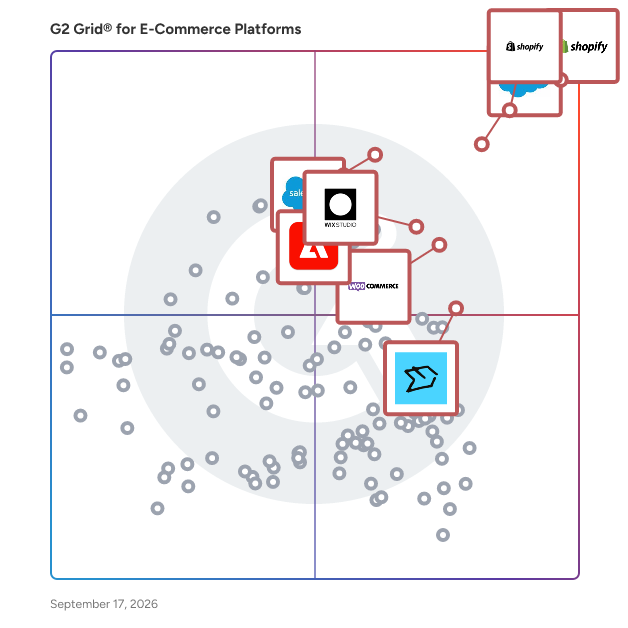
- [Shopify](https://www.g2.com/products/shopify/reviews) — The most widely adopted e-commerce platform globally, recognized for its clean storefront builder, extensive app marketplace, and ability to take businesses from their first online sale to high-volume retail operations with minimal technical overhead.
- [Shopify Plus](https://www.g2.com/products/shopify-plus/reviews) — The enterprise tier of Shopify, rated highly by scaling brands for its advanced automation tools, checkout customization capabilities, and dedicated merchant success support that helps high-growth retailers expand without re-platforming.
- [WooCommerce](https://www.g2.com/products/woocommerce/reviews) — An open-source e-commerce plugin for WordPress that earns strong marks for its flexibility, deep customization capabilities, and the control it gives merchants who prefer to manage their own hosting and storefront configuration.
- [BigCommerce](https://www.g2.com/products/bigcommerce/reviews) — A SaaS e-commerce platform praised for its built-in multi-channel selling tools, strong SEO infrastructure, and enterprise-ready feature set that scales without requiring additional paid apps for core functionality.

#### What are the top platforms for B2B e-commerce?

B2B e-commerce platforms need capabilities beyond standard retail, including account-based pricing, buyer approval processes, large catalog management, and ERP integration. The platforms rated highest in this segment address all of these requirements.

- [Salesforce Commerce for B2B](https://www.g2.com/products/salesforce-b2b-commerce/reviews) — A purpose-built B2B commerce platform that handles complex account hierarchies, contract pricing, guided selling, and self-service reordering — tightly integrated with the broader Salesforce ecosystem for organizations already on CRM and CPQ.
- [SAP Commerce Cloud](https://www.g2.com/products/sap-commerce-cloud/reviews) — An enterprise commerce platform adopted by large B2B organizations for its catalog management depth, configurable product support, and native integration with SAP ERP and S/4HANA that keeps pricing, inventory, and order data synchronized.
- [Sana Commerce Cloud](https://www.g2.com/products/sana-commerce-cloud/reviews) — A B2B e-commerce platform built natively on SAP and Microsoft Dynamics ERP data, enabling manufacturers, distributors, and wholesalers to offer real-time pricing, stock availability, and order history to buyers without manual data synchronization.
- [Shopware](https://www.g2.com/products/shopware/reviews) — A European-headquartered open-source commerce platform gaining traction in B2B for its composable architecture, flexible rule builder for tiered pricing, and strong community of extensions that support complex wholesale and distributor processes.

#### What are the most reliable e-commerce platforms for digital products?

Selling digital products requires an e-commerce platform built for instant delivery, license and subscription management, global payment compliance, and revenue recognition, requirements that differ significantly from physical product retail.

- [Cleverbridge](https://www.g2.com/products/cleverbridge/reviews) — A commerce platform purpose-built for software and digital product companies, offering global subscription billing, automated tax and VAT compliance, and a checkout infrastructure designed to maximize conversion for SaaS and perpetual license sales.
- [FastSpring](https://www.g2.com/products/fastspring/reviews) — A merchant of record platform used by software and digital media companies to sell globally without managing international tax obligations directly, with built-in localized checkout, multiple currencies, and automated compliance across 200+ countries.
- [PayPro Global](https://www.g2.com/products/payproglobal/reviews) — A high-satisfaction commerce platform for software, SaaS, and digital goods businesses, combining merchant of record services, subscription management, and global payment processing in a solution that takes on the compliance burden for selling across markets.
- [Sellfy](https://www.g2.com/products/sellfy/reviews) — A streamlined digital storefront platform for creators and small publishers selling downloads, subscriptions, and print-on-demand products, valued for its simple setup, built-in marketing tools, and zero transaction fees on direct digital sales.

#### What is the most user-friendly e-commerce platform for businesses?

Ease of use across storefront design, product management, and order processing is a top evaluation criterion for businesses that want to manage their online store without relying on developers for day-to-day operations.

- [Wix Studio](https://www.g2.com/products/wix-studio/reviews) — A website and e-commerce builder praised for its drag-and-drop design flexibility, AI-assisted store setup, and accessible interface that allows business owners to launch and manage a professional online storefront without technical skills.
- [Ecwid](https://www.g2.com/products/ecwid/reviews) — A lightweight e-commerce solution that embeds directly into any existing website, praised for its fast setup, multi-channel selling support across social platforms, and an admin interface that non-technical merchants can navigate immediately.
- [BigCommerce](https://www.g2.com/products/bigcommerce/reviews) — Consistently rated for its intuitive product catalog management, native SEO tools, and a storefront editor that gives business users meaningful design control without requiring a developer for most day-to-day store management tasks.
- [nopCommerce](https://www.g2.com/products/nopcommerce/reviews) — An open-source e-commerce platform recognized for its well-structured admin panel, strong plugin library, and accessible configuration for businesses that want the control of a self-hosted solution without a steep technical learning curve.

#### Which e-commerce platform is best for beginners?

The best e-commerce platforms for beginners prioritize fast store setup, guided onboarding, and an interface that allows new merchants to start selling without needing to understand hosting, coding, or complex configuration.

- [Shopify Plus](https://www.g2.com/products/shopify-plus/reviews) — While Shopify Plus is the growth tier, it inherits Shopify&#39;s reputation for fast setup and accessible store management, with a dedicated onboarding team and customizable checkout that removes many of the technical barriers that slow new merchants down.
- [BigCommerce](https://www.g2.com/products/bigcommerce/reviews) — Beginners frequently cite BigCommerce&#39;s structured onboarding checklist, template-driven storefront setup, and comprehensive built-in features that reduce the number of third-party integrations a new merchant needs to research and install.
- [WooCommerce](https://www.g2.com/products/woocommerce/reviews) — A popular starting point for businesses already on WordPress, WooCommerce allows beginners to add e-commerce to an existing site with a guided setup wizard and a large library of free documentation, tutorials, and community support.
- [ikas](https://www.g2.com/products/ikas/reviews) — A modern e-commerce platform built for simplicity, recognized for its quick store launch process, clean merchant dashboard, and built-in multi-channel selling tools that get new businesses to their first sale without extended configuration.

### Small Business FAQs

#### What is the most affordable e-commerce platform for small businesses?

For operators evaluating [small business e-commerce platforms](https://www.g2.com/categories/e-commerce-platforms/small-business), the strongest affordable options balance essential storefront, payment, and product management functionality with flat-rate or usage-based pricing that keeps total costs predictable as order volumes grow.

- [SimplyDepo](https://www.g2.com/products/simplydepo/reviews) — A wholesale ordering platform built for small distributors and field sales teams, delivering route management, digital catalog, and order management at a cost-accessible price point that replaces expensive custom order portals.
- [SureCart](https://www.g2.com/products/surecart/reviews) — A WordPress-native e-commerce platform with a generous free tier covering one-time payments, subscriptions, and digital downloads, allowing small businesses to process online orders without per-transaction fees or a monthly subscription requirement.
- [Turis](https://www.g2.com/products/turis/reviews) — An affordable B2B wholesale storefront platform designed for small brands and distributors that want to give retail buyers a self-service ordering experience without the cost and complexity of a full enterprise commerce implementation.
- [Selldone](https://www.g2.com/products/selldone/reviews) — A no-transaction-fee e-commerce platform with a free entry tier that small businesses use to manage physical and digital storefronts, multi-channel selling, and order fulfillment without paying a percentage of every sale to their platform provider.

#### What is the best e-commerce platform for startups?

Startups need an e-commerce platform that gets them selling quickly, integrates with modern marketing and fulfillment tools, and scales in capability as order volume grows without requiring a re-platform migration. You can explore the full [small business e-commerce platform](https://www.g2.com/categories/e-commerce-platforms/small-business) category on G2 to see the top-rated options.

- [Shopify](https://www.g2.com/products/shopify/reviews) — The default starting point for most e-commerce startups, offering a guided setup process, an extensive app ecosystem, and a payments infrastructure that allows new businesses to start selling within hours and expand into new channels as they grow.
- [WooCommerce](https://www.g2.com/products/woocommerce/reviews) — A cost-effective choice for startups already on WordPress, offering a free core plugin with full product management, payment gateway flexibility, and a large open-source extension library that keeps initial platform costs minimal.
- [Wix Studio](https://www.g2.com/products/wix-studio/reviews) — A popular choice for early-stage businesses that need both a professional website and an integrated store, with drag-and-drop design tools and a low barrier to entry that lets founders launch their first storefront without developer support.
- [10Web](https://www.g2.com/products/10web/reviews) — An AI-powered website and e-commerce builder that startup teams use to generate a functional WooCommerce-powered storefront from a brief description, dramatically reducing the time and cost of getting an online store live for the first time.

#### Which e-commerce platform is the most user-friendly for small business startups?

For startup founders managing their store alongside every other business function, ease of use in product setup, order management, and storefront updates is a deciding factor. These platforms earn the highest usability marks from small-team operators.

- [Shopify Plus](https://www.g2.com/products/shopify-plus/reviews) — Startup teams scaling quickly onto Shopify Plus consistently highlight the platform&#39;s clean admin experience, intuitive flow automation builder, and extensive help documentation, which reduces the time spent on operational tasks versus selling.
- [ikas](https://www.g2.com/products/ikas/reviews) — A modern e-commerce platform built around a streamlined merchant dashboard that startup founders regularly cite for requiring minimal training, with a product management and order workflow interface that feels familiar from day one.
- [Ecwid](https://www.g2.com/products/ecwid/reviews) — Praised by small business owners for the speed and simplicity of embedding a full-featured store into an existing site, with a management interface that non-technical founders can operate confidently without ongoing developer involvement.
- [PayPro Global](https://www.g2.com/products/payproglobal/reviews) — Software and digital product startups cite PayPro Global&#39;s self-service setup, pre-built checkout flows, and automated tax compliance as key usability advantages that remove complex configuration steps from the path to their first digital sale.

#### What is the best e-commerce platform for B2B wholesale businesses?

Small B2B wholesale businesses need an e-commerce platform that supports account-based pricing, minimum order quantities, bulk ordering processes, and buyer-specific catalogs without requiring an enterprise-level implementation budget. Explore the full [small business e-commerce platform](https://www.g2.com/categories/e-commerce-platforms/small-business) category on G2 to compare options.

- [Zoey](https://www.g2.com/products/zoey/reviews) — A B2B-focused e-commerce platform built for wholesalers and manufacturers, offering tiered pricing, custom buyer portals, quote management, and approval processes that give small wholesale businesses a self-service ordering experience without custom development.
- [nopCommerce](https://www.g2.com/products/nopcommerce/reviews) — An open-source platform with strong B2B capabilities, including customer group pricing, bulk discount rules, and multi-vendor support, giving small wholesale businesses a self-hosted solution with extensive configuration flexibility at low licensing cost.
- [Salesforce Commerce for B2B](https://www.g2.com/products/salesforce-b2b-commerce/reviews) — Small and growing B2B businesses on the Salesforce ecosystem use this platform for its self-service reorder capabilities, contract pricing enforcement, and built-in integration with Salesforce CRM that connects online orders directly to sales team processes.
- [Elastic Suite](https://www.g2.com/products/elastic-suite/reviews) — A digital wholesale platform designed for brands managing retailer and dealer ordering, offering branded order portals, line sheet management, and replenishment tools that help small wholesale businesses move buyers off email and spreadsheet ordering.

#### What is the best e-commerce platform for small retailers?

Small retailers need an e-commerce platform that handles both online and in-person sales, supports product catalog management at a manageable scale, and connects to the marketing and fulfillment tools they already use without requiring a large technical team.

- [Shopify](https://www.g2.com/products/shopify/reviews) — The most commonly adopted platform among small retailers for its seamless integration of online store, POS, and inventory management, giving shop owners a single system to manage in-person and digital sales without separate tools for each channel.
- [Shopify Plus](https://www.g2.com/products/shopify-plus/reviews) — Small retailers with growing order volumes use Shopify Plus for its advanced automation, customizable checkout, and dedicated support resources that help them handle peak retail periods without platform bottlenecks.
- [Ecwid](https://www.g2.com/products/ecwid/reviews) — A practical choice for small retailers who already have a website or social media presence and want to add a fully functional store without rebuilding their online presence, with multi-channel selling across Facebook, Instagram, and marketplaces built in.
- [2Checkout Monetization Platform](https://www.g2.com/products/2checkout-monetization-platform/reviews) — A global commerce and payments platform used by small retailers selling across markets, valued for its built-in tax and currency management, flexible checkout options, and subscription billing tools that support both one-time and recurring retail models.

### Enterprise FAQs

#### What is the best-rated e-commerce platform for tech enterprises?

Technology enterprises need [enterprise e-commerce platforms](https://www.g2.com/categories/e-commerce-platforms/enterprise) with composable architecture, headless commerce capability, enterprise-grade security, and deep integration ecosystems that connect commerce to ERP, PIM, CRM, and analytics infrastructure. These platforms earn the highest marks from large-scale enterprise buyers.

- [Salesforce Commerce for B2C](https://www.g2.com/products/salesforce-b2c-commerce/reviews) — An enterprise-grade commerce platform adopted by large tech-oriented retail organizations for its AI-powered merchandising, headless commerce capabilities, and deep integration with the Salesforce Customer 360 ecosystem for unified customer data across marketing, service, and commerce.
- [SAP Commerce Cloud](https://www.g2.com/products/sap-commerce-cloud/reviews) — A highly configurable enterprise commerce platform used by global technology companies for its composable architecture, omnichannel order management, and native integration with SAP ERP and supply chain systems that manage complex product and pricing data at scale.
- [SCAYLE Commerce Engine](https://www.g2.com/products/scayle-commerce-engine/reviews) — A headless commerce platform purpose-built for high-volume enterprise retailers, recognized for its performance architecture, developer-first API layer, and the flexibility to power highly customized storefront experiences without the constraints of a monolithic platform.
- [Shopify](https://www.g2.com/products/shopify/reviews) — Increasingly adopted by enterprise technology organizations for its modern API-first architecture, extensive partner ecosystem, and operational simplicity at scale, allowing large brands to reduce platform management overhead while maintaining commerce agility.

#### What is the most reliable e-commerce platform for enterprises?

Enterprise commerce buyers prioritize platform uptime, transaction reliability, and consistent performance during high-traffic events such as product launches and peak seasonal periods, where any downtime directly translates to lost revenue.

- [Salesforce Commerce for B2B](https://www.g2.com/products/salesforce-b2b-commerce/reviews) — Enterprise B2B teams cite Salesforce Commerce&#39;s platform reliability and compliance infrastructure as core reasons for long-term adoption, with a proven track record of uptime and data integrity for organizations running high-value business transactions through self-service portals.
- [SAP Commerce Cloud](https://www.g2.com/products/sap-commerce-cloud/reviews) — Recognized by large enterprises for its robust deployment options — including cloud, on-premise, and hybrid- and its long operational track record in environments where transaction volume, catalog complexity, and data accuracy requirements are non-negotiable.
- [WooCommerce](https://www.g2.com/products/woocommerce/reviews) — Enterprise teams running WooCommerce at scale highlight its reliability when paired with managed cloud infrastructure, noting the control of a self-hosted architecture combined with a mature plugin ecosystem that supports high-volume order management.
- [Cleverbridge](https://www.g2.com/products/cleverbridge/reviews) — Enterprise software and digital product companies trust Cleverbridge for the reliability of its global payment processing, subscription renewal infrastructure, and merchant of record services, where failed transactions and payment interruptions directly impact recurring revenue.

#### What is the best-reviewed e-commerce platform for enterprise app integration?

Integration depth is a primary evaluation criterion for enterprise e-commerce buyers managing technology stacks that include ERP, PIM, CRM, marketing automation, and data warehouse systems. Explore the full [enterprise e-commerce platform](https://www.g2.com/categories/e-commerce-platforms/enterprise) category on G2 for detailed integration comparisons.

- [Shopify](https://www.g2.com/products/shopify/reviews) — Enterprise reviewers highlight Shopify&#39;s extensive app marketplace, with thousands of verified integrations, and its robust API infrastructure as primary drivers of adoption for organizations that need commerce data flowing into fulfillment, ERP, marketing, and analytics systems.
- [Sana Commerce Cloud](https://www.g2.com/products/sana-commerce-cloud/reviews) — Purpose-built for ERP-driven organizations, Sana Commerce Cloud offers native integration with SAP and Microsoft Dynamics, ensuring real-time synchronization of pricing, inventory, and customer account data between the commerce layer and back-office systems.
- [Salesforce Commerce for B2C](https://www.g2.com/products/salesforce-b2c-commerce/reviews) — Enterprise teams operating on the Salesforce platform use Commerce for B2C for its native connectivity to Marketing Cloud, Service Cloud, and Einstein AI — enabling unified customer experiences across commerce, marketing, and service without custom integration work.
- [SCAYLE Commerce Engine](https://www.g2.com/products/scayle-commerce-engine/reviews) — A headless commerce platform recognized for its open API-first architecture that allows enterprise developers to integrate any frontend, CMS, PIM, or middleware layer cleanly, reducing the total integration complexity of a modern composable commerce stack.

#### What is the best enterprise e-commerce platform for global and multi-market commerce?

Global enterprise commerce requires a platform with multi-currency pricing, localized checkout experiences, country-specific tax and regulatory compliance, and the ability to manage multiple storefronts from a centralized administration layer. Browse the full [enterprise e-commerce platform](https://www.g2.com/categories/e-commerce-platforms/enterprise) category on G2 for detailed multi-market capability comparisons.

- [SAP Commerce Cloud](https://www.g2.com/products/sap-commerce-cloud/reviews) — Widely adopted by global enterprises for its multi-site and multi-language management capabilities, SAP Commerce Cloud supports localized pricing, regional catalog segmentation, and country-specific compliance requirements across unified platform administration.
- [Cleverbridge](https://www.g2.com/products/cleverbridge/reviews) — Enterprise digital and software companies use Cleverbridge for global commerce operations, relying on its 240+ supported payment methods, automated multi-country VAT compliance, and currency localization that drives conversion in international markets.
- [Sana Commerce Cloud](https://www.g2.com/products/sana-commerce-cloud/reviews) — Global B2B manufacturers and distributors use Sana Commerce Cloud to deploy localized buyer portals across regions, with ERP-driven pricing and inventory data ensuring that each market sees accurate, real-time information in its local language and currency.
- [WooCommerce](https://www.g2.com/products/woocommerce/reviews) — Enterprise teams running globally distributed WooCommerce storefronts rely on its multi-currency and multi-language plugin ecosystem to deliver localized shopping experiences, with the self-hosted architecture providing the control needed for regional compliance and data residency requirements.

#### What is the best enterprise e-commerce platform for B2B organizations?

Enterprise B2B commerce platforms must handle organizational account structures, contract-based pricing, complex approval processes, and high-volume reorder patterns, requirements that consumer-facing platforms are not architected to address.

- [Salesforce Commerce for B2B](https://www.g2.com/products/salesforce-b2b-commerce/reviews) — The leading dedicated B2B commerce platform for enterprise organizations, used by manufacturers, distributors, and wholesale businesses to deliver account-specific catalogs, tiered pricing, buyer approval flows, and self-service reorder functionality within the Salesforce ecosystem.
- [SCAYLE Commerce Engine](https://www.g2.com/products/scayle-commerce-engine/reviews) — Enterprise organizations use SCAYLE for its high-performance API architecture that supports complex B2B catalog structures, custom buyer experiences, and the traffic volumes associated with large-account wholesale and distributor commerce at a global scale.
- [Cleverbridge](https://www.g2.com/products/cleverbridge/reviews) — Enterprise software and SaaS companies use Cleverbridge as their B2B commerce layer for managing volume licensing, multi-seat subscription renewals, reseller channel management, and enterprise procurement compliance, use cases that standard e-commerce platforms do not support natively.
- [Sana Commerce Cloud](https://www.g2.com/products/sana-commerce-cloud/reviews) — An enterprise B2B commerce platform built specifically for ERP-centric organizations, enabling large manufacturers and distributors to offer buyers a self-service portal with real-time access to their account history, contract pricing, and inventory without data latency or manual updates.

**Last updated on April 24, 2026**