  # Best Enterprise Cloud Platform as a Service (PaaS) Software

  *By [Adam Crivello](https://research.g2.com/insights/author/adam-crivello)*

   Products classified in the overall Cloud Platform as a Service (PaaS) category are similar in many regards and help companies of all sizes solve their business problems. However, enterprise business features, pricing, setup, and installation differ from businesses of other sizes, which is why we match buyers to the right Enterprise Business Cloud Platform as a Service (PaaS) to fit their needs. Compare product ratings based on reviews from enterprise users or connect with one of G2&#39;s buying advisors to find the right solutions within the Enterprise Business Cloud Platform as a Service (PaaS) category.

In addition to qualifying for inclusion in the Cloud Platform as a Service (PaaS) Software category, to qualify for inclusion in the Enterprise Business Cloud Platform as a Service (PaaS) Software category, a product must have at least 10 reviews left by a reviewer from an enterprise business.


## How Many Cloud Platform as a Service (PaaS) Software Products Does G2 Track?
**Total Products under this Category:** 206

### Category Stats (May 2026)
- **Average Rating**: 4.42/5 (↑0.01 vs Apr 2026)
- **New Reviews This Quarter**: 142
- **Buyer Segments**: Small-Business 45% │ Mid-Market 32% │ Enterprise 23%
- **Top Trending Product**: AppHarbor (+0.33)
*Last updated: May 18, 2026*

  
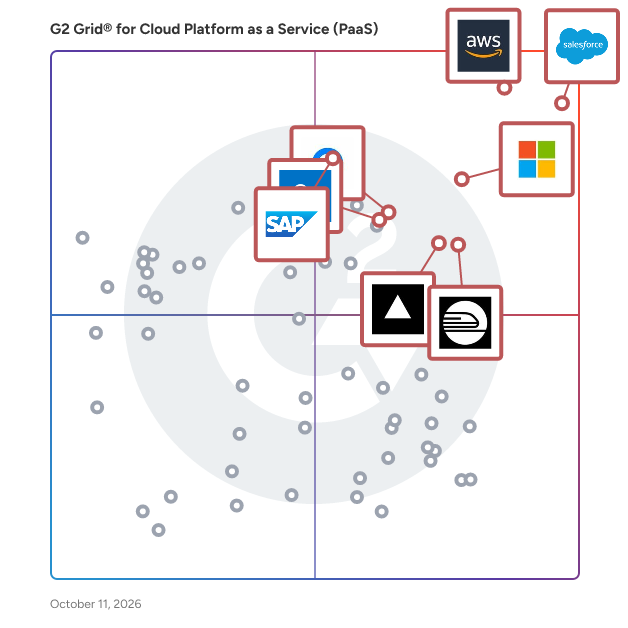
## How Does G2 Rank Cloud Platform as a Service (PaaS) Software Products?

**Why You Can Trust G2's Software Rankings:**

- 30 Analysts and Data Experts
- 14,100+ Authentic Reviews
- 206+ Products
- Unbiased Rankings

G2's software rankings are built on verified user reviews, rigorous moderation, and a consistent research methodology maintained by a team of analysts and data experts. Each product is measured using the same transparent criteria, with no paid placement or vendor influence. While reviews reflect real user experiences, which can be subjective, they offer valuable insight into how software performs in the hands of professionals. Together, these inputs power the G2 Score, a standardized way to compare tools within every category.

  
## Which Cloud Platform as a Service (PaaS) Software Is Best for Your Use Case?

- **Best for Small Businesses:** [Agentforce 360 Platform (formerly Salesforce Platform)](https://www.g2.com/products/agentforce-360-platform-formerly-salesforce-platform/reviews)
- **Best for Mid-Market:** [Agentforce 360 Platform (formerly Salesforce Platform)](https://www.g2.com/products/agentforce-360-platform-formerly-salesforce-platform/reviews)
- **Best for Enterprise:** [Agentforce 360 Platform (formerly Salesforce Platform)](https://www.g2.com/products/agentforce-360-platform-formerly-salesforce-platform/reviews)
- **Highest User Satisfaction:** [Agentforce 360 Platform (formerly Salesforce Platform)](https://www.g2.com/products/agentforce-360-platform-formerly-salesforce-platform/reviews)
- **Best Free Software:** [Cloudways](https://www.g2.com/products/cloudways/reviews)

  
---

**Sponsored**

### UpCloud

UpCloud is European cloud service provider. Everything from Public Cloud to Private Cloud to Managed Kubernetes &amp; Databases. With a global cloud platform spanning four continents, we offer a reliable, ISO27001 certified &amp; GDPR compliant cloud-native product portfolio in 15 locations worldwide. Our 99.999% SLA ensures uninterrupted services, empowering businesses worldwide to thrive. Formed in 2012, UpCloud is headquartered in Helsinki, Finland.


[Visit website](https://www.g2.com/external_clickthroughs/record?secure%5Bad_program%5D=ppc&amp;secure%5Bad_slot%5D=category_product_list&amp;secure%5Bcategory_id%5D=59&amp;secure%5Bdisplayable_resource_id%5D=80&amp;secure%5Bdisplayable_resource_type%5D=Category&amp;secure%5Bmedium%5D=sponsored&amp;secure%5Bplacement_reason%5D=neighbor_category&amp;secure%5Bplacement_resource_ids%5D%5B%5D=80&amp;secure%5Bplacement_resource_ids%5D%5B%5D=188&amp;secure%5Bprioritized%5D=false&amp;secure%5Bproduct_id%5D=17906&amp;secure%5Bresource_id%5D=59&amp;secure%5Bresource_type%5D=Category&amp;secure%5Bsource_type%5D=category_page&amp;secure%5Bsource_url%5D=https%3A%2F%2Fwww.g2.com%2Fcategories%2Fcloud-platform-as-a-service-paas&amp;secure%5Btoken%5D=8372b2a7ec2fa8be0ae6137ee988e79a90936c9084e786c006d0f9f0d5be3a86&amp;secure%5Burl%5D=https%3A%2F%2Fsignup.upcloud.com%2F%3Fpromo%3Ddeploy250&amp;secure%5Burl_type%5D=custom_url)

---

  ## What Are the Top-Rated Cloud Platform as a Service (PaaS) Software Products in 2026?
### 1. [Agentforce 360 Platform (formerly Salesforce Platform)](https://www.g2.com/products/agentforce-360-platform-formerly-salesforce-platform/reviews)
  Salesforce Platform is the leading low-code development platform that empowers your team to build and extend your Customer 360 with AI, automation, and data. With the Salesforce Platform, you can execute on your Customer 360 vision, securely, and keep your customer at the center of everything you do. Access a harmonized, unified view of your customers, automate manual, inefficient processes to drive productivity, and empower your employees to deliver a seamless, connected customer experience. Accelerate your Salesforce development, increase developer efficiency, and save on IT costs with the Salesforce platform.


  **Average Rating:** 4.5/5.0
  **Total Reviews:** 3,778
**How Do G2 Users Rate Agentforce 360 Platform (formerly Salesforce Platform)?**

- **Has the product been a good partner in doing business?:** 8.8/10 (Category avg: 8.9/10)
- **Application Deployment:** 8.7/10 (Category avg: 8.8/10)
- **Database Management:** 9.0/10 (Category avg: 8.4/10)
- **Networking:** 8.5/10 (Category avg: 8.4/10)

**Who Is the Company Behind Agentforce 360 Platform (formerly Salesforce Platform)?**

- **Seller:** [Salesforce](https://www.g2.com/sellers/salesforce)
- **Company Website:** https://www.salesforce.com/
- **Year Founded:** 1999
- **HQ Location:** San Francisco, CA
- **Twitter:** @salesforce (581,299 Twitter followers)
- **LinkedIn® Page:** https://www.linkedin.com/company/3185/ (88,363 employees on LinkedIn®)

**Who Uses This Product?**
  - **Who Uses This:** Salesforce Developer, Account Executive
  - **Top Industries:** Computer Software, Information Technology and Services
  - **Company Size:** 45% Mid-Market, 34% Enterprise


#### What Are Agentforce 360 Platform (formerly Salesforce Platform)'s Pros and Cons?

**Pros:**

- Ease of Use (1592 reviews)
- Features (780 reviews)
- Customization (654 reviews)
- Customizability (651 reviews)
- Customization Options (609 reviews)

**Cons:**

- Learning Curve (561 reviews)
- Complexity (525 reviews)
- Expensive (469 reviews)
- Difficult Learning (403 reviews)
- Missing Features (397 reviews)

### 2. [AWS Lambda](https://www.g2.com/products/aws-lambda/reviews)
  AWS Lambda lets you run code without provisioning or managing servers. You pay only for the compute time you consume - there is no charge when your code is not running. With Lambda, you can run code for virtually any type of application or backend service - all with zero administration. Just upload your code and Lambda takes care of everything required to run and scale your code with high availability. You can set up your code to automatically trigger from other AWS services or call it directly from any web or mobile app.


  **Average Rating:** 4.6/5.0
  **Total Reviews:** 918
**How Do G2 Users Rate AWS Lambda?**

- **Has the product been a good partner in doing business?:** 8.9/10 (Category avg: 8.9/10)
- **Application Deployment:** 8.9/10 (Category avg: 8.8/10)
- **Database Management:** 8.3/10 (Category avg: 8.4/10)
- **Networking:** 8.6/10 (Category avg: 8.4/10)

**Who Is the Company Behind AWS Lambda?**

- **Seller:** [Amazon Web Services (AWS)](https://www.g2.com/sellers/amazon-web-services-aws-3e93cc28-2e9b-4961-b258-c6ce0feec7dd)
- **Year Founded:** 2006
- **HQ Location:** Seattle, WA
- **Twitter:** @awscloud (2,228,514 Twitter followers)
- **LinkedIn® Page:** https://www.linkedin.com/company/amazon-web-services/ (156,424 employees on LinkedIn®)
- **Ownership:** NASDAQ: AMZN

**Who Uses This Product?**
  - **Who Uses This:** Software Engineer, Senior Software Engineer
  - **Top Industries:** Computer Software, Information Technology and Services
  - **Company Size:** 43% Enterprise, 36% Mid-Market


#### What Are AWS Lambda's Pros and Cons?

**Pros:**

- Ease of Use (47 reviews)
- Scalability (35 reviews)
- Cost-Effective (27 reviews)
- Cloud Services (23 reviews)
- Integrations (22 reviews)

**Cons:**

- Resource Limitations (36 reviews)
- Difficult Debugging (17 reviews)
- Slow Performance (13 reviews)
- Lagging Performance (10 reviews)
- Expensive (9 reviews)

### 3. [SAP Business Technology Platform](https://www.g2.com/products/sap-business-technology-platform/reviews)
  SAP Business Technology Platform (SAP BTP) is a multi-cloud platform-as-a-Service optimized to work with SAP solutions. It is a unified platform of technologies SAP uses for its own innovation, to extend and integrate business applications, and to infuse artificial intelligence and context-aware business data. SAP BTP brings together intelligent enterprise applications with database and data management, analytics, integration and extension capabilities into one platform for both cloud and hybrid environments, including hundreds of prebuilt business content and integrations for faster time-to-value. It can be used to create personalized experiences across business processes, build applications, analytics, and integrations faster, and to run mission-critical innovation confidently on major cloud providers&#39; infrastructure fully managed by SAP. SAP BTP offers a range of capabilities and services that: - offers fit-for-purpose tools and services that are optimized for SAP applications along with composable bespoke business processes - provides an open environment with pre-built connectors to 3rd party apps and the availability to run on leading hyperscaler IaaS Clouds (AWS, Azure, GCP, etc.) connects AI &amp; ML into business processes to enhance intelligence, automation, and productivity - delivers security and improved insights by keeping contextual data close to core business processes and applications - enables future-proofing by keeping core systems clean, greatly reducing technical debt to take advantage of cloud economics


  **Average Rating:** 4.4/5.0
  **Total Reviews:** 395
**How Do G2 Users Rate SAP Business Technology Platform?**

- **Has the product been a good partner in doing business?:** 8.5/10 (Category avg: 8.9/10)
- **Application Deployment:** 8.5/10 (Category avg: 8.8/10)
- **Database Management:** 8.9/10 (Category avg: 8.4/10)
- **Networking:** 8.4/10 (Category avg: 8.4/10)

**Who Is the Company Behind SAP Business Technology Platform?**

- **Seller:** [SAP](https://www.g2.com/sellers/sap)
- **Company Website:** https://www.sap.com/
- **Year Founded:** 1972
- **HQ Location:** Walldorf
- **Twitter:** @SAP (297,206 Twitter followers)
- **LinkedIn® Page:** https://www.linkedin.com/company/sap/ (141,341 employees on LinkedIn®)

**Who Uses This Product?**
  - **Who Uses This:** Software Engineer, System Engineer
  - **Top Industries:** Information Technology and Services, Computer Software
  - **Company Size:** 39% Enterprise, 36% Mid-Market


#### What Are SAP Business Technology Platform's Pros and Cons?

**Pros:**

- Ease of Use (132 reviews)
- Integrations (128 reviews)
- Easy Integrations (115 reviews)
- Features (103 reviews)
- Data Management (78 reviews)

**Cons:**

- Learning Curve (97 reviews)
- Complexity (88 reviews)
- Expensive (69 reviews)
- Learning Difficulty (68 reviews)
- Difficult Learning (57 reviews)

### 4. [Azure Functions](https://www.g2.com/products/azure-functions/reviews)
  Azure Functions is a serverless compute service that enables developers to build and deploy event-driven applications without the need to manage infrastructure. By automatically scaling resources based on demand, it allows for efficient execution of code in response to various triggers, such as HTTP requests, database changes, or messages from other Azure services. This approach simplifies the development process, reduces operational overhead, and supports a wide range of programming languages, including C#, JavaScript, Python, and Java. Key Features and Functionality: - Event-Driven Execution: Functions can be triggered by a variety of events, including HTTP requests, changes in data, or messages from services like Azure Service Bus. - Automatic Scaling: The service scales resources automatically based on the number of incoming events, ensuring optimal performance without manual intervention. - Multiple Language Support: Developers can write functions in languages such as C#, JavaScript, Python, and Java, allowing flexibility in development. - Integrated Development Tools: Azure Functions integrates with tools like Visual Studio and Visual Studio Code, providing a seamless development and debugging experience. - Flexible Hosting Options: Offers various hosting plans, including Consumption, Premium, and Dedicated (App Service) plans, to meet different performance and cost requirements. Primary Value and Problem Solving: Azure Functions addresses the challenge of managing infrastructure for event-driven applications by providing a fully managed, serverless environment. This allows developers to focus on writing code that responds to events without worrying about provisioning or maintaining servers. The automatic scaling feature ensures that applications can handle varying loads efficiently, while the pay-per-execution pricing model offers cost-effectiveness by charging only for the compute resources used during function execution. This combination of features accelerates development, reduces operational complexity, and enables rapid deployment of scalable applications.


  **Average Rating:** 4.4/5.0
  **Total Reviews:** 197
**How Do G2 Users Rate Azure Functions?**

- **Has the product been a good partner in doing business?:** 9.0/10 (Category avg: 8.9/10)
- **Application Deployment:** 8.9/10 (Category avg: 8.8/10)
- **Database Management:** 8.6/10 (Category avg: 8.4/10)
- **Networking:** 8.7/10 (Category avg: 8.4/10)

**Who Is the Company Behind Azure Functions?**

- **Seller:** [Microsoft](https://www.g2.com/sellers/microsoft)
- **Year Founded:** 1975
- **HQ Location:** Redmond, Washington
- **Twitter:** @microsoft (13,101,622 Twitter followers)
- **LinkedIn® Page:** https://www.linkedin.com/company/microsoft/ (227,697 employees on LinkedIn®)
- **Ownership:** MSFT

**Who Uses This Product?**
  - **Who Uses This:** Software Engineer, Senior Software Engineer
  - **Top Industries:** Information Technology and Services, Computer Software
  - **Company Size:** 39% Enterprise, 32% Mid-Market


#### What Are Azure Functions's Pros and Cons?

**Pros:**

- Ease of Use (8 reviews)
- Automation (4 reviews)
- Scalability (4 reviews)
- Security (4 reviews)
- Cloud Storage (3 reviews)

**Cons:**

- Complexity (4 reviews)
- Cost Issues (4 reviews)
- Slow Performance (3 reviews)
- Complex Pricing (2 reviews)
- Expensive (2 reviews)

### 5. [Red Hat OpenShift](https://www.g2.com/products/red-hat-red-hat-openshift/reviews)
  Red Hat OpenShift Container Platform is an open source, enterprise-grade Kubernetes platform for building, deploying, and managing containerized applications across on-premise, private cloud and public cloud infrastructure.


  **Average Rating:** 4.5/5.0
  **Total Reviews:** 288
**How Do G2 Users Rate Red Hat OpenShift?**

- **Has the product been a good partner in doing business?:** 8.6/10 (Category avg: 8.9/10)
- **Application Deployment:** 9.2/10 (Category avg: 8.8/10)
- **Database Management:** 8.3/10 (Category avg: 8.4/10)
- **Networking:** 8.7/10 (Category avg: 8.4/10)

**Who Is the Company Behind Red Hat OpenShift?**

- **Seller:** [Red Hat](https://www.g2.com/sellers/red-hat)
- **Year Founded:** 1993
- **HQ Location:** Raleigh, NC
- **Twitter:** @RedHat (300,364 Twitter followers)
- **LinkedIn® Page:** https://www.linkedin.com/company/3545/ (19,305 employees on LinkedIn®)

**Who Uses This Product?**
  - **Who Uses This:** DevOps Engineer, Senior Software Engineer
  - **Top Industries:** Information Technology and Services, Financial Services
  - **Company Size:** 48% Enterprise, 27% Mid-Market


#### What Are Red Hat OpenShift's Pros and Cons?

**Pros:**

- Ease of Use (36 reviews)
- Features (34 reviews)
- Kubernetes Management (21 reviews)
- Scalability (19 reviews)
- Deployment Ease (17 reviews)

**Cons:**

- Learning Curve (25 reviews)
- Complexity (17 reviews)
- Complex Setup (14 reviews)
- Configuration Complexity (14 reviews)
- Expensive (12 reviews)

### 6. [Microsoft Cloud Data Management](https://www.g2.com/products/microsoft-microsoft-cloud-data-management/reviews)
  Microsoft Cloud Data Management, offered through Azure, is a comprehensive suite of services designed to help organizations efficiently store, process, and govern their data across various environments. By integrating scalable storage solutions with advanced analytics and robust governance tools, Azure enables businesses to transform raw data into actionable insights while ensuring security and compliance. Key Features and Functionality: - Azure Data Lake Storage: Provides a massively scalable and secure data lake for high-performance analytics workloads, supporting structured, semi-structured, and unstructured data. - Azure Data Factory: Facilitates the creation of data-driven workflows for orchestrating and automating data movement and transformation across diverse data sources. - Azure Synapse Analytics: Combines enterprise data warehousing and big data analytics, enabling real-time analytics and reporting. - Azure Cosmos DB: Offers a globally distributed, multi-model database service designed for high availability, scalability, and low-latency access to data. - Microsoft Purview: Delivers unified data governance solutions, allowing organizations to manage and govern their on-premises, cloud, and SaaS data effectively. Primary Value and Solutions Provided: Azure&#39;s Cloud Data Management solutions address the challenges of handling vast amounts of data by offering scalable storage, seamless integration, and advanced analytics capabilities. Organizations can break down data silos, enhance data quality, and ensure compliance with regulatory standards. By leveraging Azure&#39;s services, businesses gain the agility to make informed decisions, drive innovation, and maintain a competitive edge in the data-driven landscape.


  **Average Rating:** 4.5/5.0
  **Total Reviews:** 59
**How Do G2 Users Rate Microsoft Cloud Data Management?**

- **Has the product been a good partner in doing business?:** 8.8/10 (Category avg: 8.9/10)

**Who Is the Company Behind Microsoft Cloud Data Management?**

- **Seller:** [Microsoft](https://www.g2.com/sellers/microsoft)
- **Year Founded:** 1975
- **HQ Location:** Redmond, Washington
- **Twitter:** @microsoft (13,101,622 Twitter followers)
- **LinkedIn® Page:** https://www.linkedin.com/company/microsoft/ (227,697 employees on LinkedIn®)
- **Ownership:** MSFT

**Who Uses This Product?**
  - **Company Size:** 68% Enterprise, 19% Small-Business


### 7. [spring.io](https://www.g2.com/products/spring-io/reviews)
  Spring is the most popular application development framework for enterprise Java™. Millions of developers use Spring to create high performing, easily testable, reusable code without any vendor lock-in. Spring helps Java, Groovy and Kotlin software development teams everywhere build simple, portable, fast and flexible JVM-based systems and applications.


  **Average Rating:** 4.5/5.0
  **Total Reviews:** 290
**How Do G2 Users Rate spring.io?**

- **Has the product been a good partner in doing business?:** 8.6/10 (Category avg: 8.9/10)
- **Application Deployment:** 9.6/10 (Category avg: 8.8/10)
- **Database Management:** 9.5/10 (Category avg: 8.4/10)
- **Networking:** 8.9/10 (Category avg: 8.4/10)

**Who Is the Company Behind spring.io?**

- **Seller:** [Broadcom](https://www.g2.com/sellers/broadcom-ab3091cd-4724-46a8-ac89-219d6bc8e166)
- **Year Founded:** 1991
- **HQ Location:** San Jose, CA
- **Twitter:** @broadcom (63,483 Twitter followers)
- **LinkedIn® Page:** https://www.linkedin.com/company/broadcom/ (55,707 employees on LinkedIn®)
- **Ownership:** NASDAQ: CA

**Who Uses This Product?**
  - **Who Uses This:** Software Engineer, Senior Software Engineer
  - **Top Industries:** Computer Software, Information Technology and Services
  - **Company Size:** 44% Enterprise, 34% Mid-Market


#### What Are spring.io's Pros and Cons?

**Pros:**

- Problem Solving (3 reviews)
- Ease of Use (2 reviews)
- Coding Simplicity (1 reviews)
- Comprehensive Information (1 reviews)
- Deployment Ease (1 reviews)

**Cons:**

- Learning Curve (1 reviews)
- Software Bugs (1 reviews)
- Steep Learning Curve (1 reviews)

### 8. [Google Cloud Functions](https://www.g2.com/products/google-cloud-functions/reviews)
  Run your code in the cloud with no servers or containers to manage with our scalable, pay-as-you-go functions as a service (FaaS) product. New customers get $300 in free credits to spend on Functions. All customers get 2 million monthly invocations free, not charged against your credits.


  **Average Rating:** 4.4/5.0
  **Total Reviews:** 77
**How Do G2 Users Rate Google Cloud Functions?**

- **Has the product been a good partner in doing business?:** 8.8/10 (Category avg: 8.9/10)
- **Application Deployment:** 8.7/10 (Category avg: 8.8/10)
- **Database Management:** 8.6/10 (Category avg: 8.4/10)
- **Networking:** 8.9/10 (Category avg: 8.4/10)

**Who Is the Company Behind Google Cloud Functions?**

- **Seller:** [Google](https://www.g2.com/sellers/google)
- **Year Founded:** 1998
- **HQ Location:** Mountain View, CA
- **Twitter:** @google (31,915,529 Twitter followers)
- **LinkedIn® Page:** https://www.linkedin.com/company/1441/ (336,169 employees on LinkedIn®)
- **Ownership:** NASDAQ:GOOG

**Who Uses This Product?**
  - **Top Industries:** Computer Software, Information Technology and Services
  - **Company Size:** 48% Small-Business, 28% Enterprise


#### What Are Google Cloud Functions's Pros and Cons?

**Pros:**

- Automation (1 reviews)
- Cloud Storage (1 reviews)
- Deployment Ease (1 reviews)
- Features (1 reviews)


### 9. [Azure App Service](https://www.g2.com/products/azure-app-service/reviews)
  Azure App Service is a fully managed platform-as-a-service (PaaS) offering from Microsoft Azure that enables developers to build, deploy, and scale web applications, APIs, and mobile backends efficiently. Supporting a wide range of programming languages and frameworks—including .NET, Java, Python, Node.js, PHP, and Ruby—Azure App Service allows for the creation of enterprise-grade applications without the complexities of managing the underlying infrastructure. It provides built-in capabilities such as automatic scaling, high availability, and security compliance, facilitating rapid development and deployment of applications on a reliable cloud infrastructure. Key Features and Functionality: - Multiple Language and Framework Support: Develop applications using various languages and frameworks, including .NET, Java, Python, Node.js, PHP, and Ruby, catering to diverse development needs. - Automatic Scaling and High Availability: Scale applications up or out automatically or manually to meet demand, with a 99.95% high availability commitment, ensuring consistent performance. - Integrated Security and Compliance: Benefit from built-in security features, including ISO, SOC, and PCI compliance, IP address restrictions, and native integration with Microsoft Defender for Cloud, enhancing application security. - Continuous Integration and Deployment (CI/CD): Integrate seamlessly with development tools like Azure DevOps and GitHub to enable continuous integration and deployment, streamlining the development lifecycle. - Custom Domains and SSL/TLS Certificates: Easily configure custom domain names and secure applications with SSL/TLS certificates, ensuring secure communication. - Deployment Slots: Utilize deployment slots to manage staging, testing, and production environments, allowing for zero-downtime deployments and efficient application updates. - Built-in Authentication and Authorization: Implement authentication with built-in support for identity providers such as Microsoft Entra ID, Google, Facebook, and Twitter, simplifying user management. - Monitoring and Diagnostics: Leverage tools like Application Insights, log streaming, and the Kudu console for real-time monitoring and diagnostics, aiding in application performance optimization. Primary Value and Problem Solved: Azure App Service addresses the challenges of developing, deploying, and managing web applications by providing a comprehensive, fully managed platform that abstracts the complexities of infrastructure management. Developers can focus on writing code and delivering value to users without worrying about server maintenance, scaling, or security patches. The platform&#39;s support for multiple languages and frameworks, combined with its robust features like automatic scaling, high availability, and integrated security, enables organizations to build and deploy applications faster and more efficiently. This accelerates time-to-market, reduces operational overhead, and ensures that applications are secure, reliable, and capable of meeting varying user demands.


  **Average Rating:** 4.5/5.0
  **Total Reviews:** 87
**How Do G2 Users Rate Azure App Service?**

- **Has the product been a good partner in doing business?:** 8.9/10 (Category avg: 8.9/10)
- **Application Deployment:** 9.4/10 (Category avg: 8.8/10)
- **Database Management:** 8.7/10 (Category avg: 8.4/10)
- **Networking:** 8.5/10 (Category avg: 8.4/10)

**Who Is the Company Behind Azure App Service?**

- **Seller:** [Microsoft](https://www.g2.com/sellers/microsoft)
- **Year Founded:** 1975
- **HQ Location:** Redmond, Washington
- **Twitter:** @microsoft (13,101,622 Twitter followers)
- **LinkedIn® Page:** https://www.linkedin.com/company/microsoft/ (227,697 employees on LinkedIn®)
- **Ownership:** MSFT

**Who Uses This Product?**
  - **Who Uses This:** Software Engineer
  - **Top Industries:** Information Technology and Services, Computer Software
  - **Company Size:** 44% Enterprise, 40% Small-Business


#### What Are Azure App Service's Pros and Cons?

**Pros:**

- Ease of Use (9 reviews)
- Cloud Storage (4 reviews)
- Integrations (4 reviews)
- User Interface (4 reviews)
- Application Development (3 reviews)

**Cons:**

- Cost Issues (5 reviews)
- Complexity (3 reviews)
- Expensive (3 reviews)
- Complex Pricing (2 reviews)
- Limited Features (2 reviews)

### 10. [Salesforce Heroku](https://www.g2.com/products/salesforce-heroku/reviews)
  Heroku is a cloud application platform that combines compute, data, and workflow with a high-productivity developer experience. Heroku Enterprise offers the same great developer experience along with enterprise-grade control, collaboration, and compliance. The platform gives enterprise teams the quickest path to delivering trusted customer experiences at scale. -Enhanced privacy in a network-isolated runtime environment -Seamless scalability to meet enterprise demand -Simplified compliance with PCI, HIPPA, SOC, and other standards -Automated, CI/CD workflows for optimal team collaboration -Integration with Salesforce data to build personalized experiences -Ecosystem of 150+ third-party add-on services to accelerate development -Unified dashboard to manage apps, add-ons, billing, permissions, and more. For more information, visit: https://www.heroku.com/enterprise


  **Average Rating:** 4.2/5.0
  **Total Reviews:** 143
**How Do G2 Users Rate Salesforce Heroku?**

- **Has the product been a good partner in doing business?:** 7.9/10 (Category avg: 8.9/10)
- **Application Deployment:** 9.3/10 (Category avg: 8.8/10)
- **Database Management:** 8.5/10 (Category avg: 8.4/10)
- **Networking:** 8.5/10 (Category avg: 8.4/10)

**Who Is the Company Behind Salesforce Heroku?**

- **Seller:** [Salesforce](https://www.g2.com/sellers/salesforce)
- **Year Founded:** 1999
- **HQ Location:** San Francisco, CA
- **Twitter:** @salesforce (581,299 Twitter followers)
- **LinkedIn® Page:** https://www.linkedin.com/company/3185/ (88,363 employees on LinkedIn®)
- **Ownership:** NYSE:CRM

**Who Uses This Product?**
  - **Who Uses This:** Software Engineer, Founder
  - **Top Industries:** Computer Software, Information Technology and Services
  - **Company Size:** 57% Small-Business, 28% Mid-Market


#### What Are Salesforce Heroku's Pros and Cons?

**Pros:**

- Ease of Use (2 reviews)
- Automation (1 reviews)
- Customer Support (1 reviews)
- Deployment Ease (1 reviews)
- Flexibility (1 reviews)

**Cons:**

- Poor Customer Support (2 reviews)
- Authentication Issues (1 reviews)
- Difficult Debugging (1 reviews)
- Downtime Issues (1 reviews)
- Email Issues (1 reviews)

### 11. [AWS Elastic Beanstalk](https://www.g2.com/products/aws-elastic-beanstalk/reviews)
  AWS Elastic Beanstalk is a fully managed service that simplifies the deployment and scaling of web applications and services. It supports applications developed in various languages, including Java, .NET, PHP, Node.js, Python, Ruby, Go, and Docker. By uploading your code, Elastic Beanstalk automatically handles the provisioning of resources, load balancing, auto-scaling, and monitoring, allowing developers to focus on writing code without managing the underlying infrastructure. Key Features and Functionality: - Simplified Deployment: Deploy applications by uploading code without the need to provision resources or manage configurations. - Automated Management: Handles platform updates, security patches, and health monitoring automatically. - Scalability and Availability: Provides built-in high availability, automatic scaling, and integrated security controls to ensure applications are secure and can handle varying loads. - Cost Efficiency: Operates as a managed service with no additional cost; users pay only for the AWS resources consumed. Primary Value and Problem Solved: AWS Elastic Beanstalk addresses the complexity of deploying and managing web applications by automating infrastructure tasks. This enables developers to concentrate on business logic and application development, reducing operational overhead and accelerating time-to-market. It is particularly beneficial for organizations migrating traditional applications to the cloud or those seeking a straightforward solution for deploying containerized applications without delving into complex container orchestration.


  **Average Rating:** 4.2/5.0
  **Total Reviews:** 176
**How Do G2 Users Rate AWS Elastic Beanstalk?**

- **Has the product been a good partner in doing business?:** 8.2/10 (Category avg: 8.9/10)
- **Application Deployment:** 8.8/10 (Category avg: 8.8/10)
- **Database Management:** 8.1/10 (Category avg: 8.4/10)
- **Networking:** 8.5/10 (Category avg: 8.4/10)

**Who Is the Company Behind AWS Elastic Beanstalk?**

- **Seller:** [Amazon Web Services (AWS)](https://www.g2.com/sellers/amazon-web-services-aws-3e93cc28-2e9b-4961-b258-c6ce0feec7dd)
- **Year Founded:** 2006
- **HQ Location:** Seattle, WA
- **Twitter:** @awscloud (2,228,514 Twitter followers)
- **LinkedIn® Page:** https://www.linkedin.com/company/amazon-web-services/ (156,424 employees on LinkedIn®)
- **Ownership:** NASDAQ: AMZN

**Who Uses This Product?**
  - **Who Uses This:** Software Engineer, Senior Software Engineer
  - **Top Industries:** Computer Software, Information Technology and Services
  - **Company Size:** 35% Enterprise, 34% Small-Business


#### What Are AWS Elastic Beanstalk's Pros and Cons?

**Pros:**

- Deployment Ease (2 reviews)
- Ease of Use (2 reviews)
- Automation (1 reviews)
- Easy Integrations (1 reviews)
- Easy Setup (1 reviews)

**Cons:**

- Learning Curve (2 reviews)
- Complexity (1 reviews)
- Expensive (1 reviews)
- Expertise Required (1 reviews)
- Limitations (1 reviews)

### 12. [Google App Engine](https://www.g2.com/products/google-app-engine/reviews)
  Build monolithic server-side rendered websites. App Engine supports popular development languages with a range of developer tools. New customers get $300 in free credits to spend on App Engine. All customers get 28 instances in standard environment free per day, not charged against your credits.


  **Average Rating:** 4.1/5.0
  **Total Reviews:** 192
**How Do G2 Users Rate Google App Engine?**

- **Has the product been a good partner in doing business?:** 8.0/10 (Category avg: 8.9/10)
- **Application Deployment:** 9.0/10 (Category avg: 8.8/10)
- **Database Management:** 8.5/10 (Category avg: 8.4/10)
- **Networking:** 8.8/10 (Category avg: 8.4/10)

**Who Is the Company Behind Google App Engine?**

- **Seller:** [Google](https://www.g2.com/sellers/google)
- **Year Founded:** 1998
- **HQ Location:** Mountain View, CA
- **Twitter:** @google (31,915,529 Twitter followers)
- **LinkedIn® Page:** https://www.linkedin.com/company/1441/ (336,169 employees on LinkedIn®)
- **Ownership:** NASDAQ:GOOG

**Who Uses This Product?**
  - **Who Uses This:** Software Engineer, Senior Software Engineer
  - **Top Industries:** Information Technology and Services, Computer Software
  - **Company Size:** 43% Small-Business, 30% Mid-Market


#### What Are Google App Engine's Pros and Cons?

**Pros:**

- Ease of Use (9 reviews)
- Cloud Storage (7 reviews)
- Security (5 reviews)
- Customer Support (3 reviews)
- Management Ease (3 reviews)

**Cons:**

- Expensive (4 reviews)
- Poor Customer Support (4 reviews)
- Complexity (2 reviews)
- Complex Pricing (2 reviews)
- Cost Issues (2 reviews)

### 13. [SAP Integration Suite](https://www.g2.com/products/sap-integration-suite/reviews)
  SAP Integration Suite (formerly SAP Cloud Platform Integration Suite) is an integration platform as a service (iPaaS) that allows the user to integrate on-premise and cloud-based applications and processes with tools and prebuilt content managed by SAP. With SAP Integration Suite, you can become future ready and scale up your integration capabilities to connect and contextualize experiences for customers, partners, and employees across the enterprise and extended ecosystems.


  **Average Rating:** 4.3/5.0
  **Total Reviews:** 262
**How Do G2 Users Rate SAP Integration Suite?**

- **Has the product been a good partner in doing business?:** 8.3/10 (Category avg: 8.9/10)
- **Application Deployment:** 8.7/10 (Category avg: 8.8/10)
- **Database Management:** 8.6/10 (Category avg: 8.4/10)
- **Networking:** 8.1/10 (Category avg: 8.4/10)

**Who Is the Company Behind SAP Integration Suite?**

- **Seller:** [SAP](https://www.g2.com/sellers/sap)
- **Company Website:** https://www.sap.com/
- **Year Founded:** 1972
- **HQ Location:** Walldorf
- **Twitter:** @SAP (297,206 Twitter followers)
- **LinkedIn® Page:** https://www.linkedin.com/company/sap/ (141,341 employees on LinkedIn®)

**Who Uses This Product?**
  - **Who Uses This:** Consultant, Senior Consultant
  - **Top Industries:** Information Technology and Services, Computer Software
  - **Company Size:** 51% Enterprise, 24% Mid-Market


#### What Are SAP Integration Suite's Pros and Cons?

**Pros:**

- Ease of Use (66 reviews)
- Integrations (59 reviews)
- Easy Integrations (52 reviews)
- Integration Capabilities (41 reviews)
- API Integration (39 reviews)

**Cons:**

- Complexity (33 reviews)
- Expensive (27 reviews)
- Learning Curve (26 reviews)
- Difficult Learning (22 reviews)
- Difficult Debugging (20 reviews)

### 14. [Oracle Java Cloud Service](https://www.g2.com/products/oracle-java-cloud-service/reviews)
  Easy, rapid and agile deployment of any Java application. Experience full control and flexibility of your application in public cloud.


  **Average Rating:** 3.7/5.0
  **Total Reviews:** 47
**How Do G2 Users Rate Oracle Java Cloud Service?**

- **Has the product been a good partner in doing business?:** 6.7/10 (Category avg: 8.9/10)
- **Application Deployment:** 8.1/10 (Category avg: 8.8/10)
- **Database Management:** 8.5/10 (Category avg: 8.4/10)
- **Networking:** 7.9/10 (Category avg: 8.4/10)

**Who Is the Company Behind Oracle Java Cloud Service?**

- **Seller:** [Oracle](https://www.g2.com/sellers/oracle)
- **Year Founded:** 1977
- **HQ Location:** Austin, TX
- **Twitter:** @Oracle (828,755 Twitter followers)
- **LinkedIn® Page:** https://www.linkedin.com/company/1028/ (199,301 employees on LinkedIn®)
- **Ownership:** NYSE:ORCL

**Who Uses This Product?**
  - **Top Industries:** Information Technology and Services, Computer Software
  - **Company Size:** 43% Enterprise, 37% Small-Business


#### What Are Oracle Java Cloud Service's Pros and Cons?

**Pros:**

- Ease of Use (2 reviews)
- Cloud Services (1 reviews)
- Easy Access (1 reviews)
- Navigation Ease (1 reviews)
- Performance Speed (1 reviews)

**Cons:**

- Learning Curve (1 reviews)
- Poor Interface Design (1 reviews)

### 15. [Azure Web Apps](https://www.g2.com/products/azure-web-apps/reviews)
  Azure Web Apps, a component of Microsoft&#39;s Azure App Service, is a fully managed platform-as-a-service (PaaS) offering that enables developers to build, deploy, and scale web applications and APIs efficiently. Supporting a wide range of programming languages—including .NET, Java, Node.js, PHP, and Python—Azure Web Apps allows for the creation of applications on both Windows and Linux environments. This service abstracts the complexities of infrastructure management, such as server maintenance, load balancing, and security patching, allowing developers to focus on delivering high-quality applications. Key Features and Functionality: - Multi-Language Support: Develop applications using various languages and frameworks, including .NET, Java, Node.js, PHP, and Python, catering to diverse development needs. - Flexible Deployment Options: Deploy applications through multiple methods, such as Git, Azure DevOps, GitHub Actions, and FTP, accommodating various development workflows. - Automatic Scaling and Load Balancing: Utilize built-in autoscaling and load balancing to adjust resources dynamically based on traffic demands, ensuring optimal performance and cost efficiency. - Continuous Integration and Deployment (CI/CD): Integrate seamlessly with CI/CD pipelines, enabling automated testing and deployment processes for faster release cycles. - Security and Compliance: Benefit from enterprise-grade security features, including ISO, SOC, and PCI compliance, as well as integration with Microsoft Defender for Cloud for enhanced threat protection. - Global Availability: Deploy applications across Microsoft&#39;s global datacenter infrastructure, ensuring high availability and reduced latency for users worldwide. Primary Value and User Solutions: Azure Web Apps simplifies the development and deployment of web applications by providing a fully managed environment that handles infrastructure concerns, such as server provisioning, maintenance, and scaling. This allows developers to concentrate on writing code and delivering features without the overhead of managing the underlying hardware. The platform&#39;s support for multiple programming languages and frameworks ensures flexibility, while its integration with various deployment methods and CI/CD tools streamlines the development process. Additionally, Azure Web Apps&#39; robust security measures and global reach make it an ideal choice for businesses aiming to deliver secure, scalable, and high-performing web applications to a worldwide audience.


  **Average Rating:** 4.2/5.0
  **Total Reviews:** 79
**How Do G2 Users Rate Azure Web Apps?**

- **Has the product been a good partner in doing business?:** 8.3/10 (Category avg: 8.9/10)
- **Application Deployment:** 8.7/10 (Category avg: 8.8/10)
- **Database Management:** 7.6/10 (Category avg: 8.4/10)
- **Networking:** 8.2/10 (Category avg: 8.4/10)

**Who Is the Company Behind Azure Web Apps?**

- **Seller:** [Microsoft](https://www.g2.com/sellers/microsoft)
- **Year Founded:** 1975
- **HQ Location:** Redmond, Washington
- **Twitter:** @microsoft (13,101,622 Twitter followers)
- **LinkedIn® Page:** https://www.linkedin.com/company/microsoft/ (227,697 employees on LinkedIn®)
- **Ownership:** MSFT

**Who Uses This Product?**
  - **Top Industries:** Computer Software, Information Technology and Services
  - **Company Size:** 43% Small-Business, 29% Mid-Market


#### What Are Azure Web Apps's Pros and Cons?

**Pros:**

- Cloud Storage (2 reviews)
- Deployment Ease (2 reviews)
- Ease of Use (2 reviews)
- Free Credits (2 reviews)
- Integrations (2 reviews)

**Cons:**

- Expensive (2 reviews)
- Learning Difficulty (2 reviews)
- Complexity (1 reviews)
- Cost Issues (1 reviews)
- Limited Free Access (1 reviews)

### 16. [Azure Cloud Services](https://www.g2.com/products/azure-cloud-services/reviews)
  Azure Cloud Services is a comprehensive cloud computing platform developed by Microsoft, offering a wide array of services designed to help organizations build, deploy, and manage applications efficiently. With over 200 products and services, Azure provides solutions for computing, storage, networking, databases, analytics, artificial intelligence, and more, enabling businesses to address current challenges and innovate for the future. Key Features and Functionality: - Compute Services: Azure offers virtual machines for both Windows and Linux, enabling users to run applications in the cloud with scalability and flexibility. - Storage Solutions: Secure and scalable storage options are available, including Blob Storage for unstructured data and Azure Files for managed file shares. - Networking: Azure provides virtual networks, load balancers, and a content delivery network (CDN) to ensure reliable and fast connectivity. - Databases: Managed database services such as Azure SQL Database and Cosmos DB support various data models and ensure high availability. - AI and Machine Learning: Azure AI services and Azure Machine Learning enable the development of intelligent applications with capabilities like natural language processing and computer vision. - Security and Compliance: Azure offers built-in security controls, threat intelligence, and compliance certifications to protect data and applications. Primary Value and Solutions: Azure Cloud Services empowers organizations to accelerate digital transformation by providing a flexible and scalable platform that supports a wide range of workloads. It addresses challenges such as infrastructure management, data storage, and application development, allowing businesses to focus on innovation and delivering value to their customers. With its global presence and commitment to security, Azure ensures that applications are reliable, performant, and compliant with industry standards.


  **Average Rating:** 4.3/5.0
  **Total Reviews:** 64
**How Do G2 Users Rate Azure Cloud Services?**

- **Has the product been a good partner in doing business?:** 8.0/10 (Category avg: 8.9/10)
- **Application Deployment:** 9.1/10 (Category avg: 8.8/10)
- **Database Management:** 8.8/10 (Category avg: 8.4/10)
- **Networking:** 9.1/10 (Category avg: 8.4/10)

**Who Is the Company Behind Azure Cloud Services?**

- **Seller:** [Microsoft](https://www.g2.com/sellers/microsoft)
- **Year Founded:** 1975
- **HQ Location:** Redmond, Washington
- **Twitter:** @microsoft (13,101,622 Twitter followers)
- **LinkedIn® Page:** https://www.linkedin.com/company/microsoft/ (227,697 employees on LinkedIn®)
- **Ownership:** MSFT

**Who Uses This Product?**
  - **Top Industries:** Information Technology and Services, Computer Software
  - **Company Size:** 49% Enterprise, 29% Mid-Market


#### What Are Azure Cloud Services's Pros and Cons?

**Pros:**

- Integrations (5 reviews)
- Ease of Use (4 reviews)
- Cloud Storage (3 reviews)
- Security (3 reviews)
- Application Development (2 reviews)

**Cons:**

- Complexity (2 reviews)
- Expensive (2 reviews)
- Integration Issues (2 reviews)
- Poor Customer Support (2 reviews)
- Bug Issues (1 reviews)

### 17. [Oracle Fusion Middleware](https://www.g2.com/products/oracle-fusion-middleware/reviews)
  Oracle Fusion Middleware is the digital business platform for the enterprise and the cloud.


  **Average Rating:** 4.3/5.0
  **Total Reviews:** 21
**How Do G2 Users Rate Oracle Fusion Middleware?**

- **Has the product been a good partner in doing business?:** 9.2/10 (Category avg: 8.9/10)
- **Application Deployment:** 8.5/10 (Category avg: 8.8/10)
- **Database Management:** 8.6/10 (Category avg: 8.4/10)
- **Networking:** 8.0/10 (Category avg: 8.4/10)

**Who Is the Company Behind Oracle Fusion Middleware?**

- **Seller:** [Oracle](https://www.g2.com/sellers/oracle)
- **Year Founded:** 1977
- **HQ Location:** Austin, TX
- **Twitter:** @Oracle (828,755 Twitter followers)
- **LinkedIn® Page:** https://www.linkedin.com/company/1028/ (199,301 employees on LinkedIn®)
- **Ownership:** NYSE:ORCL

**Who Uses This Product?**
  - **Top Industries:** Information Technology and Services
  - **Company Size:** 59% Enterprise, 36% Mid-Market


### 18. [Cloudways](https://www.g2.com/products/cloudways/reviews)
  Cloudways is a managed web hosting provider that frees businesses from hosting &amp; server management with its two unique managed hosting solutions: Cloudways Flexible &amp; Cloudways Autonomous. Over 100,000 digital agencies, e-commerce businesses, and SMBs trust Cloudways to host their websites across 50+ available data center locations worldwide. Cloudways Flexible combines the core benefits of managed hosting, giving you the unique freedom to choose from 5 top cloud providers and deploy any PHP-based app, including a custom PHP, WordPress, Magento, Laravel, and more. You can also choose server specifications and configure the flexible platform to fit your operational requirements and business processes. With our pay-as-you-go pricing model, you always have the flexibility to pay only for what you need. Cloudways Autonomous in complement &amp; contrast is a hands-off managed WordPress solution with built-in autoscaling. It is built on Kubernetes using Google&#39;s C2 machines with integrated enterprise CDN, database caching, and unlimited PHP workers. This unique yet powerful managed experience takes infrastructure and traffic management completely out of the way so businesses can focus on growth without the technical overhead. Both solutions are backed by Cloudways&#39; exceptional 24/7 free technical support, which offers prompt assistance with an average response time of 90 seconds whenever needed. Join the 100,000+ businesses worldwide who trust Cloudways for their undisrupted online presence &amp; experience the simplicity and power of managed cloud hosting today.


  **Average Rating:** 4.7/5.0
  **Total Reviews:** 1,105
**How Do G2 Users Rate Cloudways?**

- **Has the product been a good partner in doing business?:** 9.3/10 (Category avg: 8.9/10)
- **Application Deployment:** 9.1/10 (Category avg: 8.8/10)
- **Database Management:** 8.9/10 (Category avg: 8.4/10)
- **Networking:** 9.3/10 (Category avg: 8.4/10)

**Who Is the Company Behind Cloudways?**

- **Seller:** [DigitalOcean](https://www.g2.com/sellers/digitalocean)
- **Company Website:** https://www.digitalocean.com
- **Year Founded:** 2012
- **HQ Location:** New York
- **Twitter:** @digitalocean (221,405 Twitter followers)
- **LinkedIn® Page:** https://www.linkedin.com/company/2601253/ (2,441 employees on LinkedIn®)

**Who Uses This Product?**
  - **Who Uses This:** Owner, Founder
  - **Top Industries:** Marketing and Advertising, Information Technology and Services
  - **Company Size:** 92% Small-Business, 7% Mid-Market


#### What Are Cloudways's Pros and Cons?

**Pros:**

- Ease of Use (145 reviews)
- Customer Support (113 reviews)
- Easy Setup (91 reviews)
- Reliability (72 reviews)
- Helpful (65 reviews)

**Cons:**

- Expensive (49 reviews)
- Pricing Issues (45 reviews)
- Poor Customer Support (32 reviews)
- Email Issues (26 reviews)
- Poor User Experience (24 reviews)

### 19. [Oracle Developer Cloud Service](https://www.g2.com/products/oracle-developer-cloud-service/reviews)
  Oracle Developer Cloud Service (DevCS) is a cloud-based Platform as a Service (PaaS) that offers a comprehensive suite of tools for software development teams. It facilitates the entire application lifecycle, from planning and development to collaboration, building, and deployment within the Oracle Cloud environment. By integrating open-source standards, DevCS streamlines development processes, enabling teams to deliver high-quality applications more efficiently. Key Features and Functionality: - Version Control: Utilizes Git repositories to host and manage application source code, ensuring robust version tracking and collaboration. - Build Automation: Incorporates a build system that supports continuous integration and testing, automating the build process to maintain code quality. - Deployment Automation: Facilitates automated deployment to Oracle Java Cloud Service, Oracle Application Container Cloud Service, and Oracle Java Cloud Service - SaaS Extension, simplifying the release process. - Code Review: Provides tools for peer reviewing code updates, enhancing code quality and team collaboration. - Issue Tracking: Includes an issue tracking system to monitor tasks, defects, and feature requests, aiding in project management. - Wiki Collaboration: Offers wiki pages for documentation and information sharing among team members. - IDE Integration: Seamlessly integrates with popular Integrated Development Environments (IDEs) such as Oracle JDeveloper, Eclipse, and NetBeans, allowing developers to work within their preferred environments. Primary Value and User Solutions: Oracle Developer Cloud Service addresses the challenges of setting up and maintaining a development infrastructure by providing an integrated, cloud-based platform. It eliminates the need for configuring and managing separate tools for version control, build automation, and deployment, thereby reducing setup time and operational overhead. By offering a unified environment, DevCS enhances team collaboration, accelerates development cycles, and ensures consistent application quality, ultimately enabling organizations to deliver better software faster.


  **Average Rating:** 4.3/5.0
  **Total Reviews:** 22
**How Do G2 Users Rate Oracle Developer Cloud Service?**

- **Has the product been a good partner in doing business?:** 8.5/10 (Category avg: 8.9/10)
- **Application Deployment:** 8.8/10 (Category avg: 8.8/10)
- **Database Management:** 9.2/10 (Category avg: 8.4/10)
- **Networking:** 8.5/10 (Category avg: 8.4/10)

**Who Is the Company Behind Oracle Developer Cloud Service?**

- **Seller:** [Oracle](https://www.g2.com/sellers/oracle)
- **Year Founded:** 1977
- **HQ Location:** Austin, TX
- **Twitter:** @Oracle (828,755 Twitter followers)
- **LinkedIn® Page:** https://www.linkedin.com/company/1028/ (199,301 employees on LinkedIn®)
- **Ownership:** NYSE:ORCL

**Who Uses This Product?**
  - **Top Industries:** Information Technology and Services, Computer Software
  - **Company Size:** 44% Enterprise, 32% Mid-Market


#### What Are Oracle Developer Cloud Service's Pros and Cons?

**Pros:**

- Cloud Computing (1 reviews)
- Customization Options (1 reviews)
- Ease of Use (1 reviews)
- Solutions Approach (1 reviews)
- Speed (1 reviews)

**Cons:**

- Poor Customer Support (1 reviews)

### 20. [Upsun](https://www.g2.com/products/upsun/reviews)
  Test, innovate, and build without limits. Deploy without worry. Upsun is a unified multi-cloud application platform that helps engineering and IT teams build, deploy, and operate applications with standardized workflows across multiple clouds. It provides a managed platform that combines infrastructure automation, container orchestration, CI/CD build processes, observability, and security controls into a single, unified solution. Serving over 6,000 global customers, helping them standardize delivery, accelerate releases, and minimize infrastructure overhead, while giving developers and AI agents consistent, production-grade environments for iterative work across clouds. Test faster with production-perfect environment clones without touching production Analyze code to generate infrastructure configuration, expose infrastructure context through MCP servers to coding assistants, and provide production-grade environments where agents and humans can test changes against representative data. Teams can run RAG, CAG, and agent workflows alongside conventional services using existing Git processes. Every major cloud, every major language, one unified platform Upsun’s Multi-Cloud and Edge capabilities let platform teams choose the cloud provider and region that best fits each application, without changing how they build or operate it. A consistent platform layer handles provider-specific differences, helping teams meet performance, regulatory, and regional requirements without fragmenting workflows or maintaining custom infrastructure for each provider. Automate environments, infrastructure, and workflows through Git Upsun uses Git as the control plane for the application and environment lifecycle. Infrastructure configuration, environment creation, and operational workflows are defined and versioned alongside application code. This approach is built for leaders, developers, platform engineers, and DevOps teams who want repeatable automation, strong governance, and minimal manual intervention without introducing additional orchestration layers. Scale applications predictably without re-architecting Upsun lets teams adjust application capacity and performance characteristics without redesigning infrastructure or changing deployment workflows. Scaling is managed at the platform level, keeping applications responsive as demand changes. Upsun is designed for teams that need to handle growth, traffic spikes, and variable workloads while maintaining stability and control. Understand your full-stack behavior with built-in visibility Upsun provides built-in observability across infrastructure and applications, including metrics, Application Performance Monitoring (APM), and profiling. Engineers can understand how applications behave in real environments without deploying or maintaining separate monitoring infrastructure. Secure, compliant application environments by default Security and Compliance on Upsun are built into the platform, not added as optional layers. Applications inherit a hardened security posture and compliance-ready controls across all environments, from preview to production. This capability is designed for leadership, developer, platform engineering, and DevOps teams that need to meet strict security and regulatory requirements without slowing development or building custom controls. Start testing new features and running your AI agents in a secure, compliant production-perfect sandbox without touching production. Then, when you’re ready to ship, no need to shift to another platform. Upsun is your unified multi-cloud solution to help your teams test, innovate, and ship faster with peace of mind.


  **Average Rating:** 4.6/5.0
  **Total Reviews:** 134
**How Do G2 Users Rate Upsun?**

- **Has the product been a good partner in doing business?:** 9.1/10 (Category avg: 8.9/10)
- **Application Deployment:** 9.3/10 (Category avg: 8.8/10)
- **Database Management:** 8.6/10 (Category avg: 8.4/10)
- **Networking:** 8.5/10 (Category avg: 8.4/10)

**Who Is the Company Behind Upsun?**

- **Seller:** [Upsun](https://www.g2.com/sellers/upsun)
- **Company Website:** https://upsun.com/
- **Year Founded:** 2015
- **HQ Location:** Paris, lle-de-France
- **Twitter:** @upsundotcom (5,030 Twitter followers)
- **LinkedIn® Page:** https://www.linkedin.com/company/10304431/ (275 employees on LinkedIn®)

**Who Uses This Product?**
  - **Top Industries:** Information Technology and Services, Computer Software
  - **Company Size:** 67% Small-Business, 23% Mid-Market


#### What Are Upsun's Pros and Cons?

**Pros:**

- Customer Support (3 reviews)
- Helpful (3 reviews)
- Ease of Use (2 reviews)
- 24/7 Support (1 reviews)
- Backup Features (1 reviews)

**Cons:**

- Access Restrictions (1 reviews)
- Complexity Issues (1 reviews)
- Complex Setup (1 reviews)
- Difficult Setup (1 reviews)
- Domain Issues (1 reviews)

### 21. [PythonAnywhere](https://www.g2.com/products/pythonanywhere/reviews)
  PythonAnywhere makes it easy to create and run Python programs in the cloud.


  **Average Rating:** 4.4/5.0
  **Total Reviews:** 79
**How Do G2 Users Rate PythonAnywhere?**

- **Has the product been a good partner in doing business?:** 8.6/10 (Category avg: 8.9/10)
- **Application Deployment:** 8.7/10 (Category avg: 8.8/10)
- **Database Management:** 8.2/10 (Category avg: 8.4/10)
- **Networking:** 8.2/10 (Category avg: 8.4/10)

**Who Is the Company Behind PythonAnywhere?**

- **Seller:** [Python Everywhere](https://www.g2.com/sellers/python-everywhere)
- **Year Founded:** 2011
- **HQ Location:** London, London
- **Twitter:** @pythonanywhere (29,110 Twitter followers)
- **LinkedIn® Page:** https://www.linkedin.com/company/2603013/ (1 employees on LinkedIn®)

**Who Uses This Product?**
  - **Top Industries:** Education Management, Computer Software
  - **Company Size:** 46% Small-Business, 29% Enterprise


#### What Are PythonAnywhere's Pros and Cons?

**Pros:**

- API Integration (1 reviews)
- Cost-Effective (1 reviews)
- Customer Support (1 reviews)
- Dashboard Usability (1 reviews)
- Ease of Use (1 reviews)

**Cons:**

- Complexity (1 reviews)
- Expensive (1 reviews)
- Limitations (1 reviews)
- Limited Functionality (1 reviews)
- Limited Server Locations (1 reviews)

### 22. [Oracle Cloud PaaS](https://www.g2.com/products/oracle-cloud-paas/reviews)
  Oracle Cloud platform as a service (PaaS) helps enterprise IT and independent software vendor (ISV) developers rapidly build and deploy rich applications - or extend Oracle Cloud SaaS apps.


  **Average Rating:** 4.1/5.0
  **Total Reviews:** 32
**How Do G2 Users Rate Oracle Cloud PaaS?**

- **Has the product been a good partner in doing business?:** 8.0/10 (Category avg: 8.9/10)
- **Application Deployment:** 8.1/10 (Category avg: 8.8/10)
- **Database Management:** 9.2/10 (Category avg: 8.4/10)
- **Networking:** 7.7/10 (Category avg: 8.4/10)

**Who Is the Company Behind Oracle Cloud PaaS?**

- **Seller:** [Oracle](https://www.g2.com/sellers/oracle)
- **Year Founded:** 1977
- **HQ Location:** Austin, TX
- **Twitter:** @Oracle (828,755 Twitter followers)
- **LinkedIn® Page:** https://www.linkedin.com/company/1028/ (199,301 employees on LinkedIn®)
- **Ownership:** NYSE:ORCL

**Who Uses This Product?**
  - **Top Industries:** Accounting
  - **Company Size:** 41% Enterprise, 38% Mid-Market


#### What Are Oracle Cloud PaaS's Pros and Cons?

**Pros:**

- Ease of Use (4 reviews)
- Cloud Storage (2 reviews)
- Cost Efficiency (2 reviews)
- User Interface (2 reviews)
- Analytics (1 reviews)

**Cons:**

- Complexity (2 reviews)
- Cost Issues (1 reviews)
- Cost Transparency (1 reviews)
- Difficult Learning (1 reviews)
- Difficult Navigation (1 reviews)

### 23. [Plesk](https://www.g2.com/products/plesk/reviews)
  Plesk, a premier brand of WebPros International GmbH, is a leading web hosting and server management platform trusted by hosting providers, developers, and businesses worldwide. Launched in 2001, Plesk simplifies website and server administration with a versatile, user-friendly interface and powerful tools. As part of WebPros, headquartered in Luxembourg, Plesk delivers secure, scalable, and multi-platform solutions to streamline web operations for millions of users globally. Plesk, a product of WebPros, is an all-in-one web hosting control panel and server management platform designed to simplify website, server, and application management. Tailored for hosting providers, developers, and businesses, it supports multiple operating systems (Linux and Windows) and offers tools for domain management, email, databases, and DevOps workflows. From launching websites to managing cloud servers, Plesk ensures flexibility, security, and performance. Key Features: - Website Management: Manage domains, subdomains, and SSL certificates with ease. - Email Hosting: Create and manage email accounts with built-in spam protection. - WordPress Toolkit: Automate WordPress updates, staging, and security. - DevOps Tools: Integrate Git, Docker, and Node.js for streamlined development. - Security Suite: Features like Fail2Ban, Let’s Encrypt, and firewall management. Customer Support: - 24/7 Online Support: Comprehensive help via https://support.plesk.com/hc/en-us - Email Support: Submit tickets at https://support.plesk.com/hc/en-us - Knowledge Base: Extensive documentation and tutorials - Community Forums: Engage with experts at https://talk.plesk.com Ideal For: - Hosting Providers needing versatile, multi-platform server management. - Developers seeking DevOps tools and WordPress automation. - Businesses requiring secure, scalable web and cloud solutions.


  **Average Rating:** 4.4/5.0
  **Total Reviews:** 247
**How Do G2 Users Rate Plesk?**

- **Has the product been a good partner in doing business?:** 8.5/10 (Category avg: 8.9/10)
- **Application Deployment:** 8.5/10 (Category avg: 8.8/10)
- **Database Management:** 8.9/10 (Category avg: 8.4/10)
- **Networking:** 8.8/10 (Category avg: 8.4/10)

**Who Is the Company Behind Plesk?**

- **Seller:** [WebPros](https://www.g2.com/sellers/webpros)
- **Company Website:** https://webpros.com/
- **Year Founded:** 2017
- **HQ Location:** Switzerland
- **LinkedIn® Page:** https://www.linkedin.com/company/webpros/ (723 employees on LinkedIn®)

**Who Uses This Product?**
  - **Who Uses This:** CEO, Software Developer
  - **Top Industries:** Information Technology and Services, Computer Software
  - **Company Size:** 80% Small-Business, 26% Mid-Market


#### What Are Plesk's Pros and Cons?

**Pros:**

- Ease of Use (34 reviews)
- Customer Support (14 reviews)
- Hosting Services (13 reviews)
- Easy Setup (11 reviews)
- Interface Intuitiveness (11 reviews)

**Cons:**

- Expensive (11 reviews)
- Limitations (9 reviews)
- Learning Curve (7 reviews)
- Missing Features (7 reviews)
- Complexity (6 reviews)

### 24. [AppHarbor](https://www.g2.com/products/appharbor/reviews)
  AppHarbor is a fully hosted .NET Platform as a Service. AppHarbor can deploy and scale any standard .NET application to the cloud.


  **Average Rating:** 4.3/5.0
  **Total Reviews:** 12
**How Do G2 Users Rate AppHarbor?**

- **Has the product been a good partner in doing business?:** 10.0/10 (Category avg: 8.9/10)
- **Application Deployment:** 8.3/10 (Category avg: 8.8/10)
- **Database Management:** 7.9/10 (Category avg: 8.4/10)
- **Networking:** 8.1/10 (Category avg: 8.4/10)

**Who Is the Company Behind AppHarbor?**

- **Seller:** [AppHarbor](https://www.g2.com/sellers/appharbor)
- **Year Founded:** 2010
- **HQ Location:** San Francisco, CA
- **Twitter:** @appharbor (1,888 Twitter followers)
- **LinkedIn® Page:** https://www.linkedin.com/company/1539828/ (1 employees on LinkedIn®)

**Who Uses This Product?**
  - **Top Industries:** Automotive
  - **Company Size:** 100% Enterprise, 8% Mid-Market


    ## What Is Cloud Platform as a Service (PaaS) Software?
  [Development Software](https://www.g2.com/categories/development)
  ## What Software Categories Are Similar to Cloud Platform as a Service (PaaS) Software?
    - [Infrastructure as a Service (IaaS) Software](https://www.g2.com/categories/infrastructure-as-a-service-iaas)
    - [VPS Hosting Platforms](https://www.g2.com/categories/vps-hosting-platforms)
    - [Container Management Software](https://www.g2.com/categories/container-management)

  
---

## How Do You Choose the Right Cloud Platform as a Service (PaaS) Software?

### What You Should Know About Platform as a Service (PaaS) Software

### What is Cloud Platform as a Service (PaaS) Software?

The advent of cloud computing brought with it a slew of “as a service&quot; (aaS) offerings. These solutions aim to simplify aspects of the business infrastructure by offering complete cloud platforms to handle databases, IT infrastructure, disaster recovery, and more.

Platform as a service (PaaS) may sound generic—especially since most cloud service offerings are platforms—but in reality, PaaS solutions serve a very specific purpose: they enable companies to develop, deploy, and maintain software and applications from the cloud. By building in the cloud, companies don’t need to possess their own infrastructure. Instead, they rely on the PaaS provider’s infrastructure or public, distributed cloud. PaaS software is built to bring equal or greater power than their on-premises counterparts, while also supplying convenient accessibility and better overall cost management for the development lifecycle. These products are ideal for companies who either lack the immediate infrastructure to build and deploy applications or anticipate significant scaling for their developed products. **&amp;nbsp;**

### What are the Common Features of Cloud Platform as a Service (PaaS) Software?

The following are some core features within PaaS software that can help users save money and time:

**Prebuilt backend infrastructure:** A key part of what makes PaaS solutions popular is that they significantly cut the setup time and cost needed for building software and applications. PaaS software takes care of all the prebuilt infrastructure requirements, empowering users to start coding right away.

**Development tools:** This can involve a wide array of features, including but not limited to text editors, code libraries, code snippets, frameworks, and more. When looking for a PaaS solution, it’s important to ensure the software in question can handle the company’s language requirements.

**Diverse development capabilities:** PaaS solutions can be used to create diverse products, ranging from solutions to databases to applications and beyond. Regardless of what the buyer is developing, PaaS software needs to be able to handle it.

**Management:** PaaS software needs to provide high-level management capabilities for pre-, mid-, and post-development stages. These might include reporting, code management, tracking, and other functions.

**Deployment:** The software that is developed with a PaaS solution is only useful if the user can actually deploy it. PaaS software gives companies the capability to deploy their software where they need it and then maintain that software with management features once deployed.

### What are the Benefits of Cloud Platform as a Service (PaaS) Software?

**Development speed:** PaaS solutions allow developers to build software more quickly since they provide developers with prebuilt backend infrastructure. Developers spend less time setting up the framework for their software or applications, so they can use that saved time to strengthen the software’s performance and features. PaaS software typically includes staging and testing tools as well, which also improves development speed by consolidating these functions into one platform.

**Scalability:** PaaS software is designed to scale with a company’s needs. Reaching larger, or even international audiences can put a lot of strain on companies that might not have the necessary infrastructure in place to handle such growth. PaaS solutions, because they are cloud-based, can scale development and hosting according to a business’ needs without putting the infrastructure burden on the business itself.

**Reduced costs:** Most PaaS solutions will offer pay-as-you-grow pricing options based on usage levels, making them particularly beneficial for companies that might not be able to afford extensive development solutions. This gives companies a huge opportunity to build at a low cost and then scale as the need or demand rises.

### Who Uses Cloud Platform as a Service (PaaS) Software?

**Developers:** Software and application developers will be the primary users of PaaS software in a company. Since these solutions are built for helping specifically to build, deploy, and maintain software and applications, these personas find the most value in this software.

**Security professionals:** Security professionals won’t typically be utilizing PaaS software to perform their day-to-day tasks. However, many PaaS solutions integrate with a company’s security systems, meaning security teams may need to access PaaS software to ensure a high quality of security throughout the company.

#### Software Related to Cloud Platform as a Service (PaaS) Software

Related solutions that can be used together with PaaS software include:

[Infrastructure as a service (IaaS)](https://www.g2.com/categories/infrastructure-as-a-service-iaas) **:** As the name may suggest, infrastructure as a service software offers companies virtual infrastructure (e.g., servers, networks, and desktops) necessary for a company’s computing goals. What IaaS offers in general virtual infrastructure, it tends to lack in software development capabilities.

**Software as a service (SaaS):** SaaS is the cloud offering of a completed software solution. SaaS products are convenient for companies who would like remote access to that software and the information contained in it. PaaS software has the capability of developing such solutions.

[Mobile backend as a service (mBaaS)](https://www.g2.com/categories/mobile-backend-as-a-service-mbaas) **:** Focused distinctly on backend functionality, mBaaS software provides companies with the ability to connect their application’s cloud storage and other cloud resources with the application’s backend resources. These solutions, as the name suggests, specialize with mobile platforms, gaining an advantage on PaaS products specifically in that domain.

### Challenges with Cloud Platform as a Service (PaaS) Software

Software solutions can come with their own set of challenges.&amp;nbsp;

**Lack of control:** As is the common concern with other cloud service software, anything offered as a service is vulnerable to outages or downtime from the provider. While downtime might be helpful to improve the service platform, it still puts a blip in the PaaS tool functionality, which can be painful for developers. If the service goes down unexpectedly, a business doesn’t have the power to help bring it back online either—that responsibility falls to the platform provider.

**Vendor lock-in:** What if, after building the software and platform through a PaaS solution, the company needs to switch solution providers? This isn’t an easy task. Switching providers from one PaaS software to another involves a huge amount of work and expense, requiring the coordination of data migration, security changes, configuration changes, and more. It’s important to spend a lot of time researching before choosing PaaS software to avoid potentially significant costs and time consumption.

### Which Companies Should Buy Cloud Platform as a Service (PaaS) Software?

Any company with a development team can benefit from PaaS software. Below are a few major examples.

**SaaS companies:** SaaS companies build and maintain one or multiple SaaS products. As these companies scale, they can reuse existing APIs and components in the cloud to streamline their development process.

**Tech startups:** Tech startups tend to develop and sell great software, but may be lacking the budget and resources necessary to maintain a development infrastructure. These companies benefit greatly from the pay-as-you-go nature of many PaaS offerings, which eases the burden of infrastructure maintenance without breaking the bank.

**Mature enterprise companies:** Many enterprise companies looking to replace a tangled web of legacy software can do so with PaaS offerings. PaaS software offers an all-in-one package that can replace multiple disparate software tools in one swoop.

### How to Buy Cloud Platform as a Service (PaaS) Software

#### Requirements Gathering (RFI/RFP) for Cloud Platform as a Service (PaaS) Software

Companies looking for PaaS software, whether for the first time or to replace existing tools, can move forward with confidence using g2.com reviews as a guide.

When searching for PaaS software, buyers must consider their “must-haves” when it comes to&amp;nbsp;things like pricing structure, feature set, and integrations. For example, a company may be looking for a straightforward cloud-hosted development environment rather than paying for a robust, multifaceted platform to handle everything from deployment to performance monitoring. Buyers should zero-in on the features they need to begin developing on a hosted platform, then reference G2 reviews to find the right fit and ensure proper integration with their other tools.&amp;nbsp;

Narrowing down the pool of PaaS solutions by clearly defining a company’s needs allows decision making teams to then perform more direct comparisons to find the best tool for their needs. G2 reviews can make this process even easier by providing authentic insights from similar buyers.&amp;nbsp;

#### Compare Cloud Platform as a Service (PaaS) Software Products

**Create a long list**

At first, buyers should keep their options open to consider the full range of PaaS tools available to them. Using their predefined must-have features, buyers can explore the many offerings on the market to get a feel for what might be viable.&amp;nbsp;

**Create a short list**

Along with a company’s&amp;nbsp;must-have features and pricing matrix, G2 reviews can help to narrow in on a short three to five product list. At that point, buyers can begin to make more granular comparisons and reference specific pros and cons to make an informed decision.

**Conduct demos**

All of the products that wind up on a company’s short list should be demoed. During demos, buyers should seek out specific information related to their must-haves; for example, one might ask to be walked through the ease of integration between the PaaS product and a security solution.&amp;nbsp;

#### Selection of Cloud Platform as a Service (PaaS) Software

**Choose a selection team**

Companies of all sizes should involve any relevant personas when conducting the PaaS software selection process. Large companies might have the resources to assign&amp;nbsp;individual team members to fill roles such as decision maker, project manager, system owner, and developers. Smaller companies with fewer employees might overlap roles make the best assessment.&amp;nbsp;

**Negotiation**

Many companies offer PaaS solutions that go beyond certain companies’ needs to include application performance monitoring, monetization tools, and more. While some companies will not budge on the configurations of their packages, buyers looking to trim costs should try to negotiate down to the specific functions that matter to them in order to get the best price. For example, a vendor’s pricing page might indicate that the buyer’s desired functionality is only included with a robust all-in-one package, whereas a sales conversation may prove otherwise.&amp;nbsp;

**Final decision**

After this stage, it is important to perform a trial run if possible with a small selection of developers. This will help to ensure that the PaaS software of choice integrates well with a developers’ day-to-day work. If the PaaS tool is well liked and well utilized, the buyer can take that as a sign that their selection is the right one. If not, reevaluation of the options may be necessary.