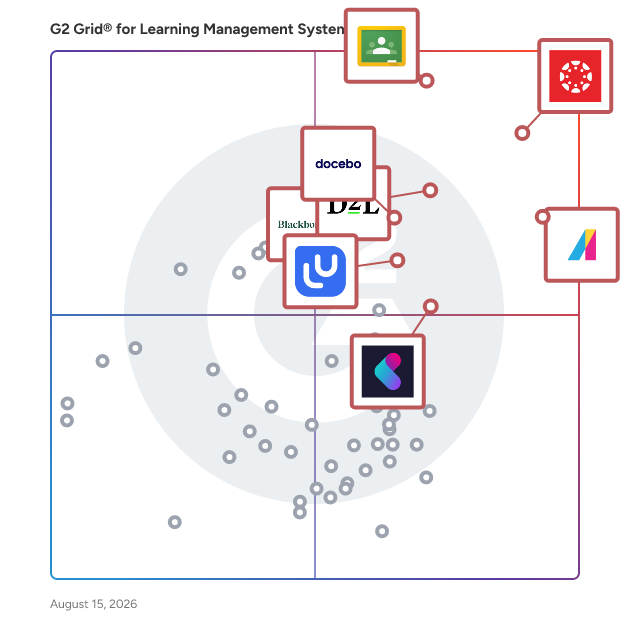
NOTE: Solutions in this category are designed to be used by educational institutions, such as K-12 schools, colleges, universities, and professional schools. If you are looking for an LMS to use in a business or corporate setting, please visit our Corporate LMS software category.
Learning management systems (LMSs) are platforms designed to help instructors manage educational coursework online. They provide educators with a single platform for making course material accessible online, including lesson content, assignments, and assessments. LMSs are used to help streamline the delivery of online learning for educational institutions, allowing for a more connected and accessible educational experience for students.
An LMS enables instructors to build digital courses that include various types of content, such as syllabi, lectures, multimedia files, and readings, as well as distribute assignments to students. LMSs also offer online assessment functionality, such as quizzes and tests. Communication features enable instructors to communicate with students and parents via direct messages, mobile notifications, and discussion forums.
Although there are similarities between education-focused LMSs and corporate LMS software products, platforms designed for K-12 or higher education typically include features specific to educational environments, such as grading functionality and individualized feedback on student assignments. LMSs work in concert with other education software, such as student information systems (SIS), to streamline student data management.
To qualify for inclusion in the Learning Management System (LMS) category, a product must:
G2 takes pride in showing unbiased reviews on user satisfaction in our ratings and reports. We do not allow paid placements in any of our ratings, rankings, or reports. Learn about our scoring methodologies.
A weekly snapshot of rising stars, new launches, and what everyone's buzzing about.
This description is provided by the seller.
Edunation is the next generation LMS for international and private schools! Instead of using a number of technology solutions which will most certainly increase costs and overwork your staff, Edunation offers schools a set of modules that will empower them with everything they need to manage a new age learning environment for their students, educators, and parents, all from one place! Edunation is the only LMS that provides and supports bilingual, multi-cultural, multi-curricular (IB, UK, US, and a conventional national program) and multi-campus environment.
This description is provided by the seller.
EduSys School LMS Software application for the administration, documentation, tracking, reporting, and delivery of educational courses.
This description is provided by the seller.
e-Logos is a complete e-learning platform that allows companies, training organizations, schools, and universities to create, manage, and deliver online courses. The platform is available in 33 languages and offers a fully customizable experience for both users and administrators. Key features include SCORM support, live webinars, automatic certificate generation, advanced learner tracking, role-based access levels (manager, teacher, presenter), and integrated e-commerce with invoicing and payment methods such as Stripe, PayPal, and bank transfer. e-Logos is mobile-friendly and can be integrated with external software via API. Ideal for professional training delivery with maximum flexibility and regulatory compliance.
Pros and Cons are compiled from review feedback and grouped into themes to provide an easy-to-understand summary of user reviews.
This description is provided by the seller.
Pros and Cons are compiled from review feedback and grouped into themes to provide an easy-to-understand summary of user reviews.
This description is provided by the seller.
eTrainCenter is a learning management system (LMS) designed to provide SiteBuilder content management (LCMS) tools that facilitate trainers and administrators to create their own online content, editing, and assessments.
This description is provided by the seller.
LMS & SIS platform for schools to support academic & administration in one integrated ecosystem.
This description is provided by the seller.
LearnLinq is an LMS with features for learning path creation, learning portals, course administration, integration, communication, and others.
This description is provided by the seller.
A lightweight SIS that allows unified access to necessary academic and account data from the moment students apply through their time as alumni.
This description is provided by the seller.
Nimble is an elearning website that it simple to create engaging courses and share them with your teams.
This description is provided by the seller.
OLAT is an open source learning management system (LMS) used all over the world.
This description is provided by the seller.
OneAdvanced Education delivers a powerful, purpose-built software portfolio designed to meet the unique challenges of UK education providers. Supporting over two million learners annually, our solutions are trusted by colleges, universities, and independent training providers to drive efficiency, enhance learner outcomes, and reduce administrative overload. Our platform brings together core products like ProSolution, our central Management Information System (MIS) for student records, funding, timetables and registers; ProMonitor, a complete solution for learner progress tracking and individual learning plans; Smart Assessor, the go-to ePortfolio system for apprenticeships and work-based learning; ProAchieve, a robust analytics tool for monitoring student retention and performance; and PICS, a trusted learner management system used across the sector for managing ILR data and compliance. These systems work seamlessly together within the OneAdvanced Platform, offering a consistent user experience, powerful integrations, and sector-ready security – all underpinned by UK-sovereign AI and intelligent automation. From enrolment to achievement, we help education providers gain complete visibility of the learner journey, unlock actionable insights, and remain compliant with ever-evolving government requirements. Beyond learner-facing tools, we also offer wider back-office capabilities covering finance, procurement, HR and workforce planning – ensuring the entire organisation benefits from connected, future-ready digital infrastructure. At OneAdvanced, we’re not about flashy gimmicks or one-size-fits-all tech – we build software with and for the education sector, shaped by decades of experience and ongoing collaboration with our customers. Whether you’re preparing for inspection, managing complex funding streams, delivering apprenticeships at scale, or simply looking to reduce time spent on admin, OneAdvanced Education is here to help you focus on what matters most: delivering outstanding outcomes for learners. With a scalable, modular approach, we meet providers where they are in their digital journey and support them as they grow, evolve, and respond to sector changes. Our mission is simple: to give educators and learners the tools they need to succeed, with software that’s secure, intelligent, and built to handle the real-world pressures of modern education.
Pros and Cons are compiled from review feedback and grouped into themes to provide an easy-to-understand summary of user reviews.
This description is provided by the seller.
Pros and Cons are compiled from review feedback and grouped into themes to provide an easy-to-understand summary of user reviews.
This description is provided by the seller.
Open source learning management system for the enterprise, business, school and other institutions.
This description is provided by the seller.
Payil is a Learning Management Platform. Payil offers streamlined learning solutions that are beneficial to administrators, employers, teachers, learners, and students. A key benefit of using a Learning Management Platform is that it treats every student and employee as equal, and provides feedback on an individual basis. It helps them to stabilize their relationship and helps them to connect with each other. Payil enables students to: - choose from an array of courses and enrol in them - access course learning materials - attend scheduled classes - engage in discussions with fellow students - seek instructors’ guidance, - take assignments Payil provides a great opportunity for students to enhance their learning through the convenience having access to all the materials and ability to interact with students and instructors during online and in person class. Instructors can publish complete lectures, readings, homework and other learning materials at any time Payil helps to evaluate students on a continuous basis and provide constant feedback. Using Payil students can participate in discussions that improve their knowledge and understanding and their communication skills. Payil empowers students to achieve academic goals through flexible hands-on education that builds on strengths and target areas in need of improvement. Payil employs the best-in-class client services and technology tools in order to provide accountability, accessibility, and involvement for all key stakeholders – students, instructors, administrators, and parents. Payil is an innovative learning platform to improve learning by using data-driven resources to monitor, get feedback, and re-evaluate all levels of service on a consistent basis. Payil enables Instructors to: - access course learning materials - scheduled classes - engage in discussions with students - guide students - give assignments - see the progress of your student Using this platform, instructors also enjoy the flexibility to schedule one-on-one classes with students to clarify their doubts and make the most of the instructor’s knowledge in the discipline of one’s choice. Using Payil content creators can also create self paced courses that students can virtually access at their own pace, based on their own schedule.
This description is provided by the seller.
ProductDyno is a content delivery platform that helps you create and sell memberships, video courses, and any type of digital product.
This description is provided by the seller.
QualCampus is an innovative software solution precisely designed to streamline and optimize the operations of educational institutions, including colleges, universities, schools and other education establishments. QualSoft Solutions has developed QualCampus to cater to institutions worldwide. With a powerful all-in-one platform, it combines the functionalities of an Enterprise Resource Planning (ERP) system, Learning Management System (LMS), and Customer Relationship Management (CRM) system, all customized to meet the unique demands of the education sector. Key Features of QualCampus: QualCampus offers a comprehensive suite of tools designed to enhance the efficiency and effectiveness of educational management: • SIMS (School Information Management System): Centralized management of student information, attendance, grades, and schedules. • Learning Management System (LMS): Facilitates online learning with tools for course management, content delivery, assessments, and student progress tracking. • CRM Functionality: Enhances communication and engagement with students, alumni, and other stakeholders through targeted campaigns and personalized interactions. • Academic Planning: Streamlines course scheduling, curriculum development, and academic calendars. • Assessment and Evaluation: Simplifies exam and assignment management with robust analytics for performance tracking. • Financial Management: Manages budgeting, accounting, tuition fee processing, and financial reporting. • HR Management: Automates recruitment, payroll, performance evaluations, and professional development. • Portals for Faculty, Management, Students, and Parents: Dedicated portals offering personalized access to information and services. • Integration with Standard APIs: Ensures compatibility and seamless data exchange with other systems. • Reporting and Analytics: Complete reports and data driven insights for informed decision making. QualCampus is designed to elevate the efficiency, effectiveness, and quality of education management. By addressing administrative, academic, and student-related functions in one unified platform, QualCampus empowers educational institutions to focus on their core mission of delivering exceptional education. QualCampus's versatility and comprehensive features make it an invaluable tool for improving operational efficiency, enhancing communication, and providing a better educational experience for all users.
This description is provided by the seller.
Everything in One Place: One platform to connect, communicate, and collaborate with parents, teachers, students, and your school community. Enhance Teaching and Learning: Utilise the latest pedagogy, track student progress, and innovate teaching and learning. The Whole Student: Support the development of the whole student; their academic growth, extracurricular involvement, and wellbeing. Everyone Engaged: Easy content and group management keeps people informed and information relevant to them, in one place. Market-leading Integrations: Enhance daily workflows and centralise your systems with our seamless, market-leading SIS and third-party integrations. Support Every Step of the Way: Drive your success with user events, professional services, and a legendary support team.
This description is provided by the seller.
LMS vendors prioritize data security and privacy compliance by implementing robust encryption protocols, regular security audits, and adherence to regulations such as GDPR and FERPA. For instance, platforms like Moodle and Canvas emphasize user data protection through customizable privacy settings and secure access controls. Additionally, many vendors offer features like single sign-on (SSO) and two-factor authentication to enhance security. User reviews highlight the importance of these features, with many users noting their satisfaction with the security measures in place, which fosters trust in the platform.
The total cost of ownership for an LMS is influenced by several factors, including subscription fees, implementation costs, training expenses, and ongoing support. User reviews indicate that platforms like Moodle and TalentLMS are often praised for their affordability, while others like Blackboard and Canvas may incur higher costs due to extensive features and support services. Additionally, customization and scalability can significantly impact overall expenses, as noted by users who emphasize the importance of aligning LMS capabilities with organizational needs.
To evaluate the reporting and analytics capabilities of an LMS, consider user feedback on features like customizable reports, real-time data tracking, and user engagement metrics. Products such as Moodle, TalentLMS, and Docebo are noted for their robust analytics, with users highlighting the importance of visual dashboards and detailed performance insights. Look for systems that allow integration with other tools for enhanced data analysis, as this is frequently mentioned in reviews. Additionally, assess user satisfaction ratings specifically related to reporting features to gauge effectiveness.
Cloud-based LMS solutions, such as TalentLMS and Docebo, offer flexibility, automatic updates, and lower upfront costs, making them ideal for remote access and scalability. In contrast, on-premise LMS like Moodle and SAP Litmos provide greater control over data security and customization but require significant initial investment and ongoing maintenance. Users often cite ease of use and integration capabilities as advantages of cloud-based systems, while on-premise solutions are preferred for organizations with strict compliance requirements.
LMS platforms typically offer robust compliance and certification tracking features, allowing organizations to monitor employee progress and ensure adherence to regulatory requirements. For instance, platforms like TalentLMS and Docebo provide automated reminders for certification renewals and detailed reporting capabilities to track compliance status. Additionally, systems such as Cornerstone OnDemand and SAP Litmos enable users to create custom compliance courses and maintain records of completed certifications, ensuring that organizations can easily manage their compliance obligations.
Common use cases for implementing a Learning Management System (LMS) include employee onboarding, where organizations streamline training processes; compliance training, ensuring staff meet regulatory requirements; and ongoing professional development, allowing users to access courses and resources for skill enhancement. Additionally, LMS platforms are utilized for tracking learner progress and performance analytics, which help organizations assess training effectiveness. Popular LMS solutions like Moodle, TalentLMS, and Docebo are frequently highlighted for their robust features supporting these use cases.
Most LMS solutions are designed to be highly scalable, accommodating the needs of growing organizations. For instance, platforms like Moodle and TalentLMS are frequently praised for their ability to handle increasing user loads without performance degradation. Users report that systems such as Docebo and Cornerstone OnDemand offer robust features that support scalability, including customizable user roles and extensive integrations. Additionally, platforms like SAP Litmos and Absorb LMS are noted for their flexibility in managing large volumes of learners and content, making them suitable for organizations anticipating growth.
Common support options available with LMS providers include 24/7 customer support, live chat, email support, and extensive knowledge bases. Many platforms also offer onboarding assistance and training resources. For instance, platforms like Moodle and TalentLMS are noted for their comprehensive support documentation, while platforms such as Docebo and Cornerstone OnDemand provide dedicated account managers and personalized training sessions. User reviews highlight the importance of responsive support teams, with many users emphasizing the value of timely assistance in resolving technical issues.
To assess the user experience of different LMS options, consider analyzing user reviews focusing on ease of use, customer support, and feature satisfaction. For instance, platforms like Moodle and Canvas are often praised for their user-friendly interfaces, while Blackboard is noted for its robust support. Look at ratings for mobile accessibility and integration capabilities, as these factors significantly impact user experience. Additionally, comparing user feedback on specific features such as reporting tools and customization options can provide deeper insights into overall satisfaction.
When selecting an LMS, consider integrations with tools like Zoom for virtual classrooms, Salesforce for CRM capabilities, Google Workspace for collaboration, and Microsoft Teams for communication. Additionally, look for compatibility with content creation tools such as Articulate and Adobe Captivate, as well as assessment platforms like ProProfs and SurveyMonkey. These integrations enhance functionality and user experience, as highlighted by user reviews that emphasize the importance of seamless connectivity with existing tools.
LMS pricing models typically include subscription-based, per-user, and tiered pricing structures. Subscription-based models are prevalent, with monthly or annual fees that can range from $5 to $20 per user, depending on features. Per-user pricing is common among platforms like Moodle and TalentLMS, where costs increase with the number of users. Tiered pricing is also seen, offering different feature sets at varying price points, which allows organizations to choose plans that best fit their needs. Overall, flexibility in pricing is a key trend, accommodating various organizational sizes and budgets.
Key features to look for in a Learning Management System include user-friendly interface, mobile accessibility, robust reporting and analytics, integration capabilities with other tools, customizable learning paths, and strong customer support. High user ratings highlight the importance of mobile access and reporting features, with many users emphasizing the need for seamless integration with existing systems. Additionally, customizable options are frequently mentioned as essential for tailoring the learning experience to specific organizational needs.


