# Best Fleet Management Software - Page 21

*By [Daniel Rivera](https://research.g2.com/insights/author/daniel-rivera)*


Fleet management software allows businesses to monitor, track, and create detailed performance reports on vehicle fleets. It is used to create more efficient driving routes, track vehicle inventory, provide cost management and analysis, and track driver performance. The best fleet management tools include mobile components to support on-the-go updates and communicate surrounding changes, enabling fleet managers and drivers to work together for maximum efficiency in distribution operations.

Fleet management software is often implemented alongside other supply chain and logistics software, such as [warehouse management software](https://www.g2.com/categories/warehouse-management), [inventory control software](https://www.g2.com/categories/inventory-control-software), and [route planning software](https://www.g2.com/categories/route-planning-software). These tools also integrate with financial software, as well as [customer relationship management (CRM) software](https://www.g2.com/categories/crm) and [order management software (OMS)](https://www.g2.com/categories/order-management). Fleet management software is now evolving to incorporate AI capabilities such as computer vision for safety cameras, biometrics, collision detection, and safety scoring.

To qualify for inclusion in the Fleet Management category, a product must:

- Manage the use of vehicles and equipment
- Dispatch vehicles and optimize route planning
- Provide vehicle tracking with telematics
- Enable mobile in-app communication and updates
- Include features for fleet maintenance
- Monitor and optimize fuel consumption
- Track safety and compliance metrics to generate proactive safety scores
- Offer visibility data to maximize overall fleet performance


## Top Fleet Management Software at a Glance
| # | Product | Rating | Best For | What Users Say |
|---|---------|--------|----------|----------------|
| 1 | [Samsara](https://www.g2.com/products/samsara/reviews) | 4.5/5.0 (4,536 reviews) | Real-time GPS, driver safety, and ELD for commercial fleets | "[Real-Time GPS Tracking and Safety Tools in a User-Friendly Fleet Platform](https://www.g2.com/survey_responses/samsara-review-12997804)" |
| 2 | [Motive](https://www.g2.com/products/motive-technologies/reviews) | 4.4/5.0 (3,084 reviews) | Fleet GPS, ELD compliance, and driver performance monitoring | "[User-Friendly Performance with Smooth API Integrations](https://www.g2.com/survey_responses/motive-review-12819966)" |
| 3 | [Geotab](https://www.g2.com/products/geotab/reviews) | 4.5/5.0 (192 reviews) | Fleet tracking with driver behavior analytics and integrations | "[Geotab Review](https://www.g2.com/survey_responses/geotab-review-12703425)" |
| 4 | [Elite EXTRA](https://www.g2.com/products/elite-extra/reviews) | 4.6/5.0 (79 reviews) | — | "[Streamlines Dispatching with Great Auto-Dispatching Features](https://www.g2.com/survey_responses/elite-extra-review-12914076)" |
| 5 | [Fleetio](https://www.g2.com/products/fleetio/reviews) | 4.6/5.0 (208 reviews) | Fleet maintenance tracking with inspections and compliance | "[Intuitive Fleet Tracking with Seamless Samsara and Fleetio Integration](https://www.g2.com/survey_responses/fleetio-review-12607399)" |
| 6 | [HCSS](https://www.g2.com/products/hcss/reviews) | 4.6/5.0 (256 reviews) | Heavy civil construction fleet and equipment management | "[This Software has Changed the Game for Our Estimating &amp; Job Costing Processes](https://www.g2.com/survey_responses/hcss-review-9317969)" |
| 7 | [Odoo Fleet](https://www.g2.com/products/odoo-fleet/reviews) | 4.5/5.0 (27 reviews) | — | "[Simple, Automated Vehicle Management with a User-Friendly Odoo Fleet Dashboard](https://www.g2.com/survey_responses/odoo-fleet-review-12832134)" |
| 8 | [Azuga Fleet](https://www.g2.com/products/azuga-fleet/reviews) | 4.7/5.0 (192 reviews) | GPS tracking and driver safety scoring for field fleets | "[Azuga: Easy to Use with Really Good Customer Service](https://www.g2.com/survey_responses/azuga-fleet-review-12831833)" |
| 9 | [Route4Me](https://www.g2.com/products/route4me/reviews) | 4.7/5.0 (131 reviews) | Dynamic route optimization for delivery and field operations | "[Optimized Routes That Keep Deliveries On Schedule](https://www.g2.com/survey_responses/route4me-review-13048001)" |
| 10 | [Netradyne](https://www.g2.com/products/netradyne/reviews) | 4.5/5.0 (78 reviews) | AI-powered driver safety coaching with video telematics | "[Definitely a Culture Changer](https://www.g2.com/survey_responses/netradyne-review-11538802)" |

---
## What Are the Most Common Questions About Fleet Management Software?
*AI-generated · Last updated: May 26, 2026*
### Which fleet management software integrates well with GPS?
Based on G2 reviews, Samsara is the most frequently mentioned product in recent fleet management feedback for GPS-connected workflows. According to verified users, it is widely used for live vehicle location, geofencing, route visibility, load tracking, and connecting fleet data in one place. G2 reviewers mention that teams rely on it to locate trucks quickly, monitor drive time, verify deliveries, and respond faster to safety or maintenance issues. Reviewers also note that setup is generally straightforward, though some mention occasional lag, pricing concerns, or limits in certain tracking and reporting views. Overall, recent reviews most consistently describe Samsara as a strong fit for GPS-based fleet visibility and day-to-day operational tracking.


### What&#39;s the best fleet tracking service for logistics company?
Based on G2 reviews, logistics teams most often describe Samsara as a strong fit for fleet tracking because it combines real-time visibility, route history, geofencing, and driver activity monitoring in one system. According to verified users, it helps dispatchers answer customer questions faster, verify deliveries, reduce delays, and improve communication across loads and drivers. G2 reviewers mention that the live map, truck location tools, and accurate hours tracking are especially useful in logistics operations where timing and load status matter. Reviewers also call out some tradeoffs, including higher pricing, occasional lag, and older footage retrieval challenges, but recent feedback still points to strong value for logistics-focused tracking needs.

**Here are some of the top-rated products on G2:**

- [Samsara](https://www.g2.com/products/samsara) – used for real-time truck location, load visibility, geofencing, and delivery verification in logistics workflows
- [Motive](https://www.g2.com/products/motive-technologies) – helps logistics teams track drivers, confirm ETAs, review route history, and improve dispatch coordination
- [Geotab](https://www.g2.com/products/geotab) – supports live fleet visibility, route coordination, fuel and diagnostics monitoring, and recurring operational reporting


### Best software for fleet maintenance and scheduling?
Based on G2 reviews, buyers looking for fleet maintenance and scheduling tools most often highlight Fleetio, Geotab, and Samsara for different needs. According to verified users, Fleetio is frequently praised for service reminders, work orders, maintenance history, fuel tracking, inspections, and centralized vehicle records. G2 reviewers mention that Geotab is useful for proactive maintenance through alerts, fault codes, and vehicle health monitoring, while Samsara is often cited for maintenance diagnostics alongside tracking and compliance. Reviewers also note some tradeoffs, such as support delays, mobile limitations, or reporting complexity depending on the product. Overall, recent reviews suggest Fleetio stands out most directly for maintenance workflows, while Geotab and Samsara are often used where maintenance is tied closely to telematics.

**Here are some of the top-rated products on G2:**

- [Fleetio](https://www.g2.com/products/fleetio) – best suited for service reminders, work orders, inspections, maintenance history, and cost tracking
- [Geotab](https://www.g2.com/products/geotab) – used for proactive maintenance with fault codes, diagnostics, and service planning tied to telematics data
- [Samsara](https://www.g2.com/products/samsara) – supports maintenance and diagnostics alongside live tracking, compliance, and fleet visibility


### Leading fleet management software for trucking industry?
Based on G2 reviews, Samsara, Motive, and Geotab appear most often in recent feedback from trucking and transportation use cases. According to verified users, Samsara is commonly used for truck location, hours tracking, safety coaching, diagnostics, and compliance workflows. G2 reviewers mention that Motive is valued for AI dashcams, ETAs, live tracking, and easier access to driver and vehicle status, while Geotab is often recognized for telematics depth, reporting, and maintenance visibility. Reviewers across these tools also mention some challenges such as pricing, interface complexity, or occasional lag depending on the platform. Still, recent reviews show these products are repeatedly used to support trucking teams that need fleet visibility, safety oversight, and operational control.

**Here are some of the top-rated products on G2:**

- [Samsara](https://www.g2.com/products/samsara) – supports trucking fleets with HOS tracking, driver coaching, truck health visibility, and compliance monitoring
- [Motive](https://www.g2.com/products/motive-technologies) – used by trucking teams for AI cameras, live ETAs, ELD workflows, and dispatch visibility
- [Geotab](https://www.g2.com/products/geotab) – fits trucking operations needing telematics reporting, diagnostics, route tracking, and maintenance planning


### Affordable fleet management software for new businesses?
Based on G2 reviews, Geotab and Motive are the strongest recent options to consider when buyers want fleet management software that feels cost-conscious for newer businesses. According to verified users, Geotab is described as cost-effective, competitively priced, or affordable in multiple recent reviews, while still offering tracking, maintenance visibility, reports, and route oversight. G2 reviewers also mention that Motive is often seen as fairly priced and useful for live tracking, safety monitoring, and dispatch visibility. Recent reviews of Samsara are more likely to mention premium pricing or contract concerns, so it is less commonly framed as affordable. For new businesses, reviewers most often point to products that balance visibility, ease of setup, and operational basics without overly complex workflows.

**Here are some of the top-rated products on G2:**

- [Geotab](https://www.g2.com/products/geotab) – often described as cost-effective while still supporting tracking, maintenance alerts, and reporting
- [Motive](https://www.g2.com/products/motive-technologies) – seen as a fair-value option for live tracking, safety monitoring, and basic fleet visibility


### Best fleet management app for small delivery business?
Based on G2 reviews, small delivery teams often value tools that make route tracking, ETAs, stop visibility, and customer updates easier to manage day to day. According to verified users, Samsara is often used to monitor deliveries, provide time windows, verify stops, and track loads in real time. G2 reviewers also mention Motive for accurate ETAs, live driver tracking, and delivery confirmation support, while Route4Me is frequently praised for route optimization, dispatch efficiency, and driver progress tracking. Reviewers note that some products have mobile or navigation limitations, but recent feedback shows these tools are commonly used to keep deliveries organized, reduce delays, and improve coordination for smaller operations where ease of use matters.

**Here are some of the top-rated products on G2:**

- [Samsara](https://www.g2.com/products/samsara) – helps small delivery teams track assets, verify deliveries, manage routes, and share clearer delivery windows
- [Motive](https://www.g2.com/products/motive-technologies) – useful for live driver tracking, ETA visibility, and resolving delivery confirmations and dispatch questions
- [Route4Me](https://www.g2.com/products/route4me) – built around route optimization, driver tracking, and delivery planning for stop-based operations


### Best-rated fleet management system for corporate fleets?
Based on G2 reviews, corporate fleet buyers most often mention Samsara, Motive, and Geotab when they need broad visibility across many vehicles, drivers, and operating locations. According to verified users, Samsara is used to centralize safety, compliance, vehicle health, and reporting in one platform, which helps larger teams move from manual tracking to more consistent oversight. G2 reviewers mention that Motive supports multi-driver visibility, safety workflows, and maintenance awareness, while Geotab is often chosen for detailed telematics, reporting depth, and operational control. Reviewers also note that larger deployments can bring learning-curve, reporting, or support considerations. Even so, recent feedback shows these platforms are repeatedly used by organizations managing complex, multi-vehicle fleet environments.

**Here are some of the top-rated products on G2:**

- [Samsara](https://www.g2.com/products/samsara) – supports centralized oversight of safety, compliance, vehicle health, and reporting across large fleet operations
- [Motive](https://www.g2.com/products/motive-technologies) – helps corporate fleets manage drivers, safety events, maintenance alerts, and multi-vehicle visibility
- [Geotab](https://www.g2.com/products/geotab) – fits corporate fleets needing detailed telematics, custom reporting, route monitoring, and operational analysis


### Best fleet management solutions for reducing fuel costs?
Based on G2 reviews, fuel cost reduction is most often tied to better visibility into idling, routing, maintenance, and driving behavior. According to verified users, Samsara helps some teams track fuel consumption, idling, route history, and engine diagnostics so they can reduce downtime and lower repair costs that affect overall operating efficiency. G2 reviewers mention that Geotab is frequently used to monitor fuel use, harsh driving, route efficiency, and scheduled reports that support cost control. Reviewers also highlight Motive for weekly spend visibility, MPG insight, and better awareness of habits that affect fuel performance. Recent reviews suggest the strongest results come from tools that combine location data, vehicle health, and driver behavior in one workflow.

**Here are some of the top-rated products on G2:**

- [Samsara](https://www.g2.com/products/samsara) – helps teams monitor idling, fuel consumption, route history, and diagnostics to improve operating efficiency
- [Geotab](https://www.g2.com/products/geotab) – widely used for fuel reporting, route efficiency, harsh driving visibility, and maintenance-linked cost control
- [Motive](https://www.g2.com/products/motive-technologies) – supports fuel oversight with spend dashboards, MPG visibility, and driver behavior coaching


### Most reliable fleet monitoring app for large fleets?
Based on G2 reviews, reliability for large-fleet monitoring usually means consistent tracking, broad visibility, and tools that scale across many vehicles and drivers. According to verified users, Samsara is frequently described as dependable for live maps, safety alerts, gateway health, camera status, reporting, and centralized fleet oversight. G2 reviewers mention that Motive is also viewed as reliable for uptime, vehicle status, AI camera support, and fleetwide visibility, although some reviews note interface or support concerns. Geotab is often praised for accurate data and scalable reporting, but some users mention a steeper learning curve. Across recent reviews, Samsara appears most consistently associated with reliable large-fleet monitoring and operational awareness.


### Top fleet management software for tracking vehicles?
Based on G2 reviews, the products most often recommended for vehicle tracking are Samsara, Motive, and Geotab. According to verified users, Samsara is commonly used for real-time truck and vehicle location, geofencing, route history, delivery verification, and driver monitoring. G2 reviewers mention that Motive is strong for at-a-glance fleet visibility, ETAs, route history, and dispatch support, while Geotab is often chosen for real-time vehicle tracking combined with diagnostics, fuel reporting, and recurring reports. Reviewers do note some occasional lag, reporting complexity, or support issues depending on the tool, but these three consistently appear in recent feedback from teams focused on knowing where vehicles are and acting on that information quickly.

**Here are some of the top-rated products on G2:**

- [Samsara](https://www.g2.com/products/samsara) – widely used for live vehicle tracking, geofencing, route history, and delivery visibility
- [Motive](https://www.g2.com/products/motive-technologies) – helps teams monitor vehicle location, ETAs, route history, and driver activity in real time
- [Geotab](https://www.g2.com/products/geotab) – supports vehicle tracking with operational reports, diagnostics, and route monitoring for daily fleet control


## How Many Fleet Management Software Products Does G2 Track?
**Total Products under this Category:** 433

### Category Stats (Jul 2026)
- **Average Rating**: 4.4/5 The average rating of products in this category, based on all submitted ratings
- **Top Trending Product**: Coastr (+1.78%) - Among all products in this category, Coastr recorded the largest rating increase compared to last month
*Last updated: July 06, 2026*


## How Does G2 Rank Fleet Management Software Products?

**Why You Can Trust G2's Software Rankings:**

- 30 Analysts and Data Experts
- 12,300+ Authentic Reviews
- 433+ Products
- Unbiased Rankings

G2's software rankings are built on verified user reviews, rigorous moderation, and a consistent research methodology maintained by a team of analysts and data experts. Each product is measured using the same transparent criteria, with no paid placement or vendor influence. While reviews reflect real user experiences, which can be subjective, they offer valuable insight into how software performs in the hands of professionals. Together, these inputs power the G2 Score, a standardized way to compare tools within every category.
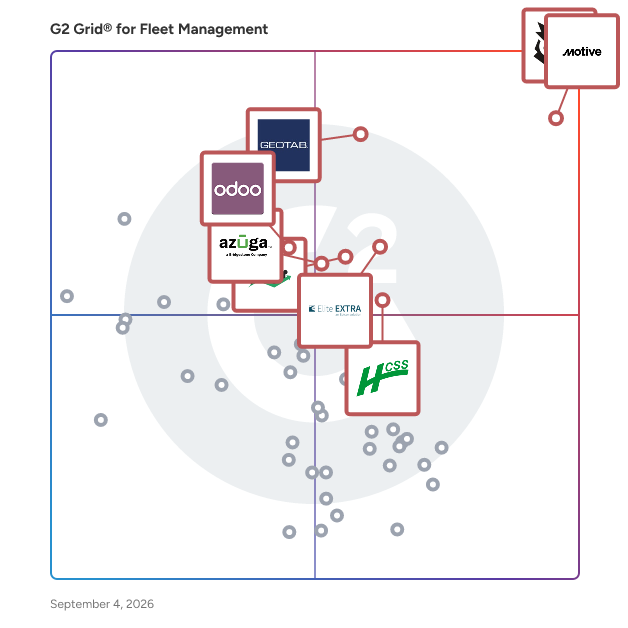

## Which Fleet Management Software Is Best for Your Use Case?

- **Leader:** [Samsara](https://www.g2.com/products/samsara/reviews)
- **Highest Performer:** [Route4Me](https://www.g2.com/products/route4me/reviews)
- **Easiest to Use:** [Samsara](https://www.g2.com/products/samsara/reviews)
- **Top Trending:** [Motive](https://www.g2.com/products/motive-technologies/reviews)
- **Best Free Software:** [Samsara](https://www.g2.com/products/samsara/reviews)


---

**Sponsored**

### Alvys

Alvys is a powerful, cloud-native Transportation Management System designed by industry experts to revolutionize efficiency for carriers, brokers, &amp; hybrid companies. This all-in-one platform streamlines everything from load and driver management to dispatch and accounting. With over 100 seamless integrations (included in every subscription), Alvys unifies all your systems into one intuitive workflow, eliminating fragmentation, errors, and the need for constant app-switching. Key Features: - Seamless EDI connectivity - One-click accounting with automated eChecks - Automatic load creation - Advanced fraud protection and safety tools - Comprehensive analytics &amp; reporting - Flexible contracts &amp; complimentary onboarding Proven Results from Real Users: - 22% average load volume increase within 4 months - Load creation time reduced by 12+ minutes per load - $120K+ annual savings in decreased overhead - New employees onboarded in just 1 week By combining cutting-edge cloud technology, effortless EDI integration, and decades of industry expertise, Alvys empowers trucking companies with a unified, cost-effective solution to optimize operations and accelerate growth. Experience the future of transportation management. Request your free Alvys demo today at Alvys.com!


[Visit website](https://www.g2.com/external_clickthroughs/record?secure%5Bad_program%5D=ppc&amp;secure%5Bad_slot%5D=category_product_list&amp;secure%5Bcategory_id%5D=373&amp;secure%5Bchosen_at%5D=2026-07-07T14%3A30%3A09Z&amp;secure%5Bdisplayable_resource_id%5D=373&amp;secure%5Bdisplayable_resource_type%5D=Category&amp;secure%5Bmedium%5D=sponsored&amp;secure%5Bplacement_reason%5D=page_category&amp;secure%5Bplacement_resource_ids%5D%5B%5D=373&amp;secure%5Bprioritized%5D=false&amp;secure%5Bproduct_id%5D=1174365&amp;secure%5Bresource_id%5D=373&amp;secure%5Bresource_type%5D=Category&amp;secure%5Bsource_type%5D=category_page&amp;secure%5Bsource_url%5D=https%3A%2F%2Fwww.g2.com%2Fcategories%2Ffleet-management%3Fpage%3D21&amp;secure%5Btoken%5D=75b0bf1d36b5b0f833a9e2c8b32ada0b3b9bcd791b4bf657429f88149eef3bcd&amp;secure%5Burl%5D=https%3A%2F%2Falvys.com%2Fget-started%2F&amp;secure%5Burl_type%5D=product_website)

---


## What Is Fleet Management Software?

[Supply Chain &amp; Logistics Software](https://www.g2.com/categories/supply-chain-logistics)

## What Software Categories Are Similar to Fleet Management Software?

- [Fleet Maintenance Software](https://www.g2.com/categories/fleet-maintenance)
- [Fleet Tracking Software](https://www.g2.com/categories/fleet-tracking)
- [Last Mile Delivery Software](https://www.g2.com/categories/last-mile-delivery)


---

## How Do You Choose the Right Fleet Management Software?

### What You Should Know About Fleet Management Software

### What is Fleet Management Software?

Fleet management software is vital to vehicle fleet operations and fleet managers, particularly within the trucking and delivery industries. These solutions are designed to optimize fleet performance, reduce operation and maintenance costs, conduct fleet tracking, and improve driver safety. Fleet management solutions provide real-time GPS tracking, real-time vehicle performance data, route planning features, and more.

The software provides asset management functionality by monitoring the health of a company’s vehicles. With the advent of the Internet of Things (IoT) and the increased capabilities of vehicle sensors, fleet management systems are equipped with even more tools to help fleet operations employees create a more efficient and effective fleet. Fleet management solutions are often used in conjunction with, or as a complement to, other distribution software such as transportation management. Businesses can use fleet management software to solve a host of business problems and gain advantages over their less technically inclined competitors.

The leading fleet management software for the trucking industry typically combines real-time GPS vehicle tracking, ELD compliance, and driver safety monitoring into a single platform that can be deployed across long-haul and regional carriers without major IT lift. Based on G2 reviews, fleet operations leaders evaluate fleet management software by comparing GPS integration depth, driver app usability, and how quickly the platform reduces fuel costs through idling and route optimization.

### What are the Common Features of Fleet Management Software?

**GPS tracking:** One of the vital features of fleet management systems is GPS vehicle tracking. Managers use solutions’ vehicle tracking software features to keep an eye on where their assets are in real time. Apart from simple location tracking, the telematics that most vehicles are equipped with can track aggressive driving behaviors, harsh braking, low tire pressure, and more.

**Real-time alerts:** The production of real-time alerts is one of the most useful features of fleet management software. Real-time alerts can range from reporting low tire pressure to pushing out event reports as they occur. Solutions that leverage telematics hardware already on board can alert the employees that need to know about engine issues in real time, as well as provide vehicle health scores based on real-time data.

**Detailed reporting:** Vehicles generate a ton of data and will continue to generate even more as the IoT allows companies to leverage the advanced reporting capabilities that on-board telematics offer. Quality fleet management software options feature detailed reporting functionality to allow users to create specific and detailed reports containing the exact data they need. Fleet management systems will often integrate with the black boxes located within most commercial vehicles to grab as much real-time data as possible.

**Engine performance data:** Using telematics and the enhanced reporting capabilities afforded by intelligent devices, fleet management solutions can transmit real-time data on engine performance. Dispatchers, managers, and drivers can stay on top of engine performance and adjust driving styles or routes accordingly.

**Route optimization:** This is another aspect of fleet management software that nearly all solutions include. Route optimization is a fundamental tenet of organizing a transportation or delivery company. Goods need to be transported as efficiently as possible, taking into account route length, potential delays, fueling stops, and the like to craft the best routing possible. Optimized routing saves on fuel costs, reduces time spent on each delivery, and improves overall performance. Fleet management solutions provide rich maps that can be used to create efficient routing.&amp;nbsp;

**Customer feedback:** Companies often face difficulties in collecting customer feedback, especially when it comes to positive feedback. Clients usually only take the time to write feedback if they want to complain about something that went wrong during their experience. Fleet management systems offer an easy outlet for customers to constantly connect with and provide feedback to the company they are working with. In practice, this means that companies can head off and prevent conflicts from occurring through the use of a built-in communication channel provided in certain solutions. Coupled with the enhanced transparency afforded by real-time GPS tracking and alerts, fleet management software becomes a powerful relations tool to improve customer satisfaction.

**KPI measurement:** Using fleet management solutions, businesses can set key performance indicators (KPI) and measure actual performance against them. The software offers granular measurements, so there are more possibilities for setting specific KPIs.

**Work orders:** Fleet management systems sometimes provide a work order feature, through which technicians can create a work order directly within the application. The software will also keep a repository of historical work order data, so technicians can view the entire fleet maintenance history of the vehicle they are servicing.

**Fuel management:** Vehicle fleet management software typically features a fuel management system, which tracks fuel consumption throughout the journey. Managers can use the data to see when and under what conditions fuel consumption rates are optimal, and then leverage that data to direct route optimization, driving policy, and other strategies that impact fuel consumption.

**Compliance:** There are fleet management solutions that also offer features designed to help businesses stay compliant under Federal Motor Carrier Safety Administration (FMCSA) regulations. The FMCSA is responsible for reducing the number of traffic accidents involving large vehicles; the organization has instituted regulations to that goal such as limiting hours of service (HOS) and keeping up vehicle maintenance standards. The features include electronic logs of hours driven to stay under law-defined HOS regulations, which outline exactly how many hours drivers can be actively driving after a certain number of hours of rest. Drivers can mark if they are on duty, off duty, in the sleeper berth, or driving; the information is captured by the in-vehicle app. In addition, solutions offer pre-trip inspection record logs to help businesses stay FMCSA compliant.

Based on G2 reviews, GPS integration in fleet management software is the foundational layer rather than a separate add-on, and buyers typically evaluate how cleanly the platform combines real-time location data with telematics signals like engine diagnostics, geofencing alerts, and driver behavior. Reviewers describe the value as coming from how GPS data joins with adjacent systems including ELD compliance, dash cam video, fuel cards, and dispatch platforms, rather than from raw GPS tracking alone. The strongest platforms are cited for plug-and-play GPS hardware that activates same-day, with live truck and trailer location accurate enough to share with brokers and customers.

### What are the Benefits of Fleet Management Software?

Fleet management solutions provide a wide variety of benefits. One of the major advantages is a holistic overview of an organization’s fleet. This is particularly useful for companies with massive numbers of vehicles. If a business has a few trucks it’s easy enough to keep a spreadsheet with all of the pertinent information; even then, by not using the software, the business is missing out on potential savings and alleviating the multitude of headaches that come with managing physical assets. Instead of carrying out preventive or even predictive maintenance, the business may experience significant downtime as one of the vital members of the fleet is put out of commission because of a preventable occurrence.

**Fuel consumption:** It’s easy enough to tell drivers to watch their fuel consumption, but gathering hard, quality data on the actual amounts of fuel they are burning each journey is extremely valuable. One might say it’s invaluable, but there is a calculable value in the form of fuel cost savings. Realizing the savings that come with reducing fuel consumption is a boost to the company’s profit margins, not to mention the PR boost that accompanies carbon footprint reduction.

**Improved client relations:** Fleet management solutions offer GPS fleet tracking capabilities, allowing fleet managers to keep a constant watch on their shipments and the exact location of every member of their fleet. This helps immensely with client relations, particularly in the event of a late shipment or a delay caused by inclement weather. Instead of responding to angry client inquiries as to the status of their delivery, managers can stay informed and relay the situation to the client to appease their desire for accurate information.

**Driver performance:** Numbers drive the transportation business, especially if a company is tasked with ensuring efficiency and optimizing fleet performance. In many cases, fleet performance is dependent on driver performance. Fleet management systems offer GPS tracking to ensure drivers are always on route, as well as a variety of other tracking methods designed to make certain that drivers are performing at their optimal level.

**Reduced insurance costs:** Implementing a fleet management solution can reduce downtime and road accidents. The second point is key, as reducing the number of accidents will reduce the cost of insurance. Any company—whether it be a multinational one enjoying the benefits of economies of scale, or a local business operating a fleet of three trucks—is looking to reduce costs. Reducing accident rates will certainly provide a push in the right safety- and profit-filled direction.

### Who Uses Fleet Management Software?

There are a few key employees that use fleet management software daily to improve the efficiency and efficacy of the company as well as themselves.

**Vehicle fleet manager:** The vehicle fleet manager is responsible for fleet operations, which includes the maintenance and management of the company’s vehicles. As the individual tasked with overseeing the readiness of the fleet, the vehicle fleet manager uses fleet management software for tasks such as vehicle tracking, scheduling vehicle maintenance, monitoring vehicles’ performance, fleet tracking, and collecting real-time data from in-use vehicles. Fleet management solutions help vehicle fleet managers maintain a holistic view of their fleets while providing data-driven insights so they can solve individual vehicle problems.

**Drivers:** Drivers, via a mobile device, use a fleet management app to access customer information, mark delivery status, pull route and navigation information, collect signatures, and track KPIs such as hours on the road, mileage completed, and more. The mobile app s makes drivers’ jobs easier by giving them access to all pertinent information while they’re in the field. Drivers can use the data that the fleet management app tracks to identify their strengths and weaknesses and leverage that information to improve their performance.

**Fleet manager:** The fleet manager is the employee in charge of the entire vehicle fleet. Fleet managers are looking for ways to optimize overall fleet performance. To do this, they use high-level insights, combed from the data that fleet management software collects, and turn those insights into action. The actions they take are designed to improve the performance level of the fleet as a whole.

For instance, a fleet manager looks at the data gathered by the software and sees that drivers are wasting fuel by idling longer than necessary. This means they are taking longer to make their deliveries and slowing the entire delivery process down. The fleet manager rearranges routes and develops a protocol designed to curb idling time. In turn, the reduction of idling time leads to reduced fuel consumption and more savings.

**Fleet maintenance manager:** Fleet maintenance managers are tasked with ensuring that all vehicles are in proper working order and performing as efficiently as possible. The fleet maintenance manager uses [fleet maintenance software](https://www.g2.com/categories/fleet-maintenance) to track the performance of each vehicle in the fleet. They make use of the tracking capabilities and the sensor data transmitted from the vehicles in the fleet to stay abreast of any changes in vehicle performance from journey to journey.

Maintenance managers use fleet management and [fleet tracking software](https://www.g2.com/categories/fleet-tracking) to track overall vehicle health in real time, as well as to schedule maintenance activities and input work orders. Fleet maintenance managers can use the historical data gathered by the software to schedule recurring preventative maintenance activities. As intelligent sensors become more prevalent, fleet maintenance managers will increasingly be able to perform predictive maintenance by using real-time data to gauge whether a part is likely to break down before it actually does.

**Warehouse manager:** Warehouse managers do not typically use the full complement of tools available within most fleet management systems. Instead, they use the tracking software features to discern which vehicles are in the warehouse, which are out delivering goods, and what goods are still in the warehouse. Warehouse managers are more concerned with keeping an accurate inventory, and fleet management solutions help them do that.

**Technician:** Some fleet management software have features designed specifically for shop floor technicians. These features include the ability to input work orders, keep accurate historical maintenance data, assign work, and create related checklists; all of which contribute to streamlining technical operations. For technicians, utilizing software means less time performing administrative tasks and more time spent working on the fleet’s technical problems. For the company, this means less money wasted on vehicle downtime, and potentially avoiding all downtime via preventive maintenance.

#### Software Related to Fleet Management Software

Fleet management systems fit within the [Distribution Software](https://www.g2.com/categories/distribution) category along with other logistics-related software solutions:

[Transportation management software](https://www.g2.com/categories/transportation-management-systems) **:** Transportation management software allows businesses to select a carrier, track shipments, provide freight audits, and issue payments to vendors providing transportation services. Vehicle fleet management software is occasionally included within transportation management solutions to cover the tracking, auditing, and payments functionality, and is included under the larger umbrella of distribution software.

[Trucking software](https://www.g2.com/categories/trucking) **:** Fleet management software is also closely connected with trucking software as both are concerned with using tracking features to manage the transportation process. Fleet management solutions cover fleets of all vehicles and include maintenance features, while trucking software is focused entirely on the trucking industry and is less robust in its feature set.

[Warehouse management software](https://www.g2.com/categories/warehouse-management) **:** Solutions within the fleet management category typically integrate with software such as warehouse management solutions, which track inventory, storing, and shipping for goods. The goods that warehouse management solutions track are usually shipped using the vehicles within a fleet that is managed by a fleet management solution.

[Shipping software](https://www.g2.com/categories/shipping) **:** Shipping software helps businesses coordinate and streamline their outgoing shipments to customers with features such as comparative carrier pricing on shipments, bulk editing and printing of shipment information, and custom tracking and confirmation notifications. Shipping software usually integrates with fleet management software.

[Supply chain suites software](https://www.g2.com/categories/supply-chain-suites) **:** Supply chain suites are all-encompassing solutions that cover the entire production process through shipping and delivery. For this reason, supply chain suites often provide fleet management capability.

[Inventory control software](https://www.g2.com/categories/inventory-control) **:** Inventory control software is dedicated to tracking company inventory. Fleet management software often integrates with inventory control solutions to provide users with the ability to track inventory and what vehicles it ends up on. Fleet management solutions then use GPS tracking to ensure the goods are delivered as promised.

[Fleet maintenance software:](https://www.g2.com/categories/fleet-maintenance) While fleet maintenance can often be found as a module within a fleet management software, some vendors often have standalone solutions that focus mostly on fleet maintenance. These tools generally offer more robust maintenance features and provide GIS features or integrate with GIS software to monitor the physical location of vehicles.

[Fleet tracking software:](https://www.g2.com/categories/fleet-tracking) Fleet tracking software leverages GPS technology to monitor the activity, vehicles, and drivers involved in transportation. Fleet tracking software is used by fleet managers to effectively track their fleets in real time and collect data on the performance of their vehicles and drivers. Although fleet tracking is often a component of fleet management systems, some vendors serve the specific function of using GPS and telematics to track vehicles and do not provide most of the additional back-office functionality of fleet management software.

### Challenges with Fleet Management Software

Fleet management is a complex business with a ton of physical assets and people to coordinate. There are bound to be issues that arise during the administration of all of those moving parts; fleet management software can help solve those problems.

**Measuring ROI:** Measuring return on investment (ROI) can be difficult when implementing a software solution. In the case of fleet management software, there are some concrete numbers that businesses can examine to ensure the solution they’ve implemented provides the benefits they expect from it. Fleet management solutions keep track of all of a company’s fleet data and allow for the creation of customized reports, so businesses can point to the numbers within the report as evidence of their ROI. Savings on fuel costs from reduced idle time, route optimization, and reduced insurance costs are all measurable benefits gained from implementing fleet management software. Increased productivity leads to more deliveries in a shorter time, with more money saved and drivers covering fewer miles.

**Maintenance:** Maintenance will always be an issue for any company with physical assets; the software helps alleviate those issues. Fleet management systems are multifaceted, and one of those facets is maintenance-focused. Much like a computerized maintenance management system (CMMS), fleet management solutions often feature a place to track maintenance, specifically for vehicles, which includes placing work orders and the maintenance of work history records for individual vehicles.

**Weather delays:** Inclement weather is a major impediment to transportation companies. Fleet management systems give businesses valuable tools to find reasonable alternatives to shutting down operations. In addition, fleet management solutions provide an avenue of communications for drivers and customers, which helps ensure driver safety as well as transparency between the company and its clients.

### Which Companies Should Buy Fleet Management?

There are various industries and types of companies that regularly use vehicle fleet management software. This is because so many companies require transportation as an integral part of their business plan. Whether this is e-commerce companies making deliveries, or construction companies trying to keep track of their trucks, fleet management systems can help businesses manage and keep track of large fleets of vehicles.

**Trucking and car companies:** Trucking and car companies regularly manage large fleets. These companies are either managing freight or transporting goods from one location to another. As such, they can use some of the core features that come along with a good fleet management solution such as routine maintenance notifications, fuel and mileage reports, driver behavior monitoring, and real-time driver communication.&amp;nbsp;

**Healthcare:** Healthcare facilities often dispatch cars for emergencies or routine pickups. As such, they can use some of the core features that come with fleet management software such as instant communication, security protocols, and emergency route optimization.&amp;nbsp;

Based on G2 reviews, the leading platforms in the trucking industry combine real-time vehicle tracking with rapid deployment that lets operators install plug-and-play telematics across mixed fleets without dedicated IT support. Reviewers consistently mention same-day setup, accurate live truck and trailer location, and integrated ELD compliance as the features that drive adoption decisions in trucking and last-mile delivery. For top fleet management software focused on vehicle tracking, granular visibility into harsh braking, idling, and trip history is what reviewers describe as the difference between a system fleet managers actively use and one that becomes a passive dashboard.

### How to Buy Fleet Management Software

#### Requirements Gathering (RFI/RFP) for Fleet Management Software

Requirements gathering is critical to ensure that the business is implementing a product that meets all of its needs. While some fleet management systems will have a full-fledged feature list with features such as driver safety management and ELD support, these solutions are generally more expensive. For buyers who want the basic functionality of fleet management software, only core features such as route planning, dispatching, driver communication, and vehicle tracking are essential. These solutions may be less expensive and cover all requirements, rather than a solution that covers all the bells and whistles.

#### Compare Fleet Management Software Products

**Create a long list**

Long lists are created by eliminating software options that do not provide critical functionality. To make a long list for a fleet management solution, a buyer should look at the following functionalities and deem which products provide the necessary functionality:

- Route planning
- Vehicle tracking&amp;nbsp;
- Fuel management
- Driver management
- Driver onboarding and training
- Driver analytics
- ELD compliance
- Fleet maintenance
- Dispatch management
- Driver documentation and compliance

**Create a short list**

Once a buyer has narrowed down their list from the following functionality above, it’s then important to get even more specific requirements. For example, if a company is in the e-commerce industry, they should make sure that there is functionality for last-mile delivery which might require delivery management features. If a company is in the healthcare industry, they might want to make sure the software has emergency dispatch features.

**Conduct demos**

Demos are one of the most important stages in the buying journey. This allows a buyer to sit through an actual product demo and see if the product matches all of the requirements. To make sure the demo runs smoothly, it’s important to ensure that the vendor has all of the requirements beforehand so they can showcase their features properly.

#### Selection of Fleet Management Software

**Choose a selection team**

It’s essential to have input from the people who will use this software before making such a hefty purchase. As such, it’s important to create a small selection team of three to eight people for purchasing a fleet management software.&amp;nbsp;

First, businesses should get input from fleet managers that prioritize driver safety and compliance. Fleet managers know more than anyone which features are important to ensure that all drivers are staying compliant on the road while balancing driver safety. Second, they should consult implementation managers to ensure that the software has the necessary features to easily implement this software quickly into the logistics process. Lastly, it’s important to have any other relevant team leaders in the selection team; these are the team members who are responsible for driver onboarding and fleet maintenance.

**Negotiation**

When it comes down to the negotiation stage buyers must consider implementation and training costs. Once a buyer ensures that all other requirements are met, the last stage is ensuring that workers will be properly trained on the new software. This should be included in the price of the software, especially if it’s a recurring revenue cost.&amp;nbsp;

**Final decision**

After the negotiation stage is conducted, the final decision requires buy-in from everyone on the selection team. It’s important to get everyone on the same page to ensure that all requirements are met and the final decision is supported by everyone involved.

### What Does Fleet Management Cost?

Fleet management software is commonly priced on a per-vehicle basis. This means that the business will pay for each vehicle that is connected to the software for a monthly price. Another pricing model which is less common can be a fixed cost up to a certain number of vehicles per year. For the per vehicle pricing model, this price generally ranges anywhere from $20-$45 per month depending on the level of functionality. For a fixed cost per year, it may cost around $3500-$6500 per year for a fleet of up to 10-20 vehicles. This price again depends on the software’s level of functionality.

Most fleet management software pricing will also allow users to pick and choose which features are critical to their business needs. This will also allow businesses to cut down on costs if they choose only what’s necessary to them.&amp;nbsp;

#### Return on Investment (ROI)

Below is the breakdown of the estimated time to ROI for fleet management according to G2 review data on G2 as of July 26, 2021:

- 27% of buyers see an ROI in 6 months or less
- 28% of buyers see an ROI in 7-12 months
- 16% of buyers see an ROI in 13-24 months
- 8% of buyers see an ROI from 24-36 months
- 21% of buyers never see a full payback from implementing the software

Based on G2 reviews, the best fleet management solutions reduce fuel costs primarily by surfacing idling time, route inefficiency, and aggressive driving behavior in real-time dashboards that fleet managers can act on weekly. Reviewers cite fuel and energy reports that flag specific drivers for coaching as the most direct mechanism for cutting fuel waste, with operators describing measurable monthly savings once idling patterns are corrected. AI-driven fault code detection and integration with fuel cards extend the same visibility into the maintenance and procurement side of fleet costs.

### Implementation of Fleet Management Software

**What Does the Implementation Process Look Like for Fleet Management Software?**

Before businesses begin implementation there should generally be a long process of employee and manager buy-in that occurs during the purchasing process. During this process, both employees and managers need to align on goals and expectations on what this new software aims to achieve after implementation. So the first step is to set metrics before implementation to determine what success looks like after this software is implemented. Some of these goals may be as follows:

- Improve delivery times by x %
- Reduce driver accidents and incidents by x %
- Reduce fleet fuel consumption by x %
- Reduce overall repair costs by x%
- Maintain compliance regulations

**When Should You Implement Fleet Management Software?**

After setting goals on business metrics, it’s important to set a rough timeline on how long it will take for the business to adopt the software and go live. According to our G2 review data as of July 31, 2021, here is a breakdown of how long it may take:

- 34% of buyers see a go live time in less than 1 day
- 40% of buyers see a go live time in less than 1 month
- 13% of buyers see a go live time of 1-3 months
- 5% of buyers see a go live time of 3-6 months
- The rest of the buyers see a go live time anywhere after 1 year

While the above data suggests it will most likely take less than three months to implement, there still needs to be alignment across IT teams and managers to effectively implement fleet management software. For example, if each vehicle will also need ELD and dash cams to integrate into the software this is something that might take some extra time from IT teams that understand how to link this data within the software.&amp;nbsp;

### Fleet Management Software Trends

The fleet management industry has not changed much over the past several decades. Now, however, fleet management software offers businesses the opportunity to leverage new technology and reshape their business processes.

**Artificial intelligence:** Artificial Intelligence presents a huge opportunity for driver enablement as well as a huge improvement in Advanced Driver Assistance Systems (ADAS). ADAS that use deep learning and machine vision technology are being deployed in vehicle fleets to improve the safety of both drivers and everyone else on the road. In addition, vehicle maintenance managers will deal with less unplanned downtime as systems become more intelligent and can leverage their ability to order preventive maintenance as needed.

**Autonomous fleets:** Driverless vehicles are on everyone’s minds these days, and the situation is no different for the fleet maintenance industry. Autonomous truck pilot programs are popping up everywhere as driverless technology is finally catching on as a real possibility. While fully autonomous fleets are likely still a few years away, this is nevertheless an industry trend to keep an eye on. In addition, there are still massive legal battles to be fought in the near future, as the inevitable errors that self-driving vehicles will make occur; however, the prospect of trucks humming along highways around the world sans human pilots is bright.

**Internet of Things:** Predictive maintenance is already in use, but can end up costing businesses money on unnecessary repairs. Predictive maintenance with the use of IoT-connected sensors is likely to become prevalent in the next few years. Essentially, predictive maintenance is predicated on taking the real-time data, transmitted from the IoT-connected sensors within the vehicles, and using it to carry out maintenance activities on parts that are degrading—before they hit the point at which they break down. This leads to less downtime, as breakdowns are prevented, along with less money being spent on unscheduled, otherwise unnecessary maintenance that is solely based on past performance metrics.

Real-time tracking is becoming more prevalent throughout the industry as fleet management and related software actively support the capability. There are already solutions providing detailed real-time data related to driver behavior, event recording, road hazards, engine and overall vehicle performance, and more. Moving forward, companies can begin to leverage the massive amount of data that is being gathered and use it to shape more well-informed policies, with the ultimate goal of keeping drivers safe and optimizing fleet performance.

Vehicles are getting smarter with the widespread adoption of IoT. Human drivers are invariably imperfect, so there has been a push to develop technology that bridges the gap created by those imperfections. Internet-connected audio and visual technology is being put on board to collect real-time data and push it to fleet managers. Operations managers will be able to use that data to not only craft routes and strategies for future applications but to optimize performance in real time.

### Fleet Management Software FAQs

### Most Popular FAQs

#### Which fleet management software has the best reviews?

Based on verified user ratings across a large volume of G2 reviews, these fleet management platforms consistently earn top marks for overall satisfaction:

- [Samsara](https://www.g2.com/products/samsara/reviews) — A widely adopted fleet management platform recognized for its real-time GPS tracking, AI-powered safety features, and end-to-end visibility across vehicles, drivers, and assets in a single dashboard.
- [Motive](https://www.g2.com/products/motive-technologies/reviews) — A fleet management and ELD compliance platform praised for its intuitive driver app, real-time safety event detection, and coaching tools that help operations teams reduce incidents across commercial fleets.
- [Fleetio](https://www.g2.com/products/fleetio/reviews) — A fleet maintenance and operations platform valued for its streamlined work order management, preventive maintenance scheduling, and clean interface that reduces the administrative burden on lean operations teams.
- [HCSS](https://www.g2.com/products/hcss/reviews) — A construction-focused fleet and equipment management platform rated highly for its job costing integration, equipment tracking, and maintenance workflows purpose-built for heavy civil and infrastructure fleets.

#### How does fleet management software work?

Fleet management software works by connecting GPS-enabled hardware installed in vehicles to a centralized cloud platform that collects and surfaces location, performance, and compliance data in real time.

Onboard devices transmit vehicle telemetry, including speed, location, engine diagnostics, hours of service, and fuel consumption, to an operations dashboard, where fleet managers monitor driver behavior, dispatch vehicles, schedule maintenance, and enforce regulatory compliance, such as ELD mandates.&amp;nbsp;

Modern platforms extend these core capabilities with AI-powered driver coaching, integrated dash cameras, route optimization, and mobile apps that give drivers direct access to their logs and assignments. The result is a connected system that reduces fuel waste, improves safety outcomes, extends vehicle lifespan, and reduces the administrative workload of managing a mobile workforce.

#### What are the best fleet management solutions for reducing fuel costs?

Fuel cost reduction is one of the most measurable ROI drivers in fleet management, and the strongest platforms provide granular visibility into idling patterns, route efficiency, and driver behavior to address waste directly.

- [Motive](https://www.g2.com/products/motive-technologies/reviews) — Offers real-time fuel usage monitoring alongside driver performance data, enabling managers to coach on speeding, hard braking, and excessive idling — behaviors that directly drive up fuel costs.
- [ClearPathGPS](https://www.g2.com/products/clearpathgps/reviews) — Provides detailed idling alerts, route replay, and driver scorecards that give fleet operators the visibility needed to identify and eliminate fuel-inefficient behaviors across their vehicles.
- [GPS Insight](https://www.g2.com/products/gps-insight/reviews) — Delivers driver behavior monitoring and fuel reporting tools that help fleet managers track consumption trends and hold drivers accountable to efficiency standards over time.
- [Fleetio](https://www.g2.com/products/fleetio/reviews) — Combines fuel log tracking with maintenance scheduling so fleet teams can correlate fuel inefficiency with vehicle health issues, catching problems before they compound into larger cost drivers.

#### What is the leading fleet management software for the trucking industry?

The trucking industry demands fleet management software built around ELD compliance, HOS monitoring, long-haul route efficiency, and driver communication, and the platforms that lead in this segment address all of these requirements.

- [Motive](https://www.g2.com/products/motive-technologies/reviews) — One of the most widely deployed ELD and fleet management platforms in commercial trucking, trusted for its compliance tools, driver-facing app, and real-time safety monitoring across long-haul and regional operations.
- [Trimble TMS](https://www.g2.com/products/trimble-tms/reviews) — An enterprise-grade transportation management system adopted by trucking carriers for its dispatch automation, freight operations workflows, and integration capabilities that connect fleet and back-office systems.
- [Alvys](https://www.g2.com/products/alvys/reviews) — A modern TMS platform built specifically for trucking carriers, recognized for its clean interface, carrier-focused workflow automation, and load management tools that reduce manual dispatch overhead.
- [Toro TMS](https://www.g2.com/products/toro-tms/reviews) — A trucking-focused TMS platform praised by small and mid-sized carriers for its practical feature set covering dispatch, driver settlements, and compliance documentation without the complexity of larger enterprise systems.

#### What are the different types of fleet management software?

Fleet management software spans several distinct functional categories, and many platforms combine two or more of these types into an integrated solution.

The primary types include:

- **GPS tracking and telematics software** , which monitors vehicle location, speed, and diagnostics in real time.
- **ELD and compliance software** , which manages Hours of Service logging and DOT regulatory requirements.
- **Fleet maintenance software** , which tracks preventive maintenance schedules, work orders, and repair history.
- **Driver safety and video telematics platforms** , which use AI-powered cameras to score and coach driver behavior.
- **Route optimization software** , which plans and dynamically adjusts delivery routes to reduce fuel costs and improve on-time performance.
- **Asset management platforms** , which extend tracking beyond powered vehicles to trailers, heavy equipment, and non-powered assets. Enterprise operations often require a platform that spans multiple categories, while smaller fleets may prioritize a focused tool that solves a single operational problem before expanding.

### Small Business FAQs

#### What is the most affordable fleet management software for SMBs?

For operators evaluating [small business fleet management software](https://www.g2.com/categories/fleet-management/small-business), the strongest affordable platforms balance core GPS tracking, maintenance, and compliance features with low per-vehicle pricing and minimal implementation overhead.

- [Simply Fleet](https://www.g2.com/products/simply-fleet-simply-fleet/reviews) — A lightweight fleet management platform designed specifically for small fleets, offering fuel tracking, maintenance scheduling, and inspection tools at a price point accessible to operators just getting started with fleet software.
- [Whip Around](https://www.g2.com/products/whip-around-whip-around/reviews) — A mobile-first fleet inspection and compliance platform that SMBs use to replace paper DVIRs and maintenance logs, with straightforward pricing and a fast setup process that requires no dedicated IT resources.
- [ClearPathGPS](https://www.g2.com/products/clearpathgps/reviews) — A cost-competitive GPS tracking platform frequently cited by small fleet operators for delivering reliable real-time location data, geofencing, and driver behavior reporting without the pricing complexity of larger enterprise tools.
- [Driveroo](https://www.g2.com/products/driveroo/reviews) — An AI-powered vehicle inspection and fleet maintenance platform built for small fleets that want to digitize inspection workflows and track repair history without investing in a full-scale fleet management suite.

#### What is the best fleet management software for startups?

Startups building out their first fleet operations need software that can be implemented quickly, requires minimal IT resources, and covers the essentials without locking them into complex configurations. You can browse the full [small business fleet management](https://www.g2.com/categories/fleet-management/small-business) category on G2 to see the top-rated options.

- [Samsara](https://www.g2.com/products/samsara/reviews) — A practical starting point for growing fleets, with guided onboarding and an intuitive dashboard that startup operations teams can learn and act on without prior fleet management experience.
- [Motive](https://www.g2.com/products/motive-technologies/reviews) — Startup fleet operators frequently cite the ease of getting drivers up and running with the Motive app, with same-day ELD activation and a straightforward admin interface that doesn&#39;t require a dedicated fleet manager.
- [Fleetx](https://www.g2.com/products/fleetx/reviews) — A GPS tracking and fleet operations platform used by early-stage logistics and delivery startups that need real-time visibility into their vehicles without the overhead of a complex multi-module system.
- [Onfleet](https://www.g2.com/products/onfleet/reviews) — A delivery operations platform that startup last-mile teams use to get route planning, driver tracking, and customer notifications running quickly, without requiring significant technical setup or training.

#### Which fleet management software is the most user-friendly for startups?

Ease of use is the top priority for lean startup teams, where no one has dedicated time for extended software training; these platforms consistently earn the highest usability marks from small-team users.

- [Route4Me](https://www.g2.com/products/route4me/reviews) — A route optimization and fleet management platform praised for its straightforward interface, with startup delivery teams regularly highlighting how quickly dispatchers and drivers can navigate their workflows from day one.
- [Digiparc](https://www.g2.com/products/digiparc/reviews) — A fleet inspection and maintenance platform recognized for its clean, minimal interface that small teams without a fleet management background can adopt and use consistently without formal onboarding sessions.
- [GPSTab](https://www.g2.com/products/gpstab/reviews) — An ELD and GPS tracking platform valued by startup trucking operations for its simple, driver-friendly interface that reduces the friction of HOS compliance for drivers unfamiliar with electronic logging.
- [Force Fleet Tracking](https://www.g2.com/products/force-fleet-tracking/reviews) — A plug-and-track GPS solution designed for simplicity, allowing startup fleet operators to install devices and start monitoring vehicles within minutes without navigating a complex configuration process.

#### What is the best fleet management app for small delivery businesses?

Small delivery businesses need a mobile-first fleet solution that supports driver dispatch, real-time tracking, and proof of delivery, tools that keep operations running from a smartphone rather than a dedicated operations center. Explore the full [small business fleet management software](https://www.g2.com/categories/fleet-management/small-business) category on G2 to compare options by feature.

- [Onfleet](https://www.g2.com/products/onfleet/reviews) — A delivery-focused operations platform that combines route optimization, live driver tracking, and proof-of-delivery capture in a mobile-native interface built specifically for last-mile delivery teams.
- [Track-POD](https://www.g2.com/products/track-pod/reviews) — A delivery management platform used by small businesses to digitize order dispatch, driver routing, and electronic proof of delivery, reducing paperwork and improving delivery accuracy for growing operations.
- [Toro TMS](https://www.g2.com/products/toro-tms/reviews) — A carrier-focused platform that small delivery operations use to manage driver assignments, load tracking, and settlement workflows from a mobile-accessible interface designed for teams without a full back-office setup.
- [FleetUp](https://www.g2.com/products/fleetup/reviews) — A GPS tracking and ELD platform with a mobile-friendly dashboard that small delivery businesses use to monitor vehicle locations, driver hours, and route progress in real time without desktop dependency.

#### Which fleet management software is best for small field service businesses?

Field service businesses managing technician vehicles, service vans, and on-site equipment need a fleet platform that handles scheduling visibility, vehicle maintenance, and job-site arrival tracking without requiring a full-time fleet administrator.

- [IntelliShift](https://www.g2.com/products/intellishift/reviews) — A connected fleet intelligence platform used by field service SMBs for combining vehicle tracking, driver safety monitoring, and inspection workflows in one interface that keeps service dispatchers informed in real time.
- [Momentum IoT](https://www.g2.com/products/momentum-iot/reviews) — An IoT-based asset tracking platform used by small field service and construction businesses to monitor both powered vehicles and non-powered equipment, giving operations managers visibility across their entire deployed asset base.
- [Whip Around](https://www.g2.com/products/whip-around-whip-around/reviews) — A fleet inspection and maintenance platform that field service businesses use to keep service vehicles roadworthy, with mobile DVIR workflows that drivers complete before and after each job without paper-based processes.
- [ClearPathGPS](https://www.g2.com/products/clearpathgps/reviews) — A GPS tracking platform that field service SMBs use to monitor technician locations, verify job-site arrivals, and optimize dispatch decisions based on real-time vehicle positions across their service territory.

### Enterprise FAQs

#### What is the best-rated fleet management software for tech enterprises?

Technology enterprises require [enterprise fleet management software](https://www.g2.com/categories/fleet-management/enterprise) with open API architecture, scalable data infrastructure, and deep third-party integrations that connect fleet operations to broader enterprise systems. These platforms earn the highest marks from large-scale buyers.

- [Samsara](https://www.g2.com/products/samsara/reviews) — A cloud-native platform built for enterprise scale, offering a robust API, native integrations with ERP and HR systems, and an AI-powered analytics layer that technology-forward operations teams use to drive continuous fleet performance improvement.
- [Motive](https://www.g2.com/products/motive-technologies/reviews) — Increasingly adopted by mid-to-large enterprises for its comprehensive safety, compliance, and fleet operations capabilities within a modern cloud architecture that supports high-volume vehicle deployments without performance degradation.
- [Azuga Fleet](https://www.g2.com/products/azuga-fleet/reviews) — An enterprise fleet management and driver safety platform valued for its risk scoring methodology, insurance program integrations, and reporting infrastructure that enterprise safety and operations teams use to manage large driver populations.
- [GPS Insight](https://www.g2.com/products/gps-insight/reviews) — A fleet intelligence platform with a strong enterprise footprint, recognized for its configurable reporting, multi-location management capabilities, and workflow integrations that give large organizations centralized visibility across distributed fleets.

#### What is the most reliable fleet management software tool for enterprises?

Enterprise buyers prioritize platform stability, data integrity, and consistent performance at scale — especially when fleet operations are tied directly to regulatory compliance requirements and customer service-level agreements.

- [Samsara](https://www.g2.com/products/samsara/reviews) — Enterprise users regularly cite Samsara&#39;s platform reliability as a core reason for long-term retention, noting consistent uptime, real-time data accuracy, and dependable alert delivery across large multi-site and multi-region deployments.
- [Trimble TMS](https://www.g2.com/products/trimble-tms/reviews) — Trusted by enterprise transportation operations for the stability of its dispatch and compliance infrastructure, with a mature platform track record supporting carriers and private fleets at significant operational scale.
- [HCSS](https://www.g2.com/products/hcss/reviews) — Enterprise construction and infrastructure fleets rely on HCSS for consistent equipment tracking and maintenance data reliability, with a platform designed around the uptime demands of large civil contracting operations.
- [Motive](https://www.g2.com/products/motive-technologies/reviews) — Enterprise users highlight Motive&#39;s consistent ELD compliance data reliability and platform stability across large driver populations, particularly in regulated industries where HOS accuracy is subject to DOT audit.

#### What is the best-reviewed fleet management software for enterprise app integration?

Integration depth is a top evaluation criterion for enterprise fleet buyers managing complex technology stacks across TMS, ERP, fuel management, and payroll systems. You can explore the full [enterprise fleet management software](https://www.g2.com/categories/fleet-management/enterprise) category on G2 for in-depth integration comparisons.

- [Motive](https://www.g2.com/products/motive-technologies/reviews) — Enterprise reviewers highlight Motive&#39;s growing integration ecosystem spanning fuel card providers, dispatch platforms, payroll systems, and analytics tools, making it a practical hub for organizations consolidating fleet data across multiple operational systems.
- [GPS Insight](https://www.g2.com/products/gps-insight/reviews) — Recognized for its flexible API and pre-built connections to work order management, fuel management, and business intelligence platforms, allowing enterprise teams to embed fleet data into their broader operational workflows.
- [Azuga Fleet](https://www.g2.com/products/azuga-fleet/reviews) — Used by enterprise risk and operations teams for its integrations with insurance carrier platforms and telematics data aggregators, enabling large organizations to connect driver safety data directly to their risk management programs.
- [Trimble TMS](https://www.g2.com/products/trimble-tms/reviews) — Offers deep integration with freight management, accounting, and carrier compliance platforms, reducing the data gap between fleet dispatch operations and back-office financial and logistics systems for enterprise transportation organizations.

#### What is the best-rated fleet management software for corporate fleets?

Corporate fleet programs managing company cars, executive vehicles, and service fleets require platforms that combine vehicle tracking, driver policy enforcement, cost reporting, and utilization analytics in a centralized system. Browse the full [enterprise fleet management software](https://www.g2.com/categories/fleet-management/enterprise) category on G2 to compare top-rated options.

- [HCSS](https://www.g2.com/products/hcss/reviews) — Corporate fleet managers in infrastructure and construction enterprises use HCSS for its equipment utilization reporting and cost tracking, providing leadership with clear visibility into the total fleet cost of ownership across large asset inventories.
- [Trimble TMS](https://www.g2.com/products/trimble-tms/reviews) — Corporate transportation fleets use Trimble for its driver management, route compliance tracking, and operational reporting capabilities that give fleet and finance teams the data needed for budgeting and performance reviews.
- [Azuga Fleet](https://www.g2.com/products/azuga-fleet/reviews) — Corporate risk and HR teams use Azuga&#39;s driver scoring and policy enforcement tools to run company-wide safe driving programs, with a reporting infrastructure that connects fleet safety outcomes to insurance and compliance objectives.
- [GPS Insight](https://www.g2.com/products/gps-insight/reviews) — Enterprise corporate fleet administrators value GPS Insight for its configurable dashboards and utilization reports that surface vehicle availability, underutilized assets, and department-level fleet cost allocation across large organizations.

#### What is the most reliable fleet monitoring platform for large fleets?

Large fleet operators managing hundreds or thousands of vehicles need a monitoring platform that delivers consistent, real-time data, scales without performance degradation, and provides dispatch and operations teams with dependable situational awareness at all times.

- [Samsara](https://www.g2.com/products/samsara/reviews) — Widely adopted by large fleet operators for its scalable real-time monitoring infrastructure, providing live vehicle location, safety event alerts, and driver status across enterprise deployments with consistent data reliability regardless of fleet size.
- [Motive](https://www.g2.com/products/motive-technologies/reviews) — A fleet monitoring platform trusted at scale for its real-time event detection accuracy, consistent ELD data integrity, and driver app performance under the demands of high-volume commercial fleet operations.
- [Trimble TMS](https://www.g2.com/products/trimble-tms/reviews) — Enterprise fleet operators use Trimble for its proven platform stability at scale, with a monitoring and dispatch infrastructure built to support large carrier networks where operational continuity directly impacts freight commitments.
- [Azuga Fleet](https://www.g2.com/products/azuga-fleet/reviews) — Recognized for reliable driver behavior monitoring and GPS accuracy across large vehicle populations, Azuga Fleet is used by enterprise safety teams that need consistent data quality for risk management and insurance reporting at scale.

**Last updated on April 24, 2026**


