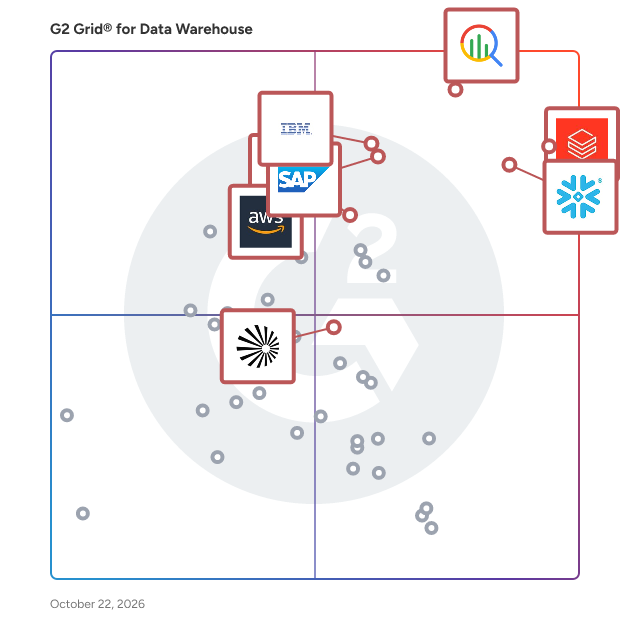
# Best Enterprise Data Warehouse Solutions

  *By [Shalaka Joshi](https://research.g2.com/insights/author/shalaka-joshi)*

   Products classified in the overall Data Warehouse category are similar in many regards and help companies of all sizes solve their business problems. However, enterprise business features, pricing, setup, and installation differ from businesses of other sizes, which is why we match buyers to the right Enterprise Business Data Warehouse to fit their needs. Compare product ratings based on reviews from enterprise users or connect with one of G2&#39;s buying advisors to find the right solutions within the Enterprise Business Data Warehouse category.

In addition to qualifying for inclusion in the Data Warehouse Solutions category, to qualify for inclusion in the Enterprise Business Data Warehouse Solutions category, a product must have at least 10 reviews left by a reviewer from an enterprise business.


## Category Overview

**Total Products under this Category:** 120


## Trust & Credibility Stats

**Why You Can Trust G2's Software Rankings:**

- 30 Analysts and Data Experts
- 6,500+ Authentic Reviews
- 120+ Products
- Unbiased Rankings

G2's software rankings are built on verified user reviews, rigorous moderation, and a consistent research methodology maintained by a team of analysts and data experts. Each product is measured using the same transparent criteria, with no paid placement or vendor influence. While reviews reflect real user experiences, which can be subjective, they offer valuable insight into how software performs in the hands of professionals. Together, these inputs power the G2 Score, a standardized way to compare tools within every category.


## Best Data Warehouse Solutions At A Glance

- **Best for Small Businesses:** [Google Cloud BigQuery](https://www.g2.com/products/google-cloud-bigquery/reviews)
- **Best for Mid-Market:** [Google Cloud BigQuery](https://www.g2.com/products/google-cloud-bigquery/reviews)
- **Best for Enterprise:** [Google Cloud BigQuery](https://www.g2.com/products/google-cloud-bigquery/reviews)
- **Highest User Satisfaction:** [Google Cloud BigQuery](https://www.g2.com/products/google-cloud-bigquery/reviews)
- **Best Free Software:** [Google Cloud BigQuery](https://www.g2.com/products/google-cloud-bigquery/reviews)


---

**Sponsored**

### COZYROC Solutions

COZYROC Solutions offers world-class On-Premises ETL and Cloud integration solutions with COZYROC.Cloud (iPaaS) COZYROC SSIS+ is a comprehensive suite of 270+ advanced components for developing ETL solutions with Microsoft SQL Server Integration Services. Our easy-to-use, coding-free library of tasks, components and reusable scripts can significantly cut your development time and also improve the execution speed of your SSIS packages. Support for SQL Server 2012-2022 \* Major highlights of the 2.2 release \* ​Derived Column transformation component, a powerful replacement of the standard Derived Column transformation with support for expressions in JavaScript. https://cozyroc.com/ssis/derived-column \* ​Database Source component for loading data from a database table, a view or a SQL command. The component can be configured for ADO.NET, OLE DB and ODBC connection managers. https://cozyroc.com/ssis/database-source \* ​ASN.1 Source component for retrieving data from ASN.1 file /BER, CER or DER encoded/ that supports multiple outputs via the composite records pattern. https://cozyroc.com/ssis/asn1-source ​Tableau Source, for consuming data from a Tableau .hyper file (i.e. the latest evolution of Tableau Data Extract). https://cozyroc.com/ssis/tableau-source \* The new version includes support for 37 additional applications https://cozyroc.com/blog/cozyroc-ssis-22-now-officially-released \* Major highlights of the 2.1 release \* XML Destination component: https://www.cozyroc.com/ssis/xml-destination \* OFTP connection manager - https://www.cozyroc.com/ssis/oftp-connection \* Database Destination component for fast loading and updating data. Insert, Update, Delete or Upsert in row-by-row or bulk-load mode for ADO.NET, OLE DB and ODBC. https://www.cozyroc.com/ssis/database-destination \* JSON Source component for retrieving data from JSON documents that supports multiple outputs via the composite records pattern. https://www.cozyroc.com/ssis/json-source \* JSON Destination component for generating JSON documents that supports multiple inputs via the composite records pattern. https://www.cozyroc.com/ssis/json-destination \* Easier connectivity to any REST service. \* Support of Dynamic data flows and composite records modelling \* Fast Sort Plus component for sorting of LARGE amounts of data. \* EDI components \* Additional REST services connectivity https://www.cozyroc.com/ssis/rest-connection COZYROC Solutions has been successfully used by thousands of businesses, in more than 142 countries around the world. \*\*\*\*\*\*\*\*\*\* COZYROC Cloud - The Simplest Way to SSIS in the Cloud: https://cozyroc.cloud COZYROC Cloud delivers seamless hybrid integrations, effortlessly connecting cloud and on-premises applications and databases, supporting cloud repatriation. \* Hosted and hybrid cloud integration solutions \* Managed &amp; On-Premises Execution Environments \* Webhook Triggers -Automatically run packages by subscribing to external events (via inbound webhooks). \* Centralized Management \* Superior support for consuming web APIs \* Advanced ETL components: Database Destination, Table Difference, Lookup+ \* Free during development &amp; testing. Pay only for production use \* Avoid cloud lock-in. Be able to transfer ETL processes on premises \* Better extensibility. Multiple component vendors. \* Lightweight JS-based components


[Visit website](https://www.g2.com/external_clickthroughs/record?secure%5Bad_program%5D=ppc&amp;secure%5Bad_slot%5D=category_product_list&amp;secure%5Bcategory_id%5D=77&amp;secure%5Bdisplayable_resource_id%5D=267&amp;secure%5Bdisplayable_resource_type%5D=Category&amp;secure%5Bmedium%5D=sponsored&amp;secure%5Bplacement_reason%5D=neighbor_category&amp;secure%5Bplacement_resource_ids%5D%5B%5D=1181&amp;secure%5Bprioritized%5D=false&amp;secure%5Bproduct_id%5D=7355&amp;secure%5Bresource_id%5D=77&amp;secure%5Bresource_type%5D=Category&amp;secure%5Bsource_type%5D=category_page&amp;secure%5Bsource_url%5D=https%3A%2F%2Fwww.g2.com%2Fcategories%2Fdata-warehouse%2Fsmall-business&amp;secure%5Btoken%5D=9d03a263449088d720fc94b708959aefbae4a39a35ce09b5ae8c85696d0918f0&amp;secure%5Burl%5D=https%3A%2F%2Fwww.cozyroc.com%2F&amp;secure%5Burl_type%5D=company_website)

---

## Top-Rated Products (Ranked by G2 Score)
### 1. [Google Cloud BigQuery](https://www.g2.com/products/google-cloud-bigquery/reviews)
  BigQuery is a fully managed, AI-ready data analytics platform that helps you maximize value from your data and is designed to be multi-engine, multi-format, and multi-cloud. Store 10 GiB of data and run up to 1 TiB of queries for free per month.


  **Average Rating:** 4.5/5.0
  **Total Reviews:** 1,157

**User Satisfaction Scores:**

- **Ease of Use:** 8.7/10 (Category avg: 8.7/10)
- **Data Governance:** 8.7/10 (Category avg: 8.4/10)
- **Data Security:** 9.1/10 (Category avg: 8.8/10)
- **Scalability:** 9.2/10 (Category avg: 8.5/10)


**Seller Details:**

- **Seller:** [Google](https://www.g2.com/sellers/google)
- **Year Founded:** 1998
- **HQ Location:** Mountain View, CA
- **Twitter:** @google (31,885,216 Twitter followers)
- **LinkedIn® Page:** https://www.linkedin.com/company/1441/ (336,169 employees on LinkedIn®)
- **Ownership:** NASDAQ:GOOG

**Reviewer Demographics:**
  - **Who Uses This:** Data Engineer, Data Analyst
  - **Top Industries:** Information Technology and Services, Computer Software
  - **Company Size:** 37% Enterprise, 35% Mid-Market


#### Pros & Cons

**Pros:**

- Ease of Use (156 reviews)
- Speed (143 reviews)
- Fast Querying (120 reviews)
- Integrations (118 reviews)
- Query Efficiency (114 reviews)

**Cons:**

- Expensive (127 reviews)
- Query Issues (78 reviews)
- Cost Issues (63 reviews)
- Cost Management (60 reviews)
- Learning Curve (54 reviews)

### 2. [Databricks](https://www.g2.com/products/databricks/reviews)
  Databricks is the Data and AI company. More than 20,000 organizations worldwide — including adidas, AT&amp;T, Bayer, Block, Mastercard, Rivian, Unilever, and over 60% of the Fortune 500 — rely on Databricks to build and scale data and AI apps, analytics and agents. Headquartered in San Francisco with 30+ offices around the globe, Databricks offers a unified Data Intelligence Platform that includes Agent Bricks, Lakeflow, Lakehouse, Lakebase and Unity Catalog.


  **Average Rating:** 4.6/5.0
  **Total Reviews:** 736

**User Satisfaction Scores:**

- **Ease of Use:** 8.9/10 (Category avg: 8.7/10)
- **Data Governance:** 8.9/10 (Category avg: 8.4/10)
- **Data Security:** 8.9/10 (Category avg: 8.8/10)
- **Scalability:** 9.2/10 (Category avg: 8.5/10)


**Seller Details:**

- **Seller:** [Databricks Inc.](https://www.g2.com/sellers/databricks-inc)
- **Company Website:** https://databricks.com
- **Year Founded:** 2013
- **HQ Location:** San Francisco, CA
- **Twitter:** @databricks (89,652 Twitter followers)
- **LinkedIn® Page:** https://www.linkedin.com/company/3477522/ (14,779 employees on LinkedIn®)

**Reviewer Demographics:**
  - **Who Uses This:** Data Engineer, Senior Data Engineer
  - **Top Industries:** Information Technology and Services, Financial Services
  - **Company Size:** 44% Enterprise, 40% Mid-Market


#### Pros & Cons

**Pros:**

- Features (288 reviews)
- Ease of Use (278 reviews)
- Integrations (189 reviews)
- Collaboration (150 reviews)
- Data Management (150 reviews)

**Cons:**

- Learning Curve (112 reviews)
- Expensive (97 reviews)
- Steep Learning Curve (96 reviews)
- Missing Features (69 reviews)
- Complexity (64 reviews)

### 3. [Snowflake](https://www.g2.com/products/snowflake/reviews)
  Snowflake makes enterprise AI easy, efficient and trusted. Thousands of companies around the globe, including hundreds of the world’s largest, use Snowflake’s AI Data Cloud to share data, build applications, and power their business with AI. The era of enterprise AI is here. Learn more at snowflake.com (NYSE: SNOW).


  **Average Rating:** 4.6/5.0
  **Total Reviews:** 670

**User Satisfaction Scores:**

- **Ease of Use:** 9.0/10 (Category avg: 8.7/10)
- **Data Governance:** 8.9/10 (Category avg: 8.4/10)
- **Data Security:** 9.1/10 (Category avg: 8.8/10)
- **Scalability:** 9.3/10 (Category avg: 8.5/10)


**Seller Details:**

- **Seller:** [Snowflake, Inc.](https://www.g2.com/sellers/snowflake-inc)
- **Company Website:** https://www.snowflake.com
- **Year Founded:** 2012
- **HQ Location:** San Mateo, CA
- **Twitter:** @SnowflakeDB (240 Twitter followers)
- **LinkedIn® Page:** https://www.linkedin.com/company/snowflake-computing/ (10,857 employees on LinkedIn®)

**Reviewer Demographics:**
  - **Who Uses This:** Data Engineer, Data Analyst
  - **Top Industries:** Information Technology and Services, Computer Software
  - **Company Size:** 44% Mid-Market, 43% Enterprise


#### Pros & Cons

**Pros:**

- Ease of Use (89 reviews)
- Scalability (68 reviews)
- Data Management (67 reviews)
- Features (66 reviews)
- Integrations (61 reviews)

**Cons:**

- Expensive (53 reviews)
- Cost (36 reviews)
- Cost Management (32 reviews)
- Learning Curve (25 reviews)
- Feature Limitations (21 reviews)

### 4. [SAP Datasphere](https://www.g2.com/products/sap-datasphere/reviews)
  SAP Datasphere is a unified service for data integration, cataloging, semantic modeling, data warehousing, and virtualizing workloads across all your data. It enables every data professional to deliver seamless and scalable access to mission-critical business data. SAP Datasphere, and its open data ecosystem, is the foundation for a business data fabric.


  **Average Rating:** 4.2/5.0
  **Total Reviews:** 137

**User Satisfaction Scores:**

- **Ease of Use:** 8.1/10 (Category avg: 8.7/10)
- **Data Governance:** 8.5/10 (Category avg: 8.4/10)
- **Data Security:** 8.7/10 (Category avg: 8.8/10)
- **Scalability:** 8.3/10 (Category avg: 8.5/10)


**Seller Details:**

- **Seller:** [SAP](https://www.g2.com/sellers/sap)
- **Company Website:** https://www.sap.com/
- **Year Founded:** 1972
- **HQ Location:** Walldorf
- **Twitter:** @SAP (297,227 Twitter followers)
- **LinkedIn® Page:** https://www.linkedin.com/company/sap/ (141,341 employees on LinkedIn®)

**Reviewer Demographics:**
  - **Who Uses This:** Business Analyst, Software Engineer
  - **Top Industries:** Information Technology and Services, Computer Software
  - **Company Size:** 38% Enterprise, 36% Mid-Market


#### Pros & Cons

**Pros:**

- Ease of Use (43 reviews)
- Easy Integrations (33 reviews)
- Data Management (29 reviews)
- Analytics (22 reviews)
- Collaboration (21 reviews)

**Cons:**

- Slow Performance (25 reviews)
- Expensive (23 reviews)
- Performance Issues (23 reviews)
- Integration Issues (19 reviews)
- Complex Setup (17 reviews)

### 5. [Teradata Vantage](https://www.g2.com/products/teradata-teradata-vantage/reviews)
  At Teradata, we believe that people thrive when empowered with better information. That’s why we built the most complete cloud analytics and data platform for AI. By delivering harmonized data, trusted AI, and faster innovation, we uplift and empower our customers—and our customers’ customers—to make better, more confident decisions. The world’s top companies across every major industry trust Teradata to improve business performance, enrich customer experiences, and fully integrate data across the enterprise. See why at Teradata.com.


  **Average Rating:** 4.3/5.0
  **Total Reviews:** 341

**User Satisfaction Scores:**

- **Ease of Use:** 8.3/10 (Category avg: 8.7/10)
- **Data Governance:** 7.9/10 (Category avg: 8.4/10)
- **Data Security:** 8.2/10 (Category avg: 8.8/10)
- **Scalability:** 8.5/10 (Category avg: 8.5/10)


**Seller Details:**

- **Seller:** [Teradata](https://www.g2.com/sellers/teradata)
- **Company Website:** https://www.teradata.com
- **Year Founded:** 1979
- **HQ Location:** San Diego, CA
- **Twitter:** @Teradata (93,183 Twitter followers)
- **LinkedIn® Page:** https://www.linkedin.com/company/1466/ (9,872 employees on LinkedIn®)

**Reviewer Demographics:**
  - **Who Uses This:** Data Engineer, Software Engineer
  - **Top Industries:** Information Technology and Services, Financial Services
  - **Company Size:** 70% Enterprise, 21% Mid-Market


#### Pros & Cons

**Pros:**

- Performance (16 reviews)
- Speed (13 reviews)
- Analytics (11 reviews)
- Scalability (11 reviews)
- Large Datasets (9 reviews)

**Cons:**

- Learning Curve (10 reviews)
- Steep Learning Curve (5 reviews)
- Complexity (4 reviews)
- Not User-Friendly (4 reviews)
- Poor UI Design (4 reviews)

### 6. [Amazon Redshift](https://www.g2.com/products/amazon-redshift/reviews)
  Tens of thousands of customers use Amazon Redshift, a fast, fully managed, petabyte-scale data warehouse service that makes it simple and cost-effective to efficiently analyze all your data using your existing business intelligence tools. It is optimized for datasets ranging from a few hundred gigabytes to a petabyte or more and costs less than $1,000 per terabyte per year, a tenth the cost of most traditional data warehousing solutions.


  **Average Rating:** 4.3/5.0
  **Total Reviews:** 367

**User Satisfaction Scores:**

- **Ease of Use:** 8.7/10 (Category avg: 8.7/10)
- **Data Governance:** 8.7/10 (Category avg: 8.4/10)
- **Data Security:** 8.8/10 (Category avg: 8.8/10)
- **Scalability:** 8.9/10 (Category avg: 8.5/10)


**Seller Details:**

- **Seller:** [Amazon Web Services (AWS)](https://www.g2.com/sellers/amazon-web-services-aws-3e93cc28-2e9b-4961-b258-c6ce0feec7dd)
- **Year Founded:** 2006
- **HQ Location:** Seattle, WA
- **Twitter:** @awscloud (2,223,984 Twitter followers)
- **LinkedIn® Page:** https://www.linkedin.com/company/amazon-web-services/ (156,424 employees on LinkedIn®)
- **Ownership:** NASDAQ: AMZN

**Reviewer Demographics:**
  - **Who Uses This:** Data Engineer, Senior Data Engineer
  - **Top Industries:** Information Technology and Services, Computer Software
  - **Company Size:** 40% Enterprise, 39% Mid-Market


#### Pros & Cons

**Pros:**

- Ease of Use (7 reviews)
- Integrations (7 reviews)
- Easy Integrations (5 reviews)
- Fast Querying (5 reviews)
- Scalability (5 reviews)

**Cons:**

- Complexity (5 reviews)
- Feature Limitations (5 reviews)
- Software Limitations (5 reviews)
- Query Issues (4 reviews)
- Query Optimization (4 reviews)

### 7. [IBM watsonx.data](https://www.g2.com/products/ibm-watsonx-data/reviews)
  IBM® watsonx.data® helps you access, integrate and understand all your data —structured and unstructured—across any environment. It optimizes workloads for price and performance while enforcing consistent governance across sources, formats and teams. Watch the demo to learn how watsonx.data empowers you to build gen AI apps and powerful AI agents. Free Trial available: https://ibm.biz/Watsonx-data\_Trial


  **Average Rating:** 4.4/5.0
  **Total Reviews:** 157

**User Satisfaction Scores:**

- **Ease of Use:** 8.2/10 (Category avg: 8.7/10)
- **Data Governance:** 9.3/10 (Category avg: 8.4/10)
- **Data Security:** 9.5/10 (Category avg: 8.8/10)
- **Scalability:** 9.0/10 (Category avg: 8.5/10)


**Seller Details:**

- **Seller:** [IBM](https://www.g2.com/sellers/ibm)
- **Company Website:** https://www.ibm.com/us-en
- **Year Founded:** 1911
- **HQ Location:** Armonk, NY
- **Twitter:** @IBM (709,023 Twitter followers)
- **LinkedIn® Page:** https://www.linkedin.com/company/1009/ (324,553 employees on LinkedIn®)

**Reviewer Demographics:**
  - **Who Uses This:** Software Engineer, CEO
  - **Top Industries:** Computer Software, Information Technology and Services
  - **Company Size:** 34% Small-Business, 33% Enterprise


#### Pros & Cons

**Pros:**

- Ease of Use (67 reviews)
- Features (47 reviews)
- Data Management (41 reviews)
- Integrations (33 reviews)
- Analytics (31 reviews)

**Cons:**

- Learning Curve (38 reviews)
- Complexity (25 reviews)
- Expensive (20 reviews)
- Difficult Setup (17 reviews)
- Difficulty (17 reviews)

### 8. [IBM Netezza Performance Server](https://www.g2.com/products/ibm-netezza-performance-server/reviews)
  Integrates database, server, storage and analytics into a single system with petabyte scalability. Fast analytics Provides a high-performance, massively parallel system that enables you to gain insight from your data and perform analytics on very large data volumes. Smart, efficient queries Simplifies analytics by consolidating all activity in one place, where the data resides. Simplified infrastructure Easy to deploy and manage; simplifies your data warehouse and analytic infrastructure. Does not require tuning, indexing or aggregated tables and needs minimal administration. Advanced security Enhanced data security is provided through self-encrypting drives as well as support for the Kerberos authentication protocol. Integrated platform Supports thousands of users, unifying data warehouse, Hadoop and business intelligence with advanced analytics.


  **Average Rating:** 4.1/5.0
  **Total Reviews:** 68

**User Satisfaction Scores:**

- **Ease of Use:** 8.8/10 (Category avg: 8.7/10)
- **Data Governance:** 8.9/10 (Category avg: 8.4/10)
- **Data Security:** 9.0/10 (Category avg: 8.8/10)
- **Scalability:** 8.5/10 (Category avg: 8.5/10)


**Seller Details:**

- **Seller:** [IBM](https://www.g2.com/sellers/ibm)
- **Year Founded:** 1911
- **HQ Location:** Armonk, NY
- **Twitter:** @IBM (709,023 Twitter followers)
- **LinkedIn® Page:** https://www.linkedin.com/company/1009/ (324,553 employees on LinkedIn®)
- **Ownership:** SWX:IBM

**Reviewer Demographics:**
  - **Top Industries:** Information Technology and Services, Banking
  - **Company Size:** 62% Enterprise, 27% Mid-Market


#### Pros & Cons

**Pros:**

- Speed (5 reviews)
- Performance (4 reviews)
- Ease of Use (3 reviews)
- Fast Processing (3 reviews)
- Efficiency (2 reviews)

**Cons:**

- Expensive (3 reviews)
- High Maintenance Costs (2 reviews)
- Integration Issues (1 reviews)
- Limited Customization (1 reviews)
- Slow Performance (1 reviews)

### 9. [IBM Db2](https://www.g2.com/products/ibm-db2/reviews)
  Built to run the world’s mission-critical workloads. Designed by the world’s leading database experts, IBM Db2 empowers developers, enterprise architects, and data engineers to run low-latency transactions and real-time analytics equipped for the most demanding workloads. From microservices to AI workloads, Db2 is the tested, resilient, and hybrid database providing the extreme availability, built-in refined security, effortless scalability, and intelligent automation for systems that run the world.


  **Average Rating:** 4.1/5.0
  **Total Reviews:** 598

**User Satisfaction Scores:**

- **Ease of Use:** 8.0/10 (Category avg: 8.7/10)
- **Data Governance:** 8.7/10 (Category avg: 8.4/10)
- **Data Security:** 9.0/10 (Category avg: 8.8/10)
- **Scalability:** 8.6/10 (Category avg: 8.5/10)


**Seller Details:**

- **Seller:** [IBM](https://www.g2.com/sellers/ibm)
- **Year Founded:** 1911
- **HQ Location:** Armonk, NY
- **Twitter:** @IBM (709,023 Twitter followers)
- **LinkedIn® Page:** https://www.linkedin.com/company/1009/ (324,553 employees on LinkedIn®)
- **Ownership:** SWX:IBM

**Reviewer Demographics:**
  - **Who Uses This:** Software Engineer, Senior Software Engineer
  - **Top Industries:** Information Technology and Services, Banking
  - **Company Size:** 66% Enterprise, 21% Mid-Market


#### Pros & Cons

**Pros:**

- Performance (14 reviews)
- Reliability (13 reviews)
- Scalability (11 reviews)
- Security (11 reviews)
- Ease of Use (10 reviews)

**Cons:**

- Complex Setup (4 reviews)
- Expensive (4 reviews)
- Learning Curve (4 reviews)
- Complexity (3 reviews)
- Difficult Setup (3 reviews)

### 10. [SQL Server 2019](https://www.g2.com/products/sql-server-2019/reviews)
  Parallel Data Warehouse offers scalability to hundreds of terabytes and high performance through a massively parallel processing architecture.


  **Average Rating:** 4.5/5.0
  **Total Reviews:** 78

**User Satisfaction Scores:**

- **Ease of Use:** 9.0/10 (Category avg: 8.7/10)
- **Data Governance:** 8.5/10 (Category avg: 8.4/10)
- **Data Security:** 9.0/10 (Category avg: 8.8/10)
- **Scalability:** 8.8/10 (Category avg: 8.5/10)


**Seller Details:**

- **Seller:** [Microsoft](https://www.g2.com/sellers/microsoft)
- **Year Founded:** 1975
- **HQ Location:** Redmond, Washington
- **Twitter:** @microsoft (13,105,844 Twitter followers)
- **LinkedIn® Page:** https://www.linkedin.com/company/microsoft/ (227,697 employees on LinkedIn®)
- **Ownership:** MSFT

**Reviewer Demographics:**
  - **Top Industries:** Computer Software, Information Technology and Services
  - **Company Size:** 37% Mid-Market, 35% Enterprise


#### Pros & Cons

**Pros:**

- Data Integration (1 reviews)
- SQL Support (1 reviews)

**Cons:**

- Expensive (1 reviews)

### 11. [ILUM](https://www.g2.com/products/ilum-ilum/reviews)
  Ilum: A Data Platform Built by Data Engineers, for Data Engineers Ilum is a Data Lakehouse platform that unifies data management, distributed processing, analytics, and AI workflows for AI engineers, data engineers, data scientists, and analysts. It belongs to the Data Platform, Data Lakehouse, and Data Engineering software categories and supports flexible deployment across cloud, on-premise, and hybrid environments. Ilum enables technical teams to build, operate, and scale modern data infrastructure using open standards. It integrates tools for batch processing, stream processing, notebook-based exploration, workflow orchestration, and business intelligence, All In a Single Platform. Ilum supports modern open table formats like Delta Lake, Apache Iceberg, Apache Hudi, and Apache Paimon. It also offers native integration with Apache Spark and Trino for compute, with Apache Flink support currently in development. Key features include: - SQL Editor: Query Delta, Iceberg, Hudi, or Spark SQL with autocomplete, result previews, and metadata inspection. - Data Lineage &amp; Catalog: Visualize data flow using OpenLineage and explore datasets through a searchable Data Catalog. - Notebook Integration: Use built-in Jupyter notebooks pre-wired to Spark, metadata, and your data environment for exploration or modeling. - Spark Job Management: Submit, monitor, and debug Spark jobs with integrated logs, metrics, scheduling, and a built-in Spark History Server. - Trino Support: Run federated queries across multiple data sources using Trino directly from within Ilum. - Declarative Pipelines: Define repeatable ETL and analytics pipelines, with dependency tracking and recovery logic. - Automatic ERD Diagrams: Instantly generate ER diagrams from schemas to aid in data understanding and onboarding. - ML Experimentation &amp; Tracking: Includes MLflow for managing experiments, tracking parameters, metrics, and artifacts, fully integrated with notebooks and data pipelines to streamline model development workflows. - AI Integration &amp; Deployment: Supports both classical ML and modern AI use cases, including GenAI workflows, vector search, and embedding-based applications. Models can be registered, versioned, and deployed for inference within declarative pipelines. - Built-in AI Agent Interface: Ilum integrates, providing a GPT-style interface to interact with your data, trigger pipelines, generate SQL, or explore metadata using natural language, bringing GenAI capabilities directly into your data platform. - BI Dashboards: Native support for Apache Superset, with JDBC integration for Tableau, Power BI, and other BI tools. Additional highlights: - Multi-Cluster Management: Connect multiple Spark or Kubernetes clusters to scale and isolate workloads. - Fine-Grained Access Control: LDAP, OAuth2, and Hydra integration for secure, role-based access. - Hybrid Ready: Designed to replace Databricks or Cloudera in environments where cloud adoption is partial, regulated, or not possible.


  **Average Rating:** 4.9/5.0
  **Total Reviews:** 23

**User Satisfaction Scores:**

- **Ease of Use:** 9.3/10 (Category avg: 8.7/10)
- **Data Governance:** 9.3/10 (Category avg: 8.4/10)
- **Data Security:** 9.2/10 (Category avg: 8.8/10)
- **Scalability:** 9.5/10 (Category avg: 8.5/10)


**Seller Details:**

- **Seller:** [Ilum](https://www.g2.com/sellers/ilum)
- **Company Website:** https://ilum.cloud/
- **Year Founded:** 2019
- **HQ Location:** Santa Fe, US
- **Twitter:** @IlumCloud (19 Twitter followers)
- **LinkedIn® Page:** https://www.linkedin.com/company/ilum-cloud/ (4 employees on LinkedIn®)

**Reviewer Demographics:**
  - **Top Industries:** Telecommunications
  - **Company Size:** 52% Enterprise, 35% Mid-Market


#### Pros & Cons

**Pros:**

- Ease of Use (17 reviews)
- Features (17 reviews)
- Integrations (17 reviews)
- Setup Ease (16 reviews)
- Easy Integrations (15 reviews)

**Cons:**

- Complex Setup (9 reviews)
- Difficult Setup (9 reviews)
- Learning Curve (9 reviews)
- UX Improvement (8 reviews)
- Complexity (7 reviews)

### 12. [Dremio](https://www.g2.com/products/dremio/reviews)
  Dremio is the pioneer of The Agentic Lakehouse—the only data platform built for agents, managed by agents. Organizations need to transform ideas into actions at unprecedented speed—Dremio delivers this agility by equipping AI agents with federated data access, unstructured data processing, and rich business context through its AI Semantic Layer. In the agentic-era, data engineering teams can’t manually tune performance for thousands of users and agents asking unpredictable questions every second. Dremio’s Agentic Lakehouse autonomously manages itself, removing undifferentiated management tasks, allowing engineers to focus on initiatives that drive business results. Dremio’s agentic lakehouse automatically optimizes queries, reorganizes data, and maintains performance at any scale. Dremio is trusted by thousands of global enterprises including Shell, TD Bank, and Michelin, and built on open standards. Dremio co-created Apache Polaris and Apache Arrow, and it&#39;s the only lakehouse built natively on Apache Iceberg, Polaris, and Arrow.


  **Average Rating:** 4.6/5.0
  **Total Reviews:** 64

**User Satisfaction Scores:**

- **Ease of Use:** 9.2/10 (Category avg: 8.7/10)
- **Data Governance:** 8.2/10 (Category avg: 8.4/10)
- **Scalability:** 8.3/10 (Category avg: 8.5/10)


**Seller Details:**

- **Seller:** [Dremio](https://www.g2.com/sellers/dremio)
- **Year Founded:** 2015
- **HQ Location:** Santa Clara, California
- **Twitter:** @dremio (5,094 Twitter followers)
- **LinkedIn® Page:** https://www.linkedin.com/company/dremio/ (362 employees on LinkedIn®)

**Reviewer Demographics:**
  - **Top Industries:** Financial Services, Information Technology and Services
  - **Company Size:** 50% Enterprise, 40% Mid-Market


#### Pros & Cons

**Pros:**

- Ease of Use (13 reviews)
- Integrations (10 reviews)
- Performance (7 reviews)
- SQL Support (7 reviews)
- Data Management (6 reviews)

**Cons:**

- Difficulty (5 reviews)
- Poor Customer Support (5 reviews)
- Learning Curve (4 reviews)
- Difficult Setup (3 reviews)
- Poor Documentation (3 reviews)

### 13. [OpenText Vertica](https://www.g2.com/products/opentext-vertica/reviews)
  Vertica is the unified analytics platform, based on a massively scalable architecture with a broad set of analytical functions spanning event and time series, pattern matching, geospatial, and built-in machine learning capability. Vertica enables data analytics teams to easily apply these powerful functions to large and demanding analytical workloads, arming them and their customers with predictive business insights. Vertica provides a unified analytics platform across major public clouds and on-premises data centers, and integrates data in cloud object storage and HDFS without forcing any data movement. Available as a SaaS option, or as a customer-managed platform, Vertica helps teams combine growing data siloes for a more complete view of available data. Vertica features separation of compute and storage, so teams can spin up storage and compute resources as needed, then spin down afterwards to reduce costs.


  **Average Rating:** 4.3/5.0
  **Total Reviews:** 195

**User Satisfaction Scores:**

- **Ease of Use:** 8.5/10 (Category avg: 8.7/10)
- **Data Governance:** 8.3/10 (Category avg: 8.4/10)
- **Data Security:** 8.5/10 (Category avg: 8.8/10)
- **Scalability:** 8.3/10 (Category avg: 8.5/10)


**Seller Details:**

- **Seller:** [OpenText](https://www.g2.com/sellers/opentext)
- **Year Founded:** 1991
- **HQ Location:** Waterloo, ON
- **Twitter:** @OpenText (21,588 Twitter followers)
- **LinkedIn® Page:** https://www.linkedin.com/company/2709/ (23,339 employees on LinkedIn®)
- **Ownership:** NASDAQ:OTEX

**Reviewer Demographics:**
  - **Who Uses This:** Senior Software Engineer, Data Engineer
  - **Top Industries:** Computer Software, Information Technology and Services
  - **Company Size:** 44% Enterprise, 39% Mid-Market


### 14. [Oracle Exadata Cloud Service](https://www.g2.com/products/oracle-exadata-cloud-service/reviews)
  Offer a fast, reliable, and cost-effective platform for data warehousing and business intelligence that is easy to scale to meet the complex reporting.


  **Average Rating:** 4.4/5.0
  **Total Reviews:** 40

**User Satisfaction Scores:**

- **Ease of Use:** 7.7/10 (Category avg: 8.7/10)
- **Data Governance:** 9.0/10 (Category avg: 8.4/10)
- **Data Security:** 9.0/10 (Category avg: 8.8/10)
- **Scalability:** 9.2/10 (Category avg: 8.5/10)


**Seller Details:**

- **Seller:** [Oracle](https://www.g2.com/sellers/oracle)
- **Year Founded:** 1977
- **HQ Location:** Austin, TX
- **Twitter:** @Oracle (827,310 Twitter followers)
- **LinkedIn® Page:** https://www.linkedin.com/company/1028/ (199,301 employees on LinkedIn®)
- **Ownership:** NYSE:ORCL

**Reviewer Demographics:**
  - **Top Industries:** Banking, Government Administration
  - **Company Size:** 73% Enterprise, 23% Mid-Market


### 15. [Starburst](https://www.g2.com/products/starburst/reviews)
  Starburst is the data platform for analytics, applications, and AI, unifying data across clouds and on-premises to accelerate AI innovation. Organizations—from startups to Fortune 500 enterprises in 60+ countries—rely on Starburst for fast data access, seamless collaboration, and enterprise-grade governance on an open hybrid data lakehouse. Wherever data lives, Starburst unlocks its full potential, powering data and AI from development to deployment. By future-proofing data architecture, Starburst helps businesses fuel innovation with AI. Learn more at starburst.ai


  **Average Rating:** 4.4/5.0
  **Total Reviews:** 92

**User Satisfaction Scores:**

- **Ease of Use:** 9.1/10 (Category avg: 8.7/10)
- **Data Governance:** 7.5/10 (Category avg: 8.4/10)
- **Data Security:** 8.4/10 (Category avg: 8.8/10)
- **Scalability:** 9.0/10 (Category avg: 8.5/10)


**Seller Details:**

- **Seller:** [Starburst](https://www.g2.com/sellers/starburst)
- **Company Website:** https://www.starburst.io/
- **Year Founded:** 2017
- **HQ Location:** Boston, MA
- **Twitter:** @starburstdata (3,461 Twitter followers)
- **LinkedIn® Page:** https://www.linkedin.com/company/starburstdata/ (525 employees on LinkedIn®)

**Reviewer Demographics:**
  - **Top Industries:** Information Technology and Services, Financial Services
  - **Company Size:** 48% Enterprise, 32% Small-Business


#### Pros & Cons

**Pros:**

- Fast Querying (20 reviews)
- Query Efficiency (18 reviews)
- Integrations (17 reviews)
- Ease of Use (15 reviews)
- Large Datasets (14 reviews)

**Cons:**

- Query Issues (14 reviews)
- Slow Performance (13 reviews)
- Complexity (11 reviews)
- Learning Curve (10 reviews)
- Performance Issues (9 reviews)

### 16. [VMware Greenplum](https://www.g2.com/products/vmware-greenplum/reviews)
  Advanced analytics meets traditional business intelligence with VMware Greenplum, the world’s first fully-featured, multi-cloud, massively parallel processing (MPP) data platform based on the open source Greenplum Database. Greenplum provides comprehensive and integrated analytics on multi-structured data. Powered by one of the world’s most advanced cost-based query optimizers, VMware Greenplum delivers unmatched analytical query performance on massive volumes of data.


  **Average Rating:** 4.3/5.0
  **Total Reviews:** 54

**User Satisfaction Scores:**

- **Ease of Use:** 8.3/10 (Category avg: 8.7/10)
- **Data Governance:** 9.3/10 (Category avg: 8.4/10)
- **Data Security:** 9.3/10 (Category avg: 8.8/10)
- **Scalability:** 8.7/10 (Category avg: 8.5/10)


**Seller Details:**

- **Seller:** [Broadcom](https://www.g2.com/sellers/broadcom-ab3091cd-4724-46a8-ac89-219d6bc8e166)
- **Year Founded:** 1991
- **HQ Location:** San Jose, CA
- **Twitter:** @broadcom (63,117 Twitter followers)
- **LinkedIn® Page:** https://www.linkedin.com/company/broadcom/ (55,707 employees on LinkedIn®)
- **Ownership:** NASDAQ: CA

**Reviewer Demographics:**
  - **Top Industries:** Information Technology and Services, Computer Software
  - **Company Size:** 48% Enterprise, 32% Mid-Market


### 17. [IBM InfoSphere Information Server](https://www.g2.com/products/ibm-infosphere-information-server/reviews)
  Better understand your data and cleanse, monitor, transform and deliver it. Build confidence in your data Delivers clean, consistent and timely information for your data warehouses or big data projects and applications. Create a flexible governance strategy Helps you adapt a data governance strategy to suit your organizational objectives, while shaping business information in unique ways to meet your needs. Modernize and consolidate your systems Enables you to consolidate applications, retire outdated databases and modernize your infrastructure, as well as automate business processes for improved cost savings. Connect business and IT Provides a unified platform that enables collaboration, which can help you bridge the gap between business and IT and align objectives.


  **Average Rating:** 4.1/5.0
  **Total Reviews:** 22

**User Satisfaction Scores:**

- **Ease of Use:** 7.2/10 (Category avg: 8.7/10)
- **Data Governance:** 8.3/10 (Category avg: 8.4/10)
- **Data Security:** 8.3/10 (Category avg: 8.8/10)
- **Scalability:** 8.3/10 (Category avg: 8.5/10)


**Seller Details:**

- **Seller:** [IBM](https://www.g2.com/sellers/ibm)
- **Year Founded:** 1911
- **HQ Location:** Armonk, NY
- **Twitter:** @IBM (709,023 Twitter followers)
- **LinkedIn® Page:** https://www.linkedin.com/company/1009/ (324,553 employees on LinkedIn®)
- **Ownership:** SWX:IBM

**Reviewer Demographics:**
  - **Top Industries:** Financial Services, Information Technology and Services
  - **Company Size:** 96% Enterprise, 26% Mid-Market


### 18. [SAP BW/4HANA](https://www.g2.com/products/sap-bw-4hana/reviews)
  SAP BW/4HANA is a next-generation data warehouse solution. It is specifically designed to use the advanced in-memory capabilities of the SAP HANA platform. For example, SAP BW/HANA can integrate many different data sources to provide a single, logical view of all the data. This could include data contained in SAP and non-SAP applications running on-premise or in the cloud, and data lakes, such as those contained in the Apache Hadoop open-source software framework. With SAP BW/4HANA, IT organizations can become the hero, providing business users with real-time analytics, tailored analytical applications, and intelligent automated support for business processes based on data from SAP and non-SAP line-of-business applications.


  **Average Rating:** 4.0/5.0
  **Total Reviews:** 15

**User Satisfaction Scores:**

- **Ease of Use:** 7.9/10 (Category avg: 8.7/10)
- **Data Governance:** 8.3/10 (Category avg: 8.4/10)
- **Data Security:** 8.3/10 (Category avg: 8.8/10)
- **Scalability:** 10.0/10 (Category avg: 8.5/10)


**Seller Details:**

- **Seller:** [SAP](https://www.g2.com/sellers/sap)
- **Year Founded:** 1972
- **HQ Location:** Walldorf
- **Twitter:** @SAP (297,227 Twitter followers)
- **LinkedIn® Page:** https://www.linkedin.com/company/sap/ (141,341 employees on LinkedIn®)
- **Ownership:** NYSE:SAP

**Reviewer Demographics:**
  - **Company Size:** 68% Enterprise, 16% Mid-Market


### 19. [Yellowbrick](https://www.g2.com/products/yellowbrick-data-yellowbrick/reviews)
  Yellowbrick is a high-performance, cloud-native data platform designed for hybrid multi-cloud and on-premises environments. It supports a wide variety of workloads, including traditional data warehousing, real-time streaming analytics, application analytics, and AI/ML workloads. Yellowbrick&#39;s architecture leverages the power of Kubernetes to deliver scalability, elasticity, and operational simplicity through SQL or a web interface, abstracting any user Kubernetes management. It provides unmatched speed and efficiency in SQL analytics, powered by the Direct Data Accelerator® and supports simultaneous querying and data loading with no impact on performance.


  **Average Rating:** 4.9/5.0
  **Total Reviews:** 14

**User Satisfaction Scores:**

- **Ease of Use:** 9.4/10 (Category avg: 8.7/10)
- **Data Governance:** 9.4/10 (Category avg: 8.4/10)
- **Data Security:** 9.4/10 (Category avg: 8.8/10)
- **Scalability:** 8.3/10 (Category avg: 8.5/10)


**Seller Details:**

- **Seller:** [Yellowbrick Data](https://www.g2.com/sellers/yellowbrick-data)
- **Year Founded:** 2014
- **HQ Location:** Mountain View, US
- **Twitter:** @YellowbrickData (6,889 Twitter followers)
- **LinkedIn® Page:** https://www.linkedin.com/company/yellowbrickdata (103 employees on LinkedIn®)

**Reviewer Demographics:**
  - **Company Size:** 71% Enterprise, 29% Mid-Market


### 20. [Zap Data Hub](https://www.g2.com/products/zap-data-hub/reviews)
  Zap Data Hub is a data warehouse automation solution that streamlines the extraction, loading and transformation (ELT) of ERP and business data into a centralized, governed warehouse for reporting and analytics. Zap Data Hub is used by finance, operations and IT teams who need a faster, more structured way to integrate ERP data from platforms such as Microsoft Dynamics 365, SAP Business One, Sage and SYSPRO alongside other business sources like CRM, payroll and inventory systems. It automates the heavy lifting involved in data integration and preparation, allowing businesses to build a trusted data foundation without extensive coding or manual processes. By automatically mapping, transforming and loading data into a warehouse, Zap eliminates reliance on spreadsheets, manual extracts and disconnected reporting. It creates a governed semantic model that ensures consistent metrics across tools like the Power BI integration, Excel add-in and browser-based reporting. Zap can be deployed in the cloud or on-premises, with support for Microsoft Fabric. Key features and value points • End-to-end data warehouse automation that structures and governs data from ERP and other business systems • Pre-built ERP connectors and models that accelerate deployment and reduce implementation effort • Governed semantic model that ensures consistent, trusted reporting across business units and analytics tools • Reporting support through the Excel add-in, Power BI integration and browser-based options • Deployment flexibility offering cloud-based or on-premises options • Future-ready architecture that integrates with Microsoft Fabric and supports evolving analytics needs Zap Data Hub is suited to organizations that want to automate their reporting data foundations, improve governance and drive business insights without the complexity of manual data engineering.


  **Average Rating:** 4.3/5.0
  **Total Reviews:** 44

**User Satisfaction Scores:**

- **Ease of Use:** 8.0/10 (Category avg: 8.7/10)
- **Data Governance:** 7.6/10 (Category avg: 8.4/10)
- **Data Security:** 7.7/10 (Category avg: 8.8/10)
- **Scalability:** 8.3/10 (Category avg: 8.5/10)


**Seller Details:**

- **Seller:** [ZAP](https://www.g2.com/sellers/zap)
- **Year Founded:** 2001
- **HQ Location:** Brisbane, Australia
- **Twitter:** @ZAP_Data (1,561 Twitter followers)
- **LinkedIn® Page:** https://www.linkedin.com/company/61528/ (95 employees on LinkedIn®)

**Reviewer Demographics:**
  - **Top Industries:** Oil &amp; Energy, Computer Software
  - **Company Size:** 61% Mid-Market, 28% Enterprise


#### Pros & Cons

**Pros:**

- Ease of Use (9 reviews)
- Integrations (8 reviews)
- Customer Support (6 reviews)
- Reporting (6 reviews)
- Analytics (5 reviews)

**Cons:**

- Learning Curve (3 reviews)
- Complexity (2 reviews)
- Import Issues (2 reviews)
- Limitations (2 reviews)
- Steep Learning Curve (2 reviews)

### 21. [Hive](https://www.g2.com/products/hive/reviews)
  Hive provides a mechanism to project structure onto this data and query the data using a SQL-like language called HiveQL. At the same time this language also allows traditional map/reduce programmers to plug in their custom mappers and reducers when it is inconvenient or inefficient to express this logic in HiveQL.


  **Average Rating:** 4.2/5.0
  **Total Reviews:** 57

**User Satisfaction Scores:**

- **Ease of Use:** 8.4/10 (Category avg: 8.7/10)
- **Data Governance:** 9.0/10 (Category avg: 8.4/10)
- **Data Security:** 8.8/10 (Category avg: 8.8/10)
- **Scalability:** 7.9/10 (Category avg: 8.5/10)


**Seller Details:**

- **Seller:** [The Apache Software Foundation](https://www.g2.com/sellers/the-apache-software-foundation)
- **Year Founded:** 1999
- **HQ Location:** Wakefield, MA
- **Twitter:** @TheASF (66,116 Twitter followers)
- **LinkedIn® Page:** https://www.linkedin.com/company/215982/ (2,408 employees on LinkedIn®)

**Reviewer Demographics:**
  - **Who Uses This:** Data Engineer
  - **Top Industries:** Internet, Computer Software
  - **Company Size:** 55% Enterprise, 35% Mid-Market


## Parent Category

[IT Infrastructure Software](https://www.g2.com/categories/it-infrastructure)


## Related Categories

- [Big Data Processing And Distribution Systems](https://www.g2.com/categories/big-data-processing-and-distribution)
- [ETL Tools](https://www.g2.com/categories/etl-tools)
- [Big Data Integration Platforms](https://www.g2.com/categories/big-data-integration-platforms)


---

## Buyer Guide

### What You Should Know About Data Warehouse Solutions

### What are Data Warehouse Solutions?

Data warehouse technology is used as a storage mechanism that pulls data from multiple disparate data sources into one single data store in an organized and efficient way to enable analytics and reporting for better decision-making. It is different from traditional database technology which is only capable of recording data. Data warehouse solutions are designed with integration and analysis in mind; and not like other databases that are designed to be queried in a variety of ways. This helps users without knowledge of SQL or other common querying languages to extract information from storage.

A data warehouse acts as a single data repository that is an analytical and reporting database used to store historical data pulled from various disparate data sources. It also enables data retrieval through complex queries using online analytical processing (OLAP).

Most data warehouse technology comes with features for data cleansing and normalization, so data can be stored in a variety of forms. This allows data from sales, marketing, research, and other departments to be stored in their natural forms but cleansed for comparative analysis.

#### What Types of Data Warehouse Solutions Exist?

Data warehouse solutions enable users to gain critical insights into their data through improved seamless self-service business intelligence (BI) capabilities. Though the purpose of the software remains the same, it differs in the mode of deployment and architecture. A&amp;nbsp;data warehouse solution can be deployed both on the cloud and on-premises.&amp;nbsp;

**Cloud data warehouse&amp;nbsp;**

With cloud data warehouses, businesses can scale horizontally to hold increased storage and compute requirements. A data warehouse deployed on the cloud provides an improved infrastructure that lets companies focus more on delivering better and faster insights rather than managing a full house of servers on premises. These solutions provide cost control as organizations pay for what they use.

**On-premises or license data warehouse&amp;nbsp;**

An on-premises data warehouse software lets organizations buy one time, deploy in-house, and enable control over their hardware and software infrastructure. This deployment solution requires a consultant to help with installation and ongoing support. One advantage of on-premises data warehouse solutions is that it gives complete control and access over the data within an organization, helping minimize security risks.

### What are the Common Features of Data Warehouse Solutions?

Data warehouses help organizations execute an effective data strategy, they feed structured and standardized data into BI tools which provide data professionals with high-level insights for decision-making. The following are some core features of data warehouse software:&amp;nbsp;

**Data source connections:** Data warehouses typically rely on a range of data sources. The data can come from disparate sources, such as spreadsheets, banking systems, and software that ranges from SQL servers and relational databases to legacy systems. This feature helps users pull data that they hope to use during the decision-making process.

**Data mart:** Data warehouses are organized into individual subsections. These segmented storage locations within the data warehouse are typically relevant to an individual team or department. Data warehouse solutions enable users to create data marts within them.

**Scaling:** Scaling allows the data warehouse to expand storage capacity and functionality while maintaining balanced workloads. This helps facilitate the growing demand for requests and expanding sets of information.

**Autoscaling**** :** While many tools allow administrators to control scaling storage, autoscaling features help to reduce the manual aspects. This is done with automation tools or bots that scale services and data automatically or on demand.

**Data sharing:** Data sharing features offer collaborative functionality for sharing queries and data sets. These can be edited or maintained between users and potentially sent to customers or business partners.

**Data discovery**** :** Search tools provide the ability to search vast, global data sets to find relevant information. This allows users self-service access and navigation to multiple datasets.

**Data modeling**** :** Data modeling tools help users structure and edit data in a manner that enables quick and accurate insight extraction. They also help translate raw data into a more digestible format.

**Compliance**** :** Compliance features monitor assets and enforce security policies. This also helps to audit assets to support compliance with personally identifiable information (PII), General Data Protection Regulation (GDPR), Health Insurance Portability and Accountability Act (HIPAA), and other regulatory standards.

**Data staging:** Data staging areas are used to normalize and structure information. These transitional storage areas are often used during extract, transform, and load (ETL) processes where information is transformed, consolidated, aligned, and eventually exported.

**Presentation tools:** Once data has been cleansed and normalized within the staging area, it will be transferred to data marts for access from users. They may be exported at that point or paired with BI tools for further visualization and data analysis.

**Integration tools:** Integration tools are used both in the collection of information from its various data sources, as well as dispensing information after it has been normalized or modeled. These tools help facilitate the input of information and utilize the data being stored within a data warehouse **.**

**Data transformation:** This feature enables functions like data cleansing, data deduplication, data validation, summarization, and more. Data transformation is needed to convert the data into a format that can be used by BI tools to extract actionable insights in a seamless manner.

**Real-time**  **analytics:** Real-time analytics features provide information in its most recent state and update users as soon as it changes. This will prevent the need to continually update data sets and simplifies the use of streaming data.

Other features of data warehouse software: [AI/ML Integration](https://www.g2.com/categories/data-warehouse/f/ai-ml-integration) and [Data Lake Integrations](https://www.g2.com/categories/data-warehouse/f/data-lake-integration).

### What are the Benefits of Data Warehouse Solutions?

Data warehouses pull data from multiple disparate sources across departments within an organization. This data flows from various CRM systems, financial systems, ERP software, and more in real time. They act as decision support systems that are designed to store historical data, further processed and transformed to make it available for decision makers to gain meaningful and valuable insights. These solutions provide a single source of truth for all the data within an organization to make data-driven decisions.

**Improved BI:** Organizations majorly use data warehouses to support their analytics and BI requirements. Data warehouses facilitate centralized data storage in a quick and easy-to-access manner which further benefits BI implementations through effective analytics and better business decision making. Thus, these solutions help gain fast, accurate, and relevant insights into their data.

**Increased return on investment (ROI):** Organizations achieve an increase in revenue due to cost savings. Deploying data warehouse solutions helps organizations consolidate data from multiple disparate sources in a specific high-quality format at one single repository, making it easily available to access and analyze better. Data warehousing solutions also help improve operational efficiency and productivity.

**Provides competitive advantage:** Data within data warehouses is pulled from multiple disparate sources from within an organization and stored in a standardized format, ready to be analyzed. This allows quick and easy access to data and helps save a lot of time in deriving insights. They enable data professionals to identify and evaluate key threats and opportunities through effective business data analysis.

**Improves operational workflow:** Data in a data warehouse is often transformed and cleaned before being loaded into it. This ensures that the data being used is good in quality and the insights generated from the data can be trusted to be accurate. This can improve the operational efficiency of businesses.

### Who Uses Data Warehouse Solutions?

Data warehousing solutions focus on data relevant to business analytics and organize and optimize it to enable efficient analysis. This software provides an easy interface for business analysts.

**Data analysts and data scientists:** These employees use data warehouses to get a centralized view of data across an organization to gain valuable insights in terms of being able to answer questions required for strategic decision making.&amp;nbsp;

#### Software Related to Data Warehouse Solutions

Related solutions that can be used together with data warehouses include:

**Databases:** Databases consist of a large family of tools used to store information digitally. There are a wide variety of databases such as [relational databases software](https://www.g2.com/categories/relational-databases), [object-oriented databases software](https://www.g2.com/categories/object-oriented-databases), and [graph databases](https://www.g2.com/categories/graph-databases). They can be used to store virtually any kind of data set, depending on their nature, but vary greatly between one another.

[ETL tools](https://www.g2.com/categories/etl-tools) **:** ETL is the most common way using which data is extracted from a data warehouse. These tools have long been used to facilitate the use of heterogeneous information sources and transform them into presentation-ready data formats.

[Big data processing and distribution software](https://www.g2.com/categories/big-data-processing-and-distribution) **:** Big data processing and distribution software often work in tandem with data warehouses to process and distribute vast sums of information prior to storage. These tools help improve the warehouse’s scalability and processing power, which improves exploration compared to ETL tools.

[Analytics platforms](https://www.g2.com/categories/analytics-platforms) **:** To implement an effective and efficient analytics system, companies require well-structured and designed data warehouses. Data warehouses can be explained as solutions for data integration which further enable reporting and analytics. Data warehouses are an essential component of analytics systems; therefore a poorly-designed data warehouse can lead to lower value from the insights generated and further impact business decision-making measures. Analytics tools are associated with data warehousing in the form of reporting and analysis of information.

### Challenges with Data Warehouse Solutions

Software solutions can come with their own set of challenges.

**On-premises data warehouse solutions:** On-premises data warehouse solutions require managing and maintenance of hardware and software infrastructure and services in-house. Organizations require dedicated teams to implement these solutions. On-premises data warehouses cannot upscale on demand. Thus, scaling up to meet changing requirements will move organizations to replace systems.

**Data quality:** Data comes in data warehouses from multiple sources within organizations. Inconsistent data like duplicates, and missing information can lead to encountering errors. Poor or error-prone data quality can result in inaccurate reports and insights, which can lead to poor decision-making.&amp;nbsp;&amp;nbsp;

### How to Buy Data Warehouse Solutions

#### Requirements Gathering (RFI/RFP) for Data Warehouse Software

If a company is just starting out and looking to purchase the first data warehouse solution, or maybe an organization needs to update a legacy system--wherever a business is in its buying process, g2.com can help select the best data warehouse software for the business.

The particular business pain points might be related to unstructured and disparate data sources that must be analyzed well to use it for decision-making. If the company has amassed a lot of data, the need is to look for a solution that can help organize and structure that data to create a centralized view for analysis. Users should think about the pain points and jot them down; these should be used to help create a checklist of criteria. Additionally, the buyer must determine the number of employees who will need to use this software, as this drives the number of licenses they are likely to buy.

Taking a holistic overview of the business and identifying pain points can help the team springboard into creating a checklist of criteria. The checklist serves as a detailed guide that includes both necessary and nice-to-have features including budget, features, number of users, integrations, security requirements, cloud or on-premises solutions, and more.

Depending on the scope of the deployment, it might be helpful to produce an RFI, a one-page list with a few bullet points describing what is needed from a data warehouse software.

#### Compare Data Warehouse Solutions Products

**Create a long list**

From meeting the business functionality needs to implementation, vendor evaluations are an essential part of the software buying process. For ease of comparison after all demos are complete, it helps to prepare a consistent list of questions regarding specific needs and concerns to ask each vendor.

**Create a short list**

From the long list of vendors, it is helpful to narrow down the list of vendors and come up with a shorter list of contenders, preferably no more than three to five. With this list in hand, businesses can produce a matrix to compare the features and pricing of the various solutions.

**Conduct demos**

To ensure the comparison is thoroughgoing, the user should demo each solution on the shortlist with the same use case and datasets. This will allow the business to evaluate like for like and see how each vendor stacks up against the competition.&amp;nbsp;

#### Selection of Data Warehouse Solutions

**Choose a selection team**

Before getting started, it&#39;s crucial to create a winning team that will work together throughout the entire process, from identifying pain points to implementation. The software selection team should consist of members of the organization who have the right interest, skills, and time to participate in this process. A good starting point is to aim for three to five people who fill roles such as the main decision maker, project manager, process owner, system owner, or staffing subject matter expert, as well as a technical lead, IT administrator, or security administrator. In smaller companies, the vendor selection team may be smaller, with fewer participants multitasking and taking on more responsibilities.

**Negotiation**

Just because something is written on a company’s pricing page, does not mean it is gospel (although some companies will not budge). It is imperative to open up a conversation regarding pricing and licensing. For example, the vendor may be willing to give a discount for multi-year contracts or for recommending the product to others.

**Final decision**

After this stage, and before going all in, it is recommended to roll out a test run or pilot program to test adoption with a small sample size of users. If the tool is well used and well received, the buyer can be confident that the selection was correct. If not, it might be time to go back to the drawing board.

### What Does Data Warehouse Solutions Cost?

Data warehouse solutions are often sold as standalone products. They can be integrated with other BI and analytics tools. These typically come in two types of pricing models—flat rate and on demand._&amp;nbsp;&amp;nbsp;_

### Implementation of Data Warehouse Solutions

**How are Data Warehouse Solutions Implemented?**

An organization could either decide to buy a commercial data warehouse or build an in-house data warehouse. Either way requires proper planning in terms of architecture and aligning the data warehouse project to the company goals because the end purpose is to obtain valuable insights for business leaders for strategic decision-making.

Data warehouse implementation can be done in the following ways: enterprise data warehouse, operational data store, and data mart.

**Operational data store:** An operational database (ODS) is designed to handle current operational data. The insights derived from this data primarily support the improvement of operational processes.

**Enterprise data warehouse (EDW):** This is a centralized data repository that collects enterprise data from multiple sources across the enterprise and makes it available for analysis to provide actionable insights.

**Data mart:** It can be considered as a subset of a data warehouse. It is focused on a specific division of business like sales, marketing, and finance. Data marts deliver data in small sets or partitions to provide easy and efficient access.

**Who is Responsible for Data Warehouse Solution Implementation?**

The deployment of a data warehouse requires the participation of multiple stakeholders. Some of them are as follows:

**C-suite executives:** These sets of people help users understand the long-term goals and strategies of an organization with regard to the data projects. They play a major role in scoping the data projects along with the project managers and the data team to help them understand what kind of data can be valuable to the organization for decision making.&amp;nbsp;

**Project managers:** They are responsible for overseeing the overall project in terms of budget, schedules, deadlines, and project roadblocks. The project manager is assigned with the task to communicate the progress of the project to the senior management.

**IT team:** These teams consist of business analysts, technical architects, ETL experts, and specialists. This team plays a role in supporting the data projects helping execute activities like developing the data warehouse, connecting data sources, executing ETL processes, and more. They may be required to support the system if it’s an on-premises deployment.

**What Does the Implementation Process Look Like for Data Warehouse Solutions?**

The implementation process of a data warehouse solution can be broken down into the following steps:

**Gathering and defining requirements:** This step involves understanding the organization’s long-term business strategies and goals. It also covers various other criteria in terms of the kind of analysis and reporting required, as well as hardware, software, testing, implementation, and training of users. This step involves multiple stakeholders starting from the C-suite decisions, data, and analytics team, IT support, and the data governance team.

**Data warehouse environment:** As the next step, users must decide which deployment model is suitable: on-premises, public or private cloud, or hybrid cloud. Public cloud is considered one of the least expensive models as the cloud provider takes care of managing and maintenance of the infrastructure hardware requirements.

**Data modeling:** One of the crucial steps in data warehouse implementation is deciding on the data model. Every data source has a specific data scheme, picking up a single schema that is a fit for all is required.&amp;nbsp;

**Connecting data sources through ETL process:** This step includes data extraction from multiple disparate sources, transforming it through converting the data from the source schema to the assigned destination schema and further loading it into the data warehouses. Transformation of the data also includes a couple of other actions that can be performed on the dataset like validation, enrichment, and other data health measures.

**Integration to BI and analytics tools:** Once a data warehouse system is set up, the next step involves integrating the BI tool being used by the organization with the warehouse data. This facilitates reporting and analytics which leads to delivering faster and easy insights for better decision making.

**Testing and validating the system:** This step includes the end-to-end testing of the entire data warehouse system. The system can be tested on various sets of parameters like data quality and integrity checks, the performance of the system, and analyzing whether it fulfills the end-user requirements in terms of reporting and analytics.

### Data Warehouse Solutions Trends

**Shifting to cloud data warehousing solutions**

Organizations are increasingly adopting cloud data warehouses to achieve improved scalability and performance. This shift helps them focus more on managing their business activities than managing a server block. Cloud data warehouse solutions also let organizations access easy real-time data from multiple sources, enabling them to gain better insights quickly. Companies can also achieve cost-effectiveness with data warehouses deployed on the cloud because it’s less expensive to scale a cloud data warehouse than one deployed on-premises. Also, buyers end up paying for the resources that they use, which further improves operational efficiency.

**Moving towards DWaaS**

Organizations are moving towards data warehouse as a service (DWaaS) as it lets buyers take advantage of eliminating hardware and software procurement, configuration, and maintenance work as a third party is responsible for these. Starting from data warehouse administration to setting up a data warehouse team, the providers are responsible for it.


---
## Frequently Asked Questions

### How can I evaluate the ROI of a Data Warehouse investment?

To evaluate the ROI of a Data Warehouse investment, consider factors such as improved data accessibility, enhanced decision-making speed, and cost savings from operational efficiencies. User reviews highlight that platforms like Snowflake and Amazon Redshift significantly reduce data retrieval times, leading to faster insights. Additionally, users report that effective data integration capabilities in tools like Google BigQuery and Microsoft Azure Synapse Analytics contribute to reduced manual reporting efforts, translating to labor cost savings. Assessing these benefits against the total cost of ownership will provide a clearer ROI picture.


### How do Data Warehouse pricing models typically work?

Data Warehouse pricing models typically include subscription-based, pay-as-you-go, and tiered pricing structures. Subscription models often charge a monthly or annual fee based on storage capacity or user count, while pay-as-you-go allows users to pay for the actual resources consumed. Tiered pricing offers different levels of service at varying price points, catering to different business needs. For instance, products like Snowflake and Amazon Redshift are noted for their flexible pricing options, allowing businesses to scale costs according to usage.


### How do Data Warehouses differ in performance and speed?

Data warehouses differ in performance and speed primarily based on architecture, data processing capabilities, and scalability. For instance, Snowflake is noted for its high concurrency and automatic scaling, which enhances performance during peak loads. Amazon Redshift offers fast query performance through columnar storage and parallel processing, while Google BigQuery excels in handling large datasets with its serverless architecture, allowing for rapid data analysis. Users often report that these features significantly impact their data retrieval speeds and overall efficiency, with Snowflake receiving high ratings for performance consistency.


### How do Data Warehouses handle data security and compliance requirements?

Data Warehouses prioritize data security and compliance through features like encryption, access controls, and audit logs. For instance, Snowflake offers robust security measures including end-to-end encryption and role-based access control, while Amazon Redshift provides compliance with standards such as HIPAA and PCI DSS. Google BigQuery emphasizes data governance with fine-grained access controls and data masking capabilities. Users frequently highlight the importance of these security features in their reviews, indicating that compliance with regulations is a critical factor in their selection process.


### How does user experience vary across different Data Warehouse platforms?

User experience across different Data Warehouse platforms varies significantly. For instance, Snowflake users rate ease of use at 8.9/10, highlighting its intuitive interface, while Amazon Redshift scores 8.2/10, with some users noting a steeper learning curve. Google BigQuery receives an 8.5/10 for its performance and scalability, but users mention challenges with complex queries. Microsoft Azure Synapse Analytics has a user satisfaction score of 8.0/10, with feedback indicating a need for better documentation. Overall, Snowflake leads in user experience, followed by BigQuery and Redshift.


### How scalable are most Data Warehouse solutions for growing businesses?

Most Data Warehouse solutions are highly scalable, with products like Snowflake, Amazon Redshift, and Google BigQuery receiving positive feedback for their ability to handle increasing data volumes and user loads. Users report that Snowflake excels in elasticity, allowing businesses to scale compute and storage independently. Amazon Redshift is noted for its robust performance in scaling for large datasets, while Google BigQuery is praised for its serverless architecture, enabling seamless scaling without infrastructure management. Overall, these solutions are well-suited for growing businesses needing flexible and scalable data management.


### What are common use cases for Data Warehouses in different industries?

Common use cases for data warehouses across industries include retail for customer behavior analysis, finance for risk management and compliance reporting, healthcare for patient data integration and analytics, and manufacturing for supply chain optimization. Users frequently highlight platforms like Snowflake, Amazon Redshift, Google BigQuery, and Microsoft Azure Synapse Analytics for their scalability and performance in handling large datasets, enabling real-time insights and reporting capabilities tailored to industry-specific needs.


### What are the key features to look for in a Data Warehouse solution?

Key features to look for in a Data Warehouse solution include scalability, which allows for handling increasing data volumes; robust security measures to protect sensitive information; real-time data processing capabilities for timely insights; user-friendly interfaces for ease of use; and strong integration options with various data sources. Additionally, support for advanced analytics and machine learning can enhance data utilization, while cost-effectiveness remains a crucial consideration for budget-conscious organizations.


### What are the most common challenges faced during Data Warehouse implementation?

Common challenges during Data Warehouse implementation include data integration issues, with 45% of users citing difficulties in consolidating data from various sources. Additionally, 38% report performance problems, particularly with query speed and data processing. User training and change management are also significant hurdles, affecting 32% of implementations, as teams struggle to adapt to new systems. Lastly, 29% of users mention high costs associated with setup and maintenance as a critical challenge.


### What are the typical implementation timelines for Data Warehouse solutions?

Implementation timelines for Data Warehouse solutions typically range from 3 to 6 months, depending on the complexity and scale of the deployment. For instance, products like Snowflake and Amazon Redshift often report shorter timelines due to their cloud-native architectures, while more traditional solutions like Microsoft SQL Server may take longer due to on-premises setup requirements. User feedback indicates that factors such as data migration, integration with existing systems, and team expertise significantly influence these timelines.


### What integrations should I consider for my Data Warehouse?

When considering integrations for your Data Warehouse, prioritize those that enhance data ingestion, transformation, and visualization. Key integrations to explore include Amazon Redshift, Snowflake, Google BigQuery, and Microsoft Azure Synapse Analytics. Users frequently highlight the importance of seamless connections with ETL tools like Talend and Apache NiFi, as well as BI tools such as Tableau and Looker, which facilitate effective data analysis and reporting. Additionally, consider integration capabilities with cloud storage solutions like AWS S3 and Google Cloud Storage for efficient data management.


### What level of customer support is standard for Data Warehouse providers?

Standard customer support for Data Warehouse providers typically includes 24/7 availability, with most vendors offering multiple channels such as email, phone, and live chat. For instance, Snowflake and Amazon Redshift are noted for their responsive support teams, while Google BigQuery users highlight the availability of extensive documentation and community forums. Additionally, many providers offer dedicated account management for enterprise clients, ensuring tailored support. Overall, user reviews indicate that the quality of customer support can significantly influence satisfaction, with many users valuing prompt and knowledgeable assistance.


